
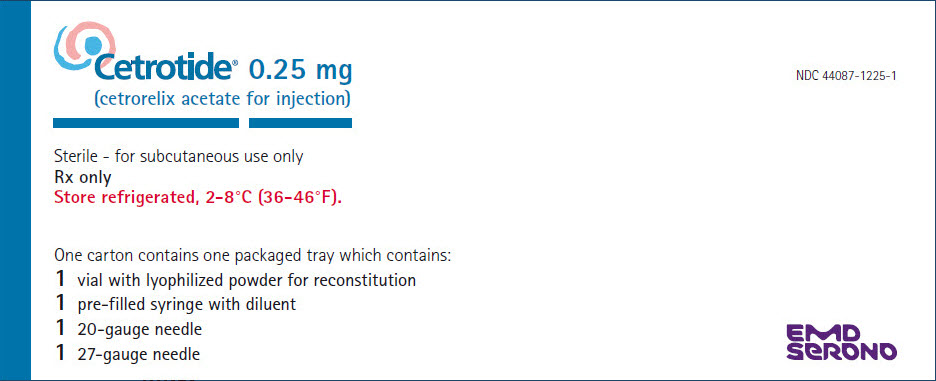
Cetrotide cetrorelix acetate Kit — NDC 44087-1225-1 (Billing 44087-1225-01)
This is a package of Cetrotide cetrorelix acetate Kit from EMD Serono, Inc., marketed since Aug 2000 and currently FDA-listed; retail pharmacies pay about $306.06 per unit (NADAC). It is this product's only package size.
NDC database record
One package, one record: these facts belong to NDC 44087-1225-1 alone.
- Record
- FDA NDC Directory package listing · Human prescription drug
- Code segments
- 44087 labeler · 1225 product · 1 package
- Package marketed since
- Aug 11, 2000
- Sample package
- No — commercial package
- Listing certified through
- Dec 31, 2026
- Barcode (UPC-A, from the NDC)
- 3 4408712251 5
- FDA record last changed
- Jul 24, 2026
Identity & classification
Regulatory identifiers FDA, NLM and CMS codes for this package
Drug-database identifiers Medi-Span GPI and First Databank GCN / HICL / AHFS classification
- GSN (GCN sequence number): 047451
- GCN: 12526
- GPI-14 (Medi-Span): 30090025106420
- HICL (First Databank): 020305
- AHFS class code: 68:18.04.00
- RxCUI (RxNorm): 283402
Where does this data come from?
- FDA openFDA NDC Directory · synced Oct 8, 2026
- FDA label on DailyMed · label index refreshed Oct 8, 2026
- RxNorm (NLM RxNav) · catalog refreshed Oct 1, 2026
- Medi-Span GPI (licensed)
- First Databank (licensed) · refreshed Oct 8, 2026
RxNorm drug class
This medicine belongs to the Gonadotropin Releasing Hormone Receptor Antagonist class.
Where does this data come from?
- RxClass (NLM) · catalog refreshed Oct 1, 2026
Clinical
Patient education
Supplement & herbal interactions
Where does this data come from?
- MedlinePlus (NLM) · refreshed Oct 8, 2026
- FDA label on DailyMed · label index refreshed Oct 8, 2026
Ask a licensed pharmacist directly — free, answered by our team.
Pricing
A drug doesn't have one price. Each row is a different public payment system, and none is what you'd pay at the counter — that depends on your insurance. The ⓘ on each row explains what it measures.
| Price system | Per ea | Per package |
|---|---|---|
| Retail pharmacies payNADAC · weekly | $306.057 | — |
| Medicaid paysCMS SDUD · 12 mo | No recent Medicaid claims on file for this NDC — rare and low-volume NDCs are suppressed in the public data. | |
| Medicare drug plans payPart D · quarterly | No Part D plan price is available for this NDC in our data. | |
Where does this data come from?
- CMS NADAC weekly file · file of Jan 14, 2026
- CMS ASP pricing files · refreshed Sep 20, 2026
- CMS Medicaid State Drug Utilization Data · refreshed Oct 8, 2026
- CMS Part D plan pricing files · refreshed Sep 24, 2026
- VA National Acquisition Center price file
Packaging — all sizes for this product
| Package NDC | Description | Marketing start | Marketing end | Status |
|---|---|---|---|---|
| 44087-1225-01 You're viewing this Main listing | 1 KIT in 1 CARTON * 1 mL in 1 VIAL, GLASS * 1 mL in 1 SYRINGE, GLASS | 2000-08-11 | — | Active |
Therapeutic equivalents
| Product | Labeler | Pack | NADAC/unit | TE | Status | Price vs. this |
|---|---|---|---|---|---|---|
| Cetrotidethis 44087-1225-01 | EMD | 1 kit | $306.057 | AP | FDA listed | — |
| Cetrorelix 00480-5795-08 | Teva | 1 kit | — | — | Discontinued | — |
| Cetrorelix acetate 60505-6270-01 | Apotex | 1 kit | — | AP | FDA listed | — |
| cetrorelix acetate 65219-0292-77 | FRESENIUS | 1 kit | — | AP | FDA listed | — |
| Cetrorelix acetate 67184-0605-02 | Qilu | 1 kit | — | AP | FDA listed | — |
| cetrorelix acetate 68083-0600-01 | Gland | 1 kit | — | AP | FDA listed | — |
| Cetrorelix Acetate 71288-0558-90 | Meitheal | 1 kit | — | AP | FDA listed | — |
Where does this data come from?
- FDA openFDA NDC Directory · synced Oct 8, 2026
- FDA Orange Book · refreshed Oct 3, 2026
- CMS NADAC weekly file · file of Jan 14, 2026
Availability & generic status
The FDA lists approved generic versions of this medicine, but that does not always mean a pharmacy can get one today. Patent rules, launch agreements, supply and pricing can affect when generics actually arrive.
Where does this data come from?
- FDA Orange Book · refreshed Oct 3, 2026
Inactive Ingredients / Excipients
Inactive ingredients, also called excipients, are components of the drug product other than the active ingredient. They may include fillers, dyes, coatings, preservatives, flavors, or other formulation ingredients.
Where does this data come from?
IACT rows and label-wide narrative are kept separate; availability and product-level specificity depend on the submitted label.- FDA label on DailyMed · label index refreshed Oct 8, 2026
- FDA openFDA NDC Directory · synced Oct 8, 2026
Inactive ingredient FAQ
Are inactive ingredients the same for every manufacturer?
Why might an inactive ingredient be missing?
Can inactive ingredients matter?
Manufacturer & labeler
More NDCs from EMD Serono, Inc. labeler code 44087
- REBIF interferon beta-1a 44 ug/.5mL Injection, Solution NDC 44087-0044-3
- Rebif Rebidose Interferon BETA-1A Kit NDC 44087-0188-1
- Gonal-f RFF Redi-ject FOLLITROPIN 300 [iU]/.5mL Injection, Solution NDC 44087-1115-1
- Gonal-f RFF Redi-ject FOLLITROPIN 450 [iU]/.75mL Injection, Solution NDC 44087-1116-1
- Gonal-f RFF Redi-ject FOLLITROPIN 900 [iU]/1.5mL Injection, Solution NDC 44087-1117-1
- Ovidrel choriogonadotropin alfa 250 ug/.5mL Injection, Solution NDC 44087-1150-1
- REBIF REBIDOSE INTERFERON BETA-1A 22 ug/.5mL Injection, Solution NDC 44087-3322-1
- REBIF REBIDOSE INTERFERON BETA-1A 44 ug/.5mL Injection, Solution NDC 44087-3344-1
- BAVENCIO avelumab 20 mg/mL Injection, Solution, Concentrate NDC 44087-3535-1
- Mavenclad Cladribine 10 mg Tablet NDC 44087-4000-0
- TEPMETKO Tepotinib Hydrochloride 225 mg Tablet NDC 44087-5000-3
- Rebif interferon beta-1a Kit NDC 44087-8822-1
Where does this data come from?
- FDA openFDA NDC Directory · synced Oct 8, 2026
- Drugs@FDA
Full prescribing information FDA SPL
🎯 Indications and Usage ▾
INDICATIONS AND USAGE Cetrotide ® (cetrorelix acetate for injection) is indicated for the inhibition of premature LH surges in women undergoing controlled ovarian stimulation.
⏱️ Dosage and Administration ▾
DOSAGE AND ADMINISTRATION Ovarian stimulation therapy with gonadotropins (FSH, hMG) is started on cycle Day 2 or 3. The dose of gonadotropins should be adjusted according to individual response. Cetrotide ® (cetrorelix acetate for injection) 0.25 mg may be administered subcutaneously once daily during the early- to mid-follicular phase.
Cetrotide ® 0.25 mg is administered on either stimulation day 5 (morning or evening) or day 6 (morning) and continued daily until the day of hCG administration. When assessment by ultrasound shows a sufficient number of follicles of adequate size, hCG is administered to induce ovulation and final maturation of the oocytes. No hCG should be administered if the ovaries show an excessive response to the treatment with gonadotropins to reduce the chance of developing ovarian hyperstimulation syndrome (OHSS).
Administration Cetrotide ® 0.25 mg can be administered by the patient herself after appropriate instructions by her doctor. Directions for using Cetrotide ® 0.25 mg with the enclosed needles and pre-filled syringe: Wash hands thoroughly with soap and water. Flip off the plastic cover of the vial and wipe the aluminum ring and the rubber stopper with an alcohol swab.
Twist the injection needle with the yellow mark (20 gauge) on the pre-filled syringe. Push the needle through the center of the rubber stopper of the vial and slowly inject the solvent into the vial. Leaving the syringe in the vial, gently swirl the vial until the solution is clear and without residues.
Avoid forming bubbles. Draw the total contents of the vial into the syringe. If necessary, invert the vial and pull back the needle as far as needed to withdraw the entire contents of the vial.
Replace the needle with the yellow mark by the injection needle with the grey mark (27 gauge). Invert the syringe and push the plunger until all air bubbles have been expelled. Choose an injection site in the lower abdominal area, preferably around, but staying at least one inch away from the navel.
Choose a different injection site each day to minimize local irritation. Use a second alcohol swab to clean the skin at the injection site and allow alcohol to dry. Gently pinch up the skin surrounding the site of injection.
Inject the prescribed dose as directed by your doctor, nurse or pharmacist. Use the syringe and needles only once. Dispose of the syringe and needles properly after use.
If available, use a medical waste container for disposal.
⛔ Contraindications ▾
CONTRAINDICATIONS Cetrotide ® (cetrorelix acetate for injection) is contraindicated under the following conditions: Hypersensitivity to cetrorelix acetate, extrinsic peptide hormones or mannitol. Known hypersensitivity to GnRH or any other GnRH analogs. Known or suspected pregnancy, and lactation (see PRECAUTIONS ). Severe renal impairment
⚠️ Warnings ▾
WARNINGS Cetrotide ® (cetrorelix acetate for injection) should be prescribed by physicians who are experienced in fertility treatment. Before starting treatment with Cetrotide ® , pregnancy must be excluded (see CONTRAINDICATIONS and PRECAUTIONS ).
🤒 Adverse Reactions ▾
ADVERSE REACTIONS The safety of Cetrotide ® (cetrorelix acetate for injection) in 949 patients undergoing controlled ovarian stimulation in clinical studies was evaluated. Women were between 19 and 40 years of age (mean: 32). 94.0% of them were Caucasian.
Cetrotide ® was given in doses ranging from 0.1 mg to 5 mg as either a single or multiple dose. Table 3 shows systemic adverse events, reported in clinical studies without regard to causality, from the beginning of Cetrotide ® treatment until confirmation of pregnancy by ultrasound at an incidence ≥ 1% in Cetrotide ® treated subjects undergoing COS. Table 3: Adverse Events in ≥1% (WHO preferred term) Cetrotide ® N=949 % (n) Ovarian Hyperstimulation Syndrome Intensity moderate or severe, or WHO Grade II or III, respectively 3.5 (33) Nausea 1.3 (12) Headache 1.1 (10) Local site reactions (e.g. redness, erythema, bruising, itching, swelling, and pruritus) were reported.
Usually, they were of a transient nature, mild intensity and short duration. During post-marketing surveillance, cases of mild to moderate Ovarian Hyperstimulation syndrome and cases of hypersensitivity reactions including anaphylactoid reactions have been reported. Two stillbirths were reported in Phase 3 studies of Cetrotide ® .
Congenital Anomalies Clinical follow-up studies of 316 newborns of women administered Cetrotide ® were reviewed. One infant of a set of twin neonates was found to have anencephaly at birth and died after four days. The other twin was normal.
Developmental findings from ongoing baby follow-up included a child with a ventricular septal defect and another child with bilateral congenital glaucoma. Four pregnancies that resulted in therapeutic abortion in Phase 2 and Phase 3 controlled ovarian stimulation studies had major anomalies (diaphragmatic hernia, trisomy 21, Klinefelter syndrome, polymalformation, and trisomy 18). In three of these four cases, intracytoplasmic sperm injection (ICSI) was the fertilization method employed; in the fourth case, in vitro fertilization (IVF) was the method employed.
The minor congenital anomalies reported include: supernumerary nipple, bilateral strabismus, imperforate hymen, congenital nevi, hemangiomata, and QT syndrome. The causal relationship between the reported anomalies and Cetrotide ® is unknown. Multiple factors, genetic and others (including, but not limited to ICSI, IVF, gonadotropins, and progesterone) make causal attribution difficult to study.
🔄 Drug Interactions ▾
Drug Interactions No formal drug interaction studies have been performed with Cetrotide ® .
🤰 Pregnancy ▾
Pregnancy (see CONTRAINDICATIONS ) Cetrotide ® is contraindicated in pregnant women. When administered to rats for the first seven days of pregnancy, cetrorelix acetate did not affect the development of the implanted conceptus at doses up to 38 μg/kg (approximately 1 times the recommended human therapeutic dose based on body surface area). However, a dose of 139 μg/kg (approximately 4 times the human dose) resulted in a resorption rate and a postimplantation loss of 100%.
When administered from day 6 to near term to pregnant rats and rabbits, very early resorptions and total implantation losses were seen in rats at doses from 4.6 μg/kg (0.2 times the human dose) and in rabbits at doses from 6.8 μg/kg (0.4 times the human dose). In animals that maintained their pregnancy, there was no increase in the incidence of fetal abnormalities. The fetal resorption observed in animals is a logical consequence of the alteration in hormonal levels effected by the antigonadotrophic properties of Cetrotide ® , which could result in fetal loss in humans as well.
Therefore, this drug should not be used in pregnant women.
🧓 Geriatric Use ▾
Geriatric Use Cetrotide ® is not intended to be used in subjects aged 65 and over.
🆘 Overdosage ▾
OVERDOSAGE There have been no reports of overdosage with Cetrotide ® 0.25 mg or 3 mg in humans. Single doses up to 120 mg Cetrotide ® have been well tolerated in patients treated for other indications without signs of overdosage.
🧬 Clinical Pharmacology ▾
CLINICAL PHARMACOLOGY GnRH induces the production and release of luteinizing hormone (LH) and follicle stimulating hormone (FSH) from the gonadotrophic cells of the anterior pituitary. Due to a positive estradiol (E2) feedback at midcycle, GnRH liberation is enhanced resulting in an LH-surge. This LH-surge induces the ovulation of the dominant follicle, resumption of oocyte meiosis and subsequently luteinization as indicated by rising progesterone levels.
Cetrotide ® competes with natural GnRH for binding to membrane receptors on pituitary cells and thus controls the release of LH and FSH in a dose-dependent manner. The onset of LH suppression is approximately one hour with the 3 mg dose and two hours with the 0.25 mg dose. This suppression is maintained by continuous treatment and there is a more pronounced effect on LH than on FSH.
An initial release of endogenous gonadotropins has not been detected with Cetrotide ® , which is consistent with an antagonist effect. The effects of Cetrotide ® on LH and FSH are reversible after discontinuation of treatment. In women, Cetrotide ® delays the LH-surge, and consequently ovulation, in a dose-dependent fashion.
FSH levels are not affected at the doses used during controlled ovarian stimulation. Following a single 3 mg dose of Cetrotide ® , duration of action of at least 4 days has been established. A dose of Cetrotide ® 0.25 mg every 24 hours has been shown to maintain the effect.
Pharmacokinetics The pharmacokinetic parameters of single and multiple doses of Cetrotide ® (cetrorelix acetate for injection) in adult healthy female subjects are summarized in Table 1. Table 1: Pharmacokinetic parameters of Cetrotide ® following 3 mg single or 0.25 mg single and multiple (daily for 14 days) subcutaneous (sc) administration. Single dose 3 mg Single dose 0.25 mg Multiple dose 0.25 mg t max Time to reach observed maximum plasma concentration t 1/2 Elimination half-life C max Maximum plasma concentration; multiple dose C ss, max AUC Area under the curve; single dose AUC 0-inf , multiple dose AUCt CL Total plasma clearance Vz Volume of distribution Geometric mean (95% CI ln ), No. of subjects 12 12 12 t max median (min-max) [h] 1.5 (0.5-2) 1.0 (0.5-1.5) 1.0 (0.5-2) t 1/2 [h] 62.8 (38.2-108) 5.0 (2.4-48.8) 20.6 (4.1-179.3) C max [ng/ml] 28.5 (22.5-36.2) 4.97 (4.17-5.92) 6.42 (5.18-7.96) AUC [ng∙h/ml] 536 (451-636) 31.4 (23.4-42.0) 44.5 (36.7-54.2) CL arithmetic mean, [ml/min∙kg]
1.28 Based on iv administration (n=6, separate study 0013) Vz [l/kg]
1.16Absorption Cetrotide ® is rapidly absorbed following subcutaneous injection, maximal plasma concentrations being achieved approximately one to two hours after administration. The mean absolute bioavailability of Cetrotide ® following subcutaneous administration to healthy female subjects is 85%. Distribution The volume of distribution of Cetrotide ® following a single intravenous dose of 3 mg is about 1 l/kg.
In vitro protein binding to human plasma is 86%. Cetrotide ® concentrations in follicular fluid and plasma were similar on the day of oocyte pick-up in patients undergoing controlled ovarian stimulation. Following subcutaneous administration of Cetrotide ® 0.25 mg and 3 mg, plasma concentrations of cetrorelix were below or in the range of the lower limit of quantitation on the day of oocyte pick-up and embryo transfer.
Metabolism After subcutaneous administration of 10 mg Cetrotide ® to females and males, Cetrotide ® and small amounts of (1-9), (1-7), (1-6), and (1-4) peptides were found in bile samples over 24 hours. In in vitro studies, Cetrotide ® was stable against phase I- and phase II-metabolism. Cetrotide ® was transformed by peptidases, and the (1-4) peptide was the predominant metabolite.
Excretion Following subcutaneous administration of 10 mg cetrorelix to males and females, only unchanged cetrorelix was detected in urine. In 24 hours, cetrorelix and small amounts of the (1-9), (1-7), (1-6), and (1-4) peptides were found in bile sa… [Excerpted — this section continues on DailyMed.]
📦 How Supplied / Storage and Handling ▾
HOW SUPPLIED Cetrotide ® (cetrorelix acetate for injection) 0.25 mg is available in a carton of one packaged tray (NDC 44087-1225-1). Each packaged tray contains: one glass vial containing 0.26 - 0.27 mg cetrorelix acetate (corresponding to 0.25 mg cetrorelix), one pre-filled glass syringe with 1 mL of Sterile Water for Injection, one 20 gauge needle (yellow) and one 27 gauge needle (grey). Storage Store Cetrotide ® 0.25 mg refrigerated, 2ºC - 8ºC (36ºF - 46ºF).
Store the packaged tray in the outer carton in order to protect from light.
📦 Storage and Handling ▾
Storage Store Cetrotide ® 0.25 mg refrigerated, 2ºC - 8ºC (36ºF - 46ºF). Store the packaged tray in the outer carton in order to protect from light.
📋 Description ▾
DESCRIPTION Cetrotide ® (cetrorelix acetate for injection) is a synthetic decapeptide with gonadotropin-releasing hormone (GnRH) antagonistic activity. Cetrorelix acetate is an analog of native GnRH with substitutions of amino acids at positions 1, 2, 3, 6, and 10. The molecular formula is Acetyl-D-3-(2´-naphthyl)-alanine-D-4-chlorophenylalanine-D-3-(3´-pyridyl)-alanine-L-serine-L-tyrosine-D-citrulline-L-leucine-L-arginine-L-proline-D-alanine-amide, and the molecular weight is 1431.06, calculated as the anhydrous free base.
The structural formula is as follows: Cetrorelix acetate (Ac-D-Nal 1 - D -Cpa 2 - D -Pal 3 -Ser 4 -Tyr 5 - D -Cit 6 -Leu 7 -Arg 8 -Pro 9 - D -Ala 10 -NH 2 ) Cetrotide ® (cetrorelix acetate for injection) 0.25 mg is a sterile lyophilized powder intended for subcutaneous injection after reconstitution with Sterile Water for Injection, that comes supplied in a 1.0 mL pre-filled syringe. Each vial of Cetrotide ® 0.25 mg contains 0.26-0.27 mg cetrorelix acetate, equivalent to 0.25 mg cetrorelix, and 54.80 mg mannitol. Chemical Structure
💬 Information for Patients ▾
Information for Patients Prior to therapy with Cetrotide ® (cetrorelix acetate for injection), patients should be informed of the duration of treatment and monitoring procedures that will be required. The risk of possible adverse reactions should be discussed (see ADVERSE REACTIONS ). Cetrotide ® should not be prescribed if a patient is pregnant.
If Cetrotide ® is prescribed to patients for self-administration, information for proper use is given in the Patient Leaflet (see below).
⚠️ Precautions ▾
PRECAUTIONS General Cases of hypersensitivity reactions, including anaphylactoid reactions with the first dose, have been reported during post-marketing surveillance (see ADVERSE REACTIONS ). A severe anaphylactic reaction associated with cough, rash, and hypotension, was observed in one patient after seven months of treatment with Cetrotide ® (10 mg/day) in a study for an indication unrelated to infertility. Special care should be taken in women with signs and symptoms of active allergic conditions or known history of allergic predisposition.
Treatment with Cetrotide ® is not advised in women with severe allergic conditions. Information for Patients Prior to therapy with Cetrotide ® (cetrorelix acetate for injection), patients should be informed of the duration of treatment and monitoring procedures that will be required. The risk of possible adverse reactions should be discussed (see ADVERSE REACTIONS ).
Cetrotide ® should not be prescribed if a patient is pregnant. If Cetrotide ® is prescribed to patients for self-administration, information for proper use is given in the Patient Leaflet (see below). Laboratory Tests After the exclusion of preexisting conditions, enzyme elevations (ALT, AST, GGT, alkaline phosphatase) were found in 1-2% of patients receiving Cetrotide ® during controlled ovarian stimulation.
The elevations ranged up to three times the upper limit of normal. The clinical significance of these findings was not determined. During stimulation with human menopausal gonadotropin, Cetrotide ® had no notable effects on hormone levels aside from inhibition of LH surges.
Drug Interactions No formal drug interaction studies have been performed with Cetrotide ® . Carcinogenesis, Mutagenesis, Impairment of Fertility Long-term carcinogenicity studies in animals have not been performed with cetrorelix acetate. Cetrorelix acetate was not genotoxic in vitro (Ames test, HPRT test, chromosome aberration test) or in vivo (chromosome aberration test, mouse micronucleus test).
Cetrorelix acetate induced polyploidy in CHL-Chinese hamster lung fibroblasts, but not in V79-Chinese hamster lung fibroblasts, cultured peripheral human lymphocytes or in an in vitro micronucleus test in the CHL-cell line. Treatment with 0.46 mg/kg cetrorelix acetate for 4 weeks resulted in complete infertility in female rats which was reversed 8 weeks after cessation of treatment. Pregnancy (see CONTRAINDICATIONS ) Cetrotide ® is contraindicated in pregnant women.
When administered to rats for the first seven days of pregnancy, cetrorelix acetate did not affect the development of the implanted conceptus at doses up to 38 μg/kg (approximately 1 times the recommended human therapeutic dose based on body surface area). However, a dose of 139 μg/kg (approximately 4 times the human dose) resulted in a resorption rate and a postimplantation loss of 100%. When administered from day 6 to near term to pregnant rats and rabbits, very early resorptions and total implantation losses were seen in rats at doses from 4.6 μg/kg (0.2 times the human dose) and in rabbits at doses from 6.8 μg/kg (0.4 times the human dose).
In animals that maintained their pregnancy, there was no increase in the incidence of fetal abnormalities. The fetal resorption observed in animals is a logical consequence of the alteration in hormonal levels effected by the antigonadotrophic properties of Cetrotide ® , which could result in fetal loss in humans as well. Therefore, this drug should not be used in pregnant women.
Nursing Mothers It is not known whether Cetrotide ® is excreted in human milk. Because many drugs are excreted in human milk, and because the effects of Cetrotide ® on lactation and/or the breast-fed child have not been determined, Cetrotide ® should not be used by nursing mothers. Geriatric Use Cetrotide ® is not intended to be used in subjects aged 65 and over.
🍼 Nursing Mothers ▾
Nursing Mothers It is not known whether Cetrotide ® is excreted in human milk. Because many drugs are excreted in human milk, and because the effects of Cetrotide ® on lactation and/or the breast-fed child have not been determined, Cetrotide ® should not be used by nursing mothers.
🧬 Pharmacokinetics ▾
Pharmacokinetics The pharmacokinetic parameters of single and multiple doses of Cetrotide ® (cetrorelix acetate for injection) in adult healthy female subjects are summarized in Table 1. Table 1: Pharmacokinetic parameters of Cetrotide ® following 3 mg single or 0.25 mg single and multiple (daily for 14 days) subcutaneous (sc) administration. Single dose 3 mg Single dose 0.25 mg Multiple dose 0.25 mg t max Time to reach observed maximum plasma concentration t 1/2 Elimination half-life C max Maximum plasma concentration; multiple dose C ss, max AUC Area under the curve; single dose AUC 0-inf , multiple dose AUCt CL Total plasma clearance Vz Volume of distribution Geometric mean (95% CI ln ), No. of subjects 12 12 12 t max median (min-max) [h] 1.5 (0.5-2) 1.0 (0.5-1.5) 1.0 (0.5-2) t 1/2 [h] 62.8 (38.2-108) 5.0 (2.4-48.8) 20.6 (4.1-179.3) C max [ng/ml] 28.5 (22.5-36.2) 4.97 (4.17-5.92) 6.42 (5.18-7.96) AUC [ng∙h/ml] 536 (451-636) 31.4 (23.4-42.0) 44.5 (36.7-54.2) CL arithmetic mean, [ml/min∙kg]
1.28 Based on iv administration (n=6, separate study 0013) Vz [l/kg]
1.16Absorption Cetrotide ® is rapidly absorbed following subcutaneous injection, maximal plasma concentrations being achieved approximately one to two hours after administration. The mean absolute bioavailability of Cetrotide ® following subcutaneous administration to healthy female subjects is 85%. Distribution The volume of distribution of Cetrotide ® following a single intravenous dose of 3 mg is about 1 l/kg.
In vitro protein binding to human plasma is 86%. Cetrotide ® concentrations in follicular fluid and plasma were similar on the day of oocyte pick-up in patients undergoing controlled ovarian stimulation. Following subcutaneous administration of Cetrotide ® 0.25 mg and 3 mg, plasma concentrations of cetrorelix were below or in the range of the lower limit of quantitation on the day of oocyte pick-up and embryo transfer.
Metabolism After subcutaneous administration of 10 mg Cetrotide ® to females and males, Cetrotide ® and small amounts of (1-9), (1-7), (1-6), and (1-4) peptides were found in bile samples over 24 hours. In in vitro studies, Cetrotide ® was stable against phase I- and phase II-metabolism. Cetrotide ® was transformed by peptidases, and the (1-4) peptide was the predominant metabolite.
Excretion Following subcutaneous administration of 10 mg cetrorelix to males and females, only unchanged cetrorelix was detected in urine. In 24 hours, cetrorelix and small amounts of the (1-9), (1-7), (1-6), and (1-4) peptides were found in bile samples. 2-4% of the dose was eliminated in the urine as unchanged cetrorelix, while 5-10% was eliminated as cetrorelix and the four metabolites in bile.
Therefore, only 7-14% of the total dose was recovered as unchanged cetrorelix and metabolites in urine and bile up to 24 hours. The remaining portion of the dose may not have been recovered since bile and urine were not collected for a longer period of time. Special Populations Pharmacokinetic investigations have not been performed either in subjects with impaired renal or liver function, or in the elderly, or in children (see PRECAUTIONS ).
Pharmacokinetic differences in different races have not been determined. There is no evidence of differences in pharmacokinetic parameters for Cetrotide ® between healthy subjects and patients undergoing controlled ovarian stimulation.
📄 Carcinogenesis, Mutagenesis, Impairment of Fertility ▾
Carcinogenesis, Mutagenesis, Impairment of Fertility Long-term carcinogenicity studies in animals have not been performed with cetrorelix acetate. Cetrorelix acetate was not genotoxic in vitro (Ames test, HPRT test, chromosome aberration test) or in vivo (chromosome aberration test, mouse micronucleus test). Cetrorelix acetate induced polyploidy in CHL-Chinese hamster lung fibroblasts, but not in V79-Chinese hamster lung fibroblasts, cultured peripheral human lymphocytes or in an in vitro micronucleus test in the CHL-cell line.
Treatment with 0.46 mg/kg cetrorelix acetate for 4 weeks resulted in complete infertility in female rats which was reversed 8 weeks after cessation of treatment.
📄 Patient Package Insert ▾
Patient Leaflet Cetrotide ® 0.25 mg Active ingredient: cetrorelix acetate Summary Cetrotide ® blocks the effects of a natural hormone, called gonadotropin-releasing hormone (GnRH). GnRH controls the secretion of another hormone, called luteinizing hormone (LH), which induces ovulation during the menstrual cycle. During hormone treatment for ovarian stimulation, premature ovulation may lead to eggs that are not suitable for fertilization.
Cetrotide ® blocks such undesirable premature ovulation. Uses Cetrotide ® is used to prevent premature ovulation during controlled ovarian stimulation. General Cautions Do not use Cetrotide ® if you have kidney disease are allergic to cetrorelix acetate, mannitol or exogenous peptide hormones (medicines similar to Cetrotide ® ) or are pregnant, or think that you might be pregnant, or if you are breast-feeding.
Consult your doctor before taking Cetrotide ® if you have had severe allergic reactions. Proper Use Ovarian stimulation therapy is started on cycle Day 2 or 3. Cetrotide ® 0.25 mg is injected under the skin once daily, as directed by your physician.
When an ultrasound examination shows that you are ready, another drug (hCG) is injected to induce ovulation. How should you use Cetrotide ® ? You may self-inject Cetrotide ® after special instruction from your doctor.
To fully benefit from Cetrotide ® , please read carefully and follow the instructions given below, unless your doctor advises you otherwise. Cetrotide ® is for injection under the skin of the lower abdominal area, preferably around, but staying at least one inch away from the belly button. Choose a different injection site each day to minimize local irritation.
Dissolve Cetrotide ® powder only with the water contained in the pre-filled syringe. Do not use a Cetrotide ® solution if it contains particles or if it is not clear. Before you inject Cetrotide ® yourself, please read the following instructions carefully: Directions for using Cetrotide ® 0.25 mg with the enclosed needles and pre-filled syringe: 1.
Wash your hands thoroughly with soap and water. 2. On a clean flat surface, lay out everything you need (one vial of powder, one pre-filled syringe, one injection needle with a yellow mark, and one injection needle with a grey mark).
3. Flip off the plastic cover of the vial. Wipe the aluminum ring and the rubber stopper with an alcohol swab.
4. Take the injection needle with the yellow mark and remove the wrapping. Take the pre-filled syringe and remove the cover.
Twist the needle on the syringe and remove the cover of the needle. 5. Push the needle through the center of the rubber stopper of the vial.
Inject the water into the vial by slowly pushing down on the plunger of the syringe. 6. Leave the syringe in the vial.
While carefully holding the syringe and vial, swirl gently to mix the powder and water together. When it is mixed, it will look clear and have no particles in it. Do not shake or you will create bubbles in your medicine.
7. Draw the total contents of the vial into the syringe. If liquid is left in the vial, invert the vial, pull back the needle until the opening of the needle is just inside the stopper.
If you look from the side through the gap in the stopper, you can control the movement of the needle and the liquid. It is important to withdraw the entire contents of the vial. 8.
Detach the syringe from the needle and lay down the syringe. Take the injection needle with the grey mark and remove its wrapping. Twist the needle on the syringe and remove the cover of the needle.
9. Invert the syringe and push the plunger until all air bubbles have been pushed out. Do not touch the needle or allow the needle to touch any surface.
10. Choose an injection site in the lower abdominal area, preferably around, but at least one inch away from the belly button. Choose a different injection site each day to minimize local irritation.
Take a second alcohol swab and clean the skin at the injection site and allow alcohol to dr… [Excerpted — this section continues on DailyMed.]
📄 Package Label / Principal Display Panel ▾
PRINCIPAL DISPLAY PANEL - Kit Carton Cetrotide ® 0.25 mg (cetrorelix acetate for injection) NDC 44087-1225-1 Sterile - for subcutaneous use only Rx only Store refrigerated, 2°C-8°C (36°F-46°F). One carton contains one packaged tray which contains: 1 vial with lyophilized powder for reconstitution 1 pre-filled syringe with diluent 1 20-gauge needle 1 27-gauge needle EMD SERONO PRINCIPAL DISPLAY PANEL - Kit Carton
About this NDC listing & data coverage
Kit / multi-component package
This NDC identifies a kit — a package containing more than one component. Structured data (pricing, ingredients, equivalents) is often reported per component rather than for the kit NDC itself, which can make this page look thinner than the components' own pages.
What data is (and isn’t) available for this NDC — tap to expand
| NDC identity (package / product / labeler codes) | ✓ Available |
| Labeler | ✓ Available |
| Product & package description | ✓ Available |
| Marketing category & status | ✓ Available |
| Active ingredient / dosage form / route | ✓ Available |
| FDA label (SPL via DailyMed) | ✓ Available |
| Package photos | ✓ Available |
| Inactive ingredients (structured) | — Not published for this NDC The labeler did not submit a structured excipient list, or no SPL is available. |
| NADAC pharmacy acquisition price (CMS) | ✓ Available |
| Orange Book / therapeutic-equivalence data | ✓ Available |
| HCPCS J-code billing crosswalk | — Not published for this NDC Most self-administered / retail products have no J-code — that is normal. |
| Medicaid utilization (CMS SDUD) | — Not published for this NDC CMS reports utilization only for NDCs with Medicaid claims above its privacy threshold. |