
Skin Balance Ingredients & Drug Interactions
What is this page for?
First and foremost: checking Skin Balance against your medications. The heart of this page is the interaction checker and the full interaction report — how this product’s ingredients may interact with prescription and over-the-counter medicines you may be taking.
Around that, we add a pharmacist’s high-level view of the product as a whole — what’s inside, the evidence for its stated use, how transparent the label is, and what safety data exists — so you can see the full picture in one place. It’s educational information from our licensed clinical databases and the clinical staff at HelloPharmacist — not medical advice — and we don’t sell or endorse products. Our editorial policy
Skin Balance is a dietary supplement by Health Concerns with 12 active ingredients. Its ingredients are commonly taken for short-term constipation relief, bowel cleansing before procedures, occasional irregularity.Based on those ingredients, 1,534 medications have a known interaction with it, the most serious rated major. The ingredients most likely to interact are Chinese Skullcap root extract, Chinese Rhubarb, Coptis Root Extract. Use the checker below to test your specific medication, or read the full HelloPharmacist Interaction Report.
Check Your Meds Against Skin Balance by Health Concerns
Ask about any prescription or over-the-counter medication and we check it for interactions with Skin Balance by Health Concerns — and tell you which ingredient is responsible.
AI summaries are generated from our interaction database for education only — always confirm with your pharmacist. How we use AI
Ask the Pharmacist
A licensed pharmacist will answer your question by email — free, usually within 24 hours.
Got it — thank you!
A licensed pharmacist will answer within 24 hours. Keep an eye on your email (worth checking spam, just in case).
HelloPharmacist Scorecard of Skin Balance by Health Concerns
Our pharmacy team’s full take, with four database checks built into the cards below — a summary of what is known, not a grade of the product itself.
What’s inside
Low disclosure
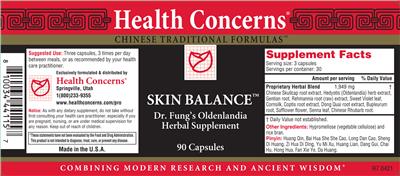
Skin Balance contains 12 ingredients total. The active herbal components are senna (a stimulant laxative), a proprietary herbal blend, gentian root extract, dong quai root extract, safflower, Chinese skullcap root extract, bupleurum, cornsilk, coptis root extract (goldthread), Chinese rhubarb, rehmannia, and sweet violet.
The product also contains inactive ingredients—hypromellose and rice bran—as excipients.
Does it work?
Strong evidence
The evidence for these ingredients is limited. Senna is likely effective for constipation and possibly effective for bowel preparation.
Rhubarb is possibly effective for pancreatitis and menopausal symptoms. Rehmannia is possibly effective for chronic kidney disease.
The remaining ingredients—gentian, dong quai, safflower, Chinese skullcap, bupleurum, cornsilk, coptis root extract, and sweet violet—all lack established evidence for any of the conditions we hold data on; the evidence base is insufficient to rate their effectiveness.
How safe is it?
Well-documented data
Short-term use of senna is generally well tolerated, though it causes common side effects like abdominal pain, cramps, diarrhea, and nausea; serious skin reactions are rare. Senna is rated possibly safe in pregnancy and lactation but should not be used long-term without medical advice.
Gentian may upset the stomach and should be avoided during pregnancy and breastfeeding due to limited safety data. Dong quai is generally well tolerated but is rated possibly unsafe in pregnancy and should be avoided while breastfeeding; it may increase sun sensitivity and bleeding risk.
Safflower flower is likely safe in pregnancy but possibly unsafe in high doses, and medicinal use should be avoided while breastfeeding. Chinese skullcap is poorly studied in humans and should be avoided during pregnancy and breastfeeding.
Bupleurum has been linked to rare lung and liver problems and should be avoided in pregnancy and lactation. Coptis root extract (containing berberine) is rated likely unsafe in pregnancy and likely unsafe in lactation.
Rhubarb root is rated possibly unsafe in pregnancy and should be avoided while breastfeeding; chronic overuse can cause cramping, electrolyte loss, and kidney damage. Rehmannia and sweet violet have insufficient safety data for pregnancy and breastfeeding and should be avoided pending more information.
Meds to double-check
Major interaction found
Before taking this product, check your medications against these drug types: blood thinners and antiplatelet agents (warfarin, aspirin, clopidogrel—Major risk with dong quai plus warfarin; Moderate risk with other ingredients), blood-pressure medications (antihypertensive drugs), diabetes medications, corticosteroids, diuretics, digoxin (a heart medication), cyclosporine (an immunosuppressant), and liver- or kidney-harming drugs. Additionally, if you take certain medications processed by your liver's CYP3A4 or CYP2C19 enzymes (such as some cholesterol or psychiatric medications), discuss those with your pharmacist.
No interactions are documented for cornsilk or oldenlandia herb extract in our data.
The bottom line
Scorecard at a glanceFormula with limited ingredient disclosure with strong clinical evidence behind its ingredients' uses. Major medication interactions have been identified, and safety information is well characterized.
This is a complex herbal supplement with multiple ingredients that interact with common medications, especially blood thinners, blood-pressure drugs, diabetes medications, and heart medications. If you take any prescription drugs—particularly warfarin, antiplatelet agents, blood-pressure or diabetes medicines, digoxin, corticosteroids, or cyclosporine—check all your medications against this product's ingredients before starting.
Talk with your own doctor or pharmacist about whether it's right for you and safe to combine with what you're currently taking.
Educational only — not medical advice; always confirm with your pharmacist. Our editorial policy · How we use AI
Assessment coverage: 10 of 12 active ingredients matched to our full ingredient reviews (monographs). Based on the product label dated Jun 22, 2023.
This Scorecard evaluates available label information, ingredient evidence, and known medication-safety considerations. It does not independently verify product identity, purity, potency, contamination, or manufacturing quality. How these ratings are computed
General information
Key facts about Skin Balance, straight from the product label.
| Brand | Health Concerns |
|---|---|
| Barcode (UPC) | 810034441157 |
| Net contents | 90 Capsule(s) |
| Market status | On market |
| Date entered into DSLD | Jun 22, 2023 |
| DSLD ID | 292692 |
| Product type | Botanical |
| Supplement form | Capsule |
| Dietary claims / uses | All Other, Structure/Function |
| Intended target group(s) | Adult (18 - 50 Years) |
Everything in this section is reproduced from the manufacturer’s own product label — it’s the label speaking, not HelloPharmacist. We show it so you can see exactly what the maker states; we don’t verify or endorse those statements.
Supplement Facts
The label details for Skin Balance by Health Concerns, sourced from the NIH Dietary Supplement Label Database.
Supplement Facts
| Ingredient | Amount | % DV |
|---|---|---|
| Senna | 0 NP | -- |
| Proprietary Herbal Blend | 1949 mg | -- |
| Gentian | 0 NP | -- |
| Dong Quai root extract | 0 NP | -- |
| Safflower | 0 NP | -- |
| Chinese Skullcap root extract | 0 NP | -- |
| Bupleurum | 0 NP | -- |
| Cornsilk | 0 NP | -- |
| Coptis Root Extract | 0 NP | -- |
| Chinese Rhubarb | 0 NP | -- |
| Rehmannia | 0 NP | -- |
| Oldenlandia Herb Extract | 0 NP | -- |
| Sweet Violet | 0 NP | -- |
Other ingredients: Hypromellose, Rice Bran
Tap any ingredient to jump to its full detail below.
These statements are the manufacturer’s wording, reproduced from the product label — the label is saying it, not HelloPharmacist. We don’t verify or endorse them.
Brand IP Statement(s)
Health Concerns Chinese Traditional Formulas
Combining Modern Research and Ancient Wisdom
Suggested/Recommended/Usage/Directions
Suggested use: Three capsules, 3 times per day between meals, or as recommended by your health care practitioner.
Precautions
Notice: As with any dietary supplement, do not take without first consulting your health care practitioner, especially if you are pregnant, nursing, or are under medical supervision for any reason.
Keep out of reach of children.
FDA Disclaimer Statement
These statements have not been evaluated by the Food and Drug Administration. This product is not intended to diagnose, treat, cure, or prevent any disease.
Formulation
Made in the U.S.A.
Formula
Dr. Fung's Oldenlandia
Pinyin: Huang Qin, Bai Hua She She Cao, Long Dan Cao, Sheng Di Huang, Zi Hua Di Ding, Yu Mi Xu, Huang Lian, Dang Gui, Chai Hu, Hong Hua, Fan Xie Ye, Da Huang.
FDA Statement of Identity
Herbal Supplement
Is this label outdated? Report a formula or label change and our pharmacy team will review it.
Skin Balance by Health Concerns label
The label scan from the NIH Dietary Supplement Label Database. Tap to enlarge.
Label images are published by the NIH Dietary Supplement Label Database for the version of this product on file. Always read your actual product label.
View the full label (PDF)The Ingredients in Skin Balance by Health Concerns
These are the 12 active ingredients this product is made of. Select any to open its full monograph.
Serving size3 Capsule(s) Dosage formCapsule Servings per container30 Amounts shown are per serving.
Most supplement products combine several ingredients, and a medication can interact with the product through any one of them. Each ingredient below shows whether it has known drug interactions.
Proprietary Herbal Blend
- › Senna
- › Gentian
- › Dong Quai root extract
- › Safflower
- › Chinese Skullcap root extract
- › Bupleurum
- › Cornsilk
- › Coptis Root Extract
- › Chinese Rhubarb
- › Rehmannia
- › Oldenlandia Herb Extract
- › Sweet Violet
Other (inactive) ingredients: Hypromellose, Rice Bran. These complete the product’s ingredient list but are not active constituents.
Skin Balance by Health Concerns Drug Interactions
HelloPharmacist Interaction Report
Skin Balance by Health Concerns contains several ingredients with documented interactions: senna, dong quai, safflower, Chinese skullcap, bupleurum, coptis root extract, Chinese rhubarb, and rehmannia.
The most serious interaction is a Major-severity risk between dong quai and warfarin (a blood thinner), where dong quai may increase warfarin's anticoagulant effects and raise bleeding risk.
Read the full breakdown — every affected drug type, severity by severity
Several ingredients interact with blood thinners and antiplatelet drugs (Moderate severity): senna, dong quai, safflower, Chinese skullcap, bupleurum, and Chinese rhubarb all theoretically increase bleeding risk when combined with these medications. Senna, safflower, and rhubarb also carry Moderate-severity interactions with warfarin specifically.
Chinese skullcap and bupleurum may interfere with blood glucose control (Moderate), while senna and rhubarb can compound potassium loss from diuretics or corticosteroids, raising the risk of low potassium (Moderate).
Chinese skullcap may increase levels of certain drugs your liver processes, and coptis root extract may raise cyclosporine levels. Senna and rhubarb can interfere with estrogen absorption, and Chinese skullcap has estrogenic activity that might reduce birth-control or hormone-replacement effectiveness.
Senna and rhubarb also carry Moderate-severity interactions with digoxin (a heart medication) due to potassium depletion, and rhubarb may lower cyclosporine or increase kidney and liver damage risk with certain other medications.
We could not check cornsilk or oldenlandia herb extract. Before starting this product, use the search tool below to verify all your exact medications against these ingredients.
Check your own medications below · Editorial policy · How we use AI
Want to check YOUR meds against Skin Balance?
Ask about interactions with your drugs in plain English — “Can I take it with lisinopril?” — and we find you the answer in seconds, ingredient by ingredient.
Go to the checkerIngredients driving the most interactions
Individual Drug Interactions
The ingredients in Skin Balance interact with 1,534 drugs. Click any drug to see the details.
9 of the 12 ingredients in Skin Balance interact with drugs. Each result below shows which ingredient is responsible. Chinese Skullcap root extract Chinese Rhubarb Coptis Root Extract Bupleurum Rehmannia Safflower Gentian Dong Quai root extract Senna
WarfarinWarfarin
How Warfarin interacts with Skin Balance — through 7 ingredients. Tap an ingredient for the detail:
Dong Quai Root ExtractAnticoagulant/antiplatelet Drugs, Warfarin (coumadin) Major
Interaction Summary
Theoretically, dong quai may increase the risk of bleeding when used with anticoagulant or antiplatelet drugs; however, research is conflicting.
Read the full Dong Quai Root Extract + Warfarin interactionBupleurumAnticoagulant/antiplatelet Drugs Moderate
Interaction Summary
Theoretically, bupleurum might increase the risk of bleeding when taken with anticoagulant or antiplatelet drugs.
Read the full Bupleurum + Warfarin interactionChinese Skullcap Root ExtractCytochrome P450 2c19 (cyp2c19) Substrates, Cytochrome P450 1a2 (cyp1a2) Substrates +1 Moderate
Interaction Summary
Theoretically, Baikal skullcap might increase levels of drugs metabolized by CYP2C19 enzymes.
Read the full Chinese Skullcap Root Extract + Warfarin interactionSennaWarfarin (coumadin) Moderate
Interaction Summary
Theoretically, excessive use of senna might increase the effects of warfarin.
Read the full Senna + Warfarin interactionChinese RhubarbWarfarin (coumadin) Moderate
Interaction Summary
Theoretically, excessive use of rhubarb might increase the risk of bleeding when taken with warfarin.
Read the full Chinese Rhubarb + Warfarin interactionCoptis Root ExtractCytochrome P450 3a4 (cyp3a4) Substrates Moderate
Interaction Summary
There's very preliminary evidence that berberine, a constituent of goldthread, might inhibit cytochrome P450 3A4 (CYP3A4) enzyme.
Read the full Coptis Root Extract + Warfarin interactionSafflowerAnticoagulant/antiplatelet Drugs, Warfarin Moderate
Interaction Summary
High doses of safflower oil might increase the risk of bleeding when taken with anticoagulant or antiplatelet drugs.
Read the full Safflower + Warfarin interactionWarfarin SodiumCoumadin, Panwarfin, Sofarin
How Warfarin Sodium interacts with Skin Balance — through 7 ingredients. Tap an ingredient for the detail:
Dong Quai Root ExtractWarfarin (coumadin), Anticoagulant/antiplatelet Drugs Major
Interaction Summary
Dong quai may increase the risk of bleeding when used with warfarin.
Read the full Dong Quai Root Extract + Warfarin Sodium interactionChinese Skullcap Root ExtractAnticoagulant/antiplatelet Drugs, Cytochrome P450 2c19 (cyp2c19) Substrates +1 Moderate
Interaction Summary
Theoretically, Baikal skullcap might increase the risk of bleeding when used concomitantly with anticoagulant and antiplatelet drugs.
Read the full Chinese Skullcap Root Extract + Warfarin Sodium interactionSennaWarfarin (coumadin) Moderate
Interaction Summary
Theoretically, excessive use of senna might increase the effects of warfarin.
Read the full Senna + Warfarin Sodium interactionBupleurumAnticoagulant/antiplatelet Drugs Moderate
Interaction Summary
Theoretically, bupleurum might increase the risk of bleeding when taken with anticoagulant or antiplatelet drugs.
Read the full Bupleurum + Warfarin Sodium interactionSafflowerAnticoagulant/antiplatelet Drugs, Warfarin Moderate
Interaction Summary
High doses of safflower oil might increase the risk of bleeding when taken with anticoagulant or antiplatelet drugs.
Read the full Safflower + Warfarin Sodium interactionChinese RhubarbWarfarin (coumadin) Moderate
Interaction Summary
Theoretically, excessive use of rhubarb might increase the risk of bleeding when taken with warfarin.
Read the full Chinese Rhubarb + Warfarin Sodium interactionCoptis Root ExtractCytochrome P450 3a4 (cyp3a4) Substrates Moderate
Interaction Summary
There's very preliminary evidence that berberine, a constituent of goldthread, might inhibit cytochrome P450 3A4 (CYP3A4) enzyme.
Read the full Coptis Root Extract + Warfarin Sodium interaction6-mercaptopurinePurinethol
How 6-mercaptopurine interacts with Skin Balance — through 2 ingredients. Tap an ingredient for the detail:
BupleurumImmunosuppressants Moderate
Interaction Summary
Theoretically, bupleurum might decrease the effects of immunosuppressants.
Read the full Bupleurum + 6-mercaptopurine interactionChinese RhubarbHepatotoxic Drugs Moderate
Interaction Summary
Theoretically, concomitant use of rhubarb with potentially hepatotoxic drugs might increase the risk of developing liver damage.
Read the full Chinese Rhubarb + 6-mercaptopurine interactionAdo-trastuzumab EmtansineKadcyla
How Ado-trastuzumab Emtansine interacts with Skin Balance — through 1 ingredient. Tap an ingredient for the detail:
Coptis Root ExtractCytochrome P450 3a4 (cyp3a4) Substrates Moderate
Interaction Summary
There's very preliminary evidence that berberine, a constituent of goldthread, might inhibit cytochrome P450 3A4 (CYP3A4) enzyme.
Read the full Coptis Root Extract + Ado-trastuzumab Emtansine interactionAbacavir Sulfate, Dolutegravir, LamivudineTriumeq
How Abacavir Sulfate, Dolutegravir, Lamivudine interacts with Skin Balance — through 1 ingredient. Tap an ingredient for the detail:
Chinese RhubarbHepatotoxic Drugs Moderate
Interaction Summary
Theoretically, concomitant use of rhubarb with potentially hepatotoxic drugs might increase the risk of developing liver damage.
Read the full Chinese Rhubarb + Abacavir Sulfate, Dolutegravir, Lamivudine interactionAbacavir, LamivudineEpzicom
How Abacavir, Lamivudine interacts with Skin Balance — through 1 ingredient. Tap an ingredient for the detail:
Chinese RhubarbHepatotoxic Drugs Moderate
Interaction Summary
Theoretically, concomitant use of rhubarb with potentially hepatotoxic drugs might increase the risk of developing liver damage.
Read the full Chinese Rhubarb + Abacavir, Lamivudine interactionAbciximabReoPro
How Abciximab interacts with Skin Balance — through 4 ingredients. Tap an ingredient for the detail:
BupleurumAnticoagulant/antiplatelet Drugs Moderate
Interaction Summary
Theoretically, bupleurum might increase the risk of bleeding when taken with anticoagulant or antiplatelet drugs.
Read the full Bupleurum + Abciximab interactionSafflowerAnticoagulant/antiplatelet Drugs Moderate
Interaction Summary
High doses of safflower oil might increase the risk of bleeding when taken with anticoagulant or antiplatelet drugs.
Read the full Safflower + Abciximab interactionDong Quai Root ExtractAnticoagulant/antiplatelet Drugs Moderate
Interaction Summary
Theoretically, dong quai may increase the risk of bleeding when used with anticoagulant or antiplatelet drugs; however, research is conflicting.
Read the full Dong Quai Root Extract + Abciximab interactionChinese Skullcap Root ExtractAnticoagulant/antiplatelet Drugs Moderate
Interaction Summary
Theoretically, Baikal skullcap might increase the risk of bleeding when used concomitantly with anticoagulant and antiplatelet drugs.
Read the full Chinese Skullcap Root Extract + Abciximab interactionAbemaciclibVerzenio
How Abemaciclib interacts with Skin Balance — through 1 ingredient. Tap an ingredient for the detail:
Coptis Root ExtractCytochrome P450 3a4 (cyp3a4) Substrates Moderate
Interaction Summary
There's very preliminary evidence that berberine, a constituent of goldthread, might inhibit cytochrome P450 3A4 (CYP3A4) enzyme.
Read the full Coptis Root Extract + Abemaciclib interactionAbiraterone
How Abiraterone interacts with Skin Balance — through 2 ingredients. Tap an ingredient for the detail:
Chinese RhubarbHepatotoxic Drugs Moderate
Interaction Summary
Theoretically, concomitant use of rhubarb with potentially hepatotoxic drugs might increase the risk of developing liver damage.
Read the full Chinese Rhubarb + Abiraterone interactionCoptis Root ExtractCytochrome P450 3a4 (cyp3a4) Substrates Moderate
Interaction Summary
There's very preliminary evidence that berberine, a constituent of goldthread, might inhibit cytochrome P450 3A4 (CYP3A4) enzyme.
Read the full Coptis Root Extract + Abiraterone interactionAbiraterone AcetateYonsa, Zytiga
How Abiraterone Acetate interacts with Skin Balance — through 2 ingredients. Tap an ingredient for the detail:
Coptis Root ExtractCytochrome P450 3a4 (cyp3a4) Substrates Moderate
Interaction Summary
There's very preliminary evidence that berberine, a constituent of goldthread, might inhibit cytochrome P450 3A4 (CYP3A4) enzyme.
Read the full Coptis Root Extract + Abiraterone Acetate interactionChinese RhubarbHepatotoxic Drugs Moderate
Interaction Summary
Theoretically, concomitant use of rhubarb with potentially hepatotoxic drugs might increase the risk of developing liver damage.
Read the full Chinese Rhubarb + Abiraterone Acetate interactionAbrocitinibCibinqo
How Abrocitinib interacts with Skin Balance — through 4 ingredients. Tap an ingredient for the detail:
SafflowerAnticoagulant/antiplatelet Drugs Moderate
Interaction Summary
High doses of safflower oil might increase the risk of bleeding when taken with anticoagulant or antiplatelet drugs.
Read the full Safflower + Abrocitinib interactionBupleurumAnticoagulant/antiplatelet Drugs, Immunosuppressants Moderate
Interaction Summary
Theoretically, bupleurum might increase the risk of bleeding when taken with anticoagulant or antiplatelet drugs.
Read the full Bupleurum + Abrocitinib interactionChinese Skullcap Root ExtractCytochrome P450 2c19 (cyp2c19) Substrates, Anticoagulant/antiplatelet Drugs Moderate
Interaction Summary
Theoretically, Baikal skullcap might increase levels of drugs metabolized by CYP2C19 enzymes.
Read the full Chinese Skullcap Root Extract + Abrocitinib interactionDong Quai Root ExtractAnticoagulant/antiplatelet Drugs Moderate
Interaction Summary
Theoretically, dong quai may increase the risk of bleeding when used with anticoagulant or antiplatelet drugs; however, research is conflicting.
Read the full Dong Quai Root Extract + Abrocitinib interactionAcalabrutinibCalquence
How Acalabrutinib interacts with Skin Balance — through 2 ingredients. Tap an ingredient for the detail:
Coptis Root ExtractCytochrome P450 3a4 (cyp3a4) Substrates Moderate
Interaction Summary
There's very preliminary evidence that berberine, a constituent of goldthread, might inhibit cytochrome P450 3A4 (CYP3A4) enzyme.
Read the full Coptis Root Extract + Acalabrutinib interactionChinese Skullcap Root ExtractP-glycoprotein Substrates Minor
Interaction Summary
Theoretically, Baikal skullcap might increase levels of drugs transported by P-glycoprotein.
Read the full Chinese Skullcap Root Extract + Acalabrutinib interactionAcarboseGlucobay, Prandase, Precose
How Acarbose interacts with Skin Balance — through 5 ingredients. Tap an ingredient for the detail:
SafflowerAntidiabetes Drugs Moderate
Interaction Summary
Theoretically, safflower oil might alter the effects of antidiabetes drugs.
Read the full Safflower + Acarbose interactionChinese RhubarbHepatotoxic Drugs Moderate
Interaction Summary
Theoretically, concomitant use of rhubarb with potentially hepatotoxic drugs might increase the risk of developing liver damage.
Read the full Chinese Rhubarb + Acarbose interactionRehmanniaAntidiabetes Drugs Moderate
Interaction Summary
Theoretically, rehmannia might increase the risk of hypoglycemia when taken with antidiabetes drugs.
Read the full Rehmannia + Acarbose interactionChinese Skullcap Root ExtractAntidiabetes Drugs Moderate
Interaction Summary
Theoretically, concomitant use of Baikal skullcap with antidiabetes drugs might enhance blood glucose lowering effects.
Read the full Chinese Skullcap Root Extract + Acarbose interactionBupleurumAntidiabetes Drugs Moderate
Interaction Summary
Theoretically, bupleurum might decrease the effects of antidiabetes drugs.
Read the full Bupleurum + Acarbose interactionAcebutololRhotral, Sectral
How Acebutolol interacts with Skin Balance — through 4 ingredients. Tap an ingredient for the detail:
Chinese Skullcap Root ExtractAntihypertensive Drugs Moderate
Interaction Summary
Theoretically, concomitant use of Baikal skullcap with antihypertensive drugs might have additive effects and increase the risk of hypotension.
Read the full Chinese Skullcap Root Extract + Acebutolol interactionGentianAntihypertensive Drugs Moderate
Interaction Summary
Theoretically, taking gentian with antihypertensive drugs might increase the risk of hypotension.
Read the full Gentian + Acebutolol interactionChinese RhubarbHepatotoxic Drugs Moderate
Interaction Summary
Theoretically, concomitant use of rhubarb with potentially hepatotoxic drugs might increase the risk of developing liver damage.
Read the full Chinese Rhubarb + Acebutolol interactionRehmanniaAntihypertensive Drugs Moderate
Interaction Summary
Theoretically, rehmannia might increase the risk of hypotension when taken with antihypertensive drugs.
Read the full Rehmannia + Acebutolol interactionAcenocoumarolSintrom
How Acenocoumarol interacts with Skin Balance — through 4 ingredients. Tap an ingredient for the detail:
Dong Quai Root ExtractAnticoagulant/antiplatelet Drugs Moderate
Interaction Summary
Theoretically, dong quai may increase the risk of bleeding when used with anticoagulant or antiplatelet drugs; however, research is conflicting.
Read the full Dong Quai Root Extract + Acenocoumarol interactionChinese Skullcap Root ExtractAnticoagulant/antiplatelet Drugs Moderate
Interaction Summary
Theoretically, Baikal skullcap might increase the risk of bleeding when used concomitantly with anticoagulant and antiplatelet drugs.
Read the full Chinese Skullcap Root Extract + Acenocoumarol interactionBupleurumAnticoagulant/antiplatelet Drugs Moderate
Interaction Summary
Theoretically, bupleurum might increase the risk of bleeding when taken with anticoagulant or antiplatelet drugs.
Read the full Bupleurum + Acenocoumarol interactionSafflowerAnticoagulant/antiplatelet Drugs Moderate
Interaction Summary
High doses of safflower oil might increase the risk of bleeding when taken with anticoagulant or antiplatelet drugs.
Read the full Safflower + Acenocoumarol interactionAcetaminophenChildren's Tylenol, Children's Tylenol Meltaways, Tylenol, Tylenol Ex Strength
How Acetaminophen interacts with Skin Balance — through 2 ingredients. Tap an ingredient for the detail:
Chinese Skullcap Root ExtractCytochrome P450 1a2 (cyp1a2) Substrates Moderate
Interaction Summary
Theoretically, Baikal skullcap may increase levels of drugs metabolized by CYP1A2 enzymes.
Read the full Chinese Skullcap Root Extract + Acetaminophen interactionChinese RhubarbNephrotoxic Drugs, Hepatotoxic Drugs Moderate
Interaction Summary
Theoretically, long-term use of anthraquinones from rhubarb might increase the risk of nephrotoxicity when used with nephrotoxic drugs.
Read the full Chinese Rhubarb + Acetaminophen interactionAcetaminophen, AspirinGemnisyn
How Acetaminophen, Aspirin interacts with Skin Balance — through 5 ingredients. Tap an ingredient for the detail:
Chinese RhubarbHepatotoxic Drugs, Nephrotoxic Drugs Moderate
Interaction Summary
Theoretically, concomitant use of rhubarb with potentially hepatotoxic drugs might increase the risk of developing liver damage.
Read the full Chinese Rhubarb + Acetaminophen, Aspirin interactionSafflowerAnticoagulant/antiplatelet Drugs Moderate
Interaction Summary
High doses of safflower oil might increase the risk of bleeding when taken with anticoagulant or antiplatelet drugs.
Read the full Safflower + Acetaminophen, Aspirin interactionChinese Skullcap Root ExtractAnticoagulant/antiplatelet Drugs, Cytochrome P450 1a2 (cyp1a2) Substrates Moderate
Interaction Summary
Theoretically, Baikal skullcap might increase the risk of bleeding when used concomitantly with anticoagulant and antiplatelet drugs.
Read the full Chinese Skullcap Root Extract + Acetaminophen, Aspirin interactionDong Quai Root ExtractAnticoagulant/antiplatelet Drugs Moderate
Interaction Summary
Theoretically, dong quai may increase the risk of bleeding when used with anticoagulant or antiplatelet drugs; however, research is conflicting.
Read the full Dong Quai Root Extract + Acetaminophen, Aspirin interactionBupleurumAnticoagulant/antiplatelet Drugs Moderate
Interaction Summary
Theoretically, bupleurum might increase the risk of bleeding when taken with anticoagulant or antiplatelet drugs.
Read the full Bupleurum + Acetaminophen, Aspirin interactionAcetaminophen, Aspirin, CaffeineExcedrin, Excedrin Extra Strength, Excedrin Migraine
How Acetaminophen, Aspirin, Caffeine interacts with Skin Balance — through 6 ingredients. Tap an ingredient for the detail:
BupleurumAnticoagulant/antiplatelet Drugs Moderate
Interaction Summary
Theoretically, bupleurum might increase the risk of bleeding when taken with anticoagulant or antiplatelet drugs.
Read the full Bupleurum + Acetaminophen, Aspirin, Caffeine interactionChinese Skullcap Root ExtractCytochrome P450 1a2 (cyp1a2) Substrates, Anticoagulant/antiplatelet Drugs Moderate
Interaction Summary
Theoretically, Baikal skullcap may increase levels of drugs metabolized by CYP1A2 enzymes.
Read the full Chinese Skullcap Root Extract + Acetaminophen, Aspirin, Caffeine interactionChinese RhubarbNephrotoxic Drugs, Hepatotoxic Drugs Moderate
Interaction Summary
Theoretically, long-term use of anthraquinones from rhubarb might increase the risk of nephrotoxicity when used with nephrotoxic drugs.
Read the full Chinese Rhubarb + Acetaminophen, Aspirin, Caffeine interactionSafflowerAnticoagulant/antiplatelet Drugs Moderate
Interaction Summary
High doses of safflower oil might increase the risk of bleeding when taken with anticoagulant or antiplatelet drugs.
Read the full Safflower + Acetaminophen, Aspirin, Caffeine interactionCoptis Root ExtractCytochrome P450 3a4 (cyp3a4) Substrates Moderate
Interaction Summary
There's very preliminary evidence that berberine, a constituent of goldthread, might inhibit cytochrome P450 3A4 (CYP3A4) enzyme.
Read the full Coptis Root Extract + Acetaminophen, Aspirin, Caffeine interactionDong Quai Root ExtractAnticoagulant/antiplatelet Drugs Moderate
Interaction Summary
Theoretically, dong quai may increase the risk of bleeding when used with anticoagulant or antiplatelet drugs; however, research is conflicting.
Read the full Dong Quai Root Extract + Acetaminophen, Aspirin, Caffeine interactionAcetaminophen, Brompheniramine, PhenylpropanolamineDimetapp Cold and Flu
How Acetaminophen, Brompheniramine, Phenylpropanolamine interacts with Skin Balance — through 2 ingredients. Tap an ingredient for the detail:
Chinese Skullcap Root ExtractCytochrome P450 1a2 (cyp1a2) Substrates Moderate
Interaction Summary
Theoretically, Baikal skullcap may increase levels of drugs metabolized by CYP1A2 enzymes.
Read the full Chinese Skullcap Root Extract + Acetaminophen, Brompheniramine, Phenylpropanolamine interactionChinese RhubarbNephrotoxic Drugs, Hepatotoxic Drugs Moderate
Interaction Summary
Theoretically, long-term use of anthraquinones from rhubarb might increase the risk of nephrotoxicity when used with nephrotoxic drugs.
Read the full Chinese Rhubarb + Acetaminophen, Brompheniramine, Phenylpropanolamine interactionAcetaminophen, ButalbitalAxocet, Bancap, Bucet, Butex Forte, Esgic CF, Orbivan CF +5 more
How Acetaminophen, Butalbital interacts with Skin Balance — through 2 ingredients. Tap an ingredient for the detail:
Chinese RhubarbHepatotoxic Drugs, Nephrotoxic Drugs Moderate
Interaction Summary
Theoretically, concomitant use of rhubarb with potentially hepatotoxic drugs might increase the risk of developing liver damage.
Read the full Chinese Rhubarb + Acetaminophen, Butalbital interactionChinese Skullcap Root ExtractCytochrome P450 1a2 (cyp1a2) Substrates Moderate
Interaction Summary
Theoretically, Baikal skullcap may increase levels of drugs metabolized by CYP1A2 enzymes.
Read the full Chinese Skullcap Root Extract + Acetaminophen, Butalbital interactionAcetaminophen, Butalbital, CaffeineEsgic, Esgic Plus, Fiogesic, Fioricet, Repan, Tecnal +1 more
How Acetaminophen, Butalbital, Caffeine interacts with Skin Balance — through 3 ingredients. Tap an ingredient for the detail:
Chinese Skullcap Root ExtractCytochrome P450 1a2 (cyp1a2) Substrates Moderate
Interaction Summary
Theoretically, Baikal skullcap may increase levels of drugs metabolized by CYP1A2 enzymes.
Read the full Chinese Skullcap Root Extract + Acetaminophen, Butalbital, Caffeine interactionCoptis Root ExtractCytochrome P450 3a4 (cyp3a4) Substrates Moderate
Interaction Summary
There's very preliminary evidence that berberine, a constituent of goldthread, might inhibit cytochrome P450 3A4 (CYP3A4) enzyme.
Read the full Coptis Root Extract + Acetaminophen, Butalbital, Caffeine interactionChinese RhubarbHepatotoxic Drugs, Nephrotoxic Drugs Moderate
Interaction Summary
Theoretically, concomitant use of rhubarb with potentially hepatotoxic drugs might increase the risk of developing liver damage.
Read the full Chinese Rhubarb + Acetaminophen, Butalbital, Caffeine interactionAcetaminophen, Butalbital, Caffeine, CodeineEsgic with Codeine, Fioricet w/ Codeine
How Acetaminophen, Butalbital, Caffeine, Codeine interacts with Skin Balance — through 3 ingredients. Tap an ingredient for the detail:
Chinese RhubarbNephrotoxic Drugs, Hepatotoxic Drugs Moderate
Interaction Summary
Theoretically, long-term use of anthraquinones from rhubarb might increase the risk of nephrotoxicity when used with nephrotoxic drugs.
Read the full Chinese Rhubarb + Acetaminophen, Butalbital, Caffeine, Codeine interactionCoptis Root ExtractCytochrome P450 3a4 (cyp3a4) Substrates Moderate
Interaction Summary
There's very preliminary evidence that berberine, a constituent of goldthread, might inhibit cytochrome P450 3A4 (CYP3A4) enzyme.
Read the full Coptis Root Extract + Acetaminophen, Butalbital, Caffeine, Codeine interactionChinese Skullcap Root ExtractCytochrome P450 1a2 (cyp1a2) Substrates, Cns Depressants Moderate
Interaction Summary
Theoretically, Baikal skullcap may increase levels of drugs metabolized by CYP1A2 enzymes.
Read the full Chinese Skullcap Root Extract + Acetaminophen, Butalbital, Caffeine, Codeine interactionAcetaminophen, Butalbital, CodeineBancap w/ Codeine
How Acetaminophen, Butalbital, Codeine interacts with Skin Balance — through 2 ingredients. Tap an ingredient for the detail:
Chinese Skullcap Root ExtractCns Depressants, Cytochrome P450 1a2 (cyp1a2) Substrates Moderate
Interaction Summary
Theoretically, Baikal skullcap might cause additive therapeutic and adverse effects when used concomitantly with drugs with sedative properties.
Read the full Chinese Skullcap Root Extract + Acetaminophen, Butalbital, Codeine interactionChinese RhubarbHepatotoxic Drugs, Nephrotoxic Drugs Moderate
Interaction Summary
Theoretically, concomitant use of rhubarb with potentially hepatotoxic drugs might increase the risk of developing liver damage.
Read the full Chinese Rhubarb + Acetaminophen, Butalbital, Codeine interactionAcetaminophen, Butalbital, Codeine PhosphatePhrenilin #3
How Acetaminophen, Butalbital, Codeine Phosphate interacts with Skin Balance — through 2 ingredients. Tap an ingredient for the detail:
Chinese RhubarbNephrotoxic Drugs, Hepatotoxic Drugs Moderate
Interaction Summary
Theoretically, long-term use of anthraquinones from rhubarb might increase the risk of nephrotoxicity when used with nephrotoxic drugs.
Read the full Chinese Rhubarb + Acetaminophen, Butalbital, Codeine Phosphate interactionChinese Skullcap Root ExtractCytochrome P450 1a2 (cyp1a2) Substrates, Cns Depressants Moderate
Interaction Summary
Theoretically, Baikal skullcap may increase levels of drugs metabolized by CYP1A2 enzymes.
Read the full Chinese Skullcap Root Extract + Acetaminophen, Butalbital, Codeine Phosphate interactionAcetaminophen, Caffeine, Chlorpheniramine, Hydrocodone, PhenylephrineHycomine Compound
How Acetaminophen, Caffeine, Chlorpheniramine, Hydrocodone, Phenylephrine interacts with Skin Balance — through 3 ingredients. Tap an ingredient for the detail:
Chinese Skullcap Root ExtractCns Depressants, Cytochrome P450 1a2 (cyp1a2) Substrates Moderate
Interaction Summary
Theoretically, Baikal skullcap might cause additive therapeutic and adverse effects when used concomitantly with drugs with sedative properties.
Read the full Chinese Skullcap Root Extract + Acetaminophen, Caffeine, Chlorpheniramine, Hydrocodone, Phenylephrine interactionChinese RhubarbHepatotoxic Drugs, Nephrotoxic Drugs Moderate
Interaction Summary
Theoretically, concomitant use of rhubarb with potentially hepatotoxic drugs might increase the risk of developing liver damage.
Read the full Chinese Rhubarb + Acetaminophen, Caffeine, Chlorpheniramine, Hydrocodone, Phenylephrine interactionCoptis Root ExtractCytochrome P450 3a4 (cyp3a4) Substrates Moderate
Interaction Summary
There's very preliminary evidence that berberine, a constituent of goldthread, might inhibit cytochrome P450 3A4 (CYP3A4) enzyme.
Read the full Coptis Root Extract + Acetaminophen, Caffeine, Chlorpheniramine, Hydrocodone, Phenylephrine interactionAcetaminophen, Caffeine, CodeineGesic C15, Gesic C30, Gesic C8, Lenoltec 1, Lenoltec 2, Lenoltec 3 +1 more
How Acetaminophen, Caffeine, Codeine interacts with Skin Balance — through 3 ingredients. Tap an ingredient for the detail:
Coptis Root ExtractCytochrome P450 3a4 (cyp3a4) Substrates Moderate
Interaction Summary
There's very preliminary evidence that berberine, a constituent of goldthread, might inhibit cytochrome P450 3A4 (CYP3A4) enzyme.
Read the full Coptis Root Extract + Acetaminophen, Caffeine, Codeine interactionChinese RhubarbNephrotoxic Drugs, Hepatotoxic Drugs Moderate
Interaction Summary
Theoretically, long-term use of anthraquinones from rhubarb might increase the risk of nephrotoxicity when used with nephrotoxic drugs.
Read the full Chinese Rhubarb + Acetaminophen, Caffeine, Codeine interactionChinese Skullcap Root ExtractCytochrome P450 1a2 (cyp1a2) Substrates, Cns Depressants Moderate
Interaction Summary
Theoretically, Baikal skullcap may increase levels of drugs metabolized by CYP1A2 enzymes.
Read the full Chinese Skullcap Root Extract + Acetaminophen, Caffeine, Codeine interactionAcetaminophen, Caffeine, Codeine, SalicylamideCodalan No.1, Codalan No.2, Codalan No.3
How Acetaminophen, Caffeine, Codeine, Salicylamide interacts with Skin Balance — through 3 ingredients. Tap an ingredient for the detail:
Chinese Skullcap Root ExtractCns Depressants, Cytochrome P450 1a2 (cyp1a2) Substrates Moderate
Interaction Summary
Theoretically, Baikal skullcap might cause additive therapeutic and adverse effects when used concomitantly with drugs with sedative properties.
Read the full Chinese Skullcap Root Extract + Acetaminophen, Caffeine, Codeine, Salicylamide interactionChinese RhubarbHepatotoxic Drugs, Nephrotoxic Drugs Moderate
Interaction Summary
Theoretically, concomitant use of rhubarb with potentially hepatotoxic drugs might increase the risk of developing liver damage.
Read the full Chinese Rhubarb + Acetaminophen, Caffeine, Codeine, Salicylamide interactionCoptis Root ExtractCytochrome P450 3a4 (cyp3a4) Substrates Moderate
Interaction Summary
There's very preliminary evidence that berberine, a constituent of goldthread, might inhibit cytochrome P450 3A4 (CYP3A4) enzyme.
Read the full Coptis Root Extract + Acetaminophen, Caffeine, Codeine, Salicylamide interactionAcetaminophen, Caffeine, DihydrocodeineDHC Plus, Panlor DC, Panlor SS
How Acetaminophen, Caffeine, Dihydrocodeine interacts with Skin Balance — through 3 ingredients. Tap an ingredient for the detail:
Chinese RhubarbNephrotoxic Drugs, Hepatotoxic Drugs Moderate
Interaction Summary
Theoretically, long-term use of anthraquinones from rhubarb might increase the risk of nephrotoxicity when used with nephrotoxic drugs.
Read the full Chinese Rhubarb + Acetaminophen, Caffeine, Dihydrocodeine interactionCoptis Root ExtractCytochrome P450 3a4 (cyp3a4) Substrates Moderate
Interaction Summary
There's very preliminary evidence that berberine, a constituent of goldthread, might inhibit cytochrome P450 3A4 (CYP3A4) enzyme.
Read the full Coptis Root Extract + Acetaminophen, Caffeine, Dihydrocodeine interactionChinese Skullcap Root ExtractCytochrome P450 1a2 (cyp1a2) Substrates, Cns Depressants Moderate
Interaction Summary
Theoretically, Baikal skullcap may increase levels of drugs metabolized by CYP1A2 enzymes.
Read the full Chinese Skullcap Root Extract + Acetaminophen, Caffeine, Dihydrocodeine interactionAcetaminophen, Caffeine, IsomethepteneMigralam
How Acetaminophen, Caffeine, Isometheptene interacts with Skin Balance — through 3 ingredients. Tap an ingredient for the detail:
Chinese Skullcap Root ExtractCytochrome P450 1a2 (cyp1a2) Substrates Moderate
Interaction Summary
Theoretically, Baikal skullcap may increase levels of drugs metabolized by CYP1A2 enzymes.
Read the full Chinese Skullcap Root Extract + Acetaminophen, Caffeine, Isometheptene interactionCoptis Root ExtractCytochrome P450 3a4 (cyp3a4) Substrates Moderate
Interaction Summary
There's very preliminary evidence that berberine, a constituent of goldthread, might inhibit cytochrome P450 3A4 (CYP3A4) enzyme.
Read the full Coptis Root Extract + Acetaminophen, Caffeine, Isometheptene interactionChinese RhubarbHepatotoxic Drugs, Nephrotoxic Drugs Moderate
Interaction Summary
Theoretically, concomitant use of rhubarb with potentially hepatotoxic drugs might increase the risk of developing liver damage.
Read the full Chinese Rhubarb + Acetaminophen, Caffeine, Isometheptene interactionAcetaminophen, Caffeine, PyrilamineMidol Max Strength Menstrual
How Acetaminophen, Caffeine, Pyrilamine interacts with Skin Balance — through 4 ingredients. Tap an ingredient for the detail:
Chinese RhubarbNephrotoxic Drugs, Hepatotoxic Drugs +1 Moderate
Interaction Summary
Theoretically, long-term use of anthraquinones from rhubarb might increase the risk of nephrotoxicity when used with nephrotoxic drugs.
Read the full Chinese Rhubarb + Acetaminophen, Caffeine, Pyrilamine interactionCoptis Root ExtractCytochrome P450 3a4 (cyp3a4) Substrates Moderate
Interaction Summary
There's very preliminary evidence that berberine, a constituent of goldthread, might inhibit cytochrome P450 3A4 (CYP3A4) enzyme.
Read the full Coptis Root Extract + Acetaminophen, Caffeine, Pyrilamine interactionChinese Skullcap Root ExtractCytochrome P450 1a2 (cyp1a2) Substrates Moderate
Interaction Summary
Theoretically, Baikal skullcap may increase levels of drugs metabolized by CYP1A2 enzymes.
Read the full Chinese Skullcap Root Extract + Acetaminophen, Caffeine, Pyrilamine interactionSennaDiuretic Drugs Moderate
Interaction Summary
Theoretically, senna might increase the risk of hypokalemia when taken with diuretic drugs.
Read the full Senna + Acetaminophen, Caffeine, Pyrilamine interactionEach ingredient & the kinds of drugs it affects
For each ingredient in Skin Balance with known interactions, here are the types of medications they can affect. Open any type for the detail — or search your exact drug in the checker above.
Chinese Skullcap root extract
Anticoagulant/Antiplatelet Drugs
Theoretically, Baikal skullcap might increase the risk of bleeding when used concomitantly with anticoagulant and antiplatelet drugs.
Preliminary clinical research suggests that taking capsules containing a combination of astragalus, goldthread, and Baikal skullcap daily for 4 weeks inhibits platelet aggregation; the effect seems to be similar to that of aspirin 50 mg daily. It is unclear if this effect is due to Baikal skullcap, other ingredients, or the combination.
Antidiabetes Drugs
Theoretically, concomitant use of Baikal skullcap with antidiabetes drugs might enhance blood glucose lowering effects.
Baicalein, a constituent of Baikal skullcap, has alpha-glucosidase inhibitory activity in vitro. Animal research also suggests that Baikal skullcap enhances the antidiabetic effects of metformin. However, in a small human study, taking Baikal skullcap extract did not enhance the antidiabetic effects of metformin, although it did modestly lower glucose levels during an oral glucose tolerance test (OGTT). Until more is known, use cautiously.
Antihypertensive Drugs
Theoretically, concomitant use of Baikal skullcap with antihypertensive drugs might have additive effects and increase the risk of hypotension.
Animal research suggests that baicalein, a constituent of Baikal skullcap, might lower blood pressure.
Antithyroid Drugs
Theoretically, concomitant use of Baikal skullcap and antithyroid drugs may result in additive activity and increase the risk of hypothyroidism.
In an animal hyperthyroid model, Baikal skullcap improved levels of triiodothyronine (T3), thyroxine (T4), and thyroid stimulating hormone (TSH). The clinical significance of this effect is unclear.
Cytochrome P450 1A2 (Cyp1A2) Substrates
Theoretically, Baikal skullcap may increase levels of drugs metabolized by CYP1A2 enzymes.
In vitro evidence suggests that constituents of Baikal skullcap inhibit the activity of CYP1A2. This effect has not been reported in humans.
Cytochrome P450 2C19 (Cyp2C19) Substrates
Theoretically, Baikal skullcap might increase levels of drugs metabolized by CYP2C19 enzymes.
In vitro evidence suggest that wogonin, a constituent of Baikal skullcap, modestly inhibits the activity of CYP2C19 enzymes. This effect has not been reported in humans.
Estrogens
Theoretically, concomitant use of large amounts of Baikal skullcap might interfere with hormone replacement therapy, due to competition for estrogen receptors.
In vitro evidence suggests that Baikal skullcap has estrogenic activity.
Lithium
Theoretically, Baikal skullcap might reduce lithium excretion and increase serum levels of lithium.
Baikal skullcap is thought to have diuretic properties, which may reduce lithium excretion. The dose of lithium might need to be decreased.
Alcohol (Ethanol)
Theoretically, Baikal skullcap might potentiate the sedative effects of alcohol.
In vitro and animal research suggests that Baikal skullcap binds to GABA-A receptors and causes sedation. Theoretically, Baikal skullcap might potentiate the sedative effects of alcohol. Preliminary clinical research has not identified clinically relevant sedation after use of Baikal skullcap; however, a thorough evaluation of safety outcomes has not been conducted.
Cns Depressants
Theoretically, Baikal skullcap might cause additive therapeutic and adverse effects when used concomitantly with drugs with sedative properties.
In vitro and animal research suggests that Baikal skullcap binds to GABA-A receptors and causes sedation. Theoretically, Baikal skullcap might cause additive therapeutic and adverse effects when used concomitantly with drugs with sedative properties. Preliminary clinical research has not identified clinically relevant sedation after use of Baikal skullcap; however, a thorough evaluation of safety outcomes has not been conducted.
Organic Anion-Transporting Polypeptide Substrates (Oatp)
Theoretically, Baikal skullcap might alter the levels and clinical effects of OATP substrates.
Some pharmacokinetic research shows that baicalin, a constituent of Baikal skullcap, can decrease plasma levels of rosuvastatin. The mechanism is thought to involve stimulation of the activity of the organic anion-transporting polypeptide 1B1 (OATP1B1), which transports rosuvastatin into the liver. This decreases plasma levels of the drug, but increases levels at the site of action in the liver. The degree to which rosuvastatin levels are affected depends on the OATP1B1 haplotype of the individual. Baikal skullcap might also affect other OATP1B1 substrates.
P-Glycoprotein Substrates
Theoretically, Baikal skullcap might increase levels of drugs transported by P-glycoprotein.
In vitro and animal research suggests that baicalein, oroxylin A, and wogonin, constituents of Baikal skullcap, can inhibit P-glycoprotein. This effect has not been reported in humans.
Chinese Rhubarb
Corticosteroids
Theoretically, frequent and high doses of rhubarb might increase the risk of hypokalemia when taken with corticosteroids.
Rhubarb has stimulant laxative effects. Overuse of rhubarb might compound corticosteroid-induced potassium loss.
Cyclosporine (Neoral, Sandimmune)
Theoretically, taking rhubarb with cyclosporine might reduce cyclosporine levels.
Animal research shows that co-administration of rhubarb decoction 0.25 or 1 gram/kg with cyclosporine 2.5 mg/kg, decreases cyclosporine maximum plasma concentration and overall exposure levels when compared with taking cyclosporine alone. The authors theorize that rhubarb might reduce cyclosporine bioavailability by inducing of P-glycoprotein and/or cytochrome P450 3A4. However, since rhubarb was administered as a single oral dose and enzyme induction usually occurs after multiple doses, it is possible that cyclosporine absorption was actually reduced via rhubarb's stimulant laxative effects. Also, the composition of the rhubarb decoction was not described.
Digoxin (Lanoxin)
Theoretically, overuse of rhubarb might increase the risk of adverse effects when taken with digoxin.
Rhubarb has stimulant laxative effects. Overuse of rhubarb might cause potassium depletion, increasing the risk of digoxin toxicity.
Diuretic Drugs
Theoretically, frequent and high doses of rhubarb might increase the risk of hypokalemia.
Rhubarb has stimulant laxative effects. Overuse of rhubarb might cause potassium depletion and compound diuretic-induced potassium loss.
Hepatotoxic Drugs
Theoretically, concomitant use of rhubarb with potentially hepatotoxic drugs might increase the risk of developing liver damage.
Some animal research suggests that anthraquinones in rhubarb might have hepatotoxic effects. Also, rhubarb use has been linked to at least 24 cases of liver injury, although details on the dose of rhubarb and duration of use in these cases is unclear.
Nephrotoxic Drugs
Theoretically, long-term use of anthraquinones from rhubarb might increase the risk of nephrotoxicity when used with nephrotoxic drugs.
The anthraquinone constituents of rhubarb have been shown to induce nephrotoxicity in animal research. Additionally, in a case report, a 23-year old female presented with kidney failure after taking 6 tablets of a proprietary slimming agent (found to contain the anthraquinones emodin and aloe-emodin from rhubarb) daily for 6 weeks and then adding diclofenac 25 mg 4 times daily for 2 days. The authors postulate that the anthraquinone constituents of rhubarb contributed to the renal dysfunction, and the addition of diclofenac, a nephrotoxic drug, led to renal failure. Until more is known, advise patients to avoid taking rhubarb if they are taking other potentially nephrotoxic drugs.
Stimulant Laxatives
Theoretically, rhubarb might increase the risk for fluid and electrolyte loss when taken with other stimulant laxatives.
Rhubarb has stimulant laxative effects. Concomitant use with stimulant laxatives might compound fluid and electrolyte loss.
Warfarin (Coumadin)
Theoretically, excessive use of rhubarb might increase the risk of bleeding when taken with warfarin.
Rhubarb has stimulant laxative effects and can cause diarrhea. Diarrhea can increase the effects of warfarin, increase international normalized ratio (INR), and increase the risk of bleeding. Advise patients who take warfarin not to take excessive amounts of rhubarb.
Coptis Root Extract
Cyclosporine (Neoral, Sandimmune)
Berberine, a constituent of goldthread, can reduce metabolism of cyclosporine and increase serum levels. It might inhibit cytochrome P450 3A4 (CYP3A4), which metabolizes cyclosporine.
Cytochrome P450 3A4 (Cyp3A4) Substrates
There's very preliminary evidence that berberine, a constituent of goldthread, might inhibit cytochrome P450 3A4 (CYP3A4) enzyme. So far, this interaction has not been reported in humans. However, watch for an increase in the levels of drugs metabolized by CYP3A4 in patients taking goldthread. Some drugs metabolized by CYP3A4 include lovastatin (Mevacor), clarithromycin (Biaxin), indinavir (Crixivan), sildenafil (Viagra), triazolam (Halcion), and numerous others. Use goldthread cautiously or avoid in patients taking these drugs.
Bupleurum
Anticoagulant/Antiplatelet Drugs
Theoretically, bupleurum might increase the risk of bleeding when taken with anticoagulant or antiplatelet drugs.
In vitro research suggests that saikosaponins, constituents of bupleurum, can inhibit platelet aggregation.
Antidiabetes Drugs
Theoretically, bupleurum might decrease the effects of antidiabetes drugs.
Animal research suggests that saikosaponins, constituents of bupleurum, can increase blood glucose.
Immunosuppressants
Theoretically, bupleurum might decrease the effects of immunosuppressants.
In vitro and animal research suggests that bupleurum might stimulate immune function.
Rehmannia
Antidiabetes Drugs
Theoretically, rehmannia might increase the risk of hypoglycemia when taken with antidiabetes drugs.
Animal research shows that rehmannia may have hypoglycemic effects.
Antihypertensive Drugs
Theoretically, rehmannia might increase the risk of hypotension when taken with antihypertensive drugs.
Animal research shows that rehmannia may have hypotensive effects. Laboratory research shows that formulations of dried and processed rehmannia root inhibit angiotensin-converting enzyme (ACE).
Safflower
Anticoagulant/Antiplatelet Drugs
High doses of safflower oil might increase the risk of bleeding when taken with anticoagulant or antiplatelet drugs.
Small clinical studies show that taking safflower oil, approximately 55 grams daily for 2-3 weeks, decreases platelet aggregation. However, taking lower doses of safflower oil, such as 5 grams daily for 4 weeks, does not seem to affect platelet function. In one case report, a 74-year-old male stabilized on warfarin developed urinary tract bleeding and an elevated INR after taking a safflower extract 20 grams daily for 14 days.
Antidiabetes Drugs
Theoretically, safflower oil might alter the effects of antidiabetes drugs.
Some clinical research shows that taking safflower oil 10 grams daily for 3 weeks can increase fasting blood glucose in patients with type 2 diabetes. However, clinical research in patients with metabolic syndrome with or without impaired glucose tolerance shows that taking safflower oil 8 grams daily for 12 weeks reduces fasting glucose levels by around 8 mg/dL. Some clinical research also shows that taking safflower oil 8 grams daily for 16 weeks does not affect fasting glucose levels in patients with type 2 diabetes.
Warfarin
Theoretically, safflower oil might increase the risk of bleeding when taken with warfarin.
In one case report, a 74-year-old male stabilized on warfarin developed urinary tract bleeding and an elevated INR after taking a safflower extract 20 grams daily for 14 days.
Gentian
Antihypertensive Drugs
Theoretically, taking gentian with antihypertensive drugs might increase the risk of hypotension.
In vitro research shows that gentian can cause vasodilation and lower blood pressure.
Dong Quai root extract
Warfarin (Coumadin)
Dong quai may increase the risk of bleeding when used with warfarin.
Case reports suggest that concomitant use of dong quai with warfarin can increase the anticoagulant effects of warfarin and increase the risk of bleeding. In one case, after 4 weeks of taking dong quai 565 mg once or twice daily, the international normalized ratio (INR) increased to 4.9. The INR normalized 4 weeks after discontinuation of dong quai.
Anticoagulant/Antiplatelet Drugs
Theoretically, dong quai may increase the risk of bleeding when used with anticoagulant or antiplatelet drugs; however, research is conflicting.
Animal studies suggest that dong quai has antithrombin activity and inhibits platelet aggregation due to its coumarin components. Additionally, some case reports in humans suggest that dong quai can increase the anticoagulant effects of warfarin. However, clinical research in healthy adults shows that taking 1 gram of dong quai root daily for 3 weeks does not significantly inhibit platelet aggregation or cause bleeding. Until more is known, use dong quai with caution in patients taking antiplatelet/anticoagulant drugs.
Estrogens
Theoretically, dong quai may reduce the effects of estrogens.
Dong quai has estrogenic effects. Theoretically, concomitant use of large amounts of dong quai might interfere with hormone replacement therapy due to competition for estrogen receptors.
Senna
Digoxin (Lanoxin)
Theoretically, senna might increase the risk of adverse effects when taken with digoxin.
Overuse/abuse of senna increases the risk of adverse effects from cardiac glycosides, such as digoxin, due to potassium depletion.
Diuretic Drugs
Theoretically, senna might increase the risk of hypokalemia when taken with diuretic drugs.
Overuse of senna might compound diuretic-induced potassium loss and increase the risk for hypokalemia.
Estrogens
Theoretically, taking senna may interfere with the absorption of exogenous estrogens.
Some preliminary clinical evidence suggests that senna reduces the absorption of estradiol and decreases serum concentrations of estrone and estrone sulfate by decreasing intestinal transit time.
Stimulant Laxatives
Theoretically, senna might increase the risk for fluid and electrolyte loss when taken with other stimulant laxatives.
Senna is a stimulant laxative; concomitant use with other stimulant laxatives might compound fluid and electrolyte loss.
Warfarin (Coumadin)
Theoretically, excessive use of senna might increase the effects of warfarin.
Senna has stimulant laxative effects and can cause diarrhea. Diarrhea can increase the effects of warfarin, increase international normalized ratio (INR), and increase the risk of bleeding. In one case report, excessive use of senna for 3 weeks resulted in diarrhea, bloody stools, and an elevated INR of 11.9.
Brand information
Manufacturer and brand details for Skin Balance, from the product label.
Health Concerns
See all Health Concerns products- Name
- Health Concerns
- City
- Springville
- State
- Utah
- Phone Number
- 1 (800) 233-9355
- Web Address
- www.healthconcerns.com/pro
Skin Balance by Health Concerns: Common Questions
Does Skin Balance by Health Concerns interact with any medications?
How can one product interact with so many drugs?
Where does this information come from?
Is this product safe to take if I'm pregnant or breastfeeding?
What does senna do, and is it safe to use long-term?
Will this product interfere with my birth-control pills or hormone replacement therapy?
What are the most serious interactions with this product?
Does this product have any serious side effects?
Can I use this product if I have diabetes or take blood-pressure medication?
Written and reviewed by the HelloPharmacist editorial staff. Our editorial policy
Not sure if Skin Balance is safe with your meds?
Our pharmacists answer your medication & supplement questions — free.
Label information is sourced from the NIH Dietary Supplement Label Database and reflects the product version on file; always read your actual product label. This page is for education only and is not a substitute for professional medical advice. Confirm with your pharmacist or doctor before combining supplements and medications.
The Full Monographs Behind Skin Balance’s Ingredients
Every ingredient we hold a full HelloPharmacist monograph for — uses, evidence, safety, and the complete interaction list.
Senna
Interacts with 140 drugsSenna is a plant-based stimulant laxative that is widely used and generally effective for short-term relief of constipation. It is best used occasionally and for only a few days at a time, s...
Read the full Senna monograph → Herb & supplement monographGentian
Interacts with 172 drugsGentian is a very bitter root traditionally used to stimulate appetite and ease mild digestive complaints, often as part of "bitters" before meals. The evidence is mostly traditional and pre...
Read the full Gentian monograph → Herb & supplement monographDong Quai
Interacts with 163 drugsDong Quai is a traditional Chinese herb often called "female ginseng" and is mostly used for menstrual and menopausal complaints. High-quality scientific evidence that it works for these use...
Read the full Dong Quai monograph → Herb & supplement monographSafflower
Interacts with 208 drugsSafflower is a thistle-like plant used mainly for its seed oil (a common cooking oil) and its colorful flowers. Safflower oil is a reasonable source of unsaturated fats, but strong proof tha...
Read the full Safflower monograph → Herb & supplement monographBaikal Skullcap
Interacts with 948 drugsBaikal skullcap is a traditional Chinese herb (Huang Qin) used for inflammation, allergies, and infections, with active compounds like baicalin and baicalein studied mostly in the lab. Human...
Read the full Baikal Skullcap monograph → Herb & supplement monographBupleurum
Interacts with 327 drugsBupleurum (Chai Hu) is a root used in traditional Chinese medicine, usually as part of multi-herb formulas, for liver, digestive, and fever-related complaints. High-quality human evidence fo...
Read the full Bupleurum monograph → Herb & supplement monographGoldthread
Interacts with 645 drugsGoldthread is a traditional Chinese and East Asian herb whose root is rich in berberine, a compound being studied for blood sugar, cholesterol, and antimicrobial effects. Strong human eviden...
Read the full Goldthread monograph → Herb & supplement monographRhubarb
Interacts with 660 drugsRhubarb root has a long history of use as a laxative and in traditional Chinese medicine, and its edible stalks are a common food. Most medicinal claims are backed by limited or low-quality...
Read the full Rhubarb monograph → Herb & supplement monographRehmannia
Interacts with 258 drugsRehmannia is a root used for centuries in Traditional Chinese Medicine, often to 'tonify' the kidneys and support energy or blood health. Human evidence for most modern uses is limited, so i...
Read the full Rehmannia monograph → Herb & supplement monographSweet Violet
Sweet Violet is a traditional herb used mainly as a soothing remedy for coughs, sore throats, and minor respiratory complaints. Modern scientific evidence supporting these uses is very limit...
Read the full Sweet Violet monograph →Sources & How We Checked
Skin Balance's label data comes from the NIH Dietary Supplement Label Database; the ingredient interaction data is from the Natural Medicines database, reviewed by our pharmacists.
- NIH Dietary Supplement Label Database (DSLD) — The official product label on file for this supplement.
- Natural Medicines (Therapeutic Research Center) — Evidence-graded clinical reference behind the ingredient interaction data.
Content is written and reviewed by licensed HelloPharmacist pharmacists. See our data sources and editorial standards for how this information is built and checked.
The 165 references behind this product’s interaction data
Every citation that drives the interaction findings for this product’s ingredients, from the evidence-graded Natural Medicines (TRC Healthcare) database. Open an ingredient to browse its citations — links open the study on PubMed or the publisher’s site.
Senna 42 references
- McGuffin M, Hobbs C, Upton R, Goldberg A, eds. American Herbal Products Association's Botanical Safety Handbook. Boca Raton, FL: CRC Press, LLC 1997.
- Brinker F. Herb Contraindications and Drug Interactions. 2nd ed. Sandy, OR: Eclectic Medical Publications, 1998.
- American Academy of Pediatrics. The transfer of drugs and other chemicals into human milk. Pediatrics 2001;108:776-89. PubMed
- Nusko G, Schneider B, Schneider I, et al. Anthranoid laxative use is not a risk factor for colorectal neoplasia: results of a prospective case control study. Gut 2000;46:651-5. PubMed
- Seybold U, Landauer N, Hillebrand S, Goebel FD. Senna-induced hepatitis in a poor metabolizer. Ann Intern Med 2004;141:650-1. PubMed
- Vanderperren B, Rizzo M, Angenot L, et al. Acute liver failure with renal impairment related to the abuse of senna anthraquinone glycosides. Ann Pharmacother 2005;39:1353-7. PubMed
- Xing JH, Soffer EE. Adverse effects of laxatives. Dis Colon Rectum 2001;44:1201-9. PubMed
- Prior J, White I. Tetany and clubbing in patient who ingested large quantities of senna. Lancet 1978;2:947. PubMed
- Langmead L, Rampton DS. Review article: herbal treatment in gastrointestinal and liver disease--benefits and dangers. Aliment Pharmacol Ther 2001;15:1239-52. PubMed
- Joo JS, Ehrenpreis ED, Gonzalez L, et al. Alterations in colonic anatomy induced by chronic stimulant laxatives: the cathartic colon revisited. J Clin Gastroenterol 1998;26:283-6. PubMed
- Godding EW. Laxatives and the special role of senna. Pharmacology 1988;36:230-6. PubMed
- van Os FH. Anthraquinone derivatives in vegetable laxatives. Pharmacology 1976;14:7-17. PubMed
- Sondheimer JM, Gervaise EP. Lubricant versus laxative in the treatment of chronic functional constipation of children: a comparative study. J Pediatr Gastroenterol Nutr 1982;1:223-6. DOI
- Perkin JM. Constipation in childhood: a controlled comparison between lactulose and standardized senna. Curr Med Res Opin 1977;4:540-3. PubMed
- Shelton MG. Standardized senna in the management of constipation in the puerperium: A clinical trial. S Afr Med J 1980;57:78-80.
- [No authors listed] Senna in the puerperium. Pharmacology 1992;44:23-5. PubMed
- Passmore AP, Davies KW, Flanagan PG, et al. A comparison of Agiolax and lactulose in elderly patients with chronic constipation. Pharmacology 1993;47:249-52. PubMed
- Passmore AP, Wilson-Davies K, Stoker C, Scott ME. Chronic constipation in long stay elderly patients: a comparison of lactulose and a senna-fibre combination. BMJ 1993;307:769-71. PubMed
- MacLennan WJ, Pooler AFWM. A comparison of sodium picosulphate ("Laxoberal") with standardised senna ("Senokot") in geriatric patients. Curr Med Res Opin. 1974;2:641-7. PubMed
- Kittisupamongkol W, Nilaratanakul V, Kulwichit W. Near-fatal bleeding, senna, and the opposite of lettuce. Lancet 2008;371:784. PubMed
- Prather CM. Pregnancy-related constipation. Curr Gastroenterol Rep 2004;6:402-4. PubMed
- Werthmann WM Jr, Krees SV. Quantitative excretion of Senokot in human breast milk. Med Ann Dist Columbia 1973;42:4-5.
- Hagemann TM. Gastrointestinal medications and breastfeeding. J Hum Lact 1998;14:259-62. PubMed
- Faber P, Strenge-Hesse A. Senna-containing laxatives: excretion in the breast milk? Geburtshilfe Frauenheilkd 1989;49:958-62.
- Faber P, Strenge-Hesse A. Relevance of rhein excretion into breast milk. Pharmacology 1988;36 Suppl 1:212-20. PubMed
- Duncan AS. Standardized senna as a laxative in the puerperium; a clinical assessment. Br Med J 1957;1:439-41. PubMed
- Stickel, F. and Schuppan, D. Herbal medicine in the treatment of liver diseases. Dig.Liver Dis. 2007;39(4):293-304. PubMed
- BALDWIN, W. F. CLINICAL STUDY OF SENNA ADMINISTRATION TO NURSING MOTHERS: ASSESSMENT OF EFFECTS ON INFANT BOWEL HABITS. Can.Med Assoc.J 9-14-1963;89:566-568. DOI
- Sonmez, A., Yilmaz, M. I., Mas, R., Ozcan, A., Celasun, B., Dogru, T., Taslipinar, A., and Kocar, I. H. Subacute cholestatic hepatitis likely related to the use of senna for chronic constipation. Acta Gastroenterol.Belg. 2005;68(3):385-387.
- Beuers, U., Spengler, U., and Pape, G. R. Hepatitis after chronic abuse of senna. Lancet 2-9-1991;337(8737):372-373. PubMed
- Lim, A. K., Hooke, D. H., and Kerr, P. G. Anorexia nervosa and senna misuse: nephrocalcinosis, digital clubbing and hypertrophic osteoarthropathy. Med J Aust. 1-21-2008;188(2):121-122. PubMed
- McLaughlin, A. F. Anorexia nervosa and senna misuse: nephrocalcinosis, digital clubbing and hypertrophic osteoarthropathy. Med J Aust. 9-15-2008;189(6):348. PubMed
- Soyuncu, S., Cete, Y., and Nokay, A. E. Portal vein thrombosis related to Cassia angustifolia. Clin.Toxicol.(Phila) 2008;46(8):774-777.
- Levine, D., Goode, A. W., and Wingate, D. L. Purgative abuse associated with reversible cachexia, hypogammaglobulinaemia, and finger clubbing. Lancet 4-25-1981;1(8226):919-920. PubMed
- Malmquist, J., Ericsson, B., Hulten-Nosslin, M. B., Jeppsson, J. O., and Ljungberg, O. Finger clubbing and aspartylglucosamine excretion in a laxative-abusing patient. Postgrad.Med J 1980;56(662):862-864. PubMed
- Lewis, S. J., Heaton, K. W., Oakey, R. E., and McGarrigle, H. H. Lower serum oestrogen concentrations associated with faster intestinal transit. Br.J Cancer 1997;76(3):395-400. PubMed
- Lewis, S. J., Oakey, R. E., and Heaton, K. W. Intestinal absorption of oestrogen: the effect of altering transit-time. Eur.J Gastroenterol.Hepatol. 1998;10(1):33-39. PubMed
- Vilanova-Sanchez A, Gasior AC, Toocheck N, et al. Are Senna based laxatives safe when used as long term treatment for constipation in children? J Pediatr Surg 2018;53(4):722-7. PubMed
- Cogley K, Echevarria A, Correa C, De la Torre-Mondragón L. Contact Burn with Blister Formation in Children Treated with Sennosides. Pediatr Dermatol 2017;34(2):e85-e88. PubMed
- Coskun Y, Yuksel I. Polyethylene glycol versus split high-dose senna for bowel preparation: A comparative prospective randomized study. J Gastroenterol Hepatol 2020;35(11):1923-1929.
- Haoudar A, Chekhlabi N, El Kettani C, Dini N. Acute Hepatitis and Pancytopenia in a Child With Chronic Abuse of Senna. Cureus 2021;13(1):e12436. PubMed
- Irazábal B, Sánchez de Vicente J, Galán C, et al. Anaphylaxis Due to Senna (Cassia angustifolia). J Investig Allergol Clin Immunol 2021;31(1):71-73. PubMed
Gentian 5 references
- Neubauer N, Marz RW. Placebo-controlled, randomized, double-blind, clincal trial with Sinupret sugar coated tablets on the basis of a therapy with antibiotics and decongestant nasal drops in acute sinusitis. Phytomedicine 1994;1:177-81.
- Marz RW, Ismail C, Popp MA. Action profile and efficacy of a herbal combination preparation for the treatment of sinusitis. Wien Med Wochenschr 1999;149:202-8.
- Uncini Manganelli RE, Chericoni S, Baragatti B. Ethnopharmacobotany in Tuscany: plants used as antihypertensives. Fitoterapia 2000;71:S95-100. PubMed
- Baragatti B, Calderone V, Testai L, et al. Vasodilator activity of crude methanolic extract of Gentiana kokiana Perr. et Song. (Gentianaceae). J Ethnopharmacol 2002;79:369-72. PubMed
- Sanatani M, Younus J, Stitt L, et al. Tolerability of the combination of ginger (Zingiber officinalis), gentian (Gentiana lutea) and turmeric (Curcuma longa) in patients with cancer-associated anorexia. J Complement Integr Med. 2015;12(1):57-60.
Dong Quai 19 references
- Hirata JD, Swiersz LM, Zell B, et al. Does dong quai have estrogenic effects in postmenopausal women? A double-blind, placebo-controlled trial. Fertil Steril 1997;68:981-6. PubMed
- Page RL II, Lawrence JD. Potentiation of warfarin by dong quai. Pharmacotherapy 1999;19:870-6. PubMed
- Heck AM, DeWitt BA, Lukes AL. Potential interactions between alternative therapies and warfarin. Am J Health Syst Pharm 2000;57:1221-7. DOI
- Eagon PK, Elm MS, Hunter DS, et al. Medicinal herbs: modulation of estrogen action. Era of Hope Mtg, Dept Defense; Breast Cancer Res Prog, Atlanta, GA 2000;Jun 8-11.
- Dr. Duke's Phytochemical and Ethnobotanical Databases. Available at: http://www.ars-grin.gov/duke/.
- Amato P, Christophe S, Mellon PL. Estrogenic activity of herbs commonly used as remedies for menopausal symptoms. Menopause 2002;9:145-50. PubMed
- Shi M, Chang L, He G. [Stimulating action of Carthamus tinctorius L., Angelica sinensis (Oliv.) Diels and Leonurus sibiricus L. on the uterus]. Zhongguo Zhong Yao Za Zhi 1995;20:173-5, 192.
- Hoult JR, Paya M. Pharmacological and biochemical actions of simple coumarins: natural products with therapeutic potential. Gen Pharmacol 1996;27:713-22.. PubMed
- Cheong JL, Bucknall R. Retinal vein thrombosis associated with a herbal phytoestrogen preparation in a susceptible patient. Postgrad Med J 2005;81:266-7.. PubMed
- Chang CJ, Chiu JH, Tseng LM, et al. Modulation of HER2 expression by ferulic acid on human breast cancer MCF7 cells. Eur J Clin Invest 2006;36:588-96. PubMed
- Chuang CH, Doyle P, Wang JD, et al. Herbal medicines used during the first trimester and major congenital malformations: an analysis of data from a pregnancy cohort study. Drug Saf 2006;29:537-48. PubMed
- Lau CBS, Ho TCY, Chan TWL, Kim SCF. Use of dong quai (Angelica sinensis) to treat peri- and postmenopausal symptoms in women with breast cancer: is it appropriate? Menopause 2005;12:734-40.
- Ellis GR, Stephens MR. Untitled (photograph and a brief case report). BMJ 1999;319:650.
- Nambiar, S., Schwartz, R. H., and Constantino, A. Hypertension in mother and baby linked to ingestion of Chinese herbal medicine. West J Med 1999;171(3):152.
- Lee, S. K., Cho, H. K., Cho, S. H., Kim, S. S., Nahm, D. H., and Park, H. S. Occupational asthma and rhinitis caused by multiple herbal agents in a pharmacist. Ann.Allergy Asthma Immunol. 2001;86(4):469-474. PubMed
- Xu, J. and Li, G. [Observation on short-term effects of Angelica injection on chronic obstructive pulmonary disease patients with pulmonary hypertension]. Zhongguo Zhong Xi Yi Jie He Za Zhi 2000;20(3):187-189.
- Scott, G. N. and Elmer, G. W. Update on natural product--drug interactions. Am J Health Syst.Pharm 2-15-2002;59(4):339-347. PubMed
- Circosta, C., Pasquale, R. D., Palumbo, D. R., Samperi, S., and Occhiuto, F. Estrogenic activity of standardized extract of Angelica sinensis. Phytother.Res. 2006;20(8):665-669.
- Fung FY, Wong WH, Ang SK, et al. A randomized, double-blind, placebo- controlled study on the anti-haemostatic effects of Curcuma longa, Angelica sinensis and Panax ginseng. Phytomedicine. 2017;32:88-96. PubMed
Safflower 14 references
- The Review of Natural Products by Facts and Comparisons. St. Louis, MO: Wolters Kluwer Co., 1999.
- Leung AY, Foster S. Encyclopedia of Common Natural Ingredients Used in Food, Drugs and Cosmetics. 2nd ed. New York, NY: John Wiley & Sons, 1996.
- McGuffin M, Hobbs C, Upton R, Goldberg A, eds. American Herbal Products Association's Botanical Safety Handbook. Boca Raton, FL: CRC Press, LLC 1997.
- Borkman M, Chisholm DJ, Furler SM, et al. Effects of fish oil supplementation on glucose and lipid metabolism in NIDDM. Diabetes 1989;38:1314-9.. PubMed
- Amato, P. and Quercia, R. A. A historical perspective and review of the safety of lipid emulsion in pregnancy. Nutr Clin Pract. 1991;6(5):189-192. PubMed
- Demke, D. M., Peters, G. R., Linet, O. I., Metzler, C. M., and Klott, K. A. Effects of a fish oil concentrate in patients with hypercholesterolemia. Atherosclerosis 1988;70(1-2):73-80. PubMed
- Kaji, K., Yoshida, S., Nagata, N., Yamashita, T., Mizukoshi, E., Honda, M., Kojima, Y., and Kaneko, S. An open-label study of administration of EH0202, a health-food additive, to patients with chronic hepatitis C. J Gastroenterol. 2004;39(9):873-878. PubMed
- Kwon, J. S., Snook, J. T., Wardlaw, G. M., and Hwang, D. H. Effects of diets high in saturated fatty acids, canola oil, or safflower oil on platelet function, thromboxane B2 formation, and fatty acid composition of platelet phospholipids. Am.J.Clin.Nutr. PubMed
- Lloyd-Still, J. D., Simon, S. H., Wessel, H. U., and Gibson, L. E. Negative effects of oral fatty acid supplementation on sweat chloride in cystic fibrosis. Pediatrics 1979;64(1):50-52. DOI
- Challen, A. D., Branch, W. J., and Cummings, J. H. The effect of aspirin and linoleic acid on platelet aggregation, platelet fatty acid composition and haemostasis in man. Hum Nutr Clin Nutr 1983;37(3):197-208.
- Asp ML, Collene AL, Norris LE, Cole RM, Stout MB, Tang SY, Hsu JC, Belury MA. Time-dependent effects of safflower oil to improve glycemia, inflammation and blood lipids in obese, post-menopausal women with type 2 diabetes: a randomized, double-masked, cro
- Liu Y, Liu S, Shi Y, et al. Effects of safflower injection on the pharmacodynamics and pharmacokinetics of warfarin in rats. Xenobiotica. 2017 Oct 25:1-6. [Epub ahead of print] PubMed
- de Ataide EC, Reges Perales S, de Oliveira Peres MA, et al. Acute liver failure induced by Carthamus tinctorius oil: Case reports and literature review. Transplant Proc. 2018;50(2):476-477. PubMed
- Ruyvaran M, Zamani A, Mohamadian A, et al. Safflower (Carthamus tinctorius L.) oil could improve abdominal obesity, blood pressure, and insulin resistance in patients with metabolic syndrome: a randomized, double-blind, placebo-controlled clinical trial. PubMed
Baikal Skullcap 34 references
- Huang KC. The pharmacology of Chinese herbs. 2nd ed. New York, NY: CRC Press LLC. 1999;385-6, 400-1.
- Hui KM, Wang XH, Xue H. Interaction of flavones from the roots of Scutellaria baicalensis with the benzodiazepine site. Planta Med 2000;66:91-3.
- Liao JF, Wang HH, Chen MC, et al. Benzodiazepine binding site-interactive flavones from Scutellaria baicalensis root. Planta Med 1998;64:571-2.
- Nishioka T, Kawabata J, Aoyama Y. Baicalein, an alpha-glucosidase inhibitor from Scutellaria baicalensis. J Nat Prod 1998;61:1413-5.
- Zhang CZ, Wang SX, Zhang Y, et al. In vitro estrogenic activities of Chinese medicinal plants traditionally used for the management of menopausal symptoms. J Ethnopharmacol 2005;98:295-300. PubMed
- Fan L, Zhang W, Guo D, et al. The effect of herbal medicine baicalin on pharmacokinetics of rosuvastatin, substrate of organic anion-transporting polypeptide 1B1. Clin Pharmacol Ther 2007;83:471-6. PubMed
- Chen C, Mireles RJ, Campbell SD, et al. Differential interaction of 3-hydroxy-3-methylglutaryl-CoA reductase inhibitors with ABCB1, ABCC2, and OATP1B1. Drug Metab Dispos 2005;33:537-46. PubMed
- Pasanen MK, Fredrikson H, Neuvonen PJ, Niemi M. Different effects of SLCO1B1 polymorphism on the pharmacokinetics of atorvastatin and rosuvastatin. Clin Pharmacol Ther 2007;82:726-33. PubMed
- Konig J, Seithel A, Gradhand U, Fromm MF. Pharmacogenomics of human OATP transporters. Naunyn-Schmiedeberg Arch Pharmacol 2006;372:432-43. PubMed
- Chalasani N, Vuppalanchi R, Navarro V, et al. Acute liver injury due to flavocoxid (Limbrel), a medical food for osteoarthritis: a case series. Ann Intern Med 2012;156:857-60. PubMed
- Reichenbach S, Juni P. Medical food and food supplements: not always as safe as generally assumed. Ann Intern Med 2012;156:894-5. PubMed
- Huang, W. M., Yan, J., and Xu, J. [Clinical and experimental study on inhibitory effect of sanhuang mixture on platelet aggregation]. Zhongguo Zhong.Xi.Yi.Jie.He.Za Zhi. 1995;15(8):465-467.
- Kim, B. R., Kim, D. H., Park, R., Kwon, K. B., Ryu, D. G., Kim, Y. C., Kim, N. Y., Jeong, S., Kang, B. K., and Kim, K. S. Effect of an extract of the root of Scutellaria baicalensis and its flavonoids on aflatoxin B1 oxidizing cytochrome P450 enzymes. Pl PubMed
- Lee, Y., Yeo, H., Liu, S. H., Jiang, Z., Savizky, R. M., Austin, D. J., and Cheng, Y. C. Increased anti-P-glycoprotein activity of baicalein by alkylation on the A ring. J Med Chem 10-21-2004;47(22):5555-5566. PubMed
- Huang, Y., Tsang, S. Y., Yao, X., and Chen, Z. Y. Biological properties of baicalein in cardiovascular system. Curr Drug Targets.Cardiovasc.Haematol.Disord 2005;5(2):177-184. PubMed
- Lee, E., Enomoto, R., Suzuki, C., Ohno, M., Ohashi, T., Miyauchi, A., Tanimoto, E., Maeda, K., Hirano, H., Yokoi, T., and Sugahara, C. Wogonin, a plant flavone, potentiates etoposide-induced apoptosis in cancer cells. Ann N Y Acad Sci 2007;1095:521-526. PubMed
- Waisundara, V. Y., Hsu, A., Huang, D., and Tan, B. K. Scutellaria baicalensis enhances the anti-diabetic activity of metformin in streptozotocin-induced diabetic Wistar rats. Am J Chin Med 2008;36(3):517-540.
- Go, W. J., Ryu, J. H., Qiang, F., and Han, H. K. Evaluation of the flavonoid oroxylin A as an inhibitor of P-glycoprotein-mediated cellular efflux. J Nat Prod 2009;72(9):1616-1619. PubMed
- Linnebur, S. A., Rapacchietta, O. C., and Vejar, M. Hepatotoxicity associated with chinese skullcap contained in Move Free Advanced dietary supplement: two case reports and review of the literature. Pharmacotherapy 2010;30(7):750, 258e-750, 262e. PubMed
- Enomoto, R., Koshiba, C., Suzuki, C., and Lee, E. Wogonin potentiates the antitumor action of etoposide and ameliorates its adverse effects. Cancer Chemother.Pharmacol 2011;67(5):1063-1072. PubMed
- Chang, H. H., Yi, P. L., Cheng, C. H., Lu, C. Y., Hsiao, Y. T., Tsai, Y. F., Li, C. L., and Chang, F. C. Biphasic effects of baicalin, an active constituent of Scutellaria baicalensis Georgi, in the spontaneous sleep-wake regulation. J Ethnopharmacol. 5- PubMed
- Li, T., Li, N., Guo, Q., Ji, H., Zhao, D., Xie, S., Li, X., Qiu, Z., Han, D., Chen, X., and You, Q. Inhibitory effects of wogonin on catalytic activity of cytochrome P450 enzyme in human liver microsomes. Eur J Drug Metab Pharmacokinet. 6-29-2011; PubMed
- Lin H, Zhou J, Lin K, et al. Efficacy of Scutellaria baicalensis for the treatment of hand, foot, and mouth disease associated with encephalitis in patients infected with EV71: a multicenter, retrospective analysis. Biomed Res Int 2016;2016:5697571.
- Papafragkakis C, Ona MA, Reddy M, Anand S. Acute hepatitis after ingestion of a preparation of Chinese skullcap and black catechu for joint pain. Case Reports Heptal 2016;2016:4356749. PubMed
- Kim M, Lee BC. Therapeutic effect of Scutellaria baicalensis on L-thyroxine-induced hyperthyroidism rats. Evid Based Complement Alternat Med. 2019;2019:3239649.
- Braude MR, Bassily R. Drug-induced liver injury secondary to Scutellaria baicalensis (Chinese skullcap). Intern Med J. 2019;49(4):544-546. PubMed
- Shin NR, Gu N, Choi HS, Kim H. Combined effects of Scutellaria baicalensis with metformin on glucose tolerance of patients with type 2 diabetes via gut microbiota modulation. Am J Physiol Endocrinol Metab. 2020;318(1):E52-E61.
- Li WJ, Bao J, Zheng DC, et al. Treatments of Peyronie's disease with Scutellaria baicalensis and surgery according to the disease course: a single-center retrospective study of 261 patients. Ann Palliat Med. 2021 Mar;10(3):2979-2989. PubMed
- Adam T, Bursztejn AC, Schmutz JL. Facial eczema from a sunscreen: Scutellaria baicalensis, a novel allergen beginning to attract attention. Contact Dermatitis. 2020 Apr;82(4):253-254.
- Luna-Bastante L, Gatica-Ortega ME, Pastor-Nieto MA, et al. Allergic contact dermatitis to Tinosorb S, Scutellaria baicalensis, and other emerging allergens in cosmetics. Contact Dermatitis. 2020 May;82(5):307-309.
- US Food and Drug Administration (FDA). FDA Alerts Consumers About Potentially Life-Threatening Health Problems Linked to Limbrel. December 19, 2017. Available at: https://www.fda.gov/food/alerts-advisories-safety-information/fda-alerts-consumers-about-pot
- Li L, Gao H, Lou K, et al. Safety, tolerability, and pharmacokinetics of oral baicalein tablets in healthy Chinese subjects: A single-center, randomized, double-blind, placebo-controlled multiple-ascending-dose study. Clin Transl Sci 2021;14(5):2017-2024. PubMed
- Badaoui A. Allergic contact dermatitis to resveratrol and Scutellaria baicalensis root extract in a cosmetic product. Contact Dermatitis 2022.
- Nogami T, Arai M. Incidence of Herb-induced Liver Injury Caused by Kampo Formulae Containing Scutellariae Radix. Tokai J Exp Clin Med 2022;47(3):94-98.
Bupleurum 17 references
- Kobashi Y, Nakajima M, Niki Y, Matsushima T. [A case of acute eosinophilic pneumonia due to Sho-saiko-to]. Nippon Kyobu Shikkan Gakkai Zasshi 1997;35:1372-7.
- Wada Y, Kubo M. [Acute lymphoblastic leukemia complicated by type C hepatitis during treatment and further by acute interstitial pneumonia due to sho-saiko-to in 7-year-old]. Arerugi 1997;46:1148-55.
- Sato A, Toyoshima M, Kondo A, et al. [Pneumonitis induced by the herbal medicine Sho-saiko-to in Japan]. Nippon Kyobu Shikkan Gakkai Zasshi 1997;35:391-5.
- Daibo A, Yoshida Y, Kitazawa S, et al. [A case of pneumonitis and hepatic injury caused by a herbal drug (sho-saiko-to)]. Nippon Kyobu Shikkan Gakkai Zasshi 1992;30:1583-8.
- Sugiyama H, Nagai M, Kotajima F, et al. [A case of interstitial pneumonia with chronic hepatitis C following interferon-alfa and sho-saiko-to therapy]. Arerugi 1995;44:711-4.
- Ishizaki T, Sasaki F, Ameshima S, et al. Pneumonitis during interferon and/or herbal drug therapy in patients with chronic active hepatitis. Eur Respir J 1996;9:2691-6. PubMed
- Nakagawa A, Yamaguchi T, Takao T, Amano H. [Five cases of drug induced pneumonitis due to Sho-saiko-to or interferon-alpha or both]. Nippon Kyobu Shikkan Gakkai Zasshi 1995;33:1361-6.
- Miyazaki E, Ando M, Ih K, et al. [Pulmonary edema associated with the Chinese medicine shosaikoto]. Nihon Kokyuki Gakkai Zasshi 1998;36:776-80.
- Matsumoto T, Yamada H. Regulation of immune complexes binding of macrophages by pectic polysaccharide from Bupleurum falcatum L.: pharmacological evidence for the requirement of intracellular calcium/calmodulin on Fc receptor up-regulation by bupleuran 2
- Hattori T, Ito M, Suzuki Y. [Studies on antinephritic effects of plant components in rats (1). Effects of saikosaponins original-type anti-GBM nephritis in rats and its mechanisms]. Nippon Yakurigaku Zasshi 1991;97:13-21. PubMed
- Chang WC, Hsu FL. Inhibition of platelet activation and endothelial cell injury by flavan-3-ol and saikosaponin compounds. Prostaglandins Leukot Essent Fatty Acids 1991;44:51-6. PubMed
- Kato M, Pu MY, Isobe K, et al. Characterization of the immunoregulatory action of saikosaponin-d. Cell Immunol 1994;159:15-25. PubMed
- Ushio Y, Oda Y, Abe H. Effect of saikosaponin on the immune responses in mice. Int J Immunopharmacol 1991;13:501-8. PubMed
- Hirayama, C., Okumura, M., Tanikawa, K., and et al. A multicenter randomized controlled clinical trial of Shosaiko-to in chronic active hepatitis. Gastroenterol Jpn 1989;24(6):715-719. PubMed
- Hiai S, Yokoyama H, Nagasawa T, and et al. Stimulation of the pituitary-adrenocortical axis by saikosaponin of Bupleuri radix. Chemical and Pharmaceutical Bulletin (Tokyo) 1981;29(2):495-499. PubMed
- Yokoyama H, Hiai S, and Oura H. Chemical structures and corticosterone secretion-inducing activities of saikosaponins. Chem Pharm Bull (Tokyo) 1981;29(2):500-504. PubMed
- Sugiyama H, Nagai M, Kotajima F, and et al. [A case of interstitial pneumonia with chronic hepatitis C following interferon-alfa and sho-saiko-to therapy]. Arerugi 1995;44(7):711-714.
Goldthread 3 references
- Chan E. Displacement of bilirubin from albumin by berberine. Biol Neonate 1993;63:201-8. PubMed
- Wu X, Li Q, Xin H, Yu A, Zhong M. Effects of berberine on the blood concentration of cyclosporin A in renal transplanted recipients: clinical and pharmacokinetic study. Eur J Clin Pharmacol 2005;61:567-72. PubMed
- Chuang CH, Doyle P, Wang JD, et al. Herbal medicines used during the first trimester and major congenital malformations: an analysis of data from a pregnancy cohort study. Drug Saf 2006;29:537-48. PubMed
Rhubarb 20 references
- Blumenthal M, ed. The Complete German Commission E Monographs: Therapeutic Guide to Herbal Medicines. Trans. S. Klein. Boston, MA: American Botanical Council, 1998.
- McGuffin M, Hobbs C, Upton R, Goldberg A, eds. American Herbal Products Association's Botanical Safety Handbook. Boca Raton, FL: CRC Press, LLC 1997.
- Gruenwald J, Brendler T, Jaenicke C. PDR for Herbal Medicines. 1st ed. Montvale, NJ: Medical Economics Company, Inc., 1998.
- Brinker F. Herb Contraindications and Drug Interactions. 2nd ed. Sandy, OR: Eclectic Medical Publications, 1998.
- Nusko G, Schneider B, Schneider I, et al. Anthranoid laxative use is not a risk factor for colorectal neoplasia: results of a prospective case control study. Gut 2000;46:651-5. PubMed
- Kwan TH, Tong MK, Leung KT, et al. Acute renal failure associated with prolonged intake of slimming pills containing anthraquinones. Hong Kong Med J 2006;12:394-7.
- Fairbairn JW. The anthraquinone laxatives. Biological assay and its relation to chemical structure. Pharmacology 1976;14:48-61. PubMed
- Siegers, C. P., Hertzberg-Lottin, E., Otte, M., and Schneider, B. Anthranoid laxative abuse--a risk for colorectal cancer? Gut 1993;34(8):1099-1101. PubMed
- Fan, J. G. Evaluating the efficacy and safety of Danning Pian in the short-term treatment of patients with non-alcoholic fatty liver disease: a multicenter clinical trial. Hepatobiliary.Pancreat.Dis.Int 2004;3(3):375-380.
- Yan, M., Zhang, L. Y., Sun, L. X., Jiang, Z. Z., and Xiao, X. H. Nephrotoxicity study of total rhubarb anthraquinones on Sprague Dawley rats using DNA microarrays. J Ethnopharmacol. 4-15-2006; PubMed
- Zhang, J. H., Li, L. S., and Zhang, M. Clinical effects of rheum and captopril on preventing progression of chronic renal failure. Chin Med J (Engl.) 1990;103(10):788-793.
- Mitsuma, T., Yokozawa, T., Oura, H., and Terasawa, K. [Rhubarb therapy in patients with chronic renal failure (Part 2)]. Nippon Jinzo Gakkai Shi 1987;29(2):195-207.
- Wu, C. X. [A preliminary study on the effect of a single Rheum officinale in heavy doses in the treatment of acute icteric hepatitis]. Zhong.Xi.Yi.Jie.He.Za Zhi.(Chinese Journal of Modern Developments in Traditional Medicine) 1984;4(2):88-89.
- Jiao, D. H. [Clinical research on the hemostatic effect of rhubarb on peptic ulcer with acute bleeding]. Zhong.Xi.Yi.Jie.He.Za Zhi.(Chinese Journal of Modern Developments in Traditional Medicine) 1984;4(10):597-600, 579.
- Jiao, D. H., Ma, Y. H., Chen, S. J., Liu, C. T., Shu, H. N., and Chu, C. M. Resume of 400 cases of acute upper digestive tract bleeding treated by rhubarb alone. Pharmacology 1980;20 Suppl 1:128-130.
- Zhang, JH, Yao, XD, Song, Y, and et al. [Long-term treating effects of rhubarb and captopril in delaying the progression of renal failure]. Chinese Kidney Disease Journal 1993;9(4):197-201.
- Rehman H, Begum W, Anjum F, Tabasum H, Zahid S. Effect of rhubarb (Rheum emodi) in primary dysmenorrhoea: a single-blind randomized controlled trial. J Complement Integr Med. 2015 Mar;12(1):61-9.
- Yu CP, Lin HJ, Lin SP, Shia CS, Chang PH, Hou YC, Hsieh YW. Rhubarb decreased the systemic exposure of cyclosporine, a probe substrate of P-glycoprotein and CYP 3A. Xenobiotica. 2016 Aug;46(8):677-82. PubMed
- Byeon JH, Kil JH, Ahn YC, Son CG. Systematic review of published data on herb induced liver injury. J Ethnopharmacol 2019;233:190-6. PubMed
- Zhao D, Feng SX, Zhang HJ, et al. Pharmacokinetics, tissue distribution and excretion of five rhubarb anthraquinones in rats after oral administration of effective fraction of anthraquinones from rheum officinale. Xenobiotica. 2021;51(8):916-925. PubMed
Rehmannia 3 references
- Zhang R, Zhou J, Jia Z, et al. Hypoglycemic effect of Rehmannia glutinosa oligosaccharide in hyperglycemic and alloxan-induced diabetic rats and its mechanism. J Ethnopharmacol 2004;90:39-43. PubMed
- Zhang RX, Li MX, Jia ZP. Rehmannia glutinosa: review of botany, chemistry and pharmacology. J Ethnopharmacol 2008;117(2):199-214. PubMed
- Chao CH, Hsu JL, Chen MF, et al. Anti-hypertensive effects of Radix Rehmanniae and its active ingredients. Nat Prod Res. 2020;34(11):1547-1552.
Sweet Violet 8 references
- Beiraghdar F, Einollahi B, Ghadyani A, et al. A two-week, double-blind, placebo-controlled trial of Viola odorata, Echium amoenum and Physalis alkekengi mixture in symptomatic benign prostate hyperplasia (BPH) men. Pharm Biol 2017;55(1):1800-5.
- Qasemzadeh MJ, Sharifi H, Hamedanian M, et al. The effect of Viola odorata flower syrup on the cough of children with asthma: a double-blind, randomized controlled trial. J Evid Based Complementary Altern Med 2015;20(4):287-91. doi: 10.1177/21565872155848 PubMed
- Feyzabadi Z, Rezaeitalab F, Badiee S, et al. Efficacy of Violet oil, a traditional Iranian formula, in patients with chronic insomnia: A randomized, double-blind, placebo-controlled study. J Ethnopharmacol 2018;214:22-8. doi: 10.1016/j.jep.2017.11.036. PubMed
- Shayesteh M, Vaez-Mahdavi MR, Shams J, et al. Effects of Viola odorata as an Add-On Therapy on Insomnia in Patients with Obsession or Depression: A Pilot Randomized Double-Blind Placebo-Controlled Trial. J Altern Complement Med 2020;26(5):398-408.
- Taherzadeh Z, Khaluyan H, Iranshahy M, Rezaeitalab F, Eshaghi Ghalibaf MH, Javadi B. Evaluation of sedative effects of an intranasal dosage form containing saffron, lettuce seeds and sweet violet in primary chronic insomnia: A randomized, double-dummy, do
- Tafazoli V, Shahriari M, Heydari M, Nikbakht HA, Zarshenaas MM, Nimrouzi M. The Effect of Viola Odorata L. Oil for Fever in Children: A Randomized Triple-blinded Placebo-controlled Clinical Trial. Curr Drug Discov Technol 2020;17(5):696-703. PubMed
- Yazdi N, Kardooni M, Namjuyan F, Vardanjani HM, Tafazoli V, Jaladat AM. Efficacy of Sweet Violet (Viola odorata) flower oil on the symptoms of adults with allergic rhinitis: A double-blind randomized placebo-controlled clinical trial. Complement Ther Med PubMed
- Saffar Shahroodi A, Nejabat M, Nimrouzi M, Aghaei H, Salehi A, Rezaei Mokarram A. Effects of intranasal administration of violet oil in dry eye disease. Clin Exp Optom 2019;102(6):576-582. PubMed
Parts of this content are provided by the Therapeutic Research Center, LLC.
DISCLAIMER: Currently this does not check for drug-drug interactions. This is not an all-inclusive comprehensive list of potential interactions and is for informational purposes only. Not all interactions are known or well-reported in the scientific literature, and new interactions are continually being reported. Input is needed from a qualified healthcare provider including a pharmacist before starting any therapy. Application of clinical judgment is necessary.
© 2021 Therapeutic Research Center, LLC