
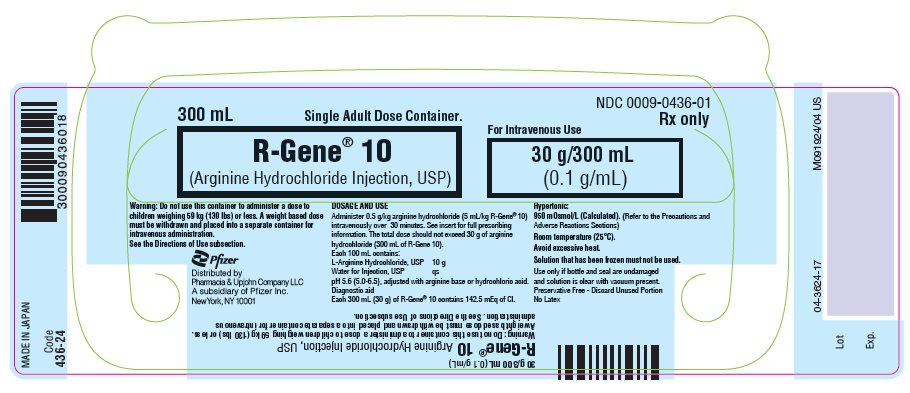
R-Gene Arginine Hydrochloride 10 g/100mL Injection, Solution, 300 mL — NDC 0009-0436-01 (Billing 00009-0436-01)
This is a package of 300 mL of R-Gene Arginine Hydrochloride 10 g/100mL Injection, Solution from Pharmacia & Upjohn Company LLC, marketed since Jun 1976 and currently FDA-listed. It is this product's only package size.
NDC database record
One package, one record: these facts belong to NDC 0009-0436-01 alone.
- Record
- FDA NDC Directory package listing · Human prescription drug
- Code segments
- 0009 labeler · 0436 product · 01 package
- Package marketed since
- Jun 15, 1976
- Sample package
- No — commercial package
- Listing certified through
- Dec 31, 2026
- Billing quantity
- 300 mL per package
- Barcode (UPC-A, from the NDC)
- 3 0009043601 8
- Medicaid fills, this package
- 161 prescriptions in the last four reported quarters
- FDA record last changed
- Jul 24, 2026
Identity & classification
Regulatory identifiers FDA, NLM and CMS codes for this package
Drug-database identifiers Medi-Span GPI and First Databank GCN / HICL / AHFS classification
- GSN (GCN sequence number): 037018
- GCN: 57881
- GPI-14 (Medi-Span): 94200012102005
- HICL (First Databank): 010305
- AHFS class code: 36:66.00.00
Where does this data come from?
- FDA openFDA NDC Directory · synced Oct 1, 2026
- FDA label on DailyMed · label index refreshed Oct 3, 2026
- RxNorm (NLM RxNav) · catalog refreshed Oct 1, 2026
- Medi-Span GPI (licensed)
- First Databank (licensed) · refreshed Oct 1, 2026
Clinical
Patient education
Supplement & herbal interactions
Where does this data come from?
- MedlinePlus (NLM) · refreshed Oct 1, 2026
- FDA label on DailyMed · label index refreshed Oct 3, 2026
Ask a licensed pharmacist directly — free, answered by our team.
Pricing
A drug doesn't have one price. Each row is a different public payment system, and none is what you'd pay at the counter — that depends on your insurance. The ⓘ on each row explains what it measures.
| Price system | Per mL | Per package |
|---|---|---|
| Retail pharmacies payNADAC · weekly | Not in the retail survey — common for institutional, discontinued, or low-volume packs. | |
| Medicaid paysCMS SDUD · 12 mo | $0.1870 | $56.10 / 300 ml |
| Medicare drug plans payPart D · quarterly | No Part D plan price is available for this NDC in our data. | |
Where does this data come from?
- CMS NADAC weekly file
- CMS ASP pricing files · refreshed Sep 20, 2026
- CMS Medicaid State Drug Utilization Data · through Q1 2026
- CMS Part D plan pricing files · refreshed Sep 24, 2026
- VA National Acquisition Center price file
Packaging — all sizes for this product
| Package NDC | Description | Marketing start | Marketing end | Status |
|---|---|---|---|---|
| 00009-0436-01 You're viewing this Main listing | 1 CONTAINER in 1 CARTON / 300 mL in 1 CONTAINER | 1976-06-15 | — | Active |
Therapeutic equivalents
| Product | Labeler | Pack | NADAC/unit | TE | Status | Price vs. this |
|---|---|---|---|---|---|---|
| R-Gene 10 g/100mLthis 00009-0436-01 | Pharmacia | 300 ml | — | — | FDA listed | — |
Where does this data come from?
- FDA openFDA NDC Directory · synced Oct 1, 2026
- FDA Orange Book · refreshed Oct 3, 2026
- CMS NADAC weekly file
Availability & generic status
We did not find an FDA-approved generic match for this exact strength, form and route.
Where does this data come from?
- FDA Orange Book · refreshed Oct 3, 2026
Inactive Ingredients / Excipients
Inactive ingredients, also called excipients, are components of the drug product other than the active ingredient. They may include fillers, dyes, coatings, preservatives, flavors, or other formulation ingredients.
💡 Tap an ingredient (hover on desktop) to see what it is and why it’s used.
-
UNII QTT17582CB
A strong acid used to adjust and maintain the proper pH level in liquid medicines, ensuring stability and preventing breakdown of active ingredients.
-
UNII 059QF0KO0R
Water is a liquid solvent that dissolves and mixes ingredients together in liquid medicines, syrups, and injections. It helps distribute the active drug evenly throughout the product.
2 inactive ingredients listed in the exact product block matched to this NDC.
Where does this data come from?
ingredient classCode="IACT" elements from the exact product block matched by this NDC. Label-section narrative from DailyMed / the openFDA label index is shown separately when available.- FDA label on DailyMed · label index refreshed Oct 3, 2026
- FDA openFDA NDC Directory · synced Oct 1, 2026
Inactive ingredient FAQ
Are inactive ingredients the same for every manufacturer?
Why might an inactive ingredient be missing?
Can inactive ingredients matter?
Manufacturer & labeler
More NDCs from Pharmacia & Upjohn Company LLC labeler code 00009
- Depo-Medrol methylprednisolone acetate 80 mg/mL Injection, Suspension NDC 0009-0306-02
- Cleocin Hydrochloride clindamycin 75 mg Capsule NDC 0009-0331-02
- Depo-Testosterone testosterone cypionate 100 mg/mL Injection, Solution NDC 0009-0347-02
- Cleocin Hydrochloride clindamycin 300 mg Capsule NDC 0009-0395-14
- Depo-Testosterone testosterone cypionate 200 mg/mL Injection, Solution NDC 0009-0417-01
- Tolterodine Tartrate 1 kg/kg Powder NDC 0009-0420-01
- Colestid Colestipol Hydrochloride 1 g Tablet NDC 0009-0450-03
- Phenytoin 1 kg/kg Powder NDC 0009-0488-01
- SOLU-MEDROL methylprednisolone sodium succinate 1 g/mL Injection, Powder, For Solution NDC 0009-0698-01
- Cleocin Phosphate clindamycin 150 mg/mL Injection, Solution NDC 0009-0728-09
- Depo-Provera medroxyprogesterone acetate 150 mg/mL Injection, Suspension NDC 0009-0746-30
- SOLU-MEDROL methylprednisolone sodium succinate 500 mg/mL Injection, Powder, For Solution NDC 0009-0758-01
Where does this data come from?
- FDA openFDA NDC Directory · synced Oct 1, 2026
- Drugs@FDA
Full prescribing information FDA SPL
🎯 Indications and Usage ▾
INDICATIONS AND USAGE R-Gene ® 10 is indicated as an intravenous stimulant to the pituitary for the release of human growth hormone in patients where the measurement of pituitary reserve for HGH can be of diagnostic usefulness. It can be used as a diagnostic aid in such conditions as panhypopituitarism, pituitary dwarfism, chromophobe adenoma, postsurgical craniopharyngioma, hypophysectomy, pituitary trauma, acromegaly, gigantism and problems of growth and stature. If the insulin hypoglycemia test has indicated a deficiency of pituitary reserve for HGH, a test with R-Gene ® 10 is advisable to confirm the negative response.
This can be done after a waiting period of one day. As patients may not respond to R-Gene ® 10 (Arginine Hydrochloride Injection, USP) during the first test, the unresponsive patient should be tested again to confirm the negative result. A second test can be performed after a waiting period of one day.
Some patients who respond to R-Gene ® 10 do not respond to insulin and vice versa. The rate of false positive responses for R-Gene ® 10 is approximately 32%, and the rate of false negatives is approximately 27%.
⏱️ Dosage and Administration ▾
DOSAGE AND ADMINISTRATION Adult Dosage The recommended adult dose is 30 g arginine hydrochloride (300 mL of R-Gene ® 10) administered by intravenous infusion over 30 minutes. The total dose should not exceed 30 g arginine hydrochloride. See Directions for Use for preparation instructions.
Pediatric Dosage The recommended pediatric dose is 0.5 g/kg arginine hydrochloride (5 mL/kg of R-Gene ® 10) administered by intravenous infusion over 30 minutes. The total dose should not exceed 30 g arginine hydrochloride. • For patients weighing 59 kg or less , withdraw a weight based dose from a sealed R-Gene ® 10 bottle and place in a separate container for intravenous infusion to avoid the inadvertent delivery and administration of the total volume from the commercially available container. See Directions for Use for preparation instructions. • For patients weighing 60 kg or more , the recommended dose is 30 g arginine hydrochloride (300 mL of R-Gene ® 10).
See Directions for Use for preparation instructions Test Procedure The intravenous infusion of R-Gene ® 10 is a part of the test for measurement of pituitary reserve of human growth hormone and, for successful administration of the test, clinical conditions and procedures should be as follows: 1. The test should be scheduled in the morning following a normal night's sleep, and an overnight fast should continue through the test period. 2.
Patients must be placed at bed rest for at least 30 minutes before the infusion begins. Care should be taken to minimize apprehension and distress. This is particularly important in children.
3. R-Gene ® 10 (Arginine Hydrochloride Injection, USP) is a hypertonic solution and should only be infused through an indwelling needle or soft catheter placed in an antecubital vein or other suitable vein (see PRECAUTIONS ). Blood samples should be taken by venipuncture from the contra-lateral arm.
4. A desirable schedule for drawing blood samples is at −30, 0, 30, 60, 90, 120 and 150 minutes. 5.
R-Gene ® 10 should be infused beginning at zero time at a uniform rate which will permit the recommended dose to be administered over 30 minutes. 6. Blood samples should be promptly centrifuged and the plasma stored at −20°C until assayed by one of the published radioimmunoassay procedures.
7. Diagnostic test results showing a deficiency of pituitary reserve for HGH should be confirmed by a second test with R-Gene ® 10, or one may elect to confirm with the insulin hypoglycemia test. A waiting period of one day is advised between tests.
Directions for Use R-Gene ® 10 is provided as a ready-to-use solution for patients weighing 60 kg (132 lbs) or more and should not be further diluted. For pediatric patients weighing 59 kg (130 lbs) or less a dose must be placed in a separate container. Follow the preparation instructions below.
Parenteral drug products should be inspected visually for particulate matter and discoloration prior to administration whenever solution and container permit. For Pediatric Patients weighing 59 kg (130 lbs) or less: Withdraw a weight-based dose from an intact sealed bottle of R-Gene ® 10. The entire 300 mL bottle of R-Gene ® 10 for infusion is not intended for use in patients weighing 59 kg or less.
The dose must be placed in a separate container, such as an evacuated sterile glass container designed for intravenous administration, using aseptic technique. Additionally, R-Gene ® 10 is stable in polypropylene syringes and plastic containers made of either polyvinyl chloride (PVC) or ethylene vinyl acetate (EVA). The post-penetration storage period is not more than 4 hours including infusion time at room temperature or 24 hours at refrigerated temperature (2-8°C).
The healthcare professional administering the dose should verify the accuracy of the dose prior to administration. Use only if the solution is clear. Discard any unused drug product.
For Adults and Pediatric Patients weighing 60kg (132 lbs) or more: Follow these directions using aseptic te… [Excerpted — this section continues on DailyMed.]
⛔ Contraindications ▾
CONTRAINDICATIONS The administration of R-Gene ® 10 is contraindicated in persons having known hypersensitivity to any ingredient in this product.
⚠️ Warnings ▾
WARNINGS There have been reports of overdosage of R-Gene ® 10 in pediatric patients leading to death. EXTREME CAUTION MUST BE EXERCISED WHEN INFUSING R-GENE ® 10 INTO PEDIATRIC PATIENTS. OVERDOSAGE OF R-GENE ® 10 IN PEDIATRIC PATIENTS CAN RESULT IN HYPERCHLOREMIC METABOLIC ACIDOSIS, CEREBRAL EDEMA, OR POSSIBLY DEATH.
Hypersensitivity reactions, including anaphylaxis have been reported. Appropriate medical support should be available during R-Gene ® 10 administration. If anaphylaxis or other serious hypersensitivity reaction occurs, R-Gene ® 10 should be discontinued and appropriate medical treatment initiated.
R-Gene ® 10 should always be administered by intravenous infusion because of its hypertonicity. R-Gene ® 10 is a diagnostic aid and is not intended for therapeutic use.
🤒 Adverse Reactions ▾
ADVERSE REACTIONS Adverse reactions associated with 1670 infusions in premarketing studies were as follows: Non-specific side effects consisting of nausea, vomiting, headache, flushing, numbness and local venous irritation were reported in approximately 3% of the patients. One patient had an allergic reaction which was manifested as a confluent macular rash with reddening and swelling of the hands and face. The rash subsided rapidly after the infusion was terminated and 50 mg of diphenhydramine were administered.
One patient had an apparent decrease in platelet count from 150,000 to 60,000. One patient with a history of acrocyanosis had an exacerbation of this condition following infusion of R-Gene ® 10. Post Marketing Experience: The following adverse events have been reported during post-marketing use: extravasation leading to burn-like reaction and/or skin necrosis requiring surgical intervention, hypersensitivity reactions including anaphylaxis, and hematuria that in some cases occurred 1–2 days after an R-Gene ® 10 administration.
Because these adverse events are reported voluntarily from a population of uncertain size, it is not always possible to reliably estimate their frequency or establish a causal relationship to drug exposure.
🤰 Pregnancy ▾
Pregnancy Reproduction studies have been performed in rabbits and mice at doses 12 times the human dose and have revealed no evidence of impaired fertility or harm to the fetus due to R-Gene ® 10 (10% Arginine Hydrochloride Injection, USP). There have been no adequate or well controlled studies for the use of R-Gene ® 10 in pregnant women. Because animal reproduction studies are not always predictive of human response, this drug should not be used during pregnancy.
🧓 Geriatric Use ▾
Geriatric Use Clinical studies of arginine did not include a sufficient number of subjects aged 65 and over to determine whether they respond differently from younger subjects. Other reported clinical experience has not identified differences in responses between the elderly and younger patients.
🆘 Overdosage ▾
OVERDOSAGE An overdosage may cause a transient metabolic acidosis with hyperventilation, which could lead to death (see " WARNINGS "). In most cases the acidosis will self-compensate and the base deficit will return to normal following completion of the infusion. If the condition persists, the deficit should be determined and corrected by a calculated dose of an alkalizing agent.
🧬 Clinical Pharmacology ▾
CLINICAL PHARMACOLOGY Intravenous infusion of R-Gene ® 10 often induces a pronounced rise in the plasma level of human growth hormone (HGH) in subjects with intact pituitary function. This rise is usually diminished or absent in patients with impairment of this function. Expected Plasma Levels of HGH in ng/mL Patient Control Range Range of Peak Response to Arginine Normal 0–6 10–30 Pituitary deficient 0–4 0–10 These ranges are based on the mean values of plasma HGH levels calculated from the data of several clinical investigators and reflect their experiences with various methods of radioimmunoassay.
Upon gaining experience with this diagnostic test, each clinician will establish his/her own ranges for control and peak levels of HGH. L-arginine is a normal metabolite in animals and man and has a low order of toxicity.
📦 How Supplied / Storage and Handling ▾
HOW SUPPLIED R-Gene ® 10 is supplied as a 30 g/300 mL (0.1 g/mL) fill in 500 mL glass containers. Preservative Free: Discard any unused portion. NDC 0009-0436-01 Exposure of pharmaceutical products to heat should be minimized.
Avoid excessive heat. It is recommended that the product be stored at room temperature (25°C); however, brief exposure up to 40°C does not adversely affect the product. Solution that has been frozen must not be used.
LAB-0020-13.0 Revised Aug 2023 Logo
📋 Description ▾
DESCRIPTION Each 100 mL of R-Gene ® 10 (Arginine Hydrochloride Injection, USP) for intravenous use contains 10 g of L-Arginine Hydrochloride, USP in Water for Injection, USP (equivalent to a 10% solution) (0.1 g/mL). L-arginine is a naturally occurring amino acid. R-Gene ® 10 is hypertonic (950 mOsmol/liter) and contains 47.5 mEq of chloride ion per 100 mL of solution. The pH is adjusted to 5.6 (5.0–6.5) with arginine base or hydrochloric acid.
⚠️ Precautions ▾
PRECAUTIONS General R-Gene ® 10 is a hypertonic (950 mOsmol/liter) and acidic (average pH of 5.6) solution that can cause irritation and damage to tissues. Care should be used to ensure administration of R-Gene ® 10 through a patent catheter within a patent vein. Excessive rates of infusion may result in local irritation and in flushing, nausea, or vomiting.
Inadequate dosing or prolongation of the infusion period may diminish the stimulus to the pituitary and nullify the test. The arginine in R-Gene ® 10 can be metabolized resulting in nitrogen-containing products for excretion. The effect of an acute amino acid or nitrogen burden upon patients with impairment of renal function should be considered when R-Gene ® 10 is to be administered.
The chloride content of R-Gene ® 10 is 47.5 mEq per 100 mL of solution, and the effect of infusing this amount of chloride into patients with electrolyte imbalance should be evaluated before the test is undertaken. It should be noted that the basal and post stimulation levels of growth hormone are elevated in patients who are pregnant or are taking oral contraceptives. Carcinogenesis, mutagenesis, and impairment of fertility Long term animal studies have not been performed to evaluate the carcinogenic potential, the mutagenic potential or the effect on fertility of intravenously administered R-Gene ® 10.
Pregnancy Reproduction studies have been performed in rabbits and mice at doses 12 times the human dose and have revealed no evidence of impaired fertility or harm to the fetus due to R-Gene ® 10 (10% Arginine Hydrochloride Injection, USP). There have been no adequate or well controlled studies for the use of R-Gene ® 10 in pregnant women. Because animal reproduction studies are not always predictive of human response, this drug should not be used during pregnancy.
Nursing Mothers It is not known whether intravenous administration of R-Gene ® 10 could result in significant quantities of arginine in breast milk. Systemically administered amino acids are secreted into breast milk in quantities not likely to have a deleterious effect on the infant. Nevertheless, caution should be exercised when R-Gene ® 10 is to be administered to nursing women.
Geriatric Use Clinical studies of arginine did not include a sufficient number of subjects aged 65 and over to determine whether they respond differently from younger subjects. Other reported clinical experience has not identified differences in responses between the elderly and younger patients.
🍼 Nursing Mothers ▾
Nursing Mothers It is not known whether intravenous administration of R-Gene ® 10 could result in significant quantities of arginine in breast milk. Systemically administered amino acids are secreted into breast milk in quantities not likely to have a deleterious effect on the infant. Nevertheless, caution should be exercised when R-Gene ® 10 is to be administered to nursing women.
📄 Carcinogenesis, Mutagenesis, Impairment of Fertility ▾
Carcinogenesis, mutagenesis, and impairment of fertility Long term animal studies have not been performed to evaluate the carcinogenic potential, the mutagenic potential or the effect on fertility of intravenously administered R-Gene ® 10.
📄 Package Label / Principal Display Panel ▾
PRINCIPAL DISPLAY PANEL - 300 mL Container Label NDC 0009-0436-01 Rx only 300 mL Single Adult Dose Container. R-Gene ® 10 (Arginine Hydrochloride Injection, USP) For Intravenous Use 30 g/300 mL (0.1 g/mL) Pfizer Distributed by Pharmacia & Upjohn Company LLC A subsidiary of Pfizer Inc. New York, NY 10001 PRINCIPAL DISPLAY PANEL - 300 mL Container Label
PRINCIPAL DISPLAY PANEL - 300 mL Container Carton NDC 0009-0436-01 300 mL Single Adult Dose Container. R-Gene ® 10 (Arginine Hydrochloride Injection, USP) For Intravenous Use 30 g/300 mL (0.1 g/mL) Warning: Do not use this container to administer a dose to children weighing 59 kg (130 lbs) or less. A weight based dose must be withdrawn and placed into a separate container for intravenous administration.
See the Directions of Use subsection. Rx only PRINCIPAL DISPLAY PANEL - 300 mL Container Carton
Medicaid utilization & spend
About this NDC listing & data coverage
What data is (and isn’t) available for this NDC — tap to expand
| NDC identity (package / product / labeler codes) | ✓ Available |
| Labeler | ✓ Available |
| Product & package description | ✓ Available |
| Marketing category & status | ✓ Available |
| Active ingredient / dosage form / route | ✓ Available |
| FDA label (SPL via DailyMed) | ✓ Available |
| Package photos | ✓ Available |
| Inactive ingredients (structured) | ✓ Available |
| NADAC pharmacy acquisition price (CMS) | — Not published for this NDC CMS publishes NADAC only for NDCs reported in its retail-pharmacy survey. |
| Orange Book / therapeutic-equivalence data | — Not published for this NDC Applies only to products approved under an NDA/ANDA; many listings are out of scope. |
| HCPCS J-code billing crosswalk | — Not published for this NDC Most self-administered / retail products have no J-code — that is normal. |
| Medicaid utilization (CMS SDUD) | ✓ Available |