
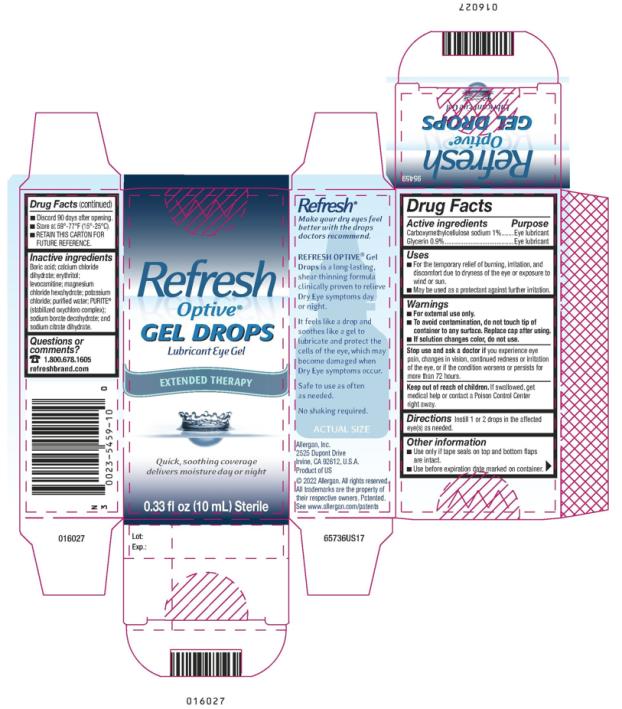
REFRESH OPTIVE Drops carboxymethylcellulose sodium and glycerin 10 mg/mL; 9 mg/mL Solution/ Drops — NDC 0023-5459-10 (Billing 00023-5459-10)
This is a package of REFRESH OPTIVE Drops carboxymethylcellulose sodium and glycerin 10 mg/mL; 9 mg/mL Solution/ Drops from Allergan, Inc., marketed since Sep 2015 and currently FDA-listed; retail pharmacies pay about $1.10 per mL (NADAC). It is the main listing for this product, which comes in 2 package sizes.
NDC database record
One package, one record: these facts belong to NDC 0023-5459-10 alone.
- Record
- FDA NDC Directory package listing · Human OTC drug
- Code segments
- 0023 labeler · 5459 product · 10 package
- Package marketed since
- Sep 30, 2015
- Sample package
- No — commercial package
- Listing certified through
- Dec 31, 2027
- Barcode (UPC-A, from the NDC)
- 3 0023545910 0
- Medicaid fills, this package
- 1,822 prescriptions in the last four reported quarters
- FDA record last changed
- Jul 24, 2026
Identity & classification
Regulatory identifiers FDA, NLM and CMS codes for this package
Drug-database identifiers Medi-Span GPI and First Databank GCN / HICL / AHFS classification
- GSN (GCN sequence number): 075177
- GCN: 40182
- GPI-14 (Medi-Span): 86209902124020
- HICL (First Databank): 034858
- AHFS class code: 52:92.00.00
- RxCUI (RxNorm): 1726416
Where does this data come from?
- FDA openFDA NDC Directory · synced Oct 1, 2026
- FDA label on DailyMed · label index refreshed Oct 5, 2026
- RxNorm (NLM RxNav) · catalog refreshed Oct 1, 2026
- Medi-Span GPI (licensed)
- First Databank (licensed) · refreshed Oct 1, 2026
Clinical
Refresh Optive is an over-the-counter eye drop solution that functions as an artificial tear product. It contains two active ingredients, carboxymethylcellulose sodium and glycerin, which are both lubricants commonly used to relieve dryness and irritation of the eye surface. The drops are applied directly to the eye to help moisturize and protect the cornea and conjunctiva. This product is marketed as an OTC monograph drug under FDA guidelines for its category.
Patient education
Supplement & herbal interactions
Where does this data come from?
- MedlinePlus (NLM) · refreshed Oct 1, 2026
- FDA label on DailyMed · label index refreshed Oct 5, 2026
Ask a licensed pharmacist directly — free, answered by our team.
Pricing
A drug doesn't have one price. Each row is a different public payment system, and none is what you'd pay at the counter — that depends on your insurance. The ⓘ on each row explains what it measures.
| Price system | Per mL | Per package |
|---|---|---|
| Retail pharmacies payNADAC · weekly | $1.099 | $10.99 / 10 ml |
| Medicaid paysCMS SDUD · 12 mo | $1.80 | $18.03 / 10 ml |
| Medicare drug plans payPart D · quarterly | No Part D plan price is available for this NDC in our data. | |
Where does this data come from?
- CMS NADAC weekly file · file of Sep 30, 2026
- CMS ASP pricing files · refreshed Sep 20, 2026
- CMS Medicaid State Drug Utilization Data · through Q1 2026
- CMS Part D plan pricing files · refreshed Sep 24, 2026
- VA National Acquisition Center price file
Packaging — all sizes for this product
| Package NDC | Description | Per unit | Per pack | Marketing start | Marketing end | Status |
|---|---|---|---|---|---|---|
| 00023-5459-02 0023-5459-02 | 1 BOTTLE, DROPPER in 1 CARTON / 2 mL in 1 BOTTLE, DROPPER Sample | — | — | 2015-09-30 | — | Active |
| 00023-5459-10 You're viewing this Main listing | 1 BOTTLE, DROPPER in 1 CARTON / 10 mL in 1 BOTTLE, DROPPER | $1.10 / mL | $10.99 | 2015-09-30 | — | Active |
In Medicaid, this is the most-dispensed pack of this product — about 100% of fills over the last four reported quarters. See all packs ↓
Pack size FAQ
What quantity is in this package?
What NDC number is used to bill for this package of REFRESH OPTIVE Drops carboxymethylcellulose sodium and glycerin 10 mg/mL; 9 mg/mL Solution/ Drops?
Prices are the latest CMS NADAC pharmacy acquisition cost per NDC; per-pack figures are per-unit × pack quantity, shown only when the pack is denominated in the same measure NADAC prices.
Therapeutic equivalents
| Product | Labeler | Pack | NADAC/unit | TE | Status | Price vs. this |
|---|---|---|---|---|---|---|
| REFRESH OPTIVE Drops 10 mg/mL; 9 mg/mLthis 00023-5459-10 | Allergan, | 1 bottle | $1.099 | — | Availability likely | — |
Where does this data come from?
- FDA openFDA NDC Directory · synced Oct 1, 2026
- FDA Orange Book · refreshed Oct 3, 2026
- CMS NADAC weekly file · file of Sep 30, 2026
Availability & generic status
We did not find an FDA-approved generic match for this exact strength, form and route.
Where does this data come from?
- FDA Orange Book · refreshed Oct 3, 2026
Inactive Ingredients / Excipients
Inactive ingredients, also called excipients, are components of the drug product other than the active ingredient. They may include fillers, dyes, coatings, preservatives, flavors, or other formulation ingredients.
💡 Tap an ingredient (hover on desktop) to see what it is and why it’s used.
-
UNII R57ZHV85D4
Boric acid is a weak acid derived from boron. In medicines, it typically serves as a buffer to help maintain the product's pH level and may act as a preservative in certain formulations.
-
UNII M4I0D6VV5M
Calcium chloride is a salt compound that acts as a firming agent and source of calcium ions in medications. It's used in formulations to help maintain tablet structure, improve texture, or serve as a buffering agent.
-
UNII RA96B954X6
Erythritol is a sugar alcohol derived from fermented fruits or grains. It's used as a sweetener and bulking agent in medicines to improve taste without adding significant calories.
-
UNII 0G389FZZ9M
Levocarnitine is an amino acid derivative that helps transport fatty acids in cells. In medications, it serves as an active nutritional component rather than a typical inactive binder or filler.
-
UNII 02F3473H9O
A mineral salt used in medications as a source of magnesium. It helps bind ingredients together, improve texture, and maintain the product's stability during storage.
-
UNII 660YQ98I10
Potassium chloride is a mineral salt used in medicines as a buffer and to help maintain the proper pH balance and stability of the formulation during storage and use.
-
UNII 91MBZ8H3QO
Sodium borate is an inorganic salt compound used in medicines as a buffer to help maintain a stable pH level, and sometimes as a mild preservative or cleansing agent in topical formulations.
-
UNII G538EBV4VF
Sodium chlorite is a white crystalline salt used as a preservative and antimicrobial agent in medications. It helps prevent bacterial and fungal growth to maintain product stability during storage.
-
UNII B22547B95K
A salt derived from citric acid that helps maintain the proper acid-base balance in the medicine. It's used as a buffer to keep the product stable and at the right pH level.
-
UNII 059QF0KO0R
Water is a liquid solvent that dissolves and mixes ingredients together in liquid medicines, syrups, and injections. It helps distribute the active drug evenly throughout the product.
10 inactive ingredients listed in the exact product block matched to this NDC.
Label-section wording can be broader than the structured product block and may mention additional formulation ingredients.
Where does this data come from?
ingredient classCode="IACT" elements from the exact product block matched by this NDC. Label-section narrative from DailyMed / the openFDA label index is shown separately when available.- FDA label on DailyMed · label index refreshed Oct 5, 2026
- FDA openFDA NDC Directory · synced Oct 1, 2026
Inactive ingredient FAQ
Are inactive ingredients the same for every manufacturer?
Why might an inactive ingredient be missing?
Can inactive ingredients matter?
Manufacturer & labeler
More NDCs from Allergan, Inc. labeler code 00023
- Refresh RELIEVA PF Carboxymethylcellulose sodium and Glycerin 5 mg/mL; 10 mg/mL Solution/ Drops NDC 0023-4515-30
- REFRESH CELLUVISC carboxymethylcellulose sodium 10 mg/mL Gel NDC 0023-4554-05
- SKIN MEDICA Purifying Foaming Wash salicylic acid 20 mg/mL Liquid NDC 0023-4948-05
- BOTULINUM TOXIN TYPE A 100 [USP'U]/mL Powder NDC 0023-5027-99
- botulinum toxin type a 200 [USP'U]/mL Powder NDC 0023-5028-99
- Restasis MultiDose cyclosporine .5 mg/mL Emulsion NDC 0023-5301-05
- TOTAL DEFENSE REPAIR BROAD SPECTRUM SPF 34 Sunscreen Octinoxate, Octisalate and Zinc Oxide 75 mg/g; 30 mg/g; 80 mg/g Lotion NDC 0023-5494-01
- TOTAL DEFENSE REPAIR BROAD SPECTRUM SPF 34 Sunscreen (Tinted) Octinoxate, Octisalate, Titanium dioxide and Zinc Oxide 75 mg/g; 30 mg/g; 35 mg/g; 80 mg/g Lotion NDC 0023-5497-01
- Essential Defense Mineral Shield Broad Spectrum SPF 32 TINTED Sunscreen Titanium Dioxide and Zinc Oxide 50 mg/g; 60 mg/g Lotion NDC 0023-5675-08
- Essential Defense Mineral Shield Broad Spectrum SPF 35 Sunscreen Titanium Dioxide and Zinc oxide 50 mg/g; 60 mg/g Lotion NDC 0023-5703-08
- Essential Defense Everyday Clear Broad Spectrum SPF 47 Sunscreen Zinc Oxide and Octinoxate 75 mg/g; 120 mg/g Lotion NDC 0023-5738-18
- REFRESH Optive Mega-3 Carboxymethylcellulose sodium, Glycerin and Polysorbate 80 5 mg/mL; 10 mg/mL; 80 5 mg/mL Solution/ Drops NDC 0023-5773-05
Where does this data come from?
- FDA openFDA NDC Directory · synced Oct 1, 2026
- Drugs@FDA
FDA label — Drug Facts FDA SPL
🎯 Indications and Usage ▾
Uses For the temporary relief of burning, irritation, and discomfort due to dryness of the eye or exposure to wind or sun. May be used as a protectant against further irritation.
⏱️ Dosage and Administration ▾
Directions Instill 1 or 2 drops in the affected eye(s) as needed.
⚠️ Warnings ▾
Warnings For external use only. To avoid contamination, do not touch tip of container to any surface. Replace cap after using.
If solution changes color or becomes cloudy, do not use. Stop use and ask a doctor if you experience eye pain, changes in vision, continued redness or irritation of the eye, or if the condition worsens or persists for more than 72 hours. Keep out of reach of children.
If swallowed, get medical help or contact a Poison Control Center right away.
🧪 Active Ingredient ▾
Active ingredients Carboxymethylcellulose sodium 1% Glycerin 0.9%
🧪 Inactive Ingredients ▾
Inactive ingredients Boric acid; calcium chloride dihydrate; erythritol; levocarnitine; magnesium chloride hexahydrate; potassium chloride; purified water; PURITE® (stabilized oxychloro complex); sodium borate decahydrate; and sodium citrate dihydrate.
🎯 Purpose ▾
Purpose Eye lubricant Eye lubricant
📄 Stop Use and Ask a Doctor If ▾
Stop use and ask a doctor if you experience eye pain, changes in vision, continued redness or irritation of the eye, or if the condition worsens or persists for more than 72 hours.
📄 Keep Out of Reach of Children ▾
Keep out of reach of children. If swallowed, get medical help or contact a Poison Control Center right away.
📄 Other Information ▾
Other information Use only if tape seals on top and bottom flaps are intact. Use before expiration date marked on container. Discard 90 days after opening. Store at 59°-77°F (15°-25°C). RETAIN THIS CARTON FOR FUTURE REFERENCE.
📄 Questions or Comments ▾
Questions or comments? 1.800.678.1605 r efresh eyedrops .com v2.0DFL5459
📄 Package Label / Principal Display Panel ▾
PRINCIPAL DISPLAY PANEL NDC 0023-5459-10 Refresh Optive ® GEL DROPS Lubricant Eye Gel Extended Relief Lasting comfort Day or Night for Dry Eyes 0.33 fl oz (10 mL) Sterile PRINCIPAL DISPLAY PANEL NDC 0023-5459-10 Refresh Optive® GEL DROPS Lubricant Eye Gel Extended Relief Lasting comfort Day or Night for Dry Eyes 0.33 fl oz (10 mL) Sterile