
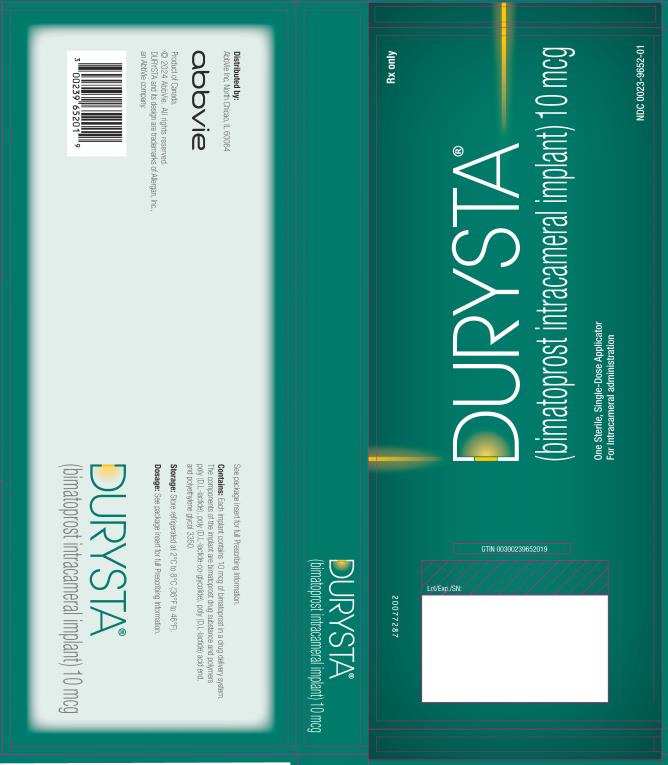
Durysta bimatoprost 10 ug Implant, 1 implant — NDC 0023-9652-01 (Billing 00023-9652-01)
This is a package of 1 implant of Durysta bimatoprost 10 ug Implant from Allergan, Inc., marketed since Mar 2020 and currently FDA-listed. It is the main listing for this product, which comes in 2 package sizes.
NDC database record
One package, one record: these facts belong to NDC 0023-9652-01 alone.
- Record
- FDA NDC Directory package listing · Human prescription drug
- Code segments
- 0023 labeler · 9652 product · 01 package
- Package marketed since
- Mar 4, 2020
- Sample package
- No — commercial package
- Listing certified through
- Dec 31, 2026
- Billing quantity
- 1 EA per package
- Barcode (UPC-A, from the NDC)
- 3 0023965201 9
- Medicaid fills, this package
- 501 prescriptions in the last four reported quarters
- FDA record last changed
- Jul 24, 2026
Identity & classification
Regulatory identifiers FDA, NLM and CMS codes for this package
Drug-database identifiers Medi-Span GPI and First Databank GCN / HICL / AHFS classification
- GSN (GCN sequence number): 080813
- GCN: 47792
- GPI-14 (Medi-Span): 86330015002320
- HICL (First Databank): 022000
- AHFS class code: 52:40.28.00
- RxCUI (RxNorm): 2286602
Where does this data come from?
- FDA openFDA NDC Directory · synced Oct 1, 2026
- FDA label on DailyMed · label index refreshed Oct 3, 2026
- RxNorm (NLM RxNav) · catalog refreshed Oct 1, 2026
- Medi-Span GPI (licensed)
- First Databank (licensed) · refreshed Oct 1, 2026
RxNorm drug class
This medicine belongs to the Prostaglandin Analog class.
Where does this data come from?
- RxClass (NLM) · catalog refreshed Oct 1, 2026
Clinical
- It depends on the product you have. Lumigan, Zolymbus and Durysta lower high eye pressure in open-angle glaucoma or ocular hypertension. Latisse and generic bimatoprost 0.03% are f...
- Lumigan and Zolymbus are one drop in the eye once daily in the evening. Latisse and generic bimatoprost 0.03% go on the upper eyelid margin once nightly with a fresh sterile applic...
- Red, itchy or dry eyes are common, and you may notice lash growth or darker skin around the eye. Most of these are mild. Call me or your doctor if you have eye pain, vision changes...
- Yes. It can make the iris more brown, and this is likely to be permanent. It may take months or years to notice. Your doctor can talk with you about this.
Patient education
Supplement & herbal interactions
Some supplements/herbs that may interact with Bimatoprost — tap one for details:
Where does this data come from?
- MedlinePlus (NLM) · refreshed Oct 1, 2026
- FDA label on DailyMed · label index refreshed Oct 3, 2026
Ask a licensed pharmacist directly — free, answered by our team.
Pricing
A drug doesn't have one price. Each row is a different public payment system, and none is what you'd pay at the counter — that depends on your insurance. The ⓘ on each row explains what it measures.
| Price system | Per each | Per package |
|---|---|---|
| Retail pharmacies payNADAC · weekly | Not in the retail survey — common for institutional, discontinued, or low-volume packs. | |
| Medicaid paysCMS SDUD · 12 mo | $1,707.42 | $1,707.42 / 1 implant |
| Medicare drug plans payPart D · quarterly | No Part D plan price is available for this NDC in our data. | |
| Medicare Part B allowsASP · J7351 | $213.756 / J7351 unit | — |
Where does this data come from?
- CMS NADAC weekly file
- CMS ASP pricing files · refreshed Sep 20, 2026
- CMS Medicaid State Drug Utilization Data · through Q4 2025
- CMS Part D plan pricing files · refreshed Sep 24, 2026
- VA National Acquisition Center price file
Billing & reimbursement
Where does this data come from?
- CMS ASP NDC-HCPCS crosswalk · refreshed Sep 22, 2026
- DMEPDAC NDC-HCPCS crosswalk
- openFDA NSDE billing units · refreshed Sep 7, 2026
Packaging — all sizes for this product
| Package NDC | Description | Marketing start | Marketing end | Status |
|---|---|---|---|---|
| 00023-9652-01 You're viewing this Main listing | 1 IMPLANT in 1 POUCH | 2020-03-04 | — | Active |
| 00023-9652-03 0023-9652-03 | 1 IMPLANT in 1 POUCH Sample | 2020-03-04 | — | Active |
In Medicaid, this is the most-dispensed pack of this product — about 100% of fills over the last four reported quarters. See all packs ↓
Pack size FAQ
What quantity is in this package?
How does this package differ from NDC 00023-9652-03?
What NDC number is used to bill for this package of Durysta bimatoprost 10 ug Implant?
Therapeutic equivalents
| Product | Labeler | Pack | NADAC/unit | TE | Status | Price vs. this |
|---|---|---|---|---|---|---|
| Durysta 10 ugthis 00023-9652-01 | Allergan, | 1 implant | — | — | FDA listed | — |
Where does this data come from?
- FDA openFDA NDC Directory · synced Oct 1, 2026
- FDA Orange Book · refreshed Oct 3, 2026
- CMS NADAC weekly file
Availability & generic status
We did not find an FDA-approved generic match for this exact strength, form and route. Patent/protection dates below may affect future generic timing.
Why the date isn’t exact: Generic timing can change because patents may be challenged, settled, licensed, added, removed, or worked around with a narrower label — and FDA approval does not always mean a pharmacy can get the generic today.
🛈 What do these terms mean?
- Patent
- Legal protection listed in the Orange Book that may delay generic approval or launch. Issued by the U.S. Patent & Trademark Office.
- Substance patent
- Covers the active drug molecule itself — the hardest to design around. A generic generally can’t launch until it expires.
- Formulation (product) patent
- Covers a specific formulation or dosage form. A generic can sometimes work around it with a different formulation.
- Method-of-use patent
- A patent covering one specific approved use of the drug — not necessarily the whole molecule. A generic can sometimes launch with a “skinny label” that carves out the protected use and keeps the others.
- Skinny label
- A generic label that omits a still-patented use when the FDA allows it — letting a generic reach the market for the unprotected uses.
- Exclusivity
- FDA-granted marketing protection, separate from patents — e.g. 5-yr new chemical entity, 7-yr orphan drug, or a +6-month pediatric extension.
- Paragraph IV
- A generic applicant’s formal challenge to a listed patent. It can potentially lead to earlier generic entry, but often involves litigation or a settlement.
- RLD / RS
- Reference Listed Drug — the brand product the FDA uses as the reference for generic applications. Reference Standard — the product the FDA expects generics to compare against in bioequivalence testing.
- TE / AB rating
- FDA therapeutic-equivalence rating. An AB rating generally means the FDA considers a generic therapeutically equivalent to — and substitutable for — the brand.
- LOE (loss of exclusivity)
- The latest patent or exclusivity currently listed — the loss-of-exclusivity / latest-listed-protection date shown on this page. Paragraph-IV challenges and settlements can move the real date earlier; FDA approval and a manufacturer’s decision to market can move it later.
Built from the FDA Orange Book. The bars above are scaled to each protection’s expiry; the red LOE marker is the last one to lapse.
| Patent | Type | Use code | Expires |
|---|---|---|---|
| US 8206737 ↗ | Method of use | U-2759 | Apr 7, 2027 |
| US 9980974 ↗ | Method of use | U-2759 | Oct 31, 2034 |
| US 9492316 ↗ | Drug product | — | Oct 31, 2034 |
| US 7799336 ↗ | Drug product | — | Apr 24, 2029 |
| US 8629185 ↗ | Drug substance | — | Jul 15, 2031 |
| US 10441543 ↗ | Drug product | — | Dec 19, 2026 |
| US 9149428 ↗ | Drug product | — | Dec 19, 2026 |
Is there a generic version of DURYSTA 10 MCG IMPLANT?
The FDA approved a generic — why can’t I get it at my pharmacy yet?
Why do different websites show different generic release dates?
What does “FDA listed” mean?
What does a patent or protection date mean here?
What does “current Orange Book estimate” mean?
Can a generic come out before the last patent expires?
Can a generic come out after the listed dates?
What is the difference between patents and exclusivity?
Why are there multiple patent dates?
Where does this data come from?
- FDA Orange Book · refreshed Oct 3, 2026
Inactive Ingredients / Excipients
Inactive ingredients, also called excipients, are components of the drug product other than the active ingredient. They may include fillers, dyes, coatings, preservatives, flavors, or other formulation ingredients.
💡 Tap an ingredient (hover on desktop) to see what it is and why it’s used.
-
UNII WE369X5600
A synthetic plastic polymer made from two natural compounds, lactic acid and glycolic acid, blended equally and designed to break down in the body over time. Used as a coating or matrix to control how slowly a medicine is released into the bloodstream.
-
UNII 3WJQ0SDW1A
Polyethylene glycol is a synthetic liquid or solid polymer used in medicines as a solvent, lubricant, and humectant. It helps dissolve active ingredients, reduces friction during manufacturing, and retains moisture in the final product.
-
UNII 459TN2L5F5
Polylactide is a biodegradable plastic polymer made from lactic acid, derived from corn or sugarcane. In medicines, it acts as a binder and film-former to hold tablets together or create coatings on capsules.
3 inactive ingredients listed in the exact product block matched to this NDC.
Where does this data come from?
ingredient classCode="IACT" elements from the exact product block matched by this NDC. Label-section narrative from DailyMed / the openFDA label index is shown separately when available.- FDA label on DailyMed · label index refreshed Oct 3, 2026
- FDA openFDA NDC Directory · synced Oct 1, 2026
Inactive ingredient FAQ
Are inactive ingredients the same for every manufacturer?
Why might an inactive ingredient be missing?
Can inactive ingredients matter?
Manufacturer & labeler
More NDCs from Allergan, Inc. labeler code 00023
- COMBIGAN brimonidine tartrate, timolol maleate 2 mg/mL; 5 mg/mL Solution/ Drops NDC 0023-9211-03
- BOTOX Cosmetic onabotulinumtoxinA 100 [USP'U]/1 Injection, Powder, Lyophilized, For Solution NDC 0023-9232-01
- ACULAR LS Ketorolac Tromethamine 4 mg/mL Solution/ Drops NDC 0023-9277-05
- ALPHAGAN P brimonidine tartrate 1 mg/mL Solution/ Drops NDC 0023-9321-03
- Refresh RELIEVA PF Carboxymethylcellulose sodium and Glycerin 5 mg/mL; 10 mg/mL Solution/ Drops NDC 0023-9537-05
- Oxytrol for Women Oxybutynin 3.9 mg/d Patch NDC 0023-9637-04
Where does this data come from?
- FDA openFDA NDC Directory · synced Oct 1, 2026
- Drugs@FDA
Full prescribing information FDA SPL
🎯 Indications and Usage ▾
1 INDICATIONS AND USAGE DURYSTA ® (bimatoprost intracameral implant) is indicated for the reduction of intraocular pressure (IOP) in patients with open angle glaucoma (OAG) or ocular hypertension (OHT). DURYSTA is a prostaglandin analog indicated for the reduction of intraocular pressure (IOP) in patients with open angle glaucoma (OAG) or ocular hypertension (OHT). ( 1 )
⏱️ Dosage and Administration ▾
2 DOSAGE AND ADMINISTRATION For ophthalmic intracameral administration. ( 2.1 ) The intracameral administration should be carried out under standard aseptic conditions. ( 2.2 ) Figure 1 Figure 2 2. 1 General Information DURYSTA is an ophthalmic drug delivery system for a single intracameral administration of a biodegradable implant. DURYSTA should not be readministered to an eye that received a prior DURYSTA.
2.2Administration The intracameral injection procedure must be performed under magnification that allows clear visualization of the anterior chamber structures and should be carried out using standard aseptic conditions for intracameral procedures, with the patient’s head in a stabilized position. The eye should not be dilated prior to the procedure. Remove the foil pouch from the carton and examine for damage.
Then, open the foil pouch over a sterile field and gently drop the applicator on a sterile tray. Once the foil pouch is opened, use the applicator promptly. Figure 1 Perform a detailed visual inspection of the applicator, including ensuring that the actuator button has not been depressed, and the safety tab is in place.
Carefully remove the plastic safety cap taking care to avoid contacting the needle tip. Inspect the needle tip for damage under magnification prior to use; the implant retention plug may be visible in the bevel and should not be removed. Prior to use, remove the safety tab by pulling it out perpendicular to the long axis of the applicator (refer to Figure 1a above).
Do not twist or bend the tab. Stabilize the eye as the needle is advanced through the cornea. Enter the anterior chamber with the needle bevel visible through clear cornea.
Enter parallel to the iris plane, adjacent to the limbus through clear cornea in the superotemporal quadrant. The needle should be inserted approximately 2 bevel lengths with the bevel completely within the anterior chamber; avoid positioning the needle bevel directly over the pupil. Ensure the needle is not bent before depressing the actuator button.
See Figure 2. Figure 2 Depress the back half of the actuator button (refer to Figure 1b above) firmly until an audible and/or palpable click is noted. Following the release of the implant, remove the needle via the same track in which it was inserted and tamponade the opening.
The implant should not be left in the corneal injection track. Check the injection site for leaks; make sure that it is self-sealing and the anterior chamber is formed. After injection, do not recap the needle.
Dispose of the used applicator in a sharps disposal container and in accordance with local requirements. Instruct the patient to remain upright for at least 1 hour after the procedure so the implant can settle. Some degree of eye redness and discomfort is expected following administration.
However, it is recommended to instruct patients that if the eye becomes progressively red, sensitive to light, painful, or develops a change in vision, they should immediately contact the physician.
💊 Dosage Forms and Strengths ▾
3 DOSAGE FORMS AND STRENGTHS Intracameral implant containing 10 mcg of bimatoprost in a drug delivery system. Intracameral implant containing bimatoprost 10 mcg, in a drug delivery system. ( 3 )
⛔ Contraindications ▾
4 CONTRAINDICATIONS Ocular or periocular infections ( 4.1 ) Corneal endothelial cell dystrophy ( 4.2 ) Prior corneal transplantation ( 4.3 ) Absent or ruptured posterior lens capsule ( 4.4 ) Hypersensitivity ( 4.5 )
4.1Ocular or Periocular Infections DURYSTA is contraindicated in patients with active or suspected ocular or periocular infections.
4.2Corneal Endothelial Cell Dystrophy DURYSTA is contraindicated in patients with corneal endothelial cell dystrophy (e.g., Fuchs’ Dystrophy) [ see Warnings and Precautions ( 5.1 ) ] .
4.3Prior Corneal Transplantation DURYSTA is contraindicated in patients with prior corneal transplantation, or endothelial cell transplants [e.g., Descemet’s Stripping Automated Endothelial Keratoplasty (DSAEK)].
4.4Absent or Ruptured Posterior Lens Capsule DURYSTA is contraindicated in patients whose posterior lens capsule is absent or ruptured, due to the risk of implant migration into the posterior segment. Laser posterior capsulotomy in pseudophakic patients is not a contraindication for DURYSTA use if the intraocular lens fully covers the opening in the posterior capsule.
4.5Hypersensitivity DURYSTA is contraindicated in patients with hypersensitivity to bimatoprost or to any other components of the product [ see Adverse Reactions ( 6.1 ) ] .
⚠️ Warnings and Cautions ▾
5 WARNINGS AND PRECAUTIONS Endothelial cell loss : Due to possible corneal endothelial cell loss, administration of DURYSTA should be limited to a single implant per eye without retreatment. ( 5.1 ) Corneal Adverse Reactions : DURYSTA has been associated with corneal adverse reactions and risks are increased with multiple implants. Use caution in patients with limited corneal endothelial cell reserve.
( 5.1 ) Iridocorneal Angle : DURYSTA should be used with caution in patients with narrow angles or anatomical angle obstruction. ( 5.2 )
5.1Corneal Adverse Reactions The presence of DURYSTA implants has been associated with corneal adverse reactions and increased risk of corneal endothelial cell loss. Administration of DURYSTA should be limited to a single implant per eye without retreatment. Caution should be used when prescribing DURYSTA in patients with limited corneal endothelial cell reserve.
5.2Iridocorneal Angle Following administration with DURYSTA, the intracameral implant is intended to settle within the inferior angle. DURYSTA should be used with caution in patients with narrow iridocorneal angles (Shaffer grade ˂ 3) or anatomical obstruction (e.g., scarring) that may prohibit settling in the inferior angle.
5.3Macular Edema Macular edema, including cystoid macular edema, has been reported during treatment with ophthalmic bimatoprost, including DURYSTA intracameral implant. DURYSTA should be used with caution in aphakic patients, in pseudophakic patients with a torn posterior lens capsule, or in patients with known risk factors for macular edema.
5.4Intraocular Inflammation Prostaglandin analogs, including DURYSTA, have been reported to cause intraocular inflammation. DURYSTA should be used with caution in patients with active intraocular inflammation (e.g., uveitis) because the inflammation may be exacerbated.
5.5Pigmentation Ophthalmic bimatoprost, including DURYSTA intracameral implant, has been reported to cause changes to pigmented tissues, such as increased pigmentation of the iris. Pigmentation of the iris is likely to be permanent. Patients who receive treatment should be informed of the possibility of increased pigmentation.
The pigmentation change is due to increased melanin content in the melanocytes rather than to an increase in the number of melanocytes. While treatment with DURYSTA can be continued in patients who develop noticeably increased iris pigmentation, these patients should be examined regularly.
5.6Endophthalmitis Intraocular surgical procedures and injections, including DURYSTA, have been associated with endophthalmitis. Proper aseptic technique must always be used with administering DURYSTA, and patients should be monitored following the administration.
🤒 Adverse Reactions ▾
6 ADVERSE REACTIONS The following clinically significant adverse reactions are described elsewhere in labeling: Implant migration [see Contraindications ( 4.4 )] Hypersensitivity [ see Contraindications ( 4.5 ) ] Corneal adverse reactions [ see Warnings and Precautions ( 5.1 ) ] Macular edema [ see Warnings and Precautions ( 5.3 ) ] Intraocular inflammation [ see Warnings and Precautions ( 5.4 ) ] Pigmentation [ see Warnings and Precautions ( 5.5 ) ] Endophthalmitis [ see Warnings and Precautions ( 5.6 ) ] In controlled studies, the most common ocular adverse reaction reported by 27% of patients was conjunctival hyperemia.
Other common adverse reactions reported in 5-10% of patients were foreign body sensation, eye pain, photophobia, conjunctival hemorrhage, dry eye, eye irritation, intraocular pressure increased, corneal endothelial cell loss, vision blurred, iritis, and headache. ( 6.1 ) To report SUSPECTED ADVERSE REACTIONS, contact AbbVie at 1-800-678-1605 or FDA at 1-800-FDA-1088 or www.fda.gov/medwatch.
6.1Clinical Trials Experience Because clinical trials are conducted under widely varying conditions, adverse reaction rates observed in the clinical trials of a drug cannot be directly compared to rates in the clinical trials of another drug and may not reflect the rates observed in practice. The most common ocular adverse reaction observed in two randomized, active-controlled clinical trials with DURYSTA in patients with OAG or OHT was conjunctival hyperemia, which was reported in 27% of patients. Other common ocular adverse reactions reported in 5-10% of patients were foreign body sensation, eye pain, photophobia, conjunctival hemorrhage, dry eye, eye irritation, intraocular pressure increased, corneal endothelial cell loss, vision blurred, and iritis.
Ocular adverse reactions occurring in 1-5% of patients were anterior chamber cell, lacrimation increased, corneal edema, aqueous humor leakage, iris adhesions, ocular discomfort, corneal touch, iris hyperpigmentation, anterior chamber flare, anterior chamber inflammation, and macular edema. The following additional adverse drug reactions occurred in less than 1% of patients: hyphema, iridocyclitis, uveitis, corneal opacity, corneal thickening, product administered at inappropriate site, corneal decompensation, cystoid macular edema, and drug hypersensitivity.
The most common nonocular adverse reaction was headache, which was observed in 5% of patients.
6.2Postmarketing Experience The following adverse reactions have been identified during postapproval use of DURYSTA. Because these reactions are reported voluntarily from a population of uncertain size, it is not always possible to reliably estimate their frequency or establish a causal relationship to drug exposure. Eye disorders : endophthalmitis
👥 Use in Specific Populations ▾
8 USE IN SPECIFIC POPULATIONS
8.1Pregnancy Risk Summary There are no adequate and well-controlled studies of DURYSTA (bimatoprost intracameral implant) administration in pregnant women to inform a drug associated risk. Oral administration of bimatoprost to pregnant rats and mice throughout organogenesis did not produce adverse maternal or fetal effects at clinically relevant exposures. Oral administration of bimatoprost to rats from the start of organogenesis to the end of lactation did not produce adverse maternal, fetal or neonatal effects at clinically relevant exposures [see Animal Data] .
Data Animal Data In an embryofetal development rat study, oral administration of bimatoprost to pregnant rats during organogenesis produced abortion at 0.6 mg/kg/day (1770-times the human systemic exposure to bimatoprost from DURYSTA, based on C max and a blood-to plasma partition ratio of 0.858). The No Observed Adverse Effect Level (NOAEL) for abortion was 0.3 mg/kg/day (estimated at 470-times the human systemic exposure to bimatoprost from DURYSTA, based on C max ). No fetal abnormalities were observed at doses up to 0.6 mg/kg/day.
In an embryofetal development mouse study, oral administration of bimatoprost to pregnant mice during organogenesis produced abortion and early delivery at 0.3 mg/kg/day (2240-times the human systemic exposure to bimatoprost from DURYSTA, based on plasma C max level; blood-to plasma partition ratio of 0.858). The NOAEL for abortion and early delivery was 0.1 mg/kg/day (400-times the human systemic exposure to bimatoprost from DURYSTA, based on C max ). No fetal abnormalities were observed at doses up to 0.6 mg/kg/day (5200-times the human systemic exposure to bimatoprost from DURYSTA, based on C max ).
In a pre/postnatal development study, oral administration of bimatoprost to pregnant rats from gestation day 7 through lactation resulted in reduced gestation length, increased late resorptions, fetal deaths, and postnatal pup mortality, and reduced pup body weight at 0.3 mg/kg/day (estimated 470-times the human systemic exposure to bimatoprost from DURYSTA, based plasma C max and a blood-to plasma partition ratio of 0.858). No adverse effects were observed in rat offspring at 0.1 mg/kg/day (estimated 350-times the human systemic exposure to bimatoprost from DURYSTA, based on plasma C max ).
8.2Lactation Risk Summary There is no information regarding the presence of bimatoprost in human milk, the effects on the breastfed infants, or the effects on milk production. In animal studies, topical bimatoprost has been shown to be excreted in breast milk. Because many drugs are excreted in human milk, caution should be exercised when DURYSTA is administered to a nursing woman.
The developmental and health benefits of breastfeeding should be considered, along with the mother's clinical need for DURYSTA and any potential adverse effects on the breastfed child from DURYSTA.
8.4Pediatric Use Safety and effectiveness of DURYSTA in pediatric patients have not been established.
8.5Geriatric Use No overall differences in safety or effectiveness have been observed between elderly and other adult patients.
🤰 Pregnancy ▾
8.1Pregnancy Risk Summary There are no adequate and well-controlled studies of DURYSTA (bimatoprost intracameral implant) administration in pregnant women to inform a drug associated risk. Oral administration of bimatoprost to pregnant rats and mice throughout organogenesis did not produce adverse maternal or fetal effects at clinically relevant exposures. Oral administration of bimatoprost to rats from the start of organogenesis to the end of lactation did not produce adverse maternal, fetal or neonatal effects at clinically relevant exposures [see Animal Data] .
Data Animal Data In an embryofetal development rat study, oral administration of bimatoprost to pregnant rats during organogenesis produced abortion at 0.6 mg/kg/day (1770-times the human systemic exposure to bimatoprost from DURYSTA, based on C max and a blood-to plasma partition ratio of 0.858). The No Observed Adverse Effect Level (NOAEL) for abortion was 0.3 mg/kg/day (estimated at 470-times the human systemic exposure to bimatoprost from DURYSTA, based on C max ). No fetal abnormalities were observed at doses up to 0.6 mg/kg/day.
In an embryofetal development mouse study, oral administration of bimatoprost to pregnant mice during organogenesis produced abortion and early delivery at 0.3 mg/kg/day (2240-times the human systemic exposure to bimatoprost from DURYSTA, based on plasma C max level; blood-to plasma partition ratio of 0.858). The NOAEL for abortion and early delivery was 0.1 mg/kg/day (400-times the human systemic exposure to bimatoprost from DURYSTA, based on C max ). No fetal abnormalities were observed at doses up to 0.6 mg/kg/day (5200-times the human systemic exposure to bimatoprost from DURYSTA, based on C max ).
In a pre/postnatal development study, oral administration of bimatoprost to pregnant rats from gestation day 7 through lactation resulted in reduced gestation length, increased late resorptions, fetal deaths, and postnatal pup mortality, and reduced pup body weight at 0.3 mg/kg/day (estimated 470-times the human systemic exposure to bimatoprost from DURYSTA, based plasma C max and a blood-to plasma partition ratio of 0.858). No adverse effects were observed in rat offspring at 0.1 mg/kg/day (estimated 350-times the human systemic exposure to bimatoprost from DURYSTA, based on plasma C max ).
🧒 Pediatric Use ▾
8.4Pediatric Use Safety and effectiveness of DURYSTA in pediatric patients have not been established.
🧓 Geriatric Use ▾
8.5Geriatric Use No overall differences in safety or effectiveness have been observed between elderly and other adult patients.
🧬 Clinical Pharmacology ▾
12 CLINICAL PHARMACOLOGY
12.1Mechanism of Action Bimatoprost, a prostaglandin analog, is a synthetic structural analog of prostaglandin with ocular hypotensive activity. Bimatoprost is believed to lower IOP in humans by increasing outflow of aqueous humor through both the trabecular meshwork (conventional) and uveoscleral routes (unconventional). Elevated IOP presents a major risk factor for glaucomatous field loss.
The higher the level of IOP, the greater the likelihood of optic nerve damage and visual field loss.
12.3Pharmacokinetics After a single administration of DURYSTA, bimatoprost concentrations were below the lower limit of quantitation (0.001 ng/mL) in the majority (approximately 92%) of patients. The maximum bimatoprost concentration observed in any patient was 0.00224 ng/mL. Bimatoprost acid concentrations were also below the lower limit of quantitation (0.01 ng/mL) in almost all (approximately 99%) of patients.
🧬 Mechanism of Action ▾
12.1Mechanism of Action Bimatoprost, a prostaglandin analog, is a synthetic structural analog of prostaglandin with ocular hypotensive activity. Bimatoprost is believed to lower IOP in humans by increasing outflow of aqueous humor through both the trabecular meshwork (conventional) and uveoscleral routes (unconventional). Elevated IOP presents a major risk factor for glaucomatous field loss.
The higher the level of IOP, the greater the likelihood of optic nerve damage and visual field loss.
📦 How Supplied / Storage and Handling ▾
16 HOW SUPPLIED/STORAGE AND HANDLING DURYSTA contains a 10 mcg bimatoprost intracameral implant in a single-use applicator that is packaged in a sealed foil pouch containing desiccant, NDC 0023-9652-01. Storage Store refrigerated at 2°C to 8°C (36°F to 46°F).
📋 Description ▾
11 DESCRIPTION DURYSTA is a sterile intracameral implant containing 10 mcg of bimatoprost, a prostaglandin analog, in a solid polymer sustained-release drug delivery system (DDS). The drug delivery system consists of poly (D,L-lactide), poly (D,L-lactide-co-glycolide), poly (D,L-lactide) acid end, and polyethylene glycol 3350. DURYSTA is preloaded into a single-use, DDS applicator to facilitate injection of the rod-shaped implant directly into the anterior chamber of the eye.
The chemical name for bimatoprost is ( Z )-7-[(1 R ,2 R ,3 R ,5 S )-3,5-dihydroxy-2-[(1 E ,3 S )-3-hydroxy-5-phenyl-1-pentenyl]cyclopentyl]- N -ethyl-5-heptenamide, and its molecular weight is 415.57. Its molecular formula is C 25 H 37 NO 4 . Its structural formula is: Bimatoprost is a white to off-white powder, soluble in ethyl alcohol and methyl alcohol and slightly soluble in water.
The polymer matrix slowly degrades to lactic acid and glycolic acid. The chemical name for bimatoprost is (Z)-7-[(1R,2R,3R,5S)-3,5-dihydroxy-2-[(1E,3S)-3-hydroxy-5-phenyl-1-pentenyl]cyclopentyl]-N-ethyl-5-heptenamide, and its molecular weight is 415.57. Its molecular formula is C25H37NO4.
💬 Information for Patients ▾
17 PATIENT COUNSELING INFORMATION Treatment-related Effects Advise patients about the potential risk for complications including, but not limited to, the development of corneal adverse events, intraocular inflammation or endophthalmitis [ see Warnings and Precautions ( 5.1 , 5.4 , 5.6 )] . Potential for Pigmentation Advise patients about the potential for increased brown pigmentation of the iris, which may be permanent [ see Warnings and Precautions ( 5.5 )] . When to Seek Physician Advice Advise patients that if the eye becomes red, sensitive to light, painful, or develops a change in vision, they should seek immediate care from an ophthalmologist [ see Warnings and Precautions ( 5.6 )] .
Distributed by: AbbVie Inc. North Chicago, IL 60064 © 2024 AbbVie. All rights reserved.
DURYSTA and its design are trademarks of Allergan, Inc., an AbbVie company. V2.0USPI9652 Abbvie Logo
🧬 Pharmacokinetics ▾
12.3Pharmacokinetics After a single administration of DURYSTA, bimatoprost concentrations were below the lower limit of quantitation (0.001 ng/mL) in the majority (approximately 92%) of patients. The maximum bimatoprost concentration observed in any patient was 0.00224 ng/mL. Bimatoprost acid concentrations were also below the lower limit of quantitation (0.01 ng/mL) in almost all (approximately 99%) of patients.
🔬 Clinical Studies ▾
14 CLINICAL STUDIES Efficacy was evaluated in two multicenter, randomized, parallel-group, controlled 20-month (including 8-month extended follow-up) studies of DURYSTA compared to twice daily topical timolol 0.5% drops, in patients with OAG or OHT. DURYSTA demonstrated an IOP reduction of approximately 5-8 mmHg in patients with a mean baseline IOP of 24.5 mmHg (see Figures 3 and 4). Figure 3: Study 1 Mean IOP (mmHg) by Treatment Group and Treatment Difference in Mean IOP Figure 4: Study 2 Mean IOP (mmHg) by Treatment Group and Treatment Difference in Mean IOP Figure 3 Figure 4
🧪 Nonclinical Toxicology ▾
13 NONCLINICAL TOXICOLOGY
13.1Carcinogenesis, Mutagenesis, Impairment of Fertility Carcinogenesis Bimatoprost was not carcinogenic in either mice or rats when administered by oral gavage at doses up to 2 mg/kg/day and 1 mg/kg/day respectively for 104 weeks (approximately 3100 and 1700 times, respectively, the maximum human exposure [based on plasma C max levels; blood-to-plasma partition ratio of 0.858]). Mutagenesis Bimatoprost was not mutagenic or clastogenic in the Ames test, in the mouse lymphoma test, or in the in vivo mouse micronucleus tests.
Impairment of Fertility Bimatoprost did not impair fertility in male or female rats up to doses of 0.6 mg/kg/day (1770-times the maximum human exposure, based on plasma C max ; blood-to-plasma partition ratio of 0.858).
📄 Carcinogenesis, Mutagenesis, Impairment of Fertility ▾
13.1Carcinogenesis, Mutagenesis, Impairment of Fertility Carcinogenesis Bimatoprost was not carcinogenic in either mice or rats when administered by oral gavage at doses up to 2 mg/kg/day and 1 mg/kg/day respectively for 104 weeks (approximately 3100 and 1700 times, respectively, the maximum human exposure [based on plasma C max levels; blood-to-plasma partition ratio of 0.858]). Mutagenesis Bimatoprost was not mutagenic or clastogenic in the Ames test, in the mouse lymphoma test, or in the in vivo mouse micronucleus tests.
Impairment of Fertility Bimatoprost did not impair fertility in male or female rats up to doses of 0.6 mg/kg/day (1770-times the maximum human exposure, based on plasma C max ; blood-to-plasma partition ratio of 0.858).
📄 Package Label / Principal Display Panel ▾
PRINCIPAL DISPLAY PANEL NDC 0023-9652-01 DURYSTA ® (bimatoprost intracameral implant) 10 mcg One Sterile, Single-Dose Applicator For Intracameral administration Rx only PRINCIPAL DISPLAY PANEL NDC 0023-9652-01 DURYSTA® (bimatoprost intracameral implant) 10 mcg One Sterile, Single-Dose Applicator For Intracameral administration Rx only
Medicaid utilization & spend
Medicaid utilization by pack size
Medicare Part D spend CMS · PART D · 2026 (Q1)
About this NDC listing & data coverage
What data is (and isn’t) available for this NDC — tap to expand
| NDC identity (package / product / labeler codes) | ✓ Available |
| Labeler | ✓ Available |
| Product & package description | ✓ Available |
| Marketing category & status | ✓ Available |
| Active ingredient / dosage form / route | ✓ Available |
| FDA label (SPL via DailyMed) | ✓ Available |
| Package photos | ✓ Available |
| Inactive ingredients (structured) | ✓ Available |
| NADAC pharmacy acquisition price (CMS) | — Not published for this NDC CMS publishes NADAC only for NDCs reported in its retail-pharmacy survey. |
| Orange Book / therapeutic-equivalence data | ✓ Available |
| HCPCS J-code billing crosswalk | ✓ Available |
| Medicaid utilization (CMS SDUD) | ✓ Available |