
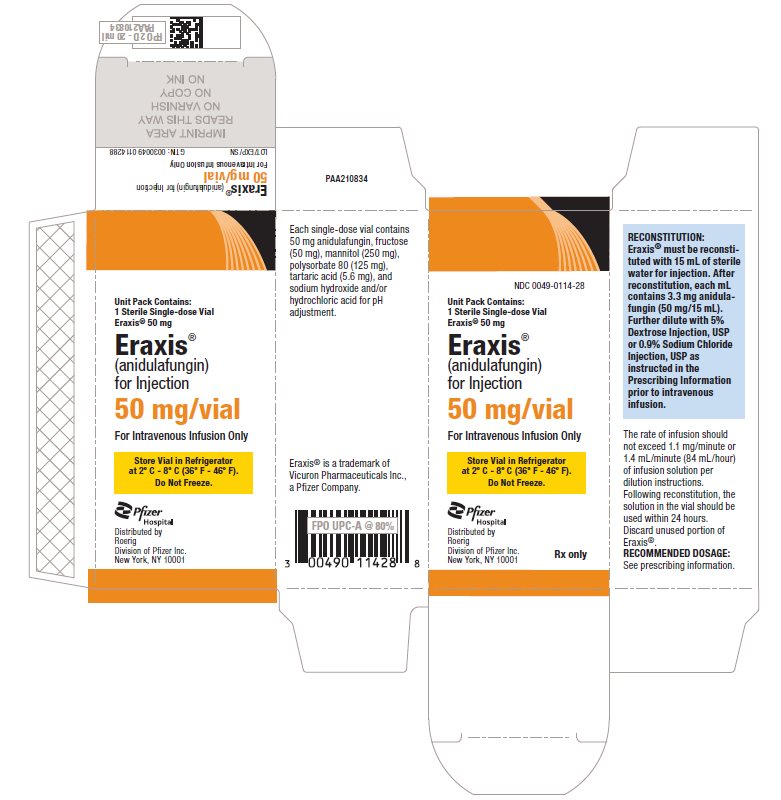
ERAXIS anidulafungin 50 mg/15mL Injection, Powder, Lyophilized, For Solution, 15 mL — NDC 0049-0114-28 (Billing 00049-0114-28)
This is a package of 15 mL of ERAXIS anidulafungin 50 mg/15mL Injection, Powder, Lyophilized, For Solution from Roerig, marketed since Feb 2006 and currently FDA-listed. It is this product's only package size.
NDC database record
One package, one record: these facts belong to NDC 0049-0114-28 alone.
- Record
- FDA NDC Directory package listing · Human prescription drug
- Code segments
- 0049 labeler · 0114 product · 28 package
- Package marketed since
- Feb 17, 2006
- Sample package
- No — commercial package
- Listing certified through
- Dec 31, 2026
- Barcode (UPC-A, from the NDC)
- 3 0049011428 8
- FDA record last changed
- Jul 24, 2026
Identity & classification
Regulatory identifiers FDA, NLM and CMS codes for this package
Drug-database identifiers Medi-Span GPI and First Databank GCN / HICL / AHFS classification
- GSN (GCN sequence number): 060436
- GCN: 26594
- GPI-14 (Medi-Span): 11500010002120
- HICL (First Databank): 033502
- AHFS class code: 08:14.16.00
- RxCUI (RxNorm): 1804743
Where does this data come from?
- FDA openFDA NDC Directory · synced Oct 8, 2026
- FDA label on DailyMed · label index refreshed Oct 8, 2026
- RxNorm (NLM RxNav) · catalog refreshed Oct 8, 2026
- Medi-Span GPI (licensed)
- First Databank (licensed) · refreshed Oct 8, 2026
RxNorm drug class
This medicine belongs to the Echinocandin Antifungal class.
Where does this data come from?
- RxClass (NLM) · catalog refreshed Oct 8, 2026
Clinical
Patient education
Supplement & herbal interactions
Some supplements/herbs that may interact with Anidulafungin — tap one for details:
Where does this data come from?
- MedlinePlus (NLM) · refreshed Oct 8, 2026
- FDA label on DailyMed · label index refreshed Oct 8, 2026
Ask a licensed pharmacist directly — free, answered by our team.
Pricing
A drug doesn't have one price. Each row is a different public payment system, and none is what you'd pay at the counter — that depends on your insurance. The ⓘ on each row explains what it measures.
| Price system | Per mL | Per package |
|---|---|---|
| Retail pharmacies payNADAC · weekly | Not in the retail survey — common for institutional, discontinued, or low-volume packs. | |
| Medicaid paysCMS SDUD · 12 mo | No recent Medicaid claims on file for this NDC — rare and low-volume NDCs are suppressed in the public data. | |
| Medicare drug plans payPart D · Q2 2026 | $95.32 | $1,429.81 / 15 ml |
| Medicare Part B allowsASP · J0348 | $0.486 / J0348 unit | — |
Where does this data come from?
- CMS NADAC weekly file
- CMS ASP pricing files · refreshed Sep 20, 2026
- CMS Medicaid State Drug Utilization Data · refreshed Oct 9, 2026
- CMS Part D plan pricing files · refreshed Sep 24, 2026
- VA National Acquisition Center price file
Billing & reimbursement
Where does this data come from?
- CMS ASP NDC-HCPCS crosswalk · refreshed Sep 22, 2026
- DMEPDAC NDC-HCPCS crosswalk
- openFDA NSDE billing units · refreshed Oct 7, 2026
Packaging — all sizes for this product
| Package NDC | Description | Marketing start | Marketing end | Status |
|---|---|---|---|---|
| 00049-0114-28 You're viewing this Main listing | 15 mL in 1 VIAL, SINGLE-USE | 2006-02-17 | — | Active |
Therapeutic equivalents
| Product | Labeler | Pack | NADAC/unit | TE | Status | Price vs. this |
|---|---|---|---|---|---|---|
| Eraxis 50 mg/15mLthis 00049-0114-28 | Roerig | 15 ml | — | — | FDA listed | — |
Where does this data come from?
- FDA openFDA NDC Directory · synced Oct 8, 2026
- FDA Orange Book · refreshed Oct 9, 2026
- CMS NADAC weekly file
Availability & generic status
We did not find an FDA-approved generic match for this exact strength, form and route.
No date yet
No generic application is on record yet. The month follows the patents and protections on record, which a challenge or a deal can end early.
See the full forecast for generic Eraxis →Where does this data come from?
- FDA Orange Book · refreshed Oct 9, 2026
Inactive Ingredients / Excipients
Inactive ingredients, also called excipients, are components of the drug product other than the active ingredient. They may include fillers, dyes, coatings, preservatives, flavors, or other formulation ingredients.
💡 Tap an ingredient (hover on desktop) to see what it is and why it’s used.
-
50 mg / 15 mL
UNII 6YSS42VSEV
Fructose is a natural sugar derived from fruits and plants. It's used in medicines as a sweetener and filler to improve taste and add bulk to tablets or syrups.
-
UNII QTT17582CB
A strong acid used to adjust and maintain the proper pH level in liquid medicines, ensuring stability and preventing breakdown of active ingredients.
-
250 mg / 15 mL
UNII 3OWL53L36A
A natural sugar alcohol derived from seaweed or synthesized in the lab. It's used as a filler to add bulk, a sweetener in sugar-free formulas, and a disintegrant to help tablets break apart in the stomach.
-
125 mg / 15 mL
UNII 6OZP39ZG8H
Polysorbate 80 is a synthetic emulsifier derived from sorbitol and oleic acid. It helps mix oil and water-based ingredients together in medications and improves how the product disperses in the body.
-
UNII 55X04QC32I
A strong alkaline chemical used to adjust and maintain the pH balance of liquid medicines. It helps keep the medicine stable and ensures it stays effective during storage.
-
5.6 mg / 15 mL
UNII W4888I119H
Tartaric acid is a natural organic acid found in grapes and tamarinds. In medicines, it works as a buffer to control acidity, an antioxidant to prevent spoilage, and sometimes a flavoring or binding agent.
6 inactive ingredients listed in the exact product block matched to this NDC.
Where does this data come from?
ingredient classCode="IACT" elements from the exact product block matched by this NDC. Label-section narrative from DailyMed / the openFDA label index is shown separately when available.- FDA label on DailyMed · label index refreshed Oct 8, 2026
- FDA openFDA NDC Directory · synced Oct 8, 2026
Inactive ingredient FAQ
Are inactive ingredients the same for every manufacturer?
Why might an inactive ingredient be missing?
Can inactive ingredients matter?
Manufacturer & labeler
More NDCs from Roerig labeler code 00049
- Unasyn ampicillin sodium and sulbactam 1 g; .5 g Injection, Powder, For Solution NDC 0049-0013-83
- Unasyn ampicillin sodium and sulbactam 2 g; 1 g Injection, Powder, For Solution NDC 0049-0014-83
- UNASYN ampicillin sodium and sulbactam 100 mg/mL; 50 mg/mL Injection, Powder, For Solution NDC 0049-0024-28
- Zoloft sertraline hydrochloride 20 mg/mL Solution, Concentrate NDC 0049-0050-01
- Geodon ziprasidone hydrochloride 60 mg Capsule NDC 0049-0056-60
- Geodon ziprasidone hydrochloride 80 mg Capsule NDC 0049-0058-60
- ERAXIS anidulafungin 100 mg/30mL Injection, Powder, Lyophilized, For Solution NDC 0049-0116-28
- Glucotrol XL glipizide 5 mg Tablet, Extended Release NDC 0049-0174-02
- Glucotrol XL glipizide 10 mg Tablet, Extended Release NDC 0049-0178-07
- Geodon ziprasidone 20 mg Capsule NDC 0049-0352-60
- Geodon ziprasidone 40 mg Capsule NDC 0049-0354-60
- Geodon ziprasidone 60 mg Capsule NDC 0049-0356-60
Where does this data come from?
- FDA openFDA NDC Directory · synced Oct 8, 2026
- Drugs@FDA
Full prescribing information FDA SPL
🎯 Indications and Usage ▾
1 INDICATIONS AND USAGE ERAXIS is an echinocandin antifungal indicated for the treatment of the following infections: • Candidemia and other forms of Candida infections (intra-abdominal abscess and peritonitis) in adults and pediatric patients (1 month of age and older) ( 1.1 ) • Esophageal candidiasis in adults ( 1.2 ) Limitations of use • ERAXIS has not been studied in adult and pediatric patients with endocarditis, osteomyelitis, and meningitis due to Candida or in sufficient numbers of neutropenic patients. The dosage of ERAXIS for the treatment of Candida dissemination into the CNS and the eye has not been established.
( 1.3 , 5.3 , 8.4 ) • ERAXIS is associated with high relapse rates in esophageal candidiasis. ( 1.3 , 14.2 )
1.1Candidemia and Other Forms of Candida Infections (Intra-abdominal Abscess and Peritonitis) ERAXIS is indicated for the treatment of candidemia and the following Candida infections: intra-abdominal abscess and peritonitis in adults and pediatric patients 1 month of age and older [see Clinical Studies (14.1) and Microbiology (12.4) ] .
1.2Esophageal Candidiasis ERAXIS is indicated for the treatment of esophageal candidiasis in adults [see Indications and Usage (1.3) , Clinical Studies (14.2) ] .
1.3Limitations of Use • ERAXIS has not been studied in adult and pediatric patients with endocarditis, osteomyelitis, and meningitis due to Candida , and has not been studied in sufficient numbers of neutropenic patients to determine efficacy in this group. The dosage of ERAXIS for the treatment of Candida dissemination into the CNS and the eye has not been established [see Warning and Precautions (5.3) , Use in Specific Populations (8.4) ] . • ERAXIS is associated with high relapse rates in esophageal candidiasis [see Clinical Studies (14.2) ] .
1.4Usage Specimens for fungal culture and other relevant laboratory studies (including histopathology) should be obtained prior to therapy to isolate and identify causative organism(s). Therapy may be instituted before the results of the cultures and other laboratory studies are known. However, once these results become available, antifungal therapy should be adjusted accordingly.
⏱️ Dosage and Administration ▾
2 DOSAGE AND ADMINISTRATION Adults Pediatric Patients 1 Month of Age and Older Candidemia and other forms of Candida infections 200 mg loading dose on Day 1, followed by 100 mg once daily maintenance dose thereafter for at least 14 days after the last positive culture ( 2.1 ) 3 mg/kg (not to exceed 200 mg) loading dose on Day 1, followed by 1.5 mg/kg (not to exceed 100 mg) once daily maintenance dose thereafter for at least 14 days after the last positive culture ( 2.2 ) Esophageal candidiasis 100 mg loading dose on Day 1, followed by 50 mg once daily maintenance dose thereafter for a minimum of 14 days and for at least 7 days following resolution of symptoms ( 2.1 ) Not Approved Rate of Infusion for Adults and Pediatric Patients The rate of infusion should not exceed 1.1 mg/minute [equivalent to 1.4 mL/minute or 84 mL/hour when reconstituted and diluted per instructions] ( 2.3 , 2.4 )
2.1Recommended Dosage in Adults Candidemia and other Candida infections (intra-abdominal abscess and peritonitis) The recommended dose is a single 200 mg loading dose of ERAXIS on Day 1, followed by a 100 mg once daily maintenance dose thereafter. Duration of treatment should be based on the patient's clinical response. In general, antifungal therapy should continue for at least 14 days after the last positive culture.
Esophageal Candidiasis The recommended dose is a single 100 mg loading dose of ERAXIS on Day 1, followed by a 50 mg once daily maintenance dose thereafter. Patients should be treated for a minimum of 14 days and for at least 7 days following resolution of symptoms. Duration of treatment should be based on the patient's clinical response.
Because of the risk of relapse of esophageal candidiasis in patients with HIV infection, suppressive antifungal therapy may be considered after a course of treatment.
2.2Recommended Dosage in Pediatric Patients (1 Month of Age and Older) Candidemia and other Candida infections (intra-abdominal abscess and peritonitis) The recommended dose is a single loading dose of 3 mg/kg (not to exceed 200 mg) of ERAXIS on Day 1, followed by a once daily maintenance dose of 1.5 mg/kg (not to exceed 100 mg) of ERAXIS thereafter. Overall antifungal treatment should continue for at least 14 days after the last positive culture.
2.3Preparation for Administration ERAXIS for Injection must be reconstituted with sterile Water for Injection and subsequently diluted only with 5% Dextrose Injection, USP or 0.9% Sodium Chloride Injection, USP (normal saline), prior to administration. The compatibility of reconstituted ERAXIS with intravenous substances, additives, or medications other than 5% Dextrose Injection, USP or 0.9% Sodium Chloride Injection, USP (normal saline) has not been established. Do NOT dilute with other solutions or co-infuse with other medications or electrolytes .
The infusion solution must not be frozen. Reconstitution of the 50 mg/vial Aseptically reconstitute each 50 mg vial with 15 mL of sterile Water for Injection to provide a concentration of 3.33 mg/mL. Reconstitution of the 100 mg/vial Aseptically reconstitute each 100 mg vial with 30 mL of sterile Water for Injection to provide a concentration of 3.33 mg/mL.
Storage of the Reconstituted Solution ERAXIS reconstituted solution can be stored at 25°C (77°F) for up to 24 hours prior to dilution into the infusion solution. Chemical and physical in-use stability of the reconstituted solution has been demonstrated for 24 hours at 25°C (77°F). From a microbiological point of view, following good aseptic practices, the reconstituted solution can be utilized for up to 24 hours when stored at 25°C.
2.4Dilution and Administration of the Infusion Parenteral drug products should be inspected visually for particulate matter and discoloration prior to administration, whenever solution and container permit. If particulate matter or discoloration is identified, discard the solution. Adult Patients Aseptically transfer the contents of the reconstituted vial(s)… [Excerpted — this section continues on DailyMed.]
💊 Dosage Forms and Strengths ▾
3 DOSAGE FORMS AND STRENGTHS For injection: 50 mg, and 100 mg of anidulafungin as a white to off-white sterile lyophilized powder in a single-dose vial for reconstitution. For injection : 50 mg, and 100 mg as a lyophilized powder in a single-dose vial for reconstitution ( 3 )
⛔ Contraindications ▾
4 CONTRAINDICATIONS ERAXIS is contraindicated in: • Patients with known hypersensitivity to anidulafungin, any component of ERAXIS, or other echinocandins [see Warnings and Precautions (5.2) ] • Patients with known or suspected Hereditary Fructose Intolerance (HFI) [see Warnings and Precautions (5.4) ] • Known hypersensitivity to anidulafungin, any component of ERAXIS, or other echinocandins ( 4 , 5.2 ) • Known or suspected Hereditary Fructose Intolerance (HFI) ( 4 , 5.4 )
⚠️ Warnings and Cautions ▾
5 WARNINGS AND PRECAUTIONS • Hepatic Effects : Risk of abnormal liver tests, hepatitis, hepatic failure; monitor hepatic function during therapy. ( 5.1 , 13.2 ) • Hypersensitivity : Anaphylaxis, including shock has been reported. Risk of infusion-related adverse reactions, possibly histamine-mediated, including rash, urticaria, flushing, pruritus, bronchospasm, dyspnea, and hypotension; to reduce occurrence, do not exceed a rate of infusion of 1.1 mg/minute.
( 2.4 , 5.2 ) • Risk of Neonatal Toxicity Associated with Polysorbates : ERAXIS contains polysorbate 80, an inactive ingredient. Thrombocytopenia, renal dysfunction, hepatomegaly, cholestasis, ascites, hypotension and metabolic acidosis haves been reported in low-birth weight infants receiving high doses of polysorbate. ERAXIS is not approved in pediatric patients younger than 1 month of age.
( 5.3 , 8.4 ) • Hereditary Fructose Intolerance (HFI) : ERAXIS contains fructose. Risk of metabolic crisis with life-threatening hypoglycemia, hypophosphatemia, lactic acidosis, and hepatic failure. Obtain history of HFI symptoms in pediatric patients before ERAXIS administration.
( 5.4 , 8.4 )
5.1Hepatic Adverse Reactions Laboratory abnormalities in liver tests have been seen in healthy volunteers and pediatric patients treated with ERAXIS. In some patients with serious underlying medical conditions who were receiving multiple concomitant medications along with ERAXIS, clinically significant hepatic abnormalities have occurred. Isolated cases of significant hepatic dysfunction, hepatitis, or hepatic failure have been reported in patients; a causal relationship to ERAXIS has not been established [see Adverse Reactions (6.1) and Nonclinical Toxicology (13.2) ] .
Patients who develop abnormal liver tests during ERAXIS therapy should be monitored for evidence of worsening hepatic tests and evaluated for risk/benefit of continuing ERAXIS therapy.
5.2Anaphylactic and Hypersensitivity Reactions Anaphylactic reactions, including shock were reported with the use of ERAXIS. If these reactions occur, ERAXIS should be discontinued and appropriate treatment administered [see Adverse Reactions (6) ] . Infusion-related adverse reactions, possibly histamine-mediated, have been reported with ERAXIS, including rash, urticaria, flushing, pruritus, bronchospasm, dyspnea, and hypotension [see Adverse Reactions (6) ] .
To reduce occurrence of these reactions, do not exceed a rate of ERAXIS infusion of 1.1 mg/minute [see Dosage and Administration (2.4) ] .
5.3Risk of Neonatal Toxicity Associated with Polysorbates ERAXIS contains polysorbate 80, an inactive ingredient. Thrombocytopenia, renal dysfunction, hepatomegaly, cholestasis, ascites, hypotension, and metabolic acidosis have been reported in low-birth weight infants receiving high doses of polysorbate. Polysorbate toxicity has not been reported with ERAXIS.
ERAXIS is not approved in pediatric patients younger than 1 month of age [see Indications and Usage (1.1 , 1.3) , Use in Specific Populations (8.4) ].
5.4Risk in Patients with Hereditary Fructose Intolerance (HFI) ERAXIS contains fructose, an inactive ingredient, and may precipitate a metabolic crisis that may include, but is not limited to life-threatening hypoglycemia, hypophosphatemia, lactic acidosis, and hepatic failure in patients with HFI. Obtain careful history of HFI symptoms (nausea, vomiting, abdominal pain) with fructose/sucrose exposure prior to ERAXIS administration because a diagnosis of HFI may not yet be established in pediatric patients [see Contraindications (4) and Use in Specific Populations (8.4) ] .
🤒 Adverse Reactions ▾
6 ADVERSE REACTIONS The following most serious adverse reactions are described elsewhere in other labeling sections: • Hepatic Adverse Reactions [see Warnings and Precautions (5.1) ] • Anaphylactic and Hypersensitivity Reactions [see Warnings and Precautions (5.2) ] Adults • Candidemia and other forms of Candida infections: Most common adverse reactions (≥15%) are hypokalemia, nausea, diarrhea, vomiting, pyrexia, insomnia, hypotension. ( 6.1 ) • Esophageal candidiasis: Most common adverse reactions (≥5%) are diarrhea, pyrexia, anemia, headache, vomiting, nausea, dyspepsia, oral candidiasis, and hypokalemia.
( 6.1 ) Pediatric Patients (1 month and older) Candidemia and other forms of Candida infections: Most common adverse reactions (≥ 5%): diarrhea, vomiting, pyrexia, abdominal pain, anemia, thrombocytopenia, alanine aminotransferase (ALT) and aspartate aminotransferase (AST) increased, hypoglycemia, epistaxis, and rash. ( 6.1 ) To report SUSPECTED ADVERSE REACTIONS, contact Pfizer Inc at 1-800-438-1985 or FDA at 1-800-FDA-1088 or www.fda.gov/medwatch .
6.1Clinical Trials Experience Because clinical trials are conducted under widely varying conditions, adverse reaction rates observed in the clinical trials of a drug cannot be directly compared to rates in the clinical trials of another drug and may not reflect the rates observed in practice. Clinical Trials Experience in Adults The safety of ERAXIS for Injection was assessed in 929 individuals, including 257 healthy subjects and 672 patients in clinical trials of candidemia, other forms of Candida infections, and esophageal candidiasis.
A total of 633 patients received ERAXIS at daily doses of either 50 mg or 100 mg. A total of 481 patients received ERAXIS for ≥14 days. Candidemia/other Candida Infections Three trials (one comparative vs. fluconazole, two non-comparative) assessed the efficacy and safety of ERAXIS (100 mg) in patients with candidemia and other Candida infections.
The data described below reflect exposure to ERAXIS and fluconazole in 127 and 118 patients, respectively, with candidemia and other forms of invasive candidiasis, in the randomized, comparative trial of the efficacy and safety of ERAXIS to that of fluconazole. In ERAXIS-treated patients, the age range was 16–89 years, the gender distribution was 51% male and 49% female, and the race distribution was 72% White, 18% Black/African American, 9% other races. Patients were randomized to receive once daily IV ERAXIS (200 mg loading dose followed by 100 mg maintenance dose) or IV fluconazole (800 mg loading dose followed by 400 mg maintenance dose).
Treatment was administered for at least 14 and not more than 42 days. The number of patients with adverse reactions leading to discontinuation of study medication was 11.5% in the ERAXIS arm and 21.6% in the fluconazole arm. The most common adverse reactions leading to study drug discontinuation were multi-organ failure (2.3%) and systemic Candida infection (1.5%) in the ERAXIS arm.
Table 2 presents adverse reactions that were reported in ≥5% of subjects receiving ERAXIS or fluconazole therapy in this trial. Table 2: Adverse Reactions Reported in ≥5% of Adult Patients Receiving ERAXIS or Fluconazole Therapy for Candidemia/other Candida Infections A patient who experienced multiple reactions within a Body System or preferred term was counted one time for that class, one time for the preferred term and one time for "subjects with at least one adverse reaction". , This trial was not designed to support comparative claims for ERAXIS for the adverse reactions reported in this table.
Adverse Reaction ERAXIS 100 mg N=131 Fluconazole 400 mg N=125 N (%) N (%) Subjects with a least one adverse reaction 130 (99) 122 (98) Gastrointestinal disorders 81 (62) 72 (58) Nausea 32 (24) 15 (12) Diarrhea 24 (18) 23 (18) Vomiting 23 (18) 12 (10) Constipation 11 (8) 14 (11) Abdominal pain 8 (6) 16 (13) General disorders and administration site conditions 70 (53) 76 (61) Pyrexia 23 (18… [Excerpted — this section continues on DailyMed.]
🔄 Drug Interactions ▾
7 DRUG INTERACTIONS
7.1Cyclosporine Administration of multiple doses of anidulafungin and cyclosporine to healthy subjects resulted in no significant alteration in the steady state pharmacokinetics of either drug. No dosage adjustment of cyclosporine or anidulafungin is needed when the two drugs are co-administered [see Clinical Pharmacology (12.3) ] .
7.2Voriconazole Administration of multiple doses of anidulafungin and voriconazole to healthy subjects resulted in no significant alteration in the steady state pharmacokinetics of either drug. No dosage adjustment of voriconazole or anidulafungin is needed when the two drugs are co-administered [see Clinical Pharmacology (12.3) ] .
7.3Tacrolimus Administration of multiple doses of anidulafungin and a single-dose of tacrolimus to healthy subjects resulted in no significant alteration in the steady state pharmacokinetics of either drug. No dosage adjustment of tacrolimus or anidulafungin is needed when the two drugs are co-administered [see Clinical Pharmacology (12.3) ] .
7.4Rifampin Administration of multiple doses of anidulafungin and rifampin to patients resulted in no significant alteration in the steady state pharmacokinetics of anidulafungin. No dosage adjustment of anidulafungin is needed when it is co-administered with rifampin [see Clinical Pharmacology (12.3) ] .
7.5Amphotericin B Liposome for Injection Administration of multiple doses of anidulafungin and liposomal amphotericin B to patients resulted in no significant alteration in the steady state pharmacokinetics of anidulafungin. No dosage adjustment of anidulafungin is needed when it is co-administered with liposomal amphotericin B [see Clinical Pharmacology (12.3) ] .
👥 Use in Specific Populations ▾
8 USE IN SPECIFIC POPULATIONS • Pregnancy : Based on findings from animal studies, ERAXIS can cause fetal harm when administered to a pregnant woman. Inform pregnant woman of the risk to the fetus. ( 8.1 ) • Pediatric Use : The safety and effectiveness in patients younger than 1 month of age has not been established. ( 8.4 )
8.1Pregnancy Risk Summary Based on findings from animal studies, ERAXIS can cause fetal harm when administered to a pregnant woman. There are no available human data on the use of ERAXIS in pregnant women to inform a drug-associated risk of adverse developmental outcomes. In animal reproduction studies fetal toxicity was observed in the presence of maternal toxicity when anidulafungin was administered to pregnant rabbits during organogenesis at 4 times the proposed therapeutic maintenance dose of 100 mg/day on the basis of relative body surface area ( see Data ) .
Inform pregnant woman of the risk to the fetus. The estimated background risk of major birth defects and miscarriage for the indicated populations are unknown. All pregnancies have a background risk of birth defect, loss, or other adverse outcomes.
In the U.S. general population, the estimated background risk of major birth defects and miscarriage in clinically recognized pregnancies is 2 to 4% and 15 to 20% respectively. Data Animal Data In a combined fertility and embryo-fetal development study in rats dosed with anidulafungin for 4 weeks prior to cohabitation and through cohabitation for males or for 2 weeks prior to cohabitation and continuing through gestation day 19 for females, there was no maternal or embryo-fetal toxicity at intravenous doses up to 20 mg/kg/day (equivalent to 2 times the proposed therapeutic maintenance dose of 100 mg/day on the basis of relative body surface area).
In a rabbit embryo-fetal development study, intravenous administration of anidulafungin (0, 5, 10, and 20 mg/kg/day) from gestation day 7 through 19, resulted in reduced fetal weights and incomplete ossification in the presence of maternal toxicity (decreased body weight gain) at 20 mg/kg/day (equivalent to 4 times the proposed therapeutic maintenance dose of 100 mg/day on the basis of relative body surface area). In a pre- and postnatal development study, pregnant rats were intravenously administered anidulafungin at doses of 2, 6, or 20 mg/kg/day from gestation day 7 through lactation day 20.
Maternal toxicity was observed at ≥6 mg/kg/day (clinical signs at ≥6 mg/kg/day and reduced body weight gain and food consumption during gestation at 20 mg/kg/day group). There were no effects on the viability or growth and development of the offspring. In this study, anidulafungin was detected in fetal plasma, indicating that it crossed the placental barrier.
8.2Lactation Risk Summary There are no data on the presence of anidulafungin in human milk, the effects on the breastfed infant or the effects on milk production. When a drug is present in animal milk, it is likely that the drug will be present in human milk. Anidulafungin was found in the milk of lactating rats ( see Data ).
The developmental and health benefits of breastfeeding should be considered along with the mother's clinical need for ERAXIS and any potential adverse effects on the breastfed child from ERAXIS or from the underlying maternal condition. Data Animal Data Pregnant rats were intravenously administered anidulafungin at doses of 2, 6, or 20 mg/kg/day from gestation day 7 through lactation day 20. Milk samples were collected from 5 rats per group on lactation day 14 at approximately 1 hours post dose.
Approximately dose-proportional anidulafungin concentrations were found in the milk of lactating rats.
8.4Pediatric Use The safety and effectiveness of ERAXIS for the treatment of candidemia and the following Candida infections: intra-abdominal abscess and peritonitis, have been established in pediatric patients 1 month of age and older. Use of ERAXIS for this indication in this age group is suppor… [Excerpted — this section continues on DailyMed.]
🤰 Pregnancy ▾
8.1Pregnancy Risk Summary Based on findings from animal studies, ERAXIS can cause fetal harm when administered to a pregnant woman. There are no available human data on the use of ERAXIS in pregnant women to inform a drug-associated risk of adverse developmental outcomes. In animal reproduction studies fetal toxicity was observed in the presence of maternal toxicity when anidulafungin was administered to pregnant rabbits during organogenesis at 4 times the proposed therapeutic maintenance dose of 100 mg/day on the basis of relative body surface area ( see Data ) .
Inform pregnant woman of the risk to the fetus. The estimated background risk of major birth defects and miscarriage for the indicated populations are unknown. All pregnancies have a background risk of birth defect, loss, or other adverse outcomes.
In the U.S. general population, the estimated background risk of major birth defects and miscarriage in clinically recognized pregnancies is 2 to 4% and 15 to 20% respectively. Data Animal Data In a combined fertility and embryo-fetal development study in rats dosed with anidulafungin for 4 weeks prior to cohabitation and through cohabitation for males or for 2 weeks prior to cohabitation and continuing through gestation day 19 for females, there was no maternal or embryo-fetal toxicity at intravenous doses up to 20 mg/kg/day (equivalent to 2 times the proposed therapeutic maintenance dose of 100 mg/day on the basis of relative body surface area).
In a rabbit embryo-fetal development study, intravenous administration of anidulafungin (0, 5, 10, and 20 mg/kg/day) from gestation day 7 through 19, resulted in reduced fetal weights and incomplete ossification in the presence of maternal toxicity (decreased body weight gain) at 20 mg/kg/day (equivalent to 4 times the proposed therapeutic maintenance dose of 100 mg/day on the basis of relative body surface area). In a pre- and postnatal development study, pregnant rats were intravenously administered anidulafungin at doses of 2, 6, or 20 mg/kg/day from gestation day 7 through lactation day 20.
Maternal toxicity was observed at ≥6 mg/kg/day (clinical signs at ≥6 mg/kg/day and reduced body weight gain and food consumption during gestation at 20 mg/kg/day group). There were no effects on the viability or growth and development of the offspring. In this study, anidulafungin was detected in fetal plasma, indicating that it crossed the placental barrier.
🧒 Pediatric Use ▾
8.4Pediatric Use The safety and effectiveness of ERAXIS for the treatment of candidemia and the following Candida infections: intra-abdominal abscess and peritonitis, have been established in pediatric patients 1 month of age and older. Use of ERAXIS for this indication in this age group is supported by evidence from adequate and well-controlled studies in adults with additional pharmacokinetic, safety data in pediatric patients 1 month of age and older [see Indications and Usage (1) , Adverse Reactions (6.1) , Clinical Pharmacology (12.3) , and Clinical Studies (14.1) ].
The safety and effectiveness of ERAXIS in patients younger than 1 month of age with candidemia/invasive candidiasis has not been established. Candidemia/invasive candidiasis in pediatric patients younger than 1 month of age has a higher rate of central nervous system (CNS) and multi-organ dissemination than in older patients. In addition, in patients younger than 1 month of age ERAXIS carries a potential risk of life-threatening toxicity associated with high doses of polysorbate 80, an inactive ingredient in ERAXIS [see Warnings and Precautions (5.3) ] .
The safety and effectiveness of ERAXIS in pediatric patients with esophageal candidiasis has not been established. ERAXIS is contraindicated in adult and pediatric patients with HFI. Because a diagnosis of HFI may not yet be established in pediatric patients, obtain a careful history of HFI symptoms with fructose/sucrose exposure prior to administration of ERAXIS [see Warnings and Precautions (5.4) ] .
🧓 Geriatric Use ▾
8.5Geriatric Use Of the total number of subjects (N = 197) in the pivotal clinical studies of anidulafungin, 35% were 65 years and over, while 18% were 75 years and over. No overall differences in safety or effectiveness were observed between these subjects and younger subjects, and other reported clinical experience has not identified differences in responses between the elderly and younger patients, but greater sensitivity of some older individuals cannot be ruled out. Dosage adjustments are not required for geriatric patients [see Clinical Pharmacology (12.3) ] .
🆘 Overdosage ▾
10 OVERDOSAGE During clinical trials a single 400 mg dose of ERAXIS was inadvertently administered as a loading dose. No clinical adverse events were reported. In a study of 10 healthy subjects administered a loading dose of 260 mg followed by 130 mg daily; 3 of the 10 subjects experienced transient, asymptomatic transaminase elevations (≤3 × ULN) [see Warnings and Precautions (5.1) ] .
Anidulafungin is not dialyzable. The maximum non-lethal dose of anidulafungin in rats was 50 mg/kg, a dose which is equivalent to 10 times the recommended daily dose for esophageal candidiasis (50 mg/day) or equivalent to 5 times the recommended daily dose for candidemia and other Candida infections (100 mg/day), based on relative body surface area comparisons.
🧬 Clinical Pharmacology ▾
12 CLINICAL PHARMACOLOGY
12.1Mechanism of Action Anidulafungin is an anti-fungal drug [see Microbiology (12.4) ].
12.3Pharmacokinetics General Pharmacokinetic Characteristics The pharmacokinetics of anidulafungin following intravenous (IV) administration of ERAXIS have been characterized in healthy subjects, special populations and patients. Systemic exposures of anidulafungin are dose-proportional and have low inter-subject variability (coefficient of variation <25%) as shown in Table 5. The steady state was achieved on the first day after a loading dose (twice the daily maintenance dose) and the estimated plasma accumulation factor at steady state is approximately 2.
Table 5: Mean (%CV) Steady State Pharmacokinetic Parameters of Anidulafungin Following IV Administration of ERAXIS Once Daily for 10 Days in Healthy Adult Subjects C max, ss = the steady state peak concentration AUC ss = the steady state area under concentration vs. time curve CL = clearance t 1/2 = the terminal elimination half-life PK Parameter Parameters were obtained from separate studies Anidulafungin IV Dosing Regimen (LD/MD, mg) LD/MD: loading dose/maintenance dose once daily 70/35 Data were collected on Day 7 , Safety and efficacy of these doses has not been established (N=6) 200/100 (N=10) 260/130 , See OVERDOSAGE (N=10) C max, ss [mg/L] 3.55 (13.2) 8.6 (16.2) 10.9 (11.7) AUC ss [mg∙h/L] 42.3 (14.5) 111.8 (24.9) 168.9 (10.8) CL [L/h] 0.84 (13.5) 0.94 (24.0) 0.78 (11.3) t 1/2 [h] 43.2 (17.7) 52.0 (11.7) 50.3 (9.7) The clearance of anidulafungin is about 1 L/h and anidulafungin has a terminal elimination half-life of 40–50 hours.
Distribution The pharmacokinetics of anidulafungin following IV administration are characterized by a short distribution half-life (0.5–1 hour) and a volume of distribution of 30–50 L that is similar to total body fluid volume. Anidulafungin is extensively bound (>99%) to human plasma proteins. Metabolism Hepatic metabolism of anidulafungin has not been observed.
Anidulafungin is not a clinically relevant substrate, inducer, or inhibitor of cytochrome P450 (CYP450) isoenzymes. It is unlikely that anidulafungin will have clinically relevant effects on the metabolism of drugs metabolized by CYP450 isoenzymes. Anidulafungin undergoes slow chemical degradation at physiologic temperature and pH to a ring-opened peptide that lacks antifungal activity.
The in vitro degradation half-life of anidulafungin under physiologic conditions is about 24 hours. In vivo , the ring-opened product is subsequently converted to peptidic degradants and eliminated. Excretion In a single-dose clinical study, radiolabeled ( 14 C) anidulafungin was administered to healthy subjects.
Approximately 30% of the administered radioactive dose was eliminated in the feces over 9 days, of which less than 10% was intact drug. Less than 1% of the administered radioactive dose was excreted in the urine. Anidulafungin concentrations fell below the lower limits of quantitation 6 days post-dose.
Negligible amounts of drug-derived radioactivity were recovered in blood, urine, and feces 8 weeks post-dose. Specific Populations Patients with fungal infections Population pharmacokinetic analyses from four clinical trials including 107 male and 118 female patients with fungal infections showed that the pharmacokinetic parameters of anidulafungin are not affected by age, race, or the presence of concomitant medications which are known metabolic substrates, inhibitors or inducers. The pharmacokinetics of anidulafungin in patients with fungal infections are similar to those observed in healthy subjects.
The pharmacokinetic parameters of anidulafungin estimated using population pharmacokinetic modeling following IV administration of a maintenance dose of 50 mg/day or 100 mg/day (following a loading dose) of ERAXIS are presented in Table 6. Table 6: Mean (%CV) Steady State Pharmacokinetic Parameters of Anidulafungin Following IV Administration of ERAXIS in Patients with Fungal Infe… [Excerpted — this section continues on DailyMed.]
🧬 Mechanism of Action ▾
12.1Mechanism of Action Anidulafungin is an anti-fungal drug [see Microbiology (12.4) ].
📦 How Supplied / Storage and Handling ▾
16 HOW SUPPLIED/STORAGE AND HANDLING
16.1How Supplied ERAXIS (anidulafungin) for Injection is supplied in a single-dose vial of sterile, lyophilized, preservative-free, white to off-white powder. ERAXIS (anidulafungin) is available in the following packaging configuration: Single-Dose Vial of ERAXIS 50 mg NDC 0049-0114-28 One - 50 mg vial Single-Dose Vial of ERAXIS 100 mg NDC 0049-0116-28 One - 100 mg vial
16.2Storage ERAXIS vials ERAXIS (unreconstituted) vials should be stored in a refrigerator at 2°C – 8°C (36°F – 46°F). Do not freeze. Excursions for 96 hours up to 25°C (77°F) are permitted, and the vial can be returned to storage at 2°C – 8°C (36°F – 46°F).
Reconstituted solution ERAXIS reconstituted solution can be stored at up to 25°C (77°F) for up to 24 hours [see Dosage and Administration (2.3) ] . Infusion Solution ERAXIS infusion solution can be stored at temperatures up to 25°C (77°F) for up to 48 hours. Do not freeze [see Dosage and Administration (2.4) ] .
📦 Storage and Handling ▾
16.2Storage ERAXIS vials ERAXIS (unreconstituted) vials should be stored in a refrigerator at 2°C – 8°C (36°F – 46°F). Do not freeze. Excursions for 96 hours up to 25°C (77°F) are permitted, and the vial can be returned to storage at 2°C – 8°C (36°F – 46°F).
Reconstituted solution ERAXIS reconstituted solution can be stored at up to 25°C (77°F) for up to 24 hours [see Dosage and Administration (2.3) ] . Infusion Solution ERAXIS infusion solution can be stored at temperatures up to 25°C (77°F) for up to 48 hours. Do not freeze [see Dosage and Administration (2.4) ] .
📋 Description ▾
11 DESCRIPTION ERAXIS for Injection is a sterile, lyophilized product for intravenous (IV) infusion that contains anidulafungin. ERAXIS (anidulafungin) is a semi-synthetic lipopeptide synthesized from a fermentation product of Aspergillus nidulans . Anidulafungin is an echinocandin, a class of antifungal drugs that inhibits the synthesis of 1,3-β-D-glucan, an essential component of fungal cell walls.
ERAXIS (anidulafungin) is 1-[(4R,5R)-4,5-dihydroxy-N 2 -[[4"-(pentyloxy)[1,1':4',1"-terphenyl]-4-yl]carbonyl]-L-ornithine]echinocandin B. Anidulafungin is a white to off-white powder that is practically insoluble in water and slightly soluble in ethanol. In addition to the active ingredient, anidulafungin, ERAXIS for Injection contains the following inactive ingredients: 50 mg/vial – fructose (50 mg), mannitol (250 mg), polysorbate 80 (125 mg), tartaric acid (5.6 mg), and sodium hydroxide and/or hydrochloric acid for pH adjustment.
100 mg/vial – fructose (100 mg), mannitol (500 mg), polysorbate 80 (250 mg), tartaric acid (11.2 mg), and sodium hydroxide and/or hydrochloric acid for pH adjustment. The empirical formula of anidulafungin is C 58 H 73 N 7 O 17 and the formula weight is 1140.3. The structural formula is: Prior to administration, ERAXIS for Injection requires reconstitution with sterile Water for Injection and subsequent dilution with either 5% Dextrose Injection, USP or 0.9% Sodium Chloride Injection, USP (normal saline).
Chemical Structure
💬 Information for Patients ▾
17 PATIENT COUNSELING INFORMATION Hepatic Adverse Reactions Inform patients about the risk of developing abnormal liver function tests and/or hepatic dysfunction. Advise the patient that liver function tests may be monitored during treatment. Anaphylactic and Hypersensitivity Reactions Inform the patient that anaphylactic reactions, including shock were reported with ERAXIS.
Inform the patient if these reactions occur, ERAXIS may be discontinued and appropriate treatment administered. Inform the patient that ERAXIS is also known to cause infusion-related adverse reactions, possibly histamine-mediated. Inform the patient to report symptoms including rash, urticaria, flushing, pruritus, dyspnea, and hypotension to their healthcare provider.
Embryo-Fetal Toxicity Advise pregnant women and females of reproductive potential of the potential risk of ERAXIS to a fetus. Advise females to inform their healthcare provider of a known or suspected pregnancy. Patients with Hereditary Fructose Intolerance (HFI) Inform patients and caregivers that ERAXIS contains fructose and can be life-threatening when administered to patients with hereditary fructose intolerance (HFI) [see Warnings and Precautions (5.4) ] .
Inquire for symptoms of fructose and/or sucrose intolerance.
🧬 Pharmacokinetics ▾
12.3Pharmacokinetics General Pharmacokinetic Characteristics The pharmacokinetics of anidulafungin following intravenous (IV) administration of ERAXIS have been characterized in healthy subjects, special populations and patients. Systemic exposures of anidulafungin are dose-proportional and have low inter-subject variability (coefficient of variation <25%) as shown in Table 5. The steady state was achieved on the first day after a loading dose (twice the daily maintenance dose) and the estimated plasma accumulation factor at steady state is approximately 2.
Table 5: Mean (%CV) Steady State Pharmacokinetic Parameters of Anidulafungin Following IV Administration of ERAXIS Once Daily for 10 Days in Healthy Adult Subjects C max, ss = the steady state peak concentration AUC ss = the steady state area under concentration vs. time curve CL = clearance t 1/2 = the terminal elimination half-life PK Parameter Parameters were obtained from separate studies Anidulafungin IV Dosing Regimen (LD/MD, mg) LD/MD: loading dose/maintenance dose once daily 70/35 Data were collected on Day 7 , Safety and efficacy of these doses has not been established (N=6) 200/100 (N=10) 260/130 , See OVERDOSAGE (N=10) C max, ss [mg/L] 3.55 (13.2) 8.6 (16.2) 10.9 (11.7) AUC ss [mg∙h/L] 42.3 (14.5) 111.8 (24.9) 168.9 (10.8) CL [L/h] 0.84 (13.5) 0.94 (24.0) 0.78 (11.3) t 1/2 [h] 43.2 (17.7) 52.0 (11.7) 50.3 (9.7) The clearance of anidulafungin is about 1 L/h and anidulafungin has a terminal elimination half-life of 40–50 hours.
Distribution The pharmacokinetics of anidulafungin following IV administration are characterized by a short distribution half-life (0.5–1 hour) and a volume of distribution of 30–50 L that is similar to total body fluid volume. Anidulafungin is extensively bound (>99%) to human plasma proteins. Metabolism Hepatic metabolism of anidulafungin has not been observed.
Anidulafungin is not a clinically relevant substrate, inducer, or inhibitor of cytochrome P450 (CYP450) isoenzymes. It is unlikely that anidulafungin will have clinically relevant effects on the metabolism of drugs metabolized by CYP450 isoenzymes. Anidulafungin undergoes slow chemical degradation at physiologic temperature and pH to a ring-opened peptide that lacks antifungal activity.
The in vitro degradation half-life of anidulafungin under physiologic conditions is about 24 hours. In vivo , the ring-opened product is subsequently converted to peptidic degradants and eliminated. Excretion In a single-dose clinical study, radiolabeled ( 14 C) anidulafungin was administered to healthy subjects.
Approximately 30% of the administered radioactive dose was eliminated in the feces over 9 days, of which less than 10% was intact drug. Less than 1% of the administered radioactive dose was excreted in the urine. Anidulafungin concentrations fell below the lower limits of quantitation 6 days post-dose.
Negligible amounts of drug-derived radioactivity were recovered in blood, urine, and feces 8 weeks post-dose. Specific Populations Patients with fungal infections Population pharmacokinetic analyses from four clinical trials including 107 male and 118 female patients with fungal infections showed that the pharmacokinetic parameters of anidulafungin are not affected by age, race, or the presence of concomitant medications which are known metabolic substrates, inhibitors or inducers. The pharmacokinetics of anidulafungin in patients with fungal infections are similar to those observed in healthy subjects.
The pharmacokinetic parameters of anidulafungin estimated using population pharmacokinetic modeling following IV administration of a maintenance dose of 50 mg/day or 100 mg/day (following a loading dose) of ERAXIS are presented in Table 6. Table 6: Mean (%CV) Steady State Pharmacokinetic Parameters of Anidulafungin Following IV Administration of ERAXIS in Patients with Fungal Infections Estimated Using Population Pharmacokinetic Modeling PK Parameter All the parameters were estimated by popula… [Excerpted — this section continues on DailyMed.]
🔬 Clinical Studies ▾
14 CLINICAL STUDIES
14.1Candidemia and Other Candida Infections (Intra-abdominal Abscess and Peritonitis) Adults Candidemia and Other Candida Infections (Intra-abdominal Abscess and Peritonitis) Trial The safety and efficacy of ERAXIS were evaluated in a Phase 3, randomized, double-blind study of patients with candidemia and/or other forms of invasive candidiasis. Patients were randomized to receive once daily IV ERAXIS (200 mg loading dose followed by 100 mg maintenance dose) or IV fluconazole (800 mg loading dose followed by 400 mg maintenance dose).
Patients were stratified by APACHE II score (≤20 and >20) and the presence or absence of neutropenia. Patients with Candida endocarditis, osteomyelitis or meningitis, or those with infection due to C. krusei, were excluded from the study. Treatment was administered for at least 14 and not more than 42 days.
Patients in both study arms were permitted to switch to oral fluconazole after at least 10 days of intravenous therapy, provided that they were able to tolerate oral medication, were afebrile for at least 24 hours, and the last blood cultures were negative for Candida species. Patients who received at least one dose of study medication and who had a positive culture for Candida species from a normally sterile site before entry into the study (modified intent-to-treat [MITT] population) were included in the analysis of global response at the end of IV therapy.
A successful global response required clinical cure or improvement (significant, but incomplete resolution of signs and symptoms of the Candida infection and no additional antifungal treatment), and documented or presumed microbiological eradication. Patients with an indeterminate outcome were analyzed as failures in this population. Two hundred and fifty-six patients in the intent-to-treat (ITT) population were randomized and received at least one dose of study medication.
In ERAXIS-treated patients, the age range was 16–89 years, the gender distribution was 50% male and 50% female, and the race distribution was 71% White, 20% Black/African American, 7% Hispanic, 2% other races. The median duration of IV therapy was 14 and 11 days in the ERAXIS and fluconazole arms, respectively. For those who received oral fluconazole, the median duration of oral therapy was 7 days for the ERAXIS arm and 5 days for the fluconazole arm.
Patient disposition is presented in Table 9. Table 9: Patient Disposition and Reasons for Discontinuation in Candidemia and other Candida Infections Study ERAXIS Fluconazole n (%) n (%) Treated patients 131 125 Patients completing study through 6 week follow-up 94 (72) 80 (64) DISCONTINUATIONS FROM STUDY MEDICATION Total discontinued from study medication 34 (26) 48 (38) Discontinued due to adverse events 12 (9) 21 (17) Discontinued due to lack of efficacy 11 (8) 16 (13) Two hundred and forty-five patients (127 ERAXIS, 118 fluconazole) met the criteria for inclusion in the MITT population.
Of these, 219 patients (116 ERAXIS, 103 fluconazole) had candidemia only. Risk factors for candidemia among patients in both treatment arms in this study were: presence of a central venous catheter (78%), receipt of broad-spectrum antibiotics (69%), recent surgery (42%), recent hyperalimentation (25%), and underlying malignancy (22%). The most frequent species isolated at baseline was C. albicans (62%), followed by C. glabrata (20%), C. parapsilosis (12%) and C. tropicalis (11%).
The majority (97%) of patients were non-neutropenic (ANC >500) and 81% had APACHE II scores less than or equal to 20. Global success rates in patients with candidemia and other Candida infections are summarized in Table 10. Table 10: Efficacy Analysis: Global Success in patients with Candidemia and other Candida Infections (MITT Population) Time-point ERAXIS (N=127) n (%) Fluconazole (N=118) n (%) Treatment Difference Calculated as ERAXIS minus fluconazole , % (95% C.I.) End of IV Therapy 96 (75.6) 71 (60.2) 15.4 (3.9, 27.0) End of All Therap… [Excerpted — this section continues on DailyMed.]
🧪 Nonclinical Toxicology ▾
13 NONCLINICAL TOXICOLOGY
13.1Carcinogenesis, Mutagenesis, Impairment of Fertility Long-term animal carcinogenicity studies of anidulafungin have not been conducted. Anidulafungin was not genotoxic in the following in vitro studies: bacterial reverse mutation assays, a chromosome aberration assay with Chinese hamster ovary cells, and a forward gene mutation assay with mouse lymphoma cells. Anidulafungin was not genotoxic in mice using the in vivo micronucleus assay.
Anidulafungin produced no adverse effects on fertility in male or female rats at intravenous doses of 20 mg/kg/day (equivalent to 2 times the proposed therapeutic maintenance dose of 100 mg/day on the basis of relative body surface area).
13.2Animal Toxicology and/or Pharmacology In 3 month studies, liver toxicity, including single cell hepatocellular necrosis, hepatocellular hypertrophy and increased liver weights were observed in monkeys and rats at doses equivalent to 5–6 times human exposure. For both species, hepatocellular hypertrophy was still noted one month after the end of dosing.
📄 Carcinogenesis, Mutagenesis, Impairment of Fertility ▾
13.1Carcinogenesis, Mutagenesis, Impairment of Fertility Long-term animal carcinogenicity studies of anidulafungin have not been conducted. Anidulafungin was not genotoxic in the following in vitro studies: bacterial reverse mutation assays, a chromosome aberration assay with Chinese hamster ovary cells, and a forward gene mutation assay with mouse lymphoma cells. Anidulafungin was not genotoxic in mice using the in vivo micronucleus assay.
Anidulafungin produced no adverse effects on fertility in male or female rats at intravenous doses of 20 mg/kg/day (equivalent to 2 times the proposed therapeutic maintenance dose of 100 mg/day on the basis of relative body surface area).
📄 Package Label / Principal Display Panel ▾
PRINCIPAL DISPLAY PANEL - 50 mg Vial Label 1 Sterile Single-dose Vial Eraxis ® (anidulafungin) for Injection 50 mg/vial For Intravenous Infusion Only Pfizer Hospital Distributed by Roerig Division of Pfizer Inc. New York, NY 10001 Rx only PRINCIPAL DISPLAY PANEL - 50 mg Vial Label
PRINCIPAL DISPLAY PANEL - 50 mg Vial Carton NDC 0049-0114-28 Unit Pack Contains: 1 Sterile Single-dose Vial Eraxis ® 50 mg Eraxis ® (anidulafungin) for Injection 50 mg/vial For Intravenous Infusion Only Store Vial in Refrigerator at 2° C - 8° C (36° F - 46° F). Do Not Freeze. Pfizer Hospital Distributed by Roerig Division of Pfizer Inc. New York, NY 10001 Rx only PRINCIPAL DISPLAY PANEL - 50 mg Vial Carton
PRINCIPAL DISPLAY PANEL - 100 mg Vial Label 1 Sterile Single-dose Vial Eraxis ® (anidulafungin) for Injection 100 mg/vial For Intravenous Infusion Only Pfizer Hospital Distributed by Roerig Division of Pfizer Inc. New York, NY 10001 Rx only PRINCIPAL DISPLAY PANEL - 100 mg Vial Label
PRINCIPAL DISPLAY PANEL - 100 mg Vial Carton NDC 0049-0116-28 Unit Pack Contains: 1 Sterile Single-dose Vial Eraxis ® 100 mg Eraxis ® (anidulafungin) for Injection 100 mg/vial For Intravenous Infusion Only Store Vial in Refrigerator at 2° C - 8° C (36° F - 46° F). Do Not Freeze. Pfizer Hospital Distributed by Roerig Division of Pfizer Inc. New York, NY 10001 Rx only PRINCIPAL DISPLAY PANEL - 100 mg Vial Carton
Medicare Part D spend CMS · PART D · 2026 (Q1)
About this NDC listing & data coverage
What data is (and isn’t) available for this NDC — tap to expand
| NDC identity (package / product / labeler codes) | ✓ Available |
| Labeler | ✓ Available |
| Product & package description | ✓ Available |
| Marketing category & status | ✓ Available |
| Active ingredient / dosage form / route | ✓ Available |
| FDA label (SPL via DailyMed) | ✓ Available |
| Package photos | ✓ Available |
| Inactive ingredients (structured) | ✓ Available |
| NADAC pharmacy acquisition price (CMS) | — Not published for this NDC CMS publishes NADAC only for NDCs reported in its retail-pharmacy survey. |
| Orange Book / therapeutic-equivalence data | — Not published for this NDC Applies only to products approved under an NDA/ANDA; many listings are out of scope. |
| HCPCS J-code billing crosswalk | ✓ Available |
| Medicaid utilization (CMS SDUD) | — Not published for this NDC CMS reports utilization only for NDCs with Medicaid claims above its privacy threshold. |