
MIOSTAT carbachol .1 mg/mL Solution, 12 vials — NDC 0065-0023-15 (Billing 00065-0023-15)
This is a package of 12 vials of MIOSTAT carbachol .1 mg/mL Solution from Alcon Laboratories, Inc., marketed since Apr 1974 and currently FDA-listed. It is this product's only package size.
NDC database record
One package, one record: these facts belong to NDC 0065-0023-15 alone.
- Record
- FDA NDC Directory package listing · Human prescription drug
- Code segments
- 0065 labeler · 0023 product · 15 package
- Package marketed since
- Apr 15, 1974
- Sample package
- No — commercial package
- Listing certified through
- Dec 31, 2026
- Barcode (UPC-A, from the NDC)
- 3 0065002315 3
- Medicaid fills, this package
- 27 prescriptions in the last four reported quarters
- FDA record last changed
- Jul 24, 2026
Past resolved recalls for this product (1)
Identity & classification
Regulatory identifiers FDA, NLM and CMS codes for this package
Drug-database identifiers Medi-Span GPI and First Databank GCN / HICL / AHFS classification
- GSN (GCN sequence number): 007804
- GCN: 32639
- GPI-14 (Medi-Span): 86501020002005
- HICL (First Databank): 004591
- AHFS class code: 52:40.20.00
- RxCUI (RxNorm): 308966
Where does this data come from?
- FDA openFDA NDC Directory · synced Oct 1, 2026
- FDA label on DailyMed · label index refreshed Oct 3, 2026
- RxNorm (NLM RxNav) · catalog refreshed Oct 1, 2026
- Medi-Span GPI (licensed)
- First Databank (licensed) · refreshed Oct 1, 2026
RxNorm drug class
This medicine belongs to the Choline esters class.
Where does this data come from?
- RxClass (NLM) · catalog refreshed Oct 1, 2026
Clinical
Patient education
Supplement & herbal interactions
Some supplements/herbs that may interact with Carbachol — tap one for details:
Where does this data come from?
- MedlinePlus (NLM) · refreshed Oct 1, 2026
- FDA label on DailyMed · label index refreshed Oct 3, 2026
Ask a licensed pharmacist directly — free, answered by our team.
Pricing
A drug doesn't have one price. Each row is a different public payment system, and none is what you'd pay at the counter — that depends on your insurance. The ⓘ on each row explains what it measures.
| Price system | Per mL | Per package |
|---|---|---|
| Retail pharmacies payNADAC · weekly | Not in the retail survey — common for institutional, discontinued, or low-volume packs. | |
| Medicaid paysCMS SDUD · 12 mo | No recent Medicaid claims on file for this NDC — rare and low-volume NDCs are suppressed in the public data. | |
| Medicare drug plans payPart D · quarterly | No Part D plan price is available for this NDC in our data. | |
Where does this data come from?
- CMS NADAC weekly file
- CMS ASP pricing files · refreshed Sep 20, 2026
- CMS Medicaid State Drug Utilization Data · through Q1 2026
- CMS Part D plan pricing files · refreshed Sep 24, 2026
- VA National Acquisition Center price file
Packaging — all sizes for this product
| Package NDC | Description | Marketing start | Marketing end | Status |
|---|---|---|---|---|
| 00065-0023-15 You're viewing this Main listing | 12 VIAL, GLASS in 1 CARTON / 1.5 mL in 1 VIAL, GLASS | 1974-04-15 | — | Active |
Therapeutic equivalents
| Product | Labeler | Pack | NADAC/unit | TE | Status | Price vs. this |
|---|---|---|---|---|---|---|
| Miostat .1 mg/mLthis 00065-0023-15 | Alcon | 12 vials | — | — | FDA listed | — |
Where does this data come from?
- FDA openFDA NDC Directory · synced Oct 1, 2026
- FDA Orange Book · refreshed Oct 3, 2026
- CMS NADAC weekly file
Availability & generic status
The FDA lists approved generic versions of this medicine, but that does not always mean a pharmacy can get one today. Patent rules, launch agreements, supply and pricing can affect when generics actually arrive.
Where does this data come from?
- FDA Orange Book · refreshed Oct 3, 2026
Inactive Ingredients / Excipients
Inactive ingredients, also called excipients, are components of the drug product other than the active ingredient. They may include fillers, dyes, coatings, preservatives, flavors, or other formulation ingredients.
💡 Tap an ingredient (hover on desktop) to see what it is and why it’s used.
-
UNII M4I0D6VV5M
Calcium chloride is a salt compound that acts as a firming agent and source of calcium ions in medications. It's used in formulations to help maintain tablet structure, improve texture, or serve as a buffering agent.
-
UNII QTT17582CB
A strong acid used to adjust and maintain the proper pH level in liquid medicines, ensuring stability and preventing breakdown of active ingredients.
-
UNII 02F3473H9O
A mineral salt used in medications as a source of magnesium. It helps bind ingredients together, improve texture, and maintain the product's stability during storage.
-
UNII 660YQ98I10
Potassium chloride is a mineral salt used in medicines as a buffer and to help maintain the proper pH balance and stability of the formulation during storage and use.
-
UNII 4550K0SC9B
Sodium acetate is a salt derived from acetic acid. It acts as a buffer to help maintain the medicine's pH stability and may serve as a preservative or solubilizer in liquid formulations.
-
UNII 451W47IQ8X
Sodium chloride is common table salt. It's used in medicines as a buffer to maintain proper pH, as a filler to add bulk, or to adjust the osmotic balance in liquid formulations.
-
UNII 55X04QC32I
A strong alkaline chemical used to adjust and maintain the pH balance of liquid medicines. It helps keep the medicine stable and ensures it stays effective during storage.
-
UNII B22547B95K
A salt derived from citric acid that helps maintain the proper acid-base balance in the medicine. It's used as a buffer to keep the product stable and at the right pH level.
-
UNII 059QF0KO0R
Water is a liquid solvent that dissolves and mixes ingredients together in liquid medicines, syrups, and injections. It helps distribute the active drug evenly throughout the product.
9 inactive ingredients listed in the exact product block matched to this NDC.
Where does this data come from?
ingredient classCode="IACT" elements from the exact product block matched by this NDC. Label-section narrative from DailyMed / the openFDA label index is shown separately when available.- FDA label on DailyMed · label index refreshed Oct 3, 2026
- FDA openFDA NDC Directory · synced Oct 1, 2026
Inactive ingredient FAQ
Are inactive ingredients the same for every manufacturer?
Why might an inactive ingredient be missing?
Can inactive ingredients matter?
Manufacturer & labeler
More NDCs from Alcon Laboratories, Inc. labeler code 00065
- Naphcon A naphazoline hydrochloride and pheniramine maleate .25 mg/mL; 3 mg/mL Solution/ Drops NDC 0065-0085-15
- FLUORESCITE fluorescein sodium 100 mg/mL Injection, Solution NDC 0065-0092-65
- Isopto Atropine atropine sulfate 10 mg/mL Solution NDC 0065-0303-55
- Phenylephrine Hydrochloride 100 mg/mL Solution/ Drops NDC 0065-0343-02
- Phenylephrine Hydrochloride 25 mg/mL Solution/ Drops NDC 0065-0349-04
- Mydriacyl tropicamide 10 mg/mL Solution/ Drops NDC 0065-0355-03
Where does this data come from?
- FDA openFDA NDC Directory · synced Oct 1, 2026
- Drugs@FDA
Full prescribing information FDA SPL
🎯 Indications and Usage ▾
INDICATIONS AND USAGE: Intraocular use for obtaining miosis during surgery. In addition, MIOSTAT* (carbachol intraocular solution, USP) 0.01% reduces the intensity of IOP elevation in the first 24 hours after cataract surgery.
⏱️ Dosage and Administration ▾
DOSAGE AND ADMINISTRATION: Aseptically remove the sterile vial from the blister package by peeling the backing paper and dropping the vial onto a sterile tray. Withdraw the contents into a dry sterile syringe, and replace the needle with an atraumatic cannula prior to intraocular instillation. No more than one-half milliliter should be gently instilled into the anterior chamber for the production of satisfactory miosis.
It may be instilled before or after securing sutures. Miosis is usually maximal within two to five minutes after application.
⛔ Contraindications ▾
CONTRAINDICATIONS: Should not be used in those persons showing hypersensitivity to any of the components of this preparation.
⚠️ Warnings ▾
WARNINGS: For single-dose intraocular use only. Discard unused portion. Intraocular carbachol 0.01% should be used with caution in patients with acute cardiac failure, bronchial asthma, peptic ulcer, hyperthyroidism, G.I. spasm, urinary tract obstruction and Parkinson's disease. The vial stopper contains natural rubber (latex) which may cause severe allergic reactions.
🤒 Adverse Reactions ▾
ADVERSE REACTIONS: Ocular: Corneal clouding, persistent bullous keratopathy, retinal detachment and postoperative iritis following cataract extraction have been reported. Systemic: Side effects such as flushing, sweating, epigastric distress, abdominal cramps, tightness in urinary bladder, and headache have been reported with topical or systemic application of carbachol. The following additional reactions have been identified during post-approval use of MIOSTAT (carbachol intraocular solution, USP) 0.01% in clinical practice.
Because they are reported voluntarily from a population of unknown size, estimates of frequency cannot be made. The reactions, which have been chosen for inclusion due to either their seriousness, frequency of reporting, possible causal connection to MIOSTAT, or a combination of these factors, include: corneal edema, drug effect prolonged (miosis), eye inflammation, eye pain, intraocular pressure increased, ocular hyperemia, vision blurred, visual impairment, and vomiting.
🤰 Pregnancy ▾
Pregnancy: There are no adequate and well-controlled studies in pregnant women. MIOSTAT* (carbachol intraocular solution, USP) 0.01% should be used during pregnancy only if the potential benefit justifies the potential risk to the fetus.
🧒 Pediatric Use ▾
Pediatric Use: Safety and efficacy in pediatric patients have not been established.
🧓 Geriatric Use ▾
Geriatric Use: No overall differences in safety or effectiveness have been observed between elderly and younger patients.
🧬 Clinical Pharmacology ▾
CLINICAL PHARMACOLOGY: Carbachol is a potent cholinergic (parasympathomimetic) agent which produces constriction of the iris and ciliary body resulting in reduction in intraocular pressure (IOP). The exact mechanism by which carbachol lowers IOP is not precisely known.
📦 How Supplied / Storage and Handling ▾
HOW SUPPLIED: In a 2.0 mL glass vial with a 1.5 mL fill, grey butyl stopper and aluminum seal packaged twelve to a carton …………………………………………………………………………..NDC 0065-0023-15 STORAGE: Store at 15° - 30°C (59° - 86°F). © 2021 Alcon Inc. Distributed by: Alcon Laboratories, Inc. Fort Worth, Texas 76134 300048977-0621
📋 Description ▾
DESCRIPTION: MIOSTAT™ (carbachol intraocular solution, USP) 0.01% is a sterile balanced salt solution of carbachol for intraocular injection. The active ingredient is represented by the chemical structure: Established Name: Carbachol Chemical Name: Ethanaminium, 2-[(aminocarbonyl)oxy]-N,N,Ntrimethyl-, chloride. Molecular Formula: C 6 H 15 CIN 2 O 2 Molecular Weight: 182.65 Each mL of MIOSTAT™ (carbachol intraocular solution, USP) 0.01% contains: Active: carbachol 0.01%.
Inactives: sodium chloride 0.64%, potassium chloride 0.075%, calcium chloride dehydrate 0.048%, magnesium chloride hexahydrate 0.03%, sodium acetate trihydrate 0.39%, sodium citrate dihydrate 0.17%, sodium hydroxide and/or hydrochloric acid (to adjust pH) and Water for Injection. pH range is 6.5-7.5. chemical
⚠️ Precautions ▾
PRECAUTIONS: Use only if the container is undamaged. Carcinogenesis: Studies in animals to evaluate the carcinogenic potential have not been conducted. Pregnancy: There are no adequate and well-controlled studies in pregnant women.
MIOSTAT* (carbachol intraocular solution, USP) 0.01% should be used during pregnancy only if the potential benefit justifies the potential risk to the fetus. Nursing Mothers: It is not known if this medication is excreted in breast milk. Exercise caution when administering to a nursing woman.
🍼 Nursing Mothers ▾
Nursing Mothers: It is not known if this medication is excreted in breast milk. Exercise caution when administering to a nursing woman.
📄 Carcinogenesis, Mutagenesis, Impairment of Fertility ▾
Carcinogenesis: Studies in animals to evaluate the carcinogenic potential have not been conducted.
📄 Package Label / Principal Display Panel ▾
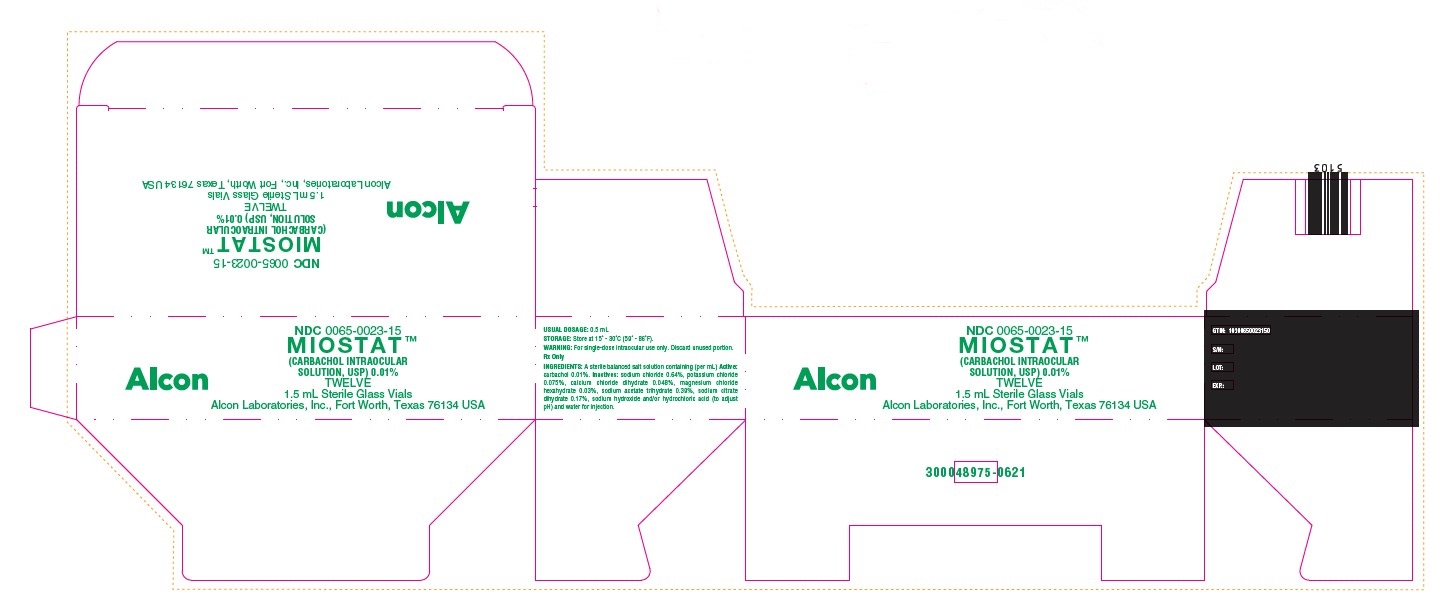
PRINCIPAL DISPLAY PANEL NDC 0065-0023-15 MIOSTAT™ (CARBACHOL INTRAOCULAR SOLUTION, USP) 0.01% TWELVE 1.5 mL Sterile Glass Vials Alcon Laboratories, Inc., Fort Worth, Texas 76134 USA Alcon USUAL DOSAGE: 0.5 mL STORAGE: Store at 15 - 30C (59 - 86F). WARNING: For single-dose intraocular use only. Discard unused portion.
Rx Only INGREDIENTS: A sterile balanced salt solution containing (per mL) Active: carbachol 0.01%. Inactives: sodium chloride 0.64%, potassium chloride 0.075%, calcium chloride dihydrate 0.048%, magnesium chloride hexahydrate 0.03%, sodium acetate trihydrate 0.39%, sodium citrate dihydrate 0.17%, sodium hydroxide and/or hydrochloric acid (to adjust pH) and water for injection. GTIN: 10300650023150 S/N: LOT: EXP.: 300048975-0621 NDC 0065-0023-15 MIOSTAT * (CARBACHOL INTRAOCULAR SOLUTION, USP) 0.01% TWELVE 1.5 mL Sterile Glass Vials Alcon Laboratories, Inc., Fort Worth, Texas 76134 USA * a trademark of Novartis ©2004, 2013, 2015 Novartis Alcon ® a Novartis company USUAL DOSAGE: 0.5 mL STORAGE: Store at 15 - 30C (59 - 86F).
Rx Only INGREDIENTS: A sterile balanced salt solution containing (per mL) Active: carbachol 0.01%. Inactives: sodium chloride 0.64%, potassium chloride 0.075%, calcium chloride dihydrate 0.048%, magnesium chloride hexahydrate 0.03%, sodium acetate trihydrate 0.39%, sodium citrate dihydrate 0.17%, sodium hydroxide and/or hydrochloric acid (to adjust pH) and water for injection. GTIN: 10300650023150 S/N LOT: EXP.: 9011781-0415 MIOSTAT ™ (carbachol intraocular solution, USP) 0.01% Alcon 300056865 LOT: EXP.: MIOSTAT ® (carbachol intraocular solution, USP) 0.01% Alcon ® © 2001, 2018 Alcon, Inc.
H15348-0718 LOT: EXP.: LOT: EXP: 305190-1104 NDC 0065-0023-15 MIOSTAT® (CARBACHOL INTRAOCULAR SOLUTION, USP) 0.01% 1.5mL Rx Only. Sterile Unless Package Open or Damaged Read enclosed insert. INGREDIENTS: Active: carbachol 0.01%.
Inactives: sodium chloride 0.64%, potassium chloride 0.075%, calcium chloride dihydrate 0.048%, magnesium chloride hexahydrate 0.03%, sodium acetate trihydrate 0.39%, sodium citrate dihydrate 0.17%, sodium hydroxide and/or hydrochloric acid (to adjust pH) and water for injection. USUAL DOSAGE: 0.5mL STORAGE: Store at 15° - 30°C (59° - 86°F). ©2004 Alcon, Inc. Alcon Labs., Inc.
Fort Worth, TX. 76134
Medicaid utilization & spend
About this NDC listing & data coverage
What data is (and isn’t) available for this NDC — tap to expand
| NDC identity (package / product / labeler codes) | ✓ Available |
| Labeler | ✓ Available |
| Product & package description | ✓ Available |
| Marketing category & status | ✓ Available |
| Active ingredient / dosage form / route | ✓ Available |
| FDA label (SPL via DailyMed) | ✓ Available |
| Package photos | ✓ Available |
| Inactive ingredients (structured) | ✓ Available |
| NADAC pharmacy acquisition price (CMS) | — Not published for this NDC CMS publishes NADAC only for NDCs reported in its retail-pharmacy survey. |
| Orange Book / therapeutic-equivalence data | — Not published for this NDC Applies only to products approved under an NDA/ANDA; many listings are out of scope. |
| HCPCS J-code billing crosswalk | — Not published for this NDC Most self-administered / retail products have no J-code — that is normal. |
| Medicaid utilization (CMS SDUD) | ✓ Available |