
TRICITRATES POTASSIUM CITRATE, SODIUM CITRATE, and CITRIC ACID MONOHYDRATE 550 mg/5mL; 500 mg/5mL; 334 mg/5mL Solution, 473 mL — NDC 0121-0677-16 (Billing 00121-0677-16)
This is a package of 473 mL of TRICITRATES POTASSIUM CITRATE, SODIUM CITRATE, and CITRIC ACID MONOHYDRATE 550 mg/5mL; 500 mg/5mL; 334 mg/5mL Solution from PAI Holdings, LLC dba PAI Pharma, marketed since May 2005 and currently FDA-listed; retail pharmacies pay about $0.0314 per mL (NADAC). It is this product's only package size.
NDC database record
One package, one record: these facts belong to NDC 0121-0677-16 alone.
- Record
- FDA NDC Directory package listing · Human prescription drug
- Code segments
- 0121 labeler · 0677 product · 16 package
- Package marketed since
- May 25, 2005
- Sample package
- No — commercial package
- Listing certified through
- Dec 31, 2026
- Billing quantity
- 473 mL per package
- Barcode (UPC)
- 0301210677168
- Medicaid fills, this package
- 724 prescriptions in the last four reported quarters
- FDA record last changed
- Oct 8, 2026
Identity & classification
Regulatory identifiers FDA, NLM and CMS codes for this package
Drug-database identifiers Medi-Span GPI and First Databank GCN / HICL / AHFS classification
- GSN (GCN sequence number): 048561
- GCN: 14027
- GPI-14 (Medi-Span): 56202030102020
- HICL (First Databank): 003681
- AHFS class code: 40:08.00.00
- RxCUI (RxNorm): 309317
Where does this data come from?
- FDA openFDA NDC Directory · synced Oct 8, 2026
- FDA label on DailyMed · label index refreshed Oct 8, 2026
- RxNorm (NLM RxNav) · catalog refreshed Oct 1, 2026
- Medi-Span GPI (licensed)
- First Databank (licensed) · refreshed Oct 8, 2026
RxNorm drug class
This medicine belongs to the Calculi Dissolution Agent class.
Where does this data come from?
- RxClass (NLM) · catalog refreshed Oct 1, 2026
Clinical
Tricitrates is an oral liquid solution containing potassium citrate, sodium citrate, and citric acid monohydrate. These citrate salts are typically used to make urine less acidic, which may help prevent or dissolve certain types of kidney stones and manage conditions where urine acidity needs to be reduced. This product is marketed without an approved FDA application.
Patient education
Supplement & herbal interactions
Where does this data come from?
- MedlinePlus (NLM) · refreshed Oct 8, 2026
- FDA label on DailyMed · label index refreshed Oct 8, 2026
Ask a licensed pharmacist directly — free, answered by our team.
Pricing
A drug doesn't have one price. Each row is a different public payment system, and none is what you'd pay at the counter — that depends on your insurance. The ⓘ on each row explains what it measures.
| Price system | Per mL | Per package |
|---|---|---|
| Retail pharmacies payNADAC · weekly | $0.031 | $14.85 / 473 ml |
| Medicaid paysCMS SDUD · 12 mo | $0.0502 | $23.74 / 473 ml |
| Medicare drug plans payPart D · quarterly | No Part D plan price is available for this NDC in our data. | |
Where does this data come from?
- CMS NADAC weekly file · file of Oct 7, 2026
- CMS ASP pricing files · refreshed Sep 20, 2026
- CMS Medicaid State Drug Utilization Data · through Q1 2026
- CMS Part D plan pricing files · refreshed Sep 24, 2026
- VA National Acquisition Center price file
Packaging — all sizes for this product
| Package NDC | Description | Marketing start | Marketing end | Status |
|---|---|---|---|---|
| 00121-0677-16 You're viewing this Main listing | 473 mL in 1 BOTTLE | 2005-05-25 | — | Active |
Therapeutic equivalents
| Product | Labeler | Pack | NADAC/unit | TE | Status | Price vs. this |
|---|---|---|---|---|---|---|
| Tricitrates 550 mg/5mL; 500 mg/5mL; 334 mg/5mLthis 00121-0677-16 | PAI | 473 ml | $0.031 | — | Availability likely | — |
| Tricitrates 550 mg/5mL; 500 mg/5mL; 334 mg/5mL 62135-0438-47 | Chartwell | 473 ml | $0.031 | — | Availability likely | — |
| Tricitrates 550 mg/5mL; 500 mg/5mL; 334 mg/5mL 68999-0438-24 | Chartwell | 10 cups | — | — | FDA listed | — |
Where does this data come from?
- FDA openFDA NDC Directory · synced Oct 8, 2026
- FDA Orange Book · refreshed Oct 3, 2026
- CMS NADAC weekly file · file of Oct 7, 2026
Availability & generic status
We did not find an FDA-approved generic match for this exact strength, form and route.
Where does this data come from?
- FDA Orange Book · refreshed Oct 3, 2026
What it looks like
Where does this data come from?
- FDA label on DailyMed · label index refreshed Oct 8, 2026
Inactive Ingredients / Excipients
Inactive ingredients, also called excipients, are components of the drug product other than the active ingredient. They may include fillers, dyes, coatings, preservatives, flavors, or other formulation ingredients.
💡 Tap an ingredient (hover on desktop) to see what it is and why it’s used.
-
UNII H77VEI93A8
A synthetic yellow dye used to color medications. It helps identify the drug and make it visually distinctive, with no effect on how the medicine works.
-
UNII 3WJQ0SDW1A
Polyethylene glycol is a synthetic liquid or solid polymer used in medicines as a solvent, lubricant, and humectant. It helps dissolve active ingredients, reduces friction during manufacturing, and retains moisture in the final product.
-
UNII 6DC9Q167V3
Propylene glycol is a clear liquid derived from petroleum or vegetable sources. It acts as a solvent, humectant, and preservative in medicines, helping dissolve active ingredients and maintain product stability.
-
UNII OJ245FE5EU
Sodium benzoate is a salt derived from benzoic acid, a preservative. It's added to medicines to prevent growth of bacteria, fungi, and other microorganisms that could spoil the product.
-
UNII 506T60A25R
Sorbitol is a natural sugar alcohol derived from glucose. It serves as a sweetener, humectant, and bulking agent in medications to improve taste and help maintain moisture in the product.
-
UNII 059QF0KO0R
Water is a liquid solvent that dissolves and mixes ingredients together in liquid medicines, syrups, and injections. It helps distribute the active drug evenly throughout the product.
6 inactive ingredients listed in the exact product block matched to this NDC.
Where does this data come from?
ingredient classCode="IACT" elements from the exact product block matched by this NDC. Label-section narrative from DailyMed / the openFDA label index is shown separately when available.- FDA label on DailyMed · label index refreshed Oct 8, 2026
- FDA openFDA NDC Directory · synced Oct 8, 2026
Inactive ingredient FAQ
Are inactive ingredients the same for every manufacturer?
Why might an inactive ingredient be missing?
Can inactive ingredients matter?
Manufacturer & labeler
More NDCs from PAI Holdings, LLC dba PAI Pharma labeler code 00121
- Fluphenazine Hydrochloride .5 mg/mL Elixir NDC 0121-0654-02
- Acetaminophen 160 mg/5mL Solution NDC 0121-0657-00
- Trihexyphenidyl Hydrochloride 2 mg/5mL Solution NDC 0121-0658-16
- ETHOSUXIMIDE 250 mg/5mL Solution NDC 0121-0670-16
- VALPROIC ACID 250 mg/5mL Solution NDC 0121-0675-16
- Potassium Citrate and Citric Acid 1100 mg/5mL; 334 mg/5mL Solution NDC 0121-0676-16
- Nortriptyline Hydrochloride 10 mg/5mL Solution NDC 0121-0678-16
- Fluoxetine 20 mg/5mL Solution NDC 0121-0721-04
- Ranitidine 15 mg/mL Syrup NDC 0121-0727-16
- GUAIFENESIN 100 mg/5mL Solution NDC 0121-0744-04
- Prednisolone Sodium Phosphate 15 mg/5mL Solution NDC 0121-0759-08
- Calcium Carbonate 1250 mg/5mL Suspension NDC 0121-0766-16
Where does this data come from?
- FDA openFDA NDC Directory · synced Oct 8, 2026
- Drugs@FDA
Full prescribing information FDA SPL
🎯 Indications and Usage ▾
INDICATIONS AND ADVANTAGES Tricitrates SF Oral Solution is an effective alkalinizing agent useful in those conditions where long-term maintenance of an alkaline urine is desirable, such as in patients with uric acid and cystine calculi of the urinary tract. In addition, it is a valuable adjuvant when administered with uricosuric agents in gout therapy, since urates tend to crystallize out of an acid urine. It is also effective in correcting the acidosis of certain renal tubular disorders.
This product is highly concentrated, and when administered after meals and before bedtime, allows one to maintain an alkaline urine pH around the clock, usually without the necessity of a 2 A.M. dose. This product alkalinizes the urine without producing a systemic alkalosis in recommended dosage. It is highly palatable, pleasant tasting, and tolerable, even when administered for long periods.
Potassium citrate and sodium citrate do not neutralize the gastric juice or disturb digestion.
⏱️ Dosage and Administration ▾
DOSAGE AND ADMINISTRATION Tricitrates SF Oral Solution should be taken diluted in water, followed by additional water, if desired. Palatability is enhanced if chilled before taking. Usual Adult Dose 3 to 6 teaspoonfuls (15 to 30 mL), diluted in water, four times a day, after meals and at bedtime, or as directed by a physician.
Usual Pediatric Dose 1 to 3 teaspoonfuls (5 to 15 mL), diluted in water, four times a day, after meals and at bedtime, or as directed by a physician. Usual Dosage Range 2 to 3 teaspoonfuls (10 to 15 mL), diluted with water, taken four times a day, will usually maintain a urinary pH of 6.5-7.4. 3 to 4 teaspoonfuls (15 to 20 mL), diluted with water, taken four times a day, will usually maintain a urinary pH of 7.0-7.6 throughout most of the 24 hours without unpleasant side effects.
To check urine pH, HYDRION Paper (pH 6.0-8.0) or NITRAZINE Paper (pH 4.5-7.5) are available and easy to use.
⛔ Contraindications ▾
CONTRAINDICATIONS Severe renal impairment with oliguria or azotemia, untreated Addison's disease, or severe myocardial damage. In certain situations, when patients are on a sodium-restricted diet, the use of potassium citrate may be preferable; or, when patients are on a potassium-restricted diet, the use of sodium citrate may be preferable.
⚠️ Warnings ▾
PRECAUTIONS AND WARNINGS Should be used with caution by patients with low urinary output or reduced glomerular filtration rates unless under the supervision of a physician. Aluminum-based antacids should be avoided in these patients. Patients should be directed to dilute adequately with water and, preferably, to take each dose after meals, to minimize the possibility of gastrointestinal injury associated with oral ingestion of potassium salt preparations and to avoid saline laxative effect.
Sodium salts should be used cautiously in patients with cardiac failure, hypertension, peripheral and pulmonary edema, and toxemia of pregnancy. Concurrent administration of potassium-containing medication, potassium-sparing diuretics, angiotensin-converting enzyme (ACE) inhibitors, or cardiac glycosides may lead to toxicity. Periodic examination and determinations of serum electrolytes, particularly serum bicarbonate level, should be carried out in those patients with renal disease in order to avoid these complications.
🤒 Adverse Reactions ▾
ADVERSE REACTIONS Tricitrates SF Oral Solution is generally well tolerated without any unpleasant side effects when given in recommended doses to patients with normal renal function and urinary output. However, as with any alkalinizing agent, caution must be used in certain patients with abnormal renal mechanisms to avoid development of hyperkalemia or alkalosis, especially in the presence of hypocalcemia. Potassium intoxication causes listlessness, weakness, mental confusion, and tingling of extremities.
🆘 Overdosage ▾
OVERDOSAGE Overdosage with sodium salts may cause diarrhea, nausea and vomiting, hypernoia, and convulsions. Overdosage with potassium salts may cause hyperkalemia and alkalosis, especially in the presence of renal disease.
🧬 Mechanism of Action ▾
ACTIONS Potassium citrate and sodium citrate are absorbed and metabolized to potassium bicarbonate and sodium bicarbonate, thus acting as systemic alkalizers. The effects are essentially those of chlorides before absorption and those of bicarbonates subsequently. Oxidation is virtually complete so that less than 5% of the citrates are excreted in the urine unchanged.
📦 How Supplied / Storage and Handling ▾
HOW SUPPLIED Tricitrates SF Oral Solution (orange colored, raspberry flavored) is supplied in the following oral dosage form: NDC 0121-0677-16: 16 fl oz (473 mL) bottles STORAGE Keep tightly closed. Store at controlled room temperature, 20°-25°C (68°-77°F). Protect from excessive heat and freezing. SHAKE WELL BEFORE USING.
📦 Storage and Handling ▾
STORAGE Keep tightly closed. Store at controlled room temperature, 20°-25°C (68°-77°F). Protect from excessive heat and freezing. SHAKE WELL BEFORE USING.
📋 Description ▾
DESCRIPTION Tricitrates SF Oral Solution is a stable and pleasant-tasting oral systemic alkalizer containing potassium citrate, sodium citrate, and citric acid in a sugar-free, non-alcoholic base. Tricitrates SF Oral Solution contains in each teaspoonful (5 mL): POTASSIUM CITRATE Monohydrate 550 mg SODIUM CITRATE Dihydrate 500 mg CITRIC ACID Monohydrate 334 mg Each mL contains 1 mEq potassium ion and 1 mEq sodium ion and is equivalent to 2 mEq bicarbonate (HCO 3 ). Inactive Ingredients: FD&C Yellow No.
6, flavoring, polyethylene glycol, propylene glycol, purified water, sodium benzoate, and sorbitol solution.
⚠️ Precautions ▾
Should be used with caution by patients with low urinary output or reduced glomerular filtration rates unless under the supervision of a physician. Aluminum-based antacids should be avoided in these patients. Patients should be directed to dilute adequately with water and, preferably, to take each dose after meals, to minimize the possibility of gastrointestinal injury associated with oral ingestion of potassium salt preparations and to avoid saline laxative effect.
Sodium salts should be used cautiously in patients with cardiac failure, hypertension, peripheral and pulmonary edema, and toxemia of pregnancy. Concurrent administration of potassium-containing medication, potassium-sparing diuretics, angiotensin-converting enzyme (ACE) inhibitors, or cardiac glycosides may lead to toxicity. Periodic examination and determinations of serum electrolytes, particularly serum bicarbonate level, should be carried out in those patients with renal disease in order to avoid these complications.
📄 Package Label / Principal Display Panel ▾
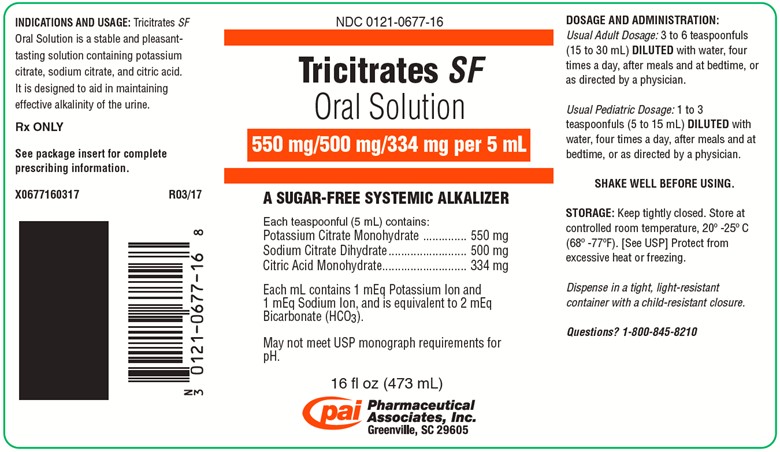
PRINCIPAL DISPLAY PANEL - 473 mL Bottle Label NDC 0121-0677-16 Tricitrates SF Oral Solution 550 mg/500 mg/334 mg per 5 mL A SUGAR-FREE SYSTEMIC ALKALIZER Each teaspoonful (5 mL) contains: Potassium Citrate Monohydrate 550 mg Sodium Citrate Dihydrate 500 mg Citric Acid Monohydrate 334 mg Each mL contains 1 mEq Potassium Ion and 1 mEq Sodium Ion, and is equivalent to 2 mEq Bicarbonate (HCO 3 ). May not meet USP monograph requirements for pH. 16 fl oz (473 mL) Pharmaceutical Associates, Inc.
Greenville, SC 29605 PRINCIPAL DISPLAY PANEL - 473 mL Bottle Label
Medicaid utilization & spend
Medicare Part D spend CMS · PART D · 2026 (Q1)
About this NDC listing & data coverage
Listed without an FDA application
This product's marketing category indicates it is marketed without an approved FDA application (no NDA, ANDA, or BLA on file). Having an NDC does not by itself establish FDA approval — the NDC Directory is a listing system, not an approval decision. Approval-linked data such as Orange Book therapeutic-equivalence ratings therefore does not apply.
What data is (and isn’t) available for this NDC — tap to expand
| NDC identity (package / product / labeler codes) | ✓ Available |
| Labeler | ✓ Available |
| Product & package description | ✓ Available |
| Marketing category & status | ✓ Available |
| Active ingredient / dosage form / route | ✓ Available |
| FDA label (SPL via DailyMed) | ✓ Available |
| Package photos | ✓ Available |
| Inactive ingredients (structured) | ✓ Available |
| NADAC pharmacy acquisition price (CMS) | ✓ Available |
| Orange Book / therapeutic-equivalence data | — Not published for this NDC Applies only to products approved under an NDA/ANDA; many listings are out of scope. |
| HCPCS J-code billing crosswalk | — Not published for this NDC Most self-administered / retail products have no J-code — that is normal. |
| Medicaid utilization (CMS SDUD) | ✓ Available |