
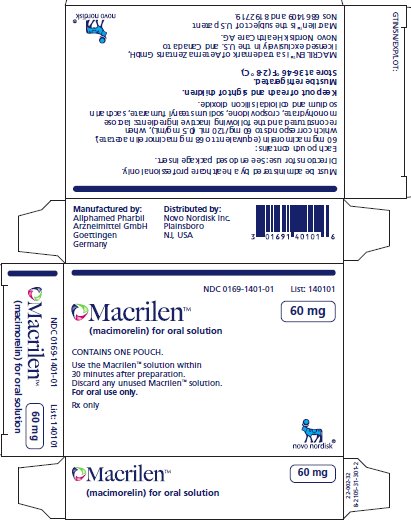
Macrilen Macimorelin acetate 60 mg/mg Granule, For Solution — NDC 0169-1401-01 (Billing 00169-1401-01)
This is a package of Macrilen Macimorelin acetate 60 mg/mg Granule, For Solution from Novo Nordisk, marketed since Jan 2022 and currently FDA-listed, this package's marketing is listed to end Feb 2027. It is this product's only package size.
NDC database record
One package, one record: these facts belong to NDC 0169-1401-01 alone.
- Record
- FDA NDC Directory package listing · Human prescription drug
- Code segments
- 0169 labeler · 1401 product · 01 package
- Package marketed since
- Jan 31, 2022
- Package marketing ended
- Feb 28, 2027
- Sample package
- No — commercial package
- Barcode (UPC-A, from the NDC)
- 3 0169140101 6
- FDA record last changed
- Jul 24, 2026
Identity & classification
Regulatory identifiers FDA, NLM and CMS codes for this package
Drug-database identifiers Medi-Span GPI and First Databank GCN / HICL / AHFS classification
- GSN (GCN sequence number): 078044
- GCN: 44266
- GPI-14 (Medi-Span): 94200062103020
- HICL (First Databank): 044711
- AHFS class code: 36:66.00.00
Where does this data come from?
- FDA openFDA NDC Directory · synced Oct 8, 2026
- FDA label on DailyMed · label index refreshed Oct 8, 2026
- RxNorm (NLM RxNav) · catalog refreshed Oct 1, 2026
- Medi-Span GPI (licensed)
- First Databank (licensed) · refreshed Oct 8, 2026
Clinical
Patient education
Supplement & herbal interactions
Some supplements/herbs that may interact with Macimorelin Acetate — tap one for details:
Where does this data come from?
- MedlinePlus (NLM) · refreshed Oct 8, 2026
- FDA label on DailyMed · label index refreshed Oct 8, 2026
Ask a licensed pharmacist directly — free, answered by our team.
Pricing
A drug doesn't have one price. Each row is a different public payment system, and none is what you'd pay at the counter — that depends on your insurance. The ⓘ on each row explains what it measures.
| Price system | Per mL | Per package |
|---|---|---|
| Retail pharmacies payNADAC · weekly | Not in the retail survey — common for institutional, discontinued, or low-volume packs. | |
| Medicaid paysCMS SDUD · 12 mo | No recent Medicaid claims on file for this NDC — rare and low-volume NDCs are suppressed in the public data. | |
| Medicare drug plans payPart D · quarterly | No Part D plan price is available for this NDC in our data. | |
Where does this data come from?
- CMS NADAC weekly file
- CMS ASP pricing files · refreshed Sep 20, 2026
- CMS Medicaid State Drug Utilization Data · refreshed Oct 8, 2026
- CMS Part D plan pricing files · refreshed Sep 24, 2026
- VA National Acquisition Center price file
Packaging — all sizes for this product
| Package NDC | Description | Marketing start | Marketing end | Status |
|---|---|---|---|---|
| 00169-1401-01 You're viewing this Main listing | 1 POUCH in 1 CARTON / 60 mg in 1 POUCH | 2022-01-31 | Feb 28, 2027 | Active |
Therapeutic equivalents
| Product | Labeler | Pack | NADAC/unit | TE | Status | Price vs. this |
|---|---|---|---|---|---|---|
| Macrilen 60 mg/mgthis 00169-1401-01 | Novo | 1 pouch | — | — | FDA listed | — |
Where does this data come from?
- FDA openFDA NDC Directory · synced Oct 8, 2026
- FDA Orange Book · refreshed Oct 3, 2026
- CMS NADAC weekly file
Availability & generic status
We did not find an FDA-approved generic match for this exact strength, form and route. Patent/protection dates below may affect future generic timing.
Why the date isn’t exact: Generic timing can change because patents may be challenged, settled, licensed, added, removed, or worked around with a narrower label — and FDA approval does not always mean a pharmacy can get the generic today.
🛈 What do these terms mean?
- Patent
- Legal protection listed in the Orange Book that may delay generic approval or launch. Issued by the U.S. Patent & Trademark Office.
- Substance patent
- Covers the active drug molecule itself — the hardest to design around. A generic generally can’t launch until it expires.
- Formulation (product) patent
- Covers a specific formulation or dosage form. A generic can sometimes work around it with a different formulation.
- Method-of-use patent
- A patent covering one specific approved use of the drug — not necessarily the whole molecule. A generic can sometimes launch with a “skinny label” that carves out the protected use and keeps the others.
- Skinny label
- A generic label that omits a still-patented use when the FDA allows it — letting a generic reach the market for the unprotected uses.
- Exclusivity
- FDA-granted marketing protection, separate from patents — e.g. 5-yr new chemical entity, 7-yr orphan drug, or a +6-month pediatric extension.
- Paragraph IV
- A generic applicant’s formal challenge to a listed patent. It can potentially lead to earlier generic entry, but often involves litigation or a settlement.
- RLD / RS
- Reference Listed Drug — the brand product the FDA uses as the reference for generic applications. Reference Standard — the product the FDA expects generics to compare against in bioequivalence testing.
- TE / AB rating
- FDA therapeutic-equivalence rating. An AB rating generally means the FDA considers a generic therapeutically equivalent to — and substitutable for — the brand.
- LOE (loss of exclusivity)
- The latest patent or exclusivity currently listed — the loss-of-exclusivity / latest-listed-protection date shown on this page. Paragraph-IV challenges and settlements can move the real date earlier; FDA approval and a manufacturer’s decision to market can move it later.
Built from the FDA Orange Book. The bars above are scaled to each protection’s expiry; the red LOE marker is the last one to lapse.
| Patent | Type | Use code | Expires |
|---|---|---|---|
| US 8192719 ↗ | Method of use | U-2220 | Oct 12, 2027 |
| US 8192719*PED ↗ | Drug product | — | Apr 12, 2028 |
| Code | What it grants | Expires |
|---|---|---|
| M-14 | New indication / labeling change (3-year) | Jul 23, 2029 |
| PED | Pediatric Exclusivity (+6 months) | Jan 23, 2030 |
Is there a generic version of MACRILEN 60 MG/120 ML SOLUTION?
The FDA approved a generic — why can’t I get it at my pharmacy yet?
Why do different websites show different generic release dates?
What does “FDA listed” mean?
What does a patent or protection date mean here?
What does “current Orange Book estimate” mean?
Can a generic come out before the last patent expires?
Can a generic come out after the listed dates?
What is the difference between patents and exclusivity?
Why are there multiple patent dates?
Where does this data come from?
- FDA Orange Book · refreshed Oct 3, 2026
Inactive Ingredients / Excipients
Inactive ingredients, also called excipients, are components of the drug product other than the active ingredient. They may include fillers, dyes, coatings, preservatives, flavors, or other formulation ingredients.
💡 Tap an ingredient (hover on desktop) to see what it is and why it’s used.
-
UNII 2S7830E561
Crospovidone is a synthetic polymer derived from povidone. It acts as a disintegrant, helping the tablet or capsule break apart quickly in the stomach so the active ingredient can be absorbed.
-
UNII EWQ57Q8I5X
Lactose monohydrate is a natural sugar derived from milk. It serves as a filler and binder in tablets and capsules, helping create the proper size, texture, and consistency of the medicine.
-
UNII SB8ZUX40TY
Saccharin sodium is an artificial sweetener made from saccharin salt. It's added to medicines to improve taste, especially in liquid formulations for children or bitter drugs.
-
UNII ETJ7Z6XBU4
Silicon dioxide is a naturally occurring mineral used as a glidant and anti-caking agent. It helps powder ingredients flow smoothly and prevents clumping during manufacturing and storage.
-
UNII 7CV7WJK4UI
Sodium stearyl fumarate is a synthetic compound made from stearyl alcohol and fumaric acid. It acts as a lubricant and glidant in tablets and capsules, helping ingredients flow smoothly during manufacturing and preventing sticking.
5 inactive ingredients listed in the exact product block matched to this NDC.
Where does this data come from?
ingredient classCode="IACT" elements from the exact product block matched by this NDC. Label-section narrative from DailyMed / the openFDA label index is shown separately when available.- FDA label on DailyMed · label index refreshed Oct 8, 2026
- FDA openFDA NDC Directory · synced Oct 8, 2026
Inactive ingredient FAQ
Are inactive ingredients the same for every manufacturer?
Why might an inactive ingredient be missing?
Can inactive ingredients matter?
Manufacturer & labeler
More NDCs from Novo Nordisk labeler code 00169
- Ozempic oral semaglutide 4 mg Tablet NDC 0169-1704-30
- Ozempic oral semaglutide 9 mg Tablet NDC 0169-1709-30
- Ozempic oral semaglutide 1.5 mg Tablet NDC 0169-1715-30
- Novolin R Human Insulin 100 [iU]/mL Injection, Solution NDC 0169-1833-02
- Novolin N Human Insulin 100 [iU]/mL Injection, Suspension NDC 0169-1834-02
- Novolin 70/30 Human Insulin 100 [iU]/mL Injection, Suspension NDC 0169-1837-02
Where does this data come from?
- FDA openFDA NDC Directory · synced Oct 8, 2026
- Drugs@FDA
Full prescribing information FDA SPL
🎯 Indications and Usage ▾
1 INDICATIONS AND USAGE MACRILEN is indicated for the diagnosis of adult growth hormone deficiency (AGHD). MACRILEN is a growth hormone (GH) secretagogue receptor agonist indicated for the diagnosis of adult growth hormone deficiency ( 1 ). Limitations of Use : The safety and diagnostic performance has not been established for subjects with BMI > 40kg/m 2 ( 1 ).
Limitations of Use The safety and diagnostic performance of MACRILEN have not been established for subjects with a body mass index (BMI) > 40 kg/m 2 .
⏱️ Dosage and Administration ▾
2 DOSAGE AND ADMINISTRATION • Recommended dose is 0.5 mg/kg as a single oral dose, after fasting for at least 8 hours ( 2.1 ). • See Full Prescribing Information for important preparation and administration instructions ( 2.3 ). • Discontinue therapy with strong CYP3A4 inducers, growth hormones and drugs that affect GH release for an adequate length of time before administering MACRILEN ( 2.2 ). • Adequately replace other hormone deficiencies before administering MACRILEN ( 2.2 ).
2.1Recommended Dose The recommended dose is a single oral dose of 0.5 mg/kg of macimorelin. The dose is administered as a reconstituted solution [see Dosage and Administration ( 2.3 )] in patients fasted for at least 8 hours.
2.2Important Recommendations Before MACRILEN Use • Discontinue strong CYP3A4 inducers prior to MACRILEN use [see Warning and Precautions ( 5.2 ) and Drug Interactions ( 7.2 )]. • Discontinue growth hormone (GH) therapy at least one week before administering MACRILEN [see Drug Interactions ( 7.3 )] . • Avoid the use of MACRILEN with drugs known to affect pituitary GH secretion [see Drug Interactions ( 7.3 )] . • For patients with deficiencies in sex hormones, thyroid hormone and/or glucocorticoid, adequately replace each of the missing hormones before administering MACRILEN. • Ensure that the patient has fasted for at least 8 hours before MACRILEN use.
2.3Directions for Preparation and Administration Prepare and administer by a healthcare professional exactly as follows. Prepare the MACRILEN solution: a. Weigh the patient in kilograms (i.e., kg) . b.
Determine the number of MACRILEN pouches needed to prepare the dose: i. For a patient weighing up to 120 kg, use 1 pouch. ii. For a patient weighing more than 120 kg, use 2 pouches. c.
Use a glass or transparent plastic container with graduation in milliliters (i.e., mL) to dissolve the entire contents of the pouch(es) in the appropriate volume of water. i. For 1 pouch dissolve in 120 mL of water (corresponds to 60 mg/120 mL). ii. For 2 pouches dissolve in 240 mL of water (corresponds to 120 mg/240 mL). d.
Stir the MACRILEN solution gently for about 2 to 3 minutes (a small amount of un-dissolved particles will remain). The solution will have a final concentration of 0.5 mg/mL . e. Use the MACRILEN solution within 30 minutes after preparation. f.
Discard any unused MACRILEN solution. Determine the volume of MACRILEN solution needed for the test: g. Determine the recommended dose to be administered by multiplying the patient weight in kilogram by 0.5 mg/kg.
For example, a 70 kg patient will need a 35 mg dose. h. Determine the volume of prepared MACRILEN solution to be administered by dividing the recommended dose by 0.5 mg/mL. For example, a patient requiring a dose of 35 mg will need 70 mL of reconstituted MACRILEN solution. i.
Use a syringe (without a needle) with graduations in mL to measure the exact volume of MACRILEN solution to be administered and transfer the required volume of MACRILEN solution into a drinking glass. Administer the MACRILEN solution and perform the test: j. Have the patient being tested drink the entire volume of MACRILEN solution in the drinking glass (i.e., the dose) within 30 seconds . k.
Observe the patient being tested per routine for the duration of the test. l. Draw venous blood samples for GH determination at 30 minutes, 45 minutes, 60 minutes and 90 minutes after administration of MACRILEN. m. Prepare serum samples and send to a laboratory for growth hormone determinations. n. o. p. q. r. s. t. u. v.
2.4Interpretation of MACRILEN Test Results Clinical studies have established that a maximally stimulated serum GH level of less than 2.8 ng/mL (i.e., at the 30, 45, 60 and 90 minute timepoints) following MACRILEN administration confirms the presence of adult growth hormone deficiency.
💊 Dosage Forms and Strengths ▾
3 DOSAGE FORMS AND STRENGTHS For oral solution: 60 mg white to off-white granules in a pouch for reconstitution in 120 mL of water, resulting in a solution of 0.5 mg/mL of macimorelin. For oral solution: 60 mg ( 3 )
⛔ Contraindications ▾
4 CONTRAINDICATIONS None None ( 4 )
⚠️ Warnings and Cautions ▾
5 WARNINGS AND PRECAUTIONS • QT Prolongation: QT prolongation can lead to development of torsade de pointes-type ventricular tachycardia. Avoid the concomitant use of MACRILEN with drugs that are known to prolong QT interval ( 5.1 , 7.1 ). • Potential for False Positive Test Results with Use of Strong CYP3A4 Inducers: Discontinue and washout strong CYP3A4 inducers before testing ( 5.2 , 7.2 ). • Potential for False Negative Test Results in Recent Onset Hypothalamic Disease: Consider repeat testing if indicated ( 5.3 ).
5.1QT Prolongation MACRILEN causes an increase of about 11 msec in the corrected QT (QTc) interval [see Clinical Pharmacology ( 12.2 )] . QT prolongation can lead to development of torsade de pointes-type ventricular tachycardia with the risk increasing as the degree of prolongation increases. The concomitant use of MACRILEN with drugs that are known to prolong the QT interval should be avoided [see Dosage and Administration ( 2.2 ) and Drug Interactions ( 7.1 )] .
5.2Potential for False Positive Test Results with Use of Strong CYP3A4 Inducers Concomitant use of strong CYP3A4 inducers with MACRILEN can decrease macimorelin plasma levels significantly and thereby lead to a false positive result [see Drug Interactions ( 7.2 )] . Strong CYP3A4 inducers should be discontinued and enough time should be given to allow washout of CYP3A4 inducers prior to test administration [see Dosage and Administration ( 2.2 )].
5.3Potential for False Negative Test Results in Recent Onset Hypothalamic Disease Adult growth hormone (GH) deficiency caused by a hypothalamic lesion may not be detected early in the disease process. Macimorelin acts downstream from the hypothalamus and macimorelin stimulated release of stored GH reserves from the anterior pituitary could produce a false negative result early when the lesion involves the hypothalamus. Repeat testing may be warranted in this situation.
🤒 Adverse Reactions ▾
6 ADVERSE REACTIONS The most common adverse reactions were dysgeusia, dizziness, headache, fatigue, nausea, hunger, diarrhea, upper respiratory tract infection, feeling hot, hyperhidrosis, nasopharyngitis, and sinus bradycardia ( 6.1 ). To report SUSPECTED ADVERSE REACTIONS, contact Novo Nordisk Inc. at 1-800-727-6500, or FDA at 1-800-FDA-1088 or www.fda.gov/medwatch.
6.1Clinical Studies Experience Because clinical trials are conducted under widely varying conditions, adverse reaction rates observed in the clinical trials of a drug cannot be directly compared to rates in the clinical trial of another drug and may not reflect the rates observed in practice. The data in Table 1 are derived from an open-label, randomized, cross-over study that compared the diagnostic performance of MACRILEN to the insulin tolerance test (ITT) for the diagnosis of adult growth hormone deficiency [see Clinical Studies ( 14 )].
A total of 154 subjects with a high to low pre-test probability of having adult growth hormone deficiency received a single oral dose of 0.5 mg/kg MACRILEN. Out of 154 subjects, 58% were male, 42% female, and 86% of white origin. Median values were for age 41 years (range: 18 – 66 years) and body mass index was 27.5 kg/m 2 (range: 16 – 40 kg/m 2 ).
Common adverse reactions presented in Table 1 were adverse reactions that were not present at baseline and occurred during MACRILEN dosing in at least two individuals. Table 1: Common Adverse Reactions Reported in at Least Two Individuals Dosed with MACRILEN in an Open-Label Study Number of Subjects (n = 154) Proportion of Subjects (%) Dysgeusia 7
4.5 Dizziness 6
3.9 Headache 6
3.9 Fatigue 6
3.9 Nausea 5
3.2 Hunger 5
3.2 Diarrhea 3
1.9 Upper respiratory tract infection 3
1.9 Feeling hot 2
1.3 Hyperhidrosis 2
1.3 Nasopharyngitis 2
1.3Sinus bradycardia 2 1.3
🔄 Drug Interactions ▾
7 DRUG INTERACTIONS
7.1Drugs that Prolong QT Interval Co-administration of MACRILEN with drugs that prolong the QT interval (such as antipsychotic medications (e.g., chlorpromazine, haloperidol, thioridazine, ziprasidone), antibiotics (e.g., moxifloxacin), Class 1A (e.g., quinidine, procainamide) and Class III (e.g., amiodarone, sotalol) antiarrhythmic medications or any other medications known to prolong the QT interval) may lead to development of torsade de pointes-type ventricular tachycardia. Avoid concomitant use of MACRILEN with drugs that prolong the QT interval.
Sufficient washout time of drugs that are known to prolong the QT interval prior to administration of MACRILEN is recommended [see Dosage and Administration ( 2.2 ) and Warnings and Precautions ( 5.1 )] .
7.2Cytochrome P450 (CYP) 3A4 Inducers Co-administration of a strong CYP3A4 inducer with MACRILEN (e.g., carbamazepine, enzalutamide, mitotane, phenytoin, rifampin, St. John's wort, bosentan, efavirenz, etravirine, modafinil, armodafinil, rufinamide) may reduce the plasma macimorelin concentrations and may lead to false positive test results. Discontinue strong CYP3A4 inducers prior to MACRILEN use.
Sufficient washout time of strong CYP3A4 inducers prior to administration of MACRILEN is recommended [see Dosage and Administration ( 2.2 ) and Warnings and Precautions ( 5.2 )] .
7.3Drugs Affecting Growth Hormone Release The following drugs may impact the accuracy of the MACRILEN diagnostic test. Avoid concomitant use of MACRILEN with the following [see Dosage and Administration ( 2.2 )] : • Drugs that directly affect the pituitary secretion of growth hormone (such as somatostatin, insulin, glucocorticoids, and cyclooxygenase inhibitors such as aspirin or indomethacin). • Drugs that may transiently elevate growth hormone concentrations (such as clonidine, levodopa, and insulin). • Drugs that may blunt the growth hormone response to MACRILEN (such as muscarinic antagonists: atropine, anti-thyroid medication: propylthiouracil, and growth hormone products).
Discontinue growth hormone products at least one week before administering the MACRILEN diagnostic test. Sufficient washout time of drugs affecting growth hormone release prior to administration of MACRILEN is recommended.
👥 Use in Specific Populations ▾
8 USE IN SPECIFIC POPULATIONS
8.1Pregnancy Risk summary There are no available data with MACRILEN use in pregnant women to inform a drug associated risk for adverse developmental outcomes. Animal reproduction studies have not been conducted with MACRILEN. MACRILEN is indicated as a single dose which limits the risk of adverse developmental outcomes from exposure to MACRILEN.
The estimated background risk of major birth defects and miscarriage for the indicated populations is unknown. All pregnancies have a background risk of birth defect, loss, or other adverse outcomes. In the U.S. general population, the estimated background risk of major birth defects and miscarriage in clinically recognized pregnancies is 2 – 4% and 15 – 20%, respectively.
8.2Lactation Risk Summary There are no data on the presence of macimorelin in human or animal milk, the effects on the breastfed infant or the effects on milk production. The lack of clinical data during lactation precludes a clear determination of the risk of MACRILEN to an infant during lactation; therefore, the developmental and health benefits of breastfeeding should be considered along with the mother's clinical need for MACRILEN and any potential adverse effects on the breastfed infant from MACRILEN or the underlying maternal condition.
8.4Pediatric Use The safety and efficacy of MACRILEN in pediatric patients have not been established.
8.5Geriatric Use Growth hormone secretion normally decreases with age. Therefore, elderly subjects might require a lower cut-off point for diagnosis of adult growth hormone deficiency. Clinical studies of MACRILEN did not include a sufficient number of subjects aged 65 and over to determine whether elderly patients respond differently from younger subjects.
🤰 Pregnancy ▾
8.1Pregnancy Risk summary There are no available data with MACRILEN use in pregnant women to inform a drug associated risk for adverse developmental outcomes. Animal reproduction studies have not been conducted with MACRILEN. MACRILEN is indicated as a single dose which limits the risk of adverse developmental outcomes from exposure to MACRILEN.
The estimated background risk of major birth defects and miscarriage for the indicated populations is unknown. All pregnancies have a background risk of birth defect, loss, or other adverse outcomes. In the U.S. general population, the estimated background risk of major birth defects and miscarriage in clinically recognized pregnancies is 2 – 4% and 15 – 20%, respectively.
🧒 Pediatric Use ▾
8.4Pediatric Use The safety and efficacy of MACRILEN in pediatric patients have not been established.
🧓 Geriatric Use ▾
8.5Geriatric Use Growth hormone secretion normally decreases with age. Therefore, elderly subjects might require a lower cut-off point for diagnosis of adult growth hormone deficiency. Clinical studies of MACRILEN did not include a sufficient number of subjects aged 65 and over to determine whether elderly patients respond differently from younger subjects.
🆘 Overdosage ▾
10 OVERDOSAGE In the event of an overdose, symptomatic and supportive measures should be employed.
🧬 Clinical Pharmacology ▾
12 CLINICAL PHARMACOLOGY
12.1Mechanism of Action Macimorelin stimulates GH release by activating growth hormone secretagogue receptors present in the pituitary and hypothalamus.
12.2Pharmacodynamics GH stimulation Maximum GH levels are observed between 30 to 90 minutes after administration of MACRILEN. Cardiac electrophysiology The effects of macimorelin on ECG parameters were investigated in a dedicated Thorough QT study that investigated in a 3-way cross-over design with 60 healthy subjects the effects of a supra-therapeutic dose of macimorelin (2 mg/kg) (4 times the recommended dosage) in comparison with placebo and with moxifloxacin. This study showed a mean baseline- and placebo-adjusted change (upper single-sided 95% confidence interval) in QTcF of 9.6 msec (11.4 msec) at 4 h post-dose, which occurred after the mean maximum macimorelin plasma concentration (0.5 h).
A similar increase in the QTcF interval was also observed in a single-ascending dose study, which included three dose levels (0.5 mg/kg, and 1 mg/kg and 2 mg/kg (2 times and 4 times the recommended dosage, respectively). All three dose levels studied showed a similar magnitude of QTcF prolongation in the Thorough QT study, suggesting an absence of dose dependent changes. The mechanism for the observed QTcF prolongation is unknown [see Warnings and Precautions ( 5.1 )] .
12.3Pharmacokinetics The mean plasma macimorelin concentrations are similar between patients with AGHD and healthy subjects for 1.5 hours following administration of a single oral dose of 0.5 mg macimorelin/kg body weight. Absorption The maximum plasma macimorelin concentrations (C max ) were observed between 0.5 hour and 1.5 hours following oral administration of 0.5 mg macimorelin/kg body weight to patients with AGHD under fasting for at least 8 hours. A liquid meal decreased the macimorelin C max and AUC by 55% and 49%, respectively.
Elimination An in vitro human liver microsomes study showed that CYP3A4 is the major enzyme to metabolize macimorelin. Macimorelin was eliminated with a mean terminal half-life (T 1/2 ) of 4.1 hours following administration of a single oral dose of 0.5 mg macimorelin/kg body weight in healthy subjects.
🧬 Mechanism of Action ▾
12.1Mechanism of Action Macimorelin stimulates GH release by activating growth hormone secretagogue receptors present in the pituitary and hypothalamus.
📦 How Supplied / Storage and Handling ▾
16 HOW SUPPLIED/STORAGE AND HANDLING MACRILEN 60 mg is supplied as white to off-white granules in an aluminum pouch. Each pouch contains 60 mg macimorelin (equivalent to 68 mg macimorelin acetate) that when reconstituted with 120 mL of water provides a 60 mg/120 mL (0.5 mg/mL) macimorelin solution. MACRILEN is available in boxes containing 1 pouch per box (NDC 0169-1401-01).
Before administration, MACRILEN for oral solution must be reconstituted by a healthcare professional [see Dosage and Administration ( 2.3 )]. Store pouches under refrigeration at 2-8°C (36-46°F). The solution must be used within 30 minutes after preparation.
Discard unused portion.
📋 Description ▾
11 DESCRIPTION MACRILEN for oral solution is macimorelin acetate, a synthetic growth hormone secretagogue receptor agonist. Macimorelin acetate is described chemically as D-Tryptophanamide, 2-methylalanyl-N-[(1R)-1-(formylamino)-2-(1H-indol-3-yl)ethyl]-acetate. The molecular formula for macimorelin acetate is C 28 H 34 N 6 O 5 with a molecular weight of 534.6 g/mol.
Figure 1: Chemical structure of macimorelin acetate Each aluminum pouch of MACRILEN contains 60 mg of macimorelin, equivalent to 68 mg of macimorelin acetate, and the following inactive ingredients: lactose monohydrate, crospovidone, sodium stearyl fumarate, saccharin sodium and colloidal silicon dioxide. figure-1
💬 Information for Patients ▾
17 PATIENT COUNSELING INFORMATION Instruct patients to discontinue treatment with GH at least one week before administering MACRILEN. Also, instruct patients to discontinue other medications that may interfere with the diagnostic test results prior to MACRILEN administration [see Drug Interactions ( 7.2 , 7.3 )] . Instruct patients to fast for at least 8 hours before MACRILEN administration [see Dosage and Administration ( 2.2 )].
Manufactured by: Allphamed Pharbil Arzneimittel GmbH, Goettingen, Germany Distributed by: Novo Nordisk Inc. Plainsboro, NJ, USA MACRILEN™ is a trademark of Aeterna Zentaris GmbH, licensed exclusively in the U.S. and Canada to Novo Nordisk Health Care AG. Novo Nordisk ® is a registered trademark of Novo Nordisk A/S.
MACRILEN is the subject of U.S. Patent Nos. 6,861,409 and 8,192,719.
For information contact: Novo Nordisk Inc. 800 Scudders Mill Road Plainsboro, NJ 08536 1-800-727-6500 www.novonordisk-us.com Revised: 7/2021
🧬 Pharmacokinetics ▾
12.3Pharmacokinetics The mean plasma macimorelin concentrations are similar between patients with AGHD and healthy subjects for 1.5 hours following administration of a single oral dose of 0.5 mg macimorelin/kg body weight. Absorption The maximum plasma macimorelin concentrations (C max ) were observed between 0.5 hour and 1.5 hours following oral administration of 0.5 mg macimorelin/kg body weight to patients with AGHD under fasting for at least 8 hours. A liquid meal decreased the macimorelin C max and AUC by 55% and 49%, respectively.
Elimination An in vitro human liver microsomes study showed that CYP3A4 is the major enzyme to metabolize macimorelin. Macimorelin was eliminated with a mean terminal half-life (T 1/2 ) of 4.1 hours following administration of a single oral dose of 0.5 mg macimorelin/kg body weight in healthy subjects.
🧬 Pharmacodynamics ▾
12.2Pharmacodynamics GH stimulation Maximum GH levels are observed between 30 to 90 minutes after administration of MACRILEN. Cardiac electrophysiology The effects of macimorelin on ECG parameters were investigated in a dedicated Thorough QT study that investigated in a 3-way cross-over design with 60 healthy subjects the effects of a supra-therapeutic dose of macimorelin (2 mg/kg) (4 times the recommended dosage) in comparison with placebo and with moxifloxacin. This study showed a mean baseline- and placebo-adjusted change (upper single-sided 95% confidence interval) in QTcF of 9.6 msec (11.4 msec) at 4 h post-dose, which occurred after the mean maximum macimorelin plasma concentration (0.5 h).
A similar increase in the QTcF interval was also observed in a single-ascending dose study, which included three dose levels (0.5 mg/kg, and 1 mg/kg and 2 mg/kg (2 times and 4 times the recommended dosage, respectively). All three dose levels studied showed a similar magnitude of QTcF prolongation in the Thorough QT study, suggesting an absence of dose dependent changes. The mechanism for the observed QTcF prolongation is unknown [see Warnings and Precautions ( 5.1 )] .
🔬 Clinical Studies ▾
14 CLINICAL STUDIES The diagnostic efficacy of the MACRILEN test was established in a randomized, open-label, single-dose, cross-over study. The objective of the study was to compare the level of agreement between MACRILEN test results and insulin tolerance test (ITT) results in adult patients with different pre-test probability of growth hormone deficiency and healthy control subjects. The four groups of individuals evaluated were: • Group A : Adults with a high likelihood of growth hormone deficiency (GHD) o Structural hypothalamic or pituitary lesions and low insulin-like growth factor 1 (IGF-1), and/or o Three or more pituitary hormone deficiencies and low IGF-1, or o Childhood onset GHD with structural lesions and low IGF-1. • Group B : Adults with an intermediate likelihood of GHD o Eligible subjects not qualifying for either high or low likelihood. • Group C : Adults with a low likelihood of GHD o One risk factor for GHD only, such as history of distant traumatic brain injury or one pituitary hormone deficiency only with otherwise normal pituitary function, or o Isolated idiopathic childhood onset GHD without additional pituitary deficits. • Group D : Healthy adult controls o Healthy subjects matching Group A subjects by sex, age ± 5 years, body mass index (BMI ± 2 kg/m 2 ), and estrogen status (females only).
For both the ITT and the MACRILEN test, serum concentrations of growth hormone were measured at 30, 45, 60, and 90 minutes after drug administration. The test was considered positive (i.e., growth hormone deficiency diagnosed) if the maximum serum GH level observed after stimulation was less than the pre-specified cut point value of 2.8 ng/mL for the MACRILEN test or 5.1 ng/mL for the ITT. The level of negative and positive agreement between the results of the ITT and the MACRILEN test was used to evaluate the performance of the MACRILEN test.
In the study, the ITT is used as the benchmark (i.e., a negative ITT indicates absence of disease and a positive ITT indicates presence of disease). Negative agreement is the proportion of subjects with a negative ITT (i.e., those who do not have GHD per the ITT) who also have a negative MACRILEN test. With a high level of negative agreement, the MACRILEN test will not wrongly diagnose an individual without GHD per the ITT as having GHD.
Positive agreement is the proportion of subjects with a positive ITT (i.e., those who have GHD per the ITT) who also have a positive MACRILEN test. With a high level of positive agreement, the MACRILEN test will not wrongly diagnose an individual with GHD per the ITT as not having GHD. The agreement measures are defined mathematically below (see Table 2 ).
Table 2: Definition of Agreement between ITT and MACRILEN Insulin Tolerance Test Total + - MACRILEN + a b a+b Positive Agreement (%)=100% x a/(a+c) - c d c+d Negative Agreement (%)=100% x d/(b+d) Total a+c b+d a+b+c+d Overall Agreement (%)=100% x (a+d)/(a+b+c+d) Results One hundred and fifty-seven subjects underwent at least one of the two tests in this study, 59% were male, 41% female, and 86% of white origin. The median age was 41 years (range: 18 – 66 years) and body mass index 27.5 kg/m 2 (range: 16 – 40 kg/m 2 ).
The study relied on a cross-over design and each participant was to undergo the two diagnostic tests and serve as his or her own control. Data on both tests were available for 140 subjects; 38 (27%) in Group A, 37 (26%) in Group B, 40 (29%) in Group C, and 25 (18%) in Group D. One out of 154 MACRILEN tests (0.6%) performed failed due to a technical error and 27 out of 157 ITTs (17.2%) performed failed because induction of severe hypoglycemia (i.e., the stimulus) could not be achieved.
Two-by-two tables presenting the pre-specified primary analysis results for the ITT and MACRILEN test are shown below for all subjects (Groups A, B, C, and D combined) and for each group separately (see Table 3 ). The estimates for negative and positive agreement between MACRILEN and the ITT in… [Excerpted — this section continues on DailyMed.]
🧪 Nonclinical Toxicology ▾
13 NONCLINICAL TOXICOLOGY
13.1Carcinogenesis, Mutagenesis, Impairment of Fertility Carcinogenesis Long-term carcinogenesis studies in rodents have not been conducted. Mutagenesis Macimorelin did not cause mutations in bacteria under assay conditions with or without metabolic activation. There were also no mutations or clastogenic effects in mouse lymphoma cells with or without metabolic activation.
Impairment of Fertility No studies have been conducted to assess the effect of macimorelin on fertility.
📄 Carcinogenesis, Mutagenesis, Impairment of Fertility ▾
13.1Carcinogenesis, Mutagenesis, Impairment of Fertility Carcinogenesis Long-term carcinogenesis studies in rodents have not been conducted. Mutagenesis Macimorelin did not cause mutations in bacteria under assay conditions with or without metabolic activation. There were also no mutations or clastogenic effects in mouse lymphoma cells with or without metabolic activation.
Impairment of Fertility No studies have been conducted to assess the effect of macimorelin on fertility.
📄 Package Label / Principal Display Panel ▾
NDC 0169-1401-01 List: 140101 Macrilen™ (macimorelin) for oral solution 60 mg CONTAINS ONE POUCH. Use the Macrilen™ solution within 30 minutes after preparation. Discard any unused Macrilen™ solution. For oral use only. Rx only carton
Reported adverse events (FAERS)
Top reported reactions
Reporter sex
Where does this data come from?
About this NDC listing & data coverage
What data is (and isn’t) available for this NDC — tap to expand
| NDC identity (package / product / labeler codes) | ✓ Available |
| Labeler | ✓ Available |
| Product & package description | ✓ Available |
| Marketing category & status | ✓ Available |
| Active ingredient / dosage form / route | ✓ Available |
| FDA label (SPL via DailyMed) | ✓ Available |
| Package photos | ✓ Available |
| Inactive ingredients (structured) | ✓ Available |
| NADAC pharmacy acquisition price (CMS) | — Not published for this NDC CMS publishes NADAC only for NDCs reported in its retail-pharmacy survey. |
| Orange Book / therapeutic-equivalence data | ✓ Available |
| HCPCS J-code billing crosswalk | — Not published for this NDC Most self-administered / retail products have no J-code — that is normal. |
| Medicaid utilization (CMS SDUD) | — Not published for this NDC CMS reports utilization only for NDCs with Medicaid claims above its privacy threshold. |