
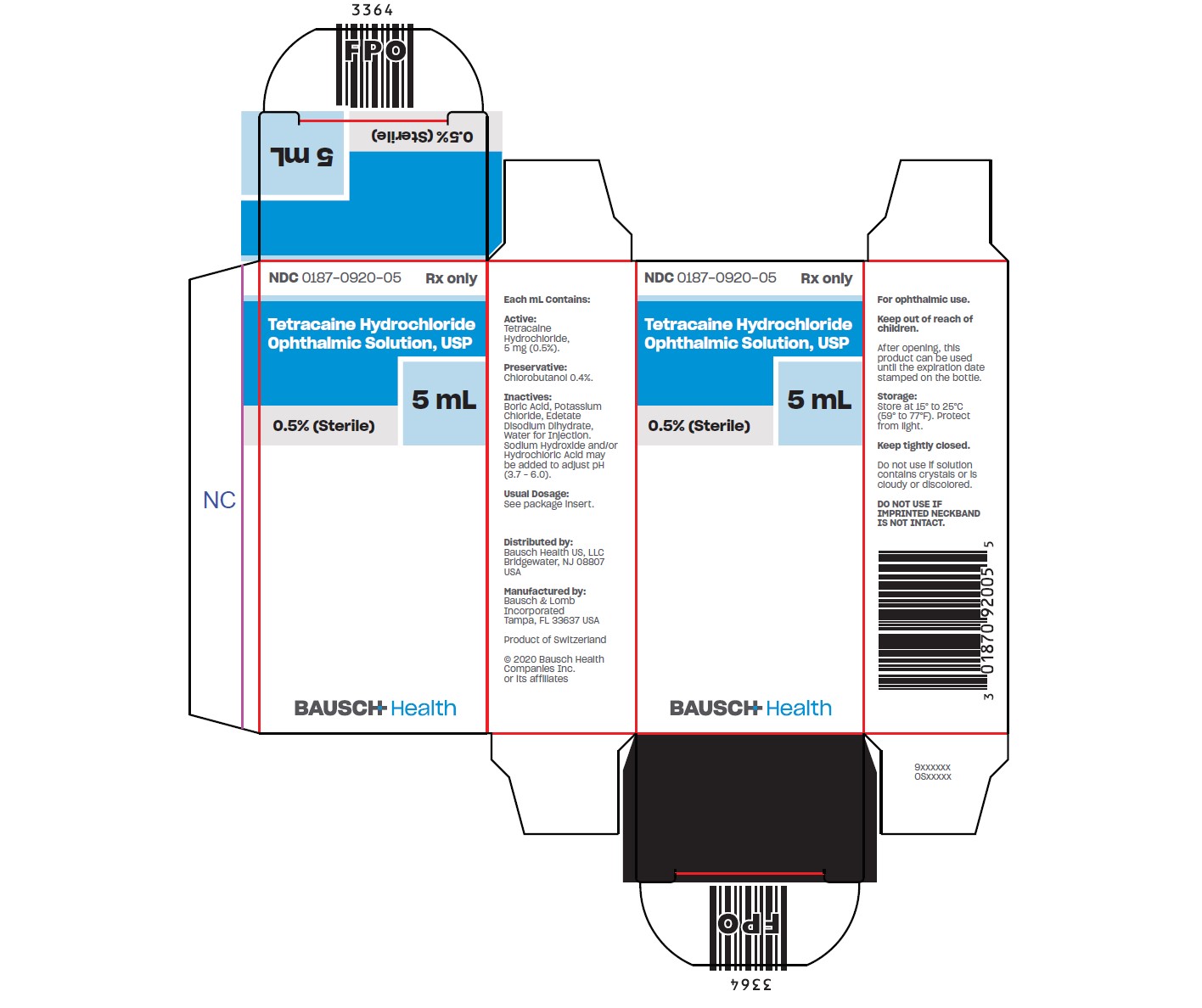
Tetracaine Hydrochloride 5 mg/mL Solution/ Drops — NDC 0187-0920-05 (Billing 00187-0920-05)
This is a package of Tetracaine Hydrochloride 5 mg/mL Solution/ Drops from Bausch Health US LLC, marketed since Jun 2019 and currently FDA-listed, this package's marketing is listed to end Apr 2027. It is this product's only package size.
Identity & classification
Regulatory identifiers FDA, NLM and CMS codes for this package
- RxCUI (RxNorm): 1547771
Where does this data come from?
- FDA openFDA NDC Directory · synced Oct 1, 2026
- FDA label on DailyMed · label index refreshed Oct 1, 2026
- RxNorm (NLM RxNav) · catalog refreshed Oct 1, 2026
- Medi-Span GPI (licensed)
- First Databank (licensed) · refreshed Oct 1, 2026
RxNorm drug class
This medicine belongs to the Ester Local Anesthetic class.
Where does this data come from?
- RxClass (NLM) · catalog refreshed Oct 1, 2026
Clinical
Patient education
Supplement & herbal interactions
Where does this data come from?
- MedlinePlus (NLM) · refreshed Oct 1, 2026
- FDA label on DailyMed · label index refreshed Oct 1, 2026
Ask a licensed pharmacist directly — free, answered by our team.
Pricing
A drug doesn't have one price. Each row is a different public payment system, and none is what you'd pay at the counter — that depends on your insurance. The ⓘ on each row explains what it measures.
| Price system | Per mL | Per package |
|---|---|---|
| Retail pharmacies payNADAC · weekly | Not in the retail survey — common for institutional, discontinued, or low-volume packs. | |
| Medicaid paysCMS SDUD · 12 mo | No recent Medicaid claims on file for this NDC — rare and low-volume NDCs are suppressed in the public data. | |
| Medicare drug plans payPart D · quarterly | No Part D plan price is available for this NDC in our data. | |
Where does this data come from?
- CMS NADAC weekly file
- CMS ASP pricing files · refreshed Sep 20, 2026
- CMS Medicaid State Drug Utilization Data · refreshed Oct 2, 2026
- CMS Part D plan pricing files · refreshed Sep 24, 2026
- VA National Acquisition Center price file
Packaging — all sizes for this product
| Package NDC | Description | Marketing start | Marketing end | Status |
|---|---|---|---|---|
| 00187-0920-05 You're viewing this Main listing | 1 BOTTLE in 1 CARTON / 5 mL in 1 BOTTLE | 2020-04-05 | Apr 30, 2027 | Active |
Therapeutic equivalents
| Product | Labeler | Pack | NADAC/unit | TE | Status | Price vs. this |
|---|---|---|---|---|---|---|
| Tetracaine Hydrochloride 5 mg/mL 70069-0596-01 | Somerset | 1 bottle | $4.330 | AB1 | Availability likely | — |
| Tetracaine Hydrochloride 5 mg/mL 82260-0920-05 | Bausch | 1 bottle | $4.330 | AB1 | Availability likely | — |
| Tetracaine Hydrochloride 5 mg/mL 00065-0741-14 | Alcon | 1 bottle | — | — | FDA listed | — |
| Tetracaine Hydrochloride 5 mg/mLthis 00187-0920-05 | Bausch | 1 bottle | — | AB1 | FDA listed | — |
| Tetracaine Hydrochloride 5 mg/mL 24208-0092-05 | Bausch | 1 bottle | — | AB1 | FDA listed | — |
| Tetracaine Hydrochloride 5 mg/mL 50090-2364-01 | A-S | 4 ml | — | — | FDA listed | — |
| Tetracaine Hydrochloride 5 mg/mL 68682-0920-05 | Oceanside | 1 bottle | — | AB1 | FDA listed | — |
| Tetracaine Hydrochloride 5 mg/mL 70069-0597-01 | Somerset | 1 bottle | — | AB1 | FDA listed | — |
| Tetracaine Hydrochloride 5 mg/mL 70518-4183-00 | REMEDYREPACK | 12 bottles | — | — | FDA listed | — |
| Tetracaine Hydrochloride 5 mg/mL 85766-0229-05 | Sportpharm | 1 bottle | — | AB1 | FDA listed | — |
| Tetracaine Hydrochloride 5 mg/mL 85766-0230-15 | Sportpharm | 1 bottle | — | AB1 | FDA listed | — |
Where does this data come from?
- FDA openFDA NDC Directory · synced Oct 1, 2026
- FDA Orange Book · refreshed Sep 3, 2026
- CMS NADAC weekly file
Availability & generic status
FDA-approved generic versions are listed, and recent pricing/market data suggests they may be available — see Therapeutic equivalents.
Where does this data come from?
- FDA Orange Book · refreshed Sep 3, 2026
Inactive Ingredients / Excipients
Inactive ingredients, also called excipients, are components of the drug product other than the active ingredient. They may include fillers, dyes, coatings, preservatives, flavors, or other formulation ingredients.
💡 Tap an ingredient (hover on desktop) to see what it is and why it’s used.
-
UNII R57ZHV85D4
Boric acid is a weak acid derived from boron. In medicines, it typically serves as a buffer to help maintain the product's pH level and may act as a preservative in certain formulations.
-
UNII HM4YQM8WRC
Chlorobutanol is a colorless crystalline chemical used as a preservative in medicines. It prevents bacterial and fungal growth to maintain product safety and shelf life.
-
UNII 7FLD91C86K
Edetate disodium is a chemical compound that binds and removes certain metal ions. In medicines, it acts as a preservative and stabilizer by preventing metals like calcium from interfering with the product's shelf life and consistency.
-
UNII QTT17582CB
A strong acid used to adjust and maintain the proper pH level in liquid medicines, ensuring stability and preventing breakdown of active ingredients.
-
UNII 660YQ98I10
Potassium chloride is a mineral salt used in medicines as a buffer and to help maintain the proper pH balance and stability of the formulation during storage and use.
-
UNII 55X04QC32I
A strong alkaline chemical used to adjust and maintain the pH balance of liquid medicines. It helps keep the medicine stable and ensures it stays effective during storage.
-
UNII 059QF0KO0R
Water is a liquid solvent that dissolves and mixes ingredients together in liquid medicines, syrups, and injections. It helps distribute the active drug evenly throughout the product.
7 inactive ingredients listed in the exact product block matched to this NDC.
Where does this data come from?
ingredient classCode="IACT" elements from the exact product block matched by this NDC. Label-section narrative from DailyMed / the openFDA label index is shown separately when available.- FDA label on DailyMed · label index refreshed Oct 1, 2026
- FDA openFDA NDC Directory · synced Oct 1, 2026
Inactive ingredient FAQ
Are inactive ingredients the same for every manufacturer?
Why might an inactive ingredient be missing?
Can inactive ingredients matter?
Manufacturer & labeler
Where does this data come from?
- FDA openFDA NDC Directory · synced Oct 1, 2026
- Drugs@FDA
Full prescribing information FDA SPL
🎯 Indications and Usage ▾
1 INDICATIONS AND USAGE Tetracaine Hydrochloride Ophthalmic Solution, USP 0.5% is indicated for procedures requiring a rapid and short-acting topical ophthalmic anesthetic. Tetracaine Hydrochloride Ophthalmic Solution, USP 0.5%, is an ester local anesthetic indicated for procedures requiring a rapid and short-acting topical ophthalmic anesthetic. ( 1 )
⏱️ Dosage and Administration ▾
2 DOSAGE AND ADMINISTRATION One drop topically in the eye(s) as needed. One drop topically in the eye(s) as needed. ( 2 )
💊 Dosage Forms and Strengths ▾
3 DOSAGE FORMS AND STRENGTHS Tetracaine Hydrochloride Ophthalmic Solution, USP 0.5% is a clear, colorless, ophthalmic solution containing 0.5% w/v tetracaine hydrochloride equivalent to tetracaine 0.44% w/v. Sterile, preserved, ophthalmic solution containing 0.5% tetracaine hydrochloride. ( 3 )
⛔ Contraindications ▾
4 CONTRAINDICATIONS Tetracaine Hydrochloride Ophthalmic Solution, USP 0.5% should not be used in patients with a history of hypersensitivity to any component of this preparation. Tetracaine Hydrochloride Ophthalmic Solution, USP 0.5%, should not be used in patients with a history of hypersensitivity to any component of this preparation. ( 4 )
⚠️ Warnings and Cautions ▾
5 WARNINGS AND PRECAUTIONS Do not use intracamerally since use may damage corneal endothelial cells. ( 5.1 ) Prolonged use or abuse may lead to corneal epithelial toxicity and may manifest as epithelial defects which may progress to permanent corneal damage. ( 5.2 ) Patients should not touch the eye for at least 10-20 minutes after using anesthetic as accidental injuries can occur due to insensitivity of the eye. ( 5.3 )
5.1Corneal Injury with Intracameral Use Not for injection or intraocular use. Do not use intracamerally because use of Tetracaine Hydrochloride Ophthalmic Solution, USP 0.5% may lead to damage of the corneal endothelial cells.
5.2Corneal Toxicity Prolonged use or abuse may lead to corneal epithelial toxicity and may manifest as epithelial defects which may progress to permanent corneal damage.
5.3Corneal Injury due to Insensitivity Patients should not touch the eye for at least 10-20 minutes after using anesthetic as accidental injuries can occur due to insensitivity of the eye.
🤒 Adverse Reactions ▾
6 ADVERSE REACTIONS The following serious ocular adverse reactions are described elsewhere in the labeling: Corneal Injury with Intracameral Use [See Warnings and Precautions ( 5.1 )] Corneal Toxicity [See Warnings and Precautions ( 5.2 )] Corneal Injury due to Insensitivity [See Warnings and Precautions ( 5.3 )] The following adverse reactions have been identified following use of Tetracaine Hydrochloride Ophthalmic Solution, USP 0.5%. Because these reactions are reported voluntarily from a population of uncertain size, it is not always possible to reliably estimate their frequency or establish a causal relationship to drug exposure.
Ocular Adverse Reactions Transient stinging, burning, and conjunctival redness, eye irritation, eye pain, ocular discomfort. Ocular adverse events: transient stinging, burning, conjunctival redness, eye irritation, eye pain, ocular discomfort. ( 6 ) To report SUSPECTED ADVERSE REACTIONS, contact Bausch Health US, LLC at 1-800-321-4576 or FDA at 1-800-FDA-1088 or www.fda.gov/medwatch.
👥 Use in Specific Populations ▾
8 USE IN SPECIFIC POPULATIONS
8.1Pregnancy Risk Summary There are no adequate and well-controlled studies with Tetracaine Hydrochloride Ophthalmic Solution, USP 0.5% in pregnant women. Animal developmental and reproductive toxicity studies with tetracaine hydrochloride have not been reported in the published literature.
8.2Lactation Risk Summary There are no data to assess whether Tetracaine Hydrochloride Ophthalmic Solution, USP 0.5% is excreted in human milk or to assess its effects on milk production/excretion. The developmental and health benefits of breastfeeding should be considered along with the mother’s clinical need for Tetracaine Hydrochloride Ophthalmic Solution, USP 0.5% and any potential adverse effects on the breastfed child from Tetracaine Hydrochloride Ophthalmic Solution, USP 0.5%.
8.3Females and Males of Reproductive Potential No human data on the effect of Tetracaine Hydrochloride Ophthalmic Solution, USP 0.5% on fertility are available.
8.4Pediatric Use Safety of Tetracaine Hydrochloride Ophthalmic Solution, USP 0.5% in the pediatric population has been demonstrated in clinical trials. Efficacy of Tetracaine Hydrochloride Ophthalmic Solution, USP 0.5% for use in pediatric patients has been extrapolated from adequate and well controlled clinical trials in the adult population.
8.5Geriatric Use No overall differences in safety or effectiveness of Tetracaine Hydrochloride Ophthalmic Solution, USP 0.5% have been observed between elderly and younger patients.
🤰 Pregnancy ▾
8.1Pregnancy Risk Summary There are no adequate and well-controlled studies with Tetracaine Hydrochloride Ophthalmic Solution, USP 0.5% in pregnant women. Animal developmental and reproductive toxicity studies with tetracaine hydrochloride have not been reported in the published literature.
🧒 Pediatric Use ▾
8.4Pediatric Use Safety of Tetracaine Hydrochloride Ophthalmic Solution, USP 0.5% in the pediatric population has been demonstrated in clinical trials. Efficacy of Tetracaine Hydrochloride Ophthalmic Solution, USP 0.5% for use in pediatric patients has been extrapolated from adequate and well controlled clinical trials in the adult population.
🧓 Geriatric Use ▾
8.5Geriatric Use No overall differences in safety or effectiveness of Tetracaine Hydrochloride Ophthalmic Solution, USP 0.5% have been observed between elderly and younger patients.
🆘 Overdosage ▾
10 OVERDOSAGE Prolonged use of a topical ocular anesthetic including Tetracaine Hydrochloride Ophthalmic Solution, USP 0.5% may produce permanent corneal opacification and ulceration with accompanying visual loss.
🧬 Clinical Pharmacology ▾
12 CLINICAL PHARMACOLOGY
12.1Mechanism of Action Tetracaine blocks sodium ion channels required for the initiation and conduction of neuronal impulses thereby affecting local anesthesia.
12.3Pharmacokinetics The systemic exposure to tetracaine following topical ocular administration of Tetracaine Hydrochloride Ophthalmic Solution, USP 0.5% has not been studied. Tetracaine hydrochloride is metabolized by plasma pseudocholinesterases and nonspecific esterases in ocular tissues.
🧬 Mechanism of Action ▾
12.1Mechanism of Action Tetracaine blocks sodium ion channels required for the initiation and conduction of neuronal impulses thereby affecting local anesthesia.
📦 How Supplied / Storage and Handling ▾
16 HOW SUPPLIED/STORAGE AND HANDLING Tetracaine Hydrochloride Ophthalmic Solution, USP 0.5% is supplied as a sterile, aqueous, topical ophthalmic solution in a low-density polyethylene plastic dropper bottle with a low-density polyethylene dropper tip and white polypropylene cap in the following sizes: NDC 0187-920-05 5 mL in a 7.5 mL Bottle After opening, this product can be used until the expiration date stamped on the bottle. Storage : Store at 15° to 25°C (59° to 77°F). Protect from light.
Do not use if solution contains crystals, cloudy, or discolored.
📋 Description ▾
11 DESCRIPTION Tetracaine Hydrochloride Ophthalmic Solution, USP 0.5% is a sterile, clear, colorless, topical local anesthetic for ophthalmic use only containing tetracaine hydrochloride as the active pharmaceutical ingredient. Tetracaine hydrochloride is chemically designated as benzoic acid, 4-(butylamino)-, 2-(dimethylamino) ethyl ester, monohydrochloride. Its chemical formula is C15H24N2O2 • HCl and it is represented by the chemical structure: Tetracaine hydrochloride is a fine, white, crystalline, odorless powder with a molecular weight of 300.82 Active ingredient : tetracaine hydrochloride 0.5% w/v (equivalent to 0.44% w/v tetracaine) Preservative : chlorobutanol 0.4% Inactive ingredients : boric acid, potassium chloride, edetate disodium dihydrate, water for injection.
Sodium hydroxide and/or hydrochloric acid may be added to adjust pH (3.7 – 6.0). chemstructure.jpg
💬 Information for Patients ▾
17 PATIENT COUNSELING INFORMATION Eye Care Precaution Do not touch the dropper tip to any surface as this may contaminate the solution. Advise patients that, due to the effect of the anesthetic, their eyes will be insensitive for up to 20 minutes and that care should be taken to avoid accidental injuries. Distributed by: Bausch Health US, LLC Bridgewater, NJ 08807 USA Manufactured by: Bausch & Lomb Incorporated Tampa, FL 33637 USA © 2020 Bausch Health Companies Inc. or its affiliates 9xxxxxx (Folded) 9xxxxxx (Flat)
🧬 Pharmacokinetics ▾
12.3Pharmacokinetics The systemic exposure to tetracaine following topical ocular administration of Tetracaine Hydrochloride Ophthalmic Solution, USP 0.5% has not been studied. Tetracaine hydrochloride is metabolized by plasma pseudocholinesterases and nonspecific esterases in ocular tissues.
🔬 Clinical Studies ▾
14 CLINICAL STUDIES Topical administration of Tetracaine Hydrochloride Ophthalmic Solution, USP 0.5% results in localized temporary anesthesia. The maximum effect is achieved within 10–20 seconds after instillation, with efficacy lasting 10–20 minutes. Duration of effect can be extended with repeated dosing. [See Warnings and Precautions ( 5.2 ) and Overdosage ( 10 )].
🧪 Nonclinical Toxicology ▾
13 NONCLINICAL TOXICOLOGY
13.1Carcinogenesis, Mutagenesis, Impairment of Fertility Studies to assess the genotoxicity of tetracaine hydrochloride have not been reported in the published literature. Long-term animal studies have not been conducted to evaluate the carcinogenic potential of tetracaine hydrochloride. Animal studies to assess the effects of tetracaine hydrochloride on fertility have not been reported in the published literature.
📄 Carcinogenesis, Mutagenesis, Impairment of Fertility ▾
13.1Carcinogenesis, Mutagenesis, Impairment of Fertility Studies to assess the genotoxicity of tetracaine hydrochloride have not been reported in the published literature. Long-term animal studies have not been conducted to evaluate the carcinogenic potential of tetracaine hydrochloride. Animal studies to assess the effects of tetracaine hydrochloride on fertility have not been reported in the published literature.
📄 Package Label / Principal Display Panel ▾
PACKAGE/LABEL PRINCIPAL DISPLAY PANEL- Carton 5 mL NDC 0187-0920-05 Rx only Tetracaine Hydrochloride Ophthalmic Solution, USP 0.05% (Sterile) 5 mL BAUSCH Health C:\Users\dale.iannetti\OneDrive - Valeant Pharmaceuticals North America, LLC\Documents\SPL Assignments\2020\Tetracaine B&L\carton.jpg
Reported adverse events (FAERS)
Top reported reactions
Age at onset
Reporter sex
Serious outcomes
Where does this data come from?
About this NDC listing & data coverage
What data is (and isn’t) available for this NDC — tap to expand
| NDC identity (package / product / labeler codes) | ✓ Available |
| Labeler | ✓ Available |
| Product & package description | ✓ Available |
| Marketing category & status | ✓ Available |
| Active ingredient / dosage form / route | ✓ Available |
| FDA label (SPL via DailyMed) | ✓ Available |
| Package photos | ✓ Available |
| Inactive ingredients (structured) | ✓ Available |
| NADAC pharmacy acquisition price (CMS) | — Not published for this NDC CMS publishes NADAC only for NDCs reported in its retail-pharmacy survey. |
| Orange Book / therapeutic-equivalence data | ✓ Available |
| HCPCS J-code billing crosswalk | — Not published for this NDC Most self-administered / retail products have no J-code — that is normal. |
| Medicaid utilization (CMS SDUD) | — Not published for this NDC CMS reports utilization only for NDCs with Medicaid claims above its privacy threshold. |