
DEXTROSE 5 g/100mL Solution — NDC 0264-7510-00 (Billing 00264-7510-00)
This is a package of DEXTROSE 5 g/100mL Solution from B. Braun Medical Inc., marketed since Feb 1988 and currently FDA-listed.
Other active recalls for Dextrose (different manufacturers) — 1 · tap to view
Identity & classification
Regulatory identifiers FDA, NLM and CMS codes for this package
Drug-database identifiers Medi-Span GPI and First Databank GCN / HICL / AHFS classification
- GSN (GCN sequence number): 001972
- GCN: 06641
- GPI-14 (Medi-Span): 80100020002015
- HICL (First Databank): 000915
- AHFS class code: 40:20.00.00
- RxCUI (RxNorm): 1795477
Where does this data come from?
- FDA openFDA NDC Directory · synced Oct 1, 2026
- FDA label on DailyMed · label index refreshed Oct 1, 2026
- RxNorm (NLM RxNav) · catalog refreshed Oct 1, 2026
- Medi-Span GPI (licensed)
- First Databank (licensed) · refreshed Oct 1, 2026
RxNorm drug class
This medicine belongs to the Other irrigating solutions class.
Where does this data come from?
- RxClass (NLM) · catalog refreshed Oct 1, 2026
Clinical
- Dextrose is essentially the same glucose your body gets from food, but in this case it's going directly into the bloodstream. That's important in two main situations: when blood su...
- Why is my loved one being given dextrose through an IV — isn't sugar just food?
- Yes, that's a real concern. Dextrose raises blood glucose, which is exactly what you need when blood sugar is too low. But if it's given too fast or in too high a concentration, it...
- Can dextrose actually cause high blood sugar? I thought it was for low blood sugar.
Patient education
Supplement & herbal interactions
Where does this data come from?
- MedlinePlus (NLM) · refreshed Oct 1, 2026
- FDA label on DailyMed · label index refreshed Oct 1, 2026
Ask a licensed pharmacist directly — free, answered by our team.
Pricing
A drug doesn't have one price. Each row is a different public payment system, and none is what you'd pay at the counter — that depends on your insurance. The ⓘ on each row explains what it measures.
| Price system | Per mL | Per package |
|---|---|---|
| Retail pharmacies payNADAC · weekly | Not in the retail survey — common for institutional, discontinued, or low-volume packs. | |
| Medicaid paysCMS SDUD · 12 mo | $0.0477 | $572.40 / 12000 ml |
| Medicare drug plans payPart D · Q2 2026 | $0.0214 | $256.80 / 12000 ml |
| Medicare Part B allowsASP · J7060 | $1.649 / J7060 unit | — |
Where does this data come from?
- CMS NADAC weekly file
- CMS ASP pricing files · refreshed Sep 20, 2026
- CMS Medicaid State Drug Utilization Data · through Q1 2026
- CMS Part D plan pricing files · refreshed Sep 24, 2026
- VA National Acquisition Center price file
Billing & reimbursement
Where does this data come from?
- CMS ASP NDC-HCPCS crosswalk · refreshed Sep 22, 2026
- DMEPDAC NDC-HCPCS crosswalk
- openFDA NSDE billing units · refreshed Sep 7, 2026
Packaging — all sizes for this product
| Package NDC | Description | Marketing start | Marketing end | Status |
|---|---|---|---|---|
| 00264-7510-00 You're viewing this | 12 CONTAINER in 1 CASE / 1000 mL in 1 CONTAINER | 1988-02-02 | — | Active |
| 00264-7510-10 0264-7510-10 | 24 CONTAINER in 1 CASE / 500 mL in 1 CONTAINER | 1988-02-02 | — | Active |
| 00264-7510-20 0264-7510-20 Main listing | 24 CONTAINER in 1 CASE / 250 mL in 1 CONTAINER | 1988-02-02 | — | Active |
This pack accounts for about 8.3% of this product's recent Medicaid fills; most go to a different pack size. See all packs ↓
Pack size FAQ
What quantity is in this package?
What NDC number is used to bill for this package of DEXTROSE 5 g/100mL Solution?
Therapeutic equivalents
| Product | Labeler | Pack | NADAC/unit | TE | Status | Price vs. this |
|---|---|---|---|---|---|---|
| Dextrose 5 g/100mLthis 00264-7510-00 | B. | 1000 ml | — | AP | FDA listed | — |
Where does this data come from?
- FDA openFDA NDC Directory · synced Oct 1, 2026
- FDA Orange Book · refreshed Sep 3, 2026
- CMS NADAC weekly file
Availability & generic status
The FDA lists approved generic versions of this medicine, but that does not always mean a pharmacy can get one today. Patent rules, launch agreements, supply and pricing can affect when generics actually arrive.
Where does this data come from?
- FDA Orange Book · refreshed Sep 3, 2026
Inactive Ingredients / Excipients
Inactive ingredients, also called excipients, are components of the drug product other than the active ingredient. They may include fillers, dyes, coatings, preservatives, flavors, or other formulation ingredients.
💡 Tap an ingredient (hover on desktop) to see what it is and why it’s used.
-
UNII 059QF0KO0R
Water is a liquid solvent that dissolves and mixes ingredients together in liquid medicines, syrups, and injections. It helps distribute the active drug evenly throughout the product.
1 inactive ingredient listed in the exact product block matched to this NDC.
Where does this data come from?
ingredient classCode="IACT" elements from the exact product block matched by this NDC. Label-section narrative from DailyMed / the openFDA label index is shown separately when available.- FDA label on DailyMed · label index refreshed Oct 1, 2026
- FDA openFDA NDC Directory · synced Oct 1, 2026
Inactive ingredient FAQ
Are inactive ingredients the same for every manufacturer?
Why might an inactive ingredient be missing?
Can inactive ingredients matter?
Manufacturer & labeler
Where does this data come from?
- FDA openFDA NDC Directory · synced Oct 1, 2026
- Drugs@FDA
Full prescribing information FDA SPL
🎯 Indications and Usage ▾
INDICATIONS AND USAGE These intravenous solutions are indicated for use in adults and pediatric patients as sources of calories and water for hydration.
⏱️ Dosage and Administration ▾
DOSAGE AND ADMINISTRATION These solutions are for intravenous use only. Dosage is to be directed by a physician and is dependent upon age, weight, clinical condition of the patient and laboratory determinations. Frequent laboratory determinations and clinical evaluation are essential to monitor changes in blood glucose and electrolyte concentrations, and fluid and electrolyte balance during prolonged parenteral therapy.
When a hypertonic solution is to be administered peripherally, it should be slowly infused through a small bore needle, placed well within the lumen of a large vein to minimize venous irritation. Carefully avoid infiltration. Fluid administration should be based on calculated maintenance or replacement fluid requirements for each patient.
Some additives may be incompatible. Consult with pharmacist. When introducing additives, use aseptic techniques.
Mix thoroughly. Do not store. Parenteral drug products should be inspected visually for particulate matter and discoloration prior to administration, whenever solution and container permit.
⛔ Contraindications ▾
CONTRAINDICATIONS Solutions containing dextrose may be contraindicated in patients with hypersensitivity to corn products.
⚠️ Warnings ▾
WARNINGS The administration of intravenous solutions can cause fluid and/or solute overload resulting in dilution of serum electrolyte concentrations, overhydration, congested states or pulmonary edema. The risk of dilutional states is inversely proportional to the electrolyte concentration. WARNING: Dextrose Injection USP contains aluminum that may be toxic.
Aluminum may reach toxic levels with prolonged parenteral administration if kidney function is impaired. Premature neonates are particularly at risk because their kidneys are immature, and they require large amounts of calcium and phosphate solutions, which contain aluminum. Research indicates that patients with impaired kidney function, including premature neonates, who receive parenteral levels of aluminum at greater than 4 to 5 mcg/kg/day accumulate aluminum at levels associated with central nervous system and bone toxicity.
Tissue loading may occur at even lower rates of administration. Prolonged infusion of isotonic or hypotonic dextrose in water may increase the volume of extracellular fluid and cause water intoxication. Solutions containing dextrose without electrolytes should not be administered simultaneously with blood through the same infusion set because of the possibility of agglomeration.
Excessive administration of potassium-free dextrose solutions may result in significant hypokalemia. Serum potassium levels should be maintained and potassium supplemented as required. In very low birth weight infants, excessive or rapid administration of dextrose injection may result in increased serum osmolality and possible intracerebral hemorrhage.
🤒 Adverse Reactions ▾
ADVERSE REACTIONS Reactions which may occur because of the solution or the technique of administration include febrile response, infection at the site of injection, venous thrombosis or phlebitis extending from the site of injection, extravasation and hypervolemia. Too rapid infusion of hypertonic solutions may cause local pain and venous irritation. Rate of administration should be adjusted according to tolerance.
Use of the largest peripheral vein and a small bore needle is recommended. (See DOSAGE AND ADMINISTRATION .) The physician should also be alert to the possibility of adverse reactions to drug additives. Prescribing information for drug additives to be administered in this manner should be consulted.
If an adverse reaction does occur, discontinue the infusion, evaluate the patient, institute appropriate therapeutic countermeasures, and save the remainder of the fluid for examination if deemed necessary.
🔄 Drug Interactions ▾
Drug Interactions Some additives may be incompatible. Consult with pharmacist. When introducing additives, use aseptic techniques. Mix thoroughly. Do not store.
🤰 Pregnancy ▾
Pregnancy Teratogenic Effects Animal reproduction studies have not been conducted with Dextrose Injections USP. It is also not known whether Dextrose Injections USP can cause fetal harm when administered to a pregnant woman or can affect reproduction capacity. Dextrose Injections USP should be given to a pregnant woman only if clearly needed.
🧒 Pediatric Use ▾
Pediatric Use In neonates or in very small infants even small volumes of fluid may affect fluid and electrolyte balance. Care must be exercised in treatment of neonates, especially pre-term neonates, whose renal function may be immature and whose ability to excrete fluid and solute loads may be limited. Fluid intake, urine output, and serum electrolytes should be monitored closely.
Serum glucose concentrations should be frequently monitored when dextrose is prescribed to pediatric patients, particularly infants, neonates, and low birth weight infants. See WARNINGS and DOSAGE AND ADMINISTRATION .
Pediatric Use There is no specific pediatric dose. The dose is dependent on weight, clinical condition, and laboratory results. Follow recommendations of appropriate pediatric reference text. (See WARNINGS and PRECAUTIONS .)
🧓 Geriatric Use ▾
Geriatric Use An evaluation of current literature revealed no clinical experience identifying differences in responses between the elderly and younger patients. In general, dose selection for an elderly patient should be cautious, usually starting at the low end of the dosing range, reflecting the greater frequency of decreased hepatic, renal, or cardiac function, and of concomitant disease or other drug therapy. These drugs are known to be substantially excreted by the kidney, and the risk of toxic reactions to these drugs may be greater in patients with impaired renal function.
Because elderly patients are more likely to have decreased renal function, care should be taken in dose selection, and it may be useful to monitor renal function. See WARNINGS .
🆘 Overdosage ▾
OVERDOSAGE In the event of a fluid or solute overload during parenteral therapy, reevaluate the patient's condition and institute appropriate corrective treatment.
🧬 Clinical Pharmacology ▾
CLINICAL PHARMACOLOGY Dextrose Injections USP provide calories and are a source of water for hydration. They are capable of inducing diuresis depending on the clinical condition of the patient. Dextrose is readily metabolized, may decrease losses of body protein and nitrogen, promotes glycogen deposition and decreases or prevents ketosis if sufficient doses are provided.
Water is an essential constituent of all body tissues and accounts for approximately 70% of total body weight. Average normal adult daily requirements range from two to three liters (1.0 to 1.5 liters each for insensible water loss by perspiration and urine production).
📦 How Supplied / Storage and Handling ▾
HOW SUPPLIED Dextrose Injections USP are supplied sterile and nonpyrogenic in EXCEL ® Containers. The 1000 mL containers are packaged 12 per case, the 500 mL and 250 mL containers are packaged 24 per case. NDC REF Size 5% Dextrose Injection USP (Canada DIN 01924281) 0264-7510-00 L5100 1000 mL 0264-7510-10 L5101 500 mL 0264-7510-20 L5102 250 mL 10% Dextrose Injection USP (Canada DIN 01924427) 0264-7520-00 L5200 1000 mL 0264-7520-10 L5201 500 mL 0264-7520-20 L5202 250 mL Exposure of pharmaceutical products to heat should be minimized.
Avoid excessive heat. Protect from freezing. It is recommended that the product be stored at room temperature (25°C); however, brief exposure up to 40°C does not adversely affect the product.
📦 Storage and Handling ▾
Exposure of pharmaceutical products to heat should be minimized. Avoid excessive heat. Protect from freezing. It is recommended that the product be stored at room temperature (25°C); however, brief exposure up to 40°C does not adversely affect the product.
📋 Description ▾
DESCRIPTION Each 100 mL of 5% Dextrose Injection USP contains: Hydrous Dextrose USP 5 g; Water for Injection USP qs pH: 4.4 (3.5–6.5); Calculated Osmolarity: 250 mOsmol/liter Calories per liter: 170 Each 100 mL of 10% Dextrose Injection USP contains: Hydrous Dextrose USP 10 g; Water for Injection USP qs pH: 4.4 (3.5–6.5); Calculated Osmolarity: 505 mOsmol/liter, hypertonic Calories per liter: 340 Dextrose Injections USP are sterile, nonpyrogenic and contain no bacteriostatic or antimicrobial agents. These products are intended for intravenous administration.
The formula of the active ingredient is: Ingredient Molecular Formula Molecular Weight Hydrous Dextrose USP 198.17 Not made with natural rubber latex, PVC or DEHP. The plastic container is made from a multilayered film specifically developed for parenteral drugs. It contains no plasticizers and exhibits virtually no leachables.
The solution contact layer is a rubberized copolymer of ethylene and propylene. The container is nontoxic and biologically inert. The container-solution unit is a closed system and is not dependent upon entry of external air during administration.
The container is overwrapped to provide protection from the physical environment and to provide an additional moisture barrier when necessary. Addition of medication should be accomplished using complete aseptic technique. The closure system has two ports; the one for the administration set has a tamper evident plastic protector and the other is a medication addition site.
Refer to the Directions for Use of the container. Chemical Structure
⚠️ Precautions ▾
PRECAUTIONS General These solutions should be used with care in patients with hypervolemia, renal insufficiency, urinary tract obstruction, or impending or frank cardiac decompensation. Solutions containing dextrose should be used with caution in patients with overt or known subclinical diabetes mellitus or carbohydrate intolerance for any reason. Essential electrolytes, minerals, and vitamins should be supplied as needed.
Hypokalemia may develop during parenteral administration of hypertonic dextrose solutions. Sufficient amounts of potassium should be added to dextrose solutions administered to fasting patients with good renal function, especially those on digitalis therapy. To minimize the risk of possible incompatibilities arising from mixing this solution with other additives that may be prescribed, the final infusate should be inspected for cloudiness or precipitation immediately after mixing, prior to administration, and periodically during administration.
Do not use plastic containers in series connection. If administration is controlled by a pumping device, care must be taken to discontinue pumping action before the container runs dry or air embolism may result. If administration is not controlled by a pumping device, refrain from applying excessive pressure (>300mmHg) causing distortion to the container such as wringing or twisting.
Such handling could result in breakage of the container. These solutions are intended for intravenous administration using sterile equipment. It is recommended that intravenous administration apparatus be replaced at least once every 24 hours.
Use only if solution is clear and container and seals are intact. Dextrose Injection USP contains no more than 25 mcg/L of aluminum. Laboratory Tests Clinical evaluation and periodic laboratory determinations are necessary to monitor changes in fluid balance, electrolyte concentrations, and acid-base balance during prolonged parenteral therapy or whenever the condition of the patient warrants such evaluation.
Significant deviations from normal concentrations may require tailoring of the electrolyte pattern, in these or alternative solutions. Drug Interactions Some additives may be incompatible. Consult with pharmacist.
When introducing additives, use aseptic techniques. Mix thoroughly. Do not store.
Carcinogenesis, Mutagenesis, Impairment of Fertility Studies with Dextrose Injections USP have not been performed to evaluate carcinogenic potential, mutagenic potential or effects on fertility. Pregnancy Teratogenic Effects Animal reproduction studies have not been conducted with Dextrose Injections USP. It is also not known whether Dextrose Injections USP can cause fetal harm when administered to a pregnant woman or can affect reproduction capacity.
Dextrose Injections USP should be given to a pregnant woman only if clearly needed. Labor and Delivery As reported in the literature, dextrose solutions have been administered during labor and delivery. Caution should be exercised, and the fluid balance, glucose and electrolyte concentrations and acid-base balance, of both mother and fetus should be evaluated periodically or whenever warranted by the condition of the patient or fetus.
Nursing Mothers Because many drugs are excreted in human milk, caution should be exercised when Dextrose Injections USP are administered to a nursing woman. Pediatric Use In neonates or in very small infants even small volumes of fluid may affect fluid and electrolyte balance. Care must be exercised in treatment of neonates, especially pre-term neonates, whose renal function may be immature and whose ability to excrete fluid and solute loads may be limited.
Fluid intake, urine output, and serum electrolytes should be monitored closely. Serum glucose concentrations should be frequently monitored when dextrose is prescribed to pediatric patients, particularly infants, neonates, and low birth weight infants. See WARNINGS and DOSAGE AND ADMINISTRATION .
Geriatric Use An evaluation… [Excerpted — this section continues on DailyMed.]
🍼 Nursing Mothers ▾
Nursing Mothers Because many drugs are excreted in human milk, caution should be exercised when Dextrose Injections USP are administered to a nursing woman.
📄 Carcinogenesis, Mutagenesis, Impairment of Fertility ▾
Carcinogenesis, Mutagenesis, Impairment of Fertility Studies with Dextrose Injections USP have not been performed to evaluate carcinogenic potential, mutagenic potential or effects on fertility.
📄 Patient Package Insert ▾
Directions for Use of EXCEL ® Container Caution: Do not use plastic containers in series connection. To Open Tear overwrap down at notch and remove solution container. Check for minute leaks by squeezing solution container firmly.
If leaks are found, discard solution as sterility may be impaired. If supplemental medication is desired, follow directions below before preparing for administration. NOTE : Before use, perform the following checks: Inspect each container.
Read the label. Ensure solution is the one ordered and is within the expiration date. Invert container and carefully inspect the solution in good light for cloudiness, haze, or particulate matter.
Any container which is suspect should not be used. Use only if solution is clear and container and seals are intact. Preparation for Administration Remove plastic protector from sterile set port at bottom of container.
Attach administration set. Refer to complete directions accompanying set. To Add Medication Warning: Some additives may be incompatible.
To Add Medication Before Solution Administration Prepare medication site. Using syringe with 18–22 gauge needle, puncture medication port and inner diaphragm and inject. Squeeze and tap ports while ports are upright and mix solution and medication thoroughly.
To Add Medication During Solution Administration Close clamp on the set. Prepare medication site. Using syringe with 18–22 gauge needle of appropriate length (at least 5/8 inch), puncture resealable medication port and inner diaphragm and inject.
Remove container from IV pole and/or turn to an upright position. Evacuate both ports by tapping and squeezing them while container is in the upright position. Mix solution and medication thoroughly.
Return container to in use position and continue administration.
📄 Package Label / Principal Display Panel ▾
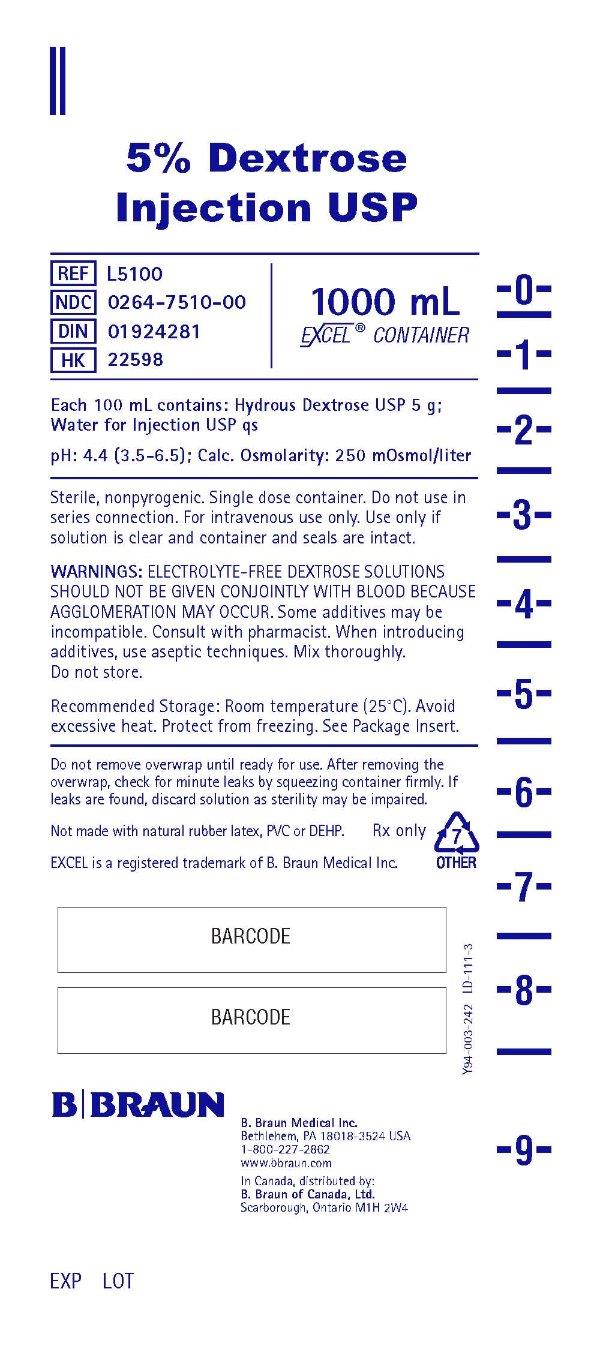
PRINCIPAL DISPLAY PANEL - 1000 mL Container Label 5% Dextrose Injection USP REF L5100 NDC 0264-7510-00 DIN 01924281 HK 22598 1000 mL EXCEL ® CONTAINER Each 100 mL contains: Hydrous Dextrose USP 5 g; Water for Injection USP qs pH: 4.4 (3.5-6.5); Calc. Osmolarity: 250 mOsmol/liter Sterile, nonpyrogenic. Single dose container.
Do not use in series connection. For intravenous use only. Use only if solution is clear and container and seals are intact.
WARNINGS: ELECTROLYTE-FREE DEXTROSE SOLUTIONS SHOULD NOT BE GIVEN CONJOINTLY WITH BLOOD BECAUSE AGGLOMERATION MAY OCCUR. Some additives may be incompatible. Consult with pharmacist.
When introducing additives, use aseptic techniques. Mix thoroughly. Do not store.
Recommended Storage: Room temperature (25°C). Avoid excessive heat. Protect from freezing.
See Package Insert. Do not remove overwrap until ready for use. After removing the overwrap, check for minute leaks by squeezing container firmly.
If leaks are found, discard solution as sterility may be impaired. Not made with natural rubber latex, PVC or DEHP. Rx only EXCEL is a registered trademark of B.
Braun Medical Inc. 7 OTHER B. Braun Medical Inc.
Bethlehem, PA 18018-3524 USA 1-800-227-2862 www.bbraun.com In Canada, distributed by: B. Braun of Canada, Ltd. Scarborough, Ontario M1H 2W4 Y94-003-242 LD-111-3 EXP LOT 1000 mL Container Label L5100
PRINCIPAL DISPLAY PANEL - 500 mL Container Label 5% Dextrose Injection USP REF L5101 NDC 0264-7510-10 DIN 01924281 HK 22598 500 mL EXCEL ® CONTAINER Each 100 mL contains: Hydrous Dextrose USP 5 g; Water for Injection USP qs pH: 4.4 (3.5-6.5); Calc. Osmolarity: 250 mOsmol/liter Sterile, nonpyrogenic. Single dose container.
Do not use in series connection. For intravenous use only. Use only if solution is clear and container and seals are intact.
WARNINGS: ELECTROLYTE-FREE DEXTROSE SOLUTIONS SHOULD NOT BE GIVEN CONJOINTLY WITH BLOOD BECAUSE AGGLOMERATION MAY OCCUR. Some additives may be incompatible. Consult with pharmacist.
When introducing additives, use aseptic techniques. Mix thoroughly. Do not store.
Recommended Storage: Room temperature (25°C). Avoid excessive heat. Protect from freezing.
See Package Insert. Do not remove overwrap until ready for use. After removing the overwrap, check for minute leaks by squeezing container firmly.
If leaks are found, discard solution as sterility may be impaired. Not made with natural rubber latex, PVC or DEHP. Rx only 7 OTHER EXCEL is a registered trademark of B.
Braun Medical Inc. B. Braun Medical Inc.
Bethlehem, PA 18018-3524 USA 1-800-227-2862 www.bbraun.com In Canada, distributed by: B. Braun of Canada, Ltd. Scarborough, Ontario M1H 2W4 Y94-003-240 LD-118-3 EXP LOT Y94-003-240 Y94-003-240
PRINCIPAL DISPLAY PANEL - 250 mL Container Label 5% Dextrose Injection USP REF L5102 NDC 0264-7510-20 DIN 01924281 HK 22598 250 mL EXCEL ® CONTAINER Each 100 mL contains: Hydrous Dextrose USP 5 g; Water for Injection USP qs pH: 4.4 (3.5-6.5); Calc. Osmolarity: 250 mOsmol/liter Sterile, nonpyrogenic. Single dose container.
Do not use in series connection. For intravenous use only. Use only if solution is clear and container and seals are intact.
WARNINGS: ELECTROLYTE-FREE DEXTROSE SOLUTIONS SHOULD NOT BE GIVEN CONJOINTLY WITH BLOOD BECAUSE AGGLOMERATION MAY OCCUR. Some additives may be incompatible. Consult with pharmacist.
When introducing additives, use aseptic techniques. Mix thoroughly. Do not store.
Recommended Storage: Room temperature (25°C). Avoid excessive heat. Protect from freezing.
See Package Insert. Do not remove overwrap until ready for use. After removing the overwrap, check for minute leaks by squeezing container firmly.
If leaks are found, discard solution as sterility may be impaired. Not made with natural rubber latex, PVC or DEHP. Rx only EXCEL is a registered trademark of B.
Braun Medical Inc. 7 OTHER B. Braun Medical Inc.
Bethlehem, PA 18018-3524 USA 1-800-227-2862 www.bbraun.com In Canada, distributed by: B. Braun of Canada, Ltd. Scarbor… [Excerpted — this section continues on DailyMed.]
Medicaid utilization & spend
Medicaid utilization by pack size
About this NDC listing & data coverage
What data is (and isn’t) available for this NDC — tap to expand
| NDC identity (package / product / labeler codes) | ✓ Available |
| Labeler | ✓ Available |
| Product & package description | ✓ Available |
| Marketing category & status | ✓ Available |
| Active ingredient / dosage form / route | ✓ Available |
| FDA label (SPL via DailyMed) | ✓ Available |
| Package photos | ✓ Available |
| Inactive ingredients (structured) | ✓ Available |
| NADAC pharmacy acquisition price (CMS) | — Not published for this NDC CMS publishes NADAC only for NDCs reported in its retail-pharmacy survey. |
| Orange Book / therapeutic-equivalence data | ✓ Available |
| HCPCS J-code billing crosswalk | ✓ Available |
| Medicaid utilization (CMS SDUD) | ✓ Available |