
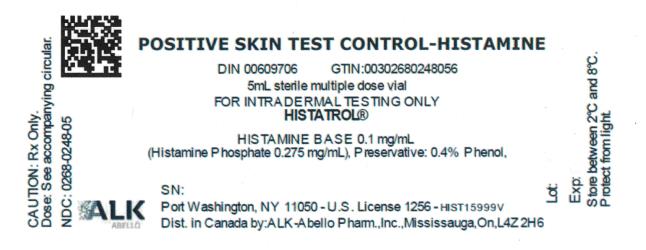
histamine positive skin test control histamine phosphate .275 mg/mL Injection, Solution, 5 mL
🆔 Identity & classification
Where does this data come from?
🏭 Manufacturer & labeler
Where does this data come from?
🩺 Clinical
Patient education
Supplement & herbal interactions
Where does this data come from?
Ask a licensed pharmacist directly — free, answered by our team.
🧪 Inactive Ingredients / Excipients
Inactive ingredients, also called excipients, are components of the drug product other than the active ingredient. They may include fillers, dyes, coatings, preservatives, flavors, or other formulation ingredients.
💡 Tap an ingredient (hover on desktop) to see what it is and why it’s used.
-
UNII QTT17582CB
A strong acid used to adjust and maintain the proper pH level in liquid medicines, ensuring stability and preventing breakdown of active ingredients.
-
0.004 mL / 1 mL
UNII 339NCG44TV
Phenol is a chemical compound derived from coal tar or petroleum. It serves as a preservative and antimicrobial agent in medicines, helping prevent bacterial and fungal growth to keep the product stable and safe during storage.
-
UNII 55X04QC32I
A strong alkaline chemical used to adjust and maintain the pH balance of liquid medicines. It helps keep the medicine stable and ensures it stays effective during storage.
3 inactive ingredients listed in the exact product block matched to this NDC.
Where does this data come from?
ingredient classCode="IACT" elements from the exact product block matched by this NDC. Label-section narrative from DailyMed / the openFDA label index is shown separately when available.Inactive ingredient FAQ
Are inactive ingredients the same for every manufacturer?
Why might an inactive ingredient be missing?
Can inactive ingredients matter?
💲 Pricing
A drug doesn't have one price. Each row is a different public payment system, and none is what you'd pay at the counter — that depends on your insurance. The ⓘ on each row explains what it measures.
| Price system | Per mL | Per package |
|---|---|---|
| Retail pharmacies payNADAC · weekly | Not in the retail survey — common for institutional, discontinued, or low-volume packs. | |
| Medicaid paysCMS SDUD · 12 mo | No recent Medicaid claims on file for this NDC — rare and low-volume NDCs are suppressed in the public data. | |
| Medicare drug plans payPart D · quarterly | No Part D plan price is available for this NDC in our data. | |
Where does this data come from?
🔁 Therapeutic equivalents
| Product | Labeler | Pack | NADAC/unit | TE | Status | Price vs. this |
|---|---|---|---|---|---|---|
| histamine positive skin test control .275 mg/mLthis 00268-0248-05 | ALK-Abello, | 5 ml | — | — | FDA listed | — |
Where does this data come from?
⏳ Availability & biosimilar status
Biologics have no small-molecule generics; biosimilar competition is tracked in the FDA Purple Book.
Where does this data come from?
🔬 Reported adverse events (FAERS)
Top reported reactions
Age at onset
Reporter sex
Where does this data come from?
📦 Packaging — all sizes for this product
| Package NDC | Description | Marketing start | Status |
|---|---|---|---|
| 00268-0248-05 You're viewing this | 5 mL in 1 VIAL, MULTI-DOSE (0268-0248-05) | 1989-10-23 | Active |
🧭 About this NDC listing & data coverage
What data is (and isn’t) available for this NDC — tap to expand
| NDC identity (package / product / labeler codes) | ✓ Available |
| Labeler | ✓ Available |
| Product & package description | ✓ Available |
| Marketing category & status | ✓ Available |
| Active ingredient / dosage form / route | ✓ Available |
| FDA label (SPL via DailyMed) | ✓ Available |
| Package photos | ✓ Available |
| Inactive ingredients (structured) | ✓ Available |
| NADAC pharmacy acquisition price (CMS) | — Not published for this NDC CMS publishes NADAC only for NDCs reported in its retail-pharmacy survey. |
| Orange Book / therapeutic-equivalence data | — Not published for this NDC Applies only to products approved under an NDA/ANDA; many listings are out of scope. |
| HCPCS J-code billing crosswalk | — Not published for this NDC Most self-administered / retail products have no J-code — that is normal. |
| Medicaid utilization (CMS SDUD) | — Not published for this NDC CMS reports utilization only for NDCs with Medicaid claims above its privacy threshold. |
Questions about this listing
Why is there no price listed?
Is the NDC printed on the package the same as the 11-digit billing NDC?
What do the three segments of this NDC mean?
Is this package still being marketed?
Who lists this product with the FDA?
Do I need a prescription for this product?
Where does this data come from?
📄 Full prescribing information FDA SPL
🎯 Indications and Usage ▾
INDICATIONS AND USAGE For use as a positive control in evaluation of allergenic (immediate hypersensitivity or "Type I") skin testing.
⏱️ Dosage and Administration ▾
DOSAGE AND ADMINISTRATION Parenteral drug products should be inspected visually for particulate matter and discoloration prior to administration, whenever solution and container permit. For Prick, Puncture and Scratch Testing Histamine base 1 mg/mL (Histamine Phosphate 2.75 mg/mL) should be used to give a reaction. (Refer to Interpretation Section.) Prick, Puncture or Scratch Test Techniques The skin in the test area should be cleansed with alcohol and air dried.
The histamine control skin test solution should be placed at the same site with the other skin test antigens, either on the patient's back or on the volar surface of the forearm. The patient should be placed in a comfortable position before the testing is begun. For the prick test, a sharp needle is used to puncture the skin, but not to draw blood.
If the scratch test is used, carefully break or scratch the skin with a sterile scarifier. Do not draw blood. Each scratch should be about 2 mm - 4 mm in length.
A small drop of the histamine base 1 mg/mL (Histamine Phosphate 2.75 mg/mL) is placed on the abraded skin site no closer than 4 or 5 cm from an adjacent test site. Some physicians prefer to place the solution on the test area and then prick through the drop with a sharp needle. Use a separate sterile scarifier or needle for each patient.
The test should be read at 15 minutes; if a large wheal reaction occurs before that time the test site should be wiped free of histamine. Interpretation The patient's response is based on the size of: erythema (degree of redness) and/or size of wheal (smooth, slightly elevated area) which appear after 10 minutes. For percutaneous testing, different devices and/or techniques influence the size of the reaction.
Therefore, it is important to refer to the device manufacturer's or distributor's instructions when grading reactions. For prick, puncture and scratch testing, histamine base 1 mg/mL (Histamine Phosphate 2.75 mg/mL) should be used to give a positive reaction. In a large population, the NHANES II survey reports a mean diameter (average of length and width) wheal of 4.4 mm ± 1.65 mm (± standard deviation) and a mean erythema of 18.4 mm ± 8.55 mm (± standard deviation) when using 25 gauge B-D needle by prick puncture (Pepys) technique.
7 All positive reactions should be interpreted against an appropriate negative control. For Intradermal Skin Testing Histamine base 0.1 mg/mL (Histamine Phosphate 0.275 mg/mL) or 0.01 mg/mL should be used to give a reaction. (Refer to Interpretation Section.) Intracutaneously (Intradermal) Test Techniques The skin should be cleansed with alcohol and air dried.
A sterile one milliliter tuberculin syringe with 26 or 27 gauge needle should be used. A single sterile syringe should be used for each solution to assure sterility. Only the histamine base 0.1 mg/mL (Histamine Phosphate, 0.275 mg/mL) or greater dilution solution should be used.
The histamine base skin test solution should be injected at the same site with the other skin test allergens, either on the patient's back or on the arm. The patient should be placed in a comfortable position before the testing is begun. The skin is held tense and the needle is inserted almost parallel to the skin, bevel side up, far enough to cover the beveled portion.
Slowly inject 0.01 mL or 0.02 mL, making a small bleb approximately 3 mm - 5 mm in diameter. The test should be read in 15 minutes. Interpretation The patient's response is based on the size of: erythema (degree of redness) and/or size of wheal (smooth, slightly elevated area) which appear after 10 minutes.
For intradermal skin testing, histamine base 0.1 mg/mL (Histamine Phosphate 0.275 mg/mL) or 0.01 mg/mL should be used to give a positive reaction. The available 0.1 mg/mL concentration must be diluted ten-fold to achieve this dose. All positive reactions should be interpreted against an appropriate negative control.
In two successive years of testing, the Committee on Standardization of the American…
⛔ Contraindications ▾
CONTRAINDICATIONS Histamine should not be injected into individuals with hypotension, severe hypertension, severe cardiac, pulmonary, or renal disease. Not to be used for diagnosis of pheochromocytoma or to test the ability of the gastric mucosa to secrete hydrochloric acid.
⚠️ Warnings ▾
WARNINGS Care must be taken in intracutaneous testing to avoid injection into a venule or capillary. Pull back gently on the syringe plunger and note if blood is drawn. If blood is drawn, withdraw needle and inject into another skin site.
Small doses by any route of administration may precipitate asthma in patients with bronchial hyperactivity. This product is not intended for inhalation, or subcutaneous injection. The utmost caution is advised in using histamine in such patients and in those with a history of bronchial asthma.
🤒 Adverse Reactions ▾
ADVERSE REACTIONS Local: Reactions such as wheal, erythema and localized pruritus are to be expected, but if very large (i.e. greater than 4+ as described dosage and administration) may be the first manifestation of a systemic reaction. Systemic: Following the injection of large doses of histamine, systemic reactions may include flushing, dizziness, headache, bronchial constriction, urticaria, asthma, marked hypertension or hypotension, abdominal cramps, vomiting, metallic taste, and local or generalized allergic manifestations (see also OVERDOSAGE ).
🔄 Drug Interactions ▾
Drug Interactions Drugs can interfere with the performance of skin tests in general, and specifically with histamine 1 . Antihistamines: Response to histamine is suppressed by antihistamines. The length of suppression varies, and is dependent on individual patient, type of antihistamine and length of time the patient has been on antihistamines.
The duration of this suppression may be as little as 24 hours (chlorpheniramine), and can be as long as 40 days (astemizole). Tricyclic Antidepressants: These exert a potent and sustained decrease of skin reactivity to histamine, which may last for a few weeks. Beta 2 Agonists: Oral terbutaline and parenteral ephedrine, in general, have been shown to decrease allergen induced wheal.
Theoretically, this may also reduce whealing capacity to histamine. Dopamine: Intravenous infusion of dopamine has been shown to inhibit skin test responses to histamine. Beta Blocking Agents: Propranolol can significantly increase skin test reactivity, including histamine.
Other Drugs: Short acting steroids, inhaled beta agonists, theophylline and cromolyn do not seem to affect skin test response.
🤰 Pregnancy ▾
Pregnancy Category C It is not known whether Histamine can cause fetal harm when administered during pregnancy or whether it can affect reproduction capacity. Histamine should be given during pregnancy only if clearly needed. There are no adequate and well-controlled studies during pregnancy.
However, based on histamine's known ability to contract uterine muscle, exposure or repeated doses should be avoided. HISTATROL ® should be used during pregnancy only if the potential benefit justifies the potential risk to the fetus or mother.
🧒 Pediatric Use ▾
Pediatric Use Histamine solutions for percutaneous testing have been given safely in infants and young children. 2,3,4,5 Neonates and infants have lower skin test reactivity to histamines as well as common allergens. 3,4,5,6 About 20% of infants less than six months of age have been observed to have a negative reaction to histamine hydrochloride (1 mg/mL of salt).
4 Skin test reactivity gradually increases to age six and plateaus to age sixty. 2,3 Therefore, small skin test reactions should be anticipated in children under age six.
🆘 Overdosage ▾
OVERDOSAGE A large subcutaneous dose of Histamine Phosphate may cause severe occipital headache, blurred vision, anginal pain, a rapid drop in blood pressure, and cyanosis of the face. Overdosage may cause severe symptoms including vasomotor collapse, shock, and even death. Epinephrine Injection 0.01 mg/kg to a maximum of 1.0 mg given subcutaneously or intramuscularly should be used in case of emergency due to severe reactions (see Precautions ).
An antihistamine preparation may be given intramuscularly to ameliorate systemic reaction to overdose.
🧬 Clinical Pharmacology ▾
CLINICAL PHARMACOLOGY Histamine acts as a potent vasodilator when released from mast cells during an allergic reaction. It is largely responsible for the immediate skin test reaction of a sensitive patient when challenged with an offending allergen. The effect of added Glycerin (50% v/v) to 1 mg/mL histamine base was studied by puncture testing using a bifurcated needle in twelve volunteer subjects.
The mean sum of cross-diameters of the wheals was 13.25 mm (range 10-15 mm) for the non-glycerinated, and 12.54 mm (range 9-15 mm) for the glycerinated formulation. Sum of cross-diameters of erythema was 52.88 mm (range 23-92 mm) for the non-glycerinated, and 54.42 mm (range 19-87 mm) for the glycerinated formulation. These differences are not statistically significant.
📦 How Supplied / Storage and Handling ▾
HOW SUPPLIED Multidose vials containing 5 mL histamine base, 1 mg/mL (Histamine Phosphate 2.75 mg/mL) in Glycerin 50% (v/v) for prick, puncture, or scratch testing. Multidose vials containing 5 mL histamine base, 0.1 mg/mL (Histamine Phosphate 0.275 mg/mL) in aqueous solution for intradermal testing. Store at 2° - 8°C.
📋 Description ▾
DESCRIPTION The chemical formula for Histamine Phosphate is C 5 H 9 N 3 · 2H 3 PO 4 ; its molecular weight is 307.14. For prick, puncture or scratch testing, the product is a sterile solution that contains 1 mg/mL histamine base (2.75 mg/mL Histamine Phosphate) in Water for Injection; it also contains Glycerin 50% (v/v) as viscosity agent and Phenol 0.4% as preservative. For intracutaneous (intradermal) skin testing, the product is a sterile solution that contains 0.1 mg/mL histamine base (0.275 mg/mL Histamine Phosphate) in Water for Injection and Phenol 0.4% as preservative.
The product should be stored refrigerated and protected from light.