
Hextend HETASTARCH 6 g/100mL Injection, Solution — NDC 0409-1555-54 (Billing 00409-1555-54)
This is a package of Hextend HETASTARCH 6 g/100mL Injection, Solution from Hospira, Inc., marketed since Feb 2005 and currently FDA-listed. It is this product's only package size.
NDC database record
One package, one record: these facts belong to NDC 0409-1555-54 alone.
- Record
- FDA NDC Directory package listing · Human prescription drug
- Code segments
- 0409 labeler · 1555 product · 54 package
- Package marketed since
- Feb 2, 2005
- Sample package
- No — commercial package
- Listing certified through
- Dec 31, 2027
- Barcode (UPC-A, from the NDC)
- 3 0409155554 9
- FDA record last changed
- Jul 24, 2026
Identity & classification
Regulatory identifiers FDA, NLM and CMS codes for this package
Drug-database identifiers Medi-Span GPI and First Databank GCN / HICL / AHFS classification
- GSN (GCN sequence number): 042851
- GCN: 92712
- GPI-14 (Medi-Span): 85300010402020
- HICL (First Databank): 020290
- AHFS class code: 40:12.00.00
- RxCUI (RxNorm): 310757
Where does this data come from?
- FDA openFDA NDC Directory · synced Oct 8, 2026
- FDA label on DailyMed · label index refreshed Oct 6, 2026
- RxNorm (NLM RxNav) · catalog refreshed Oct 1, 2026
- Medi-Span GPI (licensed)
- First Databank (licensed) · refreshed Oct 8, 2026
RxNorm drug class
This medicine belongs to the Plasma Volume Expander class.
Where does this data come from?
- RxClass (NLM) · catalog refreshed Oct 1, 2026
Clinical
Patient education
Supplement & herbal interactions
Where does this data come from?
- MedlinePlus (NLM) · refreshed Oct 1, 2026
- FDA label on DailyMed · label index refreshed Oct 6, 2026
Ask a licensed pharmacist directly — free, answered by our team.
Pricing
A drug doesn't have one price. Each row is a different public payment system, and none is what you'd pay at the counter — that depends on your insurance. The ⓘ on each row explains what it measures.
| Price system | Per mL | Per package |
|---|---|---|
| Retail pharmacies payNADAC · weekly | Not in the retail survey — common for institutional, discontinued, or low-volume packs. | |
| Medicaid paysCMS SDUD · 12 mo | No recent Medicaid claims on file for this NDC — rare and low-volume NDCs are suppressed in the public data. | |
| Medicare drug plans payPart D · quarterly | No Part D plan price is available for this NDC in our data. | |
Where does this data come from?
- CMS NADAC weekly file
- CMS ASP pricing files · refreshed Sep 20, 2026
- CMS Medicaid State Drug Utilization Data · refreshed Oct 8, 2026
- CMS Part D plan pricing files · refreshed Sep 24, 2026
- VA National Acquisition Center price file
Packaging — all sizes for this product
| Package NDC | Description | Marketing start | Marketing end | Status |
|---|---|---|---|---|
| 00409-1555-54 You're viewing this Main listing | 12 BAG in 1 CASE / 500 mL in 1 BAG | 2005-02-02 | — | Active |
Therapeutic equivalents
| Product | Labeler | Pack | NADAC/unit | TE | Status | Price vs. this |
|---|---|---|---|---|---|---|
| Hextend 6 g/100mLthis 00409-1555-54 | Hospira, | 500 ml | — | — | FDA listed | — |
| Hetastarch in Sodium Chloride 6 g/100mL 00409-7248-03 | Hospira, | 500 ml | — | — | FDA listed | — |
| 6% Hetastarch In 0.9% Sodium Chloride 6 g/100mL 51662-1317-01 | HF | 500 ml | — | — | FDA listed | — |
Where does this data come from?
- FDA openFDA NDC Directory · synced Oct 8, 2026
- FDA Orange Book · refreshed Oct 3, 2026
- CMS NADAC weekly file
Availability & generic status
The FDA lists approved generic versions of this medicine, but that does not always mean a pharmacy can get one today. Patent rules, launch agreements, supply and pricing can affect when generics actually arrive.
Where does this data come from?
- FDA Orange Book · refreshed Oct 3, 2026
Inactive Ingredients / Excipients
Inactive ingredients, also called excipients, are components of the drug product other than the active ingredient. They may include fillers, dyes, coatings, preservatives, flavors, or other formulation ingredients.
💡 Tap an ingredient (hover on desktop) to see what it is and why it’s used.
-
UNII M4I0D6VV5M
Calcium chloride is a salt compound that acts as a firming agent and source of calcium ions in medications. It's used in formulations to help maintain tablet structure, improve texture, or serve as a buffering agent.
-
UNII LX22YL083G
A simple sugar derived from corn or other sources. It acts as a filler to give the medicine bulk and volume, and as a sweetener to improve taste in oral medications.
-
UNII 02F3473H9O
A mineral salt used in medications as a source of magnesium. It helps bind ingredients together, improve texture, and maintain the product's stability during storage.
-
UNII 660YQ98I10
Potassium chloride is a mineral salt used in medicines as a buffer and to help maintain the proper pH balance and stability of the formulation during storage and use.
-
UNII 451W47IQ8X
Sodium chloride is common table salt. It's used in medicines as a buffer to maintain proper pH, as a filler to add bulk, or to adjust the osmotic balance in liquid formulations.
-
UNII TU7HW0W0QT
A salt derived from lactic acid, sodium lactate acts as a buffer and pH stabilizer in medicines. It helps maintain the product's acidity level and can also serve as a humectant to retain moisture.
-
UNII 059QF0KO0R
Water is a liquid solvent that dissolves and mixes ingredients together in liquid medicines, syrups, and injections. It helps distribute the active drug evenly throughout the product.
7 inactive ingredients listed in the exact product block matched to this NDC.
Where does this data come from?
ingredient classCode="IACT" elements from the exact product block matched by this NDC. Label-section narrative from DailyMed / the openFDA label index is shown separately when available.- FDA label on DailyMed · label index refreshed Oct 6, 2026
- FDA openFDA NDC Directory · synced Oct 8, 2026
Inactive ingredient FAQ
Are inactive ingredients the same for every manufacturer?
Why might an inactive ingredient be missing?
Can inactive ingredients matter?
Manufacturer & labeler
More NDCs from Hospira, Inc. labeler code 00409
- Nalbuphine Hydrochloride 10 mg/mL Injection, Solution NDC 0409-1464-01
- Nalbuphine Hydrochloride 20 mg/mL Injection, Solution NDC 0409-1465-01
- Nalbuphine Hydrochloride 20 mg/mL Injection, Solution NDC 0409-1467-01
- PROPOFOL 10 mg/mL Injection, Emulsion NDC 0409-1511-98
- Marcaine BUPIVACAINE HYDROCHLORIDE 150 mg/30mL Injection, Solution NDC 0409-1530-25
- Marcaine with Epinephrine BUPIVACAINE HYDROCHLORIDE AND 2.5 mg/mL; .0091 mg/mL Injection, Solution NDC 0409-1541-10
- Marcaine BUPIVACAINE HYDROCHLORIDE 7.5 mg/mL Injection, Solution NDC 0409-1582-10
- Marcaine BUPIVACAINE HYDROCHLORIDE 2.5 mg/mL Injection, Solution NDC 0409-1587-50
- THAM TROMETHAMINE 3.6 g/100mL Injection, Solution NDC 0409-1593-04
- Precedex DEXMEDETOMIDINE HYDROCHLORIDE 4 ug/mL Injection, Solution NDC 0409-1596-01
- Butorphanol Tartrate 1 mg/mL Injection, Solution NDC 0409-1623-01
- Butorphanol Tartrate 2 mg/mL Injection, Solution NDC 0409-1626-01
Where does this data come from?
- FDA openFDA NDC Directory · synced Oct 8, 2026
- Drugs@FDA
Full prescribing information FDA SPL
🚨 Boxed Warning ▾
WARNING: MORTALITY; KIDNEY INJURY; COAGULOPATHY • Use of hydroxyethyl starch (HES) products, including HEXTEND ® , increases risk of o Mortality o Kidney injury o Coagulopathy DO NOT use HES products, including HEXTEND ® , unless adequate alternative treatment is unavailable.
🎯 Indications and Usage ▾
INDICATIONS AND USAGE HEXTEND (6% Hetastarch in Lactated Electrolyte Injection) is indicated in the treatment of hypovolemia when plasma volume expansion is desired in settings where adequate alternative treatment is unavailable. It is not a substitute for blood or plasma.
⏱️ Dosage and Administration ▾
DOSAGE AND ADMINISTRATION Dosage for Acute Use in Plasma Volume Expansion HEXTEND is administered by intravenous infusion only. Total dosage and rate of infusion depend upon the amount of blood or plasma lost and the resultant hemoconcentration as well as age, weight, and clinical condition of the patient. Adults: The amount usually administered is 500 to 1000 mL.
Doses of more than 1500 mL per day for the typical 70 kg patient (approximately 20 mL per kg of body weight) are usually not required although doses of isotonic solutions containing 6% hetastarch up to 1500 mL have been used during major surgery generally without a need for blood or blood products. Volumes in excess of 1500 mL per day have been used where severe blood loss has occurred although generally only in conjunction with the administration of blood and blood products (see WARNINGS AND PRECAUTIONS ). Pediatric Patients: Adequate, well controlled clinical trials to establish the safety and effectiveness of HEXTEND in pediatric patients have not been conducted (see WARNINGS AND PRECAUTIONS , Pediatric Use ).
General Recommendations Do not use plastic container in series connection. If administration is controlled by a pumping device, care must be taken to discontinue pumping action before the container runs dry or air embolism may result. This solution is intended for intravenous administration using sterile equipment.
It is recommended that intravenous administration apparatus be replaced at least once every 24 hours. Use only if solution is clear and container and seals are intact. Parenteral drug products should be inspected visually for particulate matter and discoloration prior to administration whenever solution and container permit.
If administration is by pressure infusion, all air should be withdrawn or expelled from the bag through the medication port prior to infusion. The safety and compatibility of other additives have not been established. This product contains calcium and should not be administered simultaneously with blood through the same administration set because of the likelihood of coagulation (see WARNINGS AND PRECAUTIONS ).
The solution contains no bacteriostat or antimicrobial agent and is intended only for single-dose injection. When smaller doses are required, the unused portion should be discarded.
⛔ Contraindications ▾
CONTRAINDICATIONS Do not use HES products, including HEXTEND, unless adequate alternative treatment is unavailable.
⚠️ Warnings and Cautions ▾
WARNINGS AND PRECAUTIONS • Increased risk of mortality and acute kidney injury (AKI) in critically ill patients, including patients with sepsis; surgical patients; and blunt trauma patients • Avoid use in patients with pre-existing renal dysfunction • Discontinue use of HEXTEND at the first sign of renal injury • Continue to monitor renal function for at least 90 days as use of renal replacement therapy (RRT) has been reported up to 90 days after administration of HES products • Monitor the coagulation status of surgery patients, as excess bleeding has been reported with HES solutions in this population.
Discontinue use of HEXTEND at the first sign of coagulopathy • Monitor liver function in patients receiving HES products, including HEXTEND Solutions containing calcium should not be administered simultaneously with blood through the same administration set because of the likelihood of coagulation. Life threatening anaphylactic/anaphylactoid reactions have been rarely reported with solutions containing hetastarch; death has occurred, but a causal relationship has not been established. Patients who develop severe anaphylactic/anaphylactoid reactions may need continued supportive care until symptoms have resolved.
Hypersensitivity reactions can occur even after solutions containing hetastarch have been discontinued. Solutions which contain potassium should be used with great care, if at all, in patients with hyperkalemia and severe renal failure and in situations in which potassium retention is present. Solutions containing sodium ions should be used with great care, if at all, in patients with congestive heart failure and severe renal insufficiency and in clinical states in which edema with sodium retention occurs.
In patients with diminished renal function, administration of solutions containing sodium or potassium ions may result in sodium or potassium retention. Solutions containing lactate ions should be used with great care in patients with metabolic or respiratory alkalosis. The administration of lactate ions should be performed with great care when dealing with conditions in which an increased level or an impaired utilization of these ions occurs, such as severe hepatic insufficiency.
DO NOT USE IN LEUKAPHERESIS. Usage in Plasma Volume Expansion Large volumes of isotonic solutions containing 6% hetastarch (HEXTEND or 6% Hetastarch in 0.9% Sodium Chloride Injection) may transiently alter the coagulation mechanism due to hemodilution and a direct inhibitory action on Factor VIII. Hemodilution by isotonic solutions containing 6% hetastarch may also result in a 24 hour decline of total protein, albumin, and fibrinogen levels and in transient prolongation of prothrombin, activated partial thromboplastin, clotting, and bleeding times.
Increased bleeding has been reported in patients undergoing open heart surgery in association with cardiopulmonary bypass following the use of 6% Hetastarch in 0.9% Sodium Chloride Injection. 5,6 Although the electrolyte content of HEXTEND resembles that of the principal ionic constituents of normal plasma, its 6% Hetastarch component is identical to that of 6% Hetastarch in 0.9% Sodium Chloride Injection and has a direct inhibitory action on Factor VIII. There are no retrospective studies similar to those with 6% Hetastarch in 0.9% Sodium Chloride Injection that compare HEXTEND to albumin in cardiopulmonary bypass surgery nor have any adequate and well-controlled clinical studies been performed.
Hematocrit may be decreased and plasma proteins diluted excessively by administration of large volumes of isotonic solutions containing 6% hetastarch. Administration of packed red cells, platelets, and fresh frozen plasma should be considered if excessive dilution occurs. In randomized, controlled, comparative studies of 6% Hetastarch in 0.9% Sodium Chloride Injection (n = 92) and Albumin (n = 85) in surgical patients, no patient in either treatment group had a bleeding complication and no significant di… [Excerpted — this section continues on DailyMed.]
🤒 Adverse Reactions ▾
ADVERSE REACTIONS Serious adverse reactions reported in postmarketing clinical trials include increased mortality and AKI (including need for RRT) in critically ill subjects, including subjects with sepsis, and surgical subjects. Clinical trials have also shown increased mortality and AKI in blunt trauma subjects. Increased coagulopathy was reported in surgical subjects.
In clinical trials comparing the plasma volume expanding properties of HEXTEND (n=60) with those of 6% Hetastarch in 0.9% Sodium Chloride Injection (n=59), there were no significant differences in the number of adverse or serious adverse events between the two groups. Reported adverse reactions with isotonic solutions containing 6% hetastarch include: General Hypersensitivity (see WARNINGS AND PRECAUTIONS ). Death, life-threatening anaphylactic/anaphylactoid reactions, cardiac arrest, ventricular fibrillation, severe hypotension, non-cardiac pulmonary edema, laryngeal edema, bronchospasm, angioedema, wheezing, restlessness, tachypnea, stridor, fever, chest pain, bradycardia, tachycardia, shortness of breath, chills, urticaria, pruritus, facial and periorbital edema, coughing, sneezing, flushing, erythema multiforme, and rash.
Cardiovascular Circulatory overload, congestive heart failure, and pulmonary edema (see WARNINGS AND PRECAUTIONS ). Hematologic Intracranial bleeding, bleeding and/or anemia due to hemodilution (see WARNINGS AND PRECAUTIONS ) and/or Factor VIII deficiency, acquired von Willebrand's-like syndrome, and coagulopathy including rare cases of disseminated intravascular coagulopathy and hemolysis. With extensive clinical use of 6% Hetastarch in 0.9% Sodium Chloride Injection, rare cases of disseminated intravascular coagulopathy and hemolysis have been observed.
Metabolic Metabolic acidosis. Other Vomiting, peripheral edema of the lower extremities, submaxillary and parotid glandular enlargement, mild influenza-like symptoms, headaches, and muscle pains. Hydroxyethyl starch-associated pruritus has been reported in some patients with deposits of hydroxyethyl starch in peripheral nerves.
🧬 Clinical Pharmacology ▾
CLINICAL PHARMACOLOGY The plasma volume expansion produced by HEXTEND approximates that produced by 6% Hetastarch in 0.9% Sodium Chloride Injection and the plasma volume expansion of 6% Hetastarch in 0.9% Sodium Chloride Injection in turn approximates that of 5% Albumin (Human). 1-4 In randomized, double-blind studies of HEXTEND versus control (6% Hetastarch in 0.9% Sodium Chloride Injection) for the treatment of hypovolemia in elective surgery, 60 patients were infused with a mean of 1596 mL of HEXTEND and 59 patients were infused with a mean of 1428 mL of 6% Hetastarch in 0.9% Sodium Chloride Injection without any serious related adverse events.
59% of the HEXTEND patients and 59% of the control patients required packed red blood cells and other blood-derived products either intraoperatively or postoperatively. Intravenous infusion of 6% Hetastarch in 0.9% Sodium Chloride Injection results in expansion of plasma volume that decreases over the succeeding 24 to 36 hours. The degree of plasma volume expansion and improvement in hemodynamic state depend upon the patient's intravascular status.
When administered intravenously, HEXTEND provides sources of water and electrolytes. Its electrolyte content resembles that of the principal ionic constituents of normal plasma. Hetastarch molecules below 50,000 molecular weight are rapidly eliminated by renal excretion.
A single dose of approximately 500 mL of 6% Hetastarch in 0.9% Sodium Chloride Injection (approximately 30 g) results in elimination in the urine of approximately 33% of the dose within 24 hours. This is a variable process but generally results in an intravascular hetastarch concentration of less than 10% of the total dose injected by two weeks. A study of the biliary excretion of hetastarch in 10 healthy males accounted for less than 1% of the dose over a 14 day period.
The hydroxyethyl group is not cleaved by the body but remains intact and attached to glucose units when excreted. Significant quantities of glucose are not produced as hydroxyethylation prevents complete metabolism of the smaller polymers.
📦 How Supplied / Storage and Handling ▾
HOW SUPPLIED HEXTEND (6% Hetastarch in Lactated Electrolyte Injection) is supplied sterile and nonpyrogenic in 500 mL single-dose flexible plastic infusion containers. Unit of Sale Volume/Container Each NDC 0409-1555-54 Case containing 12 500 mL NDC 0409-1555-64 Single-dose Flexible Container Exposure of pharmaceutical products to heat should be minimized. Avoid excessive heat.
Protect from freezing. It is recommended that the product be stored at room temperature (25°C/77°F); however, brief exposure up to 40°C does not adversely affect the product. References: 1.
Diehl J, et al., Clinical Comparison of Hetastarch and Albumin in Postoperative Cardiac Patients. The Annals of Thoracic Surgery , 1982;34(6):674-679. 2.
Gold M, et al., Comparison of Hetastarch to Albumin for Perioperative Bleeding in Patients Undergoing Abdominal Aortic Aneurysm Surgery, Annals of Surgery , 1990;211(4):482-485. 3. Kirklin J, et al., Hydroxyethyl Starch versus Albumin for Colloid Infusion Following Cardiopulmonary Bypass in Patients Undergoing Myocardial Revascularization, The Annals of Thoracic Surgery , 1984;37(1):40-46.
4. Moggio RA, et al., Hemodynamic Comparison of Albumin and Hydroxyethyl Starch in Postoperative Cardiac Surgery Patients, Critical Care Medicine , 1983;11(12):943-945. 5.
Knutson, JE, et al., Does Intraoperative Hetastarch Administration Increase Blood Loss and Transfusion Requirements After Cardiac Surgery? Anesthesia Analg ., 2000;90: 801-7. 6.
Cope, JT, et al., Intraoperative Hetastarch Infusion Impairs Hemostasis After Cardiac Operations, The Annals of Thoracic Surgery , 1997;63: 78-83. 7. Damon L, Intracranial Bleeding During Treatment with Hydroxyethyl Starch, New England Journal of Medicine , 1987; 317(15):964-965.
8. Brutocao D, et al., Comparison of Hetastarch with Albumin for Postoperative Volume Expansion in Children After Cardiopulmonary Bypass, Journal of Cardiothoracic and Vascular Anesthesia , 1996;10(3):348-351. 9.
Perner A, Haase N, Guttormsen AB, et al. Hydroxyethyl Starch 130/0.42 versus Ringer's Acetate in Severe Sepsis. N Eng J Med 2012; 367(2): 124-34 10.
CRYSTMAS: Guidet B, Martinet O, Boulain T, et al. Assessment of hemodynamic efficacy and safety of 6% hydroxyethylstarch 130/0.4 versus 0.9% NaCl fluid replacement in patients with severe sepsis: The CRYSTMAS study. Crit Care 2012; 16(3): R94 11.
Myburgh JA, Finfer S, Bellomo R, et al. Hydroxyethyl starch or saline for fluid resuscitation in intensive care. N Engl J Med 2012; 367(20): 1901-11 12.
Ahn HJ, Kim JA, Lee AR, et al. The risk of acute kidney injury from fluid restriction and hydroxyethyl starch in thoracic surgery. Anesth Analg 2016; 122(1):186–193.
13. Green RS, Butler MB, Hicks SD, et al. Effect of hydroxyethyl starch on outcomes in high-risk vascular surgery patients: A retrospective analysis.
J Cardiothorac Vasc Anesth 2016; 30(4):967–72. 14. Kashy BK, Podolyak A, Makarova N, et al.
Effect of hydroxyethyl starch on postoperative kidney function in patients having noncardiac surgery. Anesthesiology 2014; 121 (4):730–9. 15.
Patel MS, Niemann CU, Sally MB, et al. The impact of hydroxyethyl starch use in deceased organ donors on the development of delayed graft function in kidney transplant recipients: A Propensity-Adjusted Analysis. Am J of Transplant 2015; 15 (8):2152–8.
16. Rasmussen KC, Johansson PI, Højskov M, et al. Hydroxyethyl starch reduces coagulation competence and increases blood loss during major surgery: results from a randomized controlled trial.
Ann Surg 2014; 259 (2):249–54. 17. Bayer O, Schwarzkopf D, Doenst T, et al.
Perioperative fluid therapy with tetrastarch and gelatin in cardiac surgery – a prospective sequential analysis. Crit Care Med 2013; 41(11):2532–42. 18.
Lagny MG, Roediger L, Koch JN, et al. Hydroxyethyl starch 130/0.4 and the risk of acute kidney injury after cardiopulmonary bypass: A single-center retrospective study. J of Cardiothorac and Vasc Anesth 2016: 30(4):869–75.
19. Wilkes MM, Navickis RJ. Postoperative r… [Excerpted — this section continues on DailyMed.]
📋 Description ▾
HEXTEND ® (6% Hetastarch in Lactated Electrolyte Injection) is a sterile, nonpyrogenic solution for intravenous administration. The composition, pH, and osmolarity are given in Table 1 and the electrolyte composition in Table 2 . Table 1 Each 100 mL contains Hetastarch 6 g Sodium Chloride, USP 672 mg Sodium Lactate Anhydrous, USP 317 mg Dextrose Hydrous, USP 99 mg Calcium Chloride Dihydrate, USP 37 mg Potassium Chloride, USP 22 mg Magnesium Chloride Hexahydrate, USP 9 mg Water for Injection, USP qs pH: approximately 5.9 with negligible buffering capacity Calculated Osmolarity: approximately 307 mOsM Table 2 Concentration of Electrolytes (mEq/L) Sodium 143 Chloride 124 Lactate 28 Calcium 5 Potassium 3 Magnesium
0.9HEXTEND (6% Hetastarch in Lactated Electrolyte Injection) is an artificial colloidal solution, pharmacologically classified as a plasma volume expander, and is intended to support oncotic pressure as well as provide electrolytes. HEXTEND contains high molecular weight hetastarch at a concentration of 6% as an oncotic agent to permit retention of intravascular fluid until the hetastarch is replaced by blood proteins. Hetastarch is an artificial colloid derived from a waxy starch composed almost entirely of amylopectin.
Hydroxyethyl ether groups are introduced into the glucose units of the starch, and the resultant material is hydrolyzed to yield a product with a molecular weight suitable for use as a plasma volume expander. Hetastarch is characterized by its molar substitution and also by its molecular weight. The molar substitution is approximately 0.75 which means hetastarch has an average of approximately 75 hydroxyethyl groups for every 100 glucose units.
The weight average molecular weight is approximately 670,000 with a range of 450,000 to 800,000 and with at least 80% of the polymer units falling within the range of 20,000 to 2,500,000. Hydroxyethyl groups are attached by ether linkage primarily at C-2 of the glucose unit and to a lesser extent at C-3 and C-6. The polymer resembles glycogen, and the polymerized D-glucose units are joined primarily by α-1,4 linkages with occasional α-1,6 branching linkages.
The degree of branching is approximately 1:20 which means that there is an average of approximately one α-1,6 branch for every 20 glucose monomer units. The chemical name for hetastarch is hydroxyethyl starch. The structural formula is as follows: Amylopectin derivative in which R 2 and R 3 are H or CH 2 CH 2 OH and R 6 is H, CH 2 CH 2 OH, or a branching point in the starch polymer connected through an α-1,6 link to additional D-glucopyranosyl units HEXTEND is a clear, pale yellow to amber solution.
Exposure to prolonged adverse storage conditions may result in a change to a turbid deep brown or the formation of a crystalline precipitate. Do not use the solution if these conditions are evident. HEXTEND is formulated with normal physiological levels of calcium.
Calcium chloride in water dissociates to provide calcium (Ca ++ ) and chloride (Cl - ) ions. These are the normal constituents of the body fluids and are dependent on various physiologic mechanisms for maintenance of balance between intake and output. Approximately 80% of body calcium is excreted in the feces as insoluble salts; urinary excretion accounts for the remaining 20%.
HEXTEND also contains normal physiological levels of sodium. Additionally, chloride is present at levels closer to those normally found in blood than in plasma expanders in 0.9% Sodium Chloride Injection. Sodium chloride in water dissociates to provide sodium (Na + ) and chloride (Cl - ) ions.
Sodium (Na + ) is the principal cation of the extracellular fluid and plays a large part in the therapy of fluid and electrolyte disturbances. Chloride (Cl - ) has an integral role in buffering action when oxygen and carbon dioxide exchange occurs in the red blood cells. The distribution and excretion of sodium (Na + ) and chloride (Cl - ) are largely under the control of the kidneys, which… [Excerpted — this section continues on DailyMed.]
🔬 Clinical Studies ▾
CLINICAL STUDIES Because clinical trials are conducted under widely varying conditions, adverse reaction rates observed in the clinical trials of a drug cannot be directly compared to rates in the clinical trials of another drug and may not reflect the rates observed in clinical practice. (Note: All of the studies listed below used licensed HES products except for reference 9.) A randomized controlled trial (N=804) in severe sepsis patients using an HES product not licensed in the U.S. reported increased mortality (relative risk, 1.17; 95% CI, 1.01 to 1.36; p=0.03) and RRT (relative risk, 1.35; 95% CI, 1.01 to 1.80; p=0.04) in the HES treatment arm.
9 Another randomized controlled trial (N=196) in severe sepsis patients reported no difference in mortality (relative risk, 1.20; 95% CI, 0.83 to 1.74; p=0.33) and a trend for RRT (relative risk, 1.83; 95% CI, 0.93 to 3.59; p=0.06) in HES patients. 10 A randomized controlled trial (N=7000) in a heterogeneous population of ICU patients reported no difference in mortality (relative risk, 1.06; 95% CI, 0.96 to 1.18; p=0.26) but increased use of RRT (relative risk, 1.21; 95% CI, 1.00 to 1.45; p=0.04 in HES patients. 11 In a retrospective study of adult patients (N=1442) undergoing pulmonary or esophageal surgery who were prophylactically fluid-restricted during the procedure, 74 developed AKI (5.1%) within the first 72 hours postoperatively.
Fluid restriction neither increased nor was a risk factor for AKI. AKI occurred more often when HES products were administered to patients with decreased renal function or having >2 risk factors with normal renal function, whereas restriction of crystalloid was unrelated to AKI, regardless of preoperative renal function. 12 In a retrospective case series of high-risk adult vascular surgery patients (N=796) receiving fluid therapy during a vascular surgery procedure, logistic regression analysis using prespecified confounding variables or suspected risk factors for AKI that showed intraoperative administration of an HES product was associated with increased likelihood of 30-day mortality and need for RRT, compared with use of crystalloids alone.
13 In a retrospective study of adult patients undergoing elective noncardiac surgery, patients (N=14,680) receiving an HES product and crystalloid were propensity-matched with patients (N=14,680) receiving only crystalloid. After controlling for potential confounding variables, odds of experiencing AKI of severe intensity with HES was 21% greater than with crystalloid alone. In addition, AKI risk increased as a function of HES volume.
14 In a prospective observational study assessing the impact of HES products on recipient renal graft outcomes in brain-dead organ donors, data were obtained on 986 kidneys transplanted from 529 donors. Kidneys from donors who received HES had a higher rate of delayed graft function in recipient subjects (41% versus 31%). After accounting for the propensity of donors to receive HES products, HES product administration was independently associated with an increased risk of delayed graft function in recipients.
A dose-response relationship also was evident. 15 In a randomized, controlled trial of adult subjects (N=33) undergoing elective cystectomy comparing an HES product versus lactated Ringer's, administration of HES reduced clot strength (Maximum Amplitude; p<0.001) and increased blinded evaluation of perioperative blood loss by more than 50% (2181 mL versus 1370 mL, respectively; p=0.04). There was no significant between-group difference with respect to frequency of reoperation or length of hospital stay.
16 In a prospective, sequential, observational study in adult subjects undergoing open heart surgery in association with cardiopulmonary bypass, fluid therapy using only an HES product (2004–2006, N=2137), 4% gelatin (2006–2008, N=2324) and crystalloids (N=2017, 2008–2010) led to increased need for renal replacement therapy after HES and gelatin, compared with crystalloid.… [Excerpted — this section continues on DailyMed.]
📄 Package Label / Principal Display Panel ▾
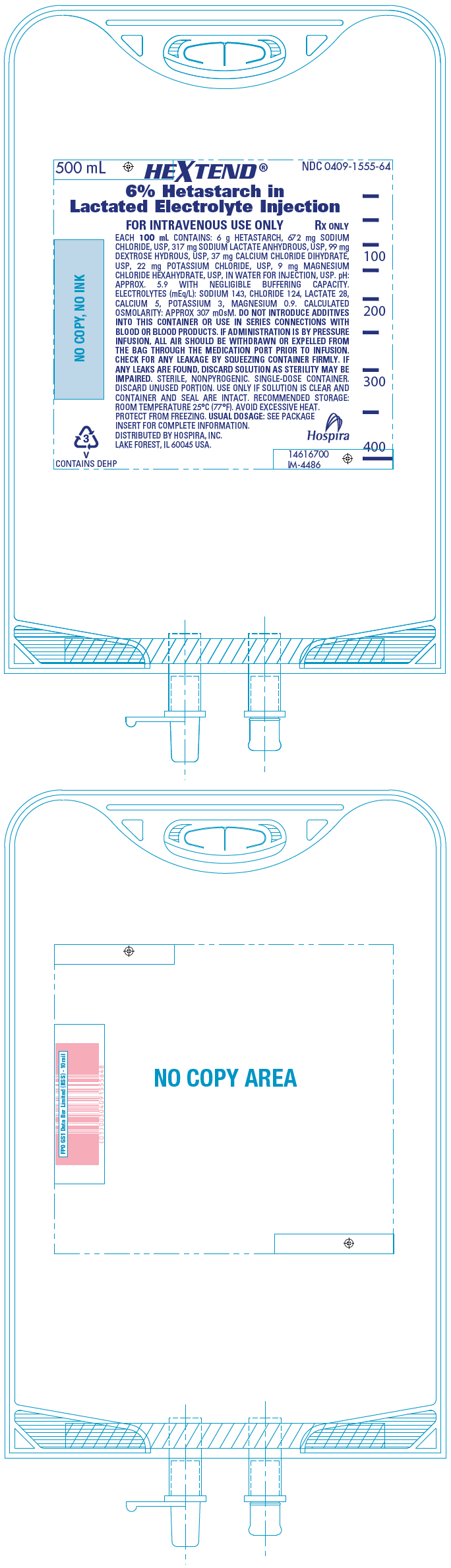
PRINCIPAL DISPLAY PANEL - 500 mL Bag 500 mL HEXTEND ® 6% Hetastarch in Lactated Electrolyte Injection NDC 0409-1555-64 FOR INTRAVENOUS USE ONLY RX ONLY EACH 100 mL CONTAINS: 6 g HETASTARCH, 672 mg SODIUM CHLORIDE, USP, 317 mg SODIUM LACTATE ANHYDROUS, USP, 99 mg DEXTROSE HYDROUS, USP, 37 mg CALCIUM CHLORIDE DIHYDRATE, USP, 22 mg POTASSIUM CHLORIDE, USP, 9 mg MAGNESIUM CHLORIDE HEXAHYDRATE, USP, IN WATER FOR INJECTION, USP. pH: APPROX.
5.9WITH NEGLIGIBLE BUFFERING CAPACITY. ELECTROLYTES (mEq/L): SODIUM 143, CHLORIDE 124, LACTATE 28, CALCIUM 5, POTASSIUM 3, MAGNESIUM 0.9. CALCULATED OSMOLARITY: APPROX 307 mOsM.
DO NOT INTRODUCE ADDITIVES INTO THIS CONTAINER OR USE IN SERIES CONNECTIONS WITH BLOOD OR BLOOD PRODUCTS. IF ADMINISTRATION IS BY PRESSURE INFUSION, ALL AIR SHOULD BE WITHDRAWN OR EXPELLED FROM THE BAG THROUGH THE MEDICATION PORT PRIOR TO INFUSION. CHECK FOR ANY LEAKAGE BY SQUEEZING CONTAINER FIRMLY.
IF ANY LEAKS ARE FOUND, DISCARD SOLUTION AS STERILITY MAY BE IMPAIRED. STERILE, NONPYROGENIC. SINGLE-DOSE CONTAINER.
DISCARD UNUSED PORTION. USE ONLY IF SOLUTION IS CLEAR AND CONTAINER AND SEAL ARE INTACT. RECOMMENDED STORAGE: ROOM TEMPERATURE 25°C (77°F).
AVOID EXCESSIVE HEAT. PROTECT FROM FREEZING. USUAL DOSAGE: SEE PACKAGE INSERT FOR COMPLETE INFORMATION.
DISTRIBUTED BY HOSPIRA, INC. LAKE FOREST, IL 60045 USA. Hospira 3 V CONTAINS DEHP 14616700 IM-4486 PRINCIPAL DISPLAY PANEL - 500 mL Bag
PRINCIPAL DISPLAY PANEL - 500 mL Overwrap Label TO OPEN TEAR AT NOTCH DO NOT REMOVE FROM OVERWRAP UNTIL READY FOR USE. AFTER REMOVING THE OVERWRAP, CHECK FOR MINUTE LEAKS BY SQUEEZING CONTAINER FIRMLY. IF LEAKS ARE FOUND, DISCARD SOLUTION AS STERILITY MAY BE IMPAIRED.
RECOMMENDED STORAGE: ROOM TEMPERATURE (25°C). AVOID EXCESSIVE HEAT. PROTECT FROM FREEZING.
SEE INSERT. IM-4498 2 HDPE Not Made With Natural Rubber Latex 14622100 PRINCIPAL DISPLAY PANEL - 500 mL Overwrap Label
About this NDC listing & data coverage
What data is (and isn’t) available for this NDC — tap to expand
| NDC identity (package / product / labeler codes) | ✓ Available |
| Labeler | ✓ Available |
| Product & package description | ✓ Available |
| Marketing category & status | ✓ Available |
| Active ingredient / dosage form / route | ✓ Available |
| FDA label (SPL via DailyMed) | ✓ Available |
| Package photos | ✓ Available |
| Inactive ingredients (structured) | ✓ Available |
| NADAC pharmacy acquisition price (CMS) | — Not published for this NDC CMS publishes NADAC only for NDCs reported in its retail-pharmacy survey. |
| Orange Book / therapeutic-equivalence data | — Not published for this NDC Applies only to products approved under an NDA/ANDA; many listings are out of scope. |
| HCPCS J-code billing crosswalk | — Not published for this NDC Most self-administered / retail products have no J-code — that is normal. |
| Medicaid utilization (CMS SDUD) | — Not published for this NDC CMS reports utilization only for NDCs with Medicaid claims above its privacy threshold. |