
THAM TROMETHAMINE 3.6 g/100mL Injection, Solution — NDC 0409-1593-04 (Billing 00409-1593-04)
This is a package of THAM TROMETHAMINE 3.6 g/100mL Injection, Solution from Hospira, Inc., marketed since Jun 2020 and currently FDA-listed. It is this product's only package size.
NDC database record
One package, one record: these facts belong to NDC 0409-1593-04 alone.
- Record
- FDA NDC Directory package listing · Human prescription drug
- Code segments
- 0409 labeler · 1593 product · 04 package
- Package marketed since
- Jun 24, 2020
- Sample package
- No — commercial package
- Listing certified through
- Dec 31, 2027
- Barcode (UPC-A, from the NDC)
- 3 0409159304 6
- FDA record last changed
- Jul 24, 2026
Identity & classification
Regulatory identifiers FDA, NLM and CMS codes for this package
Drug-database identifiers Medi-Span GPI and First Databank GCN / HICL / AHFS classification
- GSN (GCN sequence number): 001191
- GCN: 02860
- GPI-14 (Medi-Span): 79050040002010
- HICL (First Databank): 000528
- AHFS class code: 40:08.00.00
- RxCUI (RxNorm): 198412
Where does this data come from?
- FDA openFDA NDC Directory · synced Oct 8, 2026
- FDA label on DailyMed · label index refreshed Oct 6, 2026
- RxNorm (NLM RxNav) · catalog refreshed Oct 1, 2026
- Medi-Span GPI (licensed)
- First Databank (licensed) · refreshed Oct 8, 2026
RxNorm drug class
This medicine belongs to the Solutions affecting the electrolyte balance class.
Where does this data come from?
- RxClass (NLM) · catalog refreshed Oct 1, 2026
Clinical
Patient education
Supplement & herbal interactions
Where does this data come from?
- MedlinePlus (NLM) · refreshed Oct 1, 2026
- FDA label on DailyMed · label index refreshed Oct 6, 2026
Ask a licensed pharmacist directly — free, answered by our team.
Pricing
A drug doesn't have one price. Each row is a different public payment system, and none is what you'd pay at the counter — that depends on your insurance. The ⓘ on each row explains what it measures.
| Price system | Per mL | Per package |
|---|---|---|
| Retail pharmacies payNADAC · weekly | Not in the retail survey — common for institutional, discontinued, or low-volume packs. | |
| Medicaid paysCMS SDUD · 12 mo | No recent Medicaid claims on file for this NDC — rare and low-volume NDCs are suppressed in the public data. | |
| Medicare drug plans payPart D · quarterly | No Part D plan price is available for this NDC in our data. | |
Where does this data come from?
- CMS NADAC weekly file
- CMS ASP pricing files · refreshed Sep 20, 2026
- CMS Medicaid State Drug Utilization Data · refreshed Oct 8, 2026
- CMS Part D plan pricing files · refreshed Sep 24, 2026
- VA National Acquisition Center price file
Packaging — all sizes for this product
| Package NDC | Description | Marketing start | Marketing end | Status |
|---|---|---|---|---|
| 00409-1593-04 You're viewing this Main listing | 6 BOTTLE, GLASS in 1 CASE / 500 mL in 1 BOTTLE, GLASS | 2020-06-24 | — | Active |
Therapeutic equivalents
| Product | Labeler | Pack | NADAC/unit | TE | Status | Price vs. this |
|---|---|---|---|---|---|---|
| Tromethamine 3.6 g/100mL 00264-8031-10 | B. | 500 ml | — | AP | FDA listed | — |
| Tham 3.6 g/100mLthis 00409-1593-04 | Hospira, | 6 bottles | — | AP | FDA listed | — |
| Tromethamine 3.6 g/100mL 71357-0001-01 | MILLA | 6 bottles | — | AP | FDA listed | — |
Where does this data come from?
- FDA openFDA NDC Directory · synced Oct 8, 2026
- FDA Orange Book · refreshed Oct 3, 2026
- CMS NADAC weekly file
Availability & generic status
The FDA lists approved generic versions of this medicine, but that does not always mean a pharmacy can get one today. Patent rules, launch agreements, supply and pricing can affect when generics actually arrive.
Where does this data come from?
- FDA Orange Book · refreshed Oct 3, 2026
Inactive Ingredients / Excipients
Inactive ingredients, also called excipients, are components of the drug product other than the active ingredient. They may include fillers, dyes, coatings, preservatives, flavors, or other formulation ingredients.
💡 Tap an ingredient (hover on desktop) to see what it is and why it’s used.
-
UNII Q40Q9N063P
Acetic acid is a weak organic acid commonly used in medicines as a buffer and pH adjuster. It helps maintain the proper acidity level to ensure the drug remains stable and effective in its formulation.
-
UNII 059QF0KO0R
Water is a liquid solvent that dissolves and mixes ingredients together in liquid medicines, syrups, and injections. It helps distribute the active drug evenly throughout the product.
2 inactive ingredients listed in the exact product block matched to this NDC.
Where does this data come from?
ingredient classCode="IACT" elements from the exact product block matched by this NDC. Label-section narrative from DailyMed / the openFDA label index is shown separately when available.- FDA label on DailyMed · label index refreshed Oct 6, 2026
- FDA openFDA NDC Directory · synced Oct 8, 2026
Inactive ingredient FAQ
Are inactive ingredients the same for every manufacturer?
Why might an inactive ingredient be missing?
Can inactive ingredients matter?
Manufacturer & labeler
More NDCs from Hospira, Inc. labeler code 00409
- PROPOFOL 10 mg/mL Injection, Emulsion NDC 0409-1511-98
- Marcaine BUPIVACAINE HYDROCHLORIDE 150 mg/30mL Injection, Solution NDC 0409-1530-25
- Marcaine with Epinephrine BUPIVACAINE HYDROCHLORIDE AND 2.5 mg/mL; .0091 mg/mL Injection, Solution NDC 0409-1541-10
- Hextend HETASTARCH 6 g/100mL Injection, Solution NDC 0409-1555-54
- Marcaine BUPIVACAINE HYDROCHLORIDE 7.5 mg/mL Injection, Solution NDC 0409-1582-10
- Marcaine BUPIVACAINE HYDROCHLORIDE 2.5 mg/mL Injection, Solution NDC 0409-1587-50
- Precedex DEXMEDETOMIDINE HYDROCHLORIDE 4 ug/mL Injection, Solution NDC 0409-1596-01
- Butorphanol Tartrate 1 mg/mL Injection, Solution NDC 0409-1623-01
- Butorphanol Tartrate 2 mg/mL Injection, Solution NDC 0409-1626-01
- Atropine Sulfate .1 mg/mL Injection, Solution NDC 0409-1630-10
- Calcium Chloride 100 mg/mL Injection, Solution NDC 0409-1631-10
- Precedex DEXMEDETOMIDINE HYDROCHLORIDE 100 ug/mL Injection, Solution, Concentrate NDC 0409-1638-02
Where does this data come from?
- FDA openFDA NDC Directory · synced Oct 8, 2026
- Drugs@FDA
Full prescribing information FDA SPL
🎯 Indications and Usage ▾
INDICATIONS AND USAGE Tham Solution (tromethamine injection) is indicated for the prevention and correction of metabolic acidosis. In the following conditions it may help to sustain vital functions and thus provide time for treatment of the primary disease: Metabolic Acidosis Associated with Cardiac Bypass Surgery. Tham Solution has been found to be primarily beneficial in correcting metabolic acidosis which may occur during or immediately following cardiac bypass surgical procedures.
Correction of Acidity of ACD Blood in Cardiac Bypass Surgery. It is well known that ACD blood is acidic and becomes more acidic on storage. Tromethamine effectively corrects this acidity.
Tham Solution may be added directly to the blood used to prime the pump-oxygenator. When ACD blood is brought to a normal pH range the patient is spared an initial acid load. Additional tromethamine may be indicated during cardiac bypass surgery should metabolic acidosis appear.
Metabolic Acidosis Associated with Cardiac Arrest. Acidosis is nearly always one of the consequences of cardiac arrest and, in some instances, may even be a causative factor in arrest. It is important therefore, that the correction of acidosis should be started promptly with other resuscitative efforts.
By correcting acidosis, Tham Solution (tromethamine injection) has caused the arrested heart to respond to resuscitative efforts after standard methods alone had failed. In these cases, tromethamine was given intraventricularly. It is to be noted, however, that such precariously ill patients often have died subsequently of causes unrelated to the administration of tromethamine.
With administration by the peripheral venous route, metabolic acidosis has been corrected in a majority of patients. The success in reinstitution of cardiac rhythm by this means probably has not been of the same order of magnitude as with the intraventricular route.
⏱️ Dosage and Administration ▾
DOSAGE AND ADMINISTRATION Tham Solution (tromethamine injection) is administered by slow intravenous infusion, by addition to pump-oxygenator ACD blood or other priming fluid or by injection into the ventricular cavity during cardiac arrest. For infusion by peripheral vein, a large needle should be used in the largest antecubital vein or an indwelling catheter placed in a large vein of an elevated limb to minimize chemical irritation of the alkaline solution during infusion. Catheters are recommended.
Dosage and rate of administration should be carefully supervised to avoid overtreatment (alkalosis). Pretreatment and subsequent determinations of blood values (e.g. pH, PCO 2 , PO 2 , glucose and electrolytes) and urinary output should be made as necessary to monitor dosage and progress of treatment. In general, dosage should be limited to an amount sufficient to increase blood pH to normal limits (7.35 to 7.45) and to correct acid-base derangements.
The total quantity to be administered during the period of illness will depend upon the severity and progression of the acidosis. The possibility of some retention of tromethamine, especially in patients with impaired renal function, should be kept in mind. The intravenous dosage of Tham Solution (tromethamine injection) may be estimated from the buffer base deficit of the extracellular fluid in mEq/liter determined by means of the Siggaard-Andersen nomogram.
The following formula is intended as a general guide: Tham Solution (mL of
0.3M) Required = Body Weight (kg) X Base Deficit (mEq/liter) X 1.1* Thus, a 70 kg patient with a buffer base deficit (“negative base excess”) of 5 mEq/liter would require 70 x 5 x 1.1 = 385 mL of Tham Solution containing 13.9 g (115 mEq) of tromethamine. The need for administration of additional Tham Solution is determined by serial determinations of the existing base deficit. * Factor of 1.1 accounts for an approximate reduction of 10% in buffering capacity due to the presence of sufficient acetic acid to lower pH of the
0.3M solution to approximately 8.6. Correction of Metabolic Acidosis Associated with Cardiac Bypass Surgery: An adverse dose of approximately 9.0 mL/kg (324 mg/kg) has been used in clinical studies with Tham Solution (tromethamine injection). This is equivalent to a total dose of 630 mL (189 mEq) for 70 kg patient.
A total single dose of 500 mL (150 mEq) is considered adequate for most adults. Larger single doses (up to 1000 mL) may be required in unusually severe cases. It is recommended that individual doses should not exceed 500 mg/kg (227 mg/lb) over a period of not less than one hour.
Thus, for a 70 kg (154 pound) patient the dose should not exceed a maximum of 35 g per hour (1078 mL of a
0.3M solution). Repeated determinations of pH and other clinical observations should be used as a guide to the need for repeat doses. Correction of Acidity of ACD Blood in Cardiac Bypass Surgery: The pH of stored blood ranges from 6.80 to 6.22 depending upon the duration of storage. The amount of Tham Solution used to correct this acidity ranges from 0.5 to 2.5 g (15 to 77 mL of a
0.3M solution) added to each 500 mL of ACD blood used for priming the pump-oxygenator. Clinical experience indicates that 2 g (62 mL of a
0.3M solution) added to 500 mL of ACD blood is usually adequate. Correction of Metabolic Acidosis Associated with Cardiac Arrest: In the treatment of cardiac arrest, Tham Solution should be given at the same time that other standard resuscitative measures, including manual systole, are being applied. If the chest is open, Tham Solution is injected directly into the ventricular cavity. From 2 to 6 g (62 to 185 mL of a
0.3M solution) should be injected immediately. Do not inject into the cardiac muscle. If the chest is not open, from 3.6 to 10.8 g (111 to 333 mL of a
0.3M solution) should be injected immediately into a larger peripheral vein. Additional amounts may be required to control acidosis persisting after cardiac arrest is… [Excerpted — this section continues on DailyMed.]
⛔ Contraindications ▾
CONTRAINDICATIONS Tham Solution (tromethamine injection) is contraindicated in uremia and anuria. In neonates it is also contraindicated in chronic respiratory acidosis and salicylate intoxication.
⚠️ Warnings ▾
WARNINGS Large doses of Tham Solution may depress ventilation, as a result of increased blood pH and reduced CO 2 concentration. Thus, dosage should be adjusted so that blood pH is not allowed to increase above normal. In situations in which respiratory acidosis may be present concomitantly with metabolic acidosis, the drug may be used with mechanical assistance to ventilation.
Care must be exercised to prevent perivascular infiltration since this can cause inflammation, necrosis and sloughing of tissue. Venospasm and intravenous thrombosis, which may occur during infusion, can be minimized by insuring that the injection needle is well within the largest available vein and that solutions are slowly infused. Intravenous catheters are recommended.
If perivascular infiltration occurs, institute appropriate countermeasures (see ADVERSE REACTIONS ). Tham Solution (tromethamine injection) should be administered slowly and in amounts sufficient only to correct the existing acidosis, and to avoid overdosage and alkalosis. Overdosage in terms of total drug and/or too rapid administration, may cause hypoglycemia of a prolonged duration (several hours).
Therefore, frequent blood glucose determinations should be made during and after therapy. Extreme care should be exercised in patients with renal disease or reduced urinary output because of potential hyperkalemia and the possibility of a decreased excretion of tromethamine. In such patients, the drug should be used cautiously with electrocardiographic monitoring and frequent serum potassium determinations.
Because clinical experience has been limited generally to short-term use, the drug should not be administered for more than a period of one day except in a life-threatening situation. The intravenous administration of Tham Solution can cause fluid and/or solute overloading resulting in dilution of serum electrolyte concentrations, overhydration, congested states or pulmonary edema. Additives may be incompatible.
Consult with pharmacist, if available. When introducing additives, use aseptic technique, mix thoroughly and do not store.
🤒 Adverse Reactions ▾
ADVERSE REACTIONS Generally, side effects have been infrequent. Respiratory: Although the incidence of ventilatory depression is low, it is important to keep in mind that such depression may occur. Respiratory depression may be more likely to occur in patients who have chronic hypoventilation or those who have been treated with drugs which depress respiration.
In patients with associated respiratory acidosis, tromethamine should be administered with mechanical assistance to ventilation. Vascular: Extreme care should be taken to avoid perivascular infiltration. Local tissue damage and subsequent sloughing may occur if extravasation occurs.
Chemical phlebitis and venospasm also have been reported. Hematologic: Transient depression of blood glucose may occur. Hepatic: Infusion via low-lying umbilical venous catheters has been associated with hepatocellular necrosis.
Reactions which may occur because of the solution or the technique of administration include febrile response, infection at the site of injection, venous thrombosis or phlebitis extending from the site of injection extravasation and hypervolemia. If an adverse reaction does occur, discontinue the infusion, evaluate the patient, institute appropriate therapeutic countermeasures and save the remainder of the fluid for examination if deemed necessary.
🤰 Pregnancy ▾
Pregnancy: Animal reproduction studies have not been conducted with tromethamine. It is also not known whether tromethamine can cause fetal harm when administered to a pregnant woman or can affect reproduction capacity. Tromethamine should be given to a pregnant woman only if clearly needed.
🧒 Pediatric Use ▾
Pediatric Use: The safety and effectiveness of THAM Solution in pediatric patients is based on over 30 years’ clinical experience documented in the literature and on safety surveillance. THAM Solution has been used to treat severe cases of metabolic acidosis with concurrent respiratory acidosis because it does not raise PCO 2 as bicarbonate does in neonates and infants with respiratory failure. It has also been used in neonates and infants with hypernatremia and metabolic acidosis to avoid the additional sodium given with the bicarbonate.
However, because the osmotic effects of THAM Solution are greater and large continuous doses are required, bicarbonate is preferred to THAM Solution in the treatment of acidotic neonates and infants with RDS. Hypoglycemia may occur when this product is used in premature and even full-term neonates (see WARNINGS and ADVERSE REACTIONS ).
🧓 Geriatric Use ▾
Geriatric Use: Clinical studies of Tham solution did not include sufficient numbers of subjects aged 65 and over to determine whether they respond differently from younger subjects. Other reported clinical experience has not identified differences in response between the elderly and younger patients. In general, dose selection for an elderly patient should be cautious, usually starting at the low end of the dosing range, reflecting the greater frequency of decreased hepatic, renal, or cardiac function, and of concomitant disease or other drug therapy.
This drug is known to be substantially excreted by the kidney, and the risk of toxic reactions to this drug may be greater in patients with impaired renal function. Because elderly patients are more likely to have decreased renal function, care should be taken in dose selection, and it may be useful to monitor renal function.
🆘 Overdosage ▾
OVERDOSAGE Too rapid administration and/or excessive amounts of tromethamine may cause alkalosis, hypoglycemia, overhydration or solute overload. In the event of overdosage, discontinue the infusion, evaluate the patient and institute appropriate countermeasures (see WARNINGS , PRECAUTIONS and ADVERSE REACTIONS ). The LD 50 values for the acute intravenous toxicity of THAM are influenced by the rate of infusion of the dose administered.
Intravenous LD 50 Mice = 3,500 mg/kg Intravenous LD 50 Rats = 2,300 mg/kg
🧬 Clinical Pharmacology ▾
CLINICAL PHARMACOLOGY When administered intravenously as a
0.3M solution, tromethamine act as a proton acceptor and prevents or corrects acidosis by actively binding hydrogen ions (H + ). It binds not only cations of fixed or metabolic acids, but also hydrogen ions of carbonic acid, thus increasing bicarbonate anion (HCO 3 ‾). Tromethamine also acts as an osmotic diuretic, increasing urine flow, urinary pH, and excretion of fixed acids, carbon dioxide and electrolytes.
A significant fraction of tromethamine (30% at pH 7.40) is not ionized and therefore is capable of reaching equilibrium in total body water. This portion may penetrate cells and may neutralize acidic ions of the intracellular fluid. The drug is rapidly eliminated by the kidney; 75% or more appears in the urine after eight hours.
Urinary excretion continues over a period of three days. Water is an essential constituent of all body tissues and accounts for approximately 70% of total body weight. Average normal adult daily requirement ranges from two to three liters (1.0 to 1.5 liters each for insensible water loss by perspiration and urine production).
Water balance is maintained by various regulatory mechanisms. Water distribution depends primarily on the concentration of electrolytes in the body compartments and sodium (Na + ) plays a major role in maintaining physiologic equilibrium.
📦 How Supplied / Storage and Handling ▾
HOW SUPPLIED Tham Solution (tromethamine injection) is available as: Unit of Sale Concentration NDC-0409-1593-04 Case of 6 Single-dose 500 mL large volume glass containers 500 mL (150 mEq) Store at 20 to 25°C (68 to 77°F). [See USP Controlled Room Temperature.] Protect from freezing.
📋 Description ▾
DESCRIPTION Tham Solution (tromethamine injection) is a sterile, non-pyrogenic
0.3M solution of tromethamine, adjusted to a pH of approximately 8.6 with glacial acetic acid. It is administered by intravenous injection, by addition to ACD blood for priming cardiac bypass equipment and by injection into the ventricular cavity during cardiac arrest. Each 100 mL contains tromethamine 3.6 g (30 mEq) in water for injection.
The solution is hypertonic 389 mOsmol/L (calc.). pH 8.6 (8.4-8.7). The solution contains no bacteriostat, antimicrobial agent or added buffer (except acetic acid for pH adjustment) and is intended only for use as a single-dose injection. When smaller doses are required the unused portion should be discarded.
Tham solution is a parenteral systemic alkalizer and fluid replenisher. Tromethamine, USP (sometimes called “tris” or “tris buffer”) is chemically designated 2-amino-2-(hydroxymethyl)-1, 3-propanediol, a solid readily soluble in water, also classified as an organic amine buffer. It has the following structural formula: Water for Injection, USP is chemically designated H 2 0. structural formula tromethamine
⚠️ Precautions ▾
PRECAUTIONS Blood pH, PCO 2 bicarbonate, glucose and electrolyte determinations should be performed before, during and after administration of Tham Solution. While it has not been shown that the drug increases coagulation time in humans, this possibility should be kept in mind since this has been noted experimentally in dogs. Do not administer unless solution is clear and seal is intact.
Discard unused portion. Pregnancy: Animal reproduction studies have not been conducted with tromethamine. It is also not known whether tromethamine can cause fetal harm when administered to a pregnant woman or can affect reproduction capacity.
Tromethamine should be given to a pregnant woman only if clearly needed. Nursing Mothers: It is not known whether this drug is excreted in human milk. Because many drugs are excreted in human milk, caution should be exercised when THAM Solution is administered to a nursing mother.
Carcinogenesis, Mutagenesis, Impairment of Fertility: Studies with THAM Solution have not been performed to evaluate carcinogenic potential, mutagenic potential or effects on fertility. Pediatric Use: The safety and effectiveness of THAM Solution in pediatric patients is based on over 30 years’ clinical experience documented in the literature and on safety surveillance. THAM Solution has been used to treat severe cases of metabolic acidosis with concurrent respiratory acidosis because it does not raise PCO 2 as bicarbonate does in neonates and infants with respiratory failure.
It has also been used in neonates and infants with hypernatremia and metabolic acidosis to avoid the additional sodium given with the bicarbonate. However, because the osmotic effects of THAM Solution are greater and large continuous doses are required, bicarbonate is preferred to THAM Solution in the treatment of acidotic neonates and infants with RDS. Hypoglycemia may occur when this product is used in premature and even full-term neonates (see WARNINGS and ADVERSE REACTIONS ).
Geriatric Use: Clinical studies of Tham solution did not include sufficient numbers of subjects aged 65 and over to determine whether they respond differently from younger subjects. Other reported clinical experience has not identified differences in response between the elderly and younger patients. In general, dose selection for an elderly patient should be cautious, usually starting at the low end of the dosing range, reflecting the greater frequency of decreased hepatic, renal, or cardiac function, and of concomitant disease or other drug therapy.
This drug is known to be substantially excreted by the kidney, and the risk of toxic reactions to this drug may be greater in patients with impaired renal function. Because elderly patients are more likely to have decreased renal function, care should be taken in dose selection, and it may be useful to monitor renal function.
🍼 Nursing Mothers ▾
Nursing Mothers: It is not known whether this drug is excreted in human milk. Because many drugs are excreted in human milk, caution should be exercised when THAM Solution is administered to a nursing mother.
📄 Carcinogenesis, Mutagenesis, Impairment of Fertility ▾
Carcinogenesis, Mutagenesis, Impairment of Fertility: Studies with THAM Solution have not been performed to evaluate carcinogenic potential, mutagenic potential or effects on fertility.
📄 Package Label / Principal Display Panel ▾
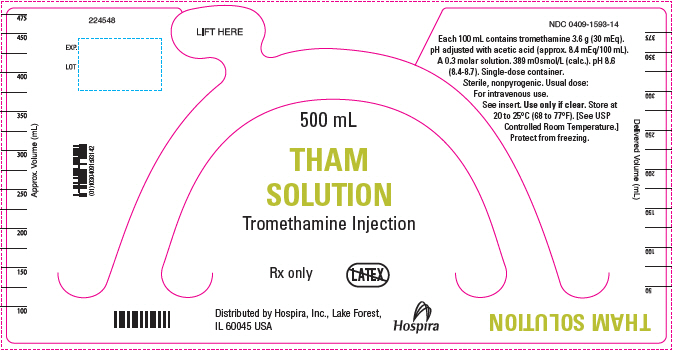
PRINCIPAL DISPLAY PANEL - 500 mL Bottle Label 500 mL THAM SOLUTION Tromethamine Injection Rx only Distributed by Hospira, Inc., Lake Forest, IL 60045 USA Hospira PRINCIPAL DISPLAY PANEL - 500 mL Bottle Label
Reported adverse events (FAERS)
Top reported reactions
Age at onset
Reporter sex
Serious outcomes
Where does this data come from?
About this NDC listing & data coverage
What data is (and isn’t) available for this NDC — tap to expand
| NDC identity (package / product / labeler codes) | ✓ Available |
| Labeler | ✓ Available |
| Product & package description | ✓ Available |
| Marketing category & status | ✓ Available |
| Active ingredient / dosage form / route | ✓ Available |
| FDA label (SPL via DailyMed) | ✓ Available |
| Package photos | ✓ Available |
| Inactive ingredients (structured) | ✓ Available |
| NADAC pharmacy acquisition price (CMS) | — Not published for this NDC CMS publishes NADAC only for NDCs reported in its retail-pharmacy survey. |
| Orange Book / therapeutic-equivalence data | ✓ Available |
| HCPCS J-code billing crosswalk | — Not published for this NDC Most self-administered / retail products have no J-code — that is normal. |
| Medicaid utilization (CMS SDUD) | — Not published for this NDC CMS reports utilization only for NDCs with Medicaid claims above its privacy threshold. |