
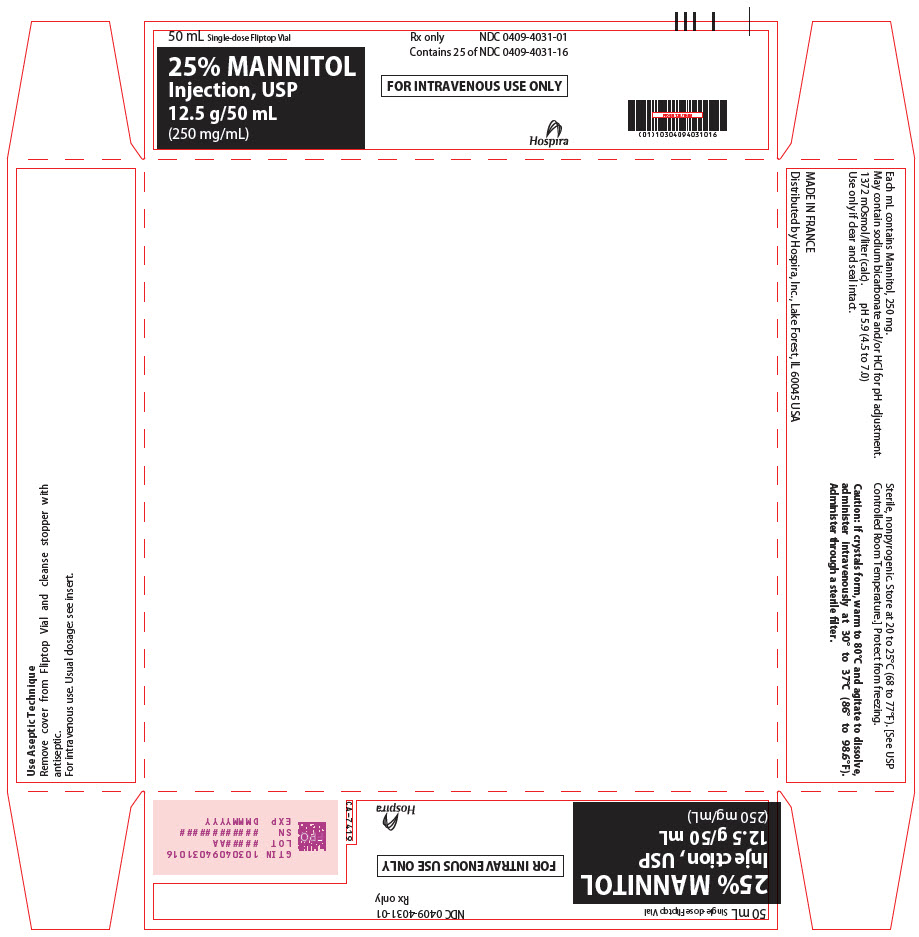
Mannitol 12.5 g/50mL Injection, Solution — NDC 0409-4031-01 (Billing 00409-4031-01)
This is a package of Mannitol 12.5 g/50mL Injection, Solution from Hospira, Inc., marketed since Nov 2004 and currently FDA-listed. It is this product's only package size.
NDC database record
One package, one record: these facts belong to NDC 0409-4031-01 alone.
- Record
- FDA NDC Directory package listing · Human prescription drug
- Code segments
- 0409 labeler · 4031 product · 01 package
- Package marketed since
- Nov 30, 2004
- Sample package
- No — commercial package
- Listing certified through
- Dec 31, 2027
- Barcode (UPC-A, from the NDC)
- 3 0409403101 9
- Medicaid fills, this package
- 581 prescriptions in the last four reported quarters
- FDA record last changed
- Jul 24, 2026
Identity & classification
Regulatory identifiers FDA, NLM and CMS codes for this package
Drug-database identifiers Medi-Span GPI and First Databank GCN / HICL / AHFS classification
- GSN (GCN sequence number): 008151
- GCN: 34551
- GPI-14 (Medi-Span): 37400030002025
- HICL (First Databank): 003635
- AHFS class code: 24:36.12.00
- RxCUI (RxNorm): 311450
Where does this data come from?
- FDA openFDA NDC Directory · synced Oct 1, 2026
- FDA label on DailyMed · label index refreshed Oct 6, 2026
- RxNorm (NLM RxNav) · catalog refreshed Oct 1, 2026
- Medi-Span GPI (licensed)
- First Databank (licensed) · refreshed Oct 1, 2026
RxNorm drug class
This medicine belongs to the Osmotic Diuretic class.
Where does this data come from?
- RxClass (NLM) · catalog refreshed Oct 1, 2026
Clinical
Patient education
Supplement & herbal interactions
Some supplements/herbs that may interact with Mannitol — tap one for details:
Mannitol may be associated with lower levels of 7 nutrients — worth a chat with your pharmacist, not a cause for alarm.
Where does this data come from?
- MedlinePlus (NLM) · refreshed Oct 1, 2026
- FDA label on DailyMed · label index refreshed Oct 6, 2026
Ask a licensed pharmacist directly — free, answered by our team.
Pricing
A drug doesn't have one price. Each row is a different public payment system, and none is what you'd pay at the counter — that depends on your insurance. The ⓘ on each row explains what it measures.
| Price system | Per mL | Per package |
|---|---|---|
| Retail pharmacies payNADAC · weekly | Not in the retail survey — common for institutional, discontinued, or low-volume packs. | |
| Medicaid paysCMS SDUD · 12 mo | $0.0785 | $98.13 / 1250 ml |
| Medicare drug plans payPart D · quarterly | No Part D plan price is available for this NDC in our data. | |
| Medicare Part B allowsASP · J2151 | $0.071 / J2151 unit | — |
Where does this data come from?
- CMS NADAC weekly file
- CMS ASP pricing files · refreshed Sep 20, 2026
- CMS Medicaid State Drug Utilization Data · through Q1 2026
- CMS Part D plan pricing files · refreshed Sep 24, 2026
- VA National Acquisition Center price file
Billing & reimbursement
Where does this data come from?
- CMS ASP NDC-HCPCS crosswalk · refreshed Sep 22, 2026
- DMEPDAC NDC-HCPCS crosswalk
- openFDA NSDE billing units · refreshed Oct 7, 2026
Packaging — all sizes for this product
| Package NDC | Description | Marketing start | Marketing end | Status |
|---|---|---|---|---|
| 00409-4031-01 You're viewing this Main listing | 25 VIAL, SINGLE-DOSE in 1 TRAY / 50 mL in 1 VIAL, SINGLE-DOSE | 2004-11-30 | — | Active |
Therapeutic equivalents
| Product | Labeler | Pack | NADAC/unit | TE | Status | Price vs. this |
|---|---|---|---|---|---|---|
| Mannitol 12.5 g/50mL 00404-9905-50 | Henry | 1 vial | — | — | FDA listed | — |
| Mannitol 12.5 g/50mLthis 00409-4031-01 | Hospira, | 25 vials | — | — | FDA listed | — |
| Mannitol 12.5 g/50mL 51662-1468-01 | HF | 50 ml | — | — | FDA listed | — |
| Mannitol 250 mg/mL 63323-0024-25 | Fresenius | 25 vials | — | AP | FDA listed | — |
| Mannitol 250 mg/mL 84549-0024-25 | ProPharma | 50 ml | — | AP | FDA listed | — |
Where does this data come from?
- FDA openFDA NDC Directory · synced Oct 1, 2026
- FDA Orange Book · refreshed Oct 3, 2026
- CMS NADAC weekly file
Availability & generic status
The FDA lists approved generic versions of this medicine, but that does not always mean a pharmacy can get one today. Patent rules, launch agreements, supply and pricing can affect when generics actually arrive.
Where does this data come from?
- FDA Orange Book · refreshed Oct 3, 2026
Inactive Ingredients / Excipients
Inactive ingredients, also called excipients, are components of the drug product other than the active ingredient. They may include fillers, dyes, coatings, preservatives, flavors, or other formulation ingredients.
💡 Tap an ingredient (hover on desktop) to see what it is and why it’s used.
-
UNII QTT17582CB
A strong acid used to adjust and maintain the proper pH level in liquid medicines, ensuring stability and preventing breakdown of active ingredients.
-
UNII 8MDF5V39QO
A white powder form of baking soda that acts as a buffer and pH regulator in medicines. It helps maintain the right acid-base balance and may aid tablet disintegration.
-
UNII 059QF0KO0R
Water is a liquid solvent that dissolves and mixes ingredients together in liquid medicines, syrups, and injections. It helps distribute the active drug evenly throughout the product.
3 inactive ingredients listed in the exact product block matched to this NDC.
Where does this data come from?
ingredient classCode="IACT" elements from the exact product block matched by this NDC. Label-section narrative from DailyMed / the openFDA label index is shown separately when available.- FDA label on DailyMed · label index refreshed Oct 6, 2026
- FDA openFDA NDC Directory · synced Oct 1, 2026
Inactive ingredient FAQ
Are inactive ingredients the same for every manufacturer?
Why might an inactive ingredient be missing?
Can inactive ingredients matter?
Manufacturer & labeler
More NDCs from Hospira, Inc. labeler code 00409
- Ketorolac Tromethamine 60 mg/2mL Injection, Solution NDC 0409-3796-01
- Marcaine with Epinephrine BUPIVACAINE HYDROCHLORIDE AND 2.5 mg/mL; .0091 mg/mL Injection, Solution NDC 0409-3812-01
- Morphine Sulfate .5 mg/mL Injection, Solution NDC 0409-3814-12
- Morphine Sulfate 1 mg/mL Injection, Solution NDC 0409-3815-12
- Bacteriostatic Water 1 mL/mL Injection, Solution NDC 0409-3977-03
- Verapamil Hydrochloride 2.5 mg/mL Injection, Solution NDC 0409-4011-01
- ZINC 1 mg/mL Injection, Solution NDC 0409-4090-01
- MANGANESE .1 mg/mL Injection, Solution NDC 0409-4091-01
- COPPER CUPRIC CHLORIDE .4 mg/mL Injection, Solution NDC 0409-4092-01
- Chromium Chromic Chloride 4 ug/mL Injection, Solution NDC 0409-4093-01
- Magnesium Sulfate in Water 4 g/100mL Injection, Solution NDC 0409-4121-24
- Marcaine with Epinephrine BUPIVACAINE HYDROCHLORIDE AND 5 mg/mL; .0091 mg/mL Injection, Solution NDC 0409-4208-10
Where does this data come from?
- FDA openFDA NDC Directory · synced Oct 1, 2026
- Drugs@FDA
Full prescribing information FDA SPL
🎯 Indications and Usage ▾
1 INDICATIONS AND USAGE Mannitol Injection is indicated for the reduction of: • intracranial pressure and treatment of cerebral edema. • elevated intraocular pressure. Mannitol Injection is an osmotic diuretic, indicated for the reduction of: • intracranial pressure and treatment of cerebral edema. ( 1 ) • elevated intraocular pressure. ( 1 )
⏱️ Dosage and Administration ▾
2 DOSAGE AND ADMINISTRATION Administration Instructions ( 2.1 ) : • For intravenous infusion, preferably through a central venous catheter. • Prior to administration, evaluate renal, cardiac and pulmonary status and correct fluid and electrolyte imbalances. Recommended Dosage ( 2.2 ) : • The dosage, concentration and rate of administration depend on the age, weight and condition of the patient, including fluid requirement, urinary output and concomitant therapy. • Reduction of Intracranial Pressure and Treatment of Cerebral Edema : 0.25 g/kg administered every 6 to 8 hours as an intravenous infusion over at least 30 minutes. • Reduction of Intraocular Pressure: 1.5 to 2 g/kg administered as a single dose intravenously over at least 30 minutes.
Administer 60 to 90 minutes before surgery to achieve maximal effect.
2.1Important Preparation and Administration Instructions • Mannitol Injection is for intravenous infusion preferably through a central venous catheter [see Warnings and Precautions (5.6) , Description (11) ] . • Prior to the administration of Mannitol Injection, evaluate renal, cardiac, and pulmonary status of the patient and correct fluid and electrolyte imbalances [see Dosage and Administration (2.2) ]. • Do not administer Mannitol Injection simultaneously with blood products or through the same administration set because of the possibility of pseduoagglutination or hemolysis.
If it is essential that blood be given simultaneously, at least 20 mEq of sodium chloride should be added to each liter of mannitol solution to avoid pseudoagglutination. • Do not transfer Mannitol Injection into polyvinylchloride (PVC) bags; a white flocculent precipitate may form from contact with PVC surfaces. • Administer Mannitol Injection using an administration set with a filter to ensure against infusion of mannitol crystals. Preparation 1. Visually inspect the container before preparation and again before administration.
Do not administer unless solution is clear, the container undamaged, and the fliptop vial seal intact. 2. Crystals may form in Mannitol Injection, especially if the solution is exposed to low temperatures.
If crystallization occurs, warm the vial in water at 80°C and periodically shake vigorously to dissolve the crystals. Mannitol Injection may be autoclaved at 121°C for 20 minutes at 15 psi. Cool to body temperature or less before administering.
Re-inspect Mannitol Injection for crystals prior to administration. Discard the solution if all the crystals cannot be dissolved. 3.
Remove cover from fliptop vial and cleanse stopper with antiseptic before use. 4. Additives may be incompatible.
Consult with pharmacist, if available. 5. For single use only; discard unused portion.
2.2Recommended Dosage Prior to administration of Mannitol Injection, evaluate renal, cardiac, and pulmonary status of the patient and correct fluid and electrolyte imbalances. The total dosage, concentration, and rate of administration depend on the age, weight, and condition of the patient being treated, including fluid requirement, electrolyte balance, serum osmolality, urinary output, and concomitant therapy. The following outline of administration and dosage is only a general guide to therapy.
Reduction of Intracranial Pressure and Treatment of Cerebral Edema Usually a maximum reduction in intracranial pressure can be achieved with a dose of 0.25 g/kg administered as an intravenous infusion over at least 30 minutes, which may be repeated every six to eight hours. During and following infusion of Mannitol Injection, monitor fluid and electrolytes, serum osmolarity, and renal, cardiac, and pulmonary function. Discontinue Mannitol Injection if renal, cardiac, or pulmonary status worsens or CNS toxicity develops [see Warnings and Precautions (5.2 , 5.3 , 5.4 , 5.5) ] .
Reduction of Intraocular Pressure The recommended dosage is 1.5 to 2 g/kg as a single dose administered as an intravenous infusion over at least 30 minutes. When used preoperatively,… [Excerpted — this section continues on DailyMed.]
💊 Dosage Forms and Strengths ▾
3 DOSAGE FORMS AND STRENGTHS Mannitol Injection 25%, USP: 12.5 g/50 mL (0.25 g/mL) of mannitol as a clear and colorless solution in a single-dose vial. Mannitol Injection 25%, USP: 12.5 g/50 mL (0.25 g/mL) in a single-dose vial ( 3 )
⛔ Contraindications ▾
4 CONTRAINDICATIONS Mannitol Injection is contraindicated in patients with: • Known hypersensitivity to mannitol [see Warnings and Precautions (5.1) ]. • Anuria [see Warnings and Precautions (5.2) ]. • Severe hypovolemia [see Warnings and Precautions (5.4) ]. • Pre-existing severe pulmonary vascular congestion or pulmonary edema [see Warnings and Precautions (5.5) ] . • Active intracranial bleeding except during craniotomy. • Known hypersensitivity to mannitol. ( 4 , 5.1 ) • Anuria. ( 4 , 5.2 ) • Severe hypovolemia.
( 4 , 5.4 ) • Pre-existing severe pulmonary vascular congestion or pulmonary edema. ( 4 , 5.5 ) • Active intracranial bleeding except during craniotomy. ( 4 )
⚠️ Warnings and Cautions ▾
5 WARNINGS AND PRECAUTIONS • Hypersensitivity Reactions, Including Anaphylaxis : Stop infusion immediately if hypersensitivity reactions develop. ( 5.1 ) • Renal Complications Including Renal Failure : Risk factors include pre-existing renal disease, conditions that put patients at risk for renal failure and concomitant use of nephrotoxic drugs or other diuretics. Avoid use of nephrotoxic drugs.
Discontinue Mannitol Injection if renal function worsens. ( 5.2 , 8.6 ) • Central Nervous System (CNS) Toxicity : Confusion, lethargy, and coma may occur during or after infusion. Concomitant neurotoxic drugs may potentiate toxicity.
Avoid use of neurotoxic drugs. Discontinue Mannitol Injection if CNS toxicity develops. ( 5.3 ) • Fluid and Electrolyte Imbalances, Hyperosmolarity : Hypervolemia may exacerbate congestive heart failure; hyponatremia can lead to encephalopathy; hypo/hyperkalemia can result in cardiac adverse reactions in sensitive patients.
Discontinue Mannitol Injection if fluid and/or electrolyte imbalances occur. ( 5.4 ) • Monitoring/Laboratory Tests : Monitor fluid and electrolytes, serum osmolarity and renal, cardiac, and pulmonary function. Discontinue if toxicity develops.
( 5.5 ) • Infusion Site Reactions : May cause irritation and inflammation, as well as severe reactions (compartment syndrome) when associated with extravasation. ( 5.6 ) • Interference with Laboratory Tests : High concentrations of mannitol may cause false low results of inorganic phosphorus blood concentrations. Mannitol may produce false positive results for blood ethylene glycol.
( 5.7 , 7.6 )
5.1Hypersensitivity Reactions Serious hypersensitivity reactions, including anaphylaxis, hypotension, and dyspnea resulting in cardiac arrest and death have been reported with Mannitol Injection [ see Adverse Reactions (6) ] . Stop the infusion immediately if signs or symptoms of a suspected hypersensitivity reaction develop. Initiate appropriate therapeutic countermeasures as clinically indicated.
5.2Renal Complications Including Renal Failure Renal complications, including irreversible renal failure, have been reported in patients receiving mannitol. Reversible, oliguric acute kidney injury has occurred in patients with normal pretreatment renal function who received large intravenous doses of mannitol. Although the osmotic nephrosis associated with mannitol administration is in principle reversible, osmotic nephrosis in general is known to potentially proceed chronic or even end-stage renal failure.
Monitor renal function closely, including signs of urine output reduction, during mannitol injection. Patients with pre-existing renal disease, patients with conditions that put them at risk for renal failure, or those receiving potentially nephrotoxic drugs or other diuretics, are at increased risk for renal failure following administration of Mannitol Injection. Avoid concomitant administration of nephrotoxic drugs (e.g., aminoglycosides) or other diuretics with Mannitol Injection, if possible [see Drug Interactions (7) ] .
Patients with oliguric acute kidney injury who subsequently develop anuria while receiving mannitol are at risk of congestive heart failure, pulmonary edema, hypertensive crisis, coma, and death. During and following infusion of Mannitol Injection for the reduction in intracranial pressure, monitor the patient clinically and laboratory tests for changes in fluid and electrolyte status. Discontinue Mannitol Injection if renal function worsens [see Warnings and Precautions (5.5) ] .
5.3Central Nervous System (CNS) Toxicity CNS toxicity manifested by, e.g., confusion, lethargy, coma, has been reported in patients treated with mannitol, some resulting in death, in particular in the presence of impaired renal function CNS toxicity may result from high serum mannitol concentrations, serum hyperosmolarity resulting in intracellular dehydration within CNS, hyponatremia or other disturbances of electrolyte and acid/base balance secondary to… [Excerpted — this section continues on DailyMed.]
🤒 Adverse Reactions ▾
6 ADVERSE REACTIONS The following adverse reactions associated with the use mannitol were identified in clinical studies or postmarketing reports. Because some of these reactions were reported voluntarily from a population of uncertain size, it is not always possible to reliably estimate their frequency or establish a causal relationship to drug exposure. Hypersensitivity reactions: Cardiac arrest, anaphylaxis, hypotension, dyspnea, hypertension, pyrexia, chills, sweating, cough, musculoskeletal stiffness, myalgia, urticaria/rash, pruritus, generalized pain, discomfort, nausea, vomiting, headache [see Warnings and Precautions (5.1) ] Renal failure: Acute kidney injury, osmotic nephrosis, anuria, oliguria, urinary retention [see Warnings and Precautions (5.2) ] CNS toxicity: Coma, seizures, confusion, lethargy, rebound increase in intracranial pressure, headache, dizziness [see Warnings and Precautions (5.3) ] Fluid and electrolyte imbalances: Metabolic acidosis, dehydration (hypovolemia), hypervolemia, hyponatremia, hypernatremia, hyperkalemia, hypokalemia [see Warnings and Precautions (5.4) ] Infusion site reactions: Venous thrombosis, thrombophlebitis extending from the site of injection, compartment syndrome and swelling associated with extravasation [see Warnings and Precautions 5.6) ] Cardiac and respiratory disorders: Tachycardia, angina-like chest pain, congestive heart failure, pulmonary congestion, hypotension, edema, rhinitis Gastrointestinal disorders: Dryness of mouth, nausea, vomiting General disorders: Thirst Most common adverse reactions are hypersensitivity reactions, renal failure, CNS toxicity, hypo/hypervolemia, hypo/hypernatremia, hypo/hyperkalemia, and infusion site reactions.
( 6 ) To report SUSPECTED ADVERSE REACTIONS, contact Hospira, Inc. at 1-800-441-4100 or FDA at 1-800-FDA-1088 or www.fda.gov/medwatch.
🔄 Drug Interactions ▾
7 DRUG INTERACTIONS • Nephrotoxic Drugs and Diuretics : May increase the risk of renal failure; avoid concomitant use. ( 7.1 , 7.2 ) • Neurotoxic Drugs : May potentiate CNS toxicity of mannitol; avoid concomitant use. ( 7.3 ) • Drugs Affected by Electrolyte Imbalances : May result in cardiac adverse reactions; monitor serum electrolytes and discontinue Mannitol Injection if cardiac status worsens.
( 7.4 ) • Renally Eliminated Drugs : Concomitant use may decrease the effectiveness of agents that undergo significant renal elimination. However, concomitant use of mannitol and lithium may increase risk of lithium toxicity. If concomitant use is necessary, frequently monitor lithium concentrations and for signs of toxicity.
( 7.5 )
7.1Nephrotoxic Drugs Concomitant administration of nephrotoxic drugs (e.g., cyclosporine, aminoglycosides) increases the risk of renal failure following administration of mannitol. Avoid use of nephrotoxic drugs with Mannitol Injection, if possible [see Warnings and Precautions (5.2) ] .
7.2Diuretics Concomitant administration of other diuretics may potentiate the renal toxicity of mannitol. Avoid concomitant administration of other diuretics with Mannitol Injection, if possible [see Warnings and Precautions (5.2) ] .
7.3Neurotoxic Drugs Concomitant administration of systemic neurotoxic drugs (e.g., aminoglycosides) with Mannitol Injection may potentiate the CNS toxicity of mannitol. Avoid use of systemic neurotoxic drugs with Mannitol Injection, if possible [see Warnings and Precautions (5.3) ] .
7.4Drugs Affected by Electrolyte Imbalances The development of electrolyte imbalances (e.g., hyperkalemia, hypokalemia) associated with mannitol administration may result in cardiac adverse reactions in patients receiving drugs that are sensitive to such imbalances (e.g., digoxin, drugs that prolong the QT interval, neuromuscular blocking agents) [see Warnings and Precautions (5.4) ] . During and following infusion of Mannitol Injection, monitor serum electrolytes and discontinue Mannitol Injection if cardiac status worsens [ see Warnings and Precautions (5.5) ] .
7.5Renally Eliminated Drugs Mannitol therapy may increase the elimination, and decrease the effectiveness of treatment with, drugs that undergo significant renal elimination. Concomitant administration of mannitol with lithium may initially increase the elimination of lithium but may also increase the risk of lithium toxicity if patients develop hypovolemia or renal impairment. In patients receiving lithium, consider holding lithium doses during treatment with Mannitol Injection.
In patients requiring concomitant administration of lithium and Mannitol Injection, frequently monitor serum lithium concentrations and for signs of lithium toxicity.
7.6Interference with Laboratory Tests High concentrations of mannitol can cause false low results for inorganic phosphorus blood concentrations when an assay based on the conversion of phosphate (orthophosphate) to the phosphomolybdate complex is used. Mannitol may produce false positive results in tests for blood ethylene glycol concentrations in which mannitol is initially oxidized to an aldehyde.
👥 Use in Specific Populations ▾
8 USE IN SPECIFIC POPULATIONS
8.1Pregnancy Risk Summary The available case report data with mannitol over decades of use have not identified a drug-associated risk of major birth defects, miscarriage or adverse maternal or fetal outcomes. Mannitol crosses the placenta and may cause fluid shifts that could potentially result in adverse effects in the fetus (see Data ) .No adverse developmental effects from mannitol were reported in published animal studies; however, fluid shifts occurred in fetal ewes in response to maternal infusion of mannitol.
The estimated background risk of major birth defects and miscarriage for the indicated population is unknown. All pregnancies have a background risk of birth defect, loss, or other adverse outcomes. In the U.S. general population, the estimated background risk of major birth defects and miscarriage in clinically recognized pregnancies is 2 to 4% and 15 to 20%, respectively.
Data Human Data Published literature reports the presence of mannitol in amniotic fluid when mannitol is administered to pregnant women during the third trimester of pregnancy.
8.2Lactation Risk Summary There are no data on the presence of mannitol in either human or animal milk, the effects on the breastfed infant, or the effects on milk production. The developmental and health benefits of breastfeeding should be considered along with the mother's clinical need for Mannitol Injection and any potential adverse effects on the breastfed child from Mannitol Injection or from the underlying maternal condition.
8.4Pediatric Use Mannitol Injection is approved for use in the pediatric population for the reduction of intracranial and intraocular pressure. Studies have not defined the optimal dose of Mannitol Injection in the pediatric population. The safety profile for mannitol use in pediatric patients is similar to adults at dosages described in labeling.
However, pediatric patients less than two years of age, particularly preterm and term neonates, may be at higher risk for fluid and electrolyte abnormalities following administration of Mannitol Injection due to decreased glomerular filtration rate and limited ability to concentrate urine [ see Warnings and Precautions (5.4) ] .
8.5Geriatric Use Mannitol is known to be substantially excreted by the kidney, and the risk of adverse reactions to this drug may be greater in elderly patients with impaired renal function. Evaluate the renal, cardiac and pulmonary status of the patient and correct fluid and electrolyte imbalances prior to administration of Mannitol Injection [see Warnings and Precautions (5.2 , 5.3 , 5.4 , 5.5) ] .
8.6Renal Impairment Patients with pre-existing renal disease, patients with conditions that put them at high risk for renal failure, or those receiving potentially nephrotoxic drugs or other diuretics, are at increased risk of renal failure with administration of mannitol. Evaluate the renal, cardiac, and pulmonary status of the patient and correct fluid and electrolyte imbalances prior to administration of Mannitol Injection [see Warnings and Precautions (5.2 , 5.3 , 5.4 , 5.5) ] .
🤰 Pregnancy ▾
8.1Pregnancy Risk Summary The available case report data with mannitol over decades of use have not identified a drug-associated risk of major birth defects, miscarriage or adverse maternal or fetal outcomes. Mannitol crosses the placenta and may cause fluid shifts that could potentially result in adverse effects in the fetus (see Data ) .No adverse developmental effects from mannitol were reported in published animal studies; however, fluid shifts occurred in fetal ewes in response to maternal infusion of mannitol.
The estimated background risk of major birth defects and miscarriage for the indicated population is unknown. All pregnancies have a background risk of birth defect, loss, or other adverse outcomes. In the U.S. general population, the estimated background risk of major birth defects and miscarriage in clinically recognized pregnancies is 2 to 4% and 15 to 20%, respectively.
Data Human Data Published literature reports the presence of mannitol in amniotic fluid when mannitol is administered to pregnant women during the third trimester of pregnancy.
🧒 Pediatric Use ▾
8.4Pediatric Use Mannitol Injection is approved for use in the pediatric population for the reduction of intracranial and intraocular pressure. Studies have not defined the optimal dose of Mannitol Injection in the pediatric population. The safety profile for mannitol use in pediatric patients is similar to adults at dosages described in labeling.
However, pediatric patients less than two years of age, particularly preterm and term neonates, may be at higher risk for fluid and electrolyte abnormalities following administration of Mannitol Injection due to decreased glomerular filtration rate and limited ability to concentrate urine [ see Warnings and Precautions (5.4) ] .
🧓 Geriatric Use ▾
8.5Geriatric Use Mannitol is known to be substantially excreted by the kidney, and the risk of adverse reactions to this drug may be greater in elderly patients with impaired renal function. Evaluate the renal, cardiac and pulmonary status of the patient and correct fluid and electrolyte imbalances prior to administration of Mannitol Injection [see Warnings and Precautions (5.2 , 5.3 , 5.4 , 5.5) ] .
🆘 Overdosage ▾
10 OVERDOSAGE Signs and symptoms of overdose with Mannitol Injection include renal failure and acute kidney injury, hypo/hypervolemia, hyperosmolarity and electrolyte imbalances, CNS toxicity (e.g., coma, seizures), some of which can be fatal [see Warnings and Precautions (5.2 , 5.3 , 5.4) ] . Management of overdosage with Mannitol Injection is symptomatic and supportive. Discontinue the infusion and institute appropriate corrective measures with particular attention to renal, cardiac, and pulmonary systems .
Correct fluid and electrolyte imbalances. Mannitol Injection is dialyzable (hemodialysis and peritoneal dialysis), hemodialysis may increase mannitol elimination.
🧬 Clinical Pharmacology ▾
12 CLINICAL PHARMACOLOGY
12.1Mechanism of Action Mannitol, when administered intravenously, exerts its osmotic diuretic effect as a solute of relatively small molecular size largely confined to the extracellular space. Mannitol hinders tubular reabsorption of water and enhances excretion of sodium and chloride by elevating the osmolarity of the glomerular filtrate. This increase in extracellular osmolarity affected by the intravenous administration of mannitol will induce the movement of intracellular water to the extracellular and vascular spaces.
This action underlies the role of mannitol in reducing intracranial pressure, intracranial edema, and intraocular pressure.
12.3Pharmacokinetics Distribution Mannitol distributes largely to the extracellular space within 20 to 40 minutes after intravenous administration. The volume of distribution of mannitol is approximately 17 L in adults. Elimination In subjects with normal renal function, the total clearance is 87 to 109 mL/minute.
The elimination half-life of mannitol is 0.5 to 2.5 hours Metabolism Only a relatively small amount of the mannitol dose is metabolized after intravenous administration to healthy subjects. Excretion Mannitol is eliminated primarily via the kidneys in unchanged form. Mannitol is filtered by the glomeruli, exhibits less than 10% of tubular reabsorption, and is not secreted by tubular cells.
Following intravenous administration, approximately 80% of an administered dose of mannitol is estimated to be excreted in the urine in 3 hours with lesser amounts thereafter. Specific Populations Patients with Renal Impairment In patients with renal impairment, the elimination half-life of mannitol is prolonged. In a published study, in patients with renal impairment including acute renal failure and end stage renal failure, the elimination half-life of mannitol was estimated at about 36 hours, based on serum osmolarity.
In patients with renal impairment on dialysis, the elimination half-life of mannitol was reduced to 6 and 21 hours during hemodialysis and peritoneal dialysis, respectively [see Use in Specific Populations (8.6) , Overdosage (10) ] .
🧬 Mechanism of Action ▾
12.1Mechanism of Action Mannitol, when administered intravenously, exerts its osmotic diuretic effect as a solute of relatively small molecular size largely confined to the extracellular space. Mannitol hinders tubular reabsorption of water and enhances excretion of sodium and chloride by elevating the osmolarity of the glomerular filtrate. This increase in extracellular osmolarity affected by the intravenous administration of mannitol will induce the movement of intracellular water to the extracellular and vascular spaces.
This action underlies the role of mannitol in reducing intracranial pressure, intracranial edema, and intraocular pressure.
📦 How Supplied / Storage and Handling ▾
16 HOW SUPPLIED/STORAGE AND HANDLING Mannitol Injection 25%, USP is available as 12.5 g/50 mL (0.25 g/mL) of mannitol in a single-dose vial. Supplied as a tray of 25 vials (NDC 0409-4031-01). Store at 20 to 25°C (68 to 77°F). [See USP Controlled Room Temperature.] Protect from freezing.
📦 Storage and Handling ▾
Store at 20 to 25°C (68 to 77°F). [See USP Controlled Room Temperature.] Protect from freezing.
📋 Description ▾
11 DESCRIPTION Mannitol Injection, USP is a sterile, nonpyrogenic solution of mannitol in water for injection available in a fliptop vial for intravenous administration as an osmotic diuretic. The content and characteristics are as follows: Conc. (%) g/100 mL mOsmol/liter (calc.) pH May contain sodium bicarbonate and/or hydrochloric acid for pH adjustment.
25 25 1372 5.9 (4.5 to 7.0) The solution contains no bacteriostat, antimicrobial agent, or added buffer (except for pH adjustment) and is intended only as a single-dose injection. Mannitol, USP is chemically designated D-mannitol (C 6 H 14 O 6 ), a white crystalline powder or free-flowing granules freely soluble in water. It has the following structural formula: Water for Injection, USP is chemically designated H 2 O.
Chemical Structure
💬 Information for Patients ▾
17 PATIENT COUNSELING INFORMATION Inform patients or caregivers of the following risks of Mannitol Injection: • Hypersensitivity Reactions [see Warnings and Precautions (5.1) ] • Renal Complications Including Renal Failure [see Warnings and Precautions (5.2) ] . • CNS Toxicity [see Warnings and Precautions (5.3) ] • Fluid and Electrolyte Imbalances, Hyperosmolarity [see Warnings and Precautions (5.4) ] • Infusion Site Reactions [see Warnings and Precautions (5.6) ]
🧬 Pharmacokinetics ▾
12.3Pharmacokinetics Distribution Mannitol distributes largely to the extracellular space within 20 to 40 minutes after intravenous administration. The volume of distribution of mannitol is approximately 17 L in adults. Elimination In subjects with normal renal function, the total clearance is 87 to 109 mL/minute.
The elimination half-life of mannitol is 0.5 to 2.5 hours Metabolism Only a relatively small amount of the mannitol dose is metabolized after intravenous administration to healthy subjects. Excretion Mannitol is eliminated primarily via the kidneys in unchanged form. Mannitol is filtered by the glomeruli, exhibits less than 10% of tubular reabsorption, and is not secreted by tubular cells.
Following intravenous administration, approximately 80% of an administered dose of mannitol is estimated to be excreted in the urine in 3 hours with lesser amounts thereafter. Specific Populations Patients with Renal Impairment In patients with renal impairment, the elimination half-life of mannitol is prolonged. In a published study, in patients with renal impairment including acute renal failure and end stage renal failure, the elimination half-life of mannitol was estimated at about 36 hours, based on serum osmolarity.
In patients with renal impairment on dialysis, the elimination half-life of mannitol was reduced to 6 and 21 hours during hemodialysis and peritoneal dialysis, respectively [see Use in Specific Populations (8.6) , Overdosage (10) ] .
📄 Recent Major Changes ▾
Indications and Usage (removed, revised) ( 1 ) 03/2020 Contraindications ( 4 ) 03/2020 Warnings and Precautions ( 5.1 , 5.2 , 5.3 , 5.4 , 5.5 , 5.6 , 5.7 ) 03/2020
📄 Package Label / Principal Display Panel ▾
PRINCIPAL DISPLAY PANEL - 50 mL Vial Label 50 mL Single-dose Fliptop Vial 25% MANNITOL Injection, USP 12.5 g/50 mL (250 mg/mL) For Intravenous Use Only. WARNING: SEE INSERT REGARDING CONTRAINDICATION IN SEVERE RENAL IMPAIRMENT. Distributed by Hospira, Inc., Lake Forest, IL 60045 USA PRINCIPAL DISPLAY PANEL - 50 mL Vial Label
PRINCIPAL DISPLAY PANEL - 50 mL Vial Tray 50 mL Single-dose Fliptop Vial 25% MANNITOL Injection, USP 12.5 g/50 mL (250 mg/mL) Rx only NDC 0409-4031-01 Contains 25 of NDC 0409-4031-16 FOR INTRAVENOUS USE ONLY Hospira PRINCIPAL DISPLAY PANEL - 50 mL Vial Tray
Medicaid utilization & spend
Medicare Part D spend CMS · PART D · 2025 (Q1-Q4)
About this NDC listing & data coverage
What data is (and isn’t) available for this NDC — tap to expand
| NDC identity (package / product / labeler codes) | ✓ Available |
| Labeler | ✓ Available |
| Product & package description | ✓ Available |
| Marketing category & status | ✓ Available |
| Active ingredient / dosage form / route | ✓ Available |
| FDA label (SPL via DailyMed) | ✓ Available |
| Package photos | ✓ Available |
| Inactive ingredients (structured) | ✓ Available |
| NADAC pharmacy acquisition price (CMS) | — Not published for this NDC CMS publishes NADAC only for NDCs reported in its retail-pharmacy survey. |
| Orange Book / therapeutic-equivalence data | — Not published for this NDC Applies only to products approved under an NDA/ANDA; many listings are out of scope. |
| HCPCS J-code billing crosswalk | ✓ Available |
| Medicaid utilization (CMS SDUD) | ✓ Available |