
Caffeine and Sodium Benzoate 125 mg/mL Injection, Solution — NDC 0517-2502-10 (Billing 00517-2502-10)
This is a package of Caffeine and Sodium Benzoate 125 mg/mL Injection, Solution from American Regent, Inc., marketed since Feb 1993 and currently FDA-listed. It is this product's only package size.
NDC database record
One package, one record: these facts belong to NDC 0517-2502-10 alone.
- Record
- FDA NDC Directory package listing · Human prescription drug
- Code segments
- 0517 labeler · 2502 product · 10 package
- Package marketed since
- Feb 1, 1993
- Sample package
- No — commercial package
- Listing certified through
- Dec 31, 2026
- Barcode (UPC)
- 0305172502100
- Medicaid fills, this package
- 76 prescriptions in the last four reported quarters
- FDA record last changed
- Jul 24, 2026
Identity & classification
Regulatory identifiers FDA, NLM and CMS codes for this package
Drug-database identifiers Medi-Span GPI and First Databank GCN / HICL / AHFS classification
- GSN (GCN sequence number): 019074
- GCN: 54190
- GPI-14 (Medi-Span): 61300010202010
- HICL (First Databank): 000010
- AHFS class code: 28:20.32.00
Where does this data come from?
- FDA openFDA NDC Directory · synced Oct 1, 2026
- FDA label on DailyMed · label index refreshed Oct 6, 2026
- RxNorm (NLM RxNav) · catalog refreshed Oct 1, 2026
- Medi-Span GPI (licensed)
- First Databank (licensed) · refreshed Oct 1, 2026
Clinical
- It is used short term to treat apnea of prematurity, which means pauses in breathing in premature infants. It is given as an injection or an oral solution by the healthcare team.
- The baby usually gets a one-time loading dose into a vein, then a smaller maintenance dose about every 24 hours. The maintenance dose can be given into a vein or by mouth. The dose...
- Babies may be jittery or irritable, have a fast heart rate, have feeding problems, or have a rash. Blood sugar and urine output can also change. Tell the care team if you notice an...
- Yes. Necrotizing enterocolitis, a serious intestinal problem in premature infants, was seen in trials. A cause was not proven, and the team watches closely for it. Too much caffein...
Patient education
Supplement & herbal interactions
Where does this data come from?
- MedlinePlus (NLM) · refreshed Oct 1, 2026
- FDA label on DailyMed · label index refreshed Oct 6, 2026
Ask a licensed pharmacist directly — free, answered by our team.
Pricing
A drug doesn't have one price. Each row is a different public payment system, and none is what you'd pay at the counter — that depends on your insurance. The ⓘ on each row explains what it measures.
| Price system | Per mL | Per package |
|---|---|---|
| Retail pharmacies payNADAC · weekly | Not in the retail survey — common for institutional, discontinued, or low-volume packs. | |
| Medicaid paysCMS SDUD · 12 mo | $10.02 | $200.49 / 20 ml |
| Medicare drug plans payPart D · quarterly | No Part D plan price is available for this NDC in our data. | |
Where does this data come from?
- CMS NADAC weekly file
- CMS ASP pricing files · refreshed Sep 20, 2026
- CMS Medicaid State Drug Utilization Data · through Q4 2025
- CMS Part D plan pricing files · refreshed Sep 24, 2026
- VA National Acquisition Center price file
Packaging — all sizes for this product
| Package NDC | Description | Marketing start | Marketing end | Status |
|---|---|---|---|---|
| 00517-2502-10 You're viewing this Main listing | 10 VIAL, SINGLE-DOSE in 1 BOX / 2 mL in 1 VIAL, SINGLE-DOSE | 1993-02-01 | — | Active |
Therapeutic equivalents
| Product | Labeler | Pack | NADAC/unit | TE | Status | Price vs. this |
|---|---|---|---|---|---|---|
| Caffeine and Sodium Benzoate 125 mg/mLthis 00517-2502-10 | American | 10 vials | — | — | FDA listed | — |
Where does this data come from?
- FDA openFDA NDC Directory · synced Oct 1, 2026
- FDA Orange Book · refreshed Oct 3, 2026
- CMS NADAC weekly file
Availability & generic status
We did not find an FDA-approved generic match for this exact strength, form and route.
Where does this data come from?
- FDA Orange Book · refreshed Oct 3, 2026
Inactive Ingredients / Excipients
Inactive ingredients, also called excipients, are components of the drug product other than the active ingredient. They may include fillers, dyes, coatings, preservatives, flavors, or other formulation ingredients.
🧪 Avoiding an ingredient? See Caffeine inactive ingredients by manufacturer: every current product's list side by side, so you can ask your pharmacy for the version that does not list it.
💡 Tap an ingredient (hover on desktop) to see what it is and why it’s used.
-
UNII QTT17582CB
A strong acid used to adjust and maintain the proper pH level in liquid medicines, ensuring stability and preventing breakdown of active ingredients.
-
125 mg / 1 mL
UNII OJ245FE5EU
Sodium benzoate is a salt derived from benzoic acid, a preservative. It's added to medicines to prevent growth of bacteria, fungi, and other microorganisms that could spoil the product.
-
UNII 55X04QC32I
A strong alkaline chemical used to adjust and maintain the pH balance of liquid medicines. It helps keep the medicine stable and ensures it stays effective during storage.
-
UNII 059QF0KO0R
Water is a liquid solvent that dissolves and mixes ingredients together in liquid medicines, syrups, and injections. It helps distribute the active drug evenly throughout the product.
4 inactive ingredients listed in the exact product block matched to this NDC.
Where does this data come from?
ingredient classCode="IACT" elements from the exact product block matched by this NDC. Label-section narrative from DailyMed / the openFDA label index is shown separately when available.- FDA label on DailyMed · label index refreshed Oct 6, 2026
- FDA openFDA NDC Directory · synced Oct 1, 2026
Inactive ingredient FAQ
Are inactive ingredients the same for every manufacturer?
Why might an inactive ingredient be missing?
Can inactive ingredients matter?
Manufacturer & labeler
More NDCs from American Regent, Inc. labeler code 00517
- Dicyclomine hydrochloride 20 mg/2mL Injection, Solution NDC 0517-1980-05
- Potassium Phosphates 224 mg/mL; 236 mg/mL Injection, Solution NDC 0517-2051-25
- Potassium Phosphates Potassium Phosphate 224 mg/mL; 236 mg/mL Injection, Solution NDC 0517-2102-25
- Venofer iron sucrose 20 mg/mL Injection, Solution NDC 0517-2310-05
- Venofer iron sucrose 20 mg/mL Injection, Solution NDC 0517-2325-10
- Venofer iron sucrose 20 mg/mL Injection, Solution NDC 0517-2340-01
- Potassium Phosphates Potassium Phosphate, Monobasic Potassium Phosphate, Dibasic 224 mg/mL; 236 mg/mL Injection, Solution NDC 0517-2505-25
- Gvoke VialDx glucagon injection 1 mg/.2mL Injection, Solution NDC 0517-2901-01
- Sterile Water 1 mL/mL Injection, Solution NDC 0517-3010-25
- Sterile Water 1 mL/mL Injection, Solution NDC 0517-3020-25
- Epinephrine 1 mg/mL Injection NDC 0517-3030-01
- Papaverine Hydrochloride 30 mg/mL Injection, Solution NDC 0517-4002-25
Where does this data come from?
- FDA openFDA NDC Directory · synced Oct 1, 2026
- Drugs@FDA
Full prescribing information FDA SPL
🎯 Indications and Usage ▾
INDICATIONS AND USAGE Caffeine and Sodium Benzoate Injection has been used in conjunction with supportive measure to treat respiratory depression associated with overdosage with CNS depressant drugs (e.g., narcotic analgesics, alcohol). However, because of questionable benefit and transient action, most authorities believe caffeine and other analeptics should not be used in these conditions and recommend other supportive therapy.
⏱️ Dosage and Administration ▾
DOSAGE AND ADMINISTRATION Caffeine and Sodium Benzoate Injection may be administered by intramuscular or slow intravenous injection. Some clinicians suggest that when used as a mild CNS stimulant to overcome fatigue, oral doses of 100-200 mg of anhydrous caffeine are required. One manufacturer recommends that citrated caffeine be administered orally in dosages of 65-325 mg (about 32-162 mg of anhydrous caffeine) 3 times daily.
Another manufacturer recommends an oral dosage of 250 mg of anhydrous caffeine in an extended-release formulation once daily, but warns that the drug should not be administered less than 6 hours before retiring. Analeptic use of caffeine is strongly discouraged by most clinicians. However, the manufacturer of Caffeine and Sodium Benzoate Injection recommends intramuscular, or in emergency respiratory failure, intravenous injection of 500 mg of the drug (about 250 mg of anhydrous caffeine) or a maximum single dose of 1 gram (about 500 mg of anhydrous caffeine) for the treatment of respiratory depression associated with overdosage of CNS depressants, including narcotic analgesics and alcohol, and with electric shock.
The usual dose is 0.5 g (7 ½ grains) as frequently as directed by the physician. The maximum safe dose is 0.5 g and the total dose in 24 hours should rarely exceed 2.5 g. Parenteral drug products should be inspected visually for particulate matter prior to administration whenever solution and container permit.
⛔ Contraindications ▾
CONTRAINDICATIONS None known.
🤰 Pregnancy ▾
Pregnancy Teratogenic Effects Pregnancy Category C. Animal reproduction studies have not been conducted with Caffeine and Sodium Benzoate Injection. It is also not known whether Caffeine and Sodium Benzoate Injection can cause fetal harm when administered to a pregnant woman or can affect reproduction capacity. Caffeine and Sodium Benzoate Injection should be given to a pregnant woman only if clearly needed.
🆘 Overdosage ▾
OVERDOSAGE Acute toxicity involving caffeine has been reported rarely. Mild delirium, insomnia, diuresis, dehydration, and fever commonly occur with overdosage. More serious symptoms of overdosage include cardiac arrhythmias and clonic-tonic convulsions.
In adults, IV doses of 57 mg/kg of body weight and oral doses of 18.50 grams have been fatal. In one 5-year-old patient, death occurred following oral ingestion of approximately 3 grams of caffeine. Convulsions may be treated with IV administration of diazepam or a barbiturate such as pentobarbital sodium.
🧬 Clinical Pharmacology ▾
CLINICAL PHARMACOLOGY Caffeine is pharmacologically similar to the other xanthine drugs, such as theobromine and theophylline; however, these three agents differ in the intensity of their actions on various structures. Caffeine's CNS and skeletal muscle effects are greater than those of the other xanthines. In all other areas, theophylline has greater activity than caffeine, although some studies report that caffeine has greater diuretic effect than theobromine.
The increased levels of intracellular cyclic-AMP mediate most of caffeine's pharmacologic actions. Caffeine competitively inhibits phosphodiesterase, the enzyme that degrades cyclic 3'- 5' adenosine monophosphate. Caffeine stimulates all levels of the CNS.
Caffeine's cortical effects are milder and of shorter duration than those of the amphetamines. In slightly larger doses, caffeine stimulates medullary vagal, vasomotor and respiratory centers, promoting bradycardia, vasoconstriction, and increased respiratory rate. Caffeine produces a positive inotropic effect of the myocardium and a positive chronotropic effect at the sinoatrial node, causing transient increases in heart rate, force of contraction, cardiac output and heart work.
In doses greater than 250 mg, the centrally mediated vagal effects of caffeine may be masked by increased sinus rates; tachycardia, extrasystoles, or other major ventricular arrhythmias may result. Caffeine constricts cerebral vasculature. In contrast, the drug directly dilates peripheral blood vessels, decreasing peripheral vascular resistance.
The effect of this decrease in peripheral vascular resistance (and possibly that of vagal cardiac stimulation) on blood pressure is offset by increased cardiac output (and possibly stimulation of the medullary vasomotor area). The overall effect of caffeine on heart rate and blood pressure depends on whether CNS or peripheral effects predominate. Therapeutic doses of caffeine increase blood pressure only slightly.
Caffeine stimulates voluntary skeletal muscle, increasing the force of contraction and decreasing muscular fatigue. The drug also stimulates gastric acid secretion from parietal cells. Caffeine increases renal blood flow and glomerular filtration rate and decreases proximal tubular reabsorption of sodium and water, resulting in mild diuresis.
Caffeine stimulates glycogenolysis and lipolysis, but increase in blood glucose and in plasma lipids are insignificant in normal patients. Tolerance may develop to the diuretic, cardiovascular, and CNS effects of caffeine. Pharmacokinetics Caffeine is rapidly distributed throughout the body tissues, readily crossing the placenta and blood-brain barrier.
Approximately 17% of the drug is bound to plasma proteins. Caffeine has approximately a half-life (T ½) of 3-4 hours in adults. In adults, the drug is rapidly metabolized in the liver to 1-methyluric acid, 1-methylxanthine and 7-methylxanthine.
Caffeine and its metabolites are excreted primarily by the kidneys.
📦 How Supplied / Storage and Handling ▾
HOW SUPPLIED Caffeine and Sodium Benzoate Injection, USP 250 mg/mL NDC 0517-2502-10 2 mL Single Dose Vials Packed in boxes of 10. Store at 20°-25°C (68°-77°F); excursions permitted to 15°-30"C (59°-86°F) (See USP Controlled Room Temperature). AMERICAN REGENT, INC. SHIRLEY, NY 11967 IN2502 Rev. 11/05
📋 Description ▾
DESCRIPTION Caffeine and Sodium Benzoate Injection, USP is a clear, sterile, nonpyrogenic, solution of Caffeine Alkaloid. Each mL contains: Caffeine (anhydrous) 125 mg; Sodium Benzoate (added to increase the solubility of Caffeine) 125 mg; Water for Injection, USP q.s. pH (range 6.5 to 8.5) adjusted with Hydrochloric Acid and/or Sodium Hydroxide. For intramuscular or slow intravenous administration only.
⚠️ Precautions ▾
PRECAUTIONS Large doses of caffeine may produce headache, excitement, agitation, a condition resembling anxiety neurosis, scintillating scotoma, hyperesthesia, tinnitus, muscle tremors or twitches, diuresis, tachycardia, extrasystoles, and other cardiac arrhythmias. Further CNS depression may occur when already depressed patients are too vigorously treated with Caffeine and Sodium Benzoate Injection. Caffeine and other xanthines may enhance the cardiac inotropic effects of ß-adrenergic stimulating agents.
Caffeine has also been reported to increase its own metabolism and that of other drugs, including phenobarbital and aspirin. Caffeine produces false-positive elevations of serum urate as measured by the Bittner method. The drug also produces slight increases in urine levels of vanilamandelic acid (VMA), catecholamines, and 5-hydrocyindoleacetic acid.
Because high urine levels of VMA or catecholamines may result in false-positive diagnosis of pheochromocytoma or neuroblastoma, caffeine intake should be avoided during tests for these disorders. Pregnancy Teratogenic Effects Pregnancy Category C. Animal reproduction studies have not been conducted with Caffeine and Sodium Benzoate Injection.
It is also not known whether Caffeine and Sodium Benzoate Injection can cause fetal harm when administered to a pregnant woman or can affect reproduction capacity. Caffeine and Sodium Benzoate Injection should be given to a pregnant woman only if clearly needed.
🧬 Pharmacokinetics ▾
Pharmacokinetics Caffeine is rapidly distributed throughout the body tissues, readily crossing the placenta and blood-brain barrier. Approximately 17% of the drug is bound to plasma proteins. Caffeine has approximately a half-life (T ½) of 3-4 hours in adults. In adults, the drug is rapidly metabolized in the liver to 1-methyluric acid, 1-methylxanthine and 7-methylxanthine. Caffeine and its metabolites are excreted primarily by the kidneys.
📄 Package Label / Principal Display Panel ▾
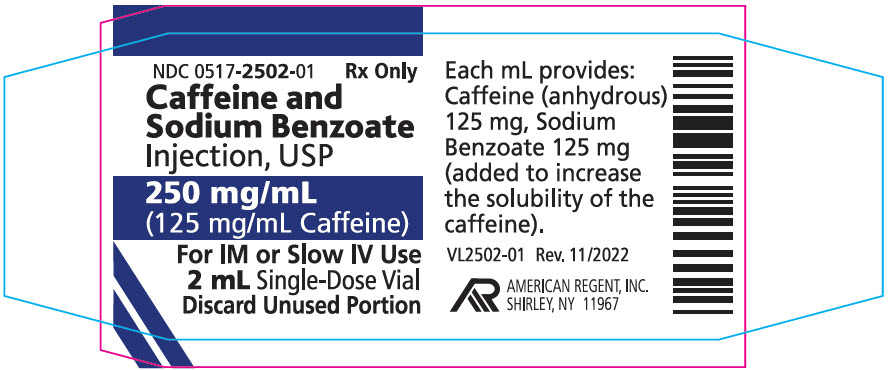
PACKAGE LABEL.PRINCIPAL DISPLAY PANEL Container Label NDC 0517-2502-01 Rx Only Caffeine and Sodium Benzoate Injection, USP 250 mg/mL (125 mg/mL Caffeine) For IM or Slow IV Use 2 mL Single-Dose Vial Discard Unused Portion Carton Labeling NDC 0517-2502-10 Rx Only Caffeine and Sodium Benzoate Injection, USP 250 mg/mL (125 mg/mL Caffeine) For Intramuscular or Slow Intravenous Use 10 X 2 mL Single-Dose Vials Discard Unused Portion Container Label Carton Labeling
Serialization Label Serialization Label
Medicaid utilization & spend
Reported adverse events (FAERS)
Top reported reactions
Reporter sex
Serious outcomes
Where does this data come from?
About this NDC listing & data coverage
Listed without an FDA application
This product's marketing category indicates it is marketed without an approved FDA application (no NDA, ANDA, or BLA on file). Having an NDC does not by itself establish FDA approval — the NDC Directory is a listing system, not an approval decision. Approval-linked data such as Orange Book therapeutic-equivalence ratings therefore does not apply.
What data is (and isn’t) available for this NDC — tap to expand
| NDC identity (package / product / labeler codes) | ✓ Available |
| Labeler | ✓ Available |
| Product & package description | ✓ Available |
| Marketing category & status | ✓ Available |
| Active ingredient / dosage form / route | ✓ Available |
| FDA label (SPL via DailyMed) | ✓ Available |
| Package photos | ✓ Available |
| Inactive ingredients (structured) | ✓ Available |
| NADAC pharmacy acquisition price (CMS) | — Not published for this NDC CMS publishes NADAC only for NDCs reported in its retail-pharmacy survey. |
| Orange Book / therapeutic-equivalence data | — Not published for this NDC Applies only to products approved under an NDA/ANDA; many listings are out of scope. |
| HCPCS J-code billing crosswalk | — Not published for this NDC Most self-administered / retail products have no J-code — that is normal. |
| Medicaid utilization (CMS SDUD) | ✓ Available |