
Multitrace-5 Trace Elements 5 4.39 mg/mL; 1.57 mg/mL; .308 mg/mL; 20.5 ug/mL; 32.7 ug/mL Injection, Solution — NDC 0517-8510-25 (Billing 00517-8510-25)
This is a package of Multitrace-5 Trace Elements 5 4.39 mg/mL; 1.57 mg/mL; .308 mg/mL; 20.5 ug/mL; 32.7 ug/mL Injection, Solution from American Regent, Inc., marketed since Feb 1994 and currently FDA-listed. It is this product's only package size.
NDC database record
One package, one record: these facts belong to NDC 0517-8510-25 alone.
- Record
- FDA NDC Directory package listing · Human prescription drug
- Code segments
- 0517 labeler · 8510 product · 25 package
- Package marketed since
- Feb 17, 1994
- Sample package
- No — commercial package
- Listing certified through
- Dec 31, 2026
- Barcode (UPC)
- 0305178510253
- FDA record last changed
- Aug 27, 2026
Identity & classification
Regulatory identifiers FDA, NLM and CMS codes for this package
Drug-database identifiers Medi-Span GPI and First Databank GCN / HICL / AHFS classification
- GSN (GCN sequence number): 045244
- GCN: 22613
- GPI-14 (Medi-Span): 79909905202010
- HICL (First Databank): 018235
- AHFS class code: 40:12.00.00
- RxCUI (RxNorm): 1293736
Where does this data come from?
- FDA openFDA NDC Directory · synced Oct 8, 2026
- FDA label on DailyMed · label index refreshed Oct 6, 2026
- RxNorm (NLM RxNav) · catalog refreshed Oct 1, 2026
- Medi-Span GPI (licensed)
- First Databank (licensed) · refreshed Oct 8, 2026
Clinical
Multitrace-5 is an injectable solution containing five trace elements (zinc, copper, manganese, chromium, and selenium) that is given intravenously. These minerals are typically used as nutritional supplements in patients who cannot obtain adequate amounts through oral intake, such as those receiving long-term intravenous feeding. Each trace element plays a role in normal body functions including immune support, wound healing, and enzyme function. This product is marketed without an approved FDA application.
Patient education
Supplement & herbal interactions
Where does this data come from?
- MedlinePlus (NLM) · refreshed Oct 1, 2026
- FDA label on DailyMed · label index refreshed Oct 6, 2026
Ask a licensed pharmacist directly — free, answered by our team.
Pricing
A drug doesn't have one price. Each row is a different public payment system, and none is what you'd pay at the counter — that depends on your insurance. The ⓘ on each row explains what it measures.
| Price system | Per mL | Per package |
|---|---|---|
| Retail pharmacies payNADAC · weekly | Not in the retail survey — common for institutional, discontinued, or low-volume packs. | |
| Medicaid paysCMS SDUD · 12 mo | No recent Medicaid claims on file for this NDC — rare and low-volume NDCs are suppressed in the public data. | |
| Medicare drug plans payPart D · quarterly | No Part D plan price is available for this NDC in our data. | |
Where does this data come from?
- CMS NADAC weekly file
- CMS ASP pricing files · refreshed Sep 20, 2026
- CMS Medicaid State Drug Utilization Data · refreshed Oct 8, 2026
- CMS Part D plan pricing files · refreshed Sep 24, 2026
- VA National Acquisition Center price file
Packaging — all sizes for this product
| Package NDC | Description | Marketing start | Marketing end | Status |
|---|---|---|---|---|
| 00517-8510-25 You're viewing this Main listing | 25 VIAL, MULTI-DOSE in 1 TRAY / 10 mL in 1 VIAL, MULTI-DOSE | 1994-02-17 | — | Active |
Therapeutic equivalents
| Product | Labeler | Pack | NADAC/unit | TE | Status | Price vs. this |
|---|---|---|---|---|---|---|
| Multitrace-5 4.39 mg/mL; 1.57 mg/mL; .308 mg/mL; 20.5 ug/mL; 32.7 ug/mLthis 00517-8510-25 | American | 25 vials | — | — | FDA listed | — |
Where does this data come from?
- FDA openFDA NDC Directory · synced Oct 8, 2026
- FDA Orange Book · refreshed Oct 3, 2026
- CMS NADAC weekly file
Availability & generic status
We did not find an FDA-approved generic match for this exact strength, form and route.
Where does this data come from?
- FDA Orange Book · refreshed Oct 3, 2026
Inactive Ingredients / Excipients
Inactive ingredients, also called excipients, are components of the drug product other than the active ingredient. They may include fillers, dyes, coatings, preservatives, flavors, or other formulation ingredients.
💡 Tap an ingredient (hover on desktop) to see what it is and why it’s used.
-
UNII LKG8494WBH
Benzyl alcohol is a clear liquid used as a preservative and solvent in medicines. It helps prevent bacterial and fungal growth and dissolves other ingredients to create uniform liquid formulations.
-
UNII 55X04QC32I
A strong alkaline chemical used to adjust and maintain the pH balance of liquid medicines. It helps keep the medicine stable and ensures it stays effective during storage.
-
UNII O40UQP6WCF
A strong acid used in small amounts to adjust and maintain the pH balance of a medicine, helping ensure stability and proper dissolution of the active ingredients.
-
UNII 059QF0KO0R
Water is a liquid solvent that dissolves and mixes ingredients together in liquid medicines, syrups, and injections. It helps distribute the active drug evenly throughout the product.
4 inactive ingredients listed in the exact product block matched to this NDC.
Where does this data come from?
ingredient classCode="IACT" elements from the exact product block matched by this NDC. Label-section narrative from DailyMed / the openFDA label index is shown separately when available.- FDA label on DailyMed · label index refreshed Oct 6, 2026
- FDA openFDA NDC Directory · synced Oct 8, 2026
Inactive ingredient FAQ
Are inactive ingredients the same for every manufacturer?
Why might an inactive ingredient be missing?
Can inactive ingredients matter?
Manufacturer & labeler
More NDCs from American Regent, Inc. labeler code 00517
- Sodium Phosphates sodium phosphate, monobasic, monohydrate and sodium phosphate, dibasic anhydrous 276 mg/mL; 142 mg/mL Injection, Solution NDC 0517-7350-25
- Acetylcysteine 100 mg/mL Inhalant NDC 0517-7504-25
- Acetylcysteine 100 mg/mL Inhalant NDC 0517-7510-03
- Acetylcysteine 200 mg/mL Inhalant NDC 0517-7604-25
- Acetylcysteine 200 mg/mL Inhalant NDC 0517-7610-03
- Zinc Sulfate 5 mg/mL Injection, Solution NDC 0517-8005-25
- Aminocaproic Acid 250 mg/mL Injection, Solution NDC 0517-9120-25
- Aminocaproic Acid 250 mg/mL Injection, Solution NDC 0517-9191-25
- Multitrace -4 Pediatric Trace Elements 4 4.39 mg/mL; .4 mg/mL; 77 ug/mL; 5.12 ug/mL Injection, Solution, Concentrate NDC 0517-9203-25
- Multrys Trace Elements Injection 4 2470 ug/mL; 150 ug/mL; 8.22 ug/mL; 9.8 ug/mL Injection, Solution NDC 0517-9302-25
- Tralement Trace Elements Injection 4 .3 mg/mL; 55 ug/mL; 60 ug/mL; 3 mg/mL Injection, Solution NDC 0517-9305-25
- Droperidol 2.5 mg/mL Injection, Solution NDC 0517-9702-25
Where does this data come from?
- FDA openFDA NDC Directory · synced Oct 8, 2026
- Drugs@FDA
Full prescribing information FDA SPL
🎯 Indications and Usage ▾
INDICATIONS AND USAGE This formulation is indicated for use as a supplement to intravenous solutions given for TPN. Administration of the solution in TPN solutions helps to maintain plasma levels of zinc, copper, manganese, selenium and chromium and to prevent depletion of endogenous stores of these trace elements and subsequent deficiency symptoms.
⏱️ Dosage and Administration ▾
DOSAGE AND ADMINISTRATION Each mL of the solution provides Zinc 1 mg, Copper 0.4 mg, Manganese 0.1 mg, Chromium 4 mcg, and Selenium 20 mcg. The suggested dosage ranges for the five trace elements are: ZINC : For the metabolically stable adult receiving TPN, the suggested intravenous dosage level is 2.5 to 4 mg zinc/day. An additional 2 mg zinc/day is suggested for acute catabolic states.
For the stable adult with fluid loss from the small bowel, an additional 12.2 mg zinc/liter of small bowel fluid lost, or an additional 17.1 mg zinc/kg of stool or ileostomy output is recommended. Frequent monitoring of zinc blood levels is suggested for patients receiving more than the usual maintenance dosage level of zinc. Normal plasma levels for zinc vary from approximately 88 to 112 mcg/100 mL.
For full term infants and children up to 5 years of age, 100 mcg zinc/kg/day is recommended. For premature infants (birth weight less than 1500 g) up to 3 kg in body weight, 300 mcg zinc/kg/day is suggested. COPPER : For the metabolically stable adult receiving TPN, the suggested additive dosage level is 0.5 to 1.5 mg copper/day.
For pediatric patients, the suggested additive dosage level is 20 mcg copper/kg/day. The normal plasma range for copper is approximately 80 to 160 mcg/100 mL. MANGANESE : For the metabolically stable adult receiving TPN, the suggested additive dosage level for manganese is 0.15 mg to 0.8 mg/day.
For pediatric patients, a dosage level of 2 to 10 mcg manganese/kg/day is recommended. CHROMIUM : For the metabolically stable adult receiving TPN, the suggested additive dosage level is 10 to 15 mcg chromium/day. The metabolically stable adult with intestinal fluid loss may require 20 mcg chromium/day, with frequent monitoring of blood levels as a guideline for subsequent administration.
For pediatric patients, the suggested additive dosage level is 0.14 to 0.20 mcg/kg/day. SELENIUM : For metabolically stable adults receiving TPN, the suggested additive dosage level is 20 to 40 mcg selenium/day. For pediatric patients, the suggested additive dosage level is 3 mcg/kg/day.
In adults, selenium deficiency states resulting from long term TPN support, selenium as selenomethionine or selenious acid, administered intravenously at 100 mcg/day for a period of 24 and 31 days, respectively, has been reported to reverse deficiency symptoms without toxicity. The normal whole blood range for selenium is approximately 10 to 37 mcg/100 mL. Periodic monitoring of plasma levels of Zinc, Copper, Manganese, Chromium and Selenium is suggested as a guideline for administration.
Aseptic addition of MULTITRACE ® - 5 to parenteral nutrition solutions under laminar flow hood is recommended. The trace elements present in MULTITRACE ® - 5 are physically compatible with the electrolytes and vitamins usually present in parenteral nutrition formulations. Do not directly mix ascorbic acid injection with copper or selenium containing parenteral products in the same syringe or vial, as this admixture may cause the formation of an insoluble precipitate.
Parenteral drug products should be inspected visually for particulate matter and discoloration prior to administration, whenever solution and container permit. Store at 20° to 25°C (68° to 77°F); excursions permitted to 15° to 30°C (59° to 86°F) (See USP Controlled Room Temperature).
⛔ Contraindications ▾
CONTRAINDICATIONS MULTITRACE ® - 5 should not be given undiluted by direct injection into a peripheral vein because of the potential of infusion phlebitis.
⚠️ Warnings ▾
WARNINGS Copper and Manganese are eliminated via the bile. In patients with severe liver dysfunction and/or biliary tract obstruction, decreasing or omitting copper and manganese supplements entirely may be necessary. This product contains aluminum that may be toxic.
Aluminum may reach toxic levels with prolonged parenteral administration if kidney function is impaired. Premature neonates are particularly at risk because their kidneys are immature, and they require large amounts of calcium and phosphate solutions, which contain aluminum. Research indicates that patients with impaired kidney function, including premature neonates, who receive parenteral levels of aluminum at greater than 4 to 5 mcg/kg/day accumulate aluminum at levels associated with central nervous system and bone toxicity.
Tissue loading may occur at even lower rates of administration.
🤒 Adverse Reactions ▾
ADVERSE REACTIONS The amounts of ZINC, COPPER, MANGANESE, CHROMIUM and SELENIUM in the solution are very small and toxicity symptoms due to these trace elements at suggested dosage levels are considered unlikely to occur.
🤰 Pregnancy ▾
Pregnancy Teratogenic Effects Pregnancy Category C: SELENIUM at high dosage levels (15-30 mcg/egg) has been reported to have adverse embryological effects among chickens. There are however no adequate and wellcontrolled studies in pregnant women. MULTITRACE ® - 5 should be used during pregnancy only if potential benefit justifies the potential risk to the fetus. Presence of SELENIUM in placenta and umbilical cord blood has been reported in humans.
🆘 Overdosage ▾
OVERDOSAGE Symptoms of ZINC overdosage resulting from oral ingestion of Zinc Sulfate in large amounts have resulted in death. Symptoms included nausea, vomiting, dehydration, electrolyte imbalances, dizziness, abdominal pain, lethargy and incoordination. Single intravenous doses of 1 to 2 mg zinc/kg body weight have been given to adult leukemic patients without toxic manifestations.
Normal plasma levels for Zinc vary from approximately 88 to 112 mcg/100 mL. Plasma levels sufficient to produce symptoms of toxic manifestations are not known. Calcium supplements may confer a protective effect against Zinc toxicity.
Symptoms of COPPER toxicity reported in literature include prostration, behavior change, diarrhea, progressive marasmus, hypotonia, photophobia and peripheral edema. D-penicillamine has been reported effective as an antidote. MANGANESE toxicity has not been reported in patients receiving TPN.
Neither have reports of manganese toxicity from excessive intake in foods and/or beverages been published. Symptoms of CHROMIUM toxicity include nausea, vomiting, ulcers of gastrointestinal tract, renal and hepatic damage, and abnormalities of the central nervous system culminating in convulsions and coma. Trivalent Chromium administered intravenously to TPN patients has been shown to be nontoxic when given at dosage levels up to 250 mcg/day for two consecutive weeks.
Chronic toxicity in humans resulting from exposure to SELENIUM in industrial environments, intake of foods grown in seleniferous soils, use of selenium contaminated water, and application of cosmetics containing selenium has been reported in literature. Toxicity symptoms include hair loss, weakened nails, dermatitis, dental defects, gastrointestinal disorders, nervousness, mental depression, metallic taste, vomiting, and garlic odor of breath and sweat. Acute poisoning due to ingestion of large amounts of selenium compounds has resulted in death with histopathological changes including fulminating peripheral vascular collapse, internal vascular congestion, diffusely hemorrhagic, congested and edematous lungs, brick-red color gastric mucosa.
The death was preceded by coma. No effective antidote to selenium poisoning in humans is known. Animal studies have shown casein and linseed oil in feeds, reduced glutathione, arsenic, magnesium sulfate, and bromobenzene to afford limited protection.
🧬 Clinical Pharmacology ▾
CLINICAL PHARMACOLOGY ZINC has been identified as a cofactor for over 70 different enzymes, including alkaline phosphatase, lactic dehydrogenase and both RNA and DNA polymerase. Zinc facilitates wound healing, helps maintain normal growth rates, normal skin hydration and senses of taste and smell. Providing zinc during TPN prevents development of the following deficiency symptoms: parakeratosis, hypogeusia, anorexia, dysosmia, geophagia, hypogonadism, growth retardation and hepatosplenomegaly.
At plasma levels below 20 mcg zinc/100 mL, dermatitis followed by alopecia has been reported for TPN patients. COPPER is essential as a cofactor for serum ceruloplasmin, an oxidase necessary for proper formation of the iron carrier protein, transferrin. Copper also helps maintain normal rates of red and white blood cell formation.
Scorbutic type bone changes seen in infants fed exclusively with copper-poor cow's milk are believed due to decreased activity of ascorbate oxidase, a cuproenzyme. Providing copper during TPN prevents development of the following deficiency symptoms: leukopenia, neutropenia, anemia, depressed ceruloplasmin levels, impaired transferrin formation and secondary iron deficiency. MANGANESE is an activator for enzymes such as polysaccharide polymerase, liver arginase, cholinesterase and pyruvate carboxylase.
Providing manganese during TPN prevents development of the following deficiency symptoms: nausea and vomiting, weight loss, dermatitis, and changes in growth and color of hair. CHROMIUM (trivalent) is part of glucose tolerance factor, an activator of insulin-mediated reactions. Chromium helps to maintain normal glucose metabolism and peripheral nerve function.
Providing chromium during TPN prevents development of the following deficiency symptoms: impaired glucose tolerance, ataxia, peripheral neuropathy and a confusional state similar to mild/moderate hepatic encephalopathy. SELENIUM is part of glutathione peroxidase which protects cell components from oxidative damage due to peroxides produced in cellular metabolism. Prolonged TPN support in humans has resulted in selenium deficiency symptoms which include muscle pain and tenderness.
The symptoms have been reported to respond to supplementation of TPN solutions with selenium.
📦 How Supplied / Storage and Handling ▾
HOW SUPPLIED MULTITRACE ® - 5 (TRACE ELEMENTS INJECTION 5, USP) Each mL provides: Zinc 1 mg, Copper 0.4 mg, Manganese 0.1 mg, Chromium 4 mcg, Selenium 20 mcg. NDC 0517-8510-25 10 mL Multiple Dose Vial* Packaged in boxes of 25 *Contains 0.9% benzyl alcohol as an antimicrobial preservative. AMERICAN REGENT, INC. SHIRLEY, NY 11967 IN8510 Rev. 8/18
📋 Description ▾
DESCRIPTION MULTITRACE ® - 5 (TRACE ELEMENTS INJECTION 5, USP) is a sterile nonpyrogenic solution containing five Trace Elements for use as an additive for Total Parenteral Nutrition (TPN). Each mL provides: Zinc 1 mg, Copper 0.4 mg, Manganese 0.1 mg, Chromium 4 mcg and Selenium 20 mcg. Each mL Contains: Zinc Sulfate Heptahydrate 4.39 mg (equivalent to 1 mg Zinc); Cupric Sulfate Pentahydrate 1.57 mg (equivalent to 0.4 mg Copper); Manganese Sulfate Monohydrate 0.308 mg (equivalent to 0.1 mg Manganese); Chromic Chloride Hexahydrate 20.5 mcg (equivalent to 4 mcg Chromium); Selenious Acid 32.7 mcg (equivalent to 20 mcg Selenium); and Water for Injection q.s. pH may be adjusted with Sulfuric Acid and/or Sodium Hydroxide.
0.9% Benzyl Alcohol added as an antimicrobial preservative.
⚠️ Precautions ▾
PRECAUTIONS Before administering MULTITRACE ® - 5 in TPN solutions, the physician must assess the metabolic requirements for trace elements and disease state of the patient. Frequent determinations of serum levels of the various trace elements are suggested as a guideline for adjusting the dosage or completely omitting the solution. ZINC is eliminated via the intestine and kidneys.
The possibility of retention should be considered in patients with malfunctioning excretory routes. COPPER and MANGANESE are eliminated via the bile, therefore the possibility of retention of these elements should be considered in patients with biliary obstruction. Ancillary routes of MANGANESE excretion, however, include pancreatic juice, or reabsorption into the lumen of duodenum, jejunum, or ileum.
In assessing the contribution of CHROMIUM supplements to maintenance of normal glucose homeostasis, consideration should be given to the possibility that the patient may be diabetic, in which case oral or intravenous antidiabetic medication may be indicated. As SELENIUM is eliminated in urine and feces, SELENIUM supplements may be adjusted, reduced or omitted in renal dysfunction and/or gastrointestinal malfunction. In patients receiving blood transfusions, contribution from such transfusions should also be considered.
Frequent selenium plasma level determinations are suggested as a guideline. In animals, SELENIUM has been reported to enhance the action of Vitamin E and decrease the toxicity of mercury, cadmium, and arsenic. Pregnancy Teratogenic Effects Pregnancy Category C: SELENIUM at high dosage levels (15-30 mcg/egg) has been reported to have adverse embryological effects among chickens.
There are however no adequate and wellcontrolled studies in pregnant women. MULTITRACE ® - 5 should be used during pregnancy only if potential benefit justifies the potential risk to the fetus. Presence of SELENIUM in placenta and umbilical cord blood has been reported in humans.
📄 Package Label / Principal Display Panel ▾
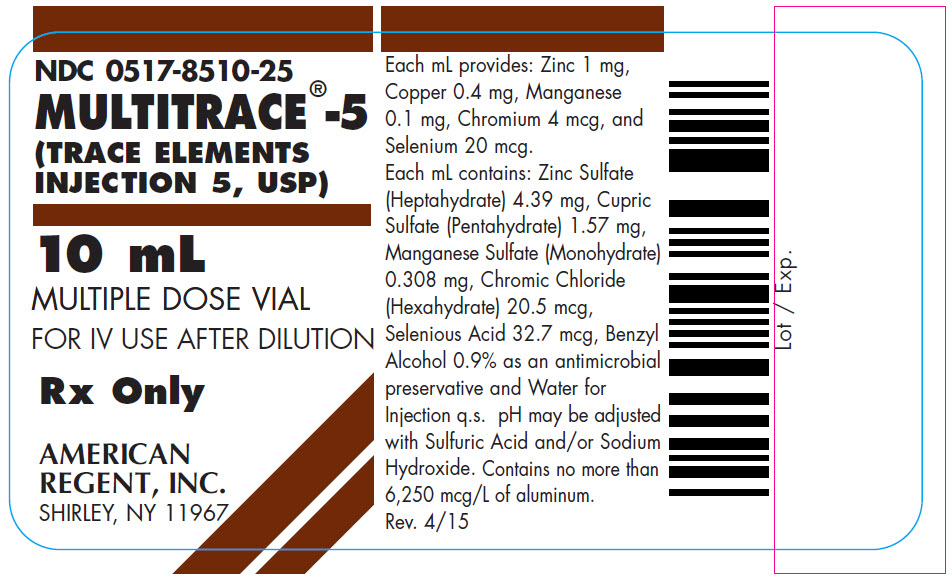
PACKAGE LABEL.PRINCIPAL DISPLAY PANEL Container NDC 0517-8510-25 MULTITRACE ® -5 (TRACE ELEMENTS INJECTION 5, USP) 10 mL MULTIPLE DOSE VIAL FOR IV USE AFTER DILUTION Rx Only Carton MULTITRACE ® -5 (TRACE ELEMENTS INJECTION 5, USP) NDC 0517-8510-25 25 x 10 mL MULTIPLE DOSE VIALS FOR IV USE AFTER DILUTION Rx Only Each mL provides: Zinc 1 mg, Copper 0.4 mg, Manganese 0.1 mg, Chromium 4 mcg and Selenium 20 mcg. Each mL contains: Zinc Sulfate (Heptahydrate) 4.39 mg, Cupric Sulfate (Pentahydrate) 1.57 mg, Manganese Sulfate (Monohydrate) 0.308 mg, Chromic Chloride (Hexahydrate) 20.5 mcg, Selenious Acid 32.7 mcg, Benzyl Alcohol 0.9% as an antimicrobial preservative, and Water for Injection q.s. pH may be adjusted with Sulfuric Acid and/or Sodium Hydroxide.
Sterile, nonpyrogenic. Store at 20°-25°C (68°-77°F); excursions permitted to 15 °-30 °C (59°-86°F) (see USP Controlled Room Temperature). Directions for Use: See Package Insert.
AMERICAN REGENT, INC. SHIRLEY, NY 11967 Rev. 11/05 10 mL Container Label 38cdbd24-figure-01
Serialization Label Serialization Label
Reported adverse events (FAERS)
Top reported reactions
Age at onset
Reporter sex
Serious outcomes
Where does this data come from?
About this NDC listing & data coverage
Listed without an FDA application
This product's marketing category indicates it is marketed without an approved FDA application (no NDA, ANDA, or BLA on file). Having an NDC does not by itself establish FDA approval — the NDC Directory is a listing system, not an approval decision. Approval-linked data such as Orange Book therapeutic-equivalence ratings therefore does not apply.
What data is (and isn’t) available for this NDC — tap to expand
| NDC identity (package / product / labeler codes) | ✓ Available |
| Labeler | ✓ Available |
| Product & package description | ✓ Available |
| Marketing category & status | ✓ Available |
| Active ingredient / dosage form / route | ✓ Available |
| FDA label (SPL via DailyMed) | ✓ Available |
| Package photos | ✓ Available |
| Inactive ingredients (structured) | ✓ Available |
| NADAC pharmacy acquisition price (CMS) | — Not published for this NDC CMS publishes NADAC only for NDCs reported in its retail-pharmacy survey. |
| Orange Book / therapeutic-equivalence data | — Not published for this NDC Applies only to products approved under an NDA/ANDA; many listings are out of scope. |
| HCPCS J-code billing crosswalk | — Not published for this NDC Most self-administered / retail products have no J-code — that is normal. |
| Medicaid utilization (CMS SDUD) | — Not published for this NDC CMS reports utilization only for NDCs with Medicaid claims above its privacy threshold. |