
HomeNDC LookupIngredientsPodofilox › 00574-0611-05
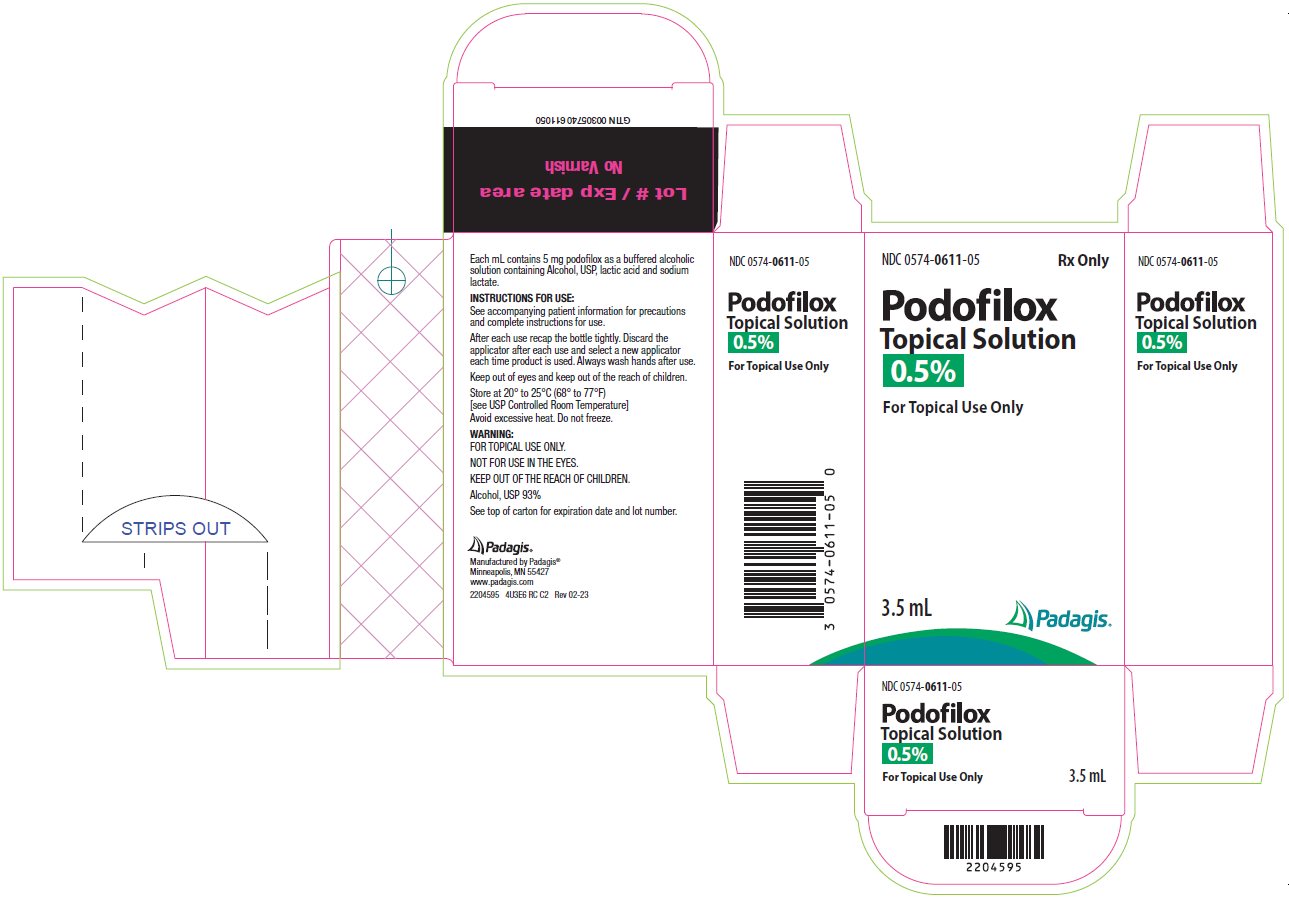
PODOFILOX 5 mg/mL Solution, 1 bottle — NDC 00574-0611-05 package photo

PODOFILOX 5 mg/mL Solution, 1 bottle

by Padagis US LLC · 1 BOTTLE, GLASS in 1 CARTON (0574-0611-05) / 3.5 mL in 1 BOTTLE, GLASS
NDC 00574-0611-05
🏷️ FDA NDC (as labeled) 0574-0611-05 billing pads the labeler segment with a zero
Rx only Generic On market Non-controlled
🗂️ Data synced Jul 24, 2026 · sources: openFDA · FDA label (DailyMed) · FDA Orange & Purple Book · First Databank · CMS NADAC, ASP, Medicare & Medicaid · RxNorm
📋 All sources & update times →

🆔 Identity & classification

FDA NDC (as labeled) 0574-0611-05
Product NDC 0574-0611
11-digit billing NDC 00574061105
NCPDP billing unit ML — per mL (volume)
RxCUI 582926
UNII L36H50F353
Application # ANDA075600
SPL Set ID 6af07697-5203-43e0-ba35-83683af851c3
Physiologic effect Decreased Mitosis
DEA schedule Non-controlled
Marketing category ANDA
Marketing status On market
FDA listing status Listed (active directory)
Marketing start 2002-01-29
Route TOPICAL
Dosage form SOLUTION
Substance PODOFILOX
GPI-14 90750015002020
GPI class Podofilox
GCN Seq No 015942
GCN 23451
HICL code 006081
Ingredient (HICL) Podofilox
HIC1 code L
Therapeutic class — broad (HIC1) Skin/Subcutaneous Tissue
HIC2 code L5
Therapeutic class — intermediate (HIC2) Keratolytics/Keratoplastics
HIC3 code L5A
Therapeutic class — specific (HIC3) Keratolytics
AHFS code 84:28.00.00
AHFS class Keratolytic Agents
FDB label name PODOFILOX 0.5% TOPICAL SOLN
FDB brand name Podofilox
Legend status F — Federal legend — prescription drug or device
Why two NDCs? The FDA registers this code as 0574-0611-05 — a 4-4-2 layout, and that's what's printed on the package and shown on DailyMed. For insurance claims, every NDC is standardized to a uniform 11-digit 5-4-2 format by adding a zero to the labeler segment → 00574-0611-05. Same drug, same package — only the format differs.
Where does this data come from?
Identifiers from the FDA openFDA NDC Directory and Structured Product Labeling; RxCUI from RxNorm (NLM); GPI from Medi-Span; GCN / HIC / AHFS / legend from First Databank.

🏷️ RxNorm drug class

This medicine belongs to the Antivirals class.

Drug family (ATC) Antivirals
Where does this data come from?
Therapeutic classes from RxNorm RxClass (U.S. National Library of Medicine) — Established Pharmacologic Class (FDA), ATC drug family (WHO) and mechanism of action, matched by this product’s RxCUI.

🏭 Manufacturer & labeler

LabelerPadagis US LLC
Application holderPADAGIS US LLC
FDA applicationANDA075600 (ANDA)
Labeler code00574
First marketedJan 2002
Product typeHuman Prescription Drug
Portfolio63 products on file
The labeler markets the product; the application holder owns the FDA approval. They’re often the same company but can differ (e.g. a repackager or an authorized generic). A mailing address / phone appears here when the manufacturer includes it in the product’s FDA label (not all do).
Where does this data come from?
Labeler, application holder and registered establishment from the FDA openFDA NDC Directory and Drugs@FDA; address/contact from the product’s FDA label.

🩺 Clinical

Label name PODOFILOX 0.5% TOPICAL SOLN Ingredient Podofilox
📖 What it is MedlinePlus · NLM

Podofilox is used to treat warts in the genital and anal area. Podofilox is in a class of medications called keratolytic agents. It works by slowly killing cells in the tissue that makes up the wart.

Read the full MedlinePlus article ↗
Where does this data come from?
Plain-language summary from MedlinePlus (U.S. National Library of Medicine); supplement & herbal interactions and nutrient depletion data from the Natural Medicines database; our full guide is HelloPharmacist editorial content.

🧪 Inactive Ingredients / Excipients

Inactive ingredients, also called excipients, are components of the drug product other than the active ingredient. They may include fillers, dyes, coatings, preservatives, flavors, or other formulation ingredients.

Loading inactive ingredients from the official FDA label in the background. No external source is being called by this page request.
Where does this data come from?
Source: official FDA Structured Product Labeling (SPL) via DailyMed and the openFDA label index. Structured IACT rows and label-wide narrative are kept separate; availability and product-level specificity depend on the submitted label.

Inactive ingredient FAQ

Are inactive ingredients the same for every manufacturer?
No. Inactive ingredients can differ by manufacturer, dosage form, strength, and package / product version.
Why might an inactive ingredient be missing?
Some SPLs do not provide a complete structured inactive-ingredient list, and older or unusual labels may only include the information in narrative text.
Can inactive ingredients matter?
Yes. They can matter for allergies, intolerances, dyes, gluten / lactose concerns, preservatives, and formulation differences — but confirm with a pharmacist or the manufacturer when it’s clinically important.

💲 Pricing

A drug doesn't have one price. Each row is a different public payment system, and none is what you'd pay at the counter — that depends on your insurance. The ⓘ on each row explains what it measures.

Price systemPer mLPer package
Retail pharmacies payNADAC · weekly $15.340 $53.69 / 3.5 ml
Medicaid paysCMS SDUD · 12 mo $16.68 $58.38 / 3.5 ml
Medicare drug plans payPart D · Q2 2026 $19.14 $66.98 / 3.5 ml
NADAC price history (per mL) — tap or hover for the price & month
Dec 2021 Jul 2022 Dec 2025 Aug 2026 $15.929 $11.250
▲ Up 17% over the last 24 months.
Where does this data come from?
NADAC (National Average Drug Acquisition Cost) is the CMS weekly pharmacy-acquisition-cost survey — what pharmacies pay. ASP (Average Sales Price) is the CMS Medicare Part B drug-payment file, published quarterly. Medicaid pays is computed by us from CMS State Drug Utilization Data (total reimbursed ÷ units, trailing 12 months) — gross of rebates and inclusive of dispensing fees, so it reflects what Medicaid paid, not an acquisition cost. Medicare drug plans pay is the median negotiated point-of-sale unit cost across plans listing this NDC in the CMS quarterly Prescription Drug Plan pricing files, before rebates. The VA pays is the federal contract price (FSS, and the statutory Big 4 ceiling where listed) from the VA National Acquisition Center pharmaceutical price file. All are free public government data; each measures a different payer, so the figures are not directly comparable.

🔁 Therapeutic equivalents

ProductLabelerPackNADAC/unitTEStatusPrice vs. this
Podofilox 5 mg/mLthis 00574-0611-05 Padagis 1 bottle $15.340 Availability likely
About this product: this is a generic version of the medicine. FDA equivalence ratings are shown when available, and other versions are listed above, least expensive first.
Where does this data come from?
Equivalents are other NDCs of the same ingredient, form and route from the openFDA NDC Directory, ranked least-expensive-first by NADAC. Therapeutic-equivalence (AB) ratings come from the FDA Orange Book; biologics use the FDA Purple Book for biosimilar & interchangeable status.

Availability & generic status

🏛️
2002
On the market since
Jan 2002
📍
2026
Currently FDA-listed
24 years listed
🔓
·
Generic on the market
this product is a generic
This is a generic drug

This product is an FDA-approved generic. Other versions of the same drug are listed under Therapeutic equivalents, least expensive first.

Where does this data come from?
Patents and exclusivity from the FDA Orange Book (small-molecule drugs), refreshed from public FDA data. Generic launch timing is an estimate, not a guarantee.

🗺️ Medicaid utilization & spend

📍 This exact package only: Medicaid data is reported per full 11-digit NDC — labeler, product and pack size — so every number here is for 00574-0611-05, not the drug overall. Other pack sizes report separately.
💊 Pharmacy benefit only: These are Medicaid outpatient pharmacy claims, billed by NDC. They exclude the medical benefit — clinic- or hospital-administered drugs billed under HCPCS J-codes — so drugs used mostly that way (e.g. Avastin, Lucentis, Keytruda) can look low or missing here. That’s expected, not an error.
📅 Q1 2025 – Q4 2025 · 4 quarters of data
ⓘ The newest quarter is usually incomplete when first published; states restate recent quarters in later CMS releases, so the latest figures typically revise upward. State coverage-policy changes can also shift quarter-to-quarter totals.
Prescriptions last 4 qtrs
8.7K
Units reimbursed last 4 qtrs
31.3K
Gross reimbursed last 4 qtrs
$522.9K
Avg / prescription
$60.25
Avg / unit
$16.6797
Latest quarter Q4 2025
1.7KRx
Medicaid pays / mL
$16.6797
gross reimbursed
vs
NADAC / mL
$15.3398
acquisition cost
=
Spread
+$1.3399
+9% vs cost
What Medicaid paid per mL (before rebates; includes the pharmacy’s dispensing fee) compared with NADAC — the average price pharmacies pay to buy the drug. A positive spread means Medicaid reimbursed more than the purchase price, before manufacturer rebates.
Fee-for-service vs managed care
38% FFS 62% MCO
Fee-for-service · 3,309 Rx Managed care · 5,370 Rx
State Medicaid map
Alaska: no data reported AK Maine: no data reported ME Washington: 448 units · 5.7 per 100k residents WA Idaho: no data reported ID Montana: no data reported MT North Dakota: no data reported ND Minnesota: 147 units · 2.6 per 100k residents MN Wisconsin: 189 units · 3.2 per 100k residents WI Michigan: 1,582 units · 15.8 per 100k residents MI New York: 3,779 units · 19.3 per 100k residents NY Vermont: 46 units · 7.1 per 100k residents VT New Hampshire: no data reported NH Oregon: 648 units · 15.3 per 100k residents OR Nevada: 137 units · 4.3 per 100k residents NV Wyoming: no data reported WY South Dakota: no data reported SD Iowa: no data reported IA Illinois: 805 units · 6.4 per 100k residents IL Indiana: 536 units · 7.8 per 100k residents IN Ohio: 1,547 units · 13.1 per 100k residents OH Pennsylvania: 2,688 units · 20.7 per 100k residents PA New Jersey: 1,810 units · 19.5 per 100k residents NJ Massachusetts: 252 units · 3.6 per 100k residents MA California: 6,564 units · 16.8 per 100k residents CA Utah: no data reported UT Colorado: 231 units · 3.9 per 100k residents CO Nebraska: no data reported NE Missouri: 214 units · 3.5 per 100k residents MO Kentucky: 364 units · 8.0 per 100k residents KY West Virginia: no data reported WV Virginia: 497 units · 5.7 per 100k residents VA Maryland: 445 units · 7.2 per 100k residents MD Connecticut: 455 units · 12.6 per 100k residents CT Rhode Island: 168 units · 15.3 per 100k residents RI Arizona: 553 units · 7.4 per 100k residents AZ New Mexico: 630 units · 29.8 per 100k residents NM Kansas: no data reported KS Arkansas: no data reported AR Tennessee: no data reported TN North Carolina: 214 units · 2.0 per 100k residents NC South Carolina: no data reported SC Delaware: 402 units · 39.0 per 100k residents DE Oklahoma: 277 units · 6.8 per 100k residents OK Louisiana: no data reported LA Mississippi: no data reported MS Alabama: 375 units · 7.3 per 100k residents AL Georgia: 53 units · 0.5 per 100k residents GA D.C.: no data reported DC Hawaii: no data reported HI Texas: 3,332 units · 10.9 per 100k residents TX Florida: 1,967 units · 8.7 per 100k residents FL
Units reimbursed · per 100k residents
0.539.0
gray = no data reported
Colors are per 100,000 residents, so big states don’t automatically dominate. Tap or hover a state for its actual totals.
Tap or hover a state
…for its Medicaid breakdown
🏆 Top states by units · per 100k residents
1 Delaware 39.0 /100k
2 New Mexico 29.8 /100k
3 Pennsylvania 20.7 /100k
4 New Jersey 19.5 /100k
5 New York 19.3 /100k
6 California 16.8 /100k
7 Michigan 15.8 /100k
8 Rhode Island 15.3 /100k
National units — by quarter
💵 About the dollar figures: “reimbursed” is what Medicaid paid pharmacies before confidential manufacturer rebates, so the program’s real net cost is lower than these numbers. Fee-for-service and managed-care claims are combined unless split above. Source: CMS State Drug Utilization Data; per-100k rates use 2023 Census population estimates.

📊 Medicare Part D spend CMS · PART D · 2026 (Q1)

Medicare Part D (outpatient prescription) spending for Podofilox — the program that covers self-administered drugs. 2 manufacturers.
⚠️ Drug-level data: CMS publishes Part D spending by drug, not by NDC — these figures combine every manufacturer, strength and package size sold under the name Podofilox. That’s a different level of aggregation than the Medicaid card above, which is specific to this exact 11-digit NDC (pack size included), so the two aren’t directly comparable.
Period
Total Part D spend
$49.1K
Claims incl. refills
404
Beneficiaries
370
Spend / beneficiary
$132.64
Spend / claim
$121.47
Trend by period
💵 About the dollar figures: spending is what Part D plans paid before confidential manufacturer rebates, so the program’s real net cost is lower. A blank patient count means fewer than 11 people — CMS hides counts that small to protect privacy. Source: CMS Medicare Quarterly Part D Spending by Drug (data.cms.gov), updated quarterly.

🔬 Reported adverse events (FAERS)

Read carefully: FAERS reports are voluntary and unverified. Counts are not incidence, do not establish causation, are subject to reporting bias, and cannot be used to compare one drug to another. Shown for signal context only. Reports for PODOFILOX — the ingredient across all brands.

Top reported reactions

Pain17
Anxiety13
Emotional Distress11
Anhedonia10
Application Site Pain9
Renal Failure9
Chronic Kidney Disease8

Reporter sex

109 reports
Male · 66%
Female · 34%

Serious outcomes

Death2
Reports over time (by year) — tap or hover for the count & year
2019 2021 2023 2026 10 0
Most recent year is provisional (FAERS lags ~3 months).
Where does this data come from?
Adverse-event reports from the FDA Adverse Event Reporting System (FAERS) via openFDA. FAERS reports are voluntary and unverified — counts are not incidence and don’t establish causation.

📦 Packaging — all sizes for this product

Package NDCDescription Marketing startStatus
00574-0611-05 You're viewing this 1 BOTTLE, GLASS in 1 CARTON (0574-0611-05) / 3.5 mL in 1 BOTTLE, GLASS 2002-01-29 Active

📄 Full prescribing information FDA SPL

The complete FDA label for this product — the official prescribing information, verbatim, section by section. Jump with a chip, search within the label, or expand everything.
🎯 Indications and Usage 90 words

INDICATIONS AND USAGE Podofilox Topical Solution 0.5% is indicated for the topical treatment of external genital warts (Condyloma acuminatum). This product is not indicated in the treatment of perianal or mucous membrane warts (see PRECAUTIONS ). Diagnosis Although genital warts have a characteristic appearance, histopathologic confirmation should be obtained if there is any doubt of the diagnosis.

Differentiating warts from squamous cell carcinoma (so-called "Bowenoid papulosis") is of particular concern. Squamous cell carcinoma may also be associated with human papillomavirus but should not be treated with Podofilox Topical Solution 0.5%.

⏱️ Dosage and Administration ~1 min read

DOSAGE AND ADMINISTRATION In order to ensure that the patient is fully aware of the correct method of therapy and to identify which specific warts should be treated, the technique for initial application of the medication should be demonstrated by the prescriber. Apply twice daily morning and evening (every 12 hours), for 3 consecutive days, then withhold use for 4 consecutive days. This one week cycle of treatment may be repeated up to four times until there is no visible wart tissue.

If there is incomplete response after four treatment weeks, alternative treatment should be considered. Safety and effectiveness of more than four treatment weeks have not been established. Podofilox Topical Solution 0.5% is applied to the warts with an applicator supplied with the drug.

The drug-dampened applicator should be touched to the wart to be treated, applying the minimum amount of solution necessary to cover the lesion. Treatment should be limited to less than 10 cm 2 of wart tissue and to no more than 0.5 mL of the solution per day. There is no evidence to suggest that more frequent application will increase efficacy, but additional applications would be expected to increase the rate of local adverse reactions and systemic absorption.

Care should be taken to allow the solution to dry before allowing the return of opposing skin surfaces to their normal positions. After each treatment, the used applicator should be carefully disposed of and the patient should wash his or her hands.

Contraindications 20 words

CONTRAINDICATIONS Podofilox Topical Solution 0.5% is contraindicated for patients who develop hypersensitivity or intolerance to any component of the formulation.

⚠️ Warnings 57 words

WARNINGS Correct diagnosis of the lesions to be treated is essential. See the " Diagnosis " subsection of the INDICATIONS AND USAGE statement. Podofilox Topical Solution 0.5% is intended for cutaneous use only. Avoid contact with the eye. If eye contact occurs, patient should immediately flush the eye with copious quantities of water and seek medical advice.

🤒 Adverse Reactions 86 words

ADVERSE REACTIONS In clinical trials, the following local adverse reactions were reported at some point during treatment. Adverse Experience Males Females Burning 64% 78% Pain 50% 72% Inflammation 71% 63% Erosion 67% 67% Itching 50% 65% Reports of burning and pain were more frequent and of greater severity in women than in men. Adverse effects reported in less than 5% of the patients included pain with intercourse, insomnia, tingling, bleeding, tenderness, chafing, malodor, dizziness, scarring, vesicle formation, crusting edema, dryness/peeling, foreskin irretraction, hematuria, vomiting and ulceration.

🤰 Pregnancy 105 words

Pregnancy Teratogenic Effects: Pregnancy Category C: Podofilox was not teratogenic in the rabbit following topical application of up to 0.21 mg/kg (5 times the maximum human dose) once daily for 13 days. The scientific literature contains references that podofilox is embryotoxic in rats when administered systemically in a dose approximately 250 times the recommended maximum human dose. 8,9 Teratogenicity and embryotoxicity have not been studied with intravaginal application.

Many antimitotic drug products are known to be embryotoxic. There are no adequate and well-controlled studies in pregnant women. Podofilox should be used during pregnancy only if the potential benefit justifies the potential risk to the fetus.

🧒 Pediatric Use 12 words

Pediatric Use Safety and effectiveness in pediatric patients have not been established.

🆘 Overdosage 110 words

OVERDOSE Topically applied podofilox may be absorbed systemically (see CLINICAL PHARMACOLOGY section). Toxicity reported following systemic administration of podofilox in investigational use for cancer treatment included: nausea, vomiting, fever, diarrhea, bone marrow depression, and oral ulcers. Following 5 to 10 daily intravenous doses of 0.5 to 1 mg/kg/day, significant hematological toxicity occurred but was reversible.

Other toxicities occurred at lower doses. Toxicity reported following systemic administration of podophyllum resin included: nausea, vomiting, fever, diarrhea, peripheral neuropathy, altered mental status, lethargy, coma, tachypnea, respiratory failure, leukocytosis, pancytosis, hematuria, renal failure, and seizures. Treatment of topical overdosage should include washing the skin free of any remaining drug and symptomatic and supportive therapy.

🧬 Clinical Pharmacology 93 words

CLINICAL PHARMACOLOGY Mechanism of Action Treatment of genital warts with podofilox results in necrosis of visible wart tissue. The exact mechanism of action is unknown. Pharmacokinetics In systemic absorption studies in 52 patients, topical application of 0.05 mL of 0.5% podofilox solution to external genitalia did not result in detectable serum levels.

Applications of 0.1 to 1.5 mL resulted in peak serum levels of 1 to 17 ng/mL one to two hours after application. The elimination half-life ranged from 1.0 to 4.5 hours. The drug was not found to accumulate after multiple treatments.

🧬 Mechanism of Action 23 words

Mechanism of Action Treatment of genital warts with podofilox results in necrosis of visible wart tissue. The exact mechanism of action is unknown.

📦 How Supplied / Storage and Handling 43 words

HOW SUPPLIED 3.5 mL Podofilox Topical Solution 0.5% is supplied as a clear liquid in amber glass bottles with child-resistant screw caps. NDC 0574-0611-05. Store at 20° and 25°C (68° to 77°F) [see USP Controlled Room Temperature]. Avoid excessive heat. Do not freeze.

📋 Description 93 words

DESCRIPTION Podofilox Topical Solution is an antimitotic drug which can be chemically synthesized or purified from the plant families Coniferae and Berberidaceae (e.g. species of Juniperus and Podophyllum ). Podofilox Topical Solution 0.5% is formulated for topical administration. Each milliliter of solution contains 5 mg of podofilox, in a vehicle containing lactic acid and sodium lactate in alcohol 95%, USP.

Podofilox has a molecular weight of 414.4 daltons, and is soluble in alcohol and sparingly soluble in water. Its chemical name is 5,8,8a,9-Tetrahydro-9-hydroxy-5-(3,4,5-trimethoxylphenyl)furo[3',4':6,7] naphtho[2,3,d]-1, 3-dioxol-6(5aH)-one. Podofilox has the following structural formula: Chemical Structure

💬 Information for Patients 21 words

Information for Patients The patient should be provided with a Patient Information leaflet when a Podofilox Topical Solution prescription is filled.

Source: FDA Structured Product Labeling, mirrored from DailyMed / openFDA. Prefer the government’s original formatting? View this label on DailyMed ↗
For educational and professional reference only — not medical advice. Pricing reflects published NADAC and CMS ASP (free public data) and may differ from your acquisition cost; always verify before billing or dispensing.