
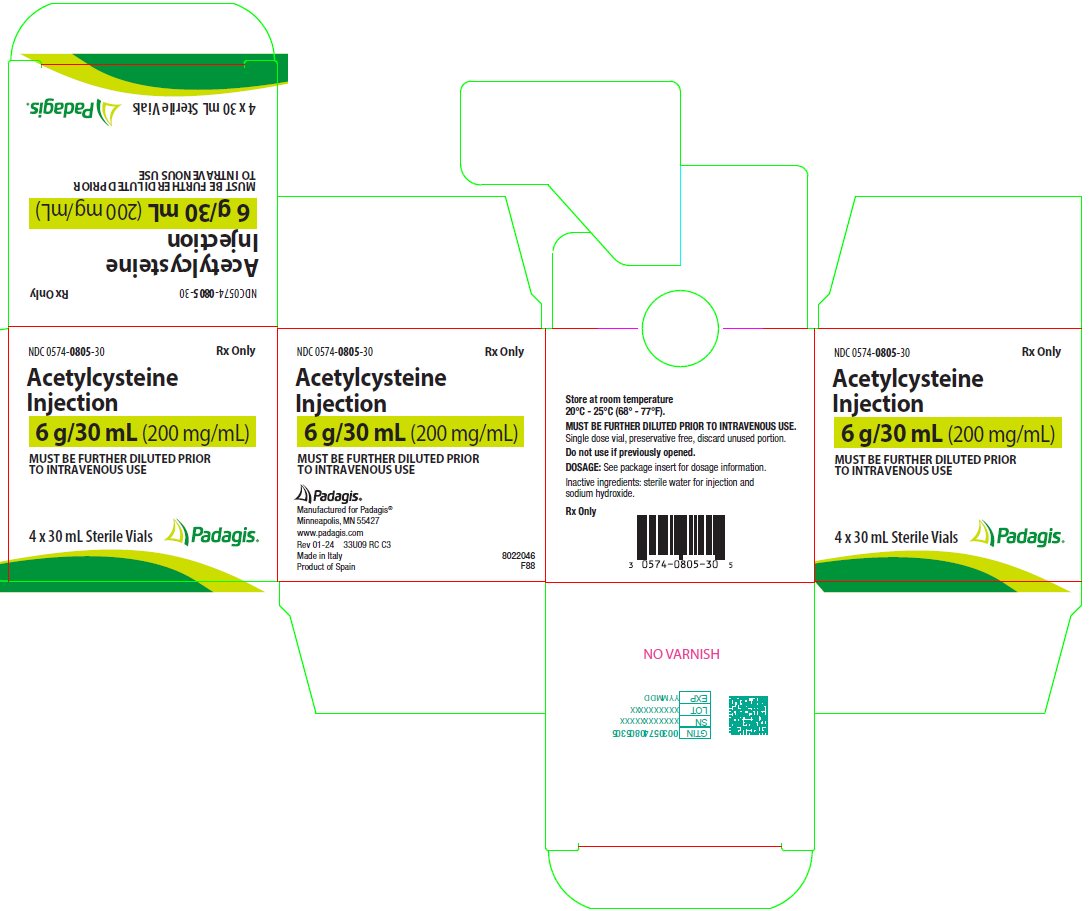
acetylcysteine 200 mg/mL Injection — NDC 0574-0805-30 (Billing 00574-0805-30)
This is a package of acetylcysteine 200 mg/mL Injection from Padagis US LLC, marketed since Dec 2012 and currently FDA-listed. It is this product's only package size.
NDC database record
One package, one record: these facts belong to NDC 0574-0805-30 alone.
- Record
- FDA NDC Directory package listing · Human prescription drug
- Code segments
- 0574 labeler · 0805 product · 30 package
- Package marketed since
- Dec 20, 2012
- Sample package
- No — commercial package
- Listing certified through
- Dec 31, 2027
- Barcode (UPC-A, from the NDC)
- 3 0574080530 5
- Medicaid fills, this package
- 52 prescriptions in the last four reported quarters
- FDA record last changed
- Jul 24, 2026
Other active recalls for Acetylcysteine (different manufacturers) — 2 · tap to view
Identity & classification
Regulatory identifiers FDA, NLM and CMS codes for this package
Drug-database identifiers Medi-Span GPI and First Databank GCN / HICL / AHFS classification
- GSN (GCN sequence number): 024398
- GCN: 04391
- GPI-14 (Medi-Span): 93000007002020
- HICL (First Databank): 000189
- AHFS class code: 48:24.00.00
- RxCUI (RxNorm): 465377
Where does this data come from?
- FDA openFDA NDC Directory · synced Oct 1, 2026
- FDA label on DailyMed · label index refreshed Oct 5, 2026
- RxNorm (NLM RxNav) · catalog refreshed Oct 1, 2026
- Medi-Span GPI (licensed)
- First Databank (licensed) · refreshed Oct 1, 2026
RxNorm drug class
This medicine belongs to the Antidote class.
Where does this data come from?
- RxClass (NLM) · catalog refreshed Oct 1, 2026
Clinical
- It has two main uses. It is an antidote that helps protect the liver after an acetaminophen overdose. In inhaled form, it also helps loosen thick, sticky mucus in many lung conditi...
- The injection is given into a vein by healthcare staff, usually starting with a loading dose. The inhaled solution is breathed in as a mist, often a few times a day. Your prescribe...
- The most common ones are rash, hives, facial flushing and itching. Some people have nausea, vomiting or a fast heartbeat. Mild flushing often fades even while the infusion continue...
- Get help for wheezing, shortness of breath, throat tightness, swelling or feeling faint. These can be signs of a serious allergic reaction. If you have asthma, tell your care team...
Patient education
Supplement & herbal interactions
Some supplements/herbs that may interact with Acetylcysteine (prescription drug) — tap one for details:
Where does this data come from?
- MedlinePlus (NLM) · refreshed Oct 1, 2026
- FDA label on DailyMed · label index refreshed Oct 5, 2026
Ask a licensed pharmacist directly — free, answered by our team.
Pricing
A drug doesn't have one price. Each row is a different public payment system, and none is what you'd pay at the counter — that depends on your insurance. The ⓘ on each row explains what it measures.
| Price system | Per each | Per package |
|---|---|---|
| Retail pharmacies payNADAC · weekly | Not in the retail survey — common for institutional, discontinued, or low-volume packs. | |
| Medicaid paysCMS SDUD · 12 mo | $2.65 | $10.60 / 4 vials |
| Medicare drug plans payPart D · quarterly | No Part D plan price is available for this NDC in our data. | |
| Medicare Part B allowsASP · J0132 | $0.389 / J0132 unit | — |
Where does this data come from?
- CMS NADAC weekly file
- CMS ASP pricing files · refreshed Sep 20, 2026
- CMS Medicaid State Drug Utilization Data · through Q1 2026
- CMS Part D plan pricing files · refreshed Sep 24, 2026
- VA National Acquisition Center price file
Billing & reimbursement
Where does this data come from?
- CMS ASP NDC-HCPCS crosswalk · refreshed Sep 22, 2026
- DMEPDAC NDC-HCPCS crosswalk
- openFDA NSDE billing units · refreshed Sep 7, 2026
Packaging — all sizes for this product
| Package NDC | Description | Marketing start | Marketing end | Status |
|---|---|---|---|---|
| 00574-0805-30 You're viewing this Main listing | 4 VIAL in 1 CARTON / 30 mL in 1 VIAL | 2012-12-20 | — | Active |
Therapeutic equivalents
| Product | Labeler | Pack | NADAC/unit | TE | Status | Price vs. this |
|---|---|---|---|---|---|---|
| Acetylcysteine 200 mg/mL 00143-9433-04 | Hikma | 4 vials | — | AP | FDA listed | — |
| acetylcysteine 200 mg/mLthis 00574-0805-30 | Padagis | 4 vials | — | AP | FDA listed | — |
| Acetylcysteine 200 mg/mL 14445-0412-04 | Indoco | 4 vials | — | AP | FDA listed | — |
| Acetylcysteine 200 mg/mL 25021-0812-30 | Sagent | 4 vials | — | AP | FDA listed | — |
| Acetylcysteine 6 g/30mL 55150-0259-30 | Eugia | 4 vials | — | AP | FDA listed | — |
| Acetylcysteine 200 mg/mL 63323-0963-44 | Fresenius | 4 vials | — | AP | FDA listed | — |
| Acetadote 200 mg/mL 66220-0207-30 | Cumberland | 4 vials | — | AP | FDA listed | — |
| Acetylcysteine 200 mg/mL 68462-0946-12 | Glenmark | 4 vials | — | AP | FDA listed | — |
| Acetylcysteine 200 mg/mL 70069-0788-04 | Somerset | 4 vials | — | AP | FDA listed | — |
| Acetylcysteine 200 mg/mL 70594-0111-02 | Xellia | 4 vials | — | AP | FDA listed | — |
| Acetylcysteine 200 mg/mL 83270-0001-04 | ONESOURCE | 4 vials | — | AP | FDA listed | — |
Where does this data come from?
- FDA openFDA NDC Directory · synced Oct 1, 2026
- FDA Orange Book · refreshed Oct 3, 2026
- CMS NADAC weekly file
Availability & generic status
The FDA lists approved generic versions of this medicine, but that does not always mean a pharmacy can get one today. Patent rules, launch agreements, supply and pricing can affect when generics actually arrive.
Why the date isn’t exact: Generic timing can change because patents may be challenged, settled, licensed, added, removed, or worked around with a narrower label — and FDA approval does not always mean a pharmacy can get the generic today.
🛈 What do these terms mean?
- Patent
- Legal protection listed in the Orange Book that may delay generic approval or launch. Issued by the U.S. Patent & Trademark Office.
- Substance patent
- Covers the active drug molecule itself — the hardest to design around. A generic generally can’t launch until it expires.
- Formulation (product) patent
- Covers a specific formulation or dosage form. A generic can sometimes work around it with a different formulation.
- Method-of-use patent
- A patent covering one specific approved use of the drug — not necessarily the whole molecule. A generic can sometimes launch with a “skinny label” that carves out the protected use and keeps the others.
- Skinny label
- A generic label that omits a still-patented use when the FDA allows it — letting a generic reach the market for the unprotected uses.
- Exclusivity
- FDA-granted marketing protection, separate from patents — e.g. 5-yr new chemical entity, 7-yr orphan drug, or a +6-month pediatric extension.
- Paragraph IV
- A generic applicant’s formal challenge to a listed patent. It can potentially lead to earlier generic entry, but often involves litigation or a settlement.
- RLD / RS
- Reference Listed Drug — the brand product the FDA uses as the reference for generic applications. Reference Standard — the product the FDA expects generics to compare against in bioequivalence testing.
- TE / AB rating
- FDA therapeutic-equivalence rating. An AB rating generally means the FDA considers a generic therapeutically equivalent to — and substitutable for — the brand.
- LOE (loss of exclusivity)
- The latest patent or exclusivity currently listed — the loss-of-exclusivity / latest-listed-protection date shown on this page. Paragraph-IV challenges and settlements can move the real date earlier; FDA approval and a manufacturer’s decision to market can move it later.
Built from the FDA Orange Book. The bars above are scaled to each protection’s expiry; the red LOE marker is the last one to lapse.
| Patent | Type | Use code | Expires |
|---|---|---|---|
| US 9327028 ↗ | Method of use | U-1839 | Jul 21, 2031 |
| US 8722738 ↗ | Method of use | U-1373 | Apr 6, 2032 |
| US 8148356 ↗ | Drug product | — | May 21, 2026 |
| Code | What it grants | Expires |
|---|---|---|
| D-196 | Other change requiring clinical data (3-year) | Nov 26, 2027 |
Is there a generic version of ACETYLCYSTEINE 6 GRAM/30 ML VL?
The FDA approved a generic — why can’t I get it at my pharmacy yet?
Why do different websites show different generic release dates?
What does “FDA listed” mean?
What does a patent or protection date mean here?
What does “current Orange Book estimate” mean?
Can a generic come out before the last patent expires?
Can a generic come out after the listed dates?
What is the difference between patents and exclusivity?
Why are there multiple patent dates?
Where does this data come from?
- FDA Orange Book · refreshed Oct 3, 2026
Inactive Ingredients / Excipients
Inactive ingredients, also called excipients, are components of the drug product other than the active ingredient. They may include fillers, dyes, coatings, preservatives, flavors, or other formulation ingredients.
💡 Tap an ingredient (hover on desktop) to see what it is and why it’s used.
-
UNII 55X04QC32I
A strong alkaline chemical used to adjust and maintain the pH balance of liquid medicines. It helps keep the medicine stable and ensures it stays effective during storage.
-
UNII 059QF0KO0R
Water is a liquid solvent that dissolves and mixes ingredients together in liquid medicines, syrups, and injections. It helps distribute the active drug evenly throughout the product.
2 inactive ingredients listed in the exact product block matched to this NDC.
Where does this data come from?
ingredient classCode="IACT" elements from the exact product block matched by this NDC. Label-section narrative from DailyMed / the openFDA label index is shown separately when available.- FDA label on DailyMed · label index refreshed Oct 5, 2026
- FDA openFDA NDC Directory · synced Oct 1, 2026
Inactive ingredient FAQ
Are inactive ingredients the same for every manufacturer?
Why might an inactive ingredient be missing?
Can inactive ingredients matter?
Manufacturer & labeler
More NDCs from Padagis US LLC labeler code 00574
- ACTIDOSE AQUA activated charcoal 208 mg/mL Suspension NDC 0574-0521-04
- Podocon 25 Podophyllum resin 1 mg/4mL Tincture NDC 0574-0601-15
- PODOFILOX 5 mg/mL Solution NDC 0574-0611-05
- Podofilox 5 mg/g Gel NDC 0574-0621-05
- methazolamide 25 mg Tablet NDC 0574-0790-01
- methazolamide 50 mg Tablet NDC 0574-0791-01
- Testosterone Cypionate 200 mg/mL Injection, Solution NDC 0574-0820-01
- Testosterone Cypionate 200 mg/mL Injection, Solution NDC 0574-0827-01
- Brompheniramine Maleate, Pseudoephedrine Hydrochloride and Dextromethorphan Hydrobromide 2 mg/5mL; 10 mg/5mL; 30 mg/5mL Syrup NDC 0574-1104-04
- SPIRONOLACTONE 25 mg/5mL Suspension NDC 0574-1133-04
- Lenalidomide 2.5 mg Capsule NDC 0574-1402-28
- Lenalidomide 5 mg Capsule NDC 0574-1405-28
Where does this data come from?
- FDA openFDA NDC Directory · synced Oct 1, 2026
- Drugs@FDA
Full prescribing information FDA SPL
🎯 Indications and Usage ▾
1 INDICATIONS AND USAGE Acetylcysteine Injection is indicated to prevent or lessen hepatic injury after ingestion of a potentially hepatotoxic quantity of acetaminophen in adults and pediatric patients who weigh 5 kg or greater with acute ingestion or from repeated supratherapeutic ingestion (RSI). Acetylcysteine Injection is an antidote for acetaminophen overdose indicated to prevent or lessen hepatic injury after ingestion of a potentially hepatotoxic quantity of acetaminophen in adults and pediatric patients who weigh 5 kg or greater with acute ingestion or from repeated supratherapeutic ingestion (RSI) ( 1 ).
⏱️ Dosage and Administration ▾
2 DOSAGE AND ADMINISTRATION Pre-Treatment Assessment Following Acute Ingestion ( 2.1 ): Prior to initiating treatment with Acetylcysteine Injection, decide whether the three-bag or two-bag regimen will be used. Obtain a plasma or serum sample to assay for acetaminophen concentration at least 4 hours after ingestion. • If the time of acetaminophen ingestion is unknown: o Administer a loading dose of Acetylcysteine Injection immediately. o Obtain an acetaminophen concentration to determine need for continued treatment. • If the acetaminophen concentration cannot be obtained (or is unavailable or uninterpretable) within the 8-hour time interval after acetaminophen ingestion or there is clinical evidence of acetaminophen toxicity: o Administer a loading dose of Acetylcysteine Injection immediately and continue treatment for a total of three doses over 21 hours ( 2.5 ). • If the patient presents more than 8 hours after ingestion and the time of acute acetaminophen ingestion is known: o Administer a loading dose of Acetylcysteine Injection immediately. o Obtain acetaminophen concentration to determine need for continued treatment. • If the patient presents less than 8 hours after ingestion and the time of acute acetaminophen ingestion is known and the acetaminophen concentration is known: o Use the revised Rumack-Matthew nomogram (Figure 1) to determine whether or not to initiate treatment with Acetylcysteine Injection ( 2.2 ) Nomogram for Estimating Potential for Hepatotoxicity from Acute Acetaminophen Ingestion ( 2.2 ): • See Full Prescribing Information for instructions on how to use the nomogram to determine the need for dosing.
Preparation and Storage of Diluted Solution Prior to Administration ( 2.3 ): • Calculate the dose (mg) based on the patient’s weight in kg; multiple vials of Acetylcysteine Injection may be required. • Acetylcysteine Injection is hyperosmolar (2,600 mOsmol/L), therefore Acetylcysteine Injection must be diluted in the recommended volume of sterile water for injection, 0.45% sodium chloride injection, or 5% dextrose in water injection prior to intravenous administration. In general, 0.45% normal saline is the preferred diluent because it provides a more consistent osmolarity profile, reduces the amount of free water delivered to the patient, and better approximates physiologic fluids.
See Full Prescribing Information for examples of osmolarity depending on the type of solution and Acetylcysteine Injection concentration. General Considerations for Selecting the Three-Bag or Two-Bag Regimen ( 2.4 ): • It is not known whether the two-bag regimen is comparable to the three-bag regimen in preventing hepatotoxicity. • Patients 40 kg or less should receive the three-bag regimen. • For patients weighing 41 kg or greater, the three-bag regimen may be preferred for those with early signs of severe liver injury or a large acetaminophen ingestion.
Recommended Dosage for Acute Acetaminophen Ingestion ( 2.5 ): • Acetylcysteine Injection is for intravenous administration only • Total dosage of Acetylcysteine Injection is 300 mg/kg given intravenously as either: o 3 separate doses infused over a total of 21 hours OR o 2 separate doses infused over a total of 20 hours. • See Full Prescribing Information for weight-based dosage and weight-based dilution ( 2.5 ) See Full Prescribing Information for recommendations for continuing Acetylcysteine Injection treatment after 21 hours ( 2.2 ).
Repeated Supratherapeutic Acetaminophen Ingestion ( 2.6 ): • Obtain acetaminophen concentration and other laboratory tests to guide treatment; revised Rumack-Matthew nomogram does not apply.
2.1Pre-Treatment Assessment and Testing Following Acute Acetaminophen Ingestion Prior to initiating treatment with Acetylcysteine Injection, decide whether the three-bag or two-bag regimen will be used [see Dosage and Administration ( 2.4 )] . The following recommendations are related to acute acetaminophen ingestion. For recommendations related to repea… [Excerpted — this section continues on DailyMed.]
💊 Dosage Forms and Strengths ▾
3 DOSAGE FORMS AND STRENGTHS Injection: 6000 mg/30 mL (200 mg/mL) of acetylcysteine in a single-dose vial. Injection: 6000 mg/30 mL (200 mg/mL) in a single-dose vial ( 3 )
⛔ Contraindications ▾
4 CONTRAINDICATIONS Acetylcysteine Injection is contraindicated in patients with a previous hypersensitivity reaction to acetylcysteine [see Warnings and Precautions ( 5.1 )] . Patients with a previous hypersensitivity reaction to acetylcysteine ( 4 )
⚠️ Warnings and Cautions ▾
5 WARNINGS AND PRECAUTIONS • Hypersensitivity Reactions: Fatal or life-threatening anaphylaxis, rash, hypotension, wheezing, shortness of breath, and/or bronchospasm have been observed. Observe patients during and after the infusion; immediately discontinue infusion if a serious reaction occurs and initiate appropriate treatment. Acetylcysteine Injection infusion may be carefully restarted after treatment of hypersensitivity has been initiated and acute symptoms have resolved ( 5.1 ). • Fluid Overload: Total volume administered should be reduced for patients weighing less than 40 kg and for those requiring fluid restriction ( 5.2 ).
5.1Hypersensitivity Reactions Serious acute hypersensitivity reactions; including fatal or life-threatening anaphylaxis, rash, hypotension, wheezing, and/or shortness of breath; have been observed in patients receiving intravenous acetylcysteine for acetaminophen overdose and occurred soon after initiation of the infusion [ see Adverse Reactions ( 6 ) ]. If a severe hypersensitivity reaction occurs, immediately stop the infusion of Acetylcysteine Injection and initiate appropriate treatment. Patients with asthma should be closely monitored during initiation of Acetylcysteine Injection therapy and throughout Acetylcysteine Injection therapy.
Acute flushing and erythema of the skin may occur in patients receiving acetylcysteine intravenously. These reactions usually occur 30 to 60 minutes after initiating the infusion and often resolve spontaneously despite continued infusion of acetylcysteine. If a reaction to acetylcysteine involves more than simply flushing and erythema of the skin, it should be treated as a hypersensitivity reaction.
Management of less severe hypersensitivity reactions should be based upon the severity of the reaction and include temporary interruption of the infusion and/or administration of antihistaminic drugs. The Acetylcysteine Injection infusion may be carefully restarted after treatment of the hypersensitivity symptoms has been initiated and acute symptoms have resolved; however, if the hypersensitivity reaction returns upon re-initiation of treatment or increases in severity, Acetylcysteine Injection should be discontinued and alternative patient management should be considered.
5.2Fluid Overload The total volume of Acetylcysteine Injection administered should be adjusted for patients less than 40 kg and for those requiring fluid restriction. Intravenous administration of Acetylcysteine Injection can cause fluid overload, potentially resulting in hyponatremia, seizure, and death. To avoid fluid overload, use the recommended dilutions [see Dosage and Administration ( 2.5 )] .
🤒 Adverse Reactions ▾
6 ADVERSE REACTIONS Most common adverse reactions (> 2%) are rash, urticaria/facial flushing and pruritus ( 6.1 ). To report SUSPECTED ADVERSE REACTIONS, contact Padagis ® at 1-866-634-9120 or FDA at 1-800-FDA-1088 or www.fda.gov/medwatch .
6.1Clinical Studies Experience The following clinically significant adverse reactions are described elsewhere in labeling: • Hypersensitivity Reactions [see Warnings and Precautions ( 5.1 )] • Fluid Overload [see Warnings and Precautions ( 5.2 )] Because clinical trials are conducted under widely varying conditions, adverse reaction rates observed in the clinical trials of a drug cannot be directly compared to rates in the clinical trials of another drug and may not reflect the rates observed in practice. In the literature, the most frequently reported adverse reactions attributed to intravenous acetylcysteine administration were rash, urticaria and pruritus.
The frequency of adverse reactions has been reported to be between 0.2% and 21%, and they most commonly occur during the initial loading dose of acetylcysteine. Loading Dose/Infusion Rate Study In a randomized, open-label, multi-center clinical study conducted in Australia in patients with acetaminophen poisoning, the rates of hypersensitivity reactions between a 15-minute and 60-minute intravenous infusion for the 150 mg/kg loading dose of acetylcysteine were compared. The incidence of drug-related adverse reactions occurring within the first 2 hours following acetylcysteine administration is presented in Table 4.
Overall, 17% of patients developed an acute hypersensitivity reaction (18% in the 15-minute infusion group; 14% in the 60-minute infusion group) [see Warnings and Precautions (5.1), Clinical Studies (14)] . Table 4. Incidence of Drug-Related Adverse Reactions Occurring Within the First 2 Hours Following Study Drug Administration by Preferred Term: Loading Dose/Infusion Rate Study Treatment Group 15-minutes 60-minutes Number of Patients n=109 n=71 Cardiac disorders 5 (5%) 2 (3%) Severity: Tachycardia NOS Unkn Mild Moderate Severe Unkn Mild Moderate Severe 4 (4%) 1 (1%) 2 (3%) Gastrointestinal disorders 16 (15%) 7 (10%) Severity: Nausea Vomiting NOS Unkn Mild Moderate Severe Unkn Mild Moderate Severe 1 (1%) 6 (6%) 1 (1%) 1 (1%) 2 (2%) 11 (10%) 2 (3%) 4 (6%) Immune System Disorders 20 (18%) 10 (14%) Severity: Hypersensitivity reaction Unkn Mild Moderate Severe Unkn Mild Moderate Severe 2 (2%) 6 (6%) 11 (10%) 1 (1%) 4 (6%) 5 (7%) 1 (1%) Respiratory, thoracic and mediastinal disorders 2 (2%) 2 (3%) Severity: Unkn Mild Moderate Severe Unkn Mild Moderate Severe Pharyngitis 1 (1%) Rhinorrea 1 (1%) Rhonchi 1 (1%) Throat tightness 1 (1%) Skin & subcutaneous tissue disorders 6 (6%) 5 (7%) Severity: Unkn Mild Moderate Severe Unkn Mild Moderate Severe Pruritus 1 (1%) 2 (3%) Rash NOS 3 (3%) 2 (2%) 3 (4%) Vascular disorders 2 (2%) 3 (4%) Severity: Unkn Mild Moderate Severe Unkn Mild Moderate Severe Flushing 1 (1%) 1 (1%) 2 (3%) 1 (1%) Unkn=Unknown; NOS=not otherwise specified Safety Study A large multi-center study was performed in Canada where data were collected from patients who were treated with intravenous acetylcysteine for acetaminophen overdose between 1980 and 2005.
This study evaluated 4709 adult cases and 1905 pediatric cases. The incidence of hypersensitivity reactions in adult (overall incidence 8%) and pediatric (overall incidence 10%) patients is presented in Tables 5 and 6. Table 5.
Distribution of reported hypersensitivity reactions in adult patients receiving intravenous acetylcysteine Reaction Incidence (%) n=4709 Urticaria/Facial Flushing 6.1% Pruritus 4.3% Respiratory Symptoms* 1.9% Edema 1.6% Hypotension 0.1% Anaphylaxis 0.1% *Respiratory symptoms are defined as presence of any of the following: cough, wheezing, stridor, shortness of breath, chest tightness, respiratory distress, or bronchospasm. Table 6. Distribution of reported hypersensitivity reactions in pediatric patients receiving intravenous acetylcysteine Re… [Excerpted — this section continues on DailyMed.]
👥 Use in Specific Populations ▾
8 USE IN SPECIFIC POPULATIONS
8.1Pregnancy Risk Summary Limited published case reports and case series of pregnant women exposed to acetylcysteine during various trimesters are not sufficient to inform any drug associated risk. Delaying treatment of acetaminophen overdose may increase the risk of maternal or fetal morbidity and mortality [ see Clinical Considerations ]. Reproduction studies in rats and rabbits following oral administration of acetylcysteine during the period of organogenesis at doses similar to the total intravenous dose (based on the body surface area) did not cause any adverse effects to the fetus.
The estimated background risk of major birth defects and miscarriage for the indicated population is unknown. In the U.S. general population, the estimated background risk of major birth defects and miscarriage in clinically recognized pregnancies is 2% to 4% and 15% to 20%, respectively. Clinical Considerations Disease-Associated Maternal and/or Embryo/Fetal Risk Acetaminophen and acetylcysteine cross the placenta.
Delaying treatment in pregnant women with acetaminophen overdose and potentially toxic acetaminophen plasma levels may increase the risk of maternal and fetal morbidity and mortality. Data Animal Data Reproduction studies have been performed following administration of acetylcysteine during the period of organogenesis in rats at oral doses up to 2000 mg/kg/day (1.1 times the recommended total human intravenous dose of 300 mg/kg based on body surface area comparison) and in rabbits at oral doses up to 1000 mg/kg/day (1.1 times the recommended total human intravenous dose of 300 mg/kg based on body surface area comparison).
No adverse developmental outcomes due to acetylcysteine were observed.
8.2Lactation Risk Summary There are no data on the presence of acetylcysteine in human milk, the effects on the breastfed infant, or the effects on milk production. The developmental and health benefits of breastfeeding should be considered along with the mother’s clinical need for Acetylcysteine Injection and any potential adverse effects on the breastfed child from Acetylcysteine Injection or from the underlying maternal condition. Clinical Considerations Based on the pharmacokinetic data, acetylcysteine should be nearly completely cleared 30 hours after administration.
Breastfeeding women may consider pumping and discarding their milk for 30 hours after administration.
8.4Pediatric Use Safety and effectiveness of Acetylcysteine Injection in pediatric patients have not been established by adequate and well-controlled studies. Use of Acetylcysteine Injection in pediatric patients 5 kg and greater is based on clinical practice [see Dosage and Administration ( 2.5 )] .
🤰 Pregnancy ▾
8.1Pregnancy Risk Summary Limited published case reports and case series of pregnant women exposed to acetylcysteine during various trimesters are not sufficient to inform any drug associated risk. Delaying treatment of acetaminophen overdose may increase the risk of maternal or fetal morbidity and mortality [ see Clinical Considerations ]. Reproduction studies in rats and rabbits following oral administration of acetylcysteine during the period of organogenesis at doses similar to the total intravenous dose (based on the body surface area) did not cause any adverse effects to the fetus.
The estimated background risk of major birth defects and miscarriage for the indicated population is unknown. In the U.S. general population, the estimated background risk of major birth defects and miscarriage in clinically recognized pregnancies is 2% to 4% and 15% to 20%, respectively. Clinical Considerations Disease-Associated Maternal and/or Embryo/Fetal Risk Acetaminophen and acetylcysteine cross the placenta.
Delaying treatment in pregnant women with acetaminophen overdose and potentially toxic acetaminophen plasma levels may increase the risk of maternal and fetal morbidity and mortality. Data Animal Data Reproduction studies have been performed following administration of acetylcysteine during the period of organogenesis in rats at oral doses up to 2000 mg/kg/day (1.1 times the recommended total human intravenous dose of 300 mg/kg based on body surface area comparison) and in rabbits at oral doses up to 1000 mg/kg/day (1.1 times the recommended total human intravenous dose of 300 mg/kg based on body surface area comparison).
No adverse developmental outcomes due to acetylcysteine were observed.
🧒 Pediatric Use ▾
8.4Pediatric Use Safety and effectiveness of Acetylcysteine Injection in pediatric patients have not been established by adequate and well-controlled studies. Use of Acetylcysteine Injection in pediatric patients 5 kg and greater is based on clinical practice [see Dosage and Administration ( 2.5 )] .
🆘 Overdosage ▾
10 OVERDOSAGE Fatal and life-threatening adverse events have been reported following acetylcysteine overdosage, including anaphylaxis, cerebral edema, and hemolytic-uremic syndrome (HUS). Stop acetylcysteine administration in the setting of suspected acetylcysteine overdosage and manage as clinically indicated. Anaphylaxis, including cases with a fatal outcome, has been reported following acetylcysteine overdosage.
Patients who experienced anaphylaxis following acetylcysteine overdosage often became symptomatic during the loading dose and experienced hypotension, rash, angioedema, bronchospasm, or respiratory distress. Cases of anaphylaxis with acetylcysteine overdosage also described coagulopathy, renal failure, or respiratory failure. Cerebral edema, including cases with a fatal outcome, has been reported following acetylcysteine overdosage.
Patients who experienced cerebral edema following acetylcysteine overdose presented with altered mental status, abnormal pupillary responses, seizures. Some cases of cerebral edema with acetylcysteine overdosage described brain herniation. HUS has been reported following acetylcysteine overdosage.
Patients who experienced HUS presented with microangiopathic hemolytic anemia, thrombocytopenia, and acute kidney injury. Removal of acetylcysteine via hemodialysis has been reported in the literature outside of the context of acetylcysteine overdosage. Studies of hemodialysis in acetaminophen overdose report significant extracorporeal removal of acetylcysteine during hemodialysis.
Contact the Poison Center (1-800-222-1222) for overdosage management recommendations for Acetylcysteine Injection including considerations for hemodialysis.
🧬 Clinical Pharmacology ▾
12 CLINICAL PHARMACOLOGY
12.1Mechanism of Action Acetylcysteine has been shown to reduce the extent of liver injury following acetaminophen overdose. Acetaminophen doses of 150 mg/kg or greater have been associated with hepatotoxicity. Acetylcysteine probably protects the liver by maintaining or restoring the glutathione levels, or by acting as an alternate substrate for conjugation with, and thus detoxification of, the reactive metabolite of acetaminophen.
12.3Pharmacokinetics After a single intravenous dose of acetylcysteine, the plasma concentration of total acetylcysteine declined in a poly-exponential decay manner with a mean terminal half-life (T 1/2 ) of 5.6 hours. The mean clearance (CL) for acetylcysteine was 0.11 liter/hr/kg and renal CL constituted about 30% of the total CL. Distribution: The steady-state volume of distribution (Vd ss ) following administration of an intravenous dose of acetylcysteine was 0.47 liter/kg.
The protein binding of acetylcysteine ranges from 66 to 87%. Elimination Metabolism: Acetylcysteine (i.e., N -acetylcysteine) is postulated to form cysteine and disulfides (N,N-diacetylcysteine and N -acetylcysteine). Cysteine is further metabolized to form glutathione and other metabolites.
Excretion After a single oral dose of [ 35 S]-acetylcysteine 100 mg, between 13 to 38% of the total radioactivity administered was recovered in urine within 24 hours. In a separate study, renal clearance was estimated to be approximately 30% of total body clearance. Specific Populations: Hepatic Impairment: Following a 600 mg intravenous dose of acetylcysteine to subjects with mild (Child Pugh Class A, n=1), moderate (Child-Pugh Class B, n=4) or severe (Child-Pugh Class C; n=4) hepatic impairment and 6 healthy matched controls, mean T1/2 increased by 80%.
Also, the mean CL decreased by 30% and the systemic acetylcysteine exposure (mean AUC) increased 1.6-fold in subjects with hepatic impairment compared to subjects with normal hepatic function. These changes are not considered to be clinically meaningful. Renal Impairment Hemodialysis may remove some of total acetylcysteine.
🧬 Mechanism of Action ▾
12.1Mechanism of Action Acetylcysteine has been shown to reduce the extent of liver injury following acetaminophen overdose. Acetaminophen doses of 150 mg/kg or greater have been associated with hepatotoxicity. Acetylcysteine probably protects the liver by maintaining or restoring the glutathione levels, or by acting as an alternate substrate for conjugation with, and thus detoxification of, the reactive metabolite of acetaminophen.
📦 How Supplied / Storage and Handling ▾
16 HOW SUPPLIED/STORAGE AND HANDLING Acetylcysteine Injection is available as a 20% solution (200 mg/mL) in 30 mL single-dose glass vials. Each single dose vial contains 6 g/30 mL (200 mg/mL) of Acetylcysteine Injection. Acetylcysteine Injection is sterile and can be used for intravenous administration.
It is available as follows: • 30 mL vials, carton of 4 (NDC 0574- 0805 -30) Do not use previously opened vials for intravenous administration. Note: The color of Acetylcysteine Injection may turn from essentially colorless to a slight pink or purple once the stopper is punctured. The color change does not affect the quality of the product.
The stopper in the Acetylcysteine Injection vial is formulated with a synthetic base-polymer and does not contain natural rubber latex, dry natural rubber, or blends of natural rubber. Store unopened vials at controlled room temperature, 20° to 25°C (68° to 77°F) [See USP Controlled Room Temperature]
📋 Description ▾
11 DESCRIPTION Acetylcysteine injection is an intravenous antidote for the treatment of acetaminophen overdose. Acetylcysteine is the nonproprietary name for the N-acetyl derivative of the naturally occurring amino acid, L-cysteine (N-acetyl-L-cysteine,). The compound is a white crystalline powder, which melts in the range of 104° to 110°C and has a very slight odor.
The molecular formula of the compound is C 5 H 9 NO 3 S, and its molecular weight is 163.2. Acetylcysteine has the following structural formula: Acetylcysteine Injection is supplied as a sterile solution in vials containing 20% w/v (200 mg/mL) acetylcysteine. The pH of the solution ranges from 6.0 to 7.5.
Acetylcysteine Injection contains the following inactive ingredients: sodium hydroxide (used for pH adjustment), and Water for Injection, USP. The amount of sodium in Acetylcysteine Injection is approximately 30 mg/mL. Because Acetylcysteine Injection is administered based on a patient’s weight, the amount of sodium administered in a course of treatment will vary from approximately 225 mg to 4500 mg.
The use of ½ normal saline will contribute approximately an additional 1770 mg of sodium per liter of diluent. Chemical Structure
💬 Information for Patients ▾
17 PATIENT COUNSELING INFORMATION Hypersensitivity Reactions Advise patients and caregivers that hypersensitivity reactions related to administration and infusion may occur during and after Acetylcysteine Injection treatment, including hypotension, wheezing, shortness of breath and bronchospasm [see Warnings and Precautions ( 5.1 )] . For specific treatment information regarding the clinical management of acetaminophen overdose, please contact your regional poison center at 1-800-222-1222, or alternatively, a special health professional assistance line for acetaminophen overdose at 1-800-525-6115.
U.S. Patent Nos. 8,148,356, 8,399,445, 8,653,061 8,722,738 and 9,327,028 Manufactured for Padagis® Minneapolis, MN 55427 www.padagis.com Rev 05-25 33U00 RC PH4 8022054
🧬 Pharmacokinetics ▾
12.3Pharmacokinetics After a single intravenous dose of acetylcysteine, the plasma concentration of total acetylcysteine declined in a poly-exponential decay manner with a mean terminal half-life (T 1/2 ) of 5.6 hours. The mean clearance (CL) for acetylcysteine was 0.11 liter/hr/kg and renal CL constituted about 30% of the total CL. Distribution: The steady-state volume of distribution (Vd ss ) following administration of an intravenous dose of acetylcysteine was 0.47 liter/kg.
The protein binding of acetylcysteine ranges from 66 to 87%. Elimination Metabolism: Acetylcysteine (i.e., N -acetylcysteine) is postulated to form cysteine and disulfides (N,N-diacetylcysteine and N -acetylcysteine). Cysteine is further metabolized to form glutathione and other metabolites.
Excretion After a single oral dose of [ 35 S]-acetylcysteine 100 mg, between 13 to 38% of the total radioactivity administered was recovered in urine within 24 hours. In a separate study, renal clearance was estimated to be approximately 30% of total body clearance. Specific Populations: Hepatic Impairment: Following a 600 mg intravenous dose of acetylcysteine to subjects with mild (Child Pugh Class A, n=1), moderate (Child-Pugh Class B, n=4) or severe (Child-Pugh Class C; n=4) hepatic impairment and 6 healthy matched controls, mean T1/2 increased by 80%.
Also, the mean CL decreased by 30% and the systemic acetylcysteine exposure (mean AUC) increased 1.6-fold in subjects with hepatic impairment compared to subjects with normal hepatic function. These changes are not considered to be clinically meaningful. Renal Impairment Hemodialysis may remove some of total acetylcysteine.
🔬 Clinical Studies ▾
14 CLINICAL STUDIES Loading Dose/Infusion Rate Study A randomized, open-label, multi-center clinical study was conducted in Australia in patients with acetaminophen poisoning to compare the rates of hypersensitivity reactions between two rates of infusion for the intravenous acetylcysteine loading dose. One hundred nine subjects were randomized to a 15-minute infusion rate and seventy-one subjects were randomized to a 60 minute infusion rate. The loading dose was 150 mg/kg followed by a maintenance dose of 50 mg/kg over 4 hours and then 100 mg/kg over 16 hours.
Of the 180 patients, 27% were male and 73% were female. Ages ranged from 15 to 83 years, with the mean age being 30 years (+13.0). A subgroup of 58 subjects (33 in the 15-minute infusion group; 25 in the 60-minute infusion group) was treated within 8 hours of acetaminophen ingestion.
No hepatotoxicity occurred within this subgroup; however, with 95% confidence, the true hepatotoxicity rates could range from 0% to 9% for the 15-minute infusion group and from 0% to 12% for the 60-minute infusion group. Observational Study An open-label, observational database contained information on 1749 patients who sought treatment for acetaminophen overdose over a 16-year period. Of the 1749 patients, 65% were female, 34% were male and less than 1% was transgender.
Ages ranged from 2 months to 96 years, with 72% of the patients falling in the 16- to 40-year-old age bracket. A total of 399 patients received acetylcysteine treatment. A post-hoc analysis identified 56 patients who (1) were at high or probable risk for hepatotoxicity (APAP greater than 150 mg/L at the four hours line according to the Australian nomogram) and (2) had a liver function test.
Of the 53 patients who were treated with intravenous acetylcysteine (300 mg/kg intravenous acetylcysteine administered over 20-21 hours) within 8 hours, two (4%) developed hepatotoxicity (AST or ALT greater than 1000 U/L). Twenty-one of 48 (44%) patients treated with acetylcysteine after 15 hours developed hepatotoxicity. The actual number of hepatotoxicity outcomes may be higher than what is reported here.
For patients with multiple admissions for acetaminophen overdose, only the first overdose treated with intravenous acetylcysteine was examined. Hepatotoxicity may have occurred in subsequent admissions. Evaluable data were available from a total of 148 pediatric patients (less than 16 years of age) who were admitted for poisoning following ingestion of acetaminophen, of whom 23 were treated with intravenous acetylcysteine.
There were no deaths of pediatric patients. None of the pediatric patients receiving intravenous acetylcysteine developed hepatotoxicity while two patients not receiving intravenous acetylcysteine developed hepatotoxicity. The number of pediatric patients is too small to provide a statistically significant finding of efficacy; however the results appear to be consistent to those observed for adults.
Three-Bag vs. Two-Bag Regimen Observational Study A multi-center, observational, retrospective cohort study investigated rates of hypersensitivity reactions in 493 patients treated with a two-bag intravenous acetylcysteine regimen compared to 274 patients treated with a three-bag regimen in Denmark between January 2012 and December 2014. The two-bag regimen consisted of a 4 hour loading dose at 200 mg/kg followed by a 16 hour infusion at 100 mg/kg.
The three-bag regimen used a 150 mg/kg loading dose administered over 15 minutes, followed by a second dose of 50 mg/kg over 4 hours and a final dose of 100 mg/kg for 16 hours. Patients in this study were treated with acetylcysteine regardless of plasma acetaminophen concentration. The median (range) serum acetaminophen concentration at presentation was <1 mcg/mL (0-353 mcg/mL) in the total study population, and only 12/767 patients (1.6%) had a serum acetaminophen level that would have warranted acetylcysteine treatment based on the revised Rumack-Mathew nomogram.
Hepatotoxic… [Excerpted — this section continues on DailyMed.]
🧪 Nonclinical Toxicology ▾
13 NONCLINICAL TOXICOLOGY
13.1Carcinogenesis, Mutagenesis, Impairment of Fertility Carcinogenesis Long-term studies in animals have not been performed to evaluate the carcinogenic potential of acetylcysteine. Mutagenesis Acetylcysteine was not genotoxic in the Ames test or the in vivo mouse micronucleus test. It was, however, positive in the in vitro mouse lymphoma cell (L5178Y/TK +/- ) forward mutation test.
Impairment of Fertility In a fertility study of acetylcysteine in rats, intravenous administration of 1,000 mg/kg/day (0.5 times the recommended human dose of 300 mg/kg based on body surface area) caused a profound reduction of fertility in females, which was correlated with morphological changes in oocytes and severe impairment of implantation (18 of 20 mated females had no implantations). The reversibility of this effect was not evaluated. No effects on fertility were observed in female rats at intravenous doses up to 300 mg/kg/day (0.2 times the recommended human dose based on body surface area), or in male rats at intravenous doses up to 1,000 mg/kg/day.
Mating was unaffected in this study. In a reproduction study of acetylcysteine, male rats were treated orally for 15 weeks prior to mating and during the mating period. A slight non-dose related reduction in fertility was observed at oral doses of 500 and 1,000 mg/kg/day (0.3 and 0.5 times the recommended human intravenous dose, respectively, based on body surface area).Treatment of male rats with acetylcysteine at an oral dose of 250 mg/kg/day for 15 weeks (0.1 times the recommended human intravenous dose based on body surface comparison) did not affect fertility or general reproductive performance.
📄 Carcinogenesis, Mutagenesis, Impairment of Fertility ▾
13.1Carcinogenesis, Mutagenesis, Impairment of Fertility Carcinogenesis Long-term studies in animals have not been performed to evaluate the carcinogenic potential of acetylcysteine. Mutagenesis Acetylcysteine was not genotoxic in the Ames test or the in vivo mouse micronucleus test. It was, however, positive in the in vitro mouse lymphoma cell (L5178Y/TK +/- ) forward mutation test.
Impairment of Fertility In a fertility study of acetylcysteine in rats, intravenous administration of 1,000 mg/kg/day (0.5 times the recommended human dose of 300 mg/kg based on body surface area) caused a profound reduction of fertility in females, which was correlated with morphological changes in oocytes and severe impairment of implantation (18 of 20 mated females had no implantations). The reversibility of this effect was not evaluated. No effects on fertility were observed in female rats at intravenous doses up to 300 mg/kg/day (0.2 times the recommended human dose based on body surface area), or in male rats at intravenous doses up to 1,000 mg/kg/day.
Mating was unaffected in this study. In a reproduction study of acetylcysteine, male rats were treated orally for 15 weeks prior to mating and during the mating period. A slight non-dose related reduction in fertility was observed at oral doses of 500 and 1,000 mg/kg/day (0.3 and 0.5 times the recommended human intravenous dose, respectively, based on body surface area).Treatment of male rats with acetylcysteine at an oral dose of 250 mg/kg/day for 15 weeks (0.1 times the recommended human intravenous dose based on body surface comparison) did not affect fertility or general reproductive performance.
📄 Recent Major Changes ▾
Dosage and Administration ( 2.1 , 2.2 , 2.3 , 2.4 , 2.5 ) 11/2024
📄 Package Label / Principal Display Panel ▾
Package/Label Display Panel NDC 0574-0805-30 Rx Only Acetylcysteine Injection 6 g/30 mL (200 mg/mL) MUST BE FURTHER DILUTED PRIOR TO INTRAVENOUS USE 4 X 30 mL Sterile Vials Acetylcysteine Injection 6 g/30 mL carton
Medicaid utilization & spend
Medicare Part D spend CMS · PART D · 2026 (Q1)
About this NDC listing & data coverage
What data is (and isn’t) available for this NDC — tap to expand
| NDC identity (package / product / labeler codes) | ✓ Available |
| Labeler | ✓ Available |
| Product & package description | ✓ Available |
| Marketing category & status | ✓ Available |
| Active ingredient / dosage form / route | ✓ Available |
| FDA label (SPL via DailyMed) | ✓ Available |
| Package photos | ✓ Available |
| Inactive ingredients (structured) | ✓ Available |
| NADAC pharmacy acquisition price (CMS) | — Not published for this NDC CMS publishes NADAC only for NDCs reported in its retail-pharmacy survey. |
| Orange Book / therapeutic-equivalence data | ✓ Available |
| HCPCS J-code billing crosswalk | ✓ Available |
| Medicaid utilization (CMS SDUD) | ✓ Available |