
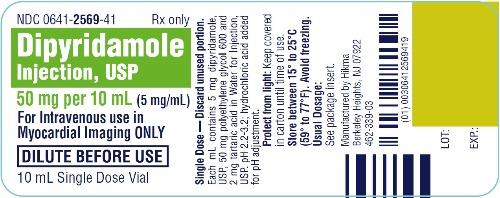
Dipyridamole 5 mg/mL Injection — NDC 0641-2569-44 (Billing 00641-2569-44)
This is a package of Dipyridamole 5 mg/mL Injection from Hikma Pharmaceuticals USA Inc., marketed since Oct 1996 and currently FDA-listed. It is this product's only package size.
Identity & classification
Regulatory identifiers FDA, NLM and CMS codes for this package
Drug-database identifiers Medi-Span GPI and First Databank GCN / HICL / AHFS classification
- GSN (GCN sequence number): 023904
- GCN: 10521
- HICL (First Databank): 000168
- AHFS class code: 20:12.18.00
- RxCUI (RxNorm): 309953
Where does this data come from?
- FDA openFDA NDC Directory · synced Oct 1, 2026
- FDA label on DailyMed · label index refreshed Oct 1, 2026
- RxNorm (NLM RxNav) · catalog refreshed Oct 1, 2026
- Medi-Span GPI (licensed)
- First Databank (licensed) · refreshed Oct 1, 2026
RxNorm drug class
This medicine belongs to the Platelet Aggregation Inhibitor class.
Where does this data come from?
- RxClass (NLM) · catalog refreshed Oct 1, 2026
Clinical
- It depends on the form. The tablets are added to warfarin-type blood thinners to help prevent clots after cardiac valve replacement. The injection is used in a heart imaging stress...
- You take them by mouth, generally four times a day, along with your usual warfarin. Follow your prescriber’s directions and the label closely.
- The label says aspirin should not be given together with coumarin anticoagulants like warfarin. Check with me or your prescriber before taking any aspirin product.
- The label’s side effect numbers come from the injection. People often had chest pain, headache, dizziness, nausea or flushing. Get help right away for severe chest pain, trouble br...
Patient education
Supplement & herbal interactions
Some supplements/herbs that may interact with Dipyridamole — tap one for details:
Where does this data come from?
- MedlinePlus (NLM) · refreshed Oct 1, 2026
- FDA label on DailyMed · label index refreshed Oct 1, 2026
Ask a licensed pharmacist directly — free, answered by our team.
Pricing
A drug doesn't have one price. Each row is a different public payment system, and none is what you'd pay at the counter — that depends on your insurance. The ⓘ on each row explains what it measures.
| Price system | Per each | Per package |
|---|---|---|
| Retail pharmacies payNADAC · weekly | Not in the retail survey — common for institutional, discontinued, or low-volume packs. | |
| Medicaid paysCMS SDUD · 12 mo | $14.12 | $70.62 / 5 vials |
| Medicare drug plans payPart D · quarterly | No Part D plan price is available for this NDC in our data. | |
| Medicare Part B allowsASP · J1245 | $8.410 / J1245 unit | — |
Where does this data come from?
- CMS NADAC weekly file
- CMS ASP pricing files · refreshed Sep 20, 2026
- CMS Medicaid State Drug Utilization Data · through Q1 2026
- CMS Part D plan pricing files · refreshed Sep 24, 2026
- VA National Acquisition Center price file
Billing & reimbursement
Where does this data come from?
- CMS ASP NDC-HCPCS crosswalk · refreshed Sep 22, 2026
- DMEPDAC NDC-HCPCS crosswalk
- openFDA NSDE billing units · refreshed Sep 7, 2026
Packaging — all sizes for this product
| Package NDC | Description | Marketing start | Marketing end | Status |
|---|---|---|---|---|
| 00641-2569-44 You're viewing this Main listing | 5 VIAL in 1 CARTON / 10 mL in 1 VIAL | 1996-10-18 | — | Active |
Therapeutic equivalents
| Product | Labeler | Pack | NADAC/unit | TE | Status | Price vs. this |
|---|---|---|---|---|---|---|
| Dipyridamole 5 mg/mL 00404-9852-10 | Henry | 1 vial | — | AP | FDA listed | — |
| Dipyridamole 5 mg/mLthis 00641-2569-44 | Hikma | 5 vials | — | AP | FDA listed | — |
| Dipyridamole 5 mg/mL 51662-1447-01 | HF | 10 ml | — | AP | FDA listed | — |
Where does this data come from?
- FDA openFDA NDC Directory · synced Oct 1, 2026
- FDA Orange Book · refreshed Sep 3, 2026
- CMS NADAC weekly file
Availability & generic status
This product is an FDA-approved generic. Other versions of the same drug are listed under Therapeutic equivalents, least expensive first.
Where does this data come from?
- FDA Orange Book · refreshed Sep 3, 2026
Inactive Ingredients / Excipients
Inactive ingredients, also called excipients, are components of the drug product other than the active ingredient. They may include fillers, dyes, coatings, preservatives, flavors, or other formulation ingredients.
💡 Tap an ingredient (hover on desktop) to see what it is and why it’s used.
-
UNII QTT17582CB
A strong acid used to adjust and maintain the proper pH level in liquid medicines, ensuring stability and preventing breakdown of active ingredients.
-
50 mg / 1 mL
UNII NL4J9F21N9
Polyethylene glycol 600 is a synthetic liquid polymer used as a solvent and humectant in medicines. It helps dissolve active ingredients and keeps products from drying out.
-
2 mg / 1 mL
UNII W4888I119H
Tartaric acid is a natural organic acid found in grapes and tamarinds. In medicines, it works as a buffer to control acidity, an antioxidant to prevent spoilage, and sometimes a flavoring or binding agent.
-
UNII 059QF0KO0R
Water is a liquid solvent that dissolves and mixes ingredients together in liquid medicines, syrups, and injections. It helps distribute the active drug evenly throughout the product.
4 inactive ingredients listed in the exact product block matched to this NDC.
Where does this data come from?
ingredient classCode="IACT" elements from the exact product block matched by this NDC. Label-section narrative from DailyMed / the openFDA label index is shown separately when available.- FDA label on DailyMed · label index refreshed Oct 1, 2026
- FDA openFDA NDC Directory · synced Oct 1, 2026
Inactive ingredient FAQ
Are inactive ingredients the same for every manufacturer?
Why might an inactive ingredient be missing?
Can inactive ingredients matter?
Manufacturer & labeler
Where does this data come from?
- FDA openFDA NDC Directory · synced Oct 1, 2026
- Drugs@FDA
Full prescribing information FDA SPL
🎯 Indications and Usage ▾
INDICATIONS AND USAGE Dipyridamole Injection is indicated as an alternative to exercise in thallium myocardial perfusion imaging for the evaluation of coronary artery disease in patients who cannot exercise adequately. In a study of about 1100 patients who underwent coronary arteriography and Dipyridamole Injection assisted thallium imaging, the results of both tests were interpreted blindly and the sensitivity and specificity of the dipyridamole thallium study in predicting the angiographic outcome were calculated.
The sensitivity of the dipyridamole test (true positive dipyridamole divided by the total number of patients with positive angiography) was about 85%. The specificity (true negative divided by the number of patients with negative angiograms) was about 50%. In a subset of patients who had exercise thallium imaging as well as dipyridamole thallium imaging, sensitivity and specificity of the two tests were almost identical.
⏱️ Dosage and Administration ▾
DOSAGE AND ADMINISTRATION The dose of intravenous Dipyridamole Injection as an adjunct to thallium myocardial perfusion imaging should be adjusted according to the weight of the patient. The recommended dose is 0.142 mg/kg/min (0.57 mg/kg total) infused over 4 minutes. Although the maximum tolerated dose has not been determined, clinical experience suggests that a total dose beyond 60 mg is not needed for any patient.
Prior to intravenous administration, Dipyridamole Injection should be diluted in at least a 1:2 ratio with sodium chloride injection 0.45%, sodium chloride injection 0.9% or dextrose injection 5% for a total volume of approximately 20 to 50 mL. Infusion of undiluted dipyridamole may cause local irritation. Thallium-201 should be injected within 5 minutes following the 4-minute infusion of dipyridamole.
Do not mix Dipyridamole Injection with other drugs in the same syringe or infusion container. Parenteral drug products should be inspected visually for particulate matter and discoloration prior to administration, whenever solution and container permit. Shaking the vial should redissolve any crystals that may have formed during storage.
⛔ Contraindications ▾
CONTRAINDICATIONS Hypersensitivity to dipyridamole or any of the other components of the drug.
⚠️ Warnings ▾
WARNINGS Serious adverse reactions associated with the administration of intravenous Dipyridamole Injection have included cardiac death, fatal and non-fatal myocardial infarction, ventricular fibrillation, symptomatic ventricular tachycardia, stroke, transient cerebral ischemia, seizures, anaphylactoid reaction, bronchospasm, severe hypotension, anaphylaxis with laryngospasm, and angioedema. There have been reported cases of asystole, sinus node arrest, sinus node depression and conduction block. Patients with abnormalities of cardiac impulse formation/conduction or severe coronary artery disease may be at increased risk for these events.
In a study of 3911 patients given intravenous dipyridamole as an adjunct to thallium myocardial perfusion imaging, two types of serious adverse events were reported: 1) four cases of myocardial infarction (0.1%), two fatal (0.05%) and two non-fatal (0.05%) and 2) six cases of severe bronchospasm (0.2%). Although the incidence of these serious adverse events was small (0.3%, 10 of 3911), the potential clinical information to be gained through use of intravenous dipyridamole thallium imaging (see INDICATIONS AND USAGE noting the rate of false positive and false negative results) must be weighed against the risk to the patient.
Patients with a history of unstable angina may be at a greater risk for severe myocardial ischemia. Patients with a history of asthma may be at a greater risk for bronchospasm during Dipyridamole Injection use. When thallium myocardial perfusion imaging is performed with intravenous dipyridamole, parenteral aminophylline should be readily available for relieving adverse events such as bronchospasm or chest pain.
Vital signs should be monitored during, and for 10-15 minutes following, the intravenous infusion of dipyridamole and an electrocardiographic tracing should be obtained using at least one chest lead. Should severe chest pain or bronchospasm occur, parenteral aminophylline may be administered by slow intravenous injection (50-100 mg over 30-60 seconds) in doses ranging from 50 to 250 mg. In the case of severe hypotension, the patient should be placed in a supine position with the head tilted down if necessary, before administration of parenteral aminophylline.
If 250 mg of aminophylline does not relieve chest pain symptoms within a few minutes, sublingual nitroglycerin may be administered. If chest pain continues despite use of aminophylline and nitroglycerin, the possibility of myocardial infarction should be considered. If the clinical condition of a patient with an adverse event permits a one-minute delay in the administration of parenteral aminophylline, thallium-201 may be injected and allowed to circulate for one minute before the injection of aminophylline.
This will allow initial thallium perfusion imaging to be performed before reversal of the pharmacologic effects of dipyridamole on the coronary circulation.
🤒 Adverse Reactions ▾
ADVERSE REACTIONS Adverse reaction information concerning intravenous Dipyridamole Injection is derived from a study of 3911 patients in which intravenous dipyridamole was used as an adjunct to thallium myocardial perfusion imaging and from spontaneous reports of adverse reactions and the published literature. Serious adverse events (cardiac death, fatal and non-fatal myocardial infarction, ventricular fibrillation, asystole, sinus node arrest, symptomatic ventricular tachycardia, stroke, transient cerebral ischemia, seizures, anaphylactoid reaction, angioedema, and bronchospasm) are described above (see WARNINGS ).
In a study of 3911 patients, the most frequent adverse reactions were: chest pain/angina pectoris (19.7%), electrocardiographic changes (most commonly ST-T changes) (15.9%), headache (12.2%) and dizziness (11.8%). Adverse reactions occurring in greater than 1% of the patients in the study are shown in the following table: Table 1 Drug-Related Adverse Reactions (%) Occurring in Greater than 1% of Patients Incidence (%) of Drug-Related Adverse Events Chest pain/angina pectoris
19.7 Headache
12.2 Dizziness
11.8 Electrocardiographic Abnormalities/ST-T changes
7.5 Electrocardiographic Abnormalities/Extrasystoles
5.2 Hypotension
4.6 Nausea
4.6 Flushing
3.4 Electrocardiographic Abnormalities/Tachycardia
3.2 Dyspnea
2.6 Pain Unspecified
2.6 Blood Pressure Lability
1.6 Hypertension
1.5 Paresthesia
1.3 Fatigue
1.2Less common adverse reactions occurring in 1% or less of the patients within the study included: Cardiovascular System Electrocardiographic abnormalities (0.8%), arrhythmia (0.6%), palpitation (0.3%), ventricular tachycardia (0.2%-see WARNINGS ), bradycardia (0.2%), myocardial infarction (0.1%–see WARNINGS ), AV block (0.1%), syncope (0.1%), orthostatic hypotension (0.1%), atrial fibrillation (0.1%), supraventricular tachycardia (0.1%), ventricular arrhythmia (0.03%–see WARNINGS ), heart block (0.03%), cardiomyopathy (0.03%), edema (0.03%).
Central and Peripheral Nervous System Hypothesia (0.5%), hypertonia (0.3%), nervousness/anxiety (0.2%), tremor (0.1%), abnormal coordination (0.03%), somnolence (0.03%), dysphonia (0.03%), migraine (0.03%), vertigo (0.03%). Gastrointestinal System Dyspepsia (1%), dry mouth (0.8%), abdominal pain (0.7%), flatulence (0.6%), vomiting (0.4%), eructation (0.1%), dysphagia (0.03%), tenesmus (0.03%), appetite increase (0.03%). Respiratory System Pharyngitis (0.3%), bronchospasm (0.2%–see WARNINGS ), hyperventilation (0.1%), rhinitis (0.1%), coughing (0.03%), pleural pain (0.03%).
Other Myalgia (0.9%), back pain (0.6%), injection site reaction unspecified (0.4%), diaphoresis (0.4%), asthenia (0.3%), malaise (0.3%), arthralgia (0.3%), injection site pain (0.1%), rigor (0.1%), earache (0.1%), tinnitus (0.1%), vision abnormalities unspecified (0.1%), dysgeusia (0.1%), thirst (0.03%), depersonalization (0.03%), eye pain (0.03%), renal pain (0.03%), perineal pain (0.03%), breast pain (0.03%), intermittent claudication (0.03%), leg cramping (0.03%). In additional postmarketing experience, there have been rare reports of allergic reaction including urticaria, pruritus, dermatitis and rash.
🔄 Drug Interactions ▾
Drug Interactions Oral maintenance theophylline and other xanthine derivatives such as caffeine may abolish the coronary vasodilatation induced by intravenous Dipyridamole Injection administration. This could lead to a false negative thallium imaging result (see CLINICAL PHARMACOLOGY – Mechanism of Action ). Myasthenia gravis patients receiving therapy with cholinesterase inhibitors may experience worsening of their disease in the presence of dipyridamole.
🤰 Pregnancy ▾
Pregnancy Teratogenic Effects Reproduction studies have been performed in mice, rabbits and rats at oral dipyridamole doses of up to 125 mg/kg, 40 mg/kg and 1000 mg/kg, respectively (about 1½, 2 and 25 times the maximum recommended daily human oral dose, respectively, on a mg/m2 basis) and have revealed no evidence of harm to the fetus due to dipyridamole. There are, however, no adequate and well-controlled studies in pregnant women. Because animal reproduction studies are not always predictive of human response, dipyridamole injection should be used during pregnancy only if clearly needed.
🧒 Pediatric Use ▾
Pediatric Use Safety and effectiveness in pediatric patients have not been established.
🆘 Overdosage ▾
OVERDOSAGE No cases of overdosage in humans have been reported. It is unlikely that overdosage will occur because of the nature of use (i.e., single intravenous administration in controlled settings). Signs and symptoms as described under ADVERSE REACTIONS are expected to occur and could be even more severe in single cases.
Symptomatic therapy is recommended. Should severe chest pain or bronchospasm occur, parenteral aminophylline may be administered by slow intravenous injection (50-100 mg over 30 to 60 seconds) in doses ranging from 50 to 250 mg. See WARNINGS
🧬 Clinical Pharmacology ▾
CLINICAL PHARMACOLOGY In a study of 10 patients with angiographically normal or minimally stenosed (less than 25% luminal diameter narrowing) coronary vessels, Dipyridamole Injection in a dose of 0.56 mg/kg infused over 4 minutes resulted in an average fivefold increase in coronary blood flow velocity compared to resting coronary flow velocity (range 3.8 to 7 times resting velocity). The mean time to peak flow velocity was 6.5 minutes from the start of the 4-minute infusion (range 2.5 to 8.7 minutes). Cardiovascular responses to the intravenous administration of Dipyridamole Injection when given to patients in the supine position include a mild but significant increase in heart rate of approximately 20% and mild but significant decreases in both systolic and diastolic blood pressure of approximately 2-8%, with vital signs returning to baseline values in approximately 30 minutes.
Mechanism of Action Dipyridamole is a coronary vasodilator in man. The mechanism of vasodilation has not been fully elucidated, but may result from inhibition of uptake of adenosine, an important mediator of coronary vasodilation. The vasodilatory effects of dipyridamole are abolished by administration of the adenosine receptor antagonist theophylline.
How dipyridamole-induced vasodilation leads to abnormalities in thallium distribution and ventricular function is also uncertain but presumably represents a “steal” phenomenon in which relatively intact vessels dilate and sustain enhanced flow, leaving reduced pressure and flow across areas of hemodynamically important coronary vascular constriction. Pharmacokinetics and Metabolism Plasma dipyridamole concentrations decline in a triexponential fashion following intravenous infusion of dipyridamole, with half-lives averaging 3-12 minutes, 33-62 minutes and 11.6-15 hours.
Two minutes following a 0.568 mg/kg dose of Dipyridamole Injection administered as a 4-minute infusion, the mean dipyridamole serum concentration is 4.6 ± 1.3 mcg/mL. The average plasma protein binding of dipyridamole is approximately 99%, primarily to α 1 -glycoprotein. Dipyridamole is metabolized in the liver to the glucuronic acid conjugate and excreted with the bile.
The average total body clearance is 2.3-3.5 mL/min/kg, with an apparent volume of distribution at steady state of 1-2.5 L/kg and a central apparent volume of 3-5 liters.
📦 How Supplied / Storage and Handling ▾
HOW SUPPLIED Dipyridamole Injection, USP is available in : 10 mL (50 mg / 10 mL) SINGLE DOSE vial packaged in 5s (NDC 0641-2569-44) Storage Storage PROTECT FROM LIGHT: Keep covered in carton until time of use. Store at 25ºC (77ºF); excursions permitted between 15º to 30ºC (59º to 86ºF). [See USP Controlled Room Temperature.]. Avoid freezing.
To report SUSPECTED ADVERSE REACTIONS, contact Hikma Pharmaceuticals USA Inc. at 1-877-845-0689, or the FDA at 1-800-FDA-1088 or www.fda.gov/medwatch. For Product Inquiry call 1-877-845-0689. Manufactured by: Hikma Pharmaceuticals USA Inc.
Berkeley Heights, NJ 07922 Revised May 2026 462-341-05
📦 Storage and Handling ▾
Storage Storage PROTECT FROM LIGHT: Keep covered in carton until time of use. Store at 25ºC (77ºF); excursions permitted between 15º to 30ºC (59º to 86ºF). [See USP Controlled Room Temperature.]. Avoid freezing.
To report SUSPECTED ADVERSE REACTIONS, contact Hikma Pharmaceuticals USA Inc. at 1-877-845-0689, or the FDA at 1-800-FDA-1088 or www.fda.gov/medwatch. For Product Inquiry call 1-877-845-0689. Manufactured by: Hikma Pharmaceuticals USA Inc.
Berkeley Heights, NJ 07922 Revised May 2026 462-341-05
📋 Description ▾
DESCRIPTION Dipyridamole is a coronary vasodilator described as 2,2',2'',2'''-[(4,8 Dipiperidinopyrimido[ 5,4-d]pyrimidine-2,6-diyl)dinitrilo]-tetraethanol. The structural formula is: C 24 H 40 N 8 O 4 MW 504 . 63 Dipyridamole Injection, USP is a sterile, odorless, pale yellow liquid which can be diluted in sodium chloride injection or dextrose injection for intravenous administration.
Each mL contains 5 mg dipyridamole, USP, 50 mg polyethylene glycol 600 and 2 mg tartaric acid in Water for Injection, USP. pH 2.2-3.2; hydrochloric acid added for pH adjustment. Structural formula
⚠️ Precautions ▾
PRECAUTIONS See WARNINGS . Drug Interactions Oral maintenance theophylline and other xanthine derivatives such as caffeine may abolish the coronary vasodilatation induced by intravenous Dipyridamole Injection administration. This could lead to a false negative thallium imaging result (see CLINICAL PHARMACOLOGY – Mechanism of Action ).
Myasthenia gravis patients receiving therapy with cholinesterase inhibitors may experience worsening of their disease in the presence of dipyridamole. Carcinogenesis, Mutagenesis, Impairment of Fertility In studies in which dipyridamole was administered in the feed to mice (up to 128 weeks in males and up to 142 weeks in females) and rats (up to 111 weeks in males and females), there was no evidence of drug-related carcinogenesis. The highest dose administered in these studies (75 mg/kg/day) was, on a mg/m 2 basis, about equivalent to the maximum recommended daily human oral dose (MRHD) in mice and about twice the MRHD in rats.
Mutagenicity tests of dipyridamole with bacterial and mammalian cell systems were negative. There was no evidence of impaired fertility when dipyridamole was administered to male and female rats at oral doses up to 500 mg/kg/day (about 12 times the MRHD on a mg/m 2 basis). A significant reduction in number of corpora lutea with consequent reduction in implantations and live fetuses was, however, observed at 1250 mg/kg (more than 30 times the MRHD on a mg/m 2 basis).
Pregnancy Teratogenic Effects Reproduction studies have been performed in mice, rabbits and rats at oral dipyridamole doses of up to 125 mg/kg, 40 mg/kg and 1000 mg/kg, respectively (about 1½, 2 and 25 times the maximum recommended daily human oral dose, respectively, on a mg/m2 basis) and have revealed no evidence of harm to the fetus due to dipyridamole. There are, however, no adequate and well-controlled studies in pregnant women. Because animal reproduction studies are not always predictive of human response, dipyridamole injection should be used during pregnancy only if clearly needed.
Nursing Mothers As dipyridamole is excreted in human milk, caution should be exercised when dipyridamole injection is administered to a nursing woman. Pediatric Use Safety and effectiveness in pediatric patients have not been established.
🍼 Nursing Mothers ▾
Nursing Mothers As dipyridamole is excreted in human milk, caution should be exercised when dipyridamole injection is administered to a nursing woman.
📄 Carcinogenesis, Mutagenesis, Impairment of Fertility ▾
Carcinogenesis, Mutagenesis, Impairment of Fertility In studies in which dipyridamole was administered in the feed to mice (up to 128 weeks in males and up to 142 weeks in females) and rats (up to 111 weeks in males and females), there was no evidence of drug-related carcinogenesis. The highest dose administered in these studies (75 mg/kg/day) was, on a mg/m 2 basis, about equivalent to the maximum recommended daily human oral dose (MRHD) in mice and about twice the MRHD in rats. Mutagenicity tests of dipyridamole with bacterial and mammalian cell systems were negative.
There was no evidence of impaired fertility when dipyridamole was administered to male and female rats at oral doses up to 500 mg/kg/day (about 12 times the MRHD on a mg/m 2 basis). A significant reduction in number of corpora lutea with consequent reduction in implantations and live fetuses was, however, observed at 1250 mg/kg (more than 30 times the MRHD on a mg/m 2 basis).
📄 Package Label / Principal Display Panel ▾
PRINCIPAL DISPLAY PANEL NDC 0641- 2569 -41 Rx only Dipyridamole Injection, USP 50 mg per 10 mL (5 mg/mL) For Intravenous use in Myocardial Imaging ONLY DILUTE BEFORE USE 10 mL Single Dose Vial NDC 0641- 2569 -44 Rx only Dipyridamole Injection, USP 50 mg per 10 mL (5 mg/mL) For Intravenous use in Myocardial Imaging ONLY DILUTE BEFORE USE 5 x 10 mL Single Dose Vials Vial Label Carton Label
Medicaid utilization & spend
Medicare Part D spend CMS · PART D · 2026 (Q1)
Reported adverse events (FAERS)
Top reported reactions
Reporter sex
Serious outcomes
Where does this data come from?
About this NDC listing & data coverage
What data is (and isn’t) available for this NDC — tap to expand
| NDC identity (package / product / labeler codes) | ✓ Available |
| Labeler | ✓ Available |
| Product & package description | ✓ Available |
| Marketing category & status | ✓ Available |
| Active ingredient / dosage form / route | ✓ Available |
| FDA label (SPL via DailyMed) | ✓ Available |
| Package photos | ✓ Available |
| Inactive ingredients (structured) | ✓ Available |
| NADAC pharmacy acquisition price (CMS) | — Not published for this NDC CMS publishes NADAC only for NDCs reported in its retail-pharmacy survey. |
| Orange Book / therapeutic-equivalence data | ✓ Available |
| HCPCS J-code billing crosswalk | ✓ Available |
| Medicaid utilization (CMS SDUD) | ✓ Available |