
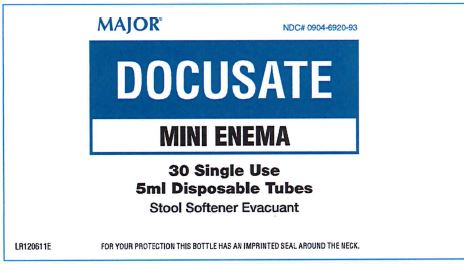
Docusate Mini Enema docusate sodium 283 mg/5mL Liquid — NDC 0904-6920-93 (Billing 00904-6920-93)
This is a package of Docusate Mini Enema docusate sodium 283 mg/5mL Liquid from Major Pharmaceuticals, marketed since Aug 2019 and currently FDA-listed; retail pharmacies pay about $0.4612 per mL (NADAC). It is this product's only package size.
NDC database record
One package, one record: these facts belong to NDC 0904-6920-93 alone.
- Record
- FDA NDC Directory package listing · Human OTC drug
- Code segments
- 0904 labeler · 6920 product · 93 package
- Package marketed since
- Aug 26, 2019
- Sample package
- No — commercial package
- Listing certified through
- Dec 31, 2026
- Barcode (UPC-A, from the NDC)
- 3 0904692093 9
- Medicaid fills, this package
- 2,688 prescriptions in the last four reported quarters
- FDA record last changed
- Jul 24, 2026
Identity & classification
Regulatory identifiers FDA, NLM and CMS codes for this package
Drug-database identifiers Medi-Span GPI and First Databank GCN / HICL / AHFS classification
- GSN (GCN sequence number): 068187
- GCN: 30916
- GPI-14 (Medi-Span): 46500010305110
- HICL (First Databank): 001326
- AHFS class code: 56:12.00.00
- RxCUI (RxNorm): 1190184
Where does this data come from?
- FDA openFDA NDC Directory · synced Oct 8, 2026
- FDA label on DailyMed · label index refreshed Oct 6, 2026
- RxNorm (NLM RxNav) · catalog refreshed Oct 1, 2026
- Medi-Span GPI (licensed)
- First Databank (licensed) · refreshed Oct 8, 2026
RxNorm drug class
This medicine belongs to the Softeners, emollients class.
Where does this data come from?
- RxClass (NLM) · catalog refreshed Oct 1, 2026
Clinical
This is an over-the-counter rectal liquid enema containing docusate sodium, a stool softener. Docusate sodium is typically used to soften stool and promote bowel movements in people experiencing constipation or difficulty with bowel regularity. The product is marketed as an OTC monograph drug, meaning it follows FDA's established safety and use guidelines for this category of laxative products. The 283 mg dose in a 5 mL liquid formulation is designed for rectal administration.
Patient education
Supplement & herbal interactions
Some supplements/herbs that may interact with Docusate Sodium — tap one for details:
Where does this data come from?
- MedlinePlus (NLM) · refreshed Oct 1, 2026
- FDA label on DailyMed · label index refreshed Oct 6, 2026
Ask a licensed pharmacist directly — free, answered by our team.
Pricing
A drug doesn't have one price. Each row is a different public payment system, and none is what you'd pay at the counter — that depends on your insurance. The ⓘ on each row explains what it measures.
| Price system | Per mL | Per package |
|---|---|---|
| Retail pharmacies payNADAC · weekly | $0.461 | $69.18 / 150 ml |
| Medicaid paysCMS SDUD · 12 mo | $0.4551 | $68.27 / 150 ml |
| Medicare drug plans payPart D · quarterly | No Part D plan price is available for this NDC in our data. | |
Where does this data come from?
- CMS NADAC weekly file · file of Oct 7, 2026
- CMS ASP pricing files · refreshed Sep 20, 2026
- CMS Medicaid State Drug Utilization Data · through Q1 2026
- CMS Part D plan pricing files · refreshed Sep 24, 2026
- VA National Acquisition Center price file
Packaging — all sizes for this product
| Package NDC | Description | Marketing start | Marketing end | Status |
|---|---|---|---|---|
| 00904-6920-93 You're viewing this Main listing | 30 TUBE in 1 JAR / 5 mL in 1 TUBE | 2019-08-26 | — | Active |
Therapeutic equivalents
| Product | Labeler | Pack | NADAC/unit | TE | Status | Price vs. this |
|---|---|---|---|---|---|---|
| Enemeez 283 mg/5mL 17433-9876-03 | Quest | 30 tubes | $0.366 | — | Availability likely | save 21% |
| Docusate Mini Enema 283 mg/5mLthis 00904-6920-93 | Major | 30 tubes | $0.461 | — | Availability likely | — |
Where does this data come from?
- FDA openFDA NDC Directory · synced Oct 8, 2026
- FDA Orange Book · refreshed Oct 3, 2026
- CMS NADAC weekly file · file of Oct 7, 2026
Availability & generic status
We did not find an FDA-approved generic match for this exact strength, form and route.
Where does this data come from?
- FDA Orange Book · refreshed Oct 3, 2026
Inactive Ingredients / Excipients
Inactive ingredients, also called excipients, are components of the drug product other than the active ingredient. They may include fillers, dyes, coatings, preservatives, flavors, or other formulation ingredients.
💡 Tap an ingredient (hover on desktop) to see what it is and why it’s used.
-
UNII PDC6A3C0OX
Glycerin is a clear, thick liquid derived from plant oils or fats. It acts as a humectant to retain moisture, a sweetener, and a solvent in medications.
-
UNII 5655G9Y8AQ
A synthetic liquid polymer used as a solvent and humectant in medications. It helps dissolve active ingredients, maintain moisture in the formulation, and improve how the medicine flows and is absorbed.
2 inactive ingredients listed in the exact product block matched to this NDC.
Label-section wording can be broader than the structured product block and may mention additional formulation ingredients.
Where does this data come from?
ingredient classCode="IACT" elements from the exact product block matched by this NDC. Label-section narrative from DailyMed / the openFDA label index is shown separately when available.- FDA label on DailyMed · label index refreshed Oct 6, 2026
- FDA openFDA NDC Directory · synced Oct 8, 2026
Inactive ingredient FAQ
Are inactive ingredients the same for every manufacturer?
Why might an inactive ingredient be missing?
Can inactive ingredients matter?
Manufacturer & labeler
More NDCs from Major Pharmaceuticals labeler code 00904
- Imatinib Mesylate 100 mg Tablet, Film Coated NDC 0904-6901-04
- Raloxifene hydrochloride 60 mg Tablet, Film Coated NDC 0904-6902-04
- Pseudoephedrine Hydrochloride 60 mg Tablet NDC 0904-6907-06
- Atomoxetine 40 mg Capsule NDC 0904-6908-04
- methylprednisolone 4 mg Tablet NDC 0904-6914-61
- Omeprazole 20 mg Capsule, Delayed Release NDC 0904-6917-61
- Prednisone 10 mg Tablet NDC 0904-6923-61
- Sertraline Hydrochloride 25 mg Tablet, Film Coated NDC 0904-6924-61
- Sertraline Hydrochloride 50 mg Tablet, Film Coated NDC 0904-6925-61
- Sertraline Hydrochloride 100 mg Tablet, Film Coated NDC 0904-6926-61
- spironolactone 25 mg Tablet, Film Coated NDC 0904-6927-61
- topiramate 25 mg Tablet, Film Coated NDC 0904-6928-61
Where does this data come from?
- FDA openFDA NDC Directory · synced Oct 8, 2026
- Drugs@FDA
FDA label — Drug Facts FDA SPL
🎯 Indications and Usage ▾
Uses For relief of occasional constipation (irregularity). This product generally produces a bowel movement in 2 to 15 minutes.
⏱️ Dosage and Administration ▾
Directions Adults and children 12 years of age and older (with adult supervision) one to three units daily. Children under 12 years of age, consult a doctor prior to use. Twist off and remove tip.
Lubricate tip prior to insertion: Place a few drops of the tube's liquid content on the shaft prior to insertion. Also apply liquid content or lubricant to the anus before inserting the mini-enema. Positioning: For best results, lay on the left side with knees bent.
Insert slowley into rectum, up to shoulder of tube. Alternate Positions: Administer while seated on the toilet. Or, kneel, then lower head and chest forward until side of face is resting on the surface.
With steady pressure, gently insert the tube into the rectum with care to prevent damage to the rectal wall. Squeeze to empty the contents. Keep the tube squeezed until it is removed from the rectum.
After the contents have been emptied, remove the disposable tube and discard. A small amount of liquid may remain in the unit after use.
⚠️ Warnings ▾
Warnings For rectal use only. Drug Interaction Precaution: Do not take this product if you are presently taking mineral oil, unless directed by a doctor.
🧪 Active Ingredient ▾
Drug Facts Active Ingredient (per delivered-dose) Docusate Sodium USP 283 mg
🧪 Inactive Ingredients ▾
Inactive Ingredients Glycerin USP and Polyethylene Glycol
🎯 Purpose ▾
Purpose Stool Softener Laxative
📄 Do Not Use ▾
Do not use Laxative products when abdominal pain, nausea or vomiting are present. Laxative products for a period longer than 1 week unless directed by a doctor.
📄 Ask a Doctor or Pharmacist Before Use If ▾
Stop use and ask a doctor if you: Rectal bleeding. Noticed a sudden change in bowel habits that persists over a period of 2 weeks. Failed to have a bowel movement after use. This may indicate a serious condition.
🤰 If Pregnant or Breast-Feeding ▾
Pregnant or Lactating Women Ask a healthcare professional before use.
📄 Keep Out of Reach of Children ▾
Keep out of reach of children In case of accidental ingestion, get medical help or contact a Poison Control Center immediately.
📄 Other Information ▾
Other Information Other Information Store at room temperature 15°-30° C (59°-86° F) RETAIN BOTTLE FOR COMPLETE DRUG FACTS
📄 Questions or Comments ▾
Questions or Comments: (800) 616-2471
📄 Package Label / Principal Display Panel ▾
pdp