
Aminosyn II ISOLEUCINE, LEUCINE, LYSINE ACETATE, METHIONINE, PHENYLALANINE, THREONINE, TRYPTOPHAN, VALINE, ALANINE, ARGININE, ASPARTIC ACID, GLUTAMIC ACID, HISTIDINE, PROLINE, SERINE, N-ACETYLTYROSINE, and GLYCINE 990 mg/100mL; 1500 mg/100mL; 1575 mg/100mL; 258 mg/100mL; 447 mg/100mL; 600 mg/100mL; 300 mg/100mL; 750 mg/100mL; 1490 mg/100mL; 1527 mg/100mL Injection, Solution — NDC 0990-7171-17 (Billing 00990-7171-17)
This is a package of Aminosyn II ISOLEUCINE, LEUCINE, LYSINE ACETATE, METHIONINE, PHENYLALANINE, THREONINE, TRYPTOPHAN, VALINE, ALANINE, ARGININE, ASPARTIC ACID, GLUTAMIC ACID, HISTIDINE, PROLINE, SERINE, N-ACETYLTYROSINE, and GLYCINE 990 mg/100mL; 1500 mg/100mL; 1575 mg/100mL; 258 mg/100mL; 447 mg/100mL; 600 mg/100mL; 300 mg/100mL; 750 mg/100mL; 1490 mg/100mL; 1527 mg/100mL Injection, Solution from ICU Medical Inc., marketed since Nov 2019 and currently FDA-listed. It is this product's only package size.
NDC database record
One package, one record: these facts belong to NDC 0990-7171-17 alone.
- Record
- FDA NDC Directory package listing · Human prescription drug
- Code segments
- 0990 labeler · 7171 product · 17 package
- Package marketed since
- Nov 1, 2019
- Sample package
- No — commercial package
- Listing certified through
- Dec 31, 2027
- Barcode (UPC-A, from the NDC)
- 3 0990717117 3
- Medicaid fills, this package
- 28 prescriptions in the last four reported quarters
- FDA record last changed
- Oct 8, 2026
Identity & classification
Regulatory identifiers FDA, NLM and CMS codes for this package
Drug-database identifiers Medi-Span GPI and First Databank GCN / HICL / AHFS classification
- GSN (GCN sequence number): 063001
- GCN: 98761
- GPI-14 (Medi-Span): 80302010102060
- HICL (First Databank): 034945
- AHFS class code: 40:20.00.00
- RxCUI (RxNorm): 800188
Where does this data come from?
- FDA openFDA NDC Directory · synced Oct 8, 2026
- FDA label on DailyMed · label index refreshed Oct 6, 2026
- RxNorm (NLM RxNav) · catalog refreshed Oct 1, 2026
- Medi-Span GPI (licensed)
- First Databank (licensed) · refreshed Oct 8, 2026
Clinical
Patient education
Supplement & herbal interactions
Where does this data come from?
- MedlinePlus (NLM) · refreshed Oct 1, 2026
- FDA label on DailyMed · label index refreshed Oct 6, 2026
Ask a licensed pharmacist directly — free, answered by our team.
Pricing
A drug doesn't have one price. Each row is a different public payment system, and none is what you'd pay at the counter — that depends on your insurance. The ⓘ on each row explains what it measures.
| Price system | Per mL | Per package |
|---|---|---|
| Retail pharmacies payNADAC · weekly | Not in the retail survey — common for institutional, discontinued, or low-volume packs. | |
| Medicaid paysCMS SDUD · 12 mo | $0.2868 | $3,441.60 / 12000 ml |
| Medicare drug plans payPart D · quarterly | No Part D plan price is available for this NDC in our data. | |
Where does this data come from?
- CMS NADAC weekly file
- CMS ASP pricing files · refreshed Sep 20, 2026
- CMS Medicaid State Drug Utilization Data · through Q1 2026
- CMS Part D plan pricing files · refreshed Sep 24, 2026
- VA National Acquisition Center price file
Packaging — all sizes for this product
| Package NDC | Description | Marketing start | Marketing end | Status |
|---|---|---|---|---|
| 00990-7171-17 You're viewing this Main listing | 6 POUCH in 1 CASE / 1 BAG in 1 POUCH / 2000 mL in 1 BAG | 2019-11-01 | — | Active |
Therapeutic equivalents
| Product | Labeler | Pack | NADAC/unit | TE | Status | Price vs. this |
|---|---|---|---|---|---|---|
| Aminosyn II 990 mg/100mL; 1500 mg/100mL; 1575 mg/100mL; 258 mg/100mL; 447 mg/100mL; 600 mg/100mL; 300 mg/100mL; 750 mg/100mL; 1490 mg/100mL; 1527 mg/100mLthis 00990-7171-17 | ICU | 6 pouches | — | — | FDA listed | — |
Where does this data come from?
- FDA openFDA NDC Directory · synced Oct 8, 2026
- FDA Orange Book · refreshed Oct 3, 2026
- CMS NADAC weekly file
Availability & generic status
The FDA lists approved generic versions of this medicine, but that does not always mean a pharmacy can get one today. Patent rules, launch agreements, supply and pricing can affect when generics actually arrive.
Where does this data come from?
- FDA Orange Book · refreshed Oct 3, 2026
Inactive Ingredients / Excipients
Inactive ingredients, also called excipients, are components of the drug product other than the active ingredient. They may include fillers, dyes, coatings, preservatives, flavors, or other formulation ingredients.
💡 Tap an ingredient (hover on desktop) to see what it is and why it’s used.
-
UNII 55X04QC32I
A strong alkaline chemical used to adjust and maintain the pH balance of liquid medicines. It helps keep the medicine stable and ensures it stays effective during storage.
1 inactive ingredient listed in the exact product block matched to this NDC.
Where does this data come from?
ingredient classCode="IACT" elements from the exact product block matched by this NDC. Label-section narrative from DailyMed / the openFDA label index is shown separately when available.- FDA label on DailyMed · label index refreshed Oct 6, 2026
- FDA openFDA NDC Directory · synced Oct 8, 2026
Inactive ingredient FAQ
Are inactive ingredients the same for every manufacturer?
Why might an inactive ingredient be missing?
Can inactive ingredients matter?
Manufacturer & labeler
More NDCs from ICU Medical Inc. labeler code 00990
- Potassium Chloride in Dextrose and Sodium 50 g/1000mL; 9 g/1000mL; 2.98 g/1000mL Injection, Solution NDC 0990-7109-09
- Potassium Chloride in Lactated Ringers and Dextrose POTASSIUM CHLORIDE, SODIUM CHLORIDE, CALCIUM CHLORIDE, SODIUM LACTATE, and DEXTROSE MONOHYDRATE 1.79 g/1000mL; 6 g/1000mL; .2 g/1000mL; 3.1 g/1000mL; 50 g/1000mL Injection, Solution NDC 0990-7111-09
- Potassium Chloride in Sodium 9 g/1000mL; 1.49 g/1000mL Injection, Solution NDC 0990-7115-09
- Potassium Chloride in Sodium 9 g/1000mL; 2.98 g/1000mL Injection, Solution NDC 0990-7116-09
- Sterile Water 1 mL/mL Injection, Solution NDC 0990-7118-07
- Dextrose 70 g/100mL Injection, Solution NDC 0990-7120-07
- Aminosyn II ISOLEUCINE, LEUCINE, LYSINE ACETATE, METHIONINE, PHENYLALANINE, THREONINE, TRYPTOPHAN, VALINE, ALANINE, ARGININE, ASPARTIC ACID, GLUTAMIC ACID, HISTIDINE, PROLINE, SERINE, N-ACETYLTYROSINE, and GLYCINE 660 mg/100mL; 1000 mg/100mL; 1050 mg/100mL; 172 mg/100mL; 298 mg/100mL; 400 mg/100mL; 200 mg/100mL; 500 mg/100mL; 993 mg/100mL; 1018 mg/100mL Injection, Solution NDC 0990-7172-17
- Ionosol MB and Dextrose DEXTROSE MONOHYDRATE, SODIUM LACTATE, POTASSIUM CHLORIDE, MAGNESIUM CHLORIDE, POTASSIUM PHOSPHATE, MONOBASIC, and SODIUM PHOSPHATE, MONOBASIC, MONOHYDRATE 5 g/100mL; 260 mg/100mL; 141 mg/100mL; 30 mg/100mL; 15 mg/100mL; 25 mg/100mL Injection, Solution NDC 0990-7372-03
- Normosol-R SODIUM CHLORIDE, SODIUM ACETATE ANHYDROUS, SODIUM GLUCONATE, POTASSIUM CHLORIDE, AND MAGNESIUM CHLORIDE 526 mg/100mL; 222 mg/100mL; 502 mg/100mL; 37 mg/100mL; 30 mg/100mL Injection, Solution NDC 0990-7670-03
- Mannitol 20 g/100mL Injection, Solution NDC 0990-7715-02
- Sodium Chloride 450 mg/100mL Injection, Solution NDC 0990-7730-36
- Lactated Ringers SODIUM CHLORIDE, SODIUM LACTATE, POTASSIUM CHLORIDE, and CALCIUM CHLORIDE 600 mg/100mL; 310 mg/100mL; 30 mg/100mL; 20 mg/100mL Irrigant NDC 0990-7828-08
Where does this data come from?
- FDA openFDA NDC Directory · synced Oct 8, 2026
- Drugs@FDA
Full prescribing information FDA SPL
🚨 Boxed Warning ▾
Pharmacy Bulk Package – Not For Direct Infusion.
🎯 Indications and Usage ▾
INDICATIONS AND USAGE Aminosyn II, Sulfite-Free, (an amino acid injection) infused with dextrose by peripheral vein infusion is indicated as a source of nitrogen in the nutritional support of patients with adequate stores of body fat, in whom, for short periods of time, oral nutrition cannot be tolerated, is undesirable, or inadequate. SUPPLEMENTAL ELECTROLYTES, IN ACCORDANCE WITH THE PRESCRIPTION OF THE ATTENDING PHYSICIAN, MUST BE ADDED TO AMINOSYN II SOLUTIONS WITHOUT ELECTROLYTES. Aminosyn II can be administered peripherally with dilute (5 to 10%) dextrose solution and I.V. fat emulsion as a source of nutritional support.
This form of nutritional support can help to preserve protein and reduce catabolism in stress conditions where oral intake is inadequate. Aminosyn II is also indicated for central vein infusion to prevent or reverse negative nitrogen balance in patients where the alimentary tract, by the oral, gastrostomy or jejunostomy route cannot or should not be used and gastrointestinal absorption of protein is impaired.
⏱️ Dosage and Administration ▾
DOSAGE AND ADMINISTRATION Each 100 mL of Aminosyn II contains: Amino Acids Nitrogen Aminosyn II 10% 10 g 1.53 g Aminosyn II 15% 15 g 2.30 g The total daily dose of the solution depends on the daily protein requirements and on the patient’s metabolic and clinical response. In many patients, provision of adequate calories in the form of hypertonic dextrose may require the administration of exogenous insulin to prevent hyperglycemia and glycosuria. To prevent rebound hypoglycemia, a solution containing 5% dextrose should be administered when hypertonic dextrose infusions are abruptly discontinued.
Parenteral drug products should be inspected visually for particulate matter and discoloration prior to administration, whenever solution and container permit. COLOR VARIATION FROM PALE YELLOW TO YELLOW IS NORMAL AND DOES NOT ALTER EFFICACY. Some opacity of the plastic due to moisture absorption during the sterilization process may be observed.
This is normal and does not affect the solution quality or safety. The opacity will diminish gradually. Aminosyn II in the 2000 mL flexible Pharmacy Bulk Package is designed for use with manual, gravity flow operations and automated gravimetric compounding devices for preparing intravenous nutritional admixtures.
Admixtures must be stored under refrigeration and used within 24 hours of admixing. Peripheral Vein Nutritional Maintenance A mixture of Aminosyn II and dextrose diluted to a final concentration of 5% to 10% amino acids and 5% to 10% dextrose is suitable for administration by peripheral vein. This solution is not intended for central vein administration because it does not contain adequate amounts of amino acids or electrolytes.
For peripheral intravenous infusion, 1 to 1.5 g/kg/day of total amino acids will reduce protein catabolism. Infusion or ingestion of carbohydrate or lipid will not reduce the nitrogen sparing effect of intravenous amino acid infusions at this dose. As with all intravenous fluid therapy, the primary aim is to provide sufficient water to compensate for insensible, urinary and other (nasogastric suction, fistula drainage, diarrhea) fluid losses.
Total fluid requirements, as well as electrolyte and acid-base needs, should be estimated and appropriately administered. For an amino acid solution of specified total concentration, the volume required to meet amino acid requirements per 24 hours can be calculated. After making an estimate of the total daily fluid (water) requirement, the balance of fluid needed beyond the volume of amino acid solution required can be provided either as a noncarbohydrate or a carbohydrate-containing electrolyte solution.
I.V. lipid emulsion may be substituted for part of the carbohydrate-containing solution. Vitamins and additional electrolytes as needed for maintenance or to correct imbalances may be added to the amino acid solution. If desired, only one-half of an estimated daily amino acid requirement of 1.5 g/kg can be given on the first day.
Amino acids together with dextrose in concentrations of 5% to 10% infused into a peripheral vein can be continued while oral nutrition is impaired. However, if a patient is unable to take oral nourishment for a prolonged period of time, institution of total parenteral nutrition with exogenous calories should be considered. Central Vein Total Parenteral Nutrition For central vein infusion with concentrated dextrose solution, alone or with I.V. lipid, the total daily dose of the amino acid solution depends upon daily protein requirements and the patient’s metabolic and clinical response.
The determination of nitrogen balance and accurate daily body weights, corrected for fluid balance, are probably the best means of assessing individual protein requirements. ADULTS Solutions containing 3.5 to 5% amino acids with 5 to 10% glucose may be infused with a fat emulsion by peripheral vein to provide approximately 1400 to 2000 kcal/day. Fat emulsion administration should be considered when prolonged parenter… [Excerpted — this section continues on DailyMed.]
⛔ Contraindications ▾
CONTRAINDICATIONS This preparation should not be used in patients with hepatic coma or metabolic disorders involving impaired nitrogen utilization.
⚠️ Warnings ▾
WARNINGS Intravenous infusion of amino acids may induce a rise in blood urea nitrogen (BUN), especially in patients with impaired hepatic or renal function. Appropriate laboratory tests should be performed periodically and infusion discontinued if BUN levels exceed normal postprandial limits and continue to rise. It should be noted that a modest rise in BUN normally occurs as a result of increased protein intake.
Administration of amino acid solutions to a patient with hepatic insufficiency may result in serum amino acid imbalances, metabolic alkalosis, prerenal azotemia, hyperammonemia, stupor and coma. Administration of amino acid solutions in the presence of impaired renal function may augment an increasing BUN, as does any protein dietary component. Solutions containing sodium ion should be used with great care, if at all, in patients with congestive heart failure, severe renal insufficiency and in clinical states in which there exists edema with sodium retention.
Solutions which contain potassium ion should be used with great care, if at all, in patients with hyperkalemia, severe renal failure and in conditions in which potassium retention is present. Solutions containing acetate ion should be used with great care in patients with metabolic or respiratory alkalosis. Acetate should be administered with great care in those conditions in which there is an increased level or an impaired utilization of this ion, such as severe hepatic insufficiency.
Hyperammonemia is of special significance in infants, as it can result in mental retardation. Therefore, it is essential that blood ammonia levels be measured frequently in infants. Instances of asymptomatic hyperammonemia have been reported in patients without overt liver dysfunction.
The mechanisms of this reaction are not clearly defined, but may involve genetic defects and immature or subclinically impaired liver function. WARNING: This product contains aluminum that may be toxic. Aluminum may reach toxic levels with prolonged parenteral administration if kidney function is impaired.
Premature neonates are particularly at risk because their kidneys are immature, and they require large amounts of calcium and phosphate solutions, which contain aluminum. Research indicates that patients with impaired kidney function, including premature neonates, who receive parenteral levels of aluminum at greater than 4 to 5 mcg/kg/day accumulate aluminum at levels associated with central nervous system and bone toxicity. Tissue loading may occur even at lower rates of administration.
🤒 Adverse Reactions ▾
ADVERSE REACTIONS Peripheral Infusions A 3.5% to 5% solution of amino acids (without additives) is slightly hypertonic. Use of large peripheral veins, inline filters, and slowing the rate of infusion may reduce the incidence of local venous irritation. Electrolyte additives should be spread throughout the day.
Irritating additive medications may need to be infused at another venous site. Generalized flushing, fever and nausea also have been reported during peripheral infusions of amino acid solutions.
🔄 Drug Interactions ▾
Drug Interactions Because of its antianabolic activity, concurrent administration of tetracycline may reduce the potential effects of amino acids infused with dextrose as part of a parenteral feeding regimen.
🤰 Pregnancy ▾
Pregnancy Category C. Animal reproduction studies have not been conducted with Aminosyn II (an amino acid injection). It is not known whether Aminosyn II can cause fetal harm when administered to a pregnant woman or can affect reproduction capacity. Aminosyn II should be given to a pregnant woman only if clearly needed.
🧒 Pediatric Use ▾
Pediatric Use: Safety and effectiveness of solutions from flexible plastic containers in pediatric patients have not been well established. CLINICAL EVALUATION AND LABORATORY DETERMINATIONS, AT THE DISCRETION OF THE ATTENDING PHYSICIAN, ARE NECESSARY FOR PROPER MONITORING DURING ADMINISTRATION. Do not withdraw venous blood for blood chemistries through the peripheral infusion site, as interference with estimations of nitrogen containing substances may occur.
Blood studies should include glucose, urea nitrogen, serum electrolytes, ammonia, cholesterol, acid-base balance, serum proteins, kidney and liver function tests, osmolarity and hemogram. White blood count and blood cultures are to be determined if indicated. Urinary osmolality and glucose should be determined as necessary.
🧓 Geriatric Use ▾
Geriatric Use: Clinical Studies of Aminosyn II have not been performed to determine whether patients over 65 years of age respond differently from younger subjects. Other reported clinical experience has not identified differences in responses between elderly and younger patients. In general, dose selection for an elderly patient should be cautious, reflecting the greater frequency of decreased hepatic, renal, or cardiac function, and of concomitant disease or other drug therapy.
This drug is known to be substantially excreted by kidney, and the risk for adverse reactions to this drug may be greater in patients with impaired renal function. Because elderly patients are more likely to have decreased renal function, care should be taken in dose selection, and it may be useful to monitor renal function.
🆘 Overdosage ▾
OVERDOSAGE In the event of overhydration or solute overload, re-evaluate the patient and institute appropriate corrective measures. (See WARNINGS and PRECAUTIONS .)
🧬 Clinical Pharmacology ▾
CLINICAL PHARMACOLOGY Aminosyn II, Sulfite-Free, (an amino acid injection) provides crystalline amino acids to promote protein synthesis and wound healing, and to reduce the rate of endogenous protein catabolism. Aminosyn II, given by central venous infusion in combination with concentrated dextrose, electrolytes, vitamins, trace metals, and ancillary fat supplements, constitutes total parenteral nutrition (TPN). Aminosyn II can also be administered by peripheral vein with dextrose and maintenance electrolytes.
Intravenous fat emulsion may be substituted for part of the carbohydrate calories during either TPN or peripheral vein administration of Aminosyn II.
📦 How Supplied / Storage and Handling ▾
HOW SUPPLIED Aminosyn II is supplied as a Pharmacy Bulk Package in a 2000 mL flexible container for continuous admixture compounding procedures. Two concentrations are available: Aminosyn II 10%, Sulfite-Free NDC 0409-7172-17 Aminosyn II 10%, Sulfite-Free NDC 0990-7172-17 Aminosyn II 15%, Sulfite-Free NDC 0409-7171-17 Aminosyn II 15%, Sulfite-Free NDC 0990-7171-17 ICU Medical is transitioning NDC codes from the "0409" to a "0990" labeler code. Both NDC codes are expected to be in the market for a period of time.
Store at 20 to 25°C (68 to 77°F). [See USP Controlled Room Temperature.] Protect from freezing. Avoid exposure to light. Revised: June, 2018 EN-4657 ICU Medical, Inc., Lake Forest, Illinois, 60045, USA
📋 Description ▾
DESCRIPTION Aminosyn ™ II, Sulfite-Free, (an amino acid injection) is a sterile, nonpyrogenic solution for intravenous infusion. Aminosyn II is oxygen sensitive. The Pharmacy Bulk Package is a sterile dosage form which contains multiple single doses for use only in a pharmacy bulk admixture program.
The formulations are described below: Essential Amino Acids (mg/100 mL) Aminosyn II 10% 15% Isoleucine 660 990 Leucine 1000 1500 Lysine (acetate)* 1050 1575 Methionine 172 258 Phenylalanine 298 447 Threonine 400 600 Tryptophan 200 300 Valine 500 750 *Amount cited is for lysine alone and does not include the acetate. Nonessential Amino Acids (mg/100 mL) Alanine 993 1490 Arginine 1018 1527 L-Aspartic Acid 700 1050 L-Glutamic Acid 738 1107 Histidine 300 450 Proline 722 1083 Serine 530 795 N-Acetyl-L-Tyrosine 270 405 Glycine 500 750 Other Characteristics Protein Equivalent (approx. grams/liter) 100 150 Total Nitrogen (grams/liter) 15.3
23.0Osmolarity (mOsmol/liter, actual) 840 1270 pH a 5.8 (5.0 – 6.5) 5.8 (5.0 – 6.5) Specific Gravity 1.03
1.05Electrolytes (mEq/L) Sodium (Na + ) b 38 50 Acetate (C 2 H 3 O 2 - ) c 71.8 107.6 a Solution contains sodium hydroxide for pH adjustment. b Figure includes Na + from the pH adjustor. c Includes acetate from lysine acetate. The flexible plastic container is fabricated from a specially formulated polyvinylchloride. Water can permeate from inside the container into the overwrap but not in amounts to affect the solution significantly.
Solutions in contact with the plastic container may leach out certain chemical components from the plastic in very small amounts; however, biological testing was supportive of the safety of the plastic container materials. Exposure to temperatures above 25°C/77°F during transport and storage will lead to minor losses in moisture content. Higher temperatures lead to greater losses.
It is unlikely that these minor losses will lead to clinically significant changes within the expiration period. The formulas for the individual amino acids are as follows: The Pharmacy Bulk Package is designed for use with manual, gravity flow operations and automated compounding devices for preparing sterile parenteral nutrient admixtures; it contains no bacteriostat. Multiple single doses may be dispensed during continual aliquoting operations.
Withdrawal of container contents should be promptly completed within 4 hours after initial closure puncture. structural formula amino acids
⚠️ Precautions ▾
PRECAUTIONS Special care must be taken when administering glucose to provide calories in diabetic or prediabetic patients. Feeding regimens which include amino acids should be used with caution in patients with history of renal disease, pulmonary disease, or with cardiac insufficiency so as to avoid excessive fluid accumulation. The effect of infusion of amino acids, without dextrose, upon carbohydrate metabolism of children is not known at this time.
Nitrogen intake should be carefully monitored in patients with impaired renal function. For long-term total nutrition, or if a patient has inadequate fat stores, it is essential to provide adequate exogenous calories concurrently with the amino acids. Concentrated dextrose solutions are an effective source of such calories.
Such strongly hypertonic nutrient solutions should be administered through an indwelling intravenous catheter with the tip located in the superior vena cava. SPECIAL PRECAUTIONS FOR CENTRAL VENOUS INFUSIONS ADMINISTRATION BY CENTRAL VENOUS CATHETER SHOULD BE USED ONLY BY THOSE FAMILIAR WITH THIS TECHNIQUE AND ITS COMPLICATIONS. Central vein infusion (with added concentrated carbohydrate solutions) of amino acid solutions requires a knowledge of nutrition as well as clinical expertise in recognition and treatment of complications.
Attention must be given to solution preparation, administration and patient monitoring. IT IS ESSENTIAL THAT A CAREFULLY PREPARED PROTOCOL BASED ON CURRENT MEDICAL PRACTICES BE FOLLOWED, PREFERABLY BY AN EXPERIENCED TEAM. SUMMARY HIGHLIGHTS OF COMPLICATIONS (consult current medical literature).
Technical: The placement of a central venous catheter should be regarded as a surgical procedure. One should be fully acquainted with various techniques of catheter insertion. For details of technique and placement sites, consult the medical literature.
X-ray is the best means of verifying catheter placement. Complications known to occur from the placement of central venous catheters are pneumothorax, hemothorax, hydrothorax, artery puncture and transection, injury to the brachial plexus, malposition of the catheter, formation of arteriovenous fistula, phlebitis, thrombosis and air and catheter emboli. Septic: The constant risk of sepsis is present during administration of total parenteral nutrition.
It is imperative that the preparation of the solution and the placement and care of catheters be accomplished under strict aseptic conditions. Solutions should ideally be prepared in the hospital pharmacy in a laminar flow hood using careful aseptic technique to avoid inadvertent touch contamination. Solutions should be used promptly after mixing.
Storage should be under refrigeration and limited to a brief period of time, preferably less than 24 hours. Administration time for a single container and set should never exceed 24 hours. Metabolic: The following metabolic complications have been reported with TPN administration: metabolic acidosis and alkalosis, hypophosphatemia, hypocalcemia, osteoporosis, glycosuria, hyperglycemia, hyperosmolar nonketotic states and dehydration, rebound hypoglycemia, osmotic diuresis and dehydration, elevated liver enzymes, hypo- and hypervitaminosis, electrolyte imbalances and hyperammonemia in pediatric patients.
Frequent evaluations are necessary especially during the first few days of therapy to prevent or minimize these complications. Administration of glucose at a rate exceeding the patient’s utilization rate may lead to hyperglycemia, coma and death. Carcinogenesis, Mutagenesis, Impairment of Fertility: Studies with solutions from flexible plastic containers have not been performed to evaluate carcinogenic potential, mutagenic potential or effects on fertility.
Pregnancy Category C. Animal reproduction studies have not been conducted with Aminosyn II (an amino acid injection). It is not known whether Aminosyn II can cause fetal harm when administered to a pregnant woman or can affect reproduction capacity.
Amin… [Excerpted — this section continues on DailyMed.]
🍼 Nursing Mothers ▾
Nursing Mothers: Caution should be exercised when solutions from flexible plastic containers are administered to a nursing mother.
📄 Carcinogenesis, Mutagenesis, Impairment of Fertility ▾
Carcinogenesis, Mutagenesis, Impairment of Fertility: Studies with solutions from flexible plastic containers have not been performed to evaluate carcinogenic potential, mutagenic potential or effects on fertility.
📄 Package Label / Principal Display Panel ▾
PRINCIPAL DISPLAY PANEL - 2000 mL Bag Label - 7172 2000 mL NDC 0990-7172-17 Rx ONLY AMINOSYN™ II 10% An Amino Acid Injection, Sulfite-Free Pharmacy Bulk Package — Not for Direct Infusion. EACH 100 mL CONTAINS: TOTAL AMINO ACIDS APPROX. 10 g.
MAY CONTAIN SODIUM HYDROXIDE FOR pH ADJUSTMENT. ESSENTIAL AMINO ACIDS/100 mL: ISOLEUCINE 660 mg; LEUCINE 1000 mg; LYSINE (AS ACETATE SALT) 1050 mg; METHIONINE 172 mg; PHENYLALANINE 298 mg; THREONINE 400 mg; TRYPTOPHAN 200 mg; VALINE 500 mg. NONESSENTIAL AMINO ACIDS/100 mL: N-ACETYL-L- TYROSINE 270 mg; ALANINE 993 mg; ARGININE 1018 mg; GLYCINE 500 mg; PROLINE 722 mg; HISTIDINE 300 mg; SERINE 530 mg; L-ASPARTIC ACID 700 mg; L-GLUTAMIC ACID 738 mg.
ELECTROLYTES (mEq/L): SODIUM 38; ACETATE 71.8. 840 mOsmol/L (ACTUAL). pH 5.8 (5.0 to 6.5) SP. GR.=1.03 FOR IV USE.
USUAL DOSAGE: SEE INSERT. STERILE, NONPYROGENIC. SEE INSERT FOR COMPLETE PRODUCT INFORMATION FOR USE OF THE PHARMACY BULK PACKAGE.
DATE ENTERED: TIME OF ENTRY: CAUTION: USE ONLY IN LAMINAR FLOW HOOD. ONCE THE OUTLET SITE HAS BEEN ENTERED, THE WITHDRAWAL OF CONTAINER CONTENTS SHOULD BE PROMPTLY COMPLETED IN ONE CONTINUOUS OPERATION. DISCARD CONTAINER NOT LATER THAN 4 HOURS AFTER INITIAL CLOSURE PUNCTURE.
SEE INSERT. ADDITIVES MAY BE INCOMPATIBLE WITH FLUID WITHDRAWN FROM THIS CONTAINER. CONSULT WITH PHARMACIST, IF AVAILABLE.
WHEN COMPOUNDING ADMIXTURES, USE ASEPTIC TECHNIQUE. MIX THOROUGHLY. DO NOT STORE SOLUTIONS CONTAINING ADDITIVES.
BECAUSE OF THE POTENTIAL FOR LIFE-THREATENING EVENTS, CAUTION SHOULD BE TAKEN TO ENSURE THAT PRECIPITATES HAVE NOT FORMED IN ANY PARENTERAL NUTRIENT MIXTURE. STORE AT 20 to 25°C (68 to 77°F). [SEE USP CONTROLLED ROOM TEMPERATURE.] PROTECT FROM FREEZING. AVOID EXPOSURE TO LIGHT.
USE ONLY IF SOLUTION IS CLEAR AND CONTAINER IS UNDAMAGED. MUST NOT BE USED IN SERIES CONNECTIONS. THIS PRODUCT CONTAINS NO MORE THAN 25 mcg/L OF ALUMINUM.
3 V CONTAINS DEHP IM-4371 ICU Medical, Inc., Lake Forest, Illinois, 60045, USA icumedical PRINCIPAL DISPLAY PANEL - 2000 mL Bag Label - 7172
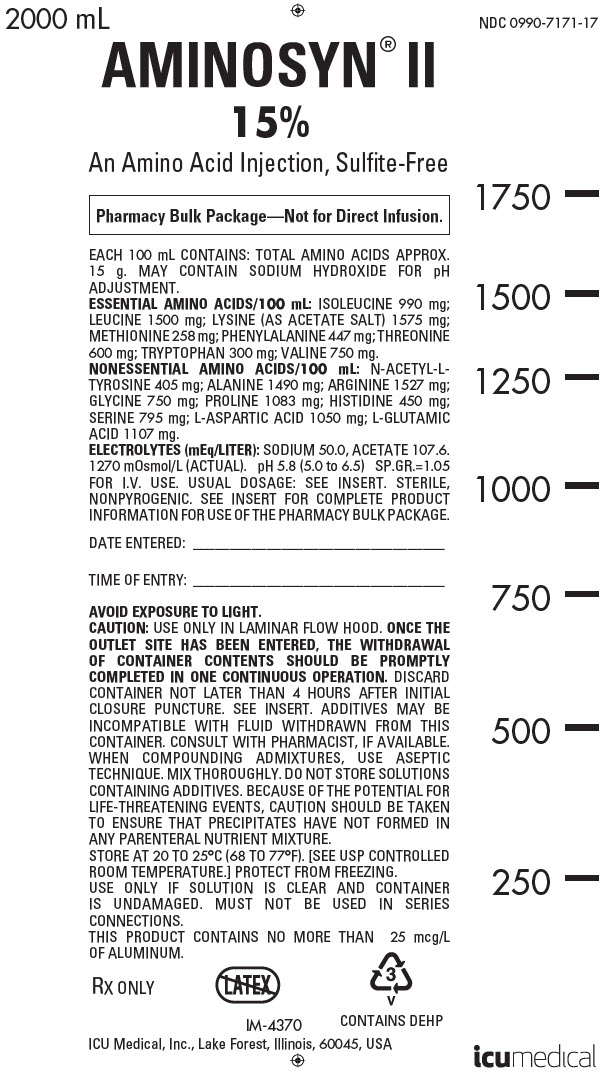
PRINCIPAL DISPLAY PANEL - 2000 mL Bag Label - 7171 2000 mL NDC 0990-7171-17 AMINOSYN ® II 15% An Amino Acid Injection, Sulfite-Free Pharmacy Bulk Package—Not for Direct Infusion. EACH 100 mL CONTAINS: TOTAL AMINO ACIDS APPROX. 15 g.
MAY CONTAIN SODIUM HYDROXIDE FOR pH ADJUSTMENT. ESSENTIAL AMINO ACIDS/100 mL: ISOLEUCINE 990 mg; LEUCINE 1500 mg; LYSINE (AS ACETATE SALT) 1575 mg; METHIONINE 258 mg; PHENYLALANINE 447 mg; THREONINE 600 mg; TRYPTOPHAN 300 mg; VALINE 750 mg. NONESSENTIAL AMINO ACIDS/100 mL: N-ACETYL-L- TYROSINE 405 mg; ALANINE 1490 mg; ARGININE 1527 mg; GLYCINE 750 mg; PROLINE 1083 mg; HISTIDINE 450 mg; SERINE 795 mg; L-ASPARTIC ACID 1050 mg; L-GLUTAMIC ACID 1107 mg.
ELECTROLYTES (mEq/LITER): SODIUM 50.0, ACETATE 107.6. 1270 mOsmol/L (ACTUAL). pH 5.8 (5.0 to 6.5) SP.GR.=1.05 FOR I.V. USE.
USUAL DOSAGE: SEE INSERT. STERILE, NONPYROGENIC. SEE INSERT FOR COMPLETE PRODUCT INFORMATION FOR USE OF THE PHARMACY BULK PACKAGE.
DATE ENTERED: TIME OF ENTRY: AVOID EXPOSURE TO LIGHT. CAUTION: USE ONLY IN LAMINAR FLOW HOOD. ONCE THE OUTLET SITE HAS BEEN ENTERED, THE WITHDRAWAL OF CONTAINER CONTENTS SHOULD BE PROMPTLY COMPLETED IN ONE CONTINUOUS OPERATION.
DISCARD CONTAINER NOT LATER THAN 4 HOURS AFTER INITIAL CLOSURE PUNCTURE. SEE INSERT. ADDITIVES MAY BE INCOMPATIBLE WITH FLUID WITHDRAWN FROM THIS CONTAINER.
CONSULT WITH PHARMACIST, IF AVAILABLE. WHEN COMPOUNDING ADMIXTURES, USE ASEPTIC TECHNIQUE. MIX THOROUGHLY.
DO NOT STORE SOLUTIONS CONTAINING ADDITIVES. BECAUSE OF THE POTENTIAL FOR LIFE-THREATENING EVENTS, CAUTION SHOULD BE TAKEN TO ENSURE THAT PRECIPITATES HAVE NOT FORMED IN ANY PARENTERAL NUTRIENT MIXTURE. STORE AT 20 TO 25°C (68 TO 77°F). [SEE USP CONTROLLED ROOM TEMPERATURE.] PROTECT FROM FREEZING.
USE ONLY IF SOLUTION IS CLEAR AND CONTAINER IS UNDAMAGED. MUST NOT BE USED IN SERIES CONNECTIONS. THIS PRODUCT CONTAINS NO MORE THAN 25 mcg/L OF ALUMINUM.
RX ONLY 3 V CONTAINS DEHP IM-4370 ICU Medical, Inc., Lake Forest, Illinois, 60045, USA… [Excerpted — this section continues on DailyMed.]
Medicaid utilization & spend
Reported adverse events (FAERS)
Top reported reactions
Age at onset
Reporter sex
Where does this data come from?
About this NDC listing & data coverage
What data is (and isn’t) available for this NDC — tap to expand
| NDC identity (package / product / labeler codes) | ✓ Available |
| Labeler | ✓ Available |
| Product & package description | ✓ Available |
| Marketing category & status | ✓ Available |
| Active ingredient / dosage form / route | ✓ Available |
| FDA label (SPL via DailyMed) | ✓ Available |
| Package photos | ✓ Available |
| Inactive ingredients (structured) | ✓ Available |
| NADAC pharmacy acquisition price (CMS) | — Not published for this NDC CMS publishes NADAC only for NDCs reported in its retail-pharmacy survey. |
| Orange Book / therapeutic-equivalence data | — Not published for this NDC Applies only to products approved under an NDA/ANDA; many listings are out of scope. |
| HCPCS J-code billing crosswalk | — Not published for this NDC Most self-administered / retail products have no J-code — that is normal. |
| Medicaid utilization (CMS SDUD) | ✓ Available |