
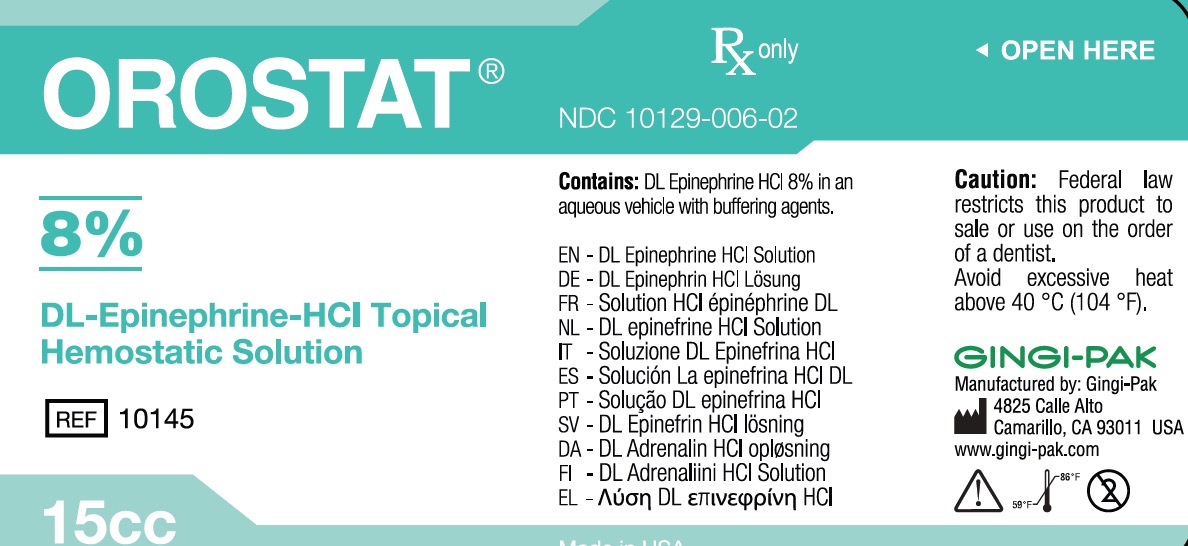
Orostat 8% EPINEPHRINE HYDROCHLORIDE 1200 mg/15mL Solution, 15 mL — NDC 10129-006-02 (Billing 10129-0006-02)
This is a package of 15 mL of Orostat 8% EPINEPHRINE HYDROCHLORIDE 1200 mg/15mL Solution from Gingi-Pak a Division of the Belport, marketed since Apr 1990 and currently FDA-listed. It is this product's only package size.
Identity & classification
Regulatory identifiers FDA, NLM and CMS codes for this package
Where does this data come from?
- FDA openFDA NDC Directory · synced Oct 1, 2026
- FDA label on DailyMed · label index refreshed Oct 1, 2026
- RxNorm (NLM RxNav) · catalog refreshed Oct 1, 2026
- Medi-Span GPI (licensed)
- First Databank (licensed) · refreshed Oct 1, 2026
Clinical
- Epinephrine works fast but wears off quickly — sometimes in as little as 15 to 20 minutes. Anaphylaxis can come back (this is called a biphasic reaction), and you may need addition...
- Why do I need to go to the ER after using my EpiPen or Auvi-Q if I already feel better?
- Yes, it absolutely matters. Inject into the outer thigh — you can even go through your clothing if needed. Never inject into the buttocks (that spot carries a risk of serious infec...
- Where exactly do I inject it, and does it matter?
Patient education
Supplement & herbal interactions
Some supplements/herbs that may interact with Epinephrine Hydrochloride — tap one for details:
Where does this data come from?
- MedlinePlus (NLM) · refreshed Oct 1, 2026
- FDA label on DailyMed · label index refreshed Oct 1, 2026
Ask a licensed pharmacist directly — free, answered by our team.
Pricing
A drug doesn't have one price. Each row is a different public payment system, and none is what you'd pay at the counter — that depends on your insurance. The ⓘ on each row explains what it measures.
| Price system | Per mL | Per package |
|---|---|---|
| Retail pharmacies payNADAC · weekly | Not in the retail survey — common for institutional, discontinued, or low-volume packs. | |
| Medicaid paysCMS SDUD · 12 mo | No recent Medicaid claims on file for this NDC — rare and low-volume NDCs are suppressed in the public data. | |
| Medicare drug plans payPart D · quarterly | No Part D plan price is available for this NDC in our data. | |
Where does this data come from?
- CMS NADAC weekly file
- CMS ASP pricing files · refreshed Sep 20, 2026
- CMS Medicaid State Drug Utilization Data · refreshed Oct 3, 2026
- CMS Part D plan pricing files · refreshed Sep 24, 2026
- VA National Acquisition Center price file
Packaging — all sizes for this product
| Package NDC | Description | Marketing start | Marketing end | Status |
|---|---|---|---|---|
| 10129-0006-02 You're viewing this Main listing | 15 mL in 1 BOTTLE, GLASS | 1990-04-04 | — | Active |
Therapeutic equivalents
| Product | Labeler | Pack | NADAC/unit | TE | Status | Price vs. this |
|---|---|---|---|---|---|---|
| Orostat 8% 1200 mg/15mLthis 10129-0006-02 | Gingi-Pak | 15 ml | — | — | FDA listed | — |
Where does this data come from?
- FDA openFDA NDC Directory · synced Oct 1, 2026
- FDA Orange Book · refreshed Oct 3, 2026
- CMS NADAC weekly file
Availability & generic status
We did not find an FDA-approved generic match for this exact strength, form and route.
Where does this data come from?
- FDA Orange Book · refreshed Oct 3, 2026
Inactive Ingredients / Excipients
Inactive ingredients, also called excipients, are components of the drug product other than the active ingredient. They may include fillers, dyes, coatings, preservatives, flavors, or other formulation ingredients.
💡 Tap an ingredient (hover on desktop) to see what it is and why it’s used.
-
0.15 mL / 15 mL
UNII LKG8494WBH
Benzyl alcohol is a clear liquid used as a preservative and solvent in medicines. It helps prevent bacterial and fungal growth and dissolves other ingredients to create uniform liquid formulations.
-
1.995 mg / 15 mL
UNII 9G34HU7RV0
EDTA is a chemical compound that binds to metals and other substances in medicines. It's used as a preservative and stabilizer to prevent discoloration and extend shelf life.
-
10.05 mg / 15 mL
UNII A2I8C7HI9T
Methylparaben is a preservative derived from benzoic acid that prevents growth of bacteria, fungi, and mold in medicines. It extends the product's shelf life and maintains safety during storage.
-
4.95 mg / 15 mL
UNII Z8IX2SC1OH
Propylparaben is a chemical preservative used to prevent bacterial and fungal growth in medicines and personal care products. It helps extend shelf life and maintain product safety during storage.
-
49.5 mg / 15 mL
UNII 451W47IQ8X
Sodium chloride is common table salt. It's used in medicines as a buffer to maintain proper pH, as a filler to add bulk, or to adjust the osmotic balance in liquid formulations.
-
37.5 mg / 15 mL
UNII 2K5B8F6ES1
Sodium dithionite is a white crystalline powder that acts as a reducing agent and antioxidant in medications. It helps prevent oxidation and degradation of active ingredients, extending the product's shelf life and stability.
-
37.5 mg / 15 mL
UNII KH7I04HPUU
A salt compound made from sodium and phosphoric acid, used as a buffer to help maintain a stable pH level in the medicine, and sometimes as a binder or filler in tablets and capsules.
-
15 mg / 15 mL
UNII HX1032V43M
Sodium thiosulfate is a salt compound used in medicines as a buffer and pH regulator. It helps stabilize the medication and may also serve as a preservative or antioxidant to maintain product quality.
8 inactive ingredients listed in the exact product block matched to this NDC.
Where does this data come from?
ingredient classCode="IACT" elements from the exact product block matched by this NDC. Label-section narrative from DailyMed / the openFDA label index is shown separately when available.- FDA label on DailyMed · label index refreshed Oct 1, 2026
- FDA openFDA NDC Directory · synced Oct 1, 2026
Inactive ingredient FAQ
Are inactive ingredients the same for every manufacturer?
Why might an inactive ingredient be missing?
Can inactive ingredients matter?
Manufacturer & labeler
Where does this data come from?
- FDA openFDA NDC Directory · synced Oct 1, 2026
- Drugs@FDA
FDA label — Drug Facts FDA SPL
🎯 Indications and Usage ▾
Uses Uses
⏱️ Dosage and Administration ▾
Directions Directions
⚠️ Warnings ▾
Warnings Warnings
📦 Storage and Handling ▾
Storage Storage
🧪 Active Ingredient ▾
Active Ingredient Active Ingredient
🧪 Inactive Ingredients ▾
Inactive Ingredient Inactive ingredients
🎯 Purpose ▾
Purpose Purpose
📋 Description ▾
Description Description
📄 Stop Use and Ask a Doctor If ▾
Do not use Do not use
📄 Keep Out of Reach of Children ▾
Keep out of reach if children Keep out of reach if children
📄 Package Label / Principal Display Panel ▾
Principal Display-Orostat 8% Principal Display-Orostat 8%
Reported adverse events (FAERS)
Top reported reactions
Age at onset
Reporter sex
Serious outcomes
Where does this data come from?
About this NDC listing & data coverage
Listed without an FDA application
This product's marketing category indicates it is marketed without an approved FDA application (no NDA, ANDA, or BLA on file). Having an NDC does not by itself establish FDA approval — the NDC Directory is a listing system, not an approval decision. Approval-linked data such as Orange Book therapeutic-equivalence ratings therefore does not apply.
What data is (and isn’t) available for this NDC — tap to expand
| NDC identity (package / product / labeler codes) | ✓ Available |
| Labeler | ✓ Available |
| Product & package description | ✓ Available |
| Marketing category & status | ✓ Available |
| Active ingredient / dosage form / route | ✓ Available |
| FDA label (SPL via DailyMed) | ✓ Available |
| Package photos | ✓ Available |
| Inactive ingredients (structured) | ✓ Available |
| NADAC pharmacy acquisition price (CMS) | — Not published for this NDC CMS publishes NADAC only for NDCs reported in its retail-pharmacy survey. |
| Orange Book / therapeutic-equivalence data | — Not published for this NDC Applies only to products approved under an NDA/ANDA; many listings are out of scope. |
| HCPCS J-code billing crosswalk | — Not published for this NDC Most self-administered / retail products have no J-code — that is normal. |
| Medicaid utilization (CMS SDUD) | — Not published for this NDC CMS reports utilization only for NDCs with Medicaid claims above its privacy threshold. |