
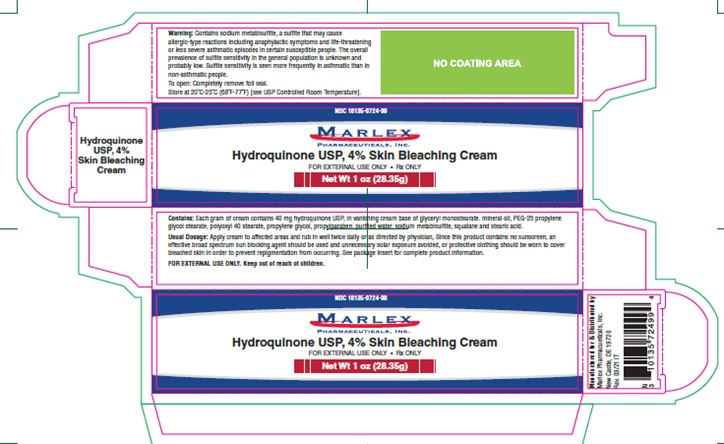
hydroquinone 40 mg/g Cream, 1 tube — NDC 10135-724-99 (Billing 10135-0724-99)
This is a package of 1 tube of hydroquinone 40 mg/g Cream from Marlex Pharmaceuticals, Inc., marketed since Mar 2021 and currently FDA-listed. It is this product's only package size.
NDC database record
One package, one record: these facts belong to NDC 10135-724-99 alone.
- Record
- FDA NDC Directory package listing · Human prescription drug
- Code segments
- 10135 labeler · 724 product · 99 package
- Package marketed since
- Mar 1, 2021
- Sample package
- No — commercial package
- Listing certified through
- Dec 31, 2026
- Barcode (UPC-A, from the NDC)
- 3 1013572499 4
- FDA record last changed
- Jul 24, 2026
Identity & classification
Regulatory identifiers FDA, NLM and CMS codes for this package
Drug-database identifiers Medi-Span GPI and First Databank GCN / HICL / AHFS classification
- GSN (GCN sequence number): 006313
- GCN: 24883
- HICL (First Databank): 002721
- AHFS class code: 84:50.04.00
- RxCUI (RxNorm): 197795
Where does this data come from?
- FDA openFDA NDC Directory · synced Oct 1, 2026
- FDA label on DailyMed · label index refreshed Oct 5, 2026
- RxNorm (NLM RxNav) · catalog refreshed Oct 1, 2026
- Medi-Span GPI (licensed)
- First Databank (licensed) · refreshed Oct 1, 2026
RxNorm drug class
This medicine belongs to the Melanin Synthesis Inhibitor class.
Where does this data come from?
- RxClass (NLM) · catalog refreshed Oct 1, 2026
Clinical
This is a topical cream containing hydroquinone at a concentration of 40 mg per gram. Hydroquinone is a melanin synthesis inhibitor that is typically used to lighten areas of darkened or discolored skin. This product is marketed without an approved FDA application and is classified as an unapproved drug.
Patient education
Supplement & herbal interactions
Where does this data come from?
- MedlinePlus (NLM) · refreshed Oct 1, 2026
- FDA label on DailyMed · label index refreshed Oct 5, 2026
Ask a licensed pharmacist directly — free, answered by our team.
Pricing
A drug doesn't have one price. Each row is a different public payment system, and none is what you'd pay at the counter — that depends on your insurance. The ⓘ on each row explains what it measures.
| Price system | Per g | Per package |
|---|---|---|
| Retail pharmacies payNADAC · weekly | Not in the retail survey — common for institutional, discontinued, or low-volume packs. | |
| Medicaid paysCMS SDUD · 12 mo | No recent Medicaid claims on file for this NDC — rare and low-volume NDCs are suppressed in the public data. | |
| Medicare drug plans payPart D · quarterly | No Part D plan price is available for this NDC in our data. | |
Where does this data come from?
- CMS NADAC weekly file
- CMS ASP pricing files · refreshed Sep 20, 2026
- CMS Medicaid State Drug Utilization Data · refreshed Oct 5, 2026
- CMS Part D plan pricing files · refreshed Sep 24, 2026
- VA National Acquisition Center price file
Packaging — all sizes for this product
| Package NDC | Description | Marketing start | Marketing end | Status |
|---|---|---|---|---|
| 10135-0724-99 You're viewing this Main listing | 1 TUBE in 1 CARTON / 28.35 g in 1 TUBE | 2021-03-01 | — | Active |
Therapeutic equivalents
| Product | Labeler | Pack | NADAC/unit | TE | Status | Price vs. this |
|---|---|---|---|---|---|---|
| Hydroquinone 4% 40 mg/g 75834-0137-01 | Nivagen | 1 tube | $0.461 | — | Availability likely | — |
| Hydroquinone 4% 40 mg/g 42192-0151-01 | Acella | 1 tube | $0.513 | — | Availability likely | — |
| Hydroquinone 40 mg/g 69367-0174-01 | Westminster | 1 tube | $0.513 | — | Availability likely | — |
| hydroquinone 40 mg/gthis 10135-0724-99 | Marlex | 1 tube | — | — | FDA listed | — |
| Hydroquinone cream 40 mg/g 24689-0101-01 | APNAR | 1 tube | — | — | FDA listed | — |
| Hydroquinone 4% 40 mg/g 50405-0800-01 | SOHM, | 1 tube | — | — | FDA listed | — |
| NU-DERM BLENDER Skin Lightener and Blending 40 mg/g 62032-0100-10 | Obagi | 28 g | — | — | FDA listed | — |
| NU-DERM CLEAR Skin Bleaching and Corrector 40 mg/g 62032-0101-36 | Obagi | 57 g | — | — | FDA listed | — |
| Obagi-C Rx system C-Therapy Night Skin Lightening with Vitamins C and E 40 mg/g 62032-0105-36 | Obagi | 57 g | — | — | FDA listed | — |
| NU-DERM SUNFADER Skin Lightener with Sunscreen (SPF 15) PABA FREE 40 mg/g; 75 mg/g; 55 mg/g 62032-0116-36 | Obagi | 57 g | — | — | FDA listed | — |
| Hydroquinone 4% 40 mg/g 71399-0400-01 | Akron | 28.35 g | — | — | FDA listed | — |
| Hydroquinone 4% 40 mg/g 72162-2422-02 | Bryant | 1 tube | — | — | FDA listed | — |
| Hydro-Q 40 mg/g 30815-0040-01 | Dermavance | 1 tube | — | — | FDA listed | — |
Where does this data come from?
- FDA openFDA NDC Directory · synced Oct 1, 2026
- FDA Orange Book · refreshed Oct 3, 2026
- CMS NADAC weekly file
Availability & generic status
We did not find an FDA-approved generic match for this exact strength, form and route.
Where does this data come from?
- FDA Orange Book · refreshed Oct 3, 2026
Inactive Ingredients / Excipients
Inactive ingredients, also called excipients, are components of the drug product other than the active ingredient. They may include fillers, dyes, coatings, preservatives, flavors, or other formulation ingredients.
💡 Tap an ingredient (hover on desktop) to see what it is and why it’s used.
-
UNII 230OU9XXE4
A waxy substance made from glycerin and stearic acid that acts as an emulsifier to blend oily and watery ingredients together. It also helps thicken and stabilize the medicine's texture.
-
UNII T5L8T28FGP
Mineral oil is a clear, odorless liquid derived from crude oil. It acts as a lubricant and emollient in medications, helping pills slide smoothly during manufacturing and aiding moisture retention in topical products.
-
UNII X21KPH4633
A synthetic compound made from propylene glycol and stearic acid, combined with polyethylene glycol. It acts as an emulsifier and surfactant to help blend oil and water-based ingredients and improve texture in liquid or semi-solid medications.
-
UNII 13A4J4NH9I
A synthetic emulsifier derived from stearic acid and polyethylene glycol. It helps mix oil and water-based ingredients together in liquid medicines and creams to create a smooth, uniform product.
-
UNII 6DC9Q167V3
Propylene glycol is a clear liquid derived from petroleum or vegetable sources. It acts as a solvent, humectant, and preservative in medicines, helping dissolve active ingredients and maintain product stability.
-
UNII Z8IX2SC1OH
Propylparaben is a chemical preservative used to prevent bacterial and fungal growth in medicines and personal care products. It helps extend shelf life and maintain product safety during storage.
-
UNII 4VON5FNS3C
Sodium metabisulfite is a preservative derived from sulfur compounds. It prevents microbial growth and oxidation in medicines, helping extend shelf life and maintain product stability.
-
UNII GW89575KF9
Squalane is a lightweight oil derived from plant sources or synthesized. It acts as an emollient and lubricant in formulations, helping ingredients blend smoothly and improving product texture and spreadability.
-
UNII 4ELV7Z65AP
Stearic acid is a fatty acid derived from plant or animal sources. It acts as a binder and lubricant in tablets and capsules, helping them hold together and flow smoothly during manufacturing.
-
UNII 059QF0KO0R
Water is a liquid solvent that dissolves and mixes ingredients together in liquid medicines, syrups, and injections. It helps distribute the active drug evenly throughout the product.
10 inactive ingredients listed in the exact product block matched to this NDC.
Where does this data come from?
ingredient classCode="IACT" elements from the exact product block matched by this NDC. Label-section narrative from DailyMed / the openFDA label index is shown separately when available.- FDA label on DailyMed · label index refreshed Oct 5, 2026
- FDA openFDA NDC Directory · synced Oct 1, 2026
Inactive ingredient FAQ
Are inactive ingredients the same for every manufacturer?
Why might an inactive ingredient be missing?
Can inactive ingredients matter?
Manufacturer & labeler
More NDCs from Marlex Pharmaceuticals, Inc. labeler code 10135
- Alendronate 35 mg Tablet NDC 10135-718-12
- Alendronate 70 mg Tablet NDC 10135-719-12
- Miconazole Nitrate Antifungal Powder 2 g/100g Powder NDC 10135-720-85
- magnesium oxide 420 mg Tablet NDC 10135-721-01
- Methocarbamol Tablets, USP, 500 mg 500 mg Tablet, Film Coated NDC 10135-722-01
- Methocarbamol Tablets, USP, 750 mg 750 mg Tablet, Film Coated NDC 10135-723-01
- Fluphenazine Hydrochloride 1 mg Tablet NDC 10135-725-01
- Fluphenazine Hydrochloride 2.5 mg Tablet NDC 10135-726-01
- Fluphenazine Hydrochloride 5 mg Tablet NDC 10135-727-01
- Fluphenazine Hydrochloride 10 mg Tablet NDC 10135-728-01
- Aspirin 81 mg Tablet NDC 10135-729-10
- Atenolol and Chlorthalidone 25 mg; 50 mg Tablet NDC 10135-733-01
Where does this data come from?
- FDA openFDA NDC Directory · synced Oct 1, 2026
- Drugs@FDA
Full prescribing information FDA SPL
🎯 Indications and Usage ▾
INDICATIONS AND USAGE HYDROQUINONE USP, 4% SKIN BLEACHING CREAM is indicated for the gradual bleaching of hyperpigmented skin conditions such as chloasma, melasma, freckles, senile lentigines, and other unwanted areas of melanin hyperpigmentation.
⏱️ Dosage and Administration ▾
DOSAGE AND ADMINISTRATION HYDROQUINONE USP, 4% SKIN BLEACHING CREAM should be applied to affected areas and rubbed in well twice daily, in the morning and before bedtime, or as directed by a physician. If no improvement is seen after 2 months of treatment, use of this product should be discontinued. There is no recommended dosage for pediatric patients under 12 years of age except under the advice and supervision of a physician.
⛔ Contraindications ▾
CONTRAINDICATIONS Prior history of sensitivity or allergic reaction to hydroquinone or to any of the ingredients of the product. The safety of topical hydroquinone use during pregnancy or for children (12 years and under) has not been established.
⚠️ Warnings ▾
WARNINGS Contains sodium metabisulfite, a sulfite that may cause allergic-type reactions including anaphylactic symptoms and life-threatening or less severe asthmatic episodes in certain susceptible people. The overall prevalence of sulfite sensitivity in the general population is unknown and probably low. Sulfite sensitivity is seen more frequently in asthmatic than in non-asthmatic people.
Since this product contains no sunscreen, an effective broad spectrum sun blocking agent should be used and unnecessary solar exposure avoided, or protective clothing should be worn to cover bleached skin in order to prevent repigmentation from occurring. Hydroquinone may produce exogenous ochronosis, a gradual blue-black darkening of the skin. If this condition occurs, discontinue treatment and consult your physician.
The majority of patients developing this condition are Black, but it may also occur in Caucasians and Hispanics.
🤒 Adverse Reactions ▾
ADVERSE REACTIONS The following adverse reactions have been reported: dryness and fissuring of paranasal and infraorbital areas, erythema, and stinging. Occasional hypersensitivity (localized contact dermatitis) may develop. If this occurs, the medication should be discontinued and the physician notified immediately.
🔄 Drug Interactions ▾
Drug Interactions Patients are cautioned on concomitant use of medications that are known to be photosensitizing.
🤰 Pregnancy ▾
Pregnancy Teratogenic Effects Pregnancy Category C Animal reproduction studies have not been conducted with topical hydroquinone. It is also not known whether topical hydroquinone can cause fetal harm when administered to a pregnant woman or can affect reproduction capacity. Topical hydroquinone should be given to a pregnant woman only if clearly needed.
🧒 Pediatric Use ▾
Pediatric Use Safety and effectiveness for pediatric patients below the age of 12 years have not been established.
🆘 Overdosage ▾
OVERDOSAGE There have been no systemic reactions reported from the use of topical hydroquinone. However, treatment should be limited to relatively small areas of the body at one time, since some patients experience a transient skin reddening and a mild burning sensation which does not preclude treatment.
🧬 Clinical Pharmacology ▾
CLINICAL PHARMACOLOGY Topical application of hydroquinone produces a reversible depigmentation of the skin by inhibition of the enzymatic oxidation of tyrosine to 3,4-dihydroxyphenylalanine (dopa) (Denton, C. et al., 1952) 1 and suppression of other melanocyte metabolic processes (Jimbow, K. et al., 1974) 2 . Exposure to sunlight or ultraviolet light will cause repigmentation of bleached areas (Parrish, J.A. et al., 1978) 3 .
📦 How Supplied / Storage and Handling ▾
HOW SUPPLIED HYDROQUINONE USP, 4% SKIN BLEACHING CREAM is available in a 1 oz (28.35 g) tube with (NDC 10135-0724-99) Store at 20°C-25°C (68°F-77°F) [see USP Controlled Room Temperature].
📋 Description ▾
DESCRIPTION Each gram of HYDROQUINONE USP, 4% SKIN BLEACHING CREAM contains 40 mg hydroquinone, in a cream base of Glyceryl Monostearate, Mineral Oil, PEG-25 Propylene Glycol Stearate, Polyoxl-40 Stearate, Propylene Glycol, Propylparaben, Purified water, sodium metabisulfite, Squalane and Stearic Acid. Chemically, hydroquinone is C 6 H 6 O 2 and has a molecular weight of 110.11. The chemical name is 1,4 dihydroxybenzene, and the structural formula of hydroquinone is: structure
💬 Information for Patients ▾
Information for Patients Sunscreen use is an essential aspect of hydroquinone therapy because even minimal sunlight sustains melanocytic activity. To prevent repigmentation, during treatment and maintenance therapy, sun exposure on treated skin should be avoided by application of a broad spectrum sunscreen (SPF 15 or greater) or by use of protective clothing. Avoid contact with eyes and mucous membranes.
Keep this and all medications out of reach of children. In case of accidental ingestion, call a physician or a poison control center immediately.
⚠️ Precautions ▾
PRECAUTIONS (see WARNINGS ) General Test for skin sensitivity before using by applying a small amount to an unbroken patch of skin; check within 24 hours. Minor redness is not a contraindication, but where there is itching or vesicle formation or excessive inflammatory response further treatment is not advised. Close patient supervision is recommended.
Hydroquinone is a skin bleaching agent which may produce unwanted cosmetic effects if not used as directed. The physician should be familiar with the contents of this insert before prescribing or dispensing this medication. Information for Patients Sunscreen use is an essential aspect of hydroquinone therapy because even minimal sunlight sustains melanocytic activity.
To prevent repigmentation, during treatment and maintenance therapy, sun exposure on treated skin should be avoided by application of a broad spectrum sunscreen (SPF 15 or greater) or by use of protective clothing. Avoid contact with eyes and mucous membranes. Keep this and all medications out of reach of children.
In case of accidental ingestion, call a physician or a poison control center immediately. Drug Interactions Patients are cautioned on concomitant use of medications that are known to be photosensitizing. Carcinogenesis, Mutagenesis, Impairment of Fertility Studies of hydroquinone in animals have demonstrated some evidence of carcinogenicity.
The carcinogenic potential of hydroquinone in humans is unknown. Published studies have demonstrated that hydroquinone is a mutagen and a clastogen. Treatment with hydroquinone has resulted in positive findings for genetic toxicity in the Ames assay in bacterial strains sensitive to oxidizing mutagens, in in vitro studies in mammalian cells, and in the in vivo mouse micronucleus assay.
Pregnancy Teratogenic Effects Pregnancy Category C Animal reproduction studies have not been conducted with topical hydroquinone. It is also not known whether topical hydroquinone can cause fetal harm when administered to a pregnant woman or can affect reproduction capacity. Topical hydroquinone should be given to a pregnant woman only if clearly needed.
Nursing Mothers It is not known whether this drug is excreted in human milk. Because many drugs are excreted in human milk, caution should be exercised when topical hydroquinone is administered to a nursing woman. Pediatric Use Safety and effectiveness for pediatric patients below the age of 12 years have not been established.
🍼 Nursing Mothers ▾
Nursing Mothers It is not known whether this drug is excreted in human milk. Because many drugs are excreted in human milk, caution should be exercised when topical hydroquinone is administered to a nursing woman.
📄 Carcinogenesis, Mutagenesis, Impairment of Fertility ▾
Carcinogenesis, Mutagenesis, Impairment of Fertility Studies of hydroquinone in animals have demonstrated some evidence of carcinogenicity. The carcinogenic potential of hydroquinone in humans is unknown. Published studies have demonstrated that hydroquinone is a mutagen and a clastogen.
Treatment with hydroquinone has resulted in positive findings for genetic toxicity in the Ames assay in bacterial strains sensitive to oxidizing mutagens, in in vitro studies in mammalian cells, and in the in vivo mouse micronucleus assay.
📄 Package Label / Principal Display Panel ▾
PRINCIPAL DISPLAY PANEL - 28.35GM Tube Carton NDC 10135-0724-99 Rx Only Hydroquinone USP, 4% Skin Bleaching Cream Net Wt 1oz (28.35g) principle display panel
About this NDC listing & data coverage
Listed without an FDA application
This product's marketing category indicates it is marketed without an approved FDA application (no NDA, ANDA, or BLA on file). Having an NDC does not by itself establish FDA approval — the NDC Directory is a listing system, not an approval decision. Approval-linked data such as Orange Book therapeutic-equivalence ratings therefore does not apply.
What data is (and isn’t) available for this NDC — tap to expand
| NDC identity (package / product / labeler codes) | ✓ Available |
| Labeler | ✓ Available |
| Product & package description | ✓ Available |
| Marketing category & status | ✓ Available |
| Active ingredient / dosage form / route | ✓ Available |
| FDA label (SPL via DailyMed) | ✓ Available |
| Package photos | ✓ Available |
| Inactive ingredients (structured) | ✓ Available |
| NADAC pharmacy acquisition price (CMS) | — Not published for this NDC CMS publishes NADAC only for NDCs reported in its retail-pharmacy survey. |
| Orange Book / therapeutic-equivalence data | — Not published for this NDC Applies only to products approved under an NDA/ANDA; many listings are out of scope. |
| HCPCS J-code billing crosswalk | — Not published for this NDC Most self-administered / retail products have no J-code — that is normal. |
| Medicaid utilization (CMS SDUD) | — Not published for this NDC CMS reports utilization only for NDCs with Medicaid claims above its privacy threshold. |