
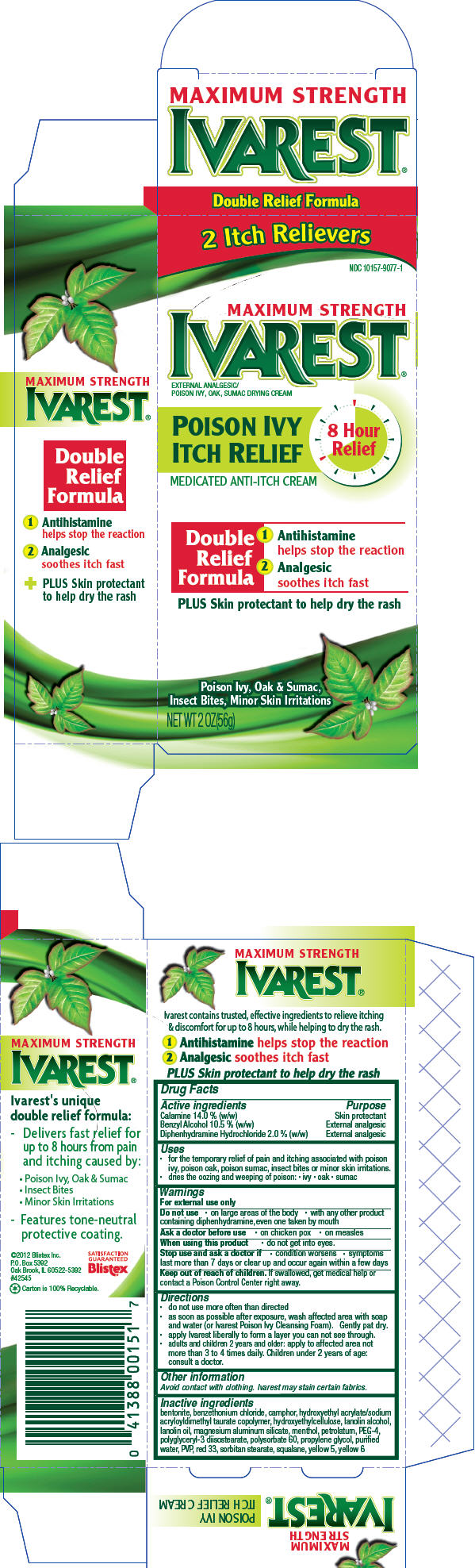
Ivarest Zinc Oxide, Benzyl Alcohol, and Diphenhydramine Hydrochloride 14 g/100g; 10.5 g/100g; 2 g/100g Cream — NDC 10157-9077-1 (Billing 10157-9077-01)
This is a package of Ivarest Zinc Oxide, Benzyl Alcohol, and Diphenhydramine Hydrochloride 14 g/100g; 10.5 g/100g; 2 g/100g Cream from Blistex Inc, marketed since Dec 2007 and currently FDA-listed. It is this product's only package size.
NDC database record
One package, one record: these facts belong to NDC 10157-9077-1 alone.
- Record
- FDA NDC Directory package listing · Human OTC drug
- Code segments
- 10157 labeler · 9077 product · 1 package
- Package marketed since
- Dec 31, 2007
- Sample package
- No — commercial package
- Listing certified through
- Dec 31, 2026
- Barcode (UPC-A, from the NDC)
- 3 1015790771 9
- FDA record last changed
- Aug 27, 2026
Identity & classification
Regulatory identifiers FDA, NLM and CMS codes for this package
Drug-database identifiers Medi-Span GPI and First Databank GCN / HICL / AHFS classification
- GPI-14 (Medi-Span): 90209903403720
- RxCUI (RxNorm): 1298467
Where does this data come from?
- FDA openFDA NDC Directory · synced Oct 8, 2026
- FDA label on DailyMed · label index refreshed Oct 8, 2026
- RxNorm (NLM RxNav) · catalog refreshed Oct 8, 2026
- Medi-Span GPI (licensed)
- First Databank (licensed) · refreshed Oct 8, 2026
Clinical
Ivarest is a topical cream that contains three active ingredients commonly used to relieve itching and treat lice infestations. Zinc oxide functions as a skin protectant and mild astringent. Benzyl alcohol and diphenhydramine hydrochloride are typically used for their anti-itching and numbing properties. This is an over-the-counter monograph product, meaning it is marketed under FDA's established category rules for such treatments rather than through individual product approval.
Patient education
Supplement & herbal interactions
Where does this data come from?
- MedlinePlus (NLM) · refreshed Oct 8, 2026
- FDA label on DailyMed · label index refreshed Oct 8, 2026
Ask a licensed pharmacist directly — free, answered by our team.
Pricing
A drug doesn't have one price. Each row is a different public payment system, and none is what you'd pay at the counter — that depends on your insurance. The ⓘ on each row explains what it measures.
| Price system | Per g | Per package |
|---|---|---|
| Retail pharmacies payNADAC · weekly | Not in the retail survey — common for institutional, discontinued, or low-volume packs. | |
| Medicaid paysCMS SDUD · 12 mo | No recent Medicaid claims on file for this NDC — rare and low-volume NDCs are suppressed in the public data. | |
| Medicare drug plans payPart D · quarterly | No Part D plan price is available for this NDC in our data. | |
Where does this data come from?
- CMS NADAC weekly file
- CMS ASP pricing files · refreshed Sep 20, 2026
- CMS Medicaid State Drug Utilization Data · refreshed Oct 9, 2026
- CMS Part D plan pricing files · refreshed Sep 24, 2026
- VA National Acquisition Center price file
Packaging — all sizes for this product
| Package NDC | Description | Marketing start | Marketing end | Status |
|---|---|---|---|---|
| 10157-9077-01 You're viewing this Main listing | 1 TUBE in 1 CARTON / 56 g in 1 TUBE | 2007-12-31 | — | Active |
Therapeutic equivalents
| Product | Labeler | Pack | NADAC/unit | TE | Status | Price vs. this |
|---|---|---|---|---|---|---|
| Ivarest 14 g/100g; 10.5 g/100g; 2 g/100gthis 10157-9077-01 | Blistex | 1 tube | — | — | FDA listed | — |
Where does this data come from?
- FDA openFDA NDC Directory · synced Oct 8, 2026
- FDA Orange Book · refreshed Oct 9, 2026
- CMS NADAC weekly file
Availability & generic status
We did not find an FDA-approved generic match for this exact strength, form and route.
Where does this data come from?
- FDA Orange Book · refreshed Oct 9, 2026
Inactive Ingredients / Excipients
Inactive ingredients, also called excipients, are components of the drug product other than the active ingredient. They may include fillers, dyes, coatings, preservatives, flavors, or other formulation ingredients.
💡 Tap an ingredient (hover on desktop) to see what it is and why it’s used.
-
UNII A3N5ZCN45C
Bentonite is a naturally occurring clay mineral used in medicines as a binder and absorbent. It helps hold tablet ingredients together and can absorb moisture or unwanted substances in the formulation.
-
UNII PH41D05744
A synthetic antimicrobial chemical compound used as a preservative in medicines and personal care products. It prevents bacterial and fungal growth to keep the product safe during storage and use.
-
UNII 5TJD82A1ET
A cooling crystalline substance made synthetically that is added to medicines as a fragrance, flavoring agent, and mild local irritant to produce a cooling or warming sensation on the skin or mucous membranes.
-
UNII 9DBA0SBB0L
A synthetic red dye derived from coal tar used as a colorant in medicines and cosmetics. It gives tablets, capsules, and liquids their red or pink appearance for identification and visual appeal.
-
UNII I753WB2F1M
FD&C Yellow No. 5 is a synthetic yellow colorant approved by the FDA. It is added to medicines to make pills, tablets, or liquids visually distinct and easier to identify.
-
UNII H77VEI93A8
A synthetic yellow dye used to color medications. It helps identify the drug and make it visually distinctive, with no effect on how the medicine works.
-
UNII 86FQE96TZ4
A synthetic polymer, this ingredient acts as a thickener and suspending agent in liquid formulations. It helps maintain uniform consistency and keeps particles evenly distributed throughout the medicine.
-
UNII 884C3FA9HE
Lanolin alcohol is a waxy substance derived from sheep's wool. It functions as an emollient and emulsifier in medicines, helping blend oil and water-based ingredients while softening the product's texture.
-
UNII OVV5IIJ58F
Lanolin oil is a waxy substance derived from sheep's wool that acts as an emollient and skin-conditioning agent. It helps soften and smooth the skin while also serving as a moisturizing component in topical formulations.
-
UNII 6M3P64V0NC
A fine powder made from magnesium, aluminum, and silicon compounds. It absorbs moisture and helps keep medicine ingredients from clumping or separating, so the product stays stable and flows smoothly during manufacturing.
-
UNII L7T10EIP3A
A cooling compound from mint plants used as a flavoring agent and to create a fresh sensation in medicines. It helps mask bitter tastes and improve how the product feels in the mouth.
-
UNII 4T6H12BN9U
Petrolatum is a purified mineral oil-based jelly derived from petroleum. In medicines, it acts as an emollient, lubricant, and moisture barrier to soften skin, reduce friction, and help prevent water loss from formulations.
-
UNII R95B8J264J
Polyethylene glycol 200 is a clear, colorless liquid made from petroleum. It acts as a solvent and humectant in medicines, helping dissolve active ingredients and retain moisture to keep the product stable.
-
UNII 3WJQ0SDW1A
Polyethylene glycol is a synthetic liquid or solid polymer used in medicines as a solvent, lubricant, and humectant. It helps dissolve active ingredients, reduces friction during manufacturing, and retains moisture in the final product.
-
UNII 46P231IQV8
A synthetic emulsifier derived from glycerin and fatty acids. It helps blend oil and water-based ingredients together in cosmetic and pharmaceutical formulations to create stable, uniform products.
-
UNII CAL22UVI4M
A synthetic emulsifier derived from sorbitol and fatty acids. It helps mix oil and water-based ingredients together and improves the texture and stability of the medicine.
-
UNII 85H0HZU99M
Povidone-iodine is a combination of iodine and a synthetic polymer that acts as a disinfectant and preservative in medicines. It helps prevent bacterial and fungal growth in liquid formulations and topical products.
-
UNII 6DC9Q167V3
Propylene glycol is a clear liquid derived from petroleum or vegetable sources. It acts as a solvent, humectant, and preservative in medicines, helping dissolve active ingredients and maintain product stability.
-
UNII NVZ4I0H58X
A waxy substance made from sorbitol and stearic acid. It acts as an emulsifier and stabilizer, helping keep oil and water mixed together and preventing separation in the medicine.
-
UNII GW89575KF9
Squalane is a lightweight oil derived from plant sources or synthesized. It acts as an emollient and lubricant in formulations, helping ingredients blend smoothly and improving product texture and spreadability.
-
UNII 059QF0KO0R
Water is a liquid solvent that dissolves and mixes ingredients together in liquid medicines, syrups, and injections. It helps distribute the active drug evenly throughout the product.
21 inactive ingredients listed in the exact product block matched to this NDC.
Label-section wording can be broader than the structured product block and may mention additional formulation ingredients.
Where does this data come from?
ingredient classCode="IACT" elements from the exact product block matched by this NDC. Label-section narrative from DailyMed / the openFDA label index is shown separately when available.- FDA label on DailyMed · label index refreshed Oct 8, 2026
- FDA openFDA NDC Directory · synced Oct 8, 2026
Inactive ingredient FAQ
Are inactive ingredients the same for every manufacturer?
Why might an inactive ingredient be missing?
Can inactive ingredients matter?
Manufacturer & labeler
More NDCs from Blistex Inc labeler code 10157
- Kanka Triple Action BENZOCAINE and MENTHOL, UNSPECIFIED FORM 20 g/100g; 2 g/100g Gel NDC 10157-2127-1
- Odor-Eaters Athletes Foot TOLNAFTATE 1 g/100g Cream NDC 10157-3100-1
- Cold Sore Fast-Acting Pain Relief GLYCERIN and LIDOCAINE 200 mg/g; 40 mg/g Gel NDC 10157-4103-1
- Medicated Peppermint Lip Balm Dimethicone, UNSPECIFIED, Octinoxate, and Octisalate 2 g/100g; 6.6 g/100g; 4.4 g/100g Stick NDC 10157-4104-3
- Blistex Odor-Eaters Powder Tolnaftate 1 g/100g Spray NDC 10157-4645-1
- Blistex Lip Medex PETROLATUM, MENTHOL, UNSPECIFIED FORM, CAMPHOR (SYNTHETIC), and PHENOL 59.14 g/100g; 1 g/100g; 1 g/100g; .6 g/100g Paste NDC 10157-8407-1
- Blistex Foille Medicated First Aid Benzocaine and Chloroxylenol 5 g/100g; .1 g/100g Ointment NDC 10157-9302-3
- Kank-A Mouth Pain Benzocaine 200 mg/mL Liquid NDC 10157-9477-1
- Blistex Medicated Lip Balm Variety Pack (Blistex Medicated Berry Lip Balm, Blistex Medicated Lip Balm, Blistex Medicated Mint Lip Balm) Dimethicone, Octinoxate, and Octisalate Kit NDC 10157-9908-1
- Blistex Medicated Lip Balm Variety Pack (Blistex Medicated Berry Lip Balm, Blistex Medicated Lip Balm, Blistex Medicated Lip) Dimethicone, Octinoxate, Octisalate, Camphor (Synthetic), Menthol, Unspecified Form, and Phenol Kit NDC 10157-9910-1
- Blistex Maximum Hydration Lip camphor (synthetic), dimethicone, unspecified, menthol, unspecified form, and phenol .5 g/100g; 1.1 g/100g; .625 g/100g; .5 g/100g Ointment NDC 10157-9913-1
- Blistex Medicated Dimethicone, Camphor (synthetic), Menthol, and Phenol 1.1 g/100g; .5 g/100g; .625 g/100g; .5 g/100g Ointment NDC 10157-9951-1
Where does this data come from?
- FDA openFDA NDC Directory · synced Oct 8, 2026
- Drugs@FDA
FDA label — Drug Facts FDA SPL
🎯 Indications and Usage ▾
Uses for the temporary relief of pain and itching associated with poison ivy, poison oak, poison sumac, insect bites or minor skin irritations. dries the oozing and weeping of poison: ivy oak sumac
⏱️ Dosage and Administration ▾
Directions do not use more often than directed as soon as possible after exposure, wash affected area with soap and water (or Ivarest Poison Ivy Cleansing Foam). Gently pat dry. apply Ivarest liberally to form a layer you can not see through. adults and children 2 years and older: apply to affected area not more than 3 to 4 times daily. Children under 2 years of age: consult a doctor.
⚠️ Warnings ▾
Warnings For external use only Do not use on large areas of the body with any other product containing diphenhydramine, even one taken by mouth Ask a doctor before use on chicken pox on measles When using this product do not get into eyes. Stop use and ask a doctor if condition worsens symptoms last more than 7 days or clear up and occur again within a few days Keep out of reach of children. If swallowed, get medical help or contact a Poison Control Center right away.
📦 Storage and Handling ▾
Other information Avoid contact with clothing. Ivarest may stain certain fabrics.
🧪 Active Ingredient ▾
Active ingredients Purpose Calamine 14.0 % (w/w) Skin protectant Benzyl Alcohol 10.5 % (w/w) External analgesic Diphenhydramine Hydrochloride 2.0 % (w/w) External analgesic
🧪 Inactive Ingredients ▾
Inactive ingredients bentonite, benzethonium chloride, camphor, hydroxyethyl acrylate/sodium acryloyldimethyl taurate copolymer, hydroxyethylcellulose, lanolin alcohol, lanolin oil, magnesium aluminum silicate, menthol, petrolatum, polyethylene glycol, polyglyceryl-3 diisostearate, polysorbate 60, propylene glycol, purified water, PVP, red 33, sorbitan stearate, squalane, yellow 5, yellow 6
🎯 Purpose ▾
Active ingredients Purpose Calamine 14.0 % (w/w) Skin protectant Benzyl Alcohol 10.5 % (w/w) External analgesic Diphenhydramine Hydrochloride 2.0 % (w/w) External analgesic
📄 Do Not Use ▾
Do not use on large areas of the body with any other product containing diphenhydramine, even one taken by mouth
📄 Ask a Doctor Before Use If ▾
Ask a doctor before use on chicken pox on measles
📄 When Using This Product ▾
When using this product do not get into eyes.
📄 Stop Use and Ask a Doctor If ▾
Stop use and ask a doctor if condition worsens symptoms last more than 7 days or clear up and occur again within a few days
📄 Keep Out of Reach of Children ▾
Keep out of reach of children. If swallowed, get medical help or contact a Poison Control Center right away.
📄 Package Label / Principal Display Panel ▾
PRINCIPAL DISPLAY PANEL - 56 g Tube Carton Long Lasting Cream NDC 10157-9077-1 MAXIMUM STRENGTH IVAREST ® EXTERNAL ANALGESIC/ POISON IVY, OAK, SUMAC DRYING CREAM POISON IVY ITCH CREAM 8 Hour Relief Double Relief Formula 1 Antihistamine helps stop the reaction 2 Analgesic soothes itch fast Plus ... Skin protectant to help dry the rash Poison Ivy, Oak & Sumac, Insect Bites, Minor Skin Irritations Net Wt. 2 oz.
(56 g) PRINCIPAL DISPLAY PANEL - 56 g Tube Carton
About this NDC listing & data coverage
What data is (and isn’t) available for this NDC — tap to expand
| NDC identity (package / product / labeler codes) | ✓ Available |
| Labeler | ✓ Available |
| Product & package description | ✓ Available |
| Marketing category & status | ✓ Available |
| Active ingredient / dosage form / route | ✓ Available |
| FDA label (SPL via DailyMed) | ✓ Available |
| Package photos | ✓ Available |
| Inactive ingredients (structured) | ✓ Available |
| NADAC pharmacy acquisition price (CMS) | — Not published for this NDC CMS publishes NADAC only for NDCs reported in its retail-pharmacy survey. |
| Orange Book / therapeutic-equivalence data | — Not published for this NDC Applies only to products approved under an NDA/ANDA; many listings are out of scope. |
| HCPCS J-code billing crosswalk | — Not published for this NDC Most self-administered / retail products have no J-code — that is normal. |
| Medicaid utilization (CMS SDUD) | — Not published for this NDC CMS reports utilization only for NDCs with Medicaid claims above its privacy threshold. |