
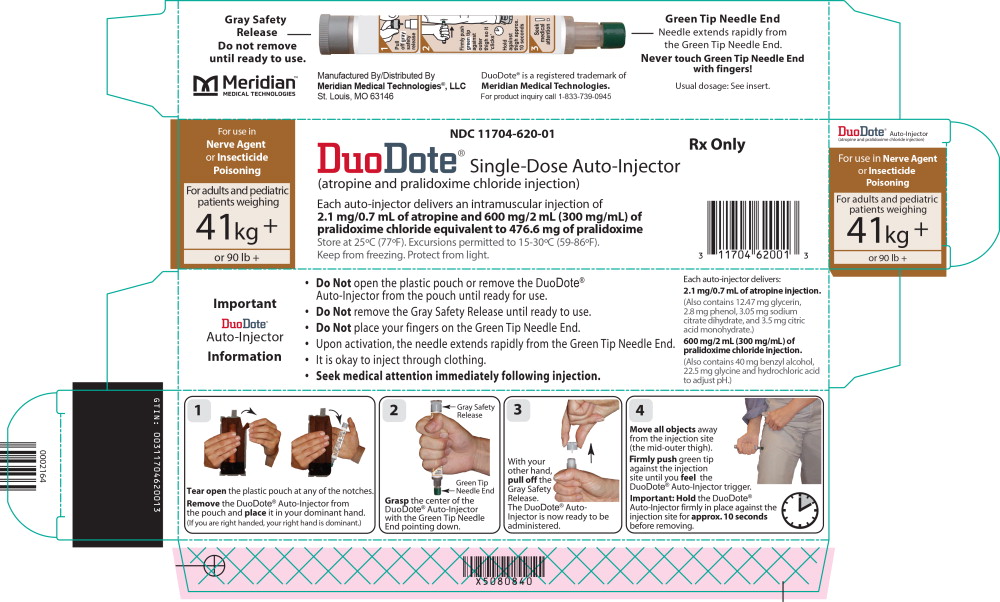
DuoDote atropine and pralidoxime chloride Kit
🆔 Identity & classification
Where does this data come from?
🏷️ RxNorm drug class
This medicine belongs to the Anticholinergic class.
Where does this data come from?
🏭 Manufacturer & labeler
Where does this data come from?
🩺 Clinical
- Both are emergency antidotes for poisoning by organophosphorus nerve agents — the kind used in chemical attacks. DuoDote is also approved for organophosphorus insecticide poisoning...
- What exactly are DuoDote and ATNAA used for?
- Both products are injected into the muscle of the outer thigh — DuoDote into the mid-lateral thigh, ATNAA into the lateral thigh or buttocks. The auto-injectors are designed to fir...
- How do I use the auto-injector, and where do I inject it?
Patient education
Supplement & herbal interactions
Where does this data come from?
Ask a licensed pharmacist directly — free, answered by our team.
🧪 Inactive Ingredients / Excipients
Inactive ingredients, also called excipients, are components of the drug product other than the active ingredient. They may include fillers, dyes, coatings, preservatives, flavors, or other formulation ingredients.
Where does this data come from?
IACT rows and label-wide narrative are kept separate; availability and product-level specificity depend on the submitted label.Inactive ingredient FAQ
Are inactive ingredients the same for every manufacturer?
Why might an inactive ingredient be missing?
Can inactive ingredients matter?
💲 Pricing
A drug doesn't have one price. Each row is a different public payment system, and none is what you'd pay at the counter — that depends on your insurance. The ⓘ on each row explains what it measures.
| Price system | Per each | Per package |
|---|---|---|
| Retail pharmacies payNADAC · weekly | Not in the retail survey — common for institutional, discontinued, or low-volume packs. | |
| Medicaid paysCMS SDUD · 12 mo | No recent Medicaid claims on file for this NDC — rare and low-volume NDCs are suppressed in the public data. | |
| Medicare drug plans payPart D · quarterly | No Part D plan price is available for this NDC in our data. | |
Where does this data come from?
🔁 Therapeutic equivalents
| Product | Labeler | Pack | NADAC/unit | TE | Status | Price vs. this |
|---|---|---|---|---|---|---|
| DuoDotethis 11704-0620-01 | Meridian | 1 kit | — | — | FDA listed | — |
| ATNAA atropine and pralidoxime chloride Auto-Injector 11704-0777-01 | Meridian | 1 kit | — | — | FDA listed | — |
Where does this data come from?
⏳ Availability & generic status
We did not find an FDA-approved generic match for this exact strength, form and route.
Where does this data come from?
📦 Packaging — all sizes for this product
| Package NDC | Description | Marketing start | Status |
|---|---|---|---|
| 11704-0620-01 You're viewing this | 1 KIT in 1 CARTON (11704-620-01) * 1 POUCH in 1 CARTON / 1 SYRINGE, PLASTIC in 1 POUCH / .7 mL in 1 SYRINGE, PLASTIC * 1 POUCH in 1 CARTON / 1 SYRINGE, PLASTIC in 1 POUCH / 2 mL in 1 SYRINGE, PLASTIC | 2006-09-28 | Active |
🧭 About this NDC listing & data coverage
Kit / multi-component package
This NDC identifies a kit — a package containing more than one component. Structured data (pricing, ingredients, equivalents) is often reported per component rather than for the kit NDC itself, which can make this page look thinner than the components' own pages.
What data is (and isn’t) available for this NDC — tap to expand
| NDC identity (package / product / labeler codes) | ✓ Available |
| Labeler | ✓ Available |
| Product & package description | ✓ Available |
| Marketing category & status | ✓ Available |
| Active ingredient / dosage form / route | ✓ Available |
| FDA label (SPL via DailyMed) | ✓ Available |
| Package photos | ✓ Available |
| Inactive ingredients (structured) | — Not published for this NDC The labeler did not submit a structured excipient list, or no SPL is available. |
| NADAC pharmacy acquisition price (CMS) | — Not published for this NDC CMS publishes NADAC only for NDCs reported in its retail-pharmacy survey. |
| Orange Book / therapeutic-equivalence data | — Not published for this NDC Applies only to products approved under an NDA/ANDA; many listings are out of scope. |
| HCPCS J-code billing crosswalk | — Not published for this NDC Most self-administered / retail products have no J-code — that is normal. |
| Medicaid utilization (CMS SDUD) | — Not published for this NDC CMS reports utilization only for NDCs with Medicaid claims above its privacy threshold. |
Questions about this listing
Why is there no price listed?
Is the NDC printed on the package the same as the 11-digit billing NDC?
What do the three segments of this NDC mean?
Is this package still being marketed?
Who lists this product with the FDA?
Do I need a prescription for this product?
Where does this data come from?
📄 Full prescribing information FDA SPL
🎯 Indications and Usage ▾
1 INDICATIONS AND USAGE DuoDote is indicated for the treatment of poisoning by organophosphorus nerve agents as well as organophosphorus insecticides in adults and pediatric patients weighing more than 41 kg (90 pounds). DuoDote, a combination of atropine, a cholinergic muscarinic antagonist, and pralidoxime chloride, a cholinesterase reactivator, is indicated for the treatment of poisoning by organophosphorus nerve agents as well as organophosphorus insecticides in adults and pediatric patients weighing more than 41 kg (90 pounds).
( 1 )
⏱️ Dosage and Administration ▾
2 DOSAGE AND ADMINISTRATION DuoDote is intended as an initial treatment as soon as symptoms appear; definitive medical care should be sought immediately. ( 2.1 ) Dosage for Mild Symptoms: If the patient experiences two or more mild symptoms, administer one injection intramuscularly into the mid-lateral thigh. If, at any time after the first dose, the patient develops any of the severe symptoms, administer two additional injections intramuscularly in rapid succession.
( 2.2 ) Dosage for Severe Symptoms: If a patient has any of the severe symptoms, immediately administer three injections intramuscularly into the patient's mid-lateral thigh in rapid succession. ( 2.2 )
2.1Important Administration Information Three (3) single-dose DuoDote autoinjectors should be available for use in each patient (including healthcare providers) at risk for organophosphorus poisoning; one (1) for mild symptoms plus two (2) more for severe symptoms [see Dosage and Administration ( 2.2 )] . Note that individuals may not have all symptoms included under the mild or severe symptom category. Only administer DuoDote to patients experiencing symptoms of organophosphorus poisoning in a situation where exposure is known or suspected.
The DuoDote autoinjector is intended as an initial treatment of the symptoms of organophosphorus nerve agent or insecticide poisonings as soon as symptoms appear; definitive medical care should be sought immediately. The DuoDote autoinjector should be administered by healthcare providers who have had adequate training in the recognition and treatment of nerve agent or insecticide intoxication. Close supervision of all treated patients is indicated for at least 48 to 72 hours.
Parenteral drug products should be inspected visually for particulate matter and discoloration prior to administration, whenever solution and container permit [see Dosage Forms and Strengths ( 3 )] .
2.2Dosage Information Dosage for Mild Symptoms in Adults and Pediatric Patients Weighing More Than 41 kg (90 Pounds) First Dose : If the patient experiences two or more mild symptoms of nerve agent or insecticide exposure listed in Table 1 , administer one (1) single-dose DuoDote injection intramuscularly into the mid-lateral thigh. Additional Doses : If, at any time after the first dose, the patient develops any of the severe symptoms listed in Table 1 , administer two (2) additional single-dose DuoDote injections intramuscularly in rapid succession.
Wait 10 to 15 minutes for DuoDote to take effect. If, after 10 to 15 minutes, the patient does not develop any of the severe symptoms listed in Table 1 , no additional DuoDote injections are recommended. Dosage for Severe Symptoms in Adults and Pediatric Patients Weighing More Than 41 kg (90 Pounds) If a patient has any of the severe symptoms listed in Table 1 , immediately administer three (3) single-dose DuoDote injections intramuscularly into the patient's mid-lateral thigh in rapid succession.
Table 1. Common Symptoms of Organophosphorus Exposure Mild Symptoms Severe Symptoms Blurred vision, miosis Excessive, unexplained teary eyes Excessive, unexplained runny nose Increased salivation such as sudden drooling Chest tightness or difficulty breathing Tremors throughout the body or muscular twitching Nausea and/or vomiting Unexplained wheezing, coughing or increased airway secretions Acute onset of stomach cramps Tachycardia or bradycardia Strange or confused behavior Severe difficulty breathing or copious secretions from lungs/airway Severe muscular twitching and general weakness Involuntary urination and defecation Convulsions Unconsciousness
2.3Administration Instructions *Do Not Remove Gray Safety Release until ready to use. * Never touch the Green Tip (Needle End)! 1) Tear open the plastic pouch at any of the notches. Remove the DuoDote autoinjector from the pouch. 2) Place the DuoDote autoinjector in your dominant hand. (If you are right-handed, your right hand is dominant.) Firmly grasp the center of t…
💊 Dosage Forms and Strengths ▾
3 DOSAGE FORMS AND STRENGTHS Each single-dose DuoDote autoinjector contains the following in two separate chambers: front chamber (visible): a clear, colorless to yellow, sterile solution of atropine (2.1 mg/0.7 mL) back chamber (not visible): a clear, colorless to yellow, sterile solution of pralidoxime chloride (600 mg/2 mL) equivalent to pralidoxime (476.6 mg/2 mL) When activated, DuoDote sequentially administers both drugs intramuscularly through a single needle in one injection. Each single-dose DuoDote autoinjector contains atropine (2.1 mg/0.7 mL) plus pralidoxime chloride (600 mg/2 mL).
( 3 )
⛔ Contraindications ▾
4 CONTRAINDICATIONS None. None. ( 4 )
⚠️ Warnings and Cautions ▾
5 WARNINGS AND PRECAUTIONS Cardiovascular (CV) Risks: Tachycardia, palpitations, premature ventricular contractions, flutter, fibrillation, etc. Use caution in patients with known CV disease or conduction problems. ( 5.1 ) Heat Injury: May inhibit sweating and lead to hyperthermia; avoid excessive exercising and heat exposure.
( 5.2 ) Acute Glaucoma: May precipitate in susceptible individuals. ( 5.3 ) Urinary Retention : Administer with caution in patient with bladder outflow obstruction. ( 5.4 ) Pyloric Stenosis: May convert into complete obstruction.
( 5.5 ) Exacerbation of Chronic Lung Disease: Atropine may cause inspissation of bronchial secretions and formation of dangerous viscid plugs in individuals with chronic lung disease; monitor respiratory status. ( 5.6 )
5.1Cardiovascular Risks Cardiovascular adverse reactions reported in the literature for atropine include, but are not limited to, sinus tachycardia, palpitations, premature ventricular contractions, atrial flutter, atrial fibrillation, ventricular flutter, ventricular fibrillation, cardiac syncope, asystole, and myocardial infarction. In patients with a recent myocardial infarction and/or severe coronary artery disease, there is a possibility that atropine-induced tachycardia may cause ischemia, extend or initiate myocardial infarcts, and stimulate ventricular ectopy and fibrillation.
DuoDote should be used with caution in patients with known cardiovascular disease or cardiac conduction problems.
5.2Heat Injury Atropine may inhibit sweating which, in a warm environment or with excessive exercise, can lead to hyperthermia and heat injury. To the extent feasible, avoid excessive exercise and heat exposure [see Overdosage ( 10.2 )].
5.3Acute Glaucoma Atropine should be administered with caution in patients at risk for acute glaucoma.
5.4Urinary Retention Atropine should be administered with caution in patients with clinically significant bladder outflow obstruction because of the risk of urinary retention.
5.5Pyloric Stenosis Atropine should be administered with caution in patients with partial pyloric stenosis because of the risk of complete pyloric obstruction.
5.6Exacerbation of Chronic Lung Disease Atropine may cause inspissation of bronchial secretions and formation of dangerous viscid plugs in individuals with chronic lung disease. Respiratory status should be monitored in individuals with chronic lung disease following administration of DuoDote.
🤒 Adverse Reactions ▾
6 ADVERSE REACTIONS The following serious adverse reactions are described elsewhere in the labeling: Cardiovascular Risks [see Warnings and Precautions ( 5.1 )] Heat Injury [see Warnings and Precautions ( 5.2 )] Acute Glaucoma [see Warnings and Precautions ( 5.3 )] Urinary Retention [see Warnings and Precautions ( 5.4 )] Pyloric Stenosis [see Warnings and Precautions ( 5.5 )] Exacerbation of Chronic Lung Disease [see Warnings and Precautions ( 5.6 )] The following adverse reactions associated with the use of atropine and pralidoxime chloride were identified in the literature.
Because these reactions are reported voluntarily from a population of uncertain size, it is not always possible to reliably estimate their frequency or establish a causal relationship to drug exposure. Common adverse reactions of atropine include dryness of mouth, blurred vision, dry eyes, photophobia, confusion, headache, and dizziness among others. ( 6.1 ) The common adverse reactions of pralidoxime chloride include changes in vision, dizziness, headache, drowsiness, nausea, tachycardia, increased blood pressure, muscular weakness, dry mouth, emesis, rash, dry skin, hyperventilation, decreased renal function, excitement, manic behavior, and transient elevation of liver enzymes and creatine phosphokinase.
( 6.2 ) To report SUSPECTED ADVERSE REACTIONS, contact Meridian Medical Technologies ® , LLC at 1-833-739-0945 or FDA at 1-800-FDA-1088 or www.fda.gov/medwatch.
6.1Atropine Because DuoDote contains pralidoxime chloride, which may potentiate the effect of atropine, signs of atropinization may occur earlier than might be expected when atropine is used alone. Common adverse reactions of atropine can be attributed to its antimuscarinic action. These include dryness of the mouth, blurred vision, dry eyes, photophobia, confusion, headache, dizziness, tachycardia, palpitations, flushing, urinary hesitancy or retention, constipation, abdominal pain, abdominal distention, nausea and vomiting, loss of libido, and impotence.
Anhidrosis may produce heat intolerance and impairment of temperature regulation in a hot environment. Dysphagia, paralytic ileus, acute angle closure glaucoma, maculopapular rash, petechial rash, and scarletiniform rash have also been reported. Adverse cardiac reactions, including arrhythmias and myocardial infarction, have been reported with atropine [see Warnings and Precautions ( 5.1 ) and Clinical Pharmacology ( 12.2 )] .
Larger doses of atropine may produce central nervous system effects such as restlessness, tremor, fatigue, locomotor difficulties, delirium, and hallucinations [see Overdosage ( 10.1 )]. Hypersensitivity reactions will occasionally occur, are usually seen as skin rashes, and may progress to exfoliation. Anaphylactic reaction and laryngospasm are rare.
6.2Pralidoxime Chloride Pralidoxime can cause blurred vision, diplopia and impaired accommodation, dizziness, headache, drowsiness, nausea, tachycardia, increased systolic and diastolic blood pressure [see Clinical Pharmacology ( 12.2 )], muscular weakness, dry mouth, emesis, rash, dry skin, hyperventilation, decreased renal function, and decreased sweating when given parenterally to normal adult volunteers who have not been exposed to anticholinesterase poisons. In several cases of organophosphorus poisoning, excitement and manic behavior have occurred immediately following recovery of consciousness, in either the presence or absence of pralidoxime administration.
However, similar behavior has not been reported in subjects given pralidoxime in the absence of organophosphorus poisoning. Elevations in AST and/or ALT enzyme levels were observed in 1 of 6 normal adult volunteers given 1200 mg of pralidoxime intramuscularly, and in 4 of 6 adult volunteers given 1800 mg intramuscularly. Levels returned to normal in about two weeks.
Transient elevations in creatine kinase were observed in all normal volunteers given the drug.
6.3 Injection Site Muscle tightness and pain may occ…
🔄 Drug Interactions ▾
7 DRUG INTERACTIONS Succinylcholine and Mivacurium: Accelerated reversal of neuromuscular blocking effects may occur; monitor with concomitant administration. ( 7.1 )
7.1Succinylcholine and Mivacurium Since pralidoxime in DuoDote reactivates cholinesterases and succinylcholine and mivacurium are metabolized by cholinesterases, patients with organophosphorus nerve agent or organophosphorus insecticide poisoning who have received DuoDote may exhibit accelerated reversal of the neuromuscular blocking effects of succinylcholine and mivacurium (relative to poisoned patients who have not received pralidoxime). Monitor for neuromuscular effects with concomitant administration.
👥 Use in Specific Populations ▾
8 USE IN SPECIFIC POPULATIONS Geriatric patients may be more susceptible to the effects of atropine. ( 8.5 )
8.1Pregnancy Risk Summary Atropine readily crosses the placental barrier and enters fetal circulation. There are no adequate data on the developmental risk associated with the use of atropine, pralidoxime, or the combination in pregnant women. Adequate animal reproduction studies have not been conducted with atropine, pralidoxime, or the combination.
In the U.S. general population, the estimated background risk of major birth defects and miscarriage in clinically recognized pregnancies is 2-4% and 15-20%, respectively.
8.2Lactation Risk Summary Atropine has been reported to be excreted in human milk. It is not known whether pralidoxime is excreted in human milk. There are no data on the effects of atropine or pralidoxime on the breastfed infant or the effects of the drugs on milk production.
The developmental and health benefits of breastfeeding should be considered along with the mother's clinical need for DuoDote and any potential adverse effects on the breastfed infant from DuoDote or from the underlying maternal condition.
8.4Pediatric Use Safety and effectiveness of atropine in DuoDote in patients weighing more than 41 kg (90 pounds) is supported by published literature. Safety and effectiveness of pralidoxime chloride in DuoDote in patients more than 41 kg (90 pounds) is supported by data from pharmacokinetic studies in adults and experience in the pediatric population. Adverse events seen in pediatric patients treated with atropine are similar to those that occur in adult patients, although central nervous system complaints are often seen earlier and at lower doses [see Adverse Reactions ( 6.1 )].
Safety and effectiveness of DuoDote in pediatric patients weighing less than or equal to 41 kg (90 pounds) have not been established.
8.5Geriatric Use Geriatric patients may be more susceptible to the effects of atropine [see Clinical Pharmacology ( 12.3 )].
8.6Renal Impairment Pralidoxime chloride can cause decreased renal function [see Adverse Reactions ( 6.2 )]. Patients with severe renal impairment may require less frequent doses after the initial dose.
8.7Hepatic Impairment Patients with severe hepatic impairment may require less frequent doses after the initial dose.
🤰 Pregnancy ▾
8.1Pregnancy Risk Summary Atropine readily crosses the placental barrier and enters fetal circulation. There are no adequate data on the developmental risk associated with the use of atropine, pralidoxime, or the combination in pregnant women. Adequate animal reproduction studies have not been conducted with atropine, pralidoxime, or the combination.
In the U.S. general population, the estimated background risk of major birth defects and miscarriage in clinically recognized pregnancies is 2-4% and 15-20%, respectively.
🧒 Pediatric Use ▾
8.4Pediatric Use Safety and effectiveness of atropine in DuoDote in patients weighing more than 41 kg (90 pounds) is supported by published literature. Safety and effectiveness of pralidoxime chloride in DuoDote in patients more than 41 kg (90 pounds) is supported by data from pharmacokinetic studies in adults and experience in the pediatric population. Adverse events seen in pediatric patients treated with atropine are similar to those that occur in adult patients, although central nervous system complaints are often seen earlier and at lower doses [see Adverse Reactions ( 6.1 )].
Safety and effectiveness of DuoDote in pediatric patients weighing less than or equal to 41 kg (90 pounds) have not been established.
🧓 Geriatric Use ▾
8.5Geriatric Use Geriatric patients may be more susceptible to the effects of atropine [see Clinical Pharmacology ( 12.3 )].
🆘 Overdosage ▾
10 OVERDOSAGE
10.1Symptoms Atropine Manifestations of atropine overdose are dose-related and include flushing, dry skin and mucous membranes, tachycardia, widely dilated pupils that are poorly responsive to light, blurred vision, and fever (which can sometimes be dangerously elevated). Locomotor difficulties, disorientation, hallucinations, delirium, confusion, agitation, coma, and central depression can occur and may last 48 hours or longer. In instances of severe atropine intoxication, respiratory depression, coma, circulatory collapse, and death may occur.
Pralidoxime It may be difficult to differentiate adverse events caused by pralidoxime from those caused by organophosphorus poisoning. Symptoms of pralidoxime overdose may include dizziness, blurred vision, diplopia, headache, impaired accommodation, nausea, and tachycardia. Transient hypertension caused by pralidoxime may last several hours.
10.2Treatment For atropine overdose, supportive treatment should be administered. If respiration is depressed, artificial respiration with oxygen is necessary. Ice bags, a hypothermia blanket, or other methods of cooling may be required to reduce atropine-induced fever, especially in pediatric patients.
Catheterization may be necessary if urinary retention occurs. Since atropine elimination largely takes place through the kidney, urinary output must be maintained and increased if possible; intravenous fluids may be indicated. Because of atropine-induced photophobia, the room should be darkened.
A benzodiazepine may be needed to control marked excitement and convulsions. However, large doses for sedation should be avoided because the central nervous system depressant effect may coincide with the depressant effect occurring late in severe atropine poisoning. Barbiturates are potentiated by the anticholinesterases; therefore, barbiturates should be used cautiously in the treatment of convulsions.
Central nervous system stimulants are not recommended.
🧬 Clinical Pharmacology ▾
12 CLINICAL PHARMACOLOGY
12.1Mechanism of Action Atropine Atropine competitively blocks the effects of acetylcholine, including excess acetylcholine due to organophosphorus poisoning, at muscarinic cholinergic receptors on smooth muscle, cardiac muscle, secretory gland cells, and in peripheral autonomic ganglia and the central nervous system. Pralidoxime Pralidoxime reactivates acetylcholinesterase which has been inactivated by phosphorylation due to an organophosphorus nerve agent or insecticide. However, pralidoxime does not reactivate acetylcholinesterase inactivated by all organophosphorus nerve agents (e.g., soman).
Pralidoxime cannot reactivate phosphorylated acetylcholinesterases that have undergone a further chemical reaction known as “aging.” Reactivated acetylcholinesterase hydrolyzes excess acetylcholine resulting from organophosphorus poisoning to help restore impaired cholinergic neural function. Reactivation is clinically important because only a small proportion of active acetylcholinesterase is needed to maintain vital functions.
12.2Pharmacodynamics Atropine Atropine reduces secretions in the mouth and respiratory passages, relieves airway constriction, and may reduce centrally-mediated respiratory paralysis. In severe organophosphorus poisoning, a fully atropinized patient may develop or continue to have respiratory failure and may require artificial respiration and suctioning of airway secretions. Atropine may cause thickening of secretions.
Atropine-induced parasympathetic inhibition may be preceded by a transient phase of stimulation, especially on the heart where small doses first slow the rate before characteristic tachycardia develops due to paralysis of vagal control. Atropine increases heart rate and reduces atrioventricular conduction time. Adequate atropine doses can prevent or abolish bradycardia or asystole produced by organophosphorus nerve agents.
Atropine may decrease the degree of partial heart block which can occur after organophosphorus poisoning. In some patients with complete heart block, atropine may accelerate the idioventricular rate; in others, the rate is stabilized. In some patients with conduction defects, atropine may cause paradoxical atrioventricular (A-V) block and nodal rhythm.
Atropine will not act on the neuromuscular junction and has no effect on muscle paralysis or weakness, fasciculations or tremors; pralidoxime is intended to treat these symptoms. Systemic doses of atropine slightly raise systolic and lower diastolic pressures and can produce significant postural hypotension. Such doses also slightly increase cardiac output and decrease central venous pressure.
Atropine can dilate cutaneous blood vessels, particularly the “blush” area (atropine flush), and may inhibit sweating, thereby causing hyperthermia, particularly in a warm environment or with exercise [see Warnings and Precautions ( 5.2 )]. Pralidoxime Chloride Pralidoxime chloride has its most critical effect in relieving respiratory muscle paralysis. Because pralidoxime is less effective in relieving depression of the respiratory center, atropine is always required concomitantly to block the effect of accumulated acetylcholine at this site.
Pralidoxime has a minor role in relieving muscarinic signs and symptoms, such as salivation or bronchospasm. DuoDote temporarily increases blood pressure, a known effect of pralidoxime. In a study of 24 healthy young adults administered a single dose of atropine and pralidoxime autoinjector intramuscularly (approximately 9 mg/kg pralidoxime chloride), diastolic blood pressure increased from baseline by 11 ± 14 mm Hg (mean ± SD), and systolic blood pressure increased by 16 ± 19 mm Hg, at 15 minutes post-dose.
Blood pressures remained elevated at these approximate levels through one hour post-dose, began to decrease at two hours post-dose and were near pre-dose baseline at four hours post-dose.
12.3 Pharmacokinetics Atropine: Atropine is well absorbed after intramuscular admin…
🧬 Mechanism of Action ▾
12.1Mechanism of Action Atropine Atropine competitively blocks the effects of acetylcholine, including excess acetylcholine due to organophosphorus poisoning, at muscarinic cholinergic receptors on smooth muscle, cardiac muscle, secretory gland cells, and in peripheral autonomic ganglia and the central nervous system. Pralidoxime Pralidoxime reactivates acetylcholinesterase which has been inactivated by phosphorylation due to an organophosphorus nerve agent or insecticide. However, pralidoxime does not reactivate acetylcholinesterase inactivated by all organophosphorus nerve agents (e.g., soman).
Pralidoxime cannot reactivate phosphorylated acetylcholinesterases that have undergone a further chemical reaction known as “aging.” Reactivated acetylcholinesterase hydrolyzes excess acetylcholine resulting from organophosphorus poisoning to help restore impaired cholinergic neural function. Reactivation is clinically important because only a small proportion of active acetylcholinesterase is needed to maintain vital functions.
📦 How Supplied / Storage and Handling ▾
16 HOW SUPPLIED/STORAGE AND HANDLING Each single-dose DuoDote (atropine and pralidoxime chloride) autoinjector contains atropine (2.1 mg/0.7 mL; colorless to yellow solution, visible in front chamber) and pralidoxime chloride (600 mg/2 mL; colorless to yellow solution, not visible in rear chamber) and is available in a single unit carton, NDC-11704-620-01. Each DuoDote autoinjector is supplied in a pouch that provides protection from light. Store at 25ºC (77ºF); excursions permitted between 15ºC and 30ºC (between 59ºF and 86ºF) [See USP Controlled Room Temperature].
Not made with natural rubber latex. Keep from freezing. Protect from light.
📋 Description ▾
11 DESCRIPTION Each prefilled DuoDote autoinjector provides a single intramuscular dose of atropine, a cholinergic muscarinic antagonist, and pralidoxime chloride, a cholinesterase reactivator, in a self-contained unit, specifically designed for administration by emergency medical services personnel. When activated, each single-dose DuoDote autoinjector delivers the following: 2.1 mg of atropine in 0.7 mL of sterile, pyrogen-free solution containing 12.47 mg glycerin, not more than 2.8 mg phenol, 3.05 mg sodium citrate dihydrate, 3.5 mg citric acid monohydrate, and Water for Injection.
The pH range is 4.0 – 5.0. 600 mg of pralidoxime chloride equivalent to 476.6 mg of pralidoxime in 2 mL of sterile, pyrogen-free solution containing 40 mg benzyl alcohol, 22.5 mg glycine, and Water for Injection. The pH is adjusted with hydrochloric acid.
The pH range is 2.0 to 3.0. Atropine occurs as white crystals, usually needle-like, or as a white, crystalline powder. It is slightly soluble in water with a molecular weight of 289.38.
Atropine, a naturally occurring belladonna alkaloid, is a racemic mixture of equal parts of d- and l-hyoscyamine, with activity due almost entirely to the levo isomer of the drug. Chemically, atropine is designated as 1αH,5αH-Tropan-3α-ol(±)-tropate. Its empirical formula is C 17 H 23 NO 3 and its structural formula is as follows: Pralidoxime chloride is an odorless, white to pale-yellow crystalline powder, freely soluble in water, with a molecular weight of 172.61.
Chemically, pralidoxime chloride is designated as 2-formyl-l-methylpyridinium chloride oxime. Its empirical formula is C 7 H 9 ClN 2 O and its structural formula is indicated above. Structural Formula
💬 Information for Patients ▾
17 PATIENT COUNSELING INFORMATION Use by Healthcare Providers DuoDote is intended for use by Healthcare Providers. See the illustrated Instruction Sheet for Healthcare Providers . Seek Definitive Medical Care If feasible and appropriate, advise patients that DuoDote is an initial emergency treatment, that they need additional care at a healthcare facility.
Avoid Overheating If feasible and appropriate, advise the patient to avoid a hot environment and excessive physical activity since DuoDote can inhibit sweating which can lead to overheating and heat injury. Manufactured by: Meridian Medical Technologies ® , LLC St. Louis, MO 63146