
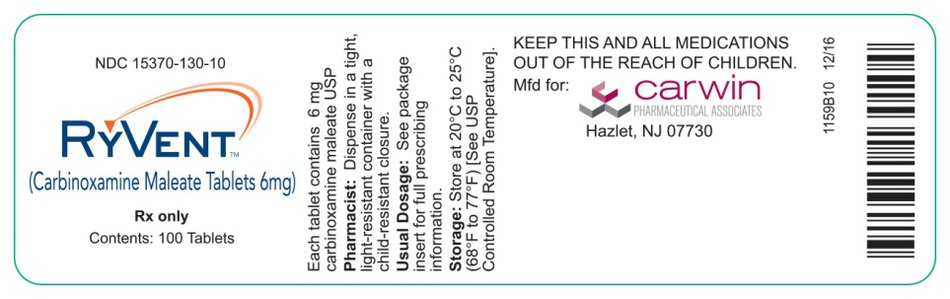
RyVent carbinoxamine maleate 6 mg Tablet, 2-count
🆔 Identity & classification
Where does this data come from?
🏷️ RxNorm drug class
This medicine belongs to the Histamine-1 Receptor Antagonist class.
Where does this data come from?
🏭 Manufacturer & labeler
Where does this data come from?
🩺 Clinical
- Carbinoxamine is an antihistamine that relieves allergy symptoms — things like a runny nose, sneezing, itchy or watery eyes, and skin reactions like hives or swelling. It also work...
- What exactly does carbinoxamine help with?
- Yes — drowsiness is one of the most common side effects, and it can be significant. Carbinoxamine is an older-style antihistamine that crosses into the brain, so it tends to be mor...
- If you've been prescribed Karbinal ER or Carbinoxamine Maleate Extended-Release Oral Suspension, always shake the bottle well before measuring each dose. Use the measuring device p...
Patient education
Supplement & herbal interactions
Some supplements/herbs that may interact with Carbinoxamine Maleate — tap one for details:
Where does this data come from?
Ask a licensed pharmacist directly — free, answered by our team.
💊 What it looks like
Where does this data come from?
🧪 Inactive Ingredients / Excipients
Inactive ingredients, also called excipients, are components of the drug product other than the active ingredient. They may include fillers, dyes, coatings, preservatives, flavors, or other formulation ingredients.
💡 Tap an ingredient (hover on desktop) to see what it is and why it’s used.
-
UNII 3SY5LH9PMK
Anhydrous lactose is a milk sugar with no water content. It acts as a filler and binder in tablets and capsules, adding bulk and helping ingredients stick together.
-
UNII OP1R32D61U
Microcrystalline cellulose is a purified form of cellulose, a natural fiber from plant sources. It acts as a binder and filler in tablets and capsules, helping hold ingredients together and give the medicine its shape and size.
-
UNII 70097M6I30
Magnesium stearate is a salt made from magnesium and stearic acid, a fatty substance. It's used in tablets and capsules as a lubricant and glidant to help ingredients flow smoothly during manufacturing and prevent sticking.
-
UNII 5856J3G2A2
A starch-based powder made from potatoes and processed with sodium. It acts as a disintegrant, helping the tablet or capsule break apart quickly in the stomach so the medicine can be absorbed.
4 inactive ingredients listed in the exact product block matched to this NDC.
Where does this data come from?
ingredient classCode="IACT" elements from the exact product block matched by this NDC. Label-section narrative from DailyMed / the openFDA label index is shown separately when available.Inactive ingredient FAQ
Are inactive ingredients the same for every manufacturer?
Why might an inactive ingredient be missing?
Can inactive ingredients matter?
💲 Pricing
A drug doesn't have one price. Each row is a different public payment system, and none is what you'd pay at the counter — that depends on your insurance. The ⓘ on each row explains what it measures.
| Price system | Per each | Per package |
|---|---|---|
| Retail pharmacies payNADAC · weekly | Not in the retail survey — common for institutional, discontinued, or low-volume packs. | |
| Medicaid paysCMS SDUD · 12 mo | No recent Medicaid claims on file for this NDC — rare and low-volume NDCs are suppressed in the public data. | |
| Medicare drug plans payPart D · quarterly | No Part D plan price is available for this NDC in our data. | |
Where does this data come from?
🔁 Therapeutic equivalents
| Product | Labeler | Pack | NADAC/unit | TE | Status | Price vs. this |
|---|---|---|---|---|---|---|
| RyVent 6 mgthis 15370-0130-02 | Carwin | 2 tablets | — | AB | FDA listed | — |
| Carbinoxamine Maleate 6 mg 69315-0239-01 | Leading | 100 tablets | — | AB | FDA listed | — |
| Carbinoxamine Maleate 6 mg 73684-0110-60 | BluCrest | 60 tablets | — | AB | FDA listed | — |
| Carbinoxamine Maleate 6 mg 80705-0120-30 | TRIPOINT | 30 tablets | — | AB | FDA listed | — |
Where does this data come from?
⏳ Availability & generic status
This product is an FDA-approved generic. Other versions of the same drug are listed under Therapeutic equivalents, least expensive first.
Where does this data come from?
💊 Medicaid utilization by pack size
📊 Medicare Part D spend CMS · PART D · 2026 (Q1)
📦 Packaging — all sizes for this product
| Package NDC | Description | Per unit | Per pack | Marketing start | Status |
|---|---|---|---|---|---|
| 15370-0130-02 You're viewing this | 2 TABLET in 1 BOTTLE, PLASTIC (15370-130-02) | — | — | 2017-02-17 | Active |
| 15370-0130-10 | 100 TABLET in 1 BOTTLE, PLASTIC (15370-130-10) | $8.12 / ea | $811.67 | 2017-02-17 | Active |
You're viewing the smallest of 2 pack sizes for this product.
This pack shows little to no recent Medicaid volume — the 100 tablets pack carries most fills. See all packs ↓
Pack size FAQ
What quantity is in NDC 15370-0130-02?
What is the difference between NDC 15370-0130-02 and NDC 15370-0130-10?
What NDC number is used to bill for this package of RyVent carbinoxamine maleate 6 mg Tablet?
Prices are the latest CMS NADAC pharmacy acquisition cost per NDC; per-pack figures are per-unit × pack quantity, shown only when the pack is denominated in the same measure NADAC prices.
🧭 About this NDC listing & data coverage
What data is (and isn’t) available for this NDC — tap to expand
| NDC identity (package / product / labeler codes) | ✓ Available |
| Labeler | ✓ Available |
| Product & package description | ✓ Available |
| Marketing category & status | ✓ Available |
| Active ingredient / dosage form / route | ✓ Available |
| FDA label (SPL via DailyMed) | ✓ Available |
| Package photos | ✓ Available |
| Inactive ingredients (structured) | ✓ Available |
| NADAC pharmacy acquisition price (CMS) | — Not published for this NDC CMS publishes NADAC only for NDCs reported in its retail-pharmacy survey. |
| Orange Book / therapeutic-equivalence data | ✓ Available |
| HCPCS J-code billing crosswalk | — Not published for this NDC Most self-administered / retail products have no J-code — that is normal. |
| Medicaid utilization (CMS SDUD) | — Not published for this NDC CMS reports utilization only for NDCs with Medicaid claims above its privacy threshold. |
Questions about this listing
Why is there no price listed?
Is the NDC printed on the package the same as the 11-digit billing NDC?
What do the three segments of this NDC mean?
Is this package still being marketed?
Does this product come in other package sizes?
Who lists this product with the FDA?
Do I need a prescription for this product?
Where does this data come from?
📄 Full prescribing information FDA SPL
🎯 Indications and Usage ▾
INDICATIONS AND USAGE Carbinoxamine maleate is effective for the symptomatic treatment of: Seasonal and perennial allergic rhinitis. Vasomotor rhinitis. Allergic conjunctivitis due to inhalant allergens and foods.
Mild, uncomplicated allergic skin manifestations of urticaria and angioedema. Dermatographism. As therapy for anaphylactic reactions adjunctive to epinephrine and other standard measures after the acute manifestations have been controlled.
Amelioration of the severity of allergic reactions to blood or plasma.
⏱️ Dosage and Administration ▾
DOSAGE AND ADMINISTRATION Carbinoxamine maleate is contraindicated in children younger than 2 years of age (see CONTRAINDICATIONS ). Carbinoxamine maleate should be taken on an empty stomach with water. DOSAGE SHOULD BE INDIVIDUALIZED ACCORDING TO THE NEEDS AND THE RESPONSE OF THE PATIENT.
Carbinoxamine maleate dosage should be based on the severity of the condition and the response of the patient. The drug is well tolerated in adults in doses as high as 24 mg daily, in divided doses, over prolonged periods. On the other hand, some patients respond to as little as 4 mg daily.
Clinical experience suggests the following dosage schedule: Usual Adult Dosage: 1 tablet (6 mg) 3 to 4 times daily
⛔ Contraindications ▾
CONTRAINDICATIONS Carbinoxamine maleate is contraindicated in children younger than 2 years of age. Carbinoxamine maleate is contraindicated in nursing mothers. Carbinoxamine maleate is contraindicated in patients who are hypersensitive to the drug or on monoamine oxidase inhibitor therapy (see Drug Interactions ).
⚠️ Warnings ▾
WARNINGS Deaths have been reported in children less than 2 years of age who were taking antihistamines, including carbinoxamine-containing drug products, therefore, carbinoxamine maleate is contraindicated in children younger than 2 years of age (see CONTRAINDICATIONS ). Antihistamines should be used with considerable caution in patients with: narrow angle glaucoma, stenosing peptic ulcer, symptomatic prostatic hypertrophy, bladder neck obstruction, pyloroduodenal obstruction.
🤒 Adverse Reactions ▾
ADVERSE REACTIONS The most frequent adverse reactions are underlined: Body as a whole: Urticaria, drug rash, anaphylactic shock, photosensitivity, excessive perspiration, chills, dryness of mouth, nose and throat Cardiovascular: Hypotension, headache, palpitations, tachycardia, extrasystoles Hematologic : Hemolytic anemia, thrombocytopenia, agranulocytosis Central nervous system: Sedation , sleepiness , dizziness , disturbed coordination , fatigue, confusion, restlessness, excitation, nervousness, tremor, irritability, insomnia, euphoria, paresthesia, blurred vision, diplopia, vertigo, tinnitus, acute labyrinthitis, hysteria, neuritis, convulsions Gastrointestinal: Epigastric distress , anorexia, nausea, vomiting, diarrhea, constipation Urogenital : Urinary frequency, difficult urination, urinary retention, early menses Respiratory: Thickening of bronchial secretions , tightness of chest and wheezing, nasal stuffiness Call your doctor for medical advice about side effects.
Report side effects to 1-844-700-5011.
🔄 Drug Interactions ▾
Drug Interactions Monoamine oxidase inhibitors prolong and intensify the anticholinergic (drying) effects of antihistamines. Carbinoxamine maleate has additive effects with alcohol and other CNS depressants (hypnotics, sedatives, tranquilizers, etc.).
🤰 Pregnancy ▾
Pregnancy Teratogenic Effects Pregnancy Category C Animal reproductive studies have not been conducted with carbinoxamine maleate. It is also not known whether carbinoxamine maleate can cause fetal harm when administered to a pregnant woman or can affect reproductive capacity. Carbinoxamine maleate should be given to a pregnant woman only if clearly needed.
🧒 Pediatric Use ▾
Pediatric Use Carbinoxamine maleate is contraindicated in children younger than 2 years of age (see CONTRAINDICATIONS ). Neonates have an increased susceptibility to anticholinergic side effects, such as CNS excitation, which may lead to convulsions. Carbinoxamine maleate may diminish mental alertness in children. In the young child, particularly, they may produce excitation.
🧓 Geriatric Use ▾
Geriatric Use Carbinoxamine maleate is more likely to cause dizziness, sedation, and hypotension in elderly patients (approximately 60 years or older). Sedating drugs may also cause confusion and over sedation in the elderly. Therefore, dose selection for an elderly patient should be cautious, usually starting at the low end of the dosing range, reflecting the greater frequency of decreased hepatic, renal, or cardiac function, and of concomitant disease or other drug therapy.
🆘 Overdosage ▾
OVERDOSAGE Manifestations Antihistamine overdosage reactions may vary from central nervous system depression to stimulation. Stimulation is particularly likely in children. Atropine-like signs and symptoms- dry mouth; fixed, dilated pupils; flushing; and gastrointestinal symptoms may also occur.
Especially in infants and children, antihistamine overdosage may cause hallucinations, convulsions, or death. The oral LD 50 of carbinoxamine maleate in guinea pigs is 411 mg/kg. Treatment The treatment of overdosage with carbinoxamine maleate is essentially symptomatic and supportive.
Vital signs (including respiration, pulse, blood pressure, and temperature) and EKG should be monitored. Induction of vomiting is not recommended. Activated charcoal should be given and gastric lavage should be considered after ingestion of a potentially life-threatening amount of drug.
In the presence of severe anticholinergic effects, physostigmine may be useful. Vasopressors may be used to treat hypotension.
🧬 Clinical Pharmacology ▾
CLINICAL PHARMACOLOGY Mechanism of Actions Carbinoxamine maleate, an ethanolamine derivative, is an antihistamine with anticholinergic (drying) and sedative properties. Carbinoxamine appears to compete with histamine (type H1) for receptor sites on effector cells in the gastrointestinal tract, blood vessels and respiratory tract. Pharmacokinetics and Metabolism Carbinoxamine is well absorbed from the GI tract and appears to be extensively metabolized by the liver, and excreted in the urine as inactive metabolites within 24 hours.
Virtually no intact drug is extended in the urine. In a study comparing a controlled release suspension and a solution of carbinoxamine, healthy volunteers were administered a single dose of 8 mg carbinoxamine. A time to maximum concentration (Tmax) was between 1.5 hours to 5 hours, a peak plasma concentration (Cmax) of about 24 ng/mL was observed, and extent of exposure (AUC) was about 286 ng hr/mL.
The serum half-life is reported to be 10 to 20 hours. Drug/Food Interactions Carbinoxamine should not be used in patients with hypersensitivity to carbinoxamine. Carbinoxamine may increase the effects of other drugs such as barbiturates, TCAs, MAO inhibitors such as Phenelzine (Nardil), Tranylcypromine (Parnate), or Selegiline (Eldepryl), alcohol, other antihistamines, and CNS depressants.
Carbinoxamine can be taken with or without food. Cardiovascular Effects Cardiac effects, including prolongation of QT interval have not been adequately studied. Unlike other newer antihistamines, severe adverse cardiovascular effects are uncommon, and usually limited to over dosage situations.
Special Populations Pediatric Patients Carbinoxamine should not be used in newborn or premature infants. Neonates have an increased susceptibility to anticholinergic side effects, such as CNS excitation, which may lead to convulsions. Pregnancy and Lactation Safe use of carbinoxamine during pregnancy has not been established.
Therefore, carbinoxamine should not be used in women who are, or may become pregnant. Carbinoxamine is in the FDA pregnancy Category C. Women who are breast-feeding should avoid use of carbinoxamine, since small amounts appear to be distributed into breast milk.
Geriatric Patients Carbinoxamine is more likely to cause dizziness, sedation, and hypotension in elderly patients. The incidence of adverse reactions is higher in the elderly; therefore, a dosing adjustment may be necessary in this subpopulation.
📦 How Supplied / Storage and Handling ▾
HOW SUPPLIED Ryvent TM (carbinoxamine maleate tablets USP, 6 mg) is supplied as a white, round tablet, debossed “404” on one side and “ADG” on the other side, in bottles of 100 tablets, NDC 15370-130-10 and bottles of 2 tablets as physician samples, NDC 15370-130-02. Store at 20° to 25°C (68° to 77°F) [see USP Controlled Room Temperature]. Dispense in a tight, light-resistant container with a child-resistant closure as defined in the official compendium.
Rx only Manufactured for: Carwin Pharmaceutical Associates, LLC Hazlet, NJ 07730 www.carwinpharma.com Code 1159B00 Rev. 09/16
📋 Description ▾
DESCRIPTION Carbinoxamine maleate is a histamine-H 1 receptor blocking agent. Each tablet contains 6 mg carbinoxamine maleate and the following inactive ingredients: anhydrous lactose, magnesium stearate, microcrystalline cellulose, and sodium starch glycolate. Carbinoxamine maleate is freely soluble in water.
Its structure is: 2-[(4-chlorophenyl)-2-pyridinylmethoxy]-N, N-dimethylethanamine (Z)-2-butenedioate (1:1) C 16 H 19 CIN 2 O·C 4 H 4 O 4 MW= 406.86 carbinoxamine maleate chemical structure
💬 Information for Patients ▾
Information for Patients Carbinoxamine maleate may cause drowsiness; alcohol, sedatives, and tranquilizers may increase the drowsiness effect. Avoid alcoholic beverages while taking this product. Do not take this product if you are taking sedatives or tranquilizers, without first consulting your doctor. Use caution when driving a motor vehicle or operating machinery.