
Trientine Hydrochloride 500 mg Capsule, 50-count — NDC 16571-812-05 (Billing 16571-0812-05)
This is a package of 50 capsules of Trientine Hydrochloride 500 mg Capsule from Rising Pharma Holdings, Inc., marketed since Sep 2023 and currently FDA-listed. It is this product's only package size.
Identity & classification
Regulatory identifiers FDA, NLM and CMS codes for this package
Drug-database identifiers Medi-Span GPI and First Databank GCN / HICL / AHFS classification
- GSN (GCN sequence number): 085351
- GCN: 54809
- GPI-14 (Medi-Span): 99200020100130
- HICL (First Databank): 001109
- AHFS class code: 64:00.00.00
- RxCUI (RxNorm): 313472
Where does this data come from?
- FDA openFDA NDC Directory · synced Oct 1, 2026
- FDA label on DailyMed · label index refreshed Oct 1, 2026
- RxNorm (NLM RxNav) · catalog refreshed Oct 1, 2026
- Medi-Span GPI (licensed)
- First Databank (licensed) · refreshed Oct 1, 2026
RxNorm drug class
This medicine belongs to the Copper Chelator class.
Where does this data come from?
- RxClass (NLM) · catalog refreshed Oct 1, 2026
Clinical
Patient education
Supplement & herbal interactions
Where does this data come from?
- MedlinePlus (NLM) · refreshed Oct 1, 2026
- FDA label on DailyMed · label index refreshed Oct 1, 2026
Ask a licensed pharmacist directly — free, answered by our team.
Pricing
A drug doesn't have one price. Each row is a different public payment system, and none is what you'd pay at the counter — that depends on your insurance. The ⓘ on each row explains what it measures.
| Price system | Per each | Per package |
|---|---|---|
| Retail pharmacies payNADAC · weekly | Not in the retail survey — common for institutional, discontinued, or low-volume packs. | |
| Medicaid paysCMS SDUD · 12 mo | No recent Medicaid claims on file for this NDC — rare and low-volume NDCs are suppressed in the public data. | |
| Medicare drug plans payPart D · Q2 2026 | $53.30 | $2,664.96 / 50 capsules |
Where does this data come from?
- CMS NADAC weekly file
- CMS ASP pricing files · refreshed Sep 20, 2026
- CMS Medicaid State Drug Utilization Data · refreshed Oct 3, 2026
- CMS Part D plan pricing files · refreshed Sep 24, 2026
- VA National Acquisition Center price file
Packaging — all sizes for this product
| Package NDC | Description | Marketing start | Marketing end | Status |
|---|---|---|---|---|
| 16571-0812-05 You're viewing this Main listing | 50 CAPSULE in 1 BOTTLE | 2023-09-22 | — | Active |
Therapeutic equivalents
| Product | Labeler | Pack | NADAC/unit | TE | Status | Price vs. this |
|---|---|---|---|---|---|---|
| Trientine Hydrochloride 500 mgthis 16571-0812-05 | Rising | 50 capsules | — | — | FDA listed | — |
Where does this data come from?
- FDA openFDA NDC Directory · synced Oct 1, 2026
- FDA Orange Book · refreshed Oct 3, 2026
- CMS NADAC weekly file
Availability & generic status
This product is an FDA-approved generic. Other versions of the same drug are listed under Therapeutic equivalents, least expensive first.
Where does this data come from?
- FDA Orange Book · refreshed Oct 3, 2026
What it looks like
Where does this data come from?
- FDA label on DailyMed · label index refreshed Oct 1, 2026
Inactive Ingredients / Excipients
Inactive ingredients, also called excipients, are components of the drug product other than the active ingredient. They may include fillers, dyes, coatings, preservatives, flavors, or other formulation ingredients.
💡 Tap an ingredient (hover on desktop) to see what it is and why it’s used.
-
UNII 1K09F3G675
Ferric oxide red is an inorganic iron compound used as a colorant in medicines. It gives tablets, capsules, or other dosage forms a red or reddish tint for identification and appearance.
-
UNII EX438O2MRT
Ferric oxide yellow is a naturally occurring iron compound used as a colorant in medications. It gives tablets, capsules, and other forms a yellow or golden hue for identification and appearance.
-
UNII XM0M87F357
A dark iron oxide compound that gives medicines their black or dark color. It's used as a colorant in tablets and capsules to help identify the product and make it visually distinctive.
-
UNII 2G86QN327L
Gelatin is a protein derived from animal collagen, commonly used in medicines as a gelling agent and capsule material. It helps create soft or hard capsule shells that hold and release medication, and can also thicken liquid formulations.
-
UNII WZH3C48M4T
Potassium hydroxide is a strong alkaline chemical used in medicines to adjust and maintain the pH level of liquid formulations, helping keep the product stable and the active ingredients effective.
-
UNII 6DC9Q167V3
Propylene glycol is a clear liquid derived from petroleum or vegetable sources. It acts as a solvent, humectant, and preservative in medicines, helping dissolve active ingredients and maintain product stability.
-
UNII 46N107B71O
Shellac is a natural resin secreted by the lac beetle. It's used as a coating on tablets and capsules to control how quickly the medicine dissolves and to improve appearance and stability.
-
UNII 4ELV7Z65AP
Stearic acid is a fatty acid derived from plant or animal sources. It acts as a binder and lubricant in tablets and capsules, helping them hold together and flow smoothly during manufacturing.
-
UNII 15FIX9V2JP
Titanium dioxide is a bright white mineral powder commonly used as a colorant and opacifying agent. It makes pills and tablets white or lighter in color and helps make coatings non-transparent.
9 inactive ingredients listed in the exact product block matched to this NDC.
Where does this data come from?
ingredient classCode="IACT" elements from the exact product block matched by this NDC. Label-section narrative from DailyMed / the openFDA label index is shown separately when available.- FDA label on DailyMed · label index refreshed Oct 1, 2026
- FDA openFDA NDC Directory · synced Oct 1, 2026
Inactive ingredient FAQ
Are inactive ingredients the same for every manufacturer?
Why might an inactive ingredient be missing?
Can inactive ingredients matter?
Manufacturer & labeler
Where does this data come from?
- FDA openFDA NDC Directory · synced Oct 1, 2026
- Drugs@FDA
Full prescribing information FDA SPL
🎯 Indications and Usage ▾
INDICATIONS AND USAGE Trientine hydrochloride is indicated in the treatment of patients with Wilson's disease who are intolerant of penicillamine. Clinical experience with trientine hydrochloride is limited and alternate dosing regimens have not been well-characterized; all endpoints in determining an individual patient's dose have not been well defined. Trientine hydrochloride and penicillamine cannot be considered interchangeable.
Trientine hydrochloride should be used when continued treatment with penicillamine is no longer possible because of intolerable or life endangering side effects. Unlike penicillamine, trientine hydrochloride is not recommended in cystinuria or rheumatoid arthritis. The absence of a sulfhydryl moiety renders it incapable of binding cystine and, therefore, it is of no use in cystinuria.
In 15 patients with rheumatoid arthritis, trientine hydrochloride was reported not to be effective in improving any clinical or biochemical parameter after 12 weeks of treatment. Trientine hydrochloride is not indicated for treatment of biliary cirrhosis.
⛔ Contraindications ▾
CONTRAINDICATIONS Hypersensitivity to this product.
⚠️ Warnings ▾
WARNINGS Patient experience with trientine hydrochloride is limited (see CLINICAL PHARMACOLOGY ). Patients receiving trientine hydrochloride capsules should remain under regular medical supervision throughout the period of drug administration. Patients (especially women) should be closely monitored for evidence of iron deficiency anemia.
🤒 Adverse Reactions ▾
ADVERSE REACTIONS Clinical experience with trientine hydrochloride has been limited. The following adverse reactions have been reported in a clinical study in patients with Wilson's disease who were on therapy with trientine hydrochloride: iron deficiency, systemic lupus erythematosus (see CLINICAL PHARMACOLOGY ). In addition, the following adverse reactions have been reported in marketed use: dystonia, muscular spasm, myasthenia gravis.
Trientine hydrochloride is not indicated for treatment of biliary cirrhosis, but in one study of 4 patients treated with trientine hydrochloride for primary biliary cirrhosis, the following adverse reactions were reported: heartburn; epigastric pain and tenderness; thickening, fissuring and flaking of the skin; hypochromic microcytic anemia; acute gastritis; aphthoid ulcers; abdominal pain; melena; anorexia; malaise; cramps; muscle pain; weakness; rhabdomyolysis. A causal relationship of these reactions to drug therapy could not be rejected or established.
To report SUSPECTED ADVERSE EVENTS, contact Rising Pharma Holdings, Inc. at 1-844-874-7464 or FDA at 1-800-FDA-1088 or http://www.fda.gov/ for voluntary reporting of adverse reactions.
🔄 Drug Interactions ▾
Drug Interactions In general, mineral supplements should not be given since they may block the absorption of trientine hydrochloride. However, iron deficiency may develop, especially in children and menstruating or pregnant women, or as a result of the low copper diet recommended for Wilson's disease. If necessary, iron may be given in short courses, but since iron and trientine hydrochloride each inhibit absorption of the other, two hours should elapse between administration of trientine hydrochloride capsules and iron.
It is important that trientine hydrochloride capsules be taken on an empty stomach, at least one hour before meals or two hours after meals and at least one hour apart from any other drug, food, or milk. This permits maximum absorption and reduces the likelihood of inactivation of the drug by metal binding in the gastrointestinal tract.
🤰 Pregnancy ▾
Pregnancy Trientine hydrochloride was teratogenic in rats at doses similar to the human dose. The frequencies of both resorptions and fetal abnormalities, including hemorrhage and edema, increased while fetal copper levels decreased when trientine hydrochloride was given in the maternal diets of rats. There are no adequate and well-controlled studies in pregnant women.
Trientine hydrochloride should be used during pregnancy only if the potential benefit justifies the potential risk to the fetus.
🧒 Pediatric Use ▾
Pediatric Use Controlled studies of the safety and effectiveness of trientine hydrochloride in pediatric patients have not been conducted. It has been used clinically in pediatric patients as young as 6 years with no reported adverse experiences.
🧓 Geriatric Use ▾
Geriatric Use Clinical studies of trientine hydrochloride did not include sufficient numbers of subjects aged 65 and over to determine whether they respond differently from younger subjects. Other reported clinical experience is insufficient to determine differences in responses between the elderly and younger patients. In general, dose selection should be cautious, usually starting at the low end of the dosing range, reflecting the greater frequency of decreased hepatic, renal or cardiac function, and of concomitant disease or other drug therapy.
🆘 Overdosage ▾
OVERDOSAGE There is a report of an adult woman who ingested 30 grams of trientine hydrochloride without apparent ill effects. No other data on overdosage are available.
🧬 Clinical Pharmacology ▾
CLINICAL PHARMACOLOGY Introduction Wilson's disease (hepatolenticular degeneration) is an autosomal inherited metabolic defect resulting in an inability to maintain a near-zero balance of copper. Excess copper accumulates possibly because the liver lacks the mechanism to excrete free copper into the bile. Hepatocytes store excess copper but when their capacity is exceeded copper is released into the blood and is taken up into extrahepatic sites.
This condition is treated with a low copper diet and the use of chelating agents that bind copper to facilitate its excretion from the body. Clinical Summary Forty-one patients (18 male and 23 female) between the ages of 6 and 54 with a diagnosis of Wilson's disease and who were intolerant of d-penicillamine were treated in two separate studies with trientine hydrochloride. The dosage varied from 450 to 2400 mg per day.
The average dosage required to achieve an optimal clinical response varied between 1000 mg and 2000 mg per day. The mean duration of trientine hydrochloride therapy was 48.7 months (range 2 to 164 months). Thirty-four of the 41 patients improved, 4 had no change in clinical global response, 2 were lost to follow-up and one showed deterioration in clinical condition.
One of the patients who improved while on therapy with trientine hydrochloride experienced a recurrence of the symptoms of systemic lupus erythematosus which had appeared originally during therapy with penicillamine. Therapy with trientine hydrochloride was discontinued. No other adverse reactions, except iron deficiency, were noted among any of these 41 patients.
One investigator treated 13 patients with trientine hydrochloride following their development of intolerance to d-penicillamine. Retrospectively, he compared these patients to an additional group of 12 patients with Wilson's disease who were both tolerant of and controlled with d-penicillamine therapy, but who failed to continue any copper chelation therapy. The mean age at onset of disease of the latter group was 12 years as compared to 21 years for the former group.
The trientine hydrochloride group received d-penicillamine for an average of 4 years as compared to an average of 10 years for the non- treated group. Various laboratory parameters showed changes in favor of the patients treated with trientine hydrochloride. Free and total serum copper, SGOT, and serum bilirubin all showed mean increases over baseline in the untreated group which were significantly larger than with the patients treated with trientine hydrochloride.
In the 13 patients treated with trientine hydrochloride, previous symptoms and signs relating to d-penicillamine intolerance disappeared in 8 patients, improved in 4 patients, and remained unchanged in one patient. The neurological status in the trientine hydrochloride group was unchanged or improved over baseline, whereas in the untreated group, 6 patients remained unchanged and 6 worsened. Kayser-Fleischer rings improved significantly during trientine hydrochloride treatment.
The clinical outcome of the two groups also differed markedly. Of the 13 patients on therapy with trientine hydrochloride (mean duration of therapy 4.1 years; range 1 to 13 years), all were alive at the data cutoff date, and in the non-treated group (mean years with no therapy 2.7 years; range 3 months to 9 years), 9 of the 12 died of hepatic disease. Chelating Properties Preclinical Studies Studies in animals have shown that trientine hydrochloride has cupriuretic activities in both normal and copper-loaded rats.
In general, the effects of trientine hydrochloride on urinary copper excretion are similar to those of equimolar doses of penicillamine, although in one study they were significantly smaller. Human Studies Renal clearance studies were carried out with penicillamine and trientine hydrochloride on separate occasions in selected patients treated with penicillamine for at least one year. Six-hour excretion rates of copper were determined off tr… [Excerpted — this section continues on DailyMed.]
📦 How Supplied / Storage and Handling ▾
HOW SUPPLIED Trientine Hydrochloride Capsule, USP 250 mg, are Size “1” hard gelatin capsule with brown opaque cap/brown opaque body, imprinted “C27” on cap with black ink and “250mg” on body with black ink filled with white to pale yellow powder. They are supplied as follows: NDC 16571-810-01 Bottles of 100 Capsules. Trientine Hydrochloride Capsule, USP 500 mg, are Size “00” hard gelatin capsule with brown opaque cap/ brown opaque body, imprinted “C28” on cap with black ink and “500 mg” on body with black ink filled with white to pale yellow powder.
They are supplied as follows: NDC 16571-812-05 Bottles of 50 Capsules. Storage Keep container tightly closed. Store below 25°C (77°F).
Store Trientine hydrochloride capsules in its original container. Manufactured for: Rising Pharma Holdings, Inc. East Brunswick, NJ 08816 Made in India Neutral Code: 4323147/TS/DRUGS/2025 Revised: 08/2025 PIR81205-01
📋 Description ▾
DESCRIPTION Trientine hydrochloride, USP is N,N' -bis (2-aminoethyl)-1,2-ethanediamine dihydrochloride. It is a white to pale yellow crystalline hygroscopic powder. It is freely soluble in water, soluble in methanol, slightly soluble in ethanol, and insoluble in chloroform and ether.
The molecular formula is C 6 H 18 N 4 •2HCl with a molecular weight of 219.2. The structural formula is: NH 2 (CH 2 ) 2 NH(CH 2 ) 2 NH(CH 2 ) 2 NH 2 •2HCl Trientine hydrochloride, USP is a chelating compound for removal of excess copper from the body. Trientine hydrochloride, USP is available as 250 mg and 500 mg capsules for oral administration.
Trientine hydrochloride capsules, USP contain gelatin, iron oxide black, iron oxide red, iron oxide yellow, potassium hydroxide, propylene glycol, shellac, stearic acid and titanium dioxide as inactive ingredients.
💬 Information for Patients ▾
Information for Patients Patients should be directed to take trientine hydrochloride capsules on an empty stomach, at least one hour before meals or two hours after meals and at least one hour apart from any other drug, food, or milk. The capsules should be swallowed whole with water and should not be opened or chewed. Because of the potential for contact dermatitis, any site of exposure to the capsule contents should be washed with water promptly.
For the first month of treatment, the patient should have his temperature taken nightly, and he should be asked to report any symptom such as fever or skin eruption.
⚠️ Precautions ▾
PRECAUTIONS General There are no reports of hypersensitivity in patients who have been administered trientine hydrochloride for Wilson's disease. However, there have been reports of asthma, bronchitis and dermatitis occurring after prolonged environmental exposure in workers who use trientine hydrochloride as a hardener of epoxy resins. Patients should be observed closely for signs of possible hypersensitivity.
Information for Patients Patients should be directed to take trientine hydrochloride capsules on an empty stomach, at least one hour before meals or two hours after meals and at least one hour apart from any other drug, food, or milk. The capsules should be swallowed whole with water and should not be opened or chewed. Because of the potential for contact dermatitis, any site of exposure to the capsule contents should be washed with water promptly.
For the first month of treatment, the patient should have his temperature taken nightly, and he should be asked to report any symptom such as fever or skin eruption. Laboratory Tests The most reliable index for monitoring treatment is the determination of free copper in the serum, which equals the difference between quantitatively determined total copper and ceruloplasmin-copper. Adequately treated patients will usually have less than 10 mcg free copper/dL of serum.
Therapy may be monitored with a 24-hour urinary copper analysis periodically (i.e., every 6 to 12 months). Urine must be collected in copper-free glassware. Since a low copper diet should keep copper absorption down to less than one milligram a day, the patient probably will be in the desired state of negative copper balance if 0.5 to 1.0 milligram of copper is present in a 24-hour collection of urine.
Drug Interactions In general, mineral supplements should not be given since they may block the absorption of trientine hydrochloride. However, iron deficiency may develop, especially in children and menstruating or pregnant women, or as a result of the low copper diet recommended for Wilson's disease. If necessary, iron may be given in short courses, but since iron and trientine hydrochloride each inhibit absorption of the other, two hours should elapse between administration of trientine hydrochloride capsules and iron.
It is important that trientine hydrochloride capsules be taken on an empty stomach, at least one hour before meals or two hours after meals and at least one hour apart from any other drug, food, or milk. This permits maximum absorption and reduces the likelihood of inactivation of the drug by metal binding in the gastrointestinal tract. Carcinogenesis, Mutagenesis, Impairment of Fertility Data on carcinogenesis, mutagenesis, and impairment of fertility are not available.
Pregnancy Trientine hydrochloride was teratogenic in rats at doses similar to the human dose. The frequencies of both resorptions and fetal abnormalities, including hemorrhage and edema, increased while fetal copper levels decreased when trientine hydrochloride was given in the maternal diets of rats. There are no adequate and well-controlled studies in pregnant women.
Trientine hydrochloride should be used during pregnancy only if the potential benefit justifies the potential risk to the fetus. Nursing Mothers It is not known whether this drug is excreted in human milk. Because many drugs are excreted in human milk, caution should be exercised when trientine hydrochloride is administered to a nursing mother.
Pediatric Use Controlled studies of the safety and effectiveness of trientine hydrochloride in pediatric patients have not been conducted. It has been used clinically in pediatric patients as young as 6 years with no reported adverse experiences. Geriatric Use Clinical studies of trientine hydrochloride did not include sufficient numbers of subjects aged 65 and over to determine whether they respond differently from younger subjects.
Other reported clinical experience is insufficient to determine differences in responses betwee… [Excerpted — this section continues on DailyMed.]
🍼 Nursing Mothers ▾
Nursing Mothers It is not known whether this drug is excreted in human milk. Because many drugs are excreted in human milk, caution should be exercised when trientine hydrochloride is administered to a nursing mother.
📄 Carcinogenesis, Mutagenesis, Impairment of Fertility ▾
Carcinogenesis, Mutagenesis, Impairment of Fertility Data on carcinogenesis, mutagenesis, and impairment of fertility are not available.
📄 Package Label / Principal Display Panel ▾
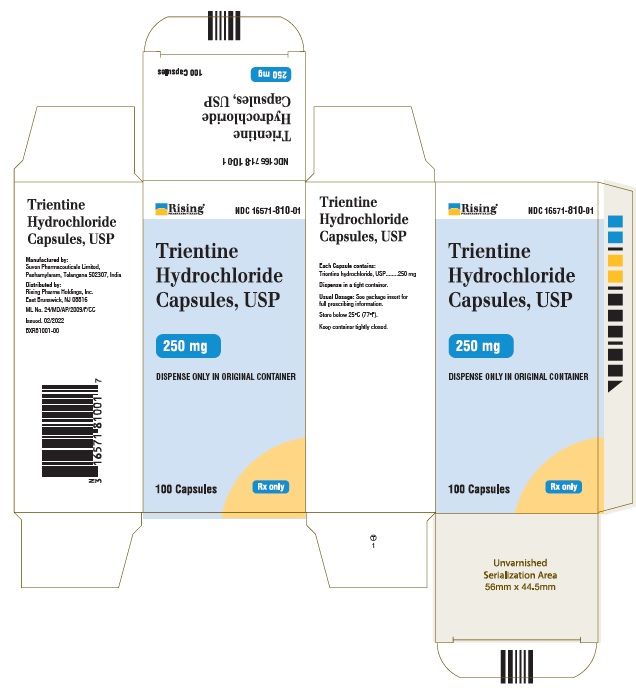
PACKAGE LABEL.PRINCIPAL DISPLAY PANEL CONTAINER LABEL Rising Pharmaceuticals NDC 16571-810-01 Trientine HCl Capsules, USP 250mg 100 Capsules Rx only CARTON LABEL Rising Pharmaceuticals NDC 16571-810-01 Trientine HCl Capsules, USP 250 mg 100 Capsules Rx Only CONATINER LABEL Rising Pharmaceuticals NDC 16571-812-05 Trientine HCl Capsules, USP 500 mg 50 Capsules Rx Only CARTON LABEL Rising Pharmaceuticals NDC 16571-812-05 Trientine HCl Capsules, USP 250 mg 100 Capsules Rx Only trientine-hcl-250.jpg trientine-hcl-250-carton.jpg trientine-hcl-500.jpg trientine-hcl-500-carton.jpg
About this NDC listing & data coverage
What data is (and isn’t) available for this NDC — tap to expand
| NDC identity (package / product / labeler codes) | ✓ Available |
| Labeler | ✓ Available |
| Product & package description | ✓ Available |
| Marketing category & status | ✓ Available |
| Active ingredient / dosage form / route | ✓ Available |
| FDA label (SPL via DailyMed) | ✓ Available |
| Package photos | ✓ Available |
| Inactive ingredients (structured) | ✓ Available |
| NADAC pharmacy acquisition price (CMS) | — Not published for this NDC CMS publishes NADAC only for NDCs reported in its retail-pharmacy survey. |
| Orange Book / therapeutic-equivalence data | — Not published for this NDC Applies only to products approved under an NDA/ANDA; many listings are out of scope. |
| HCPCS J-code billing crosswalk | — Not published for this NDC Most self-administered / retail products have no J-code — that is normal. |
| Medicaid utilization (CMS SDUD) | — Not published for this NDC CMS reports utilization only for NDCs with Medicaid claims above its privacy threshold. |