
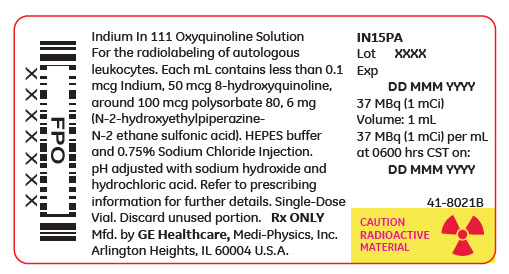
Indium in 111 Oxyquinoline 1 ug/mL Solution, 1 vial
🆔 Identity & classification
Where does this data come from?
🏭 Manufacturer & labeler
Where does this data come from?
🩺 Clinical
Patient education
Supplement & herbal interactions
Where does this data come from?
Ask a licensed pharmacist directly — free, answered by our team.
🧪 Inactive Ingredients / Excipients
Inactive ingredients, also called excipients, are components of the drug product other than the active ingredient. They may include fillers, dyes, coatings, preservatives, flavors, or other formulation ingredients.
Where does this data come from?
IACT rows and label-wide narrative are kept separate; availability and product-level specificity depend on the submitted label.Inactive ingredient FAQ
Are inactive ingredients the same for every manufacturer?
Why might an inactive ingredient be missing?
Can inactive ingredients matter?
💲 Pricing
A drug doesn't have one price. Each row is a different public payment system, and none is what you'd pay at the counter — that depends on your insurance. The ⓘ on each row explains what it measures.
| Price system | Per mL | Per package |
|---|---|---|
| Retail pharmacies payNADAC · weekly | Not in the retail survey — common for institutional, discontinued, or low-volume packs. | |
| Medicaid paysCMS SDUD · 12 mo | No recent Medicaid claims on file for this NDC — rare and low-volume NDCs are suppressed in the public data. | |
| Medicare drug plans payPart D · quarterly | No Part D plan price is available for this NDC in our data. | |
Where does this data come from?
🔁 Therapeutic equivalents
| Product | Labeler | Pack | NADAC/unit | TE | Status | Price vs. this |
|---|---|---|---|---|---|---|
| Indium in 111 Oxyquinoline 1 ug/mLthis 17156-0021-01 | Medi-Physics | 1 vial | — | AP | FDA listed | — |
Where does this data come from?
⏳ Availability & generic status
The FDA lists approved generic versions of this medicine, but that does not always mean a pharmacy can get one today. Patent rules, launch agreements, supply and pricing can affect when generics actually arrive.
Where does this data come from?
📦 Packaging — all sizes for this product
| Package NDC | Description | Marketing start | Status |
|---|---|---|---|
| 17156-0021-01 You're viewing this | 1 VIAL in 1 BOX (17156-021-01) / 1 mL in 1 VIAL | 1985-12-01 | Active |
🧭 About this NDC listing & data coverage
What data is (and isn’t) available for this NDC — tap to expand
| NDC identity (package / product / labeler codes) | ✓ Available |
| Labeler | ✓ Available |
| Product & package description | ✓ Available |
| Marketing category & status | ✓ Available |
| Active ingredient / dosage form / route | ✓ Available |
| FDA label (SPL via DailyMed) | ✓ Available |
| Package photos | ✓ Available |
| Inactive ingredients (structured) | — Not published for this NDC The labeler did not submit a structured excipient list, or no SPL is available. |
| NADAC pharmacy acquisition price (CMS) | — Not published for this NDC CMS publishes NADAC only for NDCs reported in its retail-pharmacy survey. |
| Orange Book / therapeutic-equivalence data | ✓ Available |
| HCPCS J-code billing crosswalk | — Not published for this NDC Most self-administered / retail products have no J-code — that is normal. |
| Medicaid utilization (CMS SDUD) | — Not published for this NDC CMS reports utilization only for NDCs with Medicaid claims above its privacy threshold. |
Questions about this listing
Why is there no price listed?
Is the NDC printed on the package the same as the 11-digit billing NDC?
What do the three segments of this NDC mean?
Is this package still being marketed?
Who lists this product with the FDA?
Do I need a prescription for this product?
Where does this data come from?
📄 Full prescribing information FDA SPL
🎯 Indications and Usage ▾
INDICATIONS AND USAGE Indium In 111 Oxyquinoline Solution is indicated for radiolabeling autologous leukocytes. Indium In 111 oxyquinoline labeled leukocytes may be used as an adjunct in the detection of inflammatory processes to which leukocytes migrate, such as those associated with abscesses or other infection, following reinjection and detection by appropriate imaging procedures. The degree of accuracy may vary with labeling techniques and with the size, location and nature of the inflammatory process.
Indium In 111 oxyquinoline labeled leukocyte imaging is not the preferred technique for the initial evaluation of patients with a high clinical probability of an abscess in a known location. Ultrasound or computed tomography may provide a better anatomical delineation of the infectious process and information may be obtained more quickly than with labeled leukocytes. If localization by these techniques is successful, labeled leukocytes should not be used as a confirmatory procedure.
If localization or diagnosis by these methods fails or is ambiguous, indium In 111 oxyquinoline labeled leukocyte imaging may be appropriate.
⏱️ Dosage and Administration ▾
DOSAGE AND ADMINISTRATION The recommended adult (70 kg) dose of indium In 111 oxyquinoline labeled autologous leukocytes is 7.4 to
18.5MBq, 200 to 500 µCi. Indium In 111 Oxyquinoline Solution is intended for the radiolabeling of autologous leukocytes. The indium In 111 oxyquinoline labeled autologous leukocytes are administered intravenously.
Imaging is recommended at approximately 24 hours post injection. Typically, anterior and posterior views of the chest, abdomen and pelvis should be obtained with other views as required. Aseptic procedures and a shielded syringe should be employed in the withdrawal of Indium In 111 Oxyquinoline Solution from the vial.
Similar procedures should be employed during the labeling procedure and the administration of the labeled leukocytes to the patient. The user should wear waterproof gloves during the entire procedure. The patient's dose should be measured by a suitable radioactivity calibration system immediately before administration.
At this time, the leukocyte preparation should be checked for gross clumping and red blood cell contamination.
⛔ Contraindications ▾
CONTRAINDICATIONS None known.
⚠️ Warnings ▾
WARNINGS The content of the vial of Indium In 111 Oxyquinoline Solution is intended only for use in the preparation of indium In 111 oxyquinoline labeled autologous leukocytes, and is not to be administered directly. Autologous leukocyte labeling is not recommended in leukopenic patients because of the small number of available leukocytes. Due to radiation exposure, indium In 111 oxyquinoline labeled leukocytes could cause fetal harm when administered to pregnant women.
If this radiopharmaceutical is used during pregnancy, the patient should be informed of the potential hazard to the fetus. Indium In 111 oxyquinoline labeled autologous leukocytes should be used only when the benefit to be obtained exceeds the risks involved in children under eighteen years of age owing to the high radiation burden and the potential for delayed manifestation of long-term adverse effects.
🤒 Adverse Reactions ▾
ADVERSE REACTIONS Sensitivity reactions (urticaria) have been reported. The presence of fever may mask pyrogenic reactions from indium In 111 oxyquinoline labeled leukocytes. The possibility of delayed adverse reactions has not been studied.
🤰 Pregnancy ▾
Pregnancy Animal reproduction studies have not been conducted with indium In 111 oxyquinoline labeled leukocytes. It is also not known whether indium In 111 oxyquinoline labeled leukocytes can cause fetal harm when administered to a pregnant woman or can affect reproduction capacity. However, Indium Nitrate, a closely related compound, was teratogenic and embryopathic in hamsters.
Indium In 111 oxyquinoline labeled leukocytes should be given to a pregnant woman only if clearly needed. Ideally, examinations using radiopharmaceuticals, especially those elective in nature, in women of childbearing capability should be performed during the first few (approximately ten) days following the onset of menses.
🧒 Pediatric Use ▾
Pediatric Use Safety and effectiveness in pediatric patients below age 18 have not been established (See Warnings ).
🧓 Geriatric Use ▾
Geriatric Use Other reported clinical experience has not identified differences in responses between the elderly and younger patients. In general, dose selection for an elderly patient should be cautious usually starting at the low end of the dosing range, reflecting the greater frequency of decreased hepatic, renal, or cardiac function, and of concomitant disease or other drug therapy.
🧬 Clinical Pharmacology ▾
CLINICAL PHARMACOLOGY Indium forms a saturated (1:3) complex with oxyquinoline. The complex is neutral and lipid-soluble, which enables it to penetrate the cell membrane. Within the cell, indium becomes firmly attached to cytoplasmic components; the liberated oxyquinoline is released by the cell.
It is thought likely that the mechanism of labeling cells with Indium In 111 Oxyquinoline Solution involves an exchange reaction between the oxyquinoline carrier and subcellular components which chelate indium more strongly than oxyquinoline. The low stability constant of the oxyquinoline complex, estimated at approximately 10, supports this theory. Following the recommended leukocyte cell labeling procedure, approximately 77% of the added indium In 111 oxyquinoline is incorporated in the resulting cell pellet (which represents approximately 3 to 4 × 10 8 WBC).
Cell clumping can occur and was found in about one fifth of the leukocyte preparations examined. The presence of red blood cells or plasma will lead to reduced leukocyte labeling efficiency. Transferrin in plasma competes for indium In 111 oxyquinoline.
After injection of labeled leukocytes into normal volunteers, about 30% of the dose is taken up by spleen and 30% by liver, reaching a plateau at 2 to 48 hours after injection. No significant clearance of radioactivity is observed at 72 hours in these two organs. Pulmonary uptake is 4 to 7.5% at 10 minutes but is lost rapidly; pulmonary radioactivity is usually visible in scans only up to about 4 hours after injection.
The human biodistribution studies in three normal subjects injected with indium In 111 oxyquinoline labeled leukocytes indicate a biexponential disappearance of indium In 111 from the blood when monitored for up to 72 hours. Between 9.5 to 24.4% of the injected dose remains in whole blood and clears with a biological half-time of 2.8 to 5.5 hours. The remainder (13 to 18%) clears from blood with a biological half-time of 64 to 116 hours.
Elimination from the body of injected indium In 111 oxyquinoline is probably mainly through decay to stable cadmium since only a negligible amount (less than 1%) of the dose is excreted in feces and urine in 24 hours. Clearance from whole blood and biological distribution can vary considerably with the individual recipient, the condition of the injected cells and labeling techniques used. Release of radioactivity from the labeled cells is about 3% at 1 hour and 24% at 24 hours.
Clearance from liver and spleen, for the purpose of calculating the radiation dose, is assumed to be equal to the physical half-life of indium In 111 (67.9 hours).
📦 How Supplied / Storage and Handling ▾
HOW SUPPLIED Indium In 111 Oxyquinoline Solution is supplied in a 1 mL single-dose vial containing 37 MBq, 1 mCi per mL aqueous solution at the calibration date stated on the label. Vials are packaged in individual lead shields. NDC 17156-021-01 The contents of the vial are radioactive and adequate shielding and handling precautions must be maintained.
This preparation is approved for use by persons licensed by the Illinois Emergency Management Agency pursuant to 32 IL. Adm. Code Section 330.260(a) and 335.4010 or equivalent licenses of the Nuclear Regulatory Commission or an Agreement State.
📋 Description ▾
DESCRIPTION Indium In 111 Oxyquinoline (oxine) Solution is a diagnostic radiopharmaceutical intended for radiolabeling autologous leukocytes. It is supplied as a sterile, non-pyrogenic, isotonic aqueous solution with a pH range of 6.5 to 7.5 [sodium hydroxide and hydrochloric acid may be used to adjust the pH]. Each mL of the solution contains 37 MBq, 1 mCi of indium In 111 [no carrier added, >1.85 GBq/mcg indium (>50 mCi/mcg indium)] at calibration time, 50 mcg oxyquinoline, 100 mcg polysorbate 80, and 6 mg of HEPES (N-2-hydroxyethyl-piperazine-N'-2-ethane sulfonic acid) buffer in 0.75% Sodium Chloride Solution.
The drug is intended to be used as a single-dose vial and contains no bacteriostatic agent. The radionuclidic impurity limit for indium 114m is not greater than 37 kBq, 1 µCi of indium 114m per 37 MBq, 1 mCi of indium In 111 at the time of calibration. The radionuclidic composition at expiration time is not less than 99.75% of indium In 111 and not more than 0.25% of indium In 114m/114.
Chemical name: Indium In 111 Oxyquinoline. The precise structure of the indium In 111 oxyquinoline complex is unknown at this time. The empirical formula is (C 9 H 6 NO) 3 In 111.