
Ceretec Technetium Tc-99m Exametazime and Cobaltous Chloride Kit
🆔 Identity & classification
Where does this data come from?
🏭 Manufacturer & labeler
Where does this data come from?
🩺 Clinical
Patient education
Supplement & herbal interactions
Where does this data come from?
Ask a licensed pharmacist directly — free, answered by our team.
🧪 Inactive Ingredients / Excipients
Inactive ingredients, also called excipients, are components of the drug product other than the active ingredient. They may include fillers, dyes, coatings, preservatives, flavors, or other formulation ingredients.
Where does this data come from?
IACT rows and label-wide narrative are kept separate; availability and product-level specificity depend on the submitted label.Inactive ingredient FAQ
Are inactive ingredients the same for every manufacturer?
Why might an inactive ingredient be missing?
Can inactive ingredients matter?
💲 Pricing
A drug doesn't have one price. Each row is a different public payment system, and none is what you'd pay at the counter — that depends on your insurance. The ⓘ on each row explains what it measures.
| Price system | Per each | Per package |
|---|---|---|
| Retail pharmacies payNADAC · weekly | Not in the retail survey — common for institutional, discontinued, or low-volume packs. | |
| Medicaid paysCMS SDUD · 12 mo | No recent Medicaid claims on file for this NDC — rare and low-volume NDCs are suppressed in the public data. | |
| Medicare drug plans payPart D · quarterly | No Part D plan price is available for this NDC in our data. | |
Where does this data come from?
🔁 Therapeutic equivalents
| Product | Labeler | Pack | NADAC/unit | TE | Status | Price vs. this |
|---|---|---|---|---|---|---|
| Ceretecthis 17156-0025-05 | Medi-Physics, | 1 kit | — | — | FDA listed | — |
Where does this data come from?
⏳ Availability & generic status
We did not find an FDA-approved generic match for this exact strength, form and route.
Where does this data come from?
🔬 Reported adverse events (FAERS)
Top reported reactions
Reporter sex
Serious outcomes
Where does this data come from?
📦 Packaging — all sizes for this product
| Package NDC | Description | Marketing start | Status |
|---|---|---|---|
| 17156-0025-05 You're viewing this | 1 KIT in 1 CARTON (17156-025-05) * 2.5 mL in 1 VIAL, GLASS (17156-027-01) * 5 mL in 1 VIAL, GLASS (17156-022-05) | 2018-09-25 | Active |
🧭 About this NDC listing & data coverage
Kit / multi-component package
This NDC identifies a kit — a package containing more than one component. Structured data (pricing, ingredients, equivalents) is often reported per component rather than for the kit NDC itself, which can make this page look thinner than the components' own pages.
What data is (and isn’t) available for this NDC — tap to expand
| NDC identity (package / product / labeler codes) | ✓ Available |
| Labeler | ✓ Available |
| Product & package description | ✓ Available |
| Marketing category & status | ✓ Available |
| Active ingredient / dosage form / route | ✓ Available |
| FDA label (SPL via DailyMed) | ✓ Available |
| Package photos | ✓ Available |
| Inactive ingredients (structured) | — Not published for this NDC The labeler did not submit a structured excipient list, or no SPL is available. |
| NADAC pharmacy acquisition price (CMS) | — Not published for this NDC CMS publishes NADAC only for NDCs reported in its retail-pharmacy survey. |
| Orange Book / therapeutic-equivalence data | — Not published for this NDC Applies only to products approved under an NDA/ANDA; many listings are out of scope. |
| HCPCS J-code billing crosswalk | — Not published for this NDC Most self-administered / retail products have no J-code — that is normal. |
| Medicaid utilization (CMS SDUD) | — Not published for this NDC CMS reports utilization only for NDCs with Medicaid claims above its privacy threshold. |
Questions about this listing
Why is there no price listed?
Is the NDC printed on the package the same as the 11-digit billing NDC?
What do the three segments of this NDC mean?
Is this package still being marketed?
Who lists this product with the FDA?
Do I need a prescription for this product?
Where does this data come from?
📄 Full prescribing information FDA SPL
🎯 Indications and Usage ▾
1 INDICATIONS AND USAGE Ceretec is a radioactive diagnostic agent, indicated in adults and pediatric patients age 2 to 17 for: Leukocyte Labeled Scintigraphy – As an adjunct in the localization of intraabdominal infection and inflammatory bowel disease. ( 1.1 ) Cerebral Scintigraphy – As an adjunct in the detection of altered regional cerebral perfusion in stroke. ( 1.2 )
1.1Leukocyte Labeled Scintigraphy Ceretec, when reconstituted with technetium Tc 99m exametazime (without cobalt stabilizer solution), is indicated in adults and pediatric patients age 2 to 17 for leukocyte labeled scintigraphy as an adjunct in the localization of intraabdominal infection and inflammatory bowel disease.
1.2Cerebral Scintigraphy Ceretec, when reconstituted with technetium Tc 99m exametazime (with or without cobalt stabilizer solution), is indicated in adults and pediatric patients age 2 to 17 for cerebral scintigraphy as an adjunct in the detection of altered regional cerebral perfusion in stroke.
⏱️ Dosage and Administration ▾
2 DOSAGE AND ADMINISTRATION Do not use cobalt stabilizer solution for leukocyte labeled scintigraphy. ( 2.1 ) Use appropriate radiation safety measures and aseptic technique during preparation and handling. ( 2.1 ) Leukocyte Labeled Scintigraphy - The recommended adult dose is 185 MBq to 370 MBq (5 mCi to 10 mCi) of Tc 99m exametazime labeled leukocytes by intravenous injection.
Administer as soon as possible after labeling, preferably within 20 minutes but no later than 1 hour. ( 2.2 ) Cerebral Scintigraphy - The recommended adult dose is 555 MBq to 1110 MBq (15 mCi to 30 mCi) by intravenous injection. ( 2.2 ) See full prescribing information for preparation and administration, interpretation of chromatograms and radiation dosimetry.
( 2 )
2.1Important Preparation and Radiation Safety Instructions The Ceretec kit includes a cobalt stabilizer solution, which is optional for cerebral scintigraphy. DO NOT USE COBALT STABILIZER SOLUTION FOR LEUKOCYTE LABELED Scintigraphy [see Dosage and Administration (2.4 , 2.6) ] . Technetium Tc 99m exametazime injection is a radioactive drug and should be handled with appropriate safety measures to minimize radiation exposure [see Warnings and Precautions (5.3) ] .
Use waterproof gloves and effective shielding, including syringe shields, when preparing and administering technetium Tc 99m exametazime injection.
2.2Recommended Dosing and Imaging Procedures Leukocyte Labeled Scintigraphy Dosing Adults: The recommended dose is 185 MBq to 370 MBq (5 mCi to 10 mCi) of Tc 99m exametazime labeled leukocytes by intravenous injection. Administer using a 19G needle as soon as possible, preferably within 20 minutes but no later than 1 hour, after preparing the Tc 99m labeled leukocyte suspension. Pediatric patients age 2 to 17: The recommended dose is
7.4MBq/kg (0.2 mCi/kg); with a minimum of 74 MBq (2 mCi). Do not exceed the maximum administered activity for an adult. Imaging Procedures Instruct patients to empty their bladder prior to imaging.
Dynamic imaging may be performed for the first 60 minutes after injection to assess lung clearance and to visualize cell migration. Perform static imaging at 0.5-1.5 hours , 2-4 hours and if necessary, at 18-24 hours after administration to detect focal accumulation of activity. Cerebral Scintigraphy Dosing Adults: The recommended dose is 555 MBq to 1110 MBq (15 mCi to 30 mCi) by intravenous injection.
Pediatric patients age 2 to 17: The recommended dose is
14.0MBq/kg (0.4 mCi/kg); with a minimum of 110 MBq (3.0 mCi). Do not exceed the maximum administered activity for an adult. Imaging Procedures Images may be acquired by planar or SPECT imaging techniques. Perform imaging 30-90 min. after administration and complete imaging within 4 hrs after administration.
2.3Preparation and Administration Instructions General Preparation and Administration Instructions Use aseptic procedures throughout preparation and handling. Visually inspect the reconstituted technetium Tc 99m exametazime injection prior to use and do not use if there is evidence of particulate matter or discoloration. Measure patient dose with a dose calibrator immediately prior to administration.
Instruct patients to maintain adequate hydration, after administration of technetium Tc 99m exametazime labeled white blood cells or Tc 99m exametazime injection and void frequently to minimize radiation dose to the kidneys and bladder [see Warnings and Precautions (5.3) ]. Reconstitution Instructions Elute the technetium Tc 99m generator according to the manufacturer's instructions. Only use eluate from a technetium Tc 99m generator which has been eluted within the previous 24 hours.
For the highest radiochemical purity reconstitute with freshly eluted technetium 99m generator eluate. To prepare technetium Tc 99m exametazime injection for white blood cell labeling , use generator elute that is not more than 2 hours old. To prepare technetium Tc 99m exametazime injection with cobalt stabilizer for cerebral…
💊 Dosage Forms and Strengths ▾
3 DOSAGE FORMS AND STRENGTHS The Ceretec Kit is supplied as a five-unit package. Each unit contains: One (10 mL, multiple-dose) vial of Ceretec: A lyophilized mixture of 0.5 mg exametazime, sealed under nitrogen atmosphere with a rubber closure. One vial cobalt stabilizer solution: 200 mcg cobaltous chloride 6-hydrate stabilizer solution in 2 mL of Water for Injection.
Each Ceretec kit consists of 5 units. ( 3 ) Each unit contains: One vial of Ceretec: A lyophilized mixture of 0.5 mg exametazime and 4.5 mg sodium chloride. One vial of cobalt stabilizer solution: 200 mcg cobalt chloride 6-hydrate stabilizer solution in 2 mL of Water for Injection.
⛔ Contraindications ▾
4 CONTRAINDICATIONS None None. ( 4 )
⚠️ Warnings and Cautions ▾
5 WARNINGS AND PRECAUTIONS Hypersensitivity reactions: Have cardiopulmonary resuscitation equipment and personnel available and monitor all patients for hypersensitivity reactions ( 5.1 )
5.1Hypersensitivity Reactions Hypersensitivity reactions have been reported following the administration of Tc 99m exametazime injection and Tc 99m exametazime labeled leukocytes including serious signs and symptoms of anaphylaxis following administration [see Adverse Reactions (6) ] . Always have cardiopulmonary resuscitation equipment and personnel available and monitor all patients for hypersensitivity reactions.
5.2Risk for Image Interpretation Errors The interpretation of images for leukocyte labeled imaging can be affected by the presence of other pathophysiological processes such as: tumor, infarction, trauma, and inflammatory conditions.
5.3Radiation Exposure Risk Technetium Tc 99m contributes to a patient's overall long-term cumulative radiation exposure, which is associated with an increased risk of cancer. Ensure safe handling and preparation procedures to protect patients and health care workers from unintentional radiation exposure. Encourage patients to drink fluids and instruct patients to void when the examination is completed and as often thereafter as frequently as possible after administration [see Dosage and Administration (2.1 , 2.3) ] .
Radiation risks associated with the use of Tc 99m exametazime injection and Tc 99m exametazime labeled leukocytes are greater in pediatric patients than in adults due to greater radiosensitivity and longer life expectancy.
🤒 Adverse Reactions ▾
6 ADVERSE REACTIONS The following serious adverse reactions are described elsewhere in the labeling: Hypersensitivity Reactions [see Warnings and Precautions (5.1) ]. The following adverse reactions associated with the use of Ceretec were identified in clinical studies or postmarketing reports. Because some of these reactions were reported voluntarily from a population of uncertain size, it is not always possible to reliably estimate their frequency or establish a causal relationship to drug exposure.
Cardiovascular disorders: Reversible increase in blood pressure, flushing Gastrointestinal disorders: Nausea, vomiting General disorders and administration site conditions: Malaise, fatigue, fever Immune system disorders: Hypersensitivity reactions: anaphylactic reactions including shock, facial edema, rash, pruritus or erythema Nervous system disorders: Headache, dizziness, paresthesia Most common adverse reactions include a reversible increase in blood pressure . ( 6 ) To report SUSPECTED ADVERSE REACTIONS, contact GE Healthcare at 1-800-654-0118 or FDA at 1-800-FDA-1088 or www.fda.gov/medwatch .
👥 Use in Specific Populations ▾
8 USE IN SPECIFIC POPULATIONS Pregnancy - Advise the pregnant woman of the potential risk to the fetus based on the radiation dose from the Technetium Tc 99m exametazime injection and the gestational timing of exposure. ( 8.1 ) Lactation – Temporarily discontinue breastfeeding. A lactating woman should pump and discard breastmilk for 12 to 24 hours after Technetium Tc 99m Exametazime labeled leukocyte administration. ( 8.2 )
8.1Pregnancy Risk Summary Limited available data with technetium Tc 99m exametazime use in pregnant women are insufficient to inform any drug associated risks for major birth defects and miscarriage. Technetium Tc 99m exametazime is transferred across the placenta [see Data ]. Animal reproduction studies with technetium Tc 99m exametazime have not been conducted.
However, all radiopharmaceuticals have the potential to cause fetal harm depending on the fetal stage of development and the magnitude of the radiation dose. If considering technetium Tc 99m exametazime administration to a pregnant woman, inform the patient about the potential for adverse pregnancy outcomes based on the radiation dose from technetium Tc 99m exametazime and the gestational timing of exposure. The estimated background risk of major birth defects and miscarriage for the indicated population is unknown.
All pregnancies have a background risk of birth defect, loss, or other adverse outcomes. In the U.S. general population, the estimated background risk of major birth defects and miscarriage in clinically recognized pregnancies is 2-4% and 15-20%, respectively. Data Human Data Limited published literature describes Tc 99m exametazime crossing the placental barrier and visualization of radioactivity in the fetal liver.
No adverse fetal effects or radiation-related risks have been identified for diagnostic procedures involving less than 50 mGy, which represents less than 10 mGy fetal doses.
8.2Lactation Risk Summary There are limited data available in the scientific literature on the presence of technetium Tc 99m exametazime in human milk. There are no data available regarding the effects of technetium Tc 99m exametazime on the breastfed infant or on milk production. Exposure of technetium Tc 99m exametazime to a breast fed infant can be minimized by temporary discontinuation of breastfeeding [ see Clinical Considerations ].
The developmental and health benefits of breastfeeding should be considered along with the mother's clinical need for Ceretec and any potential adverse effects on the breastfed child from Ceretec or from the underlying maternal condition. Clinical Considerations To decrease radiation exposure to the breastfed infant, advise a lactating woman to pump and discard breast milk after the administration of technetium Tc 99m exametazime injection or technetium Tc 99m exametazime-labeled leukocytes for 12 to 24 hours, where the duration corresponds to the typical range of administered activity, 259 MBq to 925 MBq (7 mCi to 25 mCi).
8.4Pediatric Use Ceretec is indicated for use in pediatric patients from 2 to 17 years of age for leukocyte labelled scintigraphy and brain scintigraphy. The use of Ceretec for leukocyte labelled scintigraphy and brain scintigraphy is supported by extrapolation from clinical effectiveness in adults. The safety and dosing recommendations are based on clinical experience.
Safety and effectiveness in pediatric patients less than 2 years of age have not been established.
8.5Geriatric Use Clinical studies of Ceretec did not include sufficient numbers of subjects aged 65 and over to determine whether they respond differently from younger subjects. Other reported clinical experience has not identified differences in responses between the elderly and younger patients. In general, dose selection for an elderly patient should be cautious, usually starting at the low end of the dosing range, reflecting the greater frequency of decreased hepatic, renal or cardiac function, and of concomitant disease or oth…
🤰 Pregnancy ▾
8.1Pregnancy Risk Summary Limited available data with technetium Tc 99m exametazime use in pregnant women are insufficient to inform any drug associated risks for major birth defects and miscarriage. Technetium Tc 99m exametazime is transferred across the placenta [see Data ]. Animal reproduction studies with technetium Tc 99m exametazime have not been conducted.
However, all radiopharmaceuticals have the potential to cause fetal harm depending on the fetal stage of development and the magnitude of the radiation dose. If considering technetium Tc 99m exametazime administration to a pregnant woman, inform the patient about the potential for adverse pregnancy outcomes based on the radiation dose from technetium Tc 99m exametazime and the gestational timing of exposure. The estimated background risk of major birth defects and miscarriage for the indicated population is unknown.
All pregnancies have a background risk of birth defect, loss, or other adverse outcomes. In the U.S. general population, the estimated background risk of major birth defects and miscarriage in clinically recognized pregnancies is 2-4% and 15-20%, respectively. Data Human Data Limited published literature describes Tc 99m exametazime crossing the placental barrier and visualization of radioactivity in the fetal liver.
No adverse fetal effects or radiation-related risks have been identified for diagnostic procedures involving less than 50 mGy, which represents less than 10 mGy fetal doses.
🧒 Pediatric Use ▾
8.4Pediatric Use Ceretec is indicated for use in pediatric patients from 2 to 17 years of age for leukocyte labelled scintigraphy and brain scintigraphy. The use of Ceretec for leukocyte labelled scintigraphy and brain scintigraphy is supported by extrapolation from clinical effectiveness in adults. The safety and dosing recommendations are based on clinical experience.
Safety and effectiveness in pediatric patients less than 2 years of age have not been established.
🧓 Geriatric Use ▾
8.5Geriatric Use Clinical studies of Ceretec did not include sufficient numbers of subjects aged 65 and over to determine whether they respond differently from younger subjects. Other reported clinical experience has not identified differences in responses between the elderly and younger patients. In general, dose selection for an elderly patient should be cautious, usually starting at the low end of the dosing range, reflecting the greater frequency of decreased hepatic, renal or cardiac function, and of concomitant disease or other drug therapy.
🧬 Clinical Pharmacology ▾
12 CLINICAL PHARMACOLOGY
12.1Mechanism of Action General When technetium Tc 99m pertechnetate is added to exametazime in the presence of stannous reductant, a lipophilic technetium Tc 99m complex is formed. This lipophilic complex is the active moiety and is able to cross the blood-brain barrier as well as penetrate cell membranes to label leukocytes. It converts to a polar hydrophilic species at approximately 12% per hour.
The polar hydrophilic species is unable to cross the blood-brain barrier or cell membranes. Mechanism for Labeling Leukocytes When incubated with leukocytes, which have been isolated from whole blood, the technetium Tc 99m exametazime complex, being lipid-soluble, penetrates the cell membrane of the leukocytes by passive diffusion. The lipophilic complex is then converted to a polar hydrophilic species, in a process possibly involving intracellular glutathione, thus trapping the technetium Tc 99m label within the cells.
Mechanism for Brain Uptake The agent localizes in the brain as a function of regional cerebral perfusion. Technetium Tc 99m exametazime is primarily extracted and trapped by cerebral gray matter and the basal ganglia during the first pass through the brain. It has been proposed that the retention in the brain of technetium Tc 99m exametazime results from in vivo conversion of the primary complex to a less lipophilic complex, which is unable to cross the blood-brain barrier.
12.2Pharmacodynamics The relationship between Tc 99m exametazime plasma concentrations and successful imaging is not known.
12.3Pharmacokinetics Distribution Leukocytes Labeled with Tc 99m Exametazime During the first hour following injection of Tc 99m labeled leukocytes, activity is seen in the lungs, liver, spleen, blood pool, bone marrow, kidneys, gall bladder, and urinary bladder. At 4 hours following injection, lung radioactivity was decreased and bone marrow radioactivity was increased. The lipophilic Tc 99m exametazime complex (that is not stabilized by cobalt chloride) is taken up by leukocytes and selectively retained in neutrophils.
Label elution rate is up to 10% in the first hour. Tc 99m Exametazime Injection Studies in normal volunteers have shown that the technetium Tc 99m exametazime is rapidly cleared from the blood after intravenous injection. Uptake in the brain reaches a maximum of 3.5 to 7% of the injected dose within one minute of injection.
Up to 15% of the activity is eliminated from the brain by 2 minutes post injection, after which little activity is lost for the following 24 hours except by physical decay of technetium Tc 99m. Elimination Excretion Leukocytes Labeled with Tc 99m Exametazime Following injection of Tc 99m labeled leukocytes, over the first 1 to 6 hours, the Tc 99m is visualized in the bowel. At 24 hours post-injection substantial colonic activity is seen, implying that excretion of radioactivity takes place through bowel.
Tc 99m Exametazime Injection About 30% of the injected dose is found in the gastrointestinal tract immediately after injection and about 50% of this is excreted through the intestinal tract over 48 hours. About 40% of the injected dose is excreted through the kidneys and urine over the 48 hours after injection. The use of cobalt stabilizer solution for stabilization prior to injection does not appear to affect the pharmacokinetic handling or distribution of Tc 99m exametazime.
🧬 Mechanism of Action ▾
12.1Mechanism of Action General When technetium Tc 99m pertechnetate is added to exametazime in the presence of stannous reductant, a lipophilic technetium Tc 99m complex is formed. This lipophilic complex is the active moiety and is able to cross the blood-brain barrier as well as penetrate cell membranes to label leukocytes. It converts to a polar hydrophilic species at approximately 12% per hour.
The polar hydrophilic species is unable to cross the blood-brain barrier or cell membranes. Mechanism for Labeling Leukocytes When incubated with leukocytes, which have been isolated from whole blood, the technetium Tc 99m exametazime complex, being lipid-soluble, penetrates the cell membrane of the leukocytes by passive diffusion. The lipophilic complex is then converted to a polar hydrophilic species, in a process possibly involving intracellular glutathione, thus trapping the technetium Tc 99m label within the cells.
Mechanism for Brain Uptake The agent localizes in the brain as a function of regional cerebral perfusion. Technetium Tc 99m exametazime is primarily extracted and trapped by cerebral gray matter and the basal ganglia during the first pass through the brain. It has been proposed that the retention in the brain of technetium Tc 99m exametazime results from in vivo conversion of the primary complex to a less lipophilic complex, which is unable to cross the blood-brain barrier.
📦 How Supplied / Storage and Handling ▾
16 HOW SUPPLIED/STORAGE AND HANDLING
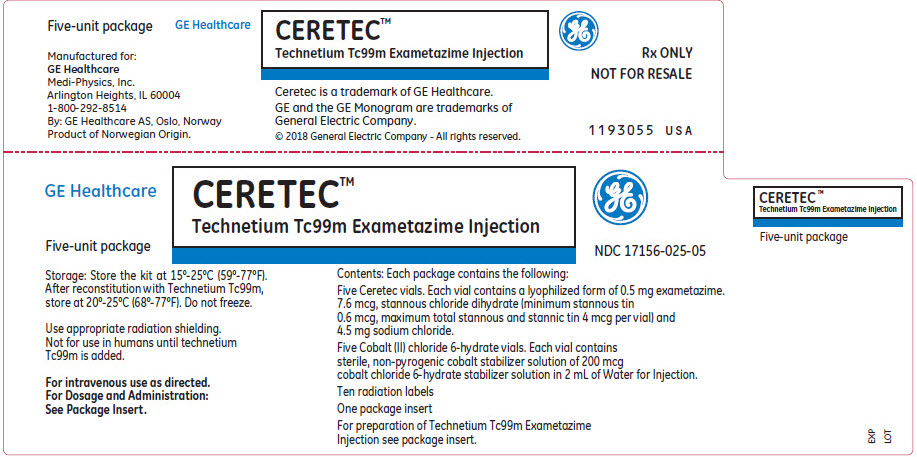
16.1How supplied Each Ceretec Kit (NDC 17156-025-05) contains: Five 10mL vials of 0.5 mg exametazime Five 10mL vials of 200 mcg Cobalt stabilizer solution Ten radiation labels One package insert Sodium Pertechnetate Tc 99m is not part of the Ceretec kit. Before reconstitution and radiolabeling with Tc 99m, the contents of the kit are not radioactive.
16.2Storage and Handling Store Ceretec kits at controlled room temperature 15°C to 25°C (59°F to 77°F). This reagent kit is approved for use by persons licensed by the U.S. Nuclear Regulatory Commission or the relevant Agreement State. Store and dispose of technetium Tc 99m exametazime in compliance with the regulations of the government agency authorized to license the use of this radionuclide.
📦 Storage and Handling ▾
16.2Storage and Handling Store Ceretec kits at controlled room temperature 15°C to 25°C (59°F to 77°F). This reagent kit is approved for use by persons licensed by the U.S. Nuclear Regulatory Commission or the relevant Agreement State. Store and dispose of technetium Tc 99m exametazime in compliance with the regulations of the government agency authorized to license the use of this radionuclide.
📋 Description ▾
11 DESCRIPTION
11.1Chemical Characteristics Ceretec (kit for the preparation of technetium Tc 99m exametazime injection) prepares a radioactive diagnostic agent for intravenous use. Each unit consists of the following: One 10 mL vial of exametazime containing a sterile, non-pyrogenic, lyophilized mixture of 0.5 mg exametazime, 7.6 mcg stannous chloride dihydrate (minimum stannous tin 0.6 mcg; maximum total stannous and stannic tin 4 mcg per vial) and 4.5 mg sodium chloride, sealed under nitrogen atmosphere with a rubber closure. The product contains no antimicrobial preservative.
One vial of cobalt stabilizer containing a sterile, non-pyrogenic solution of 200 mcg cobaltous chloride 6-hydrate in 2 mL of Water for Injection. The chemical name for Exametazime is [(RR,SS)-4.8-diaza-3,6,6,9-tetramethylundecane-2, 10-dione bisoxime]. The molecular formula of exametazime is C 13 H 28 N 4 O 2 , with the following structural formula: Prior to publication of the USAN, exametazime was known as hexamethylpropylene amine oxime (HM-PAO).
The name HM-PAO appears in many publications. When sterile pyrogen-free sodium pertechnetate Tc 99m in isotonic saline is added to the vial of exametazime, a Tc 99m complex of exametazime is formed. Chemical Structure
11.2Physical Characteristics Technetium Tc 99m decays by isomeric transition with a physical half-life of 6 hours. Photons that are useful for imaging studies are listed in Table 3. Table 3: Principal Radiation Emission Data-technetium Tc 99m Radiation Mean % Disintegration Mean Energy (keV) Gamma 2 88.5 140.5
11.3External Radiation The air-kerma-rate (exposure-rate) constant for technetium Tc 99m is 5.23 m 2 ∙pGy∙(MBq) –1 ∙s –1 [0.795 cm 2 ∙R∙(mCi) –1 ∙h –1 ]. The first half-value thickness of lead (Pb) for technetium Tc 99m is 0.25 mm. A range of values for the relative attenuation of the radiation emitted by this radionuclide that results from interposition of various thicknesses of Pb is shown in Table 4.
For example, the use of a 3 mm thickness of Pb will decrease the external radiation exposure by a factor of approximately 1,000. Table 4: Radiation Attenuation by Lead Shielding Shield Thickness (Pb) mm Coefficient of Attenuation 0 . 25 0.5 1 10 –1 2 10 –2 3 10 –3 4 10 –4 5 10 –5 To correct for physical decay of this radionuclide, the fractions that remain at selected intervals relative to the time of calibration are shown in Table 5.
Table 5: Physical Decay Chart – Tc 99m half-life 6.03 hours Hours Fraction Remaining Hours Fraction Remaining 0 Calibration time (time of preparation) 1 7 0.447 1 0.891 8 0.399 2 0.795 9 0.355 3 0.708 10 0.317 4 0.631 11 0.282 5 0.563 12 0.252 6 0.502 24 0.063
💬 Information for Patients ▾
17 PATIENT COUNSELING INFORMATION Administration Instructions Instruct patients to remain hydrated and void frequently following administration to decrease radiation exposure [see Dosage and Administration (2.3) ] . Pregnancy Advise pregnant women of the risk of fetal exposure to radiation doses if they undergo a radionuclide imaging study [see Use in Specific Populations (8.1) ]. Lactation Advise a lactating woman to pump and discard breast milk for 12-24 hours (based on injection dose) after administration to minimize radiation exposure to the breastfed infant [see Use in Specific Populations (8.2) ] .