
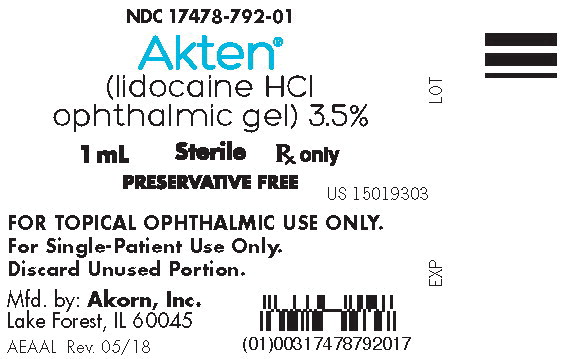
Akten Lidocaine Hydrochloride 35 mg/mL Gel, 25 tubes — NDC 17478-792-25 (Billing 17478-0792-25)
This is a package of 25 tubes of Akten Lidocaine Hydrochloride 35 mg/mL Gel from Akorn, no longer marketed, no longer in the FDA NDC Directory.
NDC database record
One package, one record: these facts belong to NDC 17478-792-25 alone.
- Record
- FDA NDC Directory package listing · Human prescription drug
- Code segments
- 17478 labeler · 792 product · 25 package
- Barcode (UPC-A, from the NDC)
- 3 1747879225 3
- FDA record last changed
- Jul 14, 2026
Other active recalls for Lidocaine Hydrochloride (different manufacturers) — 6 · tap to view
Identity & classification
Regulatory identifiers FDA, NLM and CMS codes for this package
Drug-database identifiers Medi-Span GPI and First Databank GCN / HICL / AHFS classification
- GSN (GCN sequence number): 064490
- GCN: 14424
- HICL (First Databank): 033592
- AHFS class code: 52:16.00.00
Where does this data come from?
- FDA openFDA NDC Directory · synced Oct 8, 2026
- FDA label on DailyMed · label index refreshed Oct 6, 2026
- RxNorm (NLM RxNav) · catalog refreshed Oct 1, 2026
- Medi-Span GPI (licensed)
- First Databank (licensed) · refreshed Oct 8, 2026
Clinical
- Lidocaine numbs the area where it is used. Clinicians inject it for procedures. Skin products are used for pain, itching, minor burns, insect bites, hemorrhoid discomfort, and in s...
- Clean and dry the skin first, then apply as your product’s directions say. Wash your hands afterward. Don’t exceed the number of uses on the label. Ask a doctor before using a prod...
- No. Heat can increase how much lidocaine your body absorbs. Don’t bandage tightly either. Also avoid using other topical pain products at the same time.
- Can I use a heating pad with a lidocaine patch?
Patient education
Supplement & herbal interactions
Where does this data come from?
- MedlinePlus (NLM) · refreshed Oct 1, 2026
- FDA label on DailyMed · label index refreshed Oct 6, 2026
Ask a licensed pharmacist directly — free, answered by our team.
Pricing
A drug doesn't have one price. Each row is a different public payment system, and none is what you'd pay at the counter — that depends on your insurance. The ⓘ on each row explains what it measures.
| Price system | Per g | Per package |
|---|---|---|
| Retail pharmacies payNADAC · weekly | Not in the retail survey — common for institutional, discontinued, or low-volume packs. | |
| Medicaid paysCMS SDUD · 12 mo | No recent Medicaid claims on file for this NDC — rare and low-volume NDCs are suppressed in the public data. | |
| Medicare drug plans payPart D · quarterly | No Part D plan price is available for this NDC in our data. | |
Where does this data come from?
- CMS NADAC weekly file
- CMS ASP pricing files · refreshed Sep 20, 2026
- CMS Medicaid State Drug Utilization Data · refreshed Oct 8, 2026
- CMS Part D plan pricing files · refreshed Sep 24, 2026
- VA National Acquisition Center price file
Packaging — all sizes for this product
| Package NDC | Description | Marketing start | Marketing end | Status |
|---|---|---|---|---|
| 17478-0792-01 17478-792-01 Main listing | 1 TUBE in 1 CARTON / 1 mL in 1 TUBE | 2012-12-07 | — | Inactivated by FDA |
| 17478-0792-25 You're viewing this | 25 TUBE in 1 CARTON / 1 mL in 1 TUBE | 2014-03-11 | — | Inactivated by FDA |
Pack size FAQ
What quantity is in this package?
How does this package differ from NDC 17478-0792-01?
What NDC number is used to bill for this package of Akten Lidocaine Hydrochloride 35 mg/mL Gel?
Therapeutic equivalents
| Product | Labeler | Pack | NADAC/unit | TE | Status | Price vs. this |
|---|---|---|---|---|---|---|
| Akten 35 mg/mL 82584-0792-01 | Thea | 1 tube | — | — | FDA listed | — |
| Akten 35 mg/mLthis 17478-0792-25 | Akorn | 25 tubes | — | — | Discontinued | — |
Where does this data come from?
- FDA openFDA NDC Directory · synced Oct 8, 2026
- FDA Orange Book · refreshed Oct 3, 2026
- CMS NADAC weekly file
Availability & generic status
We did not find an FDA-approved generic match for this exact strength, form and route. Patent/protection dates below may affect future generic timing.
Why the date isn’t exact: Generic timing can change because patents may be challenged, settled, licensed, added, removed, or worked around with a narrower label — and FDA approval does not always mean a pharmacy can get the generic today.
🛈 What do these terms mean?
- Patent
- Legal protection listed in the Orange Book that may delay generic approval or launch. Issued by the U.S. Patent & Trademark Office.
- Substance patent
- Covers the active drug molecule itself — the hardest to design around. A generic generally can’t launch until it expires.
- Formulation (product) patent
- Covers a specific formulation or dosage form. A generic can sometimes work around it with a different formulation.
- Method-of-use patent
- A patent covering one specific approved use of the drug — not necessarily the whole molecule. A generic can sometimes launch with a “skinny label” that carves out the protected use and keeps the others.
- Skinny label
- A generic label that omits a still-patented use when the FDA allows it — letting a generic reach the market for the unprotected uses.
- Exclusivity
- FDA-granted marketing protection, separate from patents — e.g. 5-yr new chemical entity, 7-yr orphan drug, or a +6-month pediatric extension.
- Paragraph IV
- A generic applicant’s formal challenge to a listed patent. It can potentially lead to earlier generic entry, but often involves litigation or a settlement.
- RLD / RS
- Reference Listed Drug — the brand product the FDA uses as the reference for generic applications. Reference Standard — the product the FDA expects generics to compare against in bioequivalence testing.
- TE / AB rating
- FDA therapeutic-equivalence rating. An AB rating generally means the FDA considers a generic therapeutically equivalent to — and substitutable for — the brand.
- LOE (loss of exclusivity)
- The latest patent or exclusivity currently listed — the loss-of-exclusivity / latest-listed-protection date shown on this page. Paragraph-IV challenges and settlements can move the real date earlier; FDA approval and a manufacturer’s decision to market can move it later.
Built from the FDA Orange Book. The bars above are scaled to each protection’s expiry; the red LOE marker is the last one to lapse.
| Patent | Type | Use code | Expires |
|---|---|---|---|
| US 8759401 ↗ | Method of use | U-1523 | Jul 24, 2026 |
Is there a generic version of AKTEN 3.5% GEL DROPS?
The FDA approved a generic — why can’t I get it at my pharmacy yet?
Why do different websites show different generic release dates?
What does “FDA listed” mean?
What does a patent or protection date mean here?
What does “current Orange Book estimate” mean?
Can a generic come out before the last patent expires?
Can a generic come out after the listed dates?
What is the difference between patents and exclusivity?
Why are there multiple patent dates?
Where does this data come from?
- FDA Orange Book · refreshed Oct 3, 2026
Inactive Ingredients / Excipients
Inactive ingredients, also called excipients, are components of the drug product other than the active ingredient. They may include fillers, dyes, coatings, preservatives, flavors, or other formulation ingredients.
🧪 Avoiding an ingredient? See Lidocaine inactive ingredients by manufacturer: every current product's list side by side, so you can ask your pharmacy for the version that does not list it.
💡 Tap an ingredient (hover on desktop) to see what it is and why it’s used.
-
UNII QTT17582CB
A strong acid used to adjust and maintain the proper pH level in liquid medicines, ensuring stability and preventing breakdown of active ingredients.
-
UNII 3NXW29V3WO
Hypromellose is a plant-based thickener made from cellulose. It's used in medicines as a binder to hold ingredients together, a coating for tablets, and a thickener for liquids.
-
UNII 451W47IQ8X
Sodium chloride is common table salt. It's used in medicines as a buffer to maintain proper pH, as a filler to add bulk, or to adjust the osmotic balance in liquid formulations.
-
UNII 55X04QC32I
A strong alkaline chemical used to adjust and maintain the pH balance of liquid medicines. It helps keep the medicine stable and ensures it stays effective during storage.
-
UNII 059QF0KO0R
Water is a liquid solvent that dissolves and mixes ingredients together in liquid medicines, syrups, and injections. It helps distribute the active drug evenly throughout the product.
5 inactive ingredients listed in the exact product block matched to this NDC.
Where does this data come from?
ingredient classCode="IACT" elements from the exact product block matched by this NDC. Label-section narrative from DailyMed / the openFDA label index is shown separately when available.- FDA label on DailyMed · label index refreshed Oct 6, 2026
- FDA openFDA NDC Directory · synced Oct 8, 2026
Inactive ingredient FAQ
Are inactive ingredients the same for every manufacturer?
Why might an inactive ingredient be missing?
Can inactive ingredients matter?
Manufacturer & labeler
Where does this data come from?
- FDA openFDA NDC Directory · synced Oct 8, 2026
- Drugs@FDA
Full prescribing information FDA SPL
🎯 Indications and Usage ▾
1 INDICATIONS AND USAGE AKTEN ® is indicated for ocular surface anesthesia during ophthalmologic procedures. AKTEN ® is a local anesthetic indicated for ocular surface anesthesia during ophthalmologic procedures. ( 1 )
⏱️ Dosage and Administration ▾
2 DOSAGE AND ADMINISTRATION The recommended dose of AKTEN ® is 2 drops applied to the ocular surface in the area of the planned procedure. AKTEN ® may be reapplied to maintain anesthetic effect. The recommended dose of AKTEN ® is 2 drops applied to the ocular surface in the area of the planned procedure. Additional anesthesia may be reapplied as needed. ( 2 )
💊 Dosage Forms and Strengths ▾
3 DOSAGE FORMS AND STRENGTHS AKTEN ® Ophthalmic Gel, 3.5% contains 35 mg per mL of lidocaine hydrochloride for topical ophthalmic administration. AKTEN ® 3.5% (35 mg/mL) Ophthalmic Gel. ( 3 )
⛔ Contraindications ▾
4 CONTRAINDICATIONS None. None. ( 4 )
⚠️ Warnings and Cautions ▾
5 WARNINGS AND PRECAUTIONS For Topical Ophthalmic Use: Not for Injection. ( 5.1 ) Corneal Opacification: Prolonged use of a topical ocular anesthetic may produce permanent corneal opacification and ulceration with accompanying visual loss. ( 5.2 ) For Administration by Healthcare Provider: AKTEN ® is not intended for patient self-administration. ( 5.3 )
5.1For Topical Ophthalmic Use AKTEN ® is indicated for topical ophthalmic use. Not for Injection.
5.2Corneal Opacification Prolonged use of a topical ocular anesthetic may produce permanent corneal opacification and ulceration with accompanying visual loss.
5.3For Administration by Healthcare Provider AKTEN ® is indicated for administration under the direct supervision of a healthcare provider. AKTEN ® is not intended for patient self-administration.
🤒 Adverse Reactions ▾
6 ADVERSE REACTIONS Most common adverse reactions are conjunctival hyperemia, corneal epithelial changes, headache, and burning upon instillation. Most common adverse reactions are conjunctival hyperemia, corneal epithelial changes, headache, and burning upon instillation. ( 6 ) To report SUSPECTED ADVERSE REACTIONS, contact Akorn Operating Company LLC at 1-800-932-5676 or FDA at 1-800-FDA-1088 or www.fda.gov/medwatch .
👥 Use in Specific Populations ▾
8 USE IN SPECIFIC POPULATIONS
8.1Pregnancy Reproduction studies for lidocaine have been performed in both rats and rabbits. There was no evidence of harm to the fetus at subcutaneous doses up to 50 mg/kg lidocaine (more than 800 fold greater than the human dose on a body weight basis) in the rat model. There are, however, no adequate and well controlled studies in pregnant women.
Because animal reproduction studies are not always predictive of human response, this drug should be used in pregnancy only if clearly needed.
8.3Nursing Mothers Lidocaine is secreted in human milk. The clinical significance of this observation is unknown. Although no systemic exposure is expected with administration of AKTEN ® , caution should be exercised when AKTEN ® is administered to a nursing woman.
8.4Pediatric Use Safety and efficacy in pediatric patients have been extrapolated from studies in older subjects and studies in pediatric patients using different formulations of lidocaine.
8.5Geriatric Use No overall clinical differences in safety or effectiveness were observed between the elderly and other adult patients.
🤰 Pregnancy ▾
8.1Pregnancy Reproduction studies for lidocaine have been performed in both rats and rabbits. There was no evidence of harm to the fetus at subcutaneous doses up to 50 mg/kg lidocaine (more than 800 fold greater than the human dose on a body weight basis) in the rat model. There are, however, no adequate and well controlled studies in pregnant women.
Because animal reproduction studies are not always predictive of human response, this drug should be used in pregnancy only if clearly needed.
🧒 Pediatric Use ▾
8.4Pediatric Use Safety and efficacy in pediatric patients have been extrapolated from studies in older subjects and studies in pediatric patients using different formulations of lidocaine.
🧓 Geriatric Use ▾
8.5Geriatric Use No overall clinical differences in safety or effectiveness were observed between the elderly and other adult patients.
🆘 Overdosage ▾
10 OVERDOSAGE Prolonged use of a topical ocular anesthetic may produce permanent corneal opacification and ulceration with accompanying visual loss. Acute emergencies from local anesthetics are generally related to high plasma levels encountered during therapeutic use of local anesthetics or to unintended subarachnoid injection of local anesthetic solution. However, topical ocular application of AKTEN ® is not expected to result in systemic exposure.
🧬 Clinical Pharmacology ▾
12 CLINICAL PHARMACOLOGY
12.1Mechanism of Action AKTEN ® is a local anesthetic agent that stabilizes the neuronal membrane by inhibiting the ionic fluxes required for the initiation and conduction of impulses, thereby effecting local anesthetic action. Anesthesia generally occurs between 20 seconds to 1 minute and persists for 5 to 30 minutes.
12.3Pharmacokinetics Lidocaine may be absorbed following topical administration to mucous membranes. Its rate and extent of absorption depend upon various factors such as concentration, the specific site of application, viscosity of the agent, and duration of exposure. The plasma binding of lidocaine is dependent on drug concentration, and the fraction bound decreases with increasing concentration.
At concentrations of 1 to 4 mcg of free base per mL, 60 to 80 percent of lidocaine is protein bound. Binding is also dependent on the plasma concentration of the alpha-1-acid glycoprotein. Lidocaine is metabolized rapidly by the liver, and metabolites and unchanged drug are excreted by the kidneys.
Biotransformation includes oxidative N-dealkylation, ring hydroxylation, cleavage of the amide linkage, and conjugation. N-dealkylation, a major pathway of biotransformation, yields the metabolites monoethylglycinexylidide and glycinexylidide. The pharmacologic/toxicologic actions of these metabolites are similar to, but less potent than, those of lidocaine.
Approximately 90% of lidocaine administered is excreted in the form of various metabolites, and less than 10% is excreted unchanged. The primary metabolite in urine is a conjugate of 4-hydroxy-2, 6-dimethylaniline. Studies of lidocaine metabolism following intravenous bolus injections have shown that the elimination half-life of this agent is typically 1.5 to 2 hours.
Because of the rate at which lidocaine is metabolized, any condition that affects liver function may alter lidocaine kinetics. The half-life may be prolonged twofold or more in patients with liver dysfunction. Renal dysfunction does not affect lidocaine kinetics but may increase the accumulation of metabolites.
🧬 Mechanism of Action ▾
12.1Mechanism of Action AKTEN ® is a local anesthetic agent that stabilizes the neuronal membrane by inhibiting the ionic fluxes required for the initiation and conduction of impulses, thereby effecting local anesthetic action. Anesthesia generally occurs between 20 seconds to 1 minute and persists for 5 to 30 minutes.
📦 How Supplied / Storage and Handling ▾
16 HOW SUPPLIED/STORAGE AND HANDLING AKTEN ® (lidocaine hydrochloride ophthalmic gel) 3.5% is supplied as a clear gel for single-patient use as follows: NDC 17478-792-01 1 mL fill in a white polyfoil tube* NDC 17478-792-25 Package of 25 units of 1 mL fill in a white polyfoil tube* (NDC 17478-792-01) NDC 17478-792-10 5 mL fill in a 10 mL natural, round plastic dropper bottle Storage Store at 15°C to 25°C (59°F to 77°F). Keep container closed and protected from light in the original carton until use. Discard after use.
AKORN Manufactured by: Akorn Operating Company LLC Lake Forest, IL 60045 *Made in Switzerland Patent Pending AE00N Revised 2/2022
📦 Storage and Handling ▾
Storage Store at 15°C to 25°C (59°F to 77°F). Keep container closed and protected from light in the original carton until use. Discard after use. AKORN Manufactured by: Akorn Operating Company LLC Lake Forest, IL 60045 *Made in Switzerland Patent Pending AE00N Revised 2/2022
📋 Description ▾
11 DESCRIPTION AKTEN ® (lidocaine hydrochloride ophthalmic gel) 3.5% is a sterile, preservative-free, single-patient use ophthalmic gel preparation for topical ocular anesthesia. Lidocaine hydrochloride is designated chemically as acetamide, 2-(diethylamino)-N-(2,6-dimethylphenyl) monohydrochloride with a molecular formula of C 14 H 22 N 2 O • HCl and molecular weight of 270.8. The structural formula of the active ingredient is: AKTEN ® contains 35 mg of lidocaine hydrochloride per mL as the active ingredient.
AKTEN ® also contains Hypromellose, Sodium Chloride, and Water for Injection as inactive ingredients in the 1 mL tube configuration. AKTEN ® contains Hypromellose, Sodium Chloride, and Water for Injection as inactive ingredients in the 5 mL in 10 mL bottle configuration. The pH may be adjusted to 5.5 to 7.5 with Hydrochloric Acid and/or Sodium Hydroxide.
Structural Formula
🍼 Nursing Mothers ▾
8.3Nursing Mothers Lidocaine is secreted in human milk. The clinical significance of this observation is unknown. Although no systemic exposure is expected with administration of AKTEN ® , caution should be exercised when AKTEN ® is administered to a nursing woman.
🧬 Pharmacokinetics ▾
12.3Pharmacokinetics Lidocaine may be absorbed following topical administration to mucous membranes. Its rate and extent of absorption depend upon various factors such as concentration, the specific site of application, viscosity of the agent, and duration of exposure. The plasma binding of lidocaine is dependent on drug concentration, and the fraction bound decreases with increasing concentration.
At concentrations of 1 to 4 mcg of free base per mL, 60 to 80 percent of lidocaine is protein bound. Binding is also dependent on the plasma concentration of the alpha-1-acid glycoprotein. Lidocaine is metabolized rapidly by the liver, and metabolites and unchanged drug are excreted by the kidneys.
Biotransformation includes oxidative N-dealkylation, ring hydroxylation, cleavage of the amide linkage, and conjugation. N-dealkylation, a major pathway of biotransformation, yields the metabolites monoethylglycinexylidide and glycinexylidide. The pharmacologic/toxicologic actions of these metabolites are similar to, but less potent than, those of lidocaine.
Approximately 90% of lidocaine administered is excreted in the form of various metabolites, and less than 10% is excreted unchanged. The primary metabolite in urine is a conjugate of 4-hydroxy-2, 6-dimethylaniline. Studies of lidocaine metabolism following intravenous bolus injections have shown that the elimination half-life of this agent is typically 1.5 to 2 hours.
Because of the rate at which lidocaine is metabolized, any condition that affects liver function may alter lidocaine kinetics. The half-life may be prolonged twofold or more in patients with liver dysfunction. Renal dysfunction does not affect lidocaine kinetics but may increase the accumulation of metabolites.
🔬 Clinical Studies ▾
14 CLINICAL STUDIES The effect of AKTEN ® on ocular anesthesia was studied in a multi-center, randomized, controlled, double-blind study. A total of 209 subjects were enrolled, with 54, 51, 53, and 51 subjects randomized to the sham, AKTEN ® 1.5%, AKTEN ® 2.5%, and AKTEN ® 3.5% groups, respectively. Ocular anesthesia was achieved within 5 minutes of anesthetic application by 47 of 51 subjects (92%) in the AKTEN ® 3.5% group.
The mean time to anesthesia onset ranged from 20 seconds to 5 minutes and was not affected by AKTEN ® dose. The mean time to anesthesia onset was approximately 60 seconds, with a median onset time of 40 seconds for the AKTEN ® 3.5% group. Among the subjects in the AKTEN ® groups who achieved anesthesia within 5 minutes, approximately 90% had achieved anesthesia within 60 seconds of application.
The duration of anesthesia generally ranged from approximately 5 minutes to 30 minutes, with mean anesthesia durations of approximately 15 minutes for the AKTEN ® 3.5% group. Approximately 84% of the subjects in the AKTEN ® 3.5% group experienced anesthesia for at least 5 minutes, approximately 55% of subjects experienced anesthesia for 10 minutes or longer and 27% experienced anesthesia for 15 minutes or longer. The anesthetic effect of additional applications of AKTEN ® has not been evaluated.
🧪 Nonclinical Toxicology ▾
13 NONCLINICAL TOXICOLOGY
13.1Carcinogenesis, Mutagenesis, Impairment of Fertility Long-term studies in animals have not been performed to evaluate the carcinogenic potential of AKTEN ® .
📄 Carcinogenesis, Mutagenesis, Impairment of Fertility ▾
13.1Carcinogenesis, Mutagenesis, Impairment of Fertility Long-term studies in animals have not been performed to evaluate the carcinogenic potential of AKTEN ® .
📄 Recent Major Changes ▾
Warnings and Precautions ( 5.3 ) 2/2022
📄 Package Label / Principal Display Panel ▾
Principal Display Panel Text for Container Label: NDC 17478-792-01 Akten ® (lidocaine HCl ophthalmic gel) 3.5% 1 mL Sterile Rx only PRESERVATIVE FREE Principal Display Panel Text for Container Label
Principal Display Panel Text for Carton Label: NDC 17478-792-01 Akten ® (lidocaine hydrochloride ophthalmic gel) 3.5% For Topical Ophthalmic Use Only Rx only 1 mL Sterile PRESERVATIVE FREE For Single-Patient Use Only. Discard Unused Portion. Akorn Logo Principal Display Panel Text for Carton Label
Medicare Part D spend CMS · PART D · 2025 (Q1-Q4)
About this NDC listing & data coverage
What data is (and isn’t) available for this NDC — tap to expand
| NDC identity (package / product / labeler codes) | ✓ Available |
| Labeler | ✓ Available |
| Product & package description | ✓ Available |
| Marketing category & status | ✓ Available |
| Active ingredient / dosage form / route | ✓ Available |
| FDA label (SPL via DailyMed) | ✓ Available |
| Package photos | ✓ Available |
| Inactive ingredients (structured) | ✓ Available |
| NADAC pharmacy acquisition price (CMS) | — Not published for this NDC CMS publishes NADAC only for NDCs reported in its retail-pharmacy survey. |
| Orange Book / therapeutic-equivalence data | ✓ Available |
| HCPCS J-code billing crosswalk | — Not published for this NDC Most self-administered / retail products have no J-code — that is normal. |
| Medicaid utilization (CMS SDUD) | — Not published for this NDC CMS reports utilization only for NDCs with Medicaid claims above its privacy threshold. |