
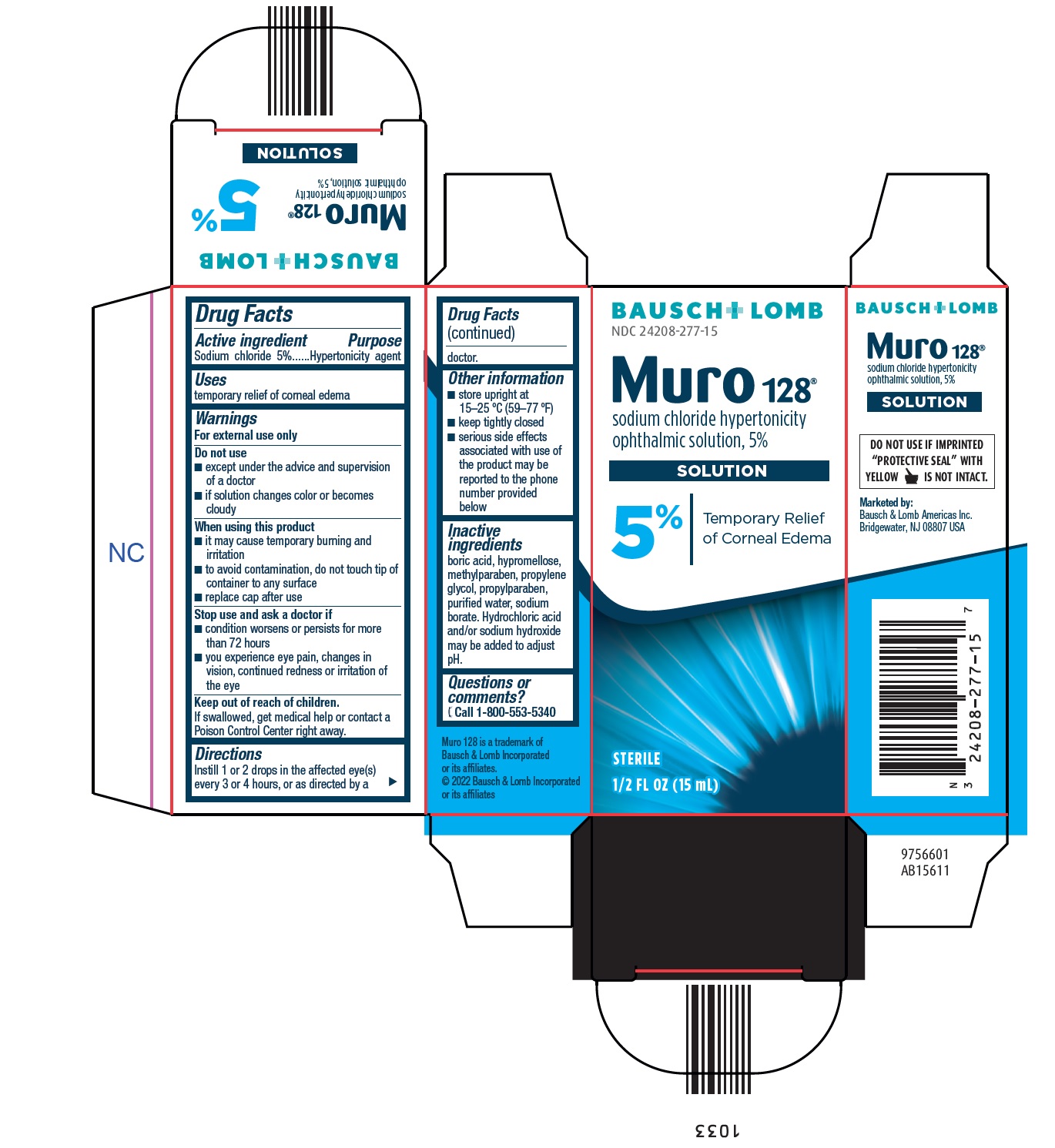
Muro 128 sodium chloride 50 mg/mL Solution — NDC 24208-277-15 (Billing 24208-0277-15)
This is a package of Muro 128 sodium chloride 50 mg/mL Solution from Bausch & Lomb Incorporated, marketed since Jan 2011 and currently FDA-listed; retail pharmacies pay about $1.12 per mL (NADAC). It is the main listing for this product, which comes in 2 package sizes.
NDC database record
One package, one record: these facts belong to NDC 24208-277-15 alone.
- Record
- FDA NDC Directory package listing · Human OTC drug
- Code segments
- 24208 labeler · 277 product · 15 package
- Package marketed since
- Jan 1, 2011
- Sample package
- No — commercial package
- Listing certified through
- Dec 31, 2027
- Barcode (UPC-A, from the NDC)
- 3 2420827715 7
- Medicaid fills, this package
- 5,285 prescriptions in the last four reported quarters
- FDA record last changed
- Oct 8, 2026
Other active recalls for Sodium Chloride (different manufacturers) — 6 · tap to view
Identity & classification
Regulatory identifiers FDA, NLM and CMS codes for this package
Drug-database identifiers Medi-Span GPI and First Databank GCN / HICL / AHFS classification
- GSN (GCN sequence number): 007739
- GCN: 31923
- GPI-14 (Medi-Span): 86804030102005
- HICL (First Databank): 003389
- AHFS class code: 52:92.00.00
- RxCUI (RxNorm): 730780
Where does this data come from?
- FDA openFDA NDC Directory · synced Oct 1, 2026
- FDA label on DailyMed · label index refreshed Oct 6, 2026
- RxNorm (NLM RxNav) · catalog refreshed Oct 1, 2026
- Medi-Span GPI (licensed)
- First Databank (licensed) · refreshed Oct 1, 2026
RxNorm drug class
This medicine belongs to the Sodium class.
Where does this data come from?
- RxClass (NLM) · catalog refreshed Oct 1, 2026
Clinical
- It depends on the product. IV forms replace fluid and salt, while injection diluents dissolve other drugs. Other forms are used for rinsing, nasal congestion and nasal care, or to...
- Follow the directions on your product. Many are used as often as needed by adults and children 4 and over. Do not share the bottle, because that can spread infection.
- Some people get fever, irritation or infection at the IV site, or too much fluid in the body. Tell your nurse right away if the IV site hurts or looks red.
- What side effects should I expect with IV sodium chloride?
Patient education
Supplement & herbal interactions
Some supplements/herbs that may interact with Sodium Chloride — tap one for details:
Where does this data come from?
- MedlinePlus (NLM) · refreshed Oct 1, 2026
- FDA label on DailyMed · label index refreshed Oct 6, 2026
Ask a licensed pharmacist directly — free, answered by our team.
Pricing
A drug doesn't have one price. Each row is a different public payment system, and none is what you'd pay at the counter — that depends on your insurance. The ⓘ on each row explains what it measures.
| Price system | Per mL | Per package |
|---|---|---|
| Retail pharmacies payNADAC · weekly | $1.116 | $16.74 / 15 ml |
| Medicaid paysCMS SDUD · 12 mo | $1.60 | $24.06 / 15 ml |
| Medicare drug plans payPart D · quarterly | No Part D plan price is available for this NDC in our data. | |
Where does this data come from?
- CMS NADAC weekly file · file of Sep 30, 2026
- CMS ASP pricing files · refreshed Sep 20, 2026
- CMS Medicaid State Drug Utilization Data · through Q1 2026
- CMS Part D plan pricing files · refreshed Sep 24, 2026
- VA National Acquisition Center price file
Packaging — all sizes for this product
| Package NDC | Description | Per unit | Per pack | Marketing start | Marketing end | Status |
|---|---|---|---|---|---|---|
| 24208-0277-15 You're viewing this Main listing | 1 BOTTLE in 1 CARTON / 15 mL in 1 BOTTLE | $1.12 / mL | $16.74 | 2011-01-01 | — | Active |
| 24208-0277-59 24208-277-59 | 1 BOTTLE in 1 CARTON / 2 mL in 1 BOTTLE Sample | — | — | 2011-01-01 | — | Active |
In Medicaid, this is the most-dispensed pack of this product — about 100% of fills over the last four reported quarters. See all packs ↓
Pack size FAQ
What quantity is in this package?
What NDC number is used to bill for this package of Muro 128 sodium chloride 50 mg/mL Solution?
Prices are the latest CMS NADAC pharmacy acquisition cost per NDC; per-pack figures are per-unit × pack quantity, shown only when the pack is denominated in the same measure NADAC prices.
Therapeutic equivalents
| Product | Labeler | Pack | NADAC/unit | TE | Status | Price vs. this |
|---|---|---|---|---|---|---|
| Sodium Chlorode Hypertonicity Ophthalmic Solution 50 mg/mL 00536-1254-94 | Rugby | 1 bottle | $0.329 | — | Availability likely | save 71% |
| Muro 128 50 mg/mLthis 24208-0277-15 | Bausch | 1 bottle | $1.116 | — | Availability likely | — |
| Sodium Chloride 50 mg/mL 00363-0193-13 | Walgreen | 1 bottle | — | — | FDA listed | — |
| Walgreens 50 mg/mL 00363-0658-05 | Walgreen | 1 bottle | — | — | FDA listed | — |
| Altachlore Sodium Chloride Hypertonicity 50 mg/mL 59390-0183-13 | Altaire | 1 bottle | — | — | FDA listed | — |
| Sodium Chloride Hypertonicity Ophthalmic Solution, 5% 50 mg/mL 69618-0077-55 | Reliable | 1 bottle | — | — | FDA listed | — |
| Sodium Chloride Hypertonicity 50 mg/mL 69842-0284-15 | CVS | 1 bottle | — | — | FDA listed | — |
Where does this data come from?
- FDA openFDA NDC Directory · synced Oct 1, 2026
- FDA Orange Book · refreshed Oct 3, 2026
- CMS NADAC weekly file · file of Sep 30, 2026
Availability & generic status
We did not find an FDA-approved generic match for this exact strength, form and route.
Where does this data come from?
- FDA Orange Book · refreshed Oct 3, 2026
Inactive Ingredients / Excipients
Inactive ingredients, also called excipients, are components of the drug product other than the active ingredient. They may include fillers, dyes, coatings, preservatives, flavors, or other formulation ingredients.
🧪 Avoiding an ingredient? See Sodium Chloride inactive ingredients by manufacturer: every current product's list side by side, so you can ask your pharmacy for the version that does not list it.
💡 Tap an ingredient (hover on desktop) to see what it is and why it’s used.
-
UNII R57ZHV85D4
Boric acid is a weak acid derived from boron. In medicines, it typically serves as a buffer to help maintain the product's pH level and may act as a preservative in certain formulations.
-
UNII QTT17582CB
A strong acid used to adjust and maintain the proper pH level in liquid medicines, ensuring stability and preventing breakdown of active ingredients.
-
UNII 3NXW29V3WO
Hypromellose is a plant-based thickener made from cellulose. It's used in medicines as a binder to hold ingredients together, a coating for tablets, and a thickener for liquids.
-
UNII A2I8C7HI9T
Methylparaben is a preservative derived from benzoic acid that prevents growth of bacteria, fungi, and mold in medicines. It extends the product's shelf life and maintains safety during storage.
-
UNII 6DC9Q167V3
Propylene glycol is a clear liquid derived from petroleum or vegetable sources. It acts as a solvent, humectant, and preservative in medicines, helping dissolve active ingredients and maintain product stability.
-
UNII Z8IX2SC1OH
Propylparaben is a chemical preservative used to prevent bacterial and fungal growth in medicines and personal care products. It helps extend shelf life and maintain product safety during storage.
-
UNII 91MBZ8H3QO
Sodium borate is an inorganic salt compound used in medicines as a buffer to help maintain a stable pH level, and sometimes as a mild preservative or cleansing agent in topical formulations.
-
UNII 55X04QC32I
A strong alkaline chemical used to adjust and maintain the pH balance of liquid medicines. It helps keep the medicine stable and ensures it stays effective during storage.
-
UNII 059QF0KO0R
Water is a liquid solvent that dissolves and mixes ingredients together in liquid medicines, syrups, and injections. It helps distribute the active drug evenly throughout the product.
9 inactive ingredients listed in the exact product block matched to this NDC.
Label-section wording can be broader than the structured product block and may mention additional formulation ingredients.
Where does this data come from?
ingredient classCode="IACT" elements from the exact product block matched by this NDC. Label-section narrative from DailyMed / the openFDA label index is shown separately when available.- FDA label on DailyMed · label index refreshed Oct 6, 2026
- FDA openFDA NDC Directory · synced Oct 1, 2026
Inactive ingredient FAQ
Are inactive ingredients the same for every manufacturer?
Why might an inactive ingredient be missing?
Can inactive ingredients matter?
Manufacturer & labeler
More NDCs from Bausch & Lomb Incorporated labeler code 24208
- Biotrue Hydration Boost Glycerin 5 mg/mL Solution/ Drops NDC 24208-006-05
- Methazolamide 25 mg Tablet NDC 24208-022-01
- Methazolamide 50 mg Tablet NDC 24208-023-01
- Xipere triamcinolone acetonide 40 mg/mL Injection, Suspension NDC 24208-040-01
- Tetracaine Hydrochloride 5 mg/mL Solution/ Drops NDC 24208-092-05
- Muro 128 sodium chloride 20 mg/mL Solution NDC 24208-276-15
- Tobramycin 3 mg/mL Solution NDC 24208-290-05
- Tobramycin and Dexamethasone 3 mg/mL; 1 mg/mL Suspension/ Drops NDC 24208-295-05
- LOTEMAX loteprednol etabonate 5 mg/mL Suspension/ Drops NDC 24208-299-01
- Soothe Night Time white petrolatum mineral oil 200 mg/g; 800 mg/g Ointment NDC 24208-313-34
- Flurbiprofen Sodium .3 mg/mL Solution/ Drops NDC 24208-314-25
- Polymyxin B Sulfate and Trimethoprim 10000 [USP'U]/mL; 1 mg/mL Solution/ Drops NDC 24208-315-10
Where does this data come from?
- FDA openFDA NDC Directory · synced Oct 1, 2026
- Drugs@FDA
FDA label — Drug Facts FDA SPL
🎯 Indications and Usage ▾
Uses temporary relief of corneal edema
⏱️ Dosage and Administration ▾
Directions Instill 1 or 2 drops in the affected eye(s) every 3 or 4 hours, or as directed by a doctor.
⚠️ Warnings ▾
Warnings For external use only Do not use except under the advice and supervision of a doctor if solution changes color or becomes cloudy When using this product it may cause temporary burning and irritation to avoid contamination, do not touch tip of container to any surface replace cap after use Stop use and ask a doctor if condition worsens or persists for more than 72 hours you experience eye pain, changes in vision, continued redness or irritation of the eye
🧪 Active Ingredient ▾
Active ingredient Sodium chloride 5%
🧪 Inactive Ingredients ▾
Inactive ingredients boric acid, hypromellose, methylparaben, propylene glycol, propylparaben, purified water, sodium borate. Hydrochloric acid and/or sodium hydroxide may be added to adjust pH.
🎯 Purpose ▾
Purpose Hypertonicity agent
📄 Keep Out of Reach of Children ▾
Keep out of reach of children. If swallowed, get medical help or contact a Poison Control Center right away.
📄 Questions or Comments ▾
Questions or comments? [telephone icon] Call 1-800-553-5340 Muro 128 is a trademark of Bausch & Lomb Incorporated or its affiliates. © 2022 Bausch & Lomb Incorporated or its affiliates Marketed by: Bausch & Lomb Americas Inc. Bridgewater, NJ 08807 USA 9756601 AB15611
📄 Package Label / Principal Display Panel ▾
Package/Label Principal Display Panel – Muro 128 15 mL BAUSCH + LOMB NDC 24208-277-15 Muro 128 ® sodium chloride hypertonicity ophthalmic solution, 5% SOLUTION 5% Temporary Relief of Corneal Edema STERILE 1/2 FL OZ (15 mL) carton5%