
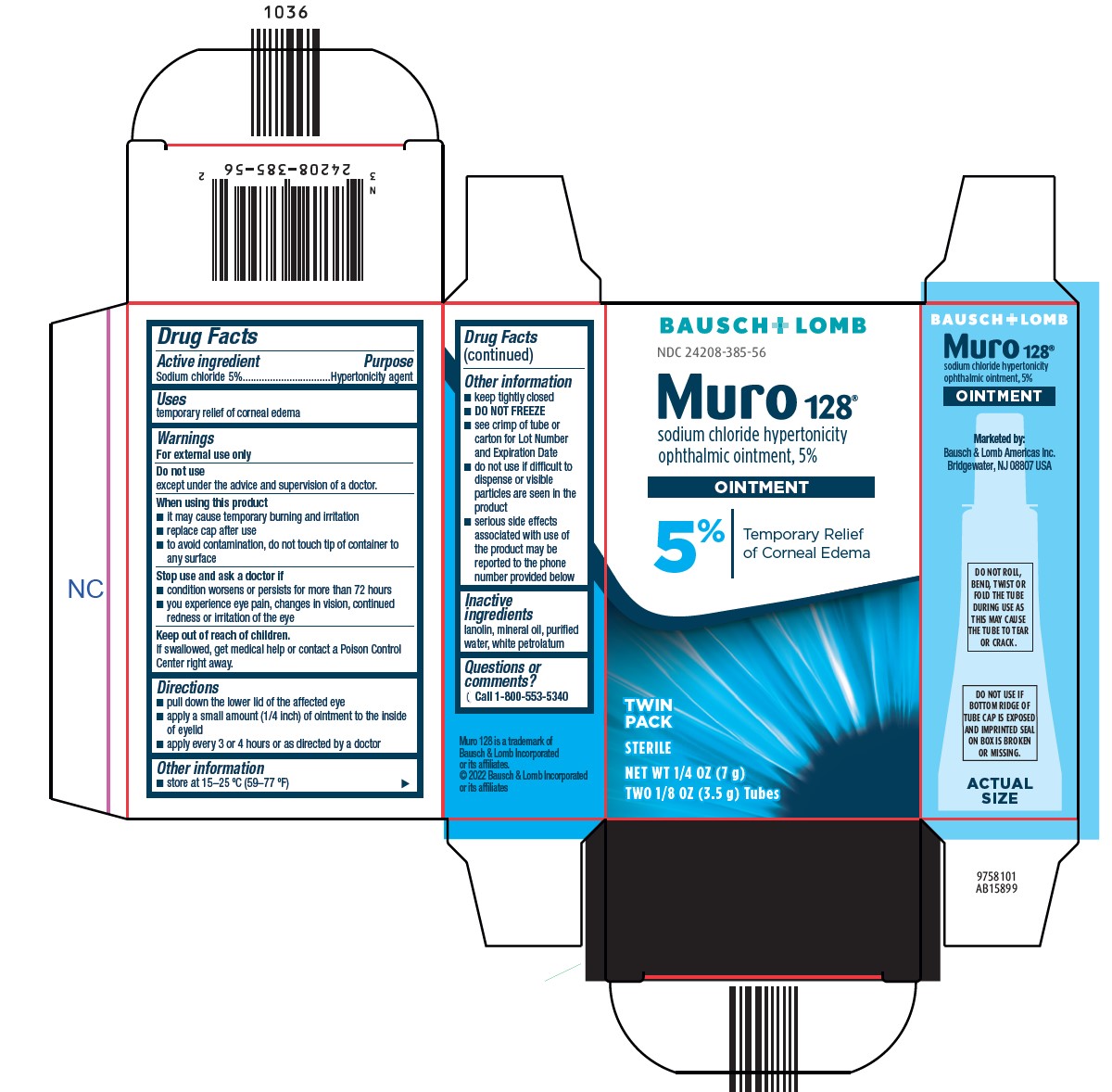
Muro 128 sodium chloride 50 mg/g Ointment, 1 tube — NDC 24208-385-55 (Billing 24208-0385-55)
This is a package of 1 tube of Muro 128 sodium chloride 50 mg/g Ointment from Bausch & Lomb Incorporated, marketed since Jan 2011 and currently FDA-listed; retail pharmacies pay about $4.79 per g (NADAC). It is the main listing for this product, which comes in 3 package sizes.
NDC database record
One package, one record: these facts belong to NDC 24208-385-55 alone.
- Record
- FDA NDC Directory package listing · Human OTC drug
- Code segments
- 24208 labeler · 385 product · 55 package
- Package marketed since
- Jan 1, 2011
- Sample package
- No — commercial package
- Listing certified through
- Dec 31, 2027
- Barcode (UPC)
- 0324208385562
- Medicaid fills, this package
- 4,814 prescriptions in the last four reported quarters
- FDA record last changed
- Oct 8, 2026
Other active recalls for Sodium Chloride (different manufacturers) — 6 · tap to view
Identity & classification
Regulatory identifiers FDA, NLM and CMS codes for this package
Drug-database identifiers Medi-Span GPI and First Databank GCN / HICL / AHFS classification
- GSN (GCN sequence number): 007737
- GCN: 31880
- GPI-14 (Medi-Span): 86804030104205
- HICL (First Databank): 003389
- AHFS class code: 52:92.00.00
- RxCUI (RxNorm): 1298435
Where does this data come from?
- FDA openFDA NDC Directory · synced Oct 8, 2026
- FDA label on DailyMed · label index refreshed Oct 8, 2026
- RxNorm (NLM RxNav) · catalog refreshed Oct 1, 2026
- Medi-Span GPI (licensed)
- First Databank (licensed) · refreshed Oct 8, 2026
RxNorm drug class
This medicine belongs to the Sodium class.
Where does this data come from?
- RxClass (NLM) · catalog refreshed Oct 1, 2026
Clinical
- It depends on the product. IV forms replace fluid and salt, while injection diluents dissolve other drugs. Other forms are used for rinsing, nasal congestion and nasal care, or to...
- Follow the directions on your product. Many are used as often as needed by adults and children 4 and over. Do not share the bottle, because that can spread infection.
- Some people get fever, irritation or infection at the IV site, or too much fluid in the body. Tell your nurse right away if the IV site hurts or looks red.
- What side effects should I expect with IV sodium chloride?
Patient education
Supplement & herbal interactions
Some supplements/herbs that may interact with Sodium Chloride — tap one for details:
Where does this data come from?
- MedlinePlus (NLM) · refreshed Oct 8, 2026
- FDA label on DailyMed · label index refreshed Oct 8, 2026
Ask a licensed pharmacist directly — free, answered by our team.
Pricing
A drug doesn't have one price. Each row is a different public payment system, and none is what you'd pay at the counter — that depends on your insurance. The ⓘ on each row explains what it measures.
| Price system | Per g | Per package |
|---|---|---|
| Retail pharmacies payNADAC · weekly | $4.791 | $16.77 / 3.5 g |
| Medicaid paysCMS SDUD · 12 mo | $5.87 | $20.53 / 3.5 g |
| Medicare drug plans payPart D · quarterly | No Part D plan price is available for this NDC in our data. | |
Where does this data come from?
- CMS NADAC weekly file · file of Oct 7, 2026
- CMS ASP pricing files · refreshed Sep 20, 2026
- CMS Medicaid State Drug Utilization Data · through Q1 2026
- CMS Part D plan pricing files · refreshed Sep 24, 2026
- VA National Acquisition Center price file
Packaging — all sizes for this product
| Package NDC | Description | Per unit | Per pack | Marketing start | Marketing end | Status |
|---|---|---|---|---|---|---|
| 24208-0385-01 24208-385-01 | 1 TUBE in 1 CARTON / 1 g in 1 TUBE Sample | — | — | 2011-01-01 | — | Active |
| 24208-0385-55 You're viewing this Main listing | 1 TUBE in 1 CARTON / 3.5 g in 1 TUBE | $4.79 / g | $16.77 | 2011-01-01 | — | Active |
| 24208-0385-56 24208-385-56 | 2 TUBE in 1 CARTON / 3.5 g in 1 TUBE | — | — | 2011-01-01 | — | Active |
In Medicaid, this is the most-dispensed pack of this product — about 87% of fills over the last four reported quarters. See all packs ↓
Pack size FAQ
What quantity is in this package?
How does this package differ from NDC 24208-0385-01?
What NDC number is used to bill for this package of Muro 128 sodium chloride 50 mg/g Ointment?
Prices are the latest CMS NADAC pharmacy acquisition cost per NDC; per-pack figures are per-unit × pack quantity, shown only when the pack is denominated in the same measure NADAC prices.
Therapeutic equivalents
| Product | Labeler | Pack | NADAC/unit | TE | Status | Price vs. this |
|---|---|---|---|---|---|---|
| Sodium Chloride Hypertonicity Ophthalmic 50 mg/g 00536-1253-91 | Rugby | 1 tube | $2.990 | — | Availability likely | save 38% |
| Muro 128 50 mg/gthis 24208-0385-55 | Bausch | 1 tube | $4.791 | — | Availability likely | — |
| Walgreens Sodium Chloride Ophthalmic 5 Percent Hypertonicity Eye 50 mg/g 00363-7500-50 | Walgreen | 1 tube | — | — | FDA listed | — |
| Sodium Chloride Ophthalmic 5 Percent Hypertonicity Eye 50 mg/g 11716-0750-00 | Hanlim | 1 tube | — | — | FDA listed | — |
| Altachlore Sodium Chloride Hypertonicity Ophthalmic 5 Percent 50 mg/g 59390-0184-50 | Altaire | 1 tube | — | — | FDA listed | — |
| Sodium Chloride Hypertonicity 50 mg/g 69842-0285-35 | CVS | 1 tube | — | — | FDA listed | — |
| Sodium Chloride Hypertonicity 50 mg/mL 73581-0708-35 | YYBA | 1 tube | — | — | FDA listed | — |
| Sodium Chloride 50 mg/g 73581-0707-01 | YYBA | 1 tube | — | — | FDA listed | — |
Where does this data come from?
- FDA openFDA NDC Directory · synced Oct 8, 2026
- FDA Orange Book · refreshed Oct 3, 2026
- CMS NADAC weekly file · file of Oct 7, 2026
Availability & generic status
We did not find an FDA-approved generic match for this exact strength, form and route.
Where does this data come from?
- FDA Orange Book · refreshed Oct 3, 2026
Inactive Ingredients / Excipients
Inactive ingredients, also called excipients, are components of the drug product other than the active ingredient. They may include fillers, dyes, coatings, preservatives, flavors, or other formulation ingredients.
🧪 Avoiding an ingredient? See Sodium Chloride inactive ingredients by manufacturer: every current product's list side by side, so you can ask your pharmacy for the version that does not list it.
💡 Tap an ingredient (hover on desktop) to see what it is and why it’s used.
-
UNII 7EV65EAW6H
Lanolin is a waxy substance derived from sheep's wool. It's used in medicines as an emollient and skin-conditioning agent to soften formulations and improve spreadability in topical products like creams and ointments.
-
UNII T5L8T28FGP
Mineral oil is a clear, odorless liquid derived from crude oil. It acts as a lubricant and emollient in medications, helping pills slide smoothly during manufacturing and aiding moisture retention in topical products.
-
UNII 4T6H12BN9U
Petrolatum is a purified mineral oil-based jelly derived from petroleum. In medicines, it acts as an emollient, lubricant, and moisture barrier to soften skin, reduce friction, and help prevent water loss from formulations.
-
UNII 059QF0KO0R
Water is a liquid solvent that dissolves and mixes ingredients together in liquid medicines, syrups, and injections. It helps distribute the active drug evenly throughout the product.
4 inactive ingredients listed in the exact product block matched to this NDC.
Label-section wording can be broader than the structured product block and may mention additional formulation ingredients.
Where does this data come from?
ingredient classCode="IACT" elements from the exact product block matched by this NDC. Label-section narrative from DailyMed / the openFDA label index is shown separately when available.- FDA label on DailyMed · label index refreshed Oct 8, 2026
- FDA openFDA NDC Directory · synced Oct 8, 2026
Inactive ingredient FAQ
Are inactive ingredients the same for every manufacturer?
Why might an inactive ingredient be missing?
Can inactive ingredients matter?
Manufacturer & labeler
More NDCs from Bausch & Lomb Incorporated labeler code 24208
- Sulfacetamide Sodium and Prednisolone Sodium Phosphate 100 mg/mL; 2.3 mg/mL Solution/ Drops NDC 24208-317-05
- Desmopressin Acetate .1 mg/mL Solution NDC 24208-342-05
- Flunisolide .25 mg/mL Solution NDC 24208-344-25
- Alrex loteprednol etabonate 2 mg/mL Suspension/ Drops NDC 24208-353-01
- Zylet loteprednol etabonate and tobramycin 5 mg/mL; 3 mg/mL Suspension/ Drops NDC 24208-358-01
- MIEBO Perfluorohexyloctane 1 mg/mg Solution NDC 24208-377-01
- Ipratropium bromide 21 ug Spray, Metered NDC 24208-398-30
- Ipratropium Bromide 42 ug Spray, Metered NDC 24208-399-15
- Ofloxacin 3 mg/mL Solution NDC 24208-410-05
- Brimonidine Tartrate 2 mg/mL Solution/ Drops NDC 24208-411-05
- Retisert Fluocinolone Acetonide .59 mg Implant NDC 24208-416-01
- Opcon-A Naphazoline hydrochloride and Pheniramine maleate .2675 mg/mL; 3.15 mg/mL Solution/ Drops NDC 24208-430-03
Where does this data come from?
- FDA openFDA NDC Directory · synced Oct 8, 2026
- Drugs@FDA
FDA label — Drug Facts FDA SPL
🎯 Indications and Usage ▾
Uses temporary relief of corneal edema
⏱️ Dosage and Administration ▾
Directions pull down the lower lid of the affected eye apply a small amount (1/4 inch) of ointment to the inside of eyelid apply every 3 or 4 hours or as directed by a doctor
⚠️ Warnings ▾
Warnings For external use only Do not use except under the advice and supervision of a doctor. When using this product it may cause temporary burning and irritation replace cap after use to avoid contamination, do not touch tip of container to any surface Stop use and ask a doctor if condition worsens or persists for more than 72 hours you experience eye pain, changes in vision, continued redness or irritation of the eye
🧪 Active Ingredient ▾
Active ingredient Sodium chloride 5%
🧪 Inactive Ingredients ▾
Inactive ingredients lanolin, mineral oil, purified water, white petrolatum
🎯 Purpose ▾
Purpose Hypertonicity agent
📄 Keep Out of Reach of Children ▾
Keep out of reach of children. If swallowed, get medical help or contact a Poison Control Center right away.
📄 Questions or Comments ▾
Questions or comments? Call 1-800-553-5340
📄 Package Label / Principal Display Panel ▾
Package/Label Principal Display Panel BAUSCH +LOMB NDC 24208-385-56 Muro 128 ® sodium chloride hypertonicity ophthalmic ointment, 5% OINTMENT 5% | Temporary Relief of Corneal Edema TWIN PACK STERILE NET WT. 1/4 OZ. (7 g) TWO 1/8 OZ (3.5 g) Tubes 9758101 AB15899 carton