
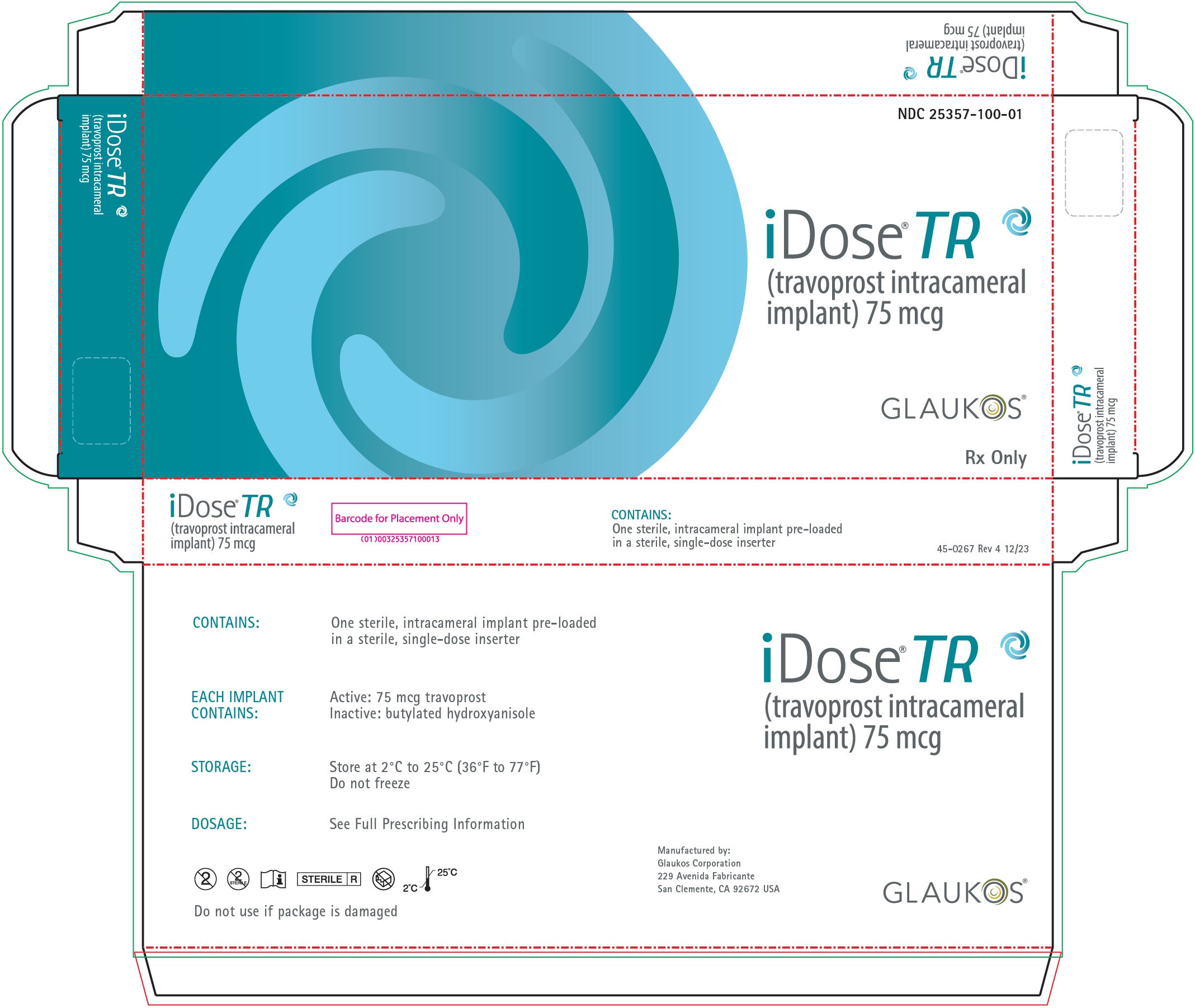
iDose TR Travoprost Intracameral 75 ug Implant, 1 implant — NDC 25357-100-01 (Billing 25357-0100-01)
This is a package of 1 implant of iDose TR Travoprost Intracameral 75 ug Implant from Glaukos Corporation, marketed since Dec 2023 and currently FDA-listed. It is the main listing for this product, which comes in 2 package sizes.
NDC database record
One package, one record: these facts belong to NDC 25357-100-01 alone.
- Record
- FDA NDC Directory package listing · Human prescription drug
- Code segments
- 25357 labeler · 100 product · 01 package
- Package marketed since
- Dec 13, 2023
- Sample package
- No — commercial package
- Listing certified through
- Dec 31, 2027
- Billing quantity
- 1 EA per package
- Barcode (UPC-A, from the NDC)
- 3 2535710001 3
- Medicaid fills, this package
- 15 prescriptions in the last four reported quarters
- FDA record last changed
- Jul 24, 2026
Identity & classification
Regulatory identifiers FDA, NLM and CMS codes for this package
Drug-database identifiers Medi-Span GPI and First Databank GCN / HICL / AHFS classification
- GSN (GCN sequence number): 085598
- GCN: 55112
- GPI-14 (Medi-Span): 86330070002320
- HICL (First Databank): 021996
- AHFS class code: 52:40.28.00
- RxCUI (RxNorm): 2672088
Where does this data come from?
- FDA openFDA NDC Directory · synced Oct 8, 2026
- FDA label on DailyMed · label index refreshed Oct 6, 2026
- RxNorm (NLM RxNav) · catalog refreshed Oct 1, 2026
- Medi-Span GPI (licensed)
- First Databank (licensed) · refreshed Oct 8, 2026
RxNorm drug class
This medicine belongs to the Prostaglandin Analog class.
Where does this data come from?
- RxClass (NLM) · catalog refreshed Oct 1, 2026
Clinical
Patient education
Supplement & herbal interactions
Where does this data come from?
- MedlinePlus (NLM) · refreshed Oct 1, 2026
- FDA label on DailyMed · label index refreshed Oct 6, 2026
Ask a licensed pharmacist directly — free, answered by our team.
Pricing
A drug doesn't have one price. Each row is a different public payment system, and none is what you'd pay at the counter — that depends on your insurance. The ⓘ on each row explains what it measures.
| Price system | Per each | Per package |
|---|---|---|
| Retail pharmacies payNADAC · weekly | Not in the retail survey — common for institutional, discontinued, or low-volume packs. | |
| Medicaid paysCMS SDUD · 12 mo | $3,542.93 | $3,542.93 / 1 implant |
| Medicare drug plans payPart D · quarterly | No Part D plan price is available for this NDC in our data. | |
| Medicare Part B allowsASP · J7355 | $196.746 / J7355 unit | — |
Where does this data come from?
- CMS NADAC weekly file
- CMS ASP pricing files · refreshed Sep 20, 2026
- CMS Medicaid State Drug Utilization Data · through Q4 2025
- CMS Part D plan pricing files · refreshed Sep 24, 2026
- VA National Acquisition Center price file
Billing & reimbursement
Where does this data come from?
- CMS ASP NDC-HCPCS crosswalk · refreshed Sep 22, 2026
- DMEPDAC NDC-HCPCS crosswalk
- openFDA NSDE billing units · refreshed Oct 7, 2026
Packaging — all sizes for this product
| Package NDC | Description | Marketing start | Marketing end | Status |
|---|---|---|---|---|
| 25357-0100-01 You're viewing this Main listing | 1 POUCH in 1 CARTON / 1 TRAY in 1 POUCH / 1 CANISTER in 1 TRAY / 1 IMPLANT in 1 CANISTER | 2023-12-13 | — | Active |
| 25357-0100-99 25357-100-99 | 1 POUCH in 1 CARTON / 1 TRAY in 1 POUCH / 1 CANISTER in 1 TRAY / 1 IMPLANT in 1 CANISTER Sample | 2026-02-17 | — | Active |
Pack size FAQ
What quantity is in this package?
How does this package differ from NDC 25357-0100-99?
What NDC number is used to bill for this package of iDose TR Travoprost Intracameral 75 ug Implant?
Therapeutic equivalents
| Product | Labeler | Pack | NADAC/unit | TE | Status | Price vs. this |
|---|---|---|---|---|---|---|
| iDose TR 75 ugthis 25357-0100-01 | Glaukos | 1 implant | — | — | FDA listed | — |
Where does this data come from?
- FDA openFDA NDC Directory · synced Oct 8, 2026
- FDA Orange Book · refreshed Oct 3, 2026
- CMS NADAC weekly file
Availability & generic status
We did not find an FDA-approved generic match for this exact strength, form and route. Patent/protection dates below may affect future generic timing.
Why the date isn’t exact: Generic timing can change because patents may be challenged, settled, licensed, added, removed, or worked around with a narrower label — and FDA approval does not always mean a pharmacy can get the generic today.
🛈 What do these terms mean?
- Patent
- Legal protection listed in the Orange Book that may delay generic approval or launch. Issued by the U.S. Patent & Trademark Office.
- Substance patent
- Covers the active drug molecule itself — the hardest to design around. A generic generally can’t launch until it expires.
- Formulation (product) patent
- Covers a specific formulation or dosage form. A generic can sometimes work around it with a different formulation.
- Method-of-use patent
- A patent covering one specific approved use of the drug — not necessarily the whole molecule. A generic can sometimes launch with a “skinny label” that carves out the protected use and keeps the others.
- Skinny label
- A generic label that omits a still-patented use when the FDA allows it — letting a generic reach the market for the unprotected uses.
- Exclusivity
- FDA-granted marketing protection, separate from patents — e.g. 5-yr new chemical entity, 7-yr orphan drug, or a +6-month pediatric extension.
- Paragraph IV
- A generic applicant’s formal challenge to a listed patent. It can potentially lead to earlier generic entry, but often involves litigation or a settlement.
- RLD / RS
- Reference Listed Drug — the brand product the FDA uses as the reference for generic applications. Reference Standard — the product the FDA expects generics to compare against in bioequivalence testing.
- TE / AB rating
- FDA therapeutic-equivalence rating. An AB rating generally means the FDA considers a generic therapeutically equivalent to — and substitutable for — the brand.
- LOE (loss of exclusivity)
- The latest patent or exclusivity currently listed — the loss-of-exclusivity / latest-listed-protection date shown on this page. Paragraph-IV challenges and settlements can move the real date earlier; FDA approval and a manufacturer’s decision to market can move it later.
Built from the FDA Orange Book. The bars above are scaled to each protection’s expiry; the red LOE marker is the last one to lapse.
| Patent | Type | Use code | Expires |
|---|---|---|---|
| US 12201557 ↗ | Drug substance | U-4129 | Jun 18, 2030 |
| US 11426306 ↗ | Drug product | — | Oct 17, 2030 |
| US 10206813 ↗ | Drug product | — | Oct 17, 2030 |
| US 12201555 ↗ | Drug substance | — | Feb 14, 2031 |
| Code | What it grants | Expires |
|---|---|---|
| NP | New Product | Dec 13, 2026 |
Is there a generic version of IDOSE TR 75 MCG IMPLANT?
The FDA approved a generic — why can’t I get it at my pharmacy yet?
Why do different websites show different generic release dates?
What does “FDA listed” mean?
What does a patent or protection date mean here?
What does “current Orange Book estimate” mean?
Can a generic come out before the last patent expires?
Can a generic come out after the listed dates?
What is the difference between patents and exclusivity?
Why are there multiple patent dates?
Where does this data come from?
- FDA Orange Book · refreshed Oct 3, 2026
Inactive Ingredients / Excipients
Inactive ingredients, also called excipients, are components of the drug product other than the active ingredient. They may include fillers, dyes, coatings, preservatives, flavors, or other formulation ingredients.
Where does this data come from?
IACT rows and label-wide narrative are kept separate; availability and product-level specificity depend on the submitted label.- FDA label on DailyMed · label index refreshed Oct 6, 2026
- FDA openFDA NDC Directory · synced Oct 8, 2026
Inactive ingredient FAQ
Are inactive ingredients the same for every manufacturer?
Why might an inactive ingredient be missing?
Can inactive ingredients matter?
Manufacturer & labeler
More NDCs from Glaukos Corporation labeler code 25357
Where does this data come from?
- FDA openFDA NDC Directory · synced Oct 8, 2026
- Drugs@FDA
Full prescribing information FDA SPL
🎯 Indications and Usage ▾
1 INDICATIONS AND USAGE iDose ® TR (travoprost intracameral implant) is indicated for the reduction of intraocular pressure (IOP) in patients with open-angle glaucoma (OAG) or ocular hypertension (OHT). iDose ® TR is a prostaglandin analog indicated for the reduction of intraocular pressure (IOP) in patients with open-angle glaucoma (OAG) or ocular hypertension (OHT) ( 1 )
⏱️ Dosage and Administration ▾
2 DOSAGE AND ADMINISTRATION For ophthalmic intracameral administration ( 2.1 ) The intracameral administration should be carried out under standard aseptic conditions ( 2.2 )
2.1General Dosing Information iDose TR is a travoprost delivery system consisting of a travoprost releasing implant pre-loaded in a sterile, single-dose inserter. iDose TR is administered intracamerally through a small, clear corneal incision and is anchored into the sclera at the iridocorneal angle.
2.2Administration Instructions 1. The procedure must be carried out under aseptic conditions which include use of sterile gloves and a sterile drape. 2.
The eye should be anesthetized using general, retrobulbar, peribulbar, or topical anesthesia per standard operating room procedures. 3. The iDose TR implantation procedure must be performed under magnification that allows clear visualization of the anterior chamber angle and angle structures including trabecular meshwork, with the patient's head in a stabilized position.
The pupil should not be dilated prior to the procedure. 4. An intracameral miotic can be injected to deepen the angle prior to insertion of the iDose TR.
5. It is recommended that the implant surgery be performed from the temporal side, using a temporal clear corneal incision. The implant will be implanted through the angle and the trabecular meshwork into the sclera on the nasal side.
6. Remove the barrier pouch from the carton and examine for damage. Open the barrier pouch, discard the oxygen scavenger packet, and remove the blister tray with Tyvek ® lid.
Open the Tyvek lid containing the iDose TR pre-loaded inserter and present to the surgeon. The iDose TR implant and single-dose inserter should be handled in the sterile field. Caution: Do not use the iDose TR if the Tyvek lid has been opened or the packaging appears damaged.
7. Prepare for gonioscopy by turning the patient's head away from the surgeon by approximately 15° to 25° and tilt the scope toward the surgeon by approximately 35°. The total combined angle should be approximately 50° to 60°.
8. Place a small amount of viscoelastic on the cornea. Position the gonioprism on the cornea using light touch gonioscopy.
Adjust the microscope to locate and focus on the trabecular meshwork. 9. Inspect the angle with a gonioprism to ensure that a good view of all angle structures is available at the nasal implant location.
10. Hold the single-dose inserter with your index finger comfortably on the implant release button (see Figure 1 ) Figure 1 11. Perform a detailed inspection of the tip of the sterile inserter under magnification to ensure that the iDose TR implant is present (see Figure 2 ).
Figure 2 12. Create a clear corneal incision of approximately 2.4 mm at the temporal limbus location using an instrument of the surgeon's choice. 13.
Add a cohesive viscoelastic to the anterior chamber as needed to form the anterior chamber and improve visualization of the angle. Be careful not to overinflate. 14.
Insertion of the implant: a. When ready for implantation, remove the safety clip which holds the release button in place by squeezing and rocking the clip backwards (see Figure 2 ). Place finger on the release button to ensure it remains in the forward position and does not prematurely release the implant. b.
To smoothly enter the anterior chamber, slide the inserter tip with implant "side to side" in the incision. c. Advance to the pupillary margin and ensure there is sufficient cohesive viscoelastic on the cornea before replacing the gonioprism onto the cornea. d. Take care to avoid contact with the lens or cornea. e.
Advance to the anterior chamber angle and approach the trabecular meshwork (see Figure 3 ). Figure 3 f. Press the implant directly through the trabecular meshwork, compressing the tissue until the implant anchor securely penetrates the sclera through the back wall of Schlemm's canal.
The base of the implant reservoir should be firmly in contact with and compressing the trabec… [Excerpted — this section continues on DailyMed.]
💊 Dosage Forms and Strengths ▾
3 DOSAGE FORMS AND STRENGTHS Intracameral implant containing 75 mcg travoprost, pre-loaded in a single-dose inserter. Intracameral implant containing 75 mcg travoprost, pre-loaded in a single-dose inserter ( 3 )
⛔ Contraindications ▾
4 CONTRAINDICATIONS Ocular or periocular infections ( 4.1 ) Corneal endothelial dystrophy ( 4.2 ) Prior corneal transplantation ( 4.3 ) Hypersensitivity ( 4.4 )
4.1Ocular or Periocular Infections iDose TR (travoprost intracameral implant) is contraindicated in patients with active or suspected ocular or periocular infections .
4.2Corneal Endothelial Dystrophy iDose TR is contraindicated in patients with corneal endothelial cell dystrophy (e.g., Fuch's Dystrophy, corneal guttatae).
4.3Prior Corneal Transplantation iDose TR is contraindicated in patients with prior corneal transplantation, or endothelial cell transplants (e.g., Descemet's Stripping Automated Endothelial Keratoplasty [DSAEK]).
4.4Hypersensitivity iDose TR is contraindicated in patients with hypersensitivity to travoprost or to any other components of the product .
⚠️ Warnings and Cautions ▾
5 WARNINGS AND PRECAUTIONS Iridocorneal Angles : iDose TR should be used with caution in patients with narrow angles or other angle abnormalities ( 5.1 ) Device Dislocation : Monitor patients routinely to confirm the location of the iDose TR at the site of administration ( 5.2 ) Pigmentation : Increased pigmentation of the iris can occur. Iris pigmentation is likely to be permanent ( 5.8 )
5.1Iridocorneal Angles iDose TR should be used with caution in patients with narrow iridocorneal angles (Shaffer grade < 3) or other angle abnormalities (e.g., peripheral anterior synechia, rubeosis iridis) that could impair proper placement of iDose TR at the planned implantation site.
5.2Device Dislocation Dislocation of the iDose TR has been observed in clinical trials. Patients should be monitored routinely to confirm the location of the iDose TR at the site of administration. If the iDose TR implant becomes dislocated, it should be surgically removed [see Dosage and Administration (2.3 , 2.4) ] .
5.3Patients without Baseline Corneal Endothelial Cell Density Prior to Initial Administration It is not recommended to readminister iDose TR if baseline central corneal endothelial cell density was not established prior to initial administration of iDose TR [see Warnings and Precautions (5.4 , 5.5) ] .
5.4Recommended Minimum Corneal Endothelial Cell Density for Readministration Central corneal endothelial cell density should not be less than the recommended minimum listed in Table 2 prior to the initial administration of iDose TR and prior to each readministration. If corneal endothelial cell density was not established prior to the initial administration of iDose TR and only a single eye was implanted, corneal endothelial cell density in the un-implanted contralateral eye meeting the recommended minimum density may be used for eligibility determination for readministration of iDose TR (see Table 2 ).
Table 2: Recommended Minimum Central Corneal Endothelial Cell Density Central Corneal Endothelial Cell Density Age Phakic Eyes Pseudophakic Eyes ≤ 45 years 2,200 (cells/mm 2 ) 1,540 (cells/mm 2 ) 46 to 55 years 2,000 (cells/mm 2 ) 1,400 (cells/mm 2 ) 56 to 65 years 1,800 (cells/mm 2 ) 1,260 (cells/mm 2 ) > 65 years 1,600 (cells/mm 2 ) 1,120 (cells/mm 2 )
5.5Corneal Endothelial Cell Loss iDose TR should be readministered with caution in eyes with 10% or greater loss in central corneal endothelial cell density from pre-administration baseline (adjusted for age-related 1% loss per year and for a 10% loss following an anterior segment surgical procedure [e.g., cataract surgery]). If baseline corneal endothelial cell density was not established prior to the initial administration of iDose TR and only a single eye is implanted, a 10% threshold level of endothelial cell density loss as a difference of the implanted eye versus un-implanted contralateral eye should be considered before readministering iDose TR.
5.6Macular Edema Macular edema, including cystoid macular edema, has been reported during treatment with ophthalmic travoprost, including iDose TR intracameral implant. iDose TR should be used with caution in aphakic patients, in pseudophakic patients with a torn posterior lens capsule, or in patients with known risk factors for macular edema.
5.7Intraocular Inflammation Prostaglandin analogs, including iDose TR, have been reported to cause intraocular inflammation. iDose TR should be used with caution in patients with active intraocular inflammation (e.g., uveitis) because the inflammation may be exacerbated.
5.8Pigmentation Topical ophthalmic travoprost has been reported to cause increased pigmentation to pigmented tissues. Pigmentation is expected to increase as long as travoprost is administered. The pigmentation change is due to increased melanin content in the melanocytes rather than to an increase in the number of melanocytes.
After discontinuation of travoprost, pigmentation of the iris is likely to be permanent. The long-term effect… [Excerpted — this section continues on DailyMed.]
🤒 Adverse Reactions ▾
6 ADVERSE REACTIONS The following adverse reactions are described elsewhere in the labeling: Ocular or periocular infections [see Contraindications ( 4.1 )] Corneal endothelial dystrophy [see Contraindications ( 4.2 )] Prior corneal transplantation [see Contraindications ( 4.3 )] Hypersensitivity [see Contraindications ( 4.4 )] Device dislocation [see Warnings and Precautions ( 5.2 )] Macular edema [see Warnings and Precautions ( 5.6 )] Intraocular inflammation [see Warnings and Precautions ( 5.7 )] Pigmentation [see Warnings and Precautions ( 5.8 )] Endophthalmitis [see Warnings and Precautions ( 5.9 )] In controlled studies, the most common ocular adverse reactions reported in 2% to 6% of patients were increases in intraocular pressure, iritis, dry eye, and visual field defects ( 6.1 ) To report SUSPECTED ADVERSE REACTIONS, contact Glaukos Corporation at 1-888-404-1644 or FDA at 1-800-FDA-1088 or www.fda.gov/medwatch.
6.1Clinical Trials Experience Because clinical trials are conducted under widely varying conditions, adverse reaction rates observed in the clinical trials of a drug cannot be directly compared to rates in the clinical trials of another drug and may not reflect the rates observed in practice. The following adverse events rates are derived from three randomized, double-masked clinical trials in which 868 patients with open angle glaucoma (OAG) or ocular hypertension (OHT) received an iDose TR and were followed for one year.
The most commonly reported ocular adverse reactions (2% to 6%) were increases in intraocular pressure, iritis, dry eye, visual field defects, eye pain, ocular hyperaemia, and reduced visual acuity. Ocular adverse reactions reported in less than 2% of patients were conjunctival hemorrhage, photophobia, punctate keratitis, blepharitis, eye irritation, corneal abrasion, device dislocation, vitreous detachment, and foreign body sensation in eyes.
👥 Use in Specific Populations ▾
8 USE IN SPECIFIC POPULATIONS
8.1Pregnancy Risk Summary There are no adequate and well-controlled studies of iDose TR (travoprost intracameral implant) administration in pregnant women to inform a drug-associated risk. Subcutaneous administration of travoprost to pregnant mice and rats throughout the period of organogenesis produced embryo-fetal lethality, spontaneous abortion, and premature delivery at potentially clinically relevant doses. Advise pregnant women of a potential risk to a fetus. iDose TR should be administered during pregnancy only if the potential benefit justifies the potential risk to the fetus.
Data Animal Data An embryo-fetal development study was conducted in pregnant rats administered travoprost once daily at doses up to 10 mcg/kg by subcutaneous injection from gestation day (GD) 6 to 17, to target the period of organogenesis. At 10 mcg/kg, 116 times the maximum human ocular dose (MHOD) of 1 implant per eye, based on body surface area (BSA), assuming sustained travoprost release from the implant for 6 months or 0.0139 mcg/kg/day, travoprost was teratogenic in rats, evidenced by an increase in the incidence of skeletal malformations as well as external and visceral malformations, including fused sternebrae, domed head and hydrocephaly.
Travoprost caused post-implantation loss at 10 mcg/kg. The fetal no observed adverse effect level (NOAEL) was 3 mcg/kg (34.5 times the maximum human ocular dose (MHOD) of 1 implant per eye, based on BSA). An embryo-fetal development study was conducted in pregnant mice administered travoprost once daily by subcutaneous injection at doses up to 1 mcg/kg from GD 6 to 16, to target the period of organogenesis.
Travoprost induced an increase in post-implantation losses and a decrease in fetal viability in mice at subcutaneous doses > 0.3 mcg/kg. The fetal NOAEL was 0.3 mcg/kg (1.7 times the MHOD based on BSA). The maternal NOAEL was 1 mcg/kg (5.8 times the MHOD based on BSA).
Pre/postnatal development studies were conducted in rats administered travoprost once daily by subcutaneous injection from GD 7 (early embryonic period) to postnatal Day 21 (end of lactation period). At doses of greater than or equal to 0.12 mcg/kg/day (1.4 times the MHOD based on BSA), the incidence of post-natal mortality was increased, and neonatal body weight was decreased. Neonatal development was also affected, evidenced by delayed eye opening, pinna detachment and preputial separation, and by decreased motor activity.
8.2Lactation Risk Summary There are no data on the effects of travoprost on the breastfed child or milk production. It is not known if travoprost is present in human milk following ophthalmic administration. The developmental and health benefits of breastfeeding should be considered, along with the mother's clinical need for iDose TR and any potential adverse effects on the breast-fed child from iDose TR.
8.4Pediatric Use The safety and effectiveness of iDose TR have not been established in pediatric patients.
8.5Geriatric Use No overall differences in safety or effectiveness have been observed between elderly and other adult patients.
🤰 Pregnancy ▾
8.1Pregnancy Risk Summary There are no adequate and well-controlled studies of iDose TR (travoprost intracameral implant) administration in pregnant women to inform a drug-associated risk. Subcutaneous administration of travoprost to pregnant mice and rats throughout the period of organogenesis produced embryo-fetal lethality, spontaneous abortion, and premature delivery at potentially clinically relevant doses. Advise pregnant women of a potential risk to a fetus. iDose TR should be administered during pregnancy only if the potential benefit justifies the potential risk to the fetus.
Data Animal Data An embryo-fetal development study was conducted in pregnant rats administered travoprost once daily at doses up to 10 mcg/kg by subcutaneous injection from gestation day (GD) 6 to 17, to target the period of organogenesis. At 10 mcg/kg, 116 times the maximum human ocular dose (MHOD) of 1 implant per eye, based on body surface area (BSA), assuming sustained travoprost release from the implant for 6 months or 0.0139 mcg/kg/day, travoprost was teratogenic in rats, evidenced by an increase in the incidence of skeletal malformations as well as external and visceral malformations, including fused sternebrae, domed head and hydrocephaly.
Travoprost caused post-implantation loss at 10 mcg/kg. The fetal no observed adverse effect level (NOAEL) was 3 mcg/kg (34.5 times the maximum human ocular dose (MHOD) of 1 implant per eye, based on BSA). An embryo-fetal development study was conducted in pregnant mice administered travoprost once daily by subcutaneous injection at doses up to 1 mcg/kg from GD 6 to 16, to target the period of organogenesis.
Travoprost induced an increase in post-implantation losses and a decrease in fetal viability in mice at subcutaneous doses > 0.3 mcg/kg. The fetal NOAEL was 0.3 mcg/kg (1.7 times the MHOD based on BSA). The maternal NOAEL was 1 mcg/kg (5.8 times the MHOD based on BSA).
Pre/postnatal development studies were conducted in rats administered travoprost once daily by subcutaneous injection from GD 7 (early embryonic period) to postnatal Day 21 (end of lactation period). At doses of greater than or equal to 0.12 mcg/kg/day (1.4 times the MHOD based on BSA), the incidence of post-natal mortality was increased, and neonatal body weight was decreased. Neonatal development was also affected, evidenced by delayed eye opening, pinna detachment and preputial separation, and by decreased motor activity.
🧒 Pediatric Use ▾
8.4Pediatric Use The safety and effectiveness of iDose TR have not been established in pediatric patients.
🧓 Geriatric Use ▾
8.5Geriatric Use No overall differences in safety or effectiveness have been observed between elderly and other adult patients.
🧬 Clinical Pharmacology ▾
12 CLINICAL PHARMACOLOGY
12.1Mechanism of Action Travoprost free acid, a prostaglandin analog is a selective FP prostanoid receptor agonist, which is believed to reduce IOP by increasing uveoscleral outflow. The exact mechanism of action is unknown at this time.
12.3Pharmacokinetics Travoprost, an isopropyl ester prodrug, is hydrolyzed by esterases in the cornea and other intraocular tissues to its biologically active free acid. Systemically, travoprost free acid is metabolized to inactive metabolites via beta-oxidation of the α (carboxylic acid) chain to give the 1,2-dinor and 1,2,3,4-tetranor analogs, via oxidation of the 15-hydroxyl moiety, as well as via reduction of the 13, 14 double bond. Data from a pharmacokinetic study of 105 subjects evaluating two models of the travoprost intracameral implant with different elution rates have shown that the plasma concentrations of travoprost free acid are below 10 pg/mL (the quantitation limit of the assay, LLOQ) in all subjects at day 10, week 12 and month 12 following administration of iDose TR.
🧬 Mechanism of Action ▾
12.1Mechanism of Action Travoprost free acid, a prostaglandin analog is a selective FP prostanoid receptor agonist, which is believed to reduce IOP by increasing uveoscleral outflow. The exact mechanism of action is unknown at this time.
📦 How Supplied / Storage and Handling ▾
16 HOW SUPPLIED/STORAGE AND HANDLING iDose TR (travoprost intracameral implant) (NDC 25357-100-01) is provided sterile and pre-loaded in a sterile, single-dose inserter that is packaged in a blister tray sealed with a Tyvek lid. Implants are individually serialized and the serial number is provided on the tray lid. The tray is sealed inside of a transparent plastic pouch along with an oxygen scavenger packet, which is packaged inside a unit carton.
Tamper evidence is provided by a seal on both ends of the carton. Storage: Store at 2°C to 25°C (36°F to 77°F). Do not freeze.
📋 Description ▾
11 DESCRIPTION iDose TR (travoprost intracameral implant) is a sterile intracameral implant containing 75 mcg of travoprost. The intracameral implant consists of a titanium implant reservoir with a membrane controlling the sustained release of travoprost. The sterile implant is pre-loaded in a sterile single-dose inserter to facilitate insertion directly through the trabecular meshwork of the anterior chamber angle into the sclera.
Travoprost is a prostaglandin analog. Its chemical name is 5-heptenoic acid, 7-[(1R,2R,3R,5S)-3,5-dihydroxy-2-[(1E,3R)-3-hydroxy-4-[3-(trifluoromethyl)phenoxy]-1-buten-1-yl]cyclopentyl]-, 1-methylethyl ester, (5Z)-. Travoprost has a molecular formula of C 26 H 35 F 3 O 6 and a molecular weight of 500.55 g/mol.
The chemical structure of travoprost is: Travoprost is a clear, colorless to slightly yellow oil that is very soluble in acetonitrile, methanol, octanol, and chloroform. It is practically insoluble in water. Figure-07
💬 Information for Patients ▾
17 PATIENT COUNSELING INFORMATION Intraocular Inflammation or Endophthalmitis Advise patients about the potential risk for complications including, but not limited to, the development of intraocular inflammation or endophthalmitis [see Warnings and Precautions ( 5.6 , 5.7 , 5.9 )]. Potential for Pigmentation Advise patients about the potential for increased brown pigmentation of the iris, which may be permanent [see Warnings and Precautions ( 5.8 )]. MR Conditional Advise patients that the implant is MR Conditional (as noted on their Patient ID card), and that if they require magnetic resonance imaging (MRI), they should inform their healthcare provider that they have iDose TR implanted in their eye [see Warnings and Precautions ( 5.10 )].
When to Seek Physician Advice Advise patients that if the eye becomes red, sensitive to light, painful, or develops a change in vision, they should seek immediate care from an ophthalmologist [see Warnings and Precautions ( 5.2 , 5.7 , 5.9 )] . Symbols that are included in the labeling of this product. Symbol Definition Catalogue/Model Number Serial Number Lot Number Do not re-use Use-by date (year-month) Do not resterilize See package insert for Full Prescribing Information Temperature limit Sterilized by e-beam irradiation For prescription use only Do not use if package is damaged MR Conditional Manufactured by Glaukos Corp., 229 Avenida Fabricante, San Clemente, CA 92672 © 2026 Glaukos.
All rights reserved. Glaukos and iDose are registered trademarks of Glaukos Corporation. All other trademarks are the property of their respective owners.
Patents www.glaukos.com/patents P-000992 Rev 2 symbol0 symbol1 symbol2 symbo13 symbo14 symbol5 symbol6 symbol7 symbol8 symbol9 symbol10 symbol11
🧬 Pharmacokinetics ▾
12.3Pharmacokinetics Travoprost, an isopropyl ester prodrug, is hydrolyzed by esterases in the cornea and other intraocular tissues to its biologically active free acid. Systemically, travoprost free acid is metabolized to inactive metabolites via beta-oxidation of the α (carboxylic acid) chain to give the 1,2-dinor and 1,2,3,4-tetranor analogs, via oxidation of the 15-hydroxyl moiety, as well as via reduction of the 13, 14 double bond. Data from a pharmacokinetic study of 105 subjects evaluating two models of the travoprost intracameral implant with different elution rates have shown that the plasma concentrations of travoprost free acid are below 10 pg/mL (the quantitation limit of the assay, LLOQ) in all subjects at day 10, week 12 and month 12 following administration of iDose TR.
🔬 Clinical Studies ▾
14 CLINICAL STUDIES iDose TR was evaluated in two multicenter, 12-month, randomized, parallel-group, double-masked, controlled clinical trials in patients with OAG or OHT. In both trials (GC-010, NCT03519386, and GC-012, NCT03868124), iDose TR was compared to twice-daily topical administration of timolol maleate ophthalmic solution, 0.5%. In the first 3 months following administration, iDose TR demonstrated an IOP change from baseline of -6.6 to -8.4 mmHg in the study eye of patients with a mean baseline IOP of 24 mmHg (see Figure 6 ).
Figure 6: Change from Baseline in Study Eye IOP (mmHg) and Treatment Difference Study GC-010 Study GC-012 iDose TR demonstrated non-inferiority to timolol ophthalmic solution in IOP reduction during the first 3 months. Subsequently, iDose TR did not demonstrate non-inferiority over the next 9 months. Figure-07 Figure-08
🧪 Nonclinical Toxicology ▾
13 NONCLINICAL TOXICOLOGY
13.1Carcinogenesis, Mutagenesis, Impairment of Fertility Carcinogenesis Two-year carcinogenicity studies in mice and rats at subcutaneous doses of 10, 30, or 100 mcg/kg/day did not show any evidence of carcinogenic potential. However, at 100 mcg/kg/day, male rats were only treated for 82 weeks, and the maximum tolerated dose (MTD) was not reached in the mouse study. The high dose (100 mcg/kg) represents > 500 times the MHOD based on BSA.
Mutagenesis Travoprost was not mutagenic in the Ames test, mouse micronucleus test or rat chromosome aberration assay. A slight increase in the mutant frequency was observed in one of two mouse lymphoma assays in the presence of rat S-9 activation enzymes. Fertility Travoprost did not affect mating or fertility indices in male or female rats at subcutaneous doses up to 10 mcg/kg/day (116 times the MHOD based on BSA) At 10 mcg/kg/day (116 times the MHOD based on BSA), the mean number of corpora lutea was reduced, and the post-implantation losses were increased.
These effects were not observed at 3 mcg/kg/day (34.5 times the MHOD based on BSA).
📄 Carcinogenesis, Mutagenesis, Impairment of Fertility ▾
13.1Carcinogenesis, Mutagenesis, Impairment of Fertility Carcinogenesis Two-year carcinogenicity studies in mice and rats at subcutaneous doses of 10, 30, or 100 mcg/kg/day did not show any evidence of carcinogenic potential. However, at 100 mcg/kg/day, male rats were only treated for 82 weeks, and the maximum tolerated dose (MTD) was not reached in the mouse study. The high dose (100 mcg/kg) represents > 500 times the MHOD based on BSA.
Mutagenesis Travoprost was not mutagenic in the Ames test, mouse micronucleus test or rat chromosome aberration assay. A slight increase in the mutant frequency was observed in one of two mouse lymphoma assays in the presence of rat S-9 activation enzymes. Fertility Travoprost did not affect mating or fertility indices in male or female rats at subcutaneous doses up to 10 mcg/kg/day (116 times the MHOD based on BSA) At 10 mcg/kg/day (116 times the MHOD based on BSA), the mean number of corpora lutea was reduced, and the post-implantation losses were increased.
These effects were not observed at 3 mcg/kg/day (34.5 times the MHOD based on BSA).
📄 Recent Major Changes ▾
Dosage and Administration ( 2.1 , 2.2 , 2.3 , 2.4 , 2.5 ) 1/2026 Warnings and Precautions ( 5.3 , 5.4 , 5.5 ) 1/2026
📄 Package Label / Principal Display Panel ▾
PRINCIPAL DISPLAY PANEL - NDC: 25357-100-01 - 75 mcg Carton Labeling PRINCIPAL DISPLAY PANEL - NDC: 25357-100-01 - 75 mcg Carton Labeling
PRINCIPAL DISPLAY PANEL - NDC: 25357-100-01 - 75 mcg Carton Labeling - Physician Sample NDC 25357-100-99 SAMPLE - NOT FOR SALE iDose ® TR (travoprost intracameral implant) 75 mcg GLAUKOS ® Rx Only PRINCIPAL DISPLAY PANEL - NDC: 25357-100-01 - 75 mcg Carton Labeling - Physician Sample
Medicaid utilization & spend
Medicaid utilization by pack size
Reported adverse events (FAERS)
Top reported reactions
Reporter sex
Where does this data come from?
About this NDC listing & data coverage
What data is (and isn’t) available for this NDC — tap to expand
| NDC identity (package / product / labeler codes) | ✓ Available |
| Labeler | ✓ Available |
| Product & package description | ✓ Available |
| Marketing category & status | ✓ Available |
| Active ingredient / dosage form / route | ✓ Available |
| FDA label (SPL via DailyMed) | ✓ Available |
| Package photos | ✓ Available |
| Inactive ingredients (structured) | — Not published for this NDC The labeler did not submit a structured excipient list, or no SPL is available. |
| NADAC pharmacy acquisition price (CMS) | — Not published for this NDC CMS publishes NADAC only for NDCs reported in its retail-pharmacy survey. |
| Orange Book / therapeutic-equivalence data | ✓ Available |
| HCPCS J-code billing crosswalk | ✓ Available |
| Medicaid utilization (CMS SDUD) | ✓ Available |