
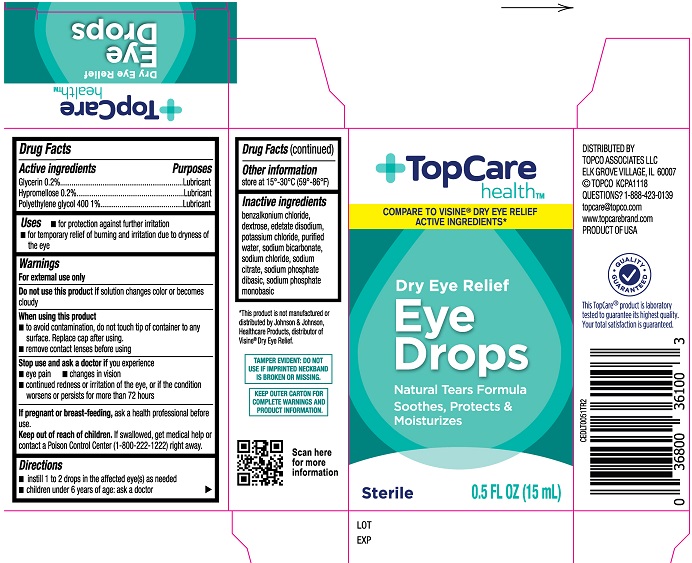
TopCare Health Dry Eye Relief Eye Drops glycerin, hypromellose, polyethylene glycol 400 400 1 g/100mL; .2 g/100mL; .2 g/100mL Solution — NDC 36800-845-01 (Billing 36800-0845-01)
This is a package of TopCare Health Dry Eye Relief Eye Drops glycerin, hypromellose, polyethylene glycol 400 400 1 g/100mL; .2 g/100mL; .2 g/100mL Solution from Topco Associates LLC, marketed since Feb 2020 and currently FDA-listed. It is this product's only package size.
NDC database record
One package, one record: these facts belong to NDC 36800-845-01 alone.
- Record
- FDA NDC Directory package listing · Human OTC drug
- Code segments
- 36800 labeler · 845 product · 01 package
- Package marketed since
- Feb 6, 2020
- Sample package
- No — commercial package
- Listing certified through
- Dec 31, 2026
- Barcode (UPC)
- 0036800361003
- FDA record last changed
- Aug 27, 2026
Other active recalls for Glycerin, Hypromellose, Polyethylene Glycol 400 (different manufacturers) — 1 · tap to view
Identity & classification
Regulatory identifiers FDA, NLM and CMS codes for this package
- RxCUI (RxNorm): 259581
Where does this data come from?
- FDA openFDA NDC Directory · synced Oct 8, 2026
- FDA label on DailyMed · label index refreshed Oct 6, 2026
- RxNorm (NLM RxNav) · catalog refreshed Oct 1, 2026
- Medi-Span GPI (licensed)
- First Databank (licensed) · refreshed Oct 8, 2026
RxNorm drug class
This medicine belongs to the Viscoelastic substances class.
Where does this data come from?
- RxClass (NLM) · catalog refreshed Oct 1, 2026
Clinical
TopCare Health Dry Eye Relief is an over-the-counter eye drop solution containing three lubricating agents: glycerin, hypromellose, and polyethylene glycol 400. These ingredients are commonly used together in artificial tear products to help moisturize and coat the surface of the eye. This product is formulated as an OTC monograph drug, meaning it follows FDA's established safety and use guidelines for its category rather than being individually approved through a new drug application.
Patient education
Supplement & herbal interactions
Where does this data come from?
- MedlinePlus (NLM) · refreshed Oct 1, 2026
- FDA label on DailyMed · label index refreshed Oct 6, 2026
Ask a licensed pharmacist directly — free, answered by our team.
Pricing
A drug doesn't have one price. Each row is a different public payment system, and none is what you'd pay at the counter — that depends on your insurance. The ⓘ on each row explains what it measures.
| Price system | Per mL | Per package |
|---|---|---|
| Retail pharmacies payNADAC · weekly | Not in the retail survey — common for institutional, discontinued, or low-volume packs. | |
| Medicaid paysCMS SDUD · 12 mo | No recent Medicaid claims on file for this NDC — rare and low-volume NDCs are suppressed in the public data. | |
| Medicare drug plans payPart D · quarterly | No Part D plan price is available for this NDC in our data. | |
Where does this data come from?
- CMS NADAC weekly file
- CMS ASP pricing files · refreshed Sep 20, 2026
- CMS Medicaid State Drug Utilization Data · refreshed Oct 8, 2026
- CMS Part D plan pricing files · refreshed Sep 24, 2026
- VA National Acquisition Center price file
Packaging — all sizes for this product
| Package NDC | Description | Marketing start | Marketing end | Status |
|---|---|---|---|---|
| 36800-0845-01 You're viewing this Main listing | 1 BOTTLE, DROPPER in 1 CARTON / 15 mL in 1 BOTTLE, DROPPER | 2020-02-06 | — | Active |
Therapeutic equivalents
Where does this data come from?
- FDA openFDA NDC Directory · synced Oct 8, 2026
- FDA Orange Book · refreshed Oct 3, 2026
- CMS NADAC weekly file
Availability & generic status
We did not find an FDA-approved generic match for this exact strength, form and route.
Where does this data come from?
- FDA Orange Book · refreshed Oct 3, 2026
Inactive Ingredients / Excipients
Inactive ingredients, also called excipients, are components of the drug product other than the active ingredient. They may include fillers, dyes, coatings, preservatives, flavors, or other formulation ingredients.
💡 Tap an ingredient (hover on desktop) to see what it is and why it’s used.
-
UNII F5UM2KM3W7
Benzalkonium chloride is a chemical compound that works as a preservative and antimicrobial agent in medications. It prevents bacterial and fungal growth in liquid formulations to keep the product safe during storage and use.
-
UNII IY9XDZ35W2
Dextrose is a simple sugar derived from corn or other sources. It serves as a filler and sweetener in medicines to add bulk, improve taste, and help stabilize the medication's form.
-
UNII 7FLD91C86K
Edetate disodium is a chemical compound that binds and removes certain metal ions. In medicines, it acts as a preservative and stabilizer by preventing metals like calcium from interfering with the product's shelf life and consistency.
-
UNII 660YQ98I10
Potassium chloride is a mineral salt used in medicines as a buffer and to help maintain the proper pH balance and stability of the formulation during storage and use.
-
UNII 8MDF5V39QO
A white powder form of baking soda that acts as a buffer and pH regulator in medicines. It helps maintain the right acid-base balance and may aid tablet disintegration.
-
UNII 451W47IQ8X
Sodium chloride is common table salt. It's used in medicines as a buffer to maintain proper pH, as a filler to add bulk, or to adjust the osmotic balance in liquid formulations.
-
UNII 1Q73Q2JULR
Sodium citrate is a salt derived from citric acid. It works as a buffer to maintain the medicine's pH level and may also help improve taste or act as a preservative in the formulation.
-
UNII GR686LBA74
Sodium phosphate, dibasic is a salt derived from phosphoric acid. It acts as a buffer to help maintain the medicine's pH balance and may serve as a binder or filler in tablets and capsules.
-
UNII 3980JIH2SW
A salt form of phosphoric acid that acts as a buffer and pH adjuster in medicines. It helps keep the product at the correct acidity level for stability and effectiveness.
-
UNII 059QF0KO0R
Water is a liquid solvent that dissolves and mixes ingredients together in liquid medicines, syrups, and injections. It helps distribute the active drug evenly throughout the product.
10 inactive ingredients listed in the exact product block matched to this NDC.
Label-section wording can be broader than the structured product block and may mention additional formulation ingredients.
Where does this data come from?
ingredient classCode="IACT" elements from the exact product block matched by this NDC. Label-section narrative from DailyMed / the openFDA label index is shown separately when available.- FDA label on DailyMed · label index refreshed Oct 6, 2026
- FDA openFDA NDC Directory · synced Oct 8, 2026
Inactive ingredient FAQ
Are inactive ingredients the same for every manufacturer?
Why might an inactive ingredient be missing?
Can inactive ingredients matter?
Manufacturer & labeler
More NDCs from Topco Associates LLC labeler code 36800
- sugar free honey lemon cough drops menthol 7.6 mg Lozenge NDC 36800-822-25
- Topcare Miconazole 7 Miconazole nitrate 2 g/100g Cream NDC 36800-825-29
- Cherry Sore Throat Lozenge Benzocaine 3.6 mg; 15 mg Lozenge NDC 36800-832-18
- TopCare Earwax Removal Kit CARBAMIDE PEROXIDE 65 mg/mL Liquid NDC 36800-835-33
- Mixed Berry Sore Throat Lozenges Benzocaine 7.5 mg; 5 mg Lozenge NDC 36800-836-18
- Awake Maximum Strength Caffeine 200 mg Tablet, Film Coated NDC 36800-844-11
- Top Care Ear Relief Ear Drops CHAMOMILE, MERCURIUS SOLUBILIS, SULFUR 10 [hp_X]/mL; 15 [hp_X]/mL; 12 [hp_X]/mL Solution/ Drops NDC 36800-846-07
- topcare tussin dm max Dextromethorphan HBr, Guaifenesin 20 mg/20mL; 400 mg/20mL Solution NDC 36800-847-26
- Topcare Allergy Relief loratadine 10 mg Tablet, Orally Disintegrating NDC 36800-853-65
- Topcare Health Ultra Itch Relief Astringent Eye Drops tetrahydrozoline HCl, zinc sulfate .05 g/100mL; .25 g/100mL Solution NDC 36800-855-01
- TopCare Health Advanced Moisturizing Plus Redness Relief dextran 70, polyethylene glycol 400, povidone, tetrahydrozoline HCl 1 g/100mL; .05 g/100mL; 400 1 g/100mL; 70 .1 g/100mL Solution NDC 36800-856-01
- TopCare Health Original Eye Drops tetrahydrozoline HCl .05 g/100mL Solution NDC 36800-858-01
Where does this data come from?
- FDA openFDA NDC Directory · synced Oct 8, 2026
- Drugs@FDA
FDA label — Drug Facts FDA SPL
🎯 Indications and Usage ▾
Uses for protection against further irritation for temporary relief of burning and irritation due to dryness of the eye
⏱️ Dosage and Administration ▾
Directions instill 1 to 2 drops in the affected eye(s) as needed children under 6 years of age: ask a doctor
⚠️ Warnings ▾
Warnings For external use onl y Do not use this product if solution changes color or becomes cloudy When using this product to avoid contamination, do not touch tip of container to any surface. Replace cap after using. Stop use and ask a doctor if you experience eye pain changes in vision continued redness or irritation of the eye, or if the condition worsens or persists for more than 72 hours If pregnant or breast-feeding, ask a health professional before use.
Keep out of reach of children. If swallowed , get medical help or contact a Poison Control Center (1-800-222-1222), right away.
🧪 Active Ingredient ▾
Active ingredients Glycerin ................... 0.2% Hypromellose ........... 0.2% Polyethylene glycol 400 ......1%
🧪 Inactive Ingredients ▾
Inactive ingredients benzalkonium chloride, dextrose, edetate disodium, potassium chloride, purified water, sodium bicarbonate, sodium chloride, sodium citrate, sodium phosphate dibasic, sodium phosphate monobasic
🎯 Purpose ▾
Purposes Glycerin.......................Lubricant Hypromellose..............Lubricant Polyethylene glycol 400.........Lubricant
📄 Do Not Use ▾
Do not use this product if solution changes color or becomes cloudy
📄 When Using This Product ▾
When using this product to avoid contamination, do not touch tip of container to any surface. Replace cap after using.
📄 Stop Use and Ask a Doctor If ▾
Stop use and ask a doctor if you experience eye pain changes in vision continued redness or irritation of the eye, or if the condition worsens or persists for more than 72 hours
🤰 If Pregnant or Breast-Feeding ▾
If pregnant or breast-feeding, ask a health professional before use.
📄 Keep Out of Reach of Children ▾
Keep out of reach of children. If swallowed , get medical help or contact a Poison Control Center (1-800-222-1222), right away.
📄 Other Information ▾
Other information store at 15º-30ºC (59º-86ºF)
📄 Package Label / Principal Display Panel ▾
carton
Reported adverse events (FAERS)
Top reported reactions
Reporter sex
Serious outcomes
Where does this data come from?
About this NDC listing & data coverage
What data is (and isn’t) available for this NDC — tap to expand
| NDC identity (package / product / labeler codes) | ✓ Available |
| Labeler | ✓ Available |
| Product & package description | ✓ Available |
| Marketing category & status | ✓ Available |
| Active ingredient / dosage form / route | ✓ Available |
| FDA label (SPL via DailyMed) | ✓ Available |
| Package photos | ✓ Available |
| Inactive ingredients (structured) | ✓ Available |
| NADAC pharmacy acquisition price (CMS) | — Not published for this NDC CMS publishes NADAC only for NDCs reported in its retail-pharmacy survey. |
| Orange Book / therapeutic-equivalence data | — Not published for this NDC Applies only to products approved under an NDA/ANDA; many listings are out of scope. |
| HCPCS J-code billing crosswalk | — Not published for this NDC Most self-administered / retail products have no J-code — that is normal. |
| Medicaid utilization (CMS SDUD) | — Not published for this NDC CMS reports utilization only for NDCs with Medicaid claims above its privacy threshold. |