
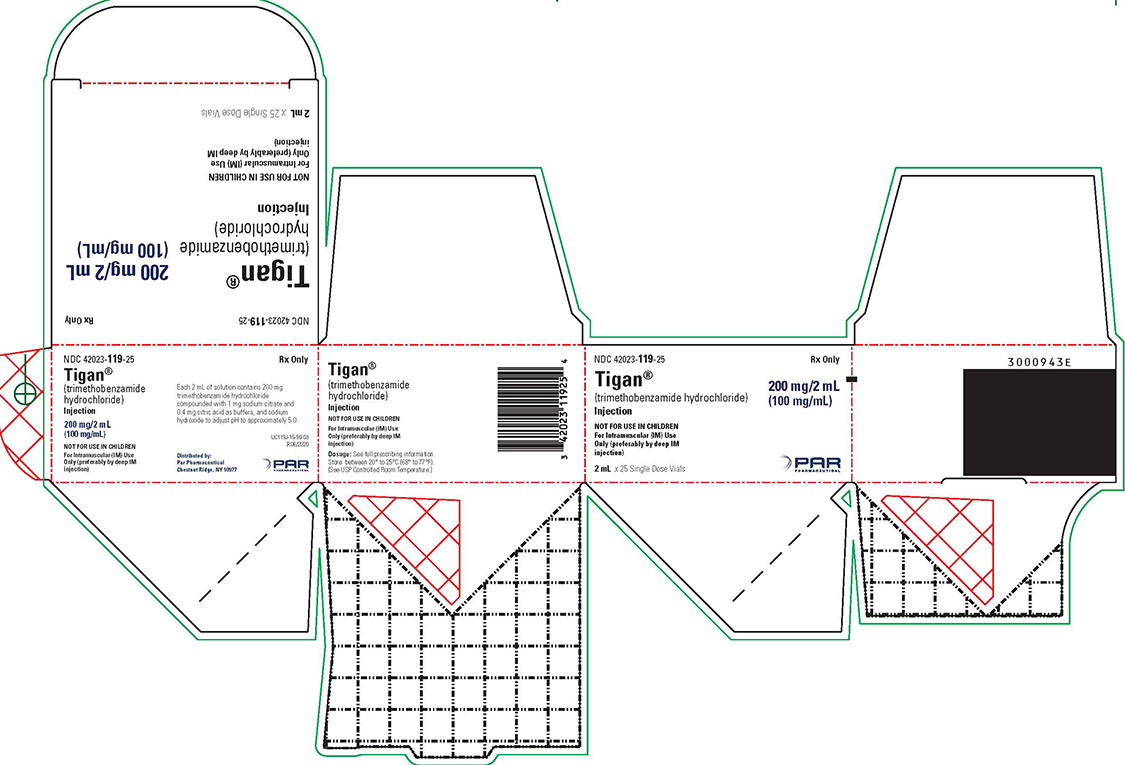
Tigan trimethobenzamide hydrochloride 100 mg/mL Injection — NDC 42023-119-25 (Billing 42023-0119-25)
This is a package of Tigan trimethobenzamide hydrochloride 100 mg/mL Injection from Par Health USA, LLC, marketed since Aug 2008 and currently FDA-listed. It is this product's only package size.
NDC database record
One package, one record: these facts belong to NDC 42023-119-25 alone.
- Record
- FDA NDC Directory package listing · Human prescription drug
- Code segments
- 42023 labeler · 119 product · 25 package
- Package marketed since
- Aug 1, 2008
- Sample package
- No — commercial package
- Listing certified through
- Dec 31, 2027
- Barcode (UPC-A, from the NDC)
- 3 4202311925 4
- Medicaid fills, this package
- 1,289 prescriptions in the last four reported quarters
- FDA record last changed
- Jul 24, 2026
Identity & classification
Regulatory identifiers FDA, NLM and CMS codes for this package
Drug-database identifiers Medi-Span GPI and First Databank GCN / HICL / AHFS classification
- GSN (GCN sequence number): 004688
- GCN: 18041
- GPI-14 (Medi-Span): 50200070102005
- HICL (First Databank): 001952
- AHFS class code: 56:22.08.00
- RxCUI (RxNorm): 1726680
Where does this data come from?
- FDA openFDA NDC Directory · synced Oct 1, 2026
- FDA label on DailyMed · label index refreshed Oct 6, 2026
- RxNorm (NLM RxNav) · catalog refreshed Oct 1, 2026
- Medi-Span GPI (licensed)
- First Databank (licensed) · refreshed Oct 1, 2026
RxNorm drug class
This medicine belongs to the Antiemetic class.
Where does this data come from?
- RxClass (NLM) · catalog refreshed Oct 1, 2026
Clinical
- It's an anti-nausea medication approved for adults to treat two specific situations: nausea and vomiting after surgery, and nausea caused by gastroenteritis — that stomach bug that...
- What exactly does trimethobenzamide treat?
- That depends on what you're taking. Trimethobenzamide can interact with a number of common drugs — including sleep aids, opioid painkillers, anti-anxiety medications, and antipsych...
- Can I take this with my other medications?
Patient education
Supplement & herbal interactions
Where does this data come from?
- MedlinePlus (NLM) · refreshed Oct 1, 2026
- FDA label on DailyMed · label index refreshed Oct 6, 2026
Ask a licensed pharmacist directly — free, answered by our team.
Pricing
A drug doesn't have one price. Each row is a different public payment system, and none is what you'd pay at the counter — that depends on your insurance. The ⓘ on each row explains what it measures.
| Price system | Per each | Per package |
|---|---|---|
| Retail pharmacies payNADAC · weekly | Not in the retail survey — common for institutional, discontinued, or low-volume packs. | |
| Medicaid paysCMS SDUD · 12 mo | $49.93 | $1,248.15 / 25 vials |
| Medicare drug plans payPart D · quarterly | No Part D plan price is available for this NDC in our data. | |
| Medicare Part B allowsASP · J3250 | $62.935 / J3250 unit | — |
Where does this data come from?
- CMS NADAC weekly file
- CMS ASP pricing files · refreshed Sep 20, 2026
- CMS Medicaid State Drug Utilization Data · through Q1 2026
- CMS Part D plan pricing files · refreshed Sep 24, 2026
- VA National Acquisition Center price file
Billing & reimbursement
Where does this data come from?
- CMS ASP NDC-HCPCS crosswalk · refreshed Sep 22, 2026
- DMEPDAC NDC-HCPCS crosswalk
- openFDA NSDE billing units · refreshed Sep 7, 2026
Packaging — all sizes for this product
| Package NDC | Description | Marketing start | Marketing end | Status |
|---|---|---|---|---|
| 42023-0119-25 You're viewing this Main listing | 25 VIAL, SINGLE-DOSE in 1 TRAY / 2 mL in 1 VIAL, SINGLE-DOSE | 2008-08-01 | — | Active |
Therapeutic equivalents
| Product | Labeler | Pack | NADAC/unit | TE | Status | Price vs. this |
|---|---|---|---|---|---|---|
| Tigan 100 mg/mL 00404-9964-02 | Henry | 1 vial | — | AP | FDA listed | — |
| Tigan 100 mg/mLthis 42023-0119-25 | Par | 25 vials | — | AP | FDA listed | — |
| Tigan(R) (Trimethobenzamide Hydrochloride) 100 mg/mL 51662-1430-01 | HF | 2 ml | — | AP | FDA listed | — |
| Trimethobenzamide Hydrochloride 100 mg/mL 54288-0158-25 | BPI | 25 vials | — | AP | FDA listed | — |
Where does this data come from?
- FDA openFDA NDC Directory · synced Oct 1, 2026
- FDA Orange Book · refreshed Oct 3, 2026
- CMS NADAC weekly file
Availability & generic status
The FDA lists approved generic versions of this medicine, but that does not always mean a pharmacy can get one today. Patent rules, launch agreements, supply and pricing can affect when generics actually arrive.
Where does this data come from?
- FDA Orange Book · refreshed Oct 3, 2026
Inactive Ingredients / Excipients
Inactive ingredients, also called excipients, are components of the drug product other than the active ingredient. They may include fillers, dyes, coatings, preservatives, flavors, or other formulation ingredients.
🧪 Avoiding an ingredient? See Trimethobenzamide inactive ingredients by manufacturer: every current product's list side by side, so you can ask your pharmacy for the version that does not list it.
💡 Tap an ingredient (hover on desktop) to see what it is and why it’s used.
-
0.2 mg / 1 mL
UNII 2968PHW8QP
A weak organic acid derived from citrus fruits or made through fermentation. It works as a buffer to control pH, a preservative to extend shelf life, and a flavoring agent in medications.
-
0.5 mg / 1 mL
UNII 1Q73Q2JULR
Sodium citrate is a salt derived from citric acid. It works as a buffer to maintain the medicine's pH level and may also help improve taste or act as a preservative in the formulation.
2 inactive ingredients listed in the exact product block matched to this NDC.
Where does this data come from?
ingredient classCode="IACT" elements from the exact product block matched by this NDC. Label-section narrative from DailyMed / the openFDA label index is shown separately when available.- FDA label on DailyMed · label index refreshed Oct 6, 2026
- FDA openFDA NDC Directory · synced Oct 1, 2026
Inactive ingredient FAQ
Are inactive ingredients the same for every manufacturer?
Why might an inactive ingredient be missing?
Can inactive ingredients matter?
Manufacturer & labeler
More NDCs from Par Health USA, LLC labeler code 42023
- Delestrogen estradiol valerate 10 mg/mL Injection NDC 42023-110-01
- Delestrogen estradiol valerate 20 mg/mL Injection NDC 42023-111-01
- Ketalar ketamine hydrochloride 10 mg/mL Injection NDC 42023-113-10
- Ketalar ketamine hydrochloride 50 mg/mL Injection NDC 42023-114-10
- Ketalar ketamine hydrochloride 100 mg/mL Injection NDC 42023-115-10
- Pitocin oxytocin 10 [iU]/mL Injection NDC 42023-116-02
- Dantrium dantrolene sodium 20 mg/60mL Injection NDC 42023-123-06
- Dantrium dantrolene sodium 25 mg Capsule NDC 42023-124-01
- Fluphenazine Decanoate 25 mg/mL Injection, Solution NDC 42023-129-01
- Pitocin oxytocin 10 [iU]/mL Injection NDC 42023-130-06
- Dexmedetomidine Hydrochloride 100 ug/mL Injection, Solution, Concentrate NDC 42023-146-25
- ETHACRYNATE SODIUM 50 mg/50mL Injection, Powder, For Solution NDC 42023-157-01
Where does this data come from?
- FDA openFDA NDC Directory · synced Oct 1, 2026
- Drugs@FDA
Full prescribing information FDA SPL
🎯 Indications and Usage ▾
INDICATIONS Tigan ® is indicated for the treatment of postoperative nausea and vomiting and for nausea associated with gastroenteritis.
⏱️ Dosage and Administration ▾
DOSAGE AND ADMINISTRATION (See WARNINGS and PRECAUTIONS .) Dosage should be adjusted according to the indication for therapy, severity of symptoms and the response of the patient. Geriatric Patients Dose adjustment such as reducing the total dose administered at each dosing or increasing the dosing interval should be considered in elderly patients with renal impairment (creatinine clearance ≤ 70 mL/min/1.73m 2 ). Final dose adjustment should be based upon integration of clinical efficacy and safety considerations.
(See CLINICAL PHARMACOLOGY and PRECAUTIONS ). Patients with Renal Impairment In subjects with renal impairment (creatinine clearance ≤ 70 mL/min/1.73m 2 ), dose adjustment such as reducing the total dose administered at each dosing or increasing the dosing interval should be considered. (See CLINICAL PHARMACOLOGY and DOSAGE AND ADMINISTRATION ).
INJECTABLE, 100 mg/mL (Not for use in pediatric patients) Usual Adult Dosage 2 mL (200 mg) t.i.d. or q.i.d. intramuscularly. NOTE: The injectable form is intended for intramuscular administration only; it is not recommended for intravenous use. Intramuscular administration may cause pain, stinging, burning, redness and swelling at the site of injection.
Such effects may be minimized by deep injection into the upper outer quadrant of the gluteal region, and by avoiding the escape of solution along the route.
⛔ Contraindications ▾
CONTRAINDICATIONS The injectable form of Tigan ® is contraindicated in pediatric patients and in patients with known hypersensitivity to trimethobenzamide.
⚠️ Warnings ▾
WARNINGS Tigan ® may produce drowsiness. Patients should not operate motor vehicles or other dangerous machinery until their individual responses have been determined. Usage in Pregnancy: Trimethobenzamide hydrochloride was studied in reproduction experiments in rats and rabbits and no teratogenicity was suggested.
The only effects observed were an increased percentage of embryonic resorptions or stillborn pups in rats administered 20 mg and 100 mg/kg and increased resorptions in rabbits receiving 100 mg/kg. In each study these adverse effects were attributed to one or two dams. The relevance to humans is not known.
Since there is no adequate experience in pregnant or lactating women who have received this drug, safety in pregnancy or in nursing mothers has not been established. Usage with Alcohol: Concomitant use of alcohol with Tigan ® may result in an adverse drug interaction.
🤒 Adverse Reactions ▾
ADVERSE REACTIONS There have been reports of hypersensitivity reactions and Parkinson-like symptoms. There have been instances of hypotension reported following parenteral administration to surgical patients. There have been reports of blood dyscrasias, blurring of vision, coma, convulsions, depression of mood, diarrhea, disorientation, dizziness, drowsiness, headache, jaundice, muscle cramps and opisthotonos.
If these occur, the administration of the drug should be discontinued. Allergic-type skin reactions have been observed; therefore, the drug should be discontinued at the first sign of sensitization. While these symptoms will usually disappear spontaneously, symptomatic treatment may be indicated in some cases.
For medical advice about adverse reactions contact your medical professional. To report SUSPECTED ADVERSE REACTIONS, contact Par Health at 1-800-828-9393 or FDA at 1-800-FDA-1088 (1-800-332-1088) or www.fda.gov/medwatch.
🤰 Pregnancy ▾
Usage in Pregnancy: Trimethobenzamide hydrochloride was studied in reproduction experiments in rats and rabbits and no teratogenicity was suggested. The only effects observed were an increased percentage of embryonic resorptions or stillborn pups in rats administered 20 mg and 100 mg/kg and increased resorptions in rabbits receiving 100 mg/kg. In each study these adverse effects were attributed to one or two dams.
The relevance to humans is not known. Since there is no adequate experience in pregnant or lactating women who have received this drug, safety in pregnancy or in nursing mothers has not been established.
🧓 Geriatric Use ▾
Geriatric Use Clinical studies of trimethobenzamide hydrochloride did not include sufficient numbers of patients aged 65 and over to determine whether they respond differently from younger patients. Although there are studies reported in the literature that include elderly patients > 65 years old with younger patients, it is not known if there are differences in efficacy or safety parameters for elderly and non-elderly patients treated with trimethobenzamide. In general, dose selection for an elderly patient should be cautious, usually starting at the low end of the dosing range, reflecting the greater frequency of decreased hepatic, renal, or cardiac function, and of concomitant disease or other drug therapy.
This drug is known to be substantially excreted by the kidney, and the risk of toxic reactions to this drug may be greater in patients with impaired renal function. Because elderly patients are more likely to have decreased renal function, care should be taken in dose selection, and it may be useful to monitor renal function. (See CLINICAL PHARMACOLOGY and DOSAGE AND ADMINISTRATION ).
🧬 Clinical Pharmacology ▾
CLINICAL PHARMACOLOGY Mechanism of Action The mechanism of action of Tigan ® as determined in animals is obscure, but may involve the chemoreceptor trigger zone (CTZ), an area in the medulla oblongata through which emetic impulses are conveyed to the vomiting center; direct impulses to the vomiting center apparently are not similarly inhibited. In dogs pretreated with trimethobenzamide HCl, the emetic response to apomorphine is inhibited, while little or no protection is afforded against emesis induced by intragastric copper sulfate.
Pharmacokinetics The pharmacokinetics of trimethobenzamide have been studied in healthy adult subjects. Following administration of 200 mg (100 mg/mL) Tigan IM injection, the time to reach maximum plasma concentration (T max ) was about half an hour, about 15 minutes longer for Tigan 300 mg oral capsule than an IM injection. A single dose of Tigan 300 mg oral capsule provided a plasma concentration profile of trimethobenzamide similar to Tigan 200 mg IM.
The relative bioavailability of the capsule formulation compared to the solution is 100%. The mean elimination half-life of trimethobenzamide is 7 to 9 hours. Between 30 – 50% of a single dose in humans is excreted unchanged in the urine within 48 – 72 hours.
The metabolic disposition of trimethobenzamide in humans is not known. Specifically, it is not known if active metabolites are generated in humans. Special Populations Age The clearance of trimethobenzamide is not known in patients with renal impairment.
However, it may be advisable to consider reduction in the dosing of trimethobenzamide in elderly patients with renal impairment considering that a substantial amount of excretion and elimination of trimethobenzamide occurs via the kidney and that elderly patients may have various degrees of renal impairment. (See PRECAUTIONS: General and DOSAGE AND ADMINISTRATION ). Gender Systemic exposure to trimethobenzamide was similar between men (N=40) and women (N=28).
Race Pharmacokinetics appeared to be similar for Caucasians (N=53) and African Americans (N=12). Renal Impairment The clearance of trimethobenzamide is not known in patients with renal impairment. However, it may be advisable to consider reduction in the dosing of trimethobenzamide in patients with renal impairment considering that a substantial amount of excretion and elimination of trimethobenzamide occurs via the kidney.
(See PRECAUTIONS: General and DOSAGE AND ADMINISTRATION ).
🧬 Mechanism of Action ▾
Mechanism of Action The mechanism of action of Tigan ® as determined in animals is obscure, but may involve the chemoreceptor trigger zone (CTZ), an area in the medulla oblongata through which emetic impulses are conveyed to the vomiting center; direct impulses to the vomiting center apparently are not similarly inhibited. In dogs pretreated with trimethobenzamide HCl, the emetic response to apomorphine is inhibited, while little or no protection is afforded against emesis induced by intragastric copper sulfate.
📦 How Supplied / Storage and Handling ▾
HOW SUPPLIED Tigan ® (trimethobenzamide hydrochloride) is available as follows: NDC 42023-119-25 200 mg/2mL (100 mg/mL) in 2 mL Single-Dose Vials. Discard Unused Portion. Pack of 25
📦 Storage and Handling ▾
STORAGE Store between 20°C to 25°C (68°F to 77°F). (See USP Controlled Room Temperature.)
📋 Description ▾
DESCRIPTION Chemically, trimethobenzamide hydrochloride (HCl) is N-[ p -[2-(dimethylamino)ethoxy]benzyl]-3,4,5-trimethoxybenzamide monohydrochloride. It has a molecular weight of 424.93 and the following structural formula: Single Dose Vials: Each 2-mL single-dose vial contains 200 mg trimethobenzamide hydrochloride compounded with 0.878 mg sodium citrate and 0.4 mg citric acid monohydrate as buffers and pH adjusted to approximately 5.0 with sodium hydroxide and citric acid solution. Chemical Structure
⚠️ Precautions ▾
PRECAUTIONS During the course of acute febrile illness, encephalitides, gastroenteritis, dehydration and electrolyte imbalance, especially in children and the elderly or debilitated, CNS reactions such as opisthotonos, convulsions, coma and extrapyramidal symptoms have been reported with and without use of Tigan ® (trimethobenzamide hydrochloride) or other antiemetic agents. In such disorders caution should be exercised in administering Tigan ® , particularly to patients who have recently received other CNS-acting agents (phenothiazines, barbiturates, belladonna derivatives).
Primary emphasis should be directed toward the restoration of body fluids and electrolyte balance, the relief of fever and relief of the causative disease process. Overhydration should be avoided since it may result in cerebral edema. The antiemetic effects of Tigan ® may render diagnosis more difficult in such conditions as appendicitis and obscure signs of toxicity due to overdosage of other drugs.
General Adjustment of Dose in Renal Failure A substantial route of elimination of unchanged trimethobenzamide is via the kidney. Dosage adjustment should be considered in patients with reduced renal function including some elderly patients. (See CLINICAL PHARMACOLOGY and DOSAGE AND ADMINISTRATION ).
Geriatric Use Clinical studies of trimethobenzamide hydrochloride did not include sufficient numbers of patients aged 65 and over to determine whether they respond differently from younger patients. Although there are studies reported in the literature that include elderly patients > 65 years old with younger patients, it is not known if there are differences in efficacy or safety parameters for elderly and non-elderly patients treated with trimethobenzamide. In general, dose selection for an elderly patient should be cautious, usually starting at the low end of the dosing range, reflecting the greater frequency of decreased hepatic, renal, or cardiac function, and of concomitant disease or other drug therapy.
This drug is known to be substantially excreted by the kidney, and the risk of toxic reactions to this drug may be greater in patients with impaired renal function. Because elderly patients are more likely to have decreased renal function, care should be taken in dose selection, and it may be useful to monitor renal function. (See CLINICAL PHARMACOLOGY and DOSAGE AND ADMINISTRATION ).
🧬 Pharmacokinetics ▾
Pharmacokinetics The pharmacokinetics of trimethobenzamide have been studied in healthy adult subjects. Following administration of 200 mg (100 mg/mL) Tigan IM injection, the time to reach maximum plasma concentration (T max ) was about half an hour, about 15 minutes longer for Tigan 300 mg oral capsule than an IM injection. A single dose of Tigan 300 mg oral capsule provided a plasma concentration profile of trimethobenzamide similar to Tigan 200 mg IM.
The relative bioavailability of the capsule formulation compared to the solution is 100%. The mean elimination half-life of trimethobenzamide is 7 to 9 hours. Between 30 – 50% of a single dose in humans is excreted unchanged in the urine within 48 – 72 hours.
The metabolic disposition of trimethobenzamide in humans is not known. Specifically, it is not known if active metabolites are generated in humans.
📄 Package Label / Principal Display Panel ▾
PRINCIPAL DISPLAY PANEL - 200 mg/2 mL Carton NDC 42023- 119 -25 Tigan ® (trimethobenzamide hydrochloride) Injection 200 mg/2 mL (100 mg/mL) For Intramuscular Use Only 2 mL Single Dose Vial This is an image of Tigan (Trimethobenzamide hydrochloride) Injection 200 mg/2mL (100 mg/mL), 2mL x 25 Single-Dose Vials, Discard Unused Portion, Carton
Medicaid utilization & spend
Medicare Part D spend CMS · PART D · 2026 (Q1)
Reported adverse events (FAERS)
Top reported reactions
Age at onset
Reporter sex
Serious outcomes
Where does this data come from?
About this NDC listing & data coverage
What data is (and isn’t) available for this NDC — tap to expand
| NDC identity (package / product / labeler codes) | ✓ Available |
| Labeler | ✓ Available |
| Product & package description | ✓ Available |
| Marketing category & status | ✓ Available |
| Active ingredient / dosage form / route | ✓ Available |
| FDA label (SPL via DailyMed) | ✓ Available |
| Package photos | ✓ Available |
| Inactive ingredients (structured) | ✓ Available |
| NADAC pharmacy acquisition price (CMS) | — Not published for this NDC CMS publishes NADAC only for NDCs reported in its retail-pharmacy survey. |
| Orange Book / therapeutic-equivalence data | ✓ Available |
| HCPCS J-code billing crosswalk | ✓ Available |
| Medicaid utilization (CMS SDUD) | ✓ Available |