
tafluprost .0045 mg/.3mL Solution/ Drops — NDC 42571-264-73 (Billing 42571-0264-73)
This is a package of tafluprost .0045 mg/.3mL Solution/ Drops from Micro Labs Limited, marketed since Nov 2022 and currently FDA-listed; retail pharmacies pay about $2.45 per unit (NADAC). It is the main listing for this product, which comes in 3 package sizes.
NDC database record
One package, one record: these facts belong to NDC 42571-264-73 alone.
- Record
- FDA NDC Directory package listing · Human prescription drug
- Code segments
- 42571 labeler · 264 product · 73 package
- Package marketed since
- Nov 18, 2022
- Sample package
- No — commercial package
- Listing certified through
- Dec 31, 2027
- Barcode (UPC)
- 0342571264734, 0342571264932
- Medicaid fills, this package
- 55 prescriptions in the last four reported quarters
- FDA record last changed
- Jul 24, 2026
Identity & classification
Regulatory identifiers FDA, NLM and CMS codes for this package
Drug-database identifiers Medi-Span GPI and First Databank GCN / HICL / AHFS classification
- GSN (GCN sequence number): 065587
- GCN: 27594
- GPI-14 (Medi-Span): 86330065002025
- HICL (First Databank): 036600
- AHFS class code: 52:40.28.00
- RxCUI (RxNorm): 1244611
Where does this data come from?
- FDA openFDA NDC Directory · synced Oct 1, 2026
- FDA label on DailyMed · label index refreshed Oct 6, 2026
- RxNorm (NLM RxNav) · catalog refreshed Oct 1, 2026
- Medi-Span GPI (licensed)
- First Databank (licensed) · refreshed Oct 1, 2026
RxNorm drug class
This medicine belongs to the Prostaglandin Analog class.
Where does this data come from?
- RxClass (NLM) · catalog refreshed Oct 1, 2026
Clinical
- It lowers high pressure inside your eye. Your doctor prescribes it for open-angle glaucoma or ocular hypertension.
- Put one drop in the affected eye(s) once a day in the evening. Don't use it more than once daily, since that can make it work less well. If your product is single-dose containers,...
- Take them out before the drop. You can put them back in 15 minutes later.
- Red eyes are the most common. You may also have stinging, itching, dry eye, or blurred vision. Your eyelashes may grow longer, thicker, or darker.
Patient education
Supplement & herbal interactions
Where does this data come from?
- MedlinePlus (NLM) · refreshed Oct 1, 2026
- FDA label on DailyMed · label index refreshed Oct 6, 2026
Ask a licensed pharmacist directly — free, answered by our team.
Pricing
A drug doesn't have one price. Each row is a different public payment system, and none is what you'd pay at the counter — that depends on your insurance. The ⓘ on each row explains what it measures.
| Price system | Per ea | Per package |
|---|---|---|
| Retail pharmacies payNADAC · weekly | $2.454 | $73.61 / 30 vials |
| Medicaid paysCMS SDUD · 12 mo | $5.37 | $161.19 / 30 vials |
| Medicare drug plans payPart D · Q2 2026 | $4.22 | $126.47 / 30 vials |
Where does this data come from?
- CMS NADAC weekly file · file of Sep 30, 2026
- CMS ASP pricing files · refreshed Sep 20, 2026
- CMS Medicaid State Drug Utilization Data · through Q1 2026
- CMS Part D plan pricing files · refreshed Sep 24, 2026
- VA National Acquisition Center price file
Packaging — all sizes for this product
| Package NDC | Description | Per unit | Per pack | Marketing start | Marketing end | Status |
|---|---|---|---|---|---|---|
| 42571-0264-26 42571-264-26 | 1 POUCH in 1 CARTON / 15 VIAL in 1 POUCH / .3 mL in 1 VIAL | — | — | 2022-11-18 | — | Active |
| 42571-0264-73 You're viewing this Main listing | 2 POUCH in 1 CARTON / 15 VIAL in 1 POUCH / .3 mL in 1 VIAL | $2.45 / ea | $73.61 | 2022-11-18 | — | Active |
| 42571-0264-74 42571-264-74 | 6 POUCH in 1 CARTON / 15 VIAL in 1 POUCH / .3 mL in 1 VIAL | — | — | 2022-11-18 | — | Active |
Pack size FAQ
What quantity is in this package?
What NDC number is used to bill for this package of tafluprost .0045 mg/.3mL Solution/ Drops?
Prices are the latest CMS NADAC pharmacy acquisition cost per NDC; per-pack figures are per-unit × pack quantity, shown only when the pack is denominated in the same measure NADAC prices.
Therapeutic equivalents
| Product | Labeler | Pack | NADAC/unit | TE | Status | Price vs. this |
|---|---|---|---|---|---|---|
| Tafluprost .0045 mg/.3mL 00781-6184-87 | Sandoz | 6 pouches | $2.454 | AT | Availability likely | — |
| tafluprost .0045 mg/.3mLthis 42571-0264-73 | Micro | 2 pouches | $2.454 | AT | Availability likely | — |
| Tafluprost .015 mg/mL 50742-0339-30 | Ingenus | 6 pouches | $2.454 | AT | Availability likely | — |
| Tafluprost Ophthalmic .0045 mg/.3mL 66993-0429-30 | Prasco | 3 pouches | $2.454 | AT | Availability likely | — |
| Zioptan .015 mg/mL 82584-0609-30 | Thea | 3 pouches | $8.486 | AT | Availability likely | +246% |
Where does this data come from?
- FDA openFDA NDC Directory · synced Oct 1, 2026
- FDA Orange Book · refreshed Oct 3, 2026
- CMS NADAC weekly file · file of Sep 30, 2026
Availability & generic status
This product is an FDA-approved generic. Other versions of the same drug are listed under Therapeutic equivalents, least expensive first.
Where does this data come from?
- FDA Orange Book · refreshed Oct 3, 2026
What it looks like
Where does this data come from?
- FDA label on DailyMed · label index refreshed Oct 6, 2026
Inactive Ingredients / Excipients
Inactive ingredients, also called excipients, are components of the drug product other than the active ingredient. They may include fillers, dyes, coatings, preservatives, flavors, or other formulation ingredients.
🧪 Avoiding an ingredient? See Tafluprost Ophthalmic inactive ingredients by manufacturer: every current product's list side by side, so you can ask your pharmacy for the version that does not list it.
💡 Tap an ingredient (hover on desktop) to see what it is and why it’s used.
-
UNII 7FLD91C86K
Edetate disodium is a chemical compound that binds and removes certain metal ions. In medicines, it acts as a preservative and stabilizer by preventing metals like calcium from interfering with the product's shelf life and consistency.
-
UNII PDC6A3C0OX
Glycerin is a clear, thick liquid derived from plant oils or fats. It acts as a humectant to retain moisture, a sweetener, and a solvent in medications.
-
UNII QTT17582CB
A strong acid used to adjust and maintain the proper pH level in liquid medicines, ensuring stability and preventing breakdown of active ingredients.
-
UNII 6OZP39ZG8H
Polysorbate 80 is a synthetic emulsifier derived from sorbitol and oleic acid. It helps mix oil and water-based ingredients together in medications and improves how the product disperses in the body.
-
UNII 55X04QC32I
A strong alkaline chemical used to adjust and maintain the pH balance of liquid medicines. It helps keep the medicine stable and ensures it stays effective during storage.
-
UNII 5QWK665956
A salt derived from phosphoric acid and sodium, used primarily as a buffer to control the acidity or pH of a medication, helping keep it stable during storage and use.
-
UNII 059QF0KO0R
Water is a liquid solvent that dissolves and mixes ingredients together in liquid medicines, syrups, and injections. It helps distribute the active drug evenly throughout the product.
7 inactive ingredients listed in the exact product block matched to this NDC.
Where does this data come from?
ingredient classCode="IACT" elements from the exact product block matched by this NDC. Label-section narrative from DailyMed / the openFDA label index is shown separately when available.- FDA label on DailyMed · label index refreshed Oct 6, 2026
- FDA openFDA NDC Directory · synced Oct 1, 2026
Inactive ingredient FAQ
Are inactive ingredients the same for every manufacturer?
Why might an inactive ingredient be missing?
Can inactive ingredients matter?
Manufacturer & labeler
More NDCs from Micro Labs Limited labeler code 42571
- Clindamycin Hydrochloride 150 mg Capsule NDC 42571-251-01
- Clindamycin Hydrochloride 300 mg Capsule NDC 42571-252-01
- Misoprostol 100 ug Tablet NDC 42571-253-12
- Misoprostol 200 ug Tablet NDC 42571-254-01
- Mefenamic acid 250 mg Capsule NDC 42571-258-01
- Roflumilast 500 ug Tablet NDC 42571-259-05
- SODIUM NITROPRUSSIDE 50 mg/2mL Injection NDC 42571-265-75
- Tofacitinib 5 mg Tablet, Film Coated NDC 42571-268-05
- Aspirin and Extended-Release Dipyridamole 25 mg; 200 mg Capsule, Extended Release NDC 42571-274-60
- Dalfampridine 10 mg Tablet, Extended Release NDC 42571-275-05
- Bepotastine Besilate 10 kg/10kg Powder NDC 42571-277-37
- Telmisartan 10 kg/10kg Powder NDC 42571-278-37
Where does this data come from?
- FDA openFDA NDC Directory · synced Oct 1, 2026
- Drugs@FDA
Full prescribing information FDA SPL
🎯 Indications and Usage ▾
1 INDICATIONS AND USAGE Tafluprost ophthalmic solution is indicated for reducing elevated intraocular pressure in patients with open-angle glaucoma or ocular hypertension. Tafluprost ophthalmic solution is a prostaglandin analog indicated for reducing elevated intraocular pressure in patients with open-angle glaucoma or ocular hypertension. ( 1 )
⏱️ Dosage and Administration ▾
2 DOSAGE AND ADMINISTRATION Apply one drop in the affected eye(s) once daily in the evening. ( 2 )
2.1Recommended Dosage The recommended dosage is one drop in the conjunctival sac of the affected eye(s) once daily in the evening.
2.2Administration Instructions Tafluprost ophthalmic solution should not be administered more than once daily since it has been shown that more frequent administration of prostaglandin analogs may lessen the intraocular pressure (IOP) lowering effect. Reduction of the intraocular pressure starts approximately 2 to 4 hours after the first administration with the maximum effect reached after 12 hours. Tafluprost ophthalmic solution may be used concomitantly with other topical ophthalmic drug products to lower IOP.
If more than one topical ophthalmic product is being used, each one should be administered at least 5 minutes apart. The solution from one single-dose container is to be used immediately after opening for administration to one or both eyes. Since sterility cannot be maintained after the single-dose container is opened, discard the open single-dose container and the remaining contents immediately after administration.
💊 Dosage Forms and Strengths ▾
3 DOSAGE FORMS AND STRENGTHS Ophthalmic solution: 0.0015% tafluprost in a single-dose container. Ophthalmic solution: 0.0015% tafluprost in a single-dose container. ( 3 )
⛔ Contraindications ▾
4 CONTRAINDICATIONS None. None. ( 4 )
⚠️ Warnings and Cautions ▾
5 WARNINGS AND PRECAUTIONS Pigmentation: Pigmentation of the iris, periorbital tissue (eyelid) and eyelashes can occur. Iris pigmentation is likely to be permanent. ( 5.1 ) Eyelash Changes: Gradual changes to eyelashes including increased length, thickness and number of lashes. Usually reversible. ( 5.2 )
5.1Pigmentation Tafluprost ophthalmic solution has been reported to cause changes to pigmented tissues. The most frequently reported changes have been increased pigmentation of the iris, periorbital tissue (eyelid) and eyelashes. Pigmentation is expected to increase as long as tafluprost is administered.
The pigmentation change is due to increased melanin content in the melanocytes rather than to an increase in the number of melanocytes. After discontinuation of tafluprost, pigmentation of the iris is likely to be permanent, while pigmentation of the periorbital tissue and eyelash changes have been reported to be reversible in some patients. Patients who receive treatment should be informed of the possibility of increased pigmentation.
The long term effects of increased pigmentation are not known. Iris color change may not be noticeable for several months to years. Typically, the brown pigmentation around the pupil spreads concentrically towards the periphery of the iris and the entire iris or parts of the iris become more brownish.
Neither nevi nor freckles of the iris appear to be affected by treatment. While treatment with tafluprost ophthalmic solution can be continued in patients who develop noticeably increased iris pigmentation, these patients should be examined regularly.
5.2Eyelash Changes Tafluprost may gradually change eyelashes and vellus hair in the treated eye. These changes include increased length, color, thickness, shape and number of lashes. Eyelash changes are usually reversible upon discontinuation of treatment.
5.3Intraocular Inflammation Tafluprost should be used with caution in patients with active intraocular inflammation (e.g., iritis/uveitis) because the inflammation may be exacerbated.
5.4Macular Edema Macular edema, including cystoid macular edema, has been reported during treatment with prostaglandin F2α analogs. Tafluprost should be used with caution in aphakic patients, in pseudophakic patients with a torn posterior lens capsule, or in patients with known risk factors for macular edema.
5.5Contact Lens Use Contact lenses should be removed prior to the administration of tafluprost ophthalmic solution and may be reinserted 15 minutes after administration.
🤒 Adverse Reactions ▾
6 ADVERSE REACTIONS Most common ocular adverse reaction is conjunctival hyperemia (4% to 20%). ( 6.1 ) To report SUSPECTED ADVERSE REACTIONS, contact Micro Labs USA Inc., at 1-855-839-8195 or FDA at 1-800-FDA-1088 or www.fda.gov/medwatch.
6.1Clinical Trials Experience Because clinical trials are conducted under widely varying conditions, adverse reaction rates observed in the clinical studies of a drug cannot be directly compared to rates in the clinical trials of another drug and may not reflect the rates observed in practice. Preservative-containing or nonpreserved tafluprost 0.0015% was evaluated in 905 patients in five controlled clinical studies of up to 24-months duration. The most common adverse reaction observed in patients treated with tafluprost was conjunctival hyperemia which was reported in a range of 4% to 20% of patients.
Approximately 1% of patients discontinued therapy due to ocular adverse reactions. Ocular adverse reactions reported at an incidence of ≥ 2% in these clinical studies included ocular stinging/irritation (7%), ocular pruritus including allergic conjunctivitis (5%), cataract (3%), dry eye (3%), ocular pain (3%), eyelash darkening (2%), growth of eyelashes (2%) and vision blurred (2%). Nonocular adverse reactions reported at an incidence of 2% to 6% in these clinical studies in patients treated with tafluprost 0.0015% were headache (6%), common cold (4%), cough (3%) and urinary tract infection (2%).
6.2Postmarketing Experience The following adverse reactions have been identified during postapproval use of tafluprost. Because postapproval adverse reactions are reported voluntarily from a population of uncertain size, it is not always possible to reliably estimate their frequency or establish a causal relationship to drug exposure. Respiratory disorders: exacerbation of asthma, dyspnea Eye disorders: iritis/uveitis In postmarketing use with prostaglandin analogs, periorbital and lid changes including deepening of the eyelid sulcus have been observed.
👥 Use in Specific Populations ▾
8 USE IN SPECIFIC POPULATIONS Use in pediatric patients is not recommended because of potential safety concerns related to increased pigmentation following long-term chronic use. ( 8.4 )
8.1Pregnancy Risk Summary There are no adequate and well-controlled studies of tafluprost administration in pregnant women to inform of drug-associated risks. In animal reproduction studies, intravenous administration of tafluprost to pregnant rabbits and rats throughout organogenesis resulted in embryofetal toxicities at exposures ≥5-times the human dose in rabbit and ≥2362-times the human dose in rat. (see Data).
The estimated background risk of major birth defects and miscarriage for the indicated population(s) is unknown. All pregnancies have a background risk of birth defect, loss, or other adverse outcomes. In the U.S. general population, the estimated background risk of major birth defects and miscarriage in clinically recognized pregnancies is 2 to 4% and 15 to 20%, respectively.
Data Animal Data In embryo-fetal development studies, intravenous administration of tafluprost to pregnant rats and rabbits during organogenesis caused increases in post-implantation losses in both species and reductions in fetal body weights in rats (≥0.03 mcg/kg/day in rabbits, 5-times the maximum clinical exposure based on C max ; ≥10 mcg/kg/day in rats, 2362-times the maximum clinical exposure based on C max ). Tafluprost also increased the incidence of vertebral skeletal abnormalities in rats and the incidence of skull, brain and spine malformations in rabbits at these same doses.
In rats, there were no adverse effects on embryo-fetal development at a dose of 3 mcg/kg/day corresponding to maternal plasma levels of tafluprost acid that were 343 times the maximum clinical exposure based on C max . At the no-effect dose in rabbits (0.01 mcg/kg/day), maternal plasma levels of tafluprost acid were below the lower level of quantification (20 pg/mL). In a pre- and postnatal development study, intravenous administration of tafluprost to pregnant rats during organogenesis and through birth and lactation, caused increased mortality of newborns, decreased body weights and delayed pinna unfolding in offsprings.
The no observed adverse effect level was at a tafluprost intravenous dose of 0.3 mcg/kg/day which is greater than 3 times the maximum recommended clinical dose based on body surface area comparison.
8.2Lactation Risk Summary There are no data on the presence of tafluprost or its metabolites in human milk, the effects on the breastfed infant, or the effects on milk production following topical ocular administration. Tafluprost and/or its metabolites are present in rat milk following ocular administration. When a drug is present in animal milk, it is likely that the drug will be present in human milk.
8.4Pediatric Use Use in pediatric patients is not recommended because of potential safety concerns related to increased pigmentation following long-term chronic use.
8.5Geriatric Use No overall clinical differences in safety or effectiveness have been observed between elderly and other adult patients.
🤰 Pregnancy ▾
8.1Pregnancy Risk Summary There are no adequate and well-controlled studies of tafluprost administration in pregnant women to inform of drug-associated risks. In animal reproduction studies, intravenous administration of tafluprost to pregnant rabbits and rats throughout organogenesis resulted in embryofetal toxicities at exposures ≥5-times the human dose in rabbit and ≥2362-times the human dose in rat. (see Data).
The estimated background risk of major birth defects and miscarriage for the indicated population(s) is unknown. All pregnancies have a background risk of birth defect, loss, or other adverse outcomes. In the U.S. general population, the estimated background risk of major birth defects and miscarriage in clinically recognized pregnancies is 2 to 4% and 15 to 20%, respectively.
Data Animal Data In embryo-fetal development studies, intravenous administration of tafluprost to pregnant rats and rabbits during organogenesis caused increases in post-implantation losses in both species and reductions in fetal body weights in rats (≥0.03 mcg/kg/day in rabbits, 5-times the maximum clinical exposure based on C max ; ≥10 mcg/kg/day in rats, 2362-times the maximum clinical exposure based on C max ). Tafluprost also increased the incidence of vertebral skeletal abnormalities in rats and the incidence of skull, brain and spine malformations in rabbits at these same doses.
In rats, there were no adverse effects on embryo-fetal development at a dose of 3 mcg/kg/day corresponding to maternal plasma levels of tafluprost acid that were 343 times the maximum clinical exposure based on C max . At the no-effect dose in rabbits (0.01 mcg/kg/day), maternal plasma levels of tafluprost acid were below the lower level of quantification (20 pg/mL). In a pre- and postnatal development study, intravenous administration of tafluprost to pregnant rats during organogenesis and through birth and lactation, caused increased mortality of newborns, decreased body weights and delayed pinna unfolding in offsprings.
The no observed adverse effect level was at a tafluprost intravenous dose of 0.3 mcg/kg/day which is greater than 3 times the maximum recommended clinical dose based on body surface area comparison.
🧒 Pediatric Use ▾
8.4Pediatric Use Use in pediatric patients is not recommended because of potential safety concerns related to increased pigmentation following long-term chronic use.
🧓 Geriatric Use ▾
8.5Geriatric Use No overall clinical differences in safety or effectiveness have been observed between elderly and other adult patients.
🧬 Clinical Pharmacology ▾
12 CLINICAL PHARMACOLOGY
12.1Mechanism of Action Tafluprost acid, a prostaglandin analog, is a selective FP prostanoid receptor agonist which is believed to reduce intraocular pressure by increasing uveoscleral outflow. The exact mechanism of action is unknown at this time.
12.3Pharmacokinetics Absorption Following instillation, tafluprost is absorbed through the cornea and is hydrolyzed to the biologically active acid metabolite, tafluprost acid. Following instillation of one drop of the 0.0015% solution once daily into each eye of healthy volunteers, the plasma concentrations of tafluprost acid peaked at a median time of 10 minutes on both Days 1 and 8. The mean plasma C max of tafluprost acid were 26 pg/mL and 27 pg/mL on Day 1, and Day 8, respectively.
The mean plasma AUC estimates of tafluprost acid were 394 pg * min/mL and 432 pg * min/mL on day 1 and 8, respectively. Elimination Metabolism Tafluprost, an ester prodrug, is hydrolyzed to its biologically active acid metabolite in the eye. The acid metabolite is further metabolized via fatty acid β-oxidation and phase II conjugation.
Mean plasma tafluprost acid concentrations were below the limit of quantification of the bioanalytical assay (10 pg/mL) at 30 minutes following topical ocular administration of tafluprost 0.0015% ophthalmic solution.
🧬 Mechanism of Action ▾
12.1Mechanism of Action Tafluprost acid, a prostaglandin analog, is a selective FP prostanoid receptor agonist which is believed to reduce intraocular pressure by increasing uveoscleral outflow. The exact mechanism of action is unknown at this time.
📦 How Supplied / Storage and Handling ▾
16 HOW SUPPLIED/STORAGE AND HANDLING Tafluprost ophthalmic solution 0.0015% is supplied as 0.3 mL a sterile solution in translucent low density polyethylene single-dose containers packaged in foil pouches (15 single-dose containers per pouch). Each single-dose container has 0.3 mL solution corresponding to 0.0045 mg tafluprost. Unit-of-Use Carton of 15 NDC 42571-264-26 Unit-of-Use Carton of 30 NDC 42571-264-73 Unit-of-Use Carton of 90 NDC 42571-264-74 Storage: Store refrigerated at 2° to 8°C (36° to 46°F).
During shipment tafluprost ophthalmic solution may be maintained at temperatures up to 40°C (104°F) for a period not exceeding 2 days. Mail-order prescriptions received after two days of the dispensing date noted in the prescribing label should not be used. Store in the original pouch.
After the pouch is opened, unopened single-dose containers may be stored in the opened foil pouch for up to 30 days at room temperature 20° to 25°C (68° to 77°F). Protect from moisture. Write down the date you open the foil pouch in the space provided on the pouch.
Discard any unopened containers 30 days after first opening the pouch.
📋 Description ▾
11 DESCRIPTION Tafluprost ophthalmic solution 0.0015% contains tafluprost, a fluorinated analog of prostaglandin F2α, for topical ophthalmic use. The chemical name for tafluprost is 1-methylethyl (5 Z )-7-{(1 R ,2 R ,3 R ,5 S )-2-[(1 E )-3,3-difluoro-4-phenoxy-1-butenyl}-3,5-dihydroxycyclopentyl]-5-heptenoate. The molecular formula of tafluprost is C 25 H 34 F 2 O 5 and its molecular weight is 452.53.
Its structural formula is: Tafluprost is a colorless to light yellow viscous liquid that is practically insoluble in water. Tafluprost ophthalmic solution is supplied as a sterile solution with a pH range of 5.5 to 6.7 and an Osmolality range of 260 to 300 mOsmol/kg. Tafluprost ophthalmic solution contains Active: tafluprost 0.015 mg/mL; Inactives: edetate disodium, glycerin, monobasic sodium phosphate dihydrate, polysorbate 80, hydrochloric acid and sodium hydroxide (to adjust pH) and water for injection.
Tafluprost ophthalmic solution does not contain a preservative. tafluprost-str.jpg
💬 Information for Patients ▾
17 PATIENT COUNSELING INFORMATION Advise patients to read the FDA-approved patient labeling (Patient Information and Instructions for Use). Potential for Pigmentation Advise patients about the potential for increased brown pigmentation of the iris, which may be permanent. Also inform patients about the possibility of eyelid skin darkening, which may be reversible after discontinuation of tafluprost ophthalmic solution.
Potential for Eyelash Changes Inform patients of the possibility of eyelash and vellus hair changes in the treated eye during treatment with tafluprost ophthalmic solution. These changes may result in a disparity between eyes in length, thickness, pigmentation, number of eyelashes or vellus hairs, and/or direction of eyelash growth. Eyelash changes are usually reversible upon discontinuation of treatment.
Once Nightly Application Advise patients to not exceed once daily dosing since more frequent administration may decrease the intraocular pressure lowering effect of tafluprost ophthalmic solution. Handling the Single-Dose Container Advise patients that tafluprost ophthalmic solution is a sterile solution that does not contain a preservative. The solution from one single-dose container is to be used immediately after opening for administration to one or both eyes.
Since sterility cannot be maintained after the single-dose container is opened, discard the open container and remaining contents immediately after administration. Open a new single-dose container every time you use tafluprost ophthalmic solution. When to Seek Physician Advice Advise patients that if they develop a new ocular condition (e.g., trauma or infection), experience a sudden decrease in visual acuity, have ocular surgery, or develop any ocular reactions, particularly conjunctivitis and eyelid reactions, they should immediately seek their physician's advice concerning the continued use of tafluprost ophthalmic solution.
Use with Other Ophthalmic Drugs Advise patients if more than one topical ophthalmic drug is being used, the drugs should be administered at least five (5) minutes between applications. Storage Information Instruct patients on proper storage of cartons, unopened foil pouches, and opened foil pouches [see How Supplied/Storage and Handling (16) ]. Recommended storage for cartons and unopened foil pouches is to store refrigerated at 2° to 8°C (36° to 46°F).
After the pouch is opened, the single-dose containers may be stored in the opened foil pouch for up to 30 days at room temperature 20° to 25°C (68° to 77°F). Protect from moisture. Manufactured by: Micro Labs Limited Bangalore – 560099, INDIA.
Manufactured for: Micro Labs USA, Inc. Somerset, NJ 08873 Rev. 03/2026
🧬 Pharmacokinetics ▾
12.3Pharmacokinetics Absorption Following instillation, tafluprost is absorbed through the cornea and is hydrolyzed to the biologically active acid metabolite, tafluprost acid. Following instillation of one drop of the 0.0015% solution once daily into each eye of healthy volunteers, the plasma concentrations of tafluprost acid peaked at a median time of 10 minutes on both Days 1 and 8. The mean plasma C max of tafluprost acid were 26 pg/mL and 27 pg/mL on Day 1, and Day 8, respectively.
The mean plasma AUC estimates of tafluprost acid were 394 pg * min/mL and 432 pg * min/mL on day 1 and 8, respectively. Elimination Metabolism Tafluprost, an ester prodrug, is hydrolyzed to its biologically active acid metabolite in the eye. The acid metabolite is further metabolized via fatty acid β-oxidation and phase II conjugation.
Mean plasma tafluprost acid concentrations were below the limit of quantification of the bioanalytical assay (10 pg/mL) at 30 minutes following topical ocular administration of tafluprost 0.0015% ophthalmic solution.
🔬 Clinical Studies ▾
14 CLINICAL STUDIES In clinical studies up to 24 months in duration, patients with open-angle glaucoma or ocular hypertension and baseline pressure of 23 to 26 mmHg who were treated with tafluprost dosed once daily in the evening demonstrated reductions in intraocular pressure at 3 and 6 months of 6 to 8 mmHg and 5 to 8 mmHg, respectively.
🧪 Nonclinical Toxicology ▾
13 NONCLINICAL TOXICOLOGY
13.1Carcinogenesis, Mutagenesis, Impairment of Fertility Carcinogenesis Tafluprost was not carcinogenic when administered subcutaneously daily for 24 months at doses up to 30 mcg/kg/day in rats and for 18 months at doses up to 100 mcg/kg/day in mice (over 1600 and 1300 times, respectively, the maximum clinical exposure based on plasma AUC). Mutagenesis Tafluprost was not mutagenic or clastogenic in a battery of genetic toxicology studies, including an in vitro microbial mutagenesis assay, an in vitro chromosomal aberration assay in Chinese hamster lung cells, and an in vivo mouse micronucleus assay in bone marrow.
Impairment of Fertility In rats, no adverse effects on mating performance or fertility were observed with intravenous dosing of tafluprost at a dose of 100 mcg/kg/day (over 14000 times the maximum clinical exposure based on plasma C max or over 3600 times based on plasma AUC).
📄 Carcinogenesis, Mutagenesis, Impairment of Fertility ▾
13.1Carcinogenesis, Mutagenesis, Impairment of Fertility Carcinogenesis Tafluprost was not carcinogenic when administered subcutaneously daily for 24 months at doses up to 30 mcg/kg/day in rats and for 18 months at doses up to 100 mcg/kg/day in mice (over 1600 and 1300 times, respectively, the maximum clinical exposure based on plasma AUC). Mutagenesis Tafluprost was not mutagenic or clastogenic in a battery of genetic toxicology studies, including an in vitro microbial mutagenesis assay, an in vitro chromosomal aberration assay in Chinese hamster lung cells, and an in vivo mouse micronucleus assay in bone marrow.
Impairment of Fertility In rats, no adverse effects on mating performance or fertility were observed with intravenous dosing of tafluprost at a dose of 100 mcg/kg/day (over 14000 times the maximum clinical exposure based on plasma C max or over 3600 times based on plasma AUC).
📄 Patient Package Insert ▾
PATIENT INFORMATION Tafluprost(TA-floo-prost) ophthalmic solution 0.0015% for topical ophthalmic use Read this Patient Information before you start using tafluprost ophthalmic solution and each time you get a refill. There may be new information. This information does not take the place of talking to your healthcare provider about your medical condition or your treatment.
What is tafluprost ophthalmic solution? Tafluprost ophthalmic solution is a prescription eye drop solution used to lower the pressure in the eye (intraocular pressure) in people with open-angle glaucoma or ocular hypertension when their eye pressure is too high. Tafluprost ophthalmic solution belongs to a group of medicines called prostaglandin analogs.
Tafluprost ophthalmic solution is not recommended for use in children. Before using tafluprost ophthalmic solution, tell your healthcare provider about all of your medical conditions, including if you: have or have had eye problems including any surgery on your eye or eyes. are using any other eye medicines. are pregnant or plan to become pregnant. It is not known if tafluprost ophthalmic solution will harm your unborn baby. are breastfeeding or plan to breastfeed.
It is not known if tafluprost passes into your breast milk. Talk to your healthcare provider about the best way to feed your baby if you use tafluprost ophthalmic solution. Tell your healthcare provider about all the medicines you take, including prescription and non-prescription medicines, vitamins, and herbal supplements.
Know the medicines you take. Keep a list of them to show your healthcare provider and pharmacist when you get a new medicine. How should I use tafluprost ophthalmic solution?
Read the Instructions for Use at the end of this Patient Information leaflet for additional instructions about the right way to use tafluprost ophthalmic solution. Use 1 drop of tafluprost ophthalmic solution in your affected eye or eyes each evening. Talk to your healthcare provider or pharmacist if you are not sure how to use tafluprost ophthalmic solution.
Your tafluprost ophthalmic solution may not work as well if you use it more than 1 time each evening. If you use other medicines in your eye, wait at least 5 minutes between using tafluprost ophthalmic solution and your other eye medicines. Contact lenses should be taken out before using tafluprost ophthalmic solution and you should wait at least 15 minutes after giving the dose of tafluprost ophthalmic solution before putting the contact lenses back into your eyes.
Use your tafluprost ophthalmic solution right away after opening for use in 1 or both eyes. Each tafluprost ophthalmic solution single-dose container is sterile and is to be used 1 time then thrown away. Do not save any tafluprost ophthalmic solution that may be left over after you use your medicine.
Using tafluprost ophthalmic solution that is not sterile may cause other eye problems. What are the possible side effects of tafluprost ophthalmic solution? Tafluprost ophthalmic solution may cause serious side effects including: changes in the color of your eye (iris).
Your iris may become more brown in color while using tafluprost ophthalmic solution. This color change may not go away when you stop using tafluprost ophthalmic solution. If tafluprost ophthalmic solution is used in 1 eye only, the color of that eye may always be a different color from the color of your other eye. darkening of the color of the skin around your eye (eyelid).
These skin changes usually go away when you stop using tafluprost ophthalmic solution. increasing the length, thickness, color, shape and number of your eyelashes. These eyelash changes usually go away when you stop using tafluprost ophthalmic solution. hair growth on your eyelids. This hair growth usually goes away when you stop using tafluprost ophthalmic solution. inner eye swelling (inflammation).
Swelling or thickening may occur in the center of your eye (macular edema) and swelling in the middle layer of… [Excerpted — this section continues on DailyMed.]
📄 Package Label / Principal Display Panel ▾
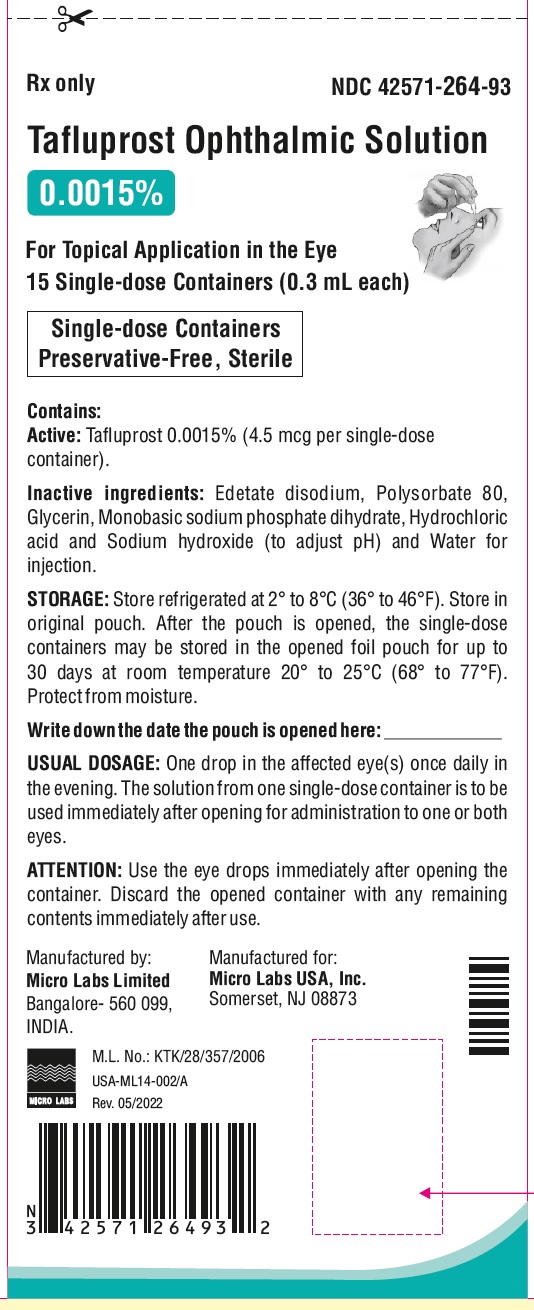
PACKAGE LABEL.PRINCIPAL DISPLAY PANEL Tafluprost Ophthalmic Solution 0.0015% 0.3 mL Container label For use in the eye Rx Only Rx Only NDC 42571-264-93 Tafluprost Ophthalmic Solution 0.0015% For Topical Application in the Eye 15 Single-dose Containers (0.3 mL each) Single-dose Containers Perservative-Free, Sterile NDC 42571-264-26 Rx Only Tafluprost Ophthalmic Solution 0.0015% For Topical Application in the Eye REFRIGERATE (2° to 8°C or 36° to 46°F) Single-dose Containers Perservative-Free, Sterile 15 Single-dose Containers (0.3 mL each) tafluprost-ampule.jpg tafluprost-pouch.jpg tafluprost-carton.jpg