
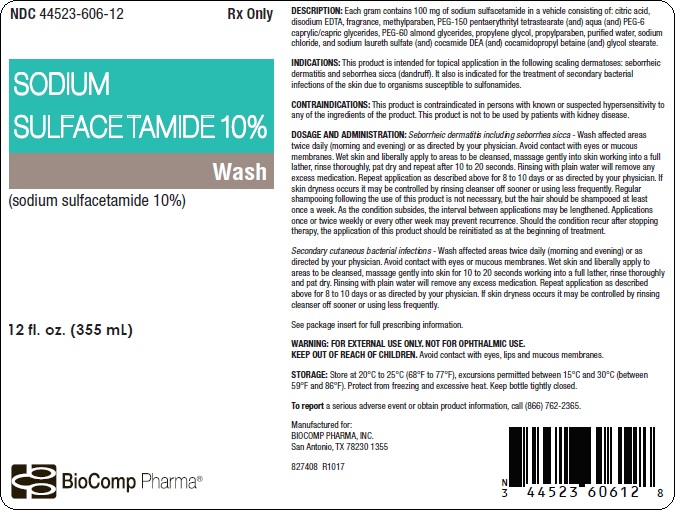
SODIUM SULFACETAMIDE 100 mg/mL Liquid, 473 mL — NDC 44523-606-16 (Billing 44523-0606-16)
This is a package of 473 mL of SODIUM SULFACETAMIDE 100 mg/mL Liquid from BioComp Pharma, Inc., marketed since Jan 2013 and currently FDA-listed.
NDC database record
One package, one record: these facts belong to NDC 44523-606-16 alone.
- Record
- FDA NDC Directory package listing · Human prescription drug
- Code segments
- 44523 labeler · 606 product · 16 package
- Package marketed since
- Jan 7, 2013
- Sample package
- No — commercial package
- Listing certified through
- Dec 31, 2026
- Billing quantity
- 473 mL per package
- Barcode (UPC-A, from the NDC)
- 3 4452360616 6
- FDA record last changed
- Jul 24, 2026
Identity & classification
Regulatory identifiers FDA, NLM and CMS codes for this package
Drug-database identifiers Medi-Span GPI and First Databank GCN / HICL / AHFS classification
- GSN (GCN sequence number): 063084
- GCN: 98844
- GPI-14 (Medi-Span): 90300060000920
- HICL (First Databank): 003345
- AHFS class code: 84:04.92.00
- RxCUI (RxNorm): 1006107
Where does this data come from?
- FDA openFDA NDC Directory · synced Oct 8, 2026
- FDA label on DailyMed · label index refreshed Oct 8, 2026
- RxNorm (NLM RxNav) · catalog refreshed Oct 1, 2026
- Medi-Span GPI (licensed)
- First Databank (licensed) · refreshed Oct 8, 2026
RxNorm drug class
This medicine belongs to the Sulfonamide Antibacterial class.
Where does this data come from?
- RxClass (NLM) · catalog refreshed Oct 1, 2026
Clinical
This is a topical liquid containing sodium sulfacetamide, a sulfonamide antibiotic. Sulfacetamide is commonly used in dermatology to treat bacterial skin infections and certain inflammatory skin conditions. The product is supplied as a liquid formulation at a concentration of 100 mg/mL for application directly to the skin. This is an unapproved drug product marketed without an FDA-approved application.
Patient education
Supplement & herbal interactions
Some supplements/herbs that may interact with sodium sulfacetamide — tap one for details:
Where does this data come from?
- MedlinePlus (NLM) · refreshed Oct 8, 2026
- FDA label on DailyMed · label index refreshed Oct 8, 2026
Ask a licensed pharmacist directly — free, answered by our team.
Pricing
A drug doesn't have one price. Each row is a different public payment system, and none is what you'd pay at the counter — that depends on your insurance. The ⓘ on each row explains what it measures.
| Price system | Per mL | Per package |
|---|---|---|
| Retail pharmacies payNADAC · weekly | Not in the retail survey — common for institutional, discontinued, or low-volume packs. | |
| Medicaid paysCMS SDUD · 12 mo | No recent Medicaid claims on file for this NDC — rare and low-volume NDCs are suppressed in the public data. | |
| Medicare drug plans payPart D · quarterly | No Part D plan price is available for this NDC in our data. | |
Where does this data come from?
- CMS NADAC weekly file
- CMS ASP pricing files · refreshed Sep 20, 2026
- CMS Medicaid State Drug Utilization Data · refreshed Oct 8, 2026
- CMS Part D plan pricing files · refreshed Sep 24, 2026
- VA National Acquisition Center price file
Packaging — all sizes for this product
| Package NDC | Description | Marketing start | Marketing end | Status |
|---|---|---|---|---|
| 44523-0606-12 44523-606-12 Main listing | 355 mL in 1 BOTTLE, PLASTIC | 2013-01-07 | — | Active |
| 44523-0606-16 You're viewing this | 473 mL in 1 BOTTLE, PLASTIC | 2013-01-07 | — | Active |
You're viewing the largest of 2 pack sizes for this product.
Pack size FAQ
What quantity is in this package?
How does this package differ from NDC 44523-0606-12?
What NDC number is used to bill for this package of SODIUM SULFACETAMIDE 100 mg/mL Liquid?
Therapeutic equivalents
| Product | Labeler | Pack | NADAC/unit | TE | Status | Price vs. this |
|---|---|---|---|---|---|---|
| Sodium Sulfacetamide 100 mg/g 58657-0477-06 | Method | 177 g | $0.114 | — | Availability likely | — |
| Sodium Sulfacetamide 100 mg/mL 42192-0129-16 | Acella | 480 ml | $0.240 | — | Availability likely | — |
| OVACE Plus 100 mg/mL 00178-0490-04 | Mission | 10 tubes | — | — | FDA listed | — |
| Ovace 100 mg/mL 00178-0499-06 | Mission | 180 ml | — | — | FDA listed | — |
| Ovace Plus 100 mg/mL 00178-0630-16 | Mission | 473 ml | — | — | FDA listed | — |
| Sodium Sulfacetamide 100 mg/mL 16477-0410-06 | Laser | 177 ml | — | — | FDA listed | — |
| Sulfacetamide Sodium 100 mg/mL 24470-0935-12 | Cintex | 355 ml | — | — | FDA listed | — |
| Sulfacetamide Sodium 100 mg/mL 24470-0937-06 | Cintex | 177 ml | — | — | FDA listed | — |
| Sulfacetamide Sodium 100 mg/mL 44523-0568-12 | BioComp | 355 ml | — | — | FDA listed | — |
| Sodium Sulfacetamide 100 mg/mLthis 44523-0606-16 | BioComp | 473 ml | — | — | FDA listed | — |
| Sodium Sulfacetamide 100 mg/mL 44523-0613-06 | BioComp | 177 ml | — | — | FDA listed | — |
| Sodium Sulfacetamide 100 mg/g 63629-9262-01 | Bryant | 177 g | — | — | FDA listed | — |
| Sodium Sulfacetamide 100 mg/g 63629-9263-01 | Bryant | 355 g | — | — | FDA listed | — |
| Sodium Sulfacetamide 100 mg/g 63629-9264-01 | Bryant | 480 g | — | — | FDA listed | — |
| Sodium Sulfacetamide 100 mg/mL 71399-0480-02 | Akron | 360 ml | — | — | FDA listed | — |
| Sodium Sulfacetamide 100 mg/g 72162-1665-02 | Bryant | 355 g | — | — | FDA listed | — |
| Sodium Sulfacetamide 10% wash 100 mg/mL 83720-0543-16 | Oncor | 473 ml | — | — | FDA listed | — |
Where does this data come from?
- FDA openFDA NDC Directory · synced Oct 8, 2026
- FDA Orange Book · refreshed Oct 3, 2026
- CMS NADAC weekly file
Availability & generic status
We did not find an FDA-approved generic match for this exact strength, form and route.
Where does this data come from?
- FDA Orange Book · refreshed Oct 3, 2026
Inactive Ingredients / Excipients
Inactive ingredients, also called excipients, are components of the drug product other than the active ingredient. They may include fillers, dyes, coatings, preservatives, flavors, or other formulation ingredients.
💡 Tap an ingredient (hover on desktop) to see what it is and why it’s used.
-
UNII DI775RT244
A natural fatty acid derived from coconut or palm oil. Used as an emulsifier and solubilizer to help mix oil and water components and improve how the medicine dissolves and absorbs in the body.
-
UNII 2968PHW8QP
A weak organic acid derived from citrus fruits or made through fermentation. It works as a buffer to control pH, a preservative to extend shelf life, and a flavoring agent in medications.
-
UNII 5OCF3O11KX
A plant-derived surfactant made from coconut oil. It helps mix oil and water ingredients together in the formulation and can improve how the medicine spreads or feels on the skin.
-
UNII 92005F972D
A foaming and thickening agent derived from coconut oil. It's used in liquid medicines to improve texture, help distribute active ingredients evenly, and create a pleasant consistency for easier swallowing or application.
-
UNII MP1J8420LU
A salt derived from edetic acid that binds to trace metals in medicines. It serves as a chelating agent and preservative to prevent metal-catalyzed breakdown of the drug and extend shelf life.
-
UNII 0324G66D0E
Glycol stearate is a waxy compound made by combining stearic acid with ethylene glycol. It acts as an emulsifier and thickener, helping keep oil and water mixed together smoothly in liquid or semi-solid medicines.
-
UNII A2I8C7HI9T
Methylparaben is a preservative derived from benzoic acid that prevents growth of bacteria, fungi, and mold in medicines. It extends the product's shelf life and maintains safety during storage.
-
UNII 8L4OOQ76AM
A waxy compound made from polyethylene glycol and stearic acid that acts as an emulsifier and thickener. It helps blend oil and water-based ingredients together and gives the medicine its proper texture and consistency.
-
UNII 4Y0E651N0F
A plant-derived emulsifier made from almond oil and polyethylene glycol. It helps mix oil and water-based ingredients together and improves how the medicine dissolves and is absorbed in the body.
-
UNII 6DC9Q167V3
Propylene glycol is a clear liquid derived from petroleum or vegetable sources. It acts as a solvent, humectant, and preservative in medicines, helping dissolve active ingredients and maintain product stability.
-
UNII Z8IX2SC1OH
Propylparaben is a chemical preservative used to prevent bacterial and fungal growth in medicines and personal care products. It helps extend shelf life and maintain product safety during storage.
-
UNII 451W47IQ8X
Sodium chloride is common table salt. It's used in medicines as a buffer to maintain proper pH, as a filler to add bulk, or to adjust the osmotic balance in liquid formulations.
-
UNII BPV390UAP0
Sodium laureth sulfate is a mild detergent and surfactant derived from coconut oil or petroleum. It helps mix oil and water in formulations and is often used as a cleaning or foaming agent in topical products like shampoos and cleansers.
-
UNII 059QF0KO0R
Water is a liquid solvent that dissolves and mixes ingredients together in liquid medicines, syrups, and injections. It helps distribute the active drug evenly throughout the product.
14 inactive ingredients listed in the exact product block matched to this NDC.
Where does this data come from?
ingredient classCode="IACT" elements from the exact product block matched by this NDC. Label-section narrative from DailyMed / the openFDA label index is shown separately when available.- FDA label on DailyMed · label index refreshed Oct 8, 2026
- FDA openFDA NDC Directory · synced Oct 8, 2026
Inactive ingredient FAQ
Are inactive ingredients the same for every manufacturer?
Why might an inactive ingredient be missing?
Can inactive ingredients matter?
Manufacturer & labeler
More NDCs from BioComp Pharma, Inc. labeler code 44523
- SULFACETAMIDE SODIUM 100 mg/mL Liquid NDC 44523-568-12
- Sodium Sulfacetamide and Sulfur 98 mg/g; 48 mg/g Lotion NDC 44523-600-02
- Sodium Sulfacetamide and Sulfur 100 mg/g; 50 mg/g Lotion NDC 44523-602-01
- Sodium Sulfacetamide and Sulfur 100 mg/g; 50 mg/g Cream NDC 44523-603-01
- Sodium Sulfacetamide, Sulfur 100 mg/g; 50 mg/g Suspension NDC 44523-604-01
- Sodium Sulfacetamide and Sulfur 45 mg/g; 90 mg/g Lotion NDC 44523-605-16
- Sodium Sulfacetamide and Sulfur 100 mg/g; 50 mg/g Lotion NDC 44523-607-01
- SODIUM SULFACETAMIDE 100 mg/mL Liquid NDC 44523-613-06
- Urea 400 mg/g Cream NDC 44523-617-01
- Urea 200 mg/g Cream NDC 44523-618-03
- SODIUM SULFACETAMIDE AND SULFUR 80 mg/mL; 40 mg/mL Suspension NDC 44523-624-16
- Sodium Sulfacetamide and Sulfur 98 mg/g; 48 mg/g Emulsion NDC 44523-748-10
Where does this data come from?
- FDA openFDA NDC Directory · synced Oct 8, 2026
- Drugs@FDA
Full prescribing information FDA SPL
🎯 Indications and Usage ▾
INDICATIONS: This product is intended for topical application in the following scaling dermatoses: seborrheic dermatitis and seborrhea sicca (dandruff). It also is indicated for the treatment of secondary bacterial infections of the skin due to organisms susceptible to sulfonamides.
⏱️ Dosage and Administration ▾
DOSAGE AND ADMINISTRATION: Seborrheic dermatitis including seborrhea sicca - Wash affected areas twice daily (morning and evening) or as directed by your physician. Avoid contact with eyes or mucous membranes. Wet skin and liberally apply to areas to be cleansed, massage gently into skin working into a full lather, rinse thoroughly, pat dry and repeat after 10 to 20 seconds.
Rinsing with plain water will remove any excess medication. Repeat application as described above for 8 to 10 days or as directed by your physician. lf skin dryness occurs it may be controlled by rinsing cleanser off sooner or using less frequently. Regular shampooing following the use of this product is not necessary, but the hair should be shampooed at least once a week.
As the condition subsides, the interval between applications may be lengthened. Applications once or twice weekly or every other week may prevent recurrence. Should the condition recur after stopping therapy, the application of this product should be reinitiated as at the beginning of treatment.
Secondary cutaneous bacterial infections - Wash affected areas twice daily (morning and evening) or as directed by your physician. Avoid contact with eyes or mucous membranes. Wet skin and liberally apply to areas to be cleansed, massage gently into skin for 10 to 20 seconds working into a full lather, rinse thoroughly and pat dry.
Rinsing with plain water will remove any excess medication. Repeat application as described above for 8 to 10 days or as directed by your physician. If skin dryness occurs it may be controlled by rinsing cleanser off sooner or using less frequently.
⛔ Contraindications ▾
CONTRAINDICATIONS: This product is contraindicated in persons with known or suspected hypersensitivity to any of the ingredients of the product. This product is not to be used by patients with kidney disease.
⚠️ Warnings ▾
WARNINGS: Sulfonamides are known to cause Stevens-Johnson syndrome in hypersensitive individuals. Stevens-Johnson syndrome also has been reported following the use of sodium sulfacetamide topically. Cases of drug-induced systemic lupus erythematosus from topical sulfacetamide also have been reported. In one of these cases, there was a fatal outcome. KEEP OUT OF THE REACH OF CHILDREN.
🤒 Adverse Reactions ▾
ADVERSE REACTIONS: Reports of irritation and hypersensitivity to sodium sulfacetamide are uncommon. The following adverse reactions, reported after administration of sterile ophthalmic sodium sulfacetamide, are noteworthy: instances of Stevens-Johnson syndrome and instances of local hypersensitivity which progressed to a syndrome resembling systemic lupus erythematosus; in one case a fatal outcome was reported (see WARNINGS).
🆘 Overdosage ▾
OVERDOSAGE: The oral LD 50 of sulfacetamide in mice is 16.5 g/kg. In the event of overdosage, emergency treatment should be started immediately. Manifestations: Overdosage may cause nausea and vomiting. Large oral overdosage may cause hematuria, crystalluria and renal shutdown due to the precipitation of sulfa crystals in the renal tubules and the urinary tract. For treatment, contact your local Poison Control Center or your doctor.
🧬 Clinical Pharmacology ▾
CLINICAL PHARMACOLOGY: Sodium sulfacetamide exerts a bacteriostatic effect against sulfonamide sensitive Gram-positive and Gram-negative microorganisms commonly isolated from secondary cutaneous pyogenic infections. It acts by restricting the synthesis of folic acid required by bacteria for growth, by its competition with para-aminobenzoic acid. There is no clinical data available on the degree and rate of systemic absorption of this product when applied to the skin or scalp.
However, significant absorption of sodium sulfacetamide through the skin has been reported. The following in vitro data is available but the clinical significance is unknown. Organisms that show susceptibility to sodium sulfacetamide are: Streptococci, Staphylococci, E. coli, Klebsiella pneumoniae, Pseudomonas pyocyanea, Salmonella species, Proteus vulgaris, Nocardia and Actinomyces.
📦 How Supplied / Storage and Handling ▾
HOW SUPPLIED: This product is supplied in the following size(s): 12 fl. oz. (355 mL) bottles, NDC 44523-606-12 16 fl. oz. (480 mL) bottles, NDC 44523-606-16 To report a serious adverse event or obtain product information, call 1-866-762-2365. Manufactured for: BioComp Pharma, Inc. San Antonio, TX 78230 826177 I826177R0415
📦 Storage and Handling ▾
STORAGE: Store at 20°C to 25°C (68°F to 77°F), excursions permitted between 15°C and 30°C (between 59°F and 86°F). Brief exposure to temperatures up to 40°C (104°F) may be tolerated provided the mean kinetic temperature does not exceed 25°C (77°F); however, such exposure should be minimized. NOTICE: Protect from freezing and excessive heat.
The product may tend to darken slightly on storage. Slight discoloration does not impair the efficacy or safety of the product. Keep bottle tightly closed.
Occasionally, a slight discoloration of fabric may occur when an excessive amount of the product is used and comes in contact with white fabrics. This discoloration, however, presents no problem, as it is readily removed by ordinary laundering without bleaches.
📋 Description ▾
DESCRIPTION: Each gram contains 100 mg of sodium sulfacetamide in a vehicle consisting of: citric acid, disodium EDTA, fragrance, methylparaben, PEG-150 pentaerythrityl tetrastearate (and) aqua (and) PEG-6 caprylic/capric glycerides, PEG-60 almond triglycerides, propylene glycol, propylparaben, purified water, sodium chloride, and sodium laureth sulfate (and) cocamide DEA (and) cocamidopropyl betaine (and) glycol stearate. Sodium sulfacetamide is a sulfonamide with antibacterial activity. Sodium sulfacetamide is C 8 H 9 N 2 NaO 3 S·H 2 O with molecular weight of 254.24.
Chemically, sodium sulfacetamide is N-[(4-aminophenyl) sulfonyl]-acetamide, monosodium salt, monohydrate. The structural formula is: Sodium sulfacetamide is an odorless, white, crystalline powder with a bitter taste. It is freely soluble in water, sparingly soluble in alcohol, while practically insoluble in benzene, in chloroform and in ether. structure
⚠️ Precautions ▾
PRECAUTIONS: FOR EXTERNAL USE ONLY. NOT FOR OPHTHALMIC USE. General: Nonsusceptible organisms, including fungi, may proliferate with the use of this preparation.
Although rare, sensitivity to sodium sulfacetamide may occur. Therefore, caution and careful supervision should be observed when prescribing this drug for patients who may be prone to hypersensitivity to topical sulfonamides. If the use of this product produces signs of hypersensitivity or other untoward reactions, discontinue use of the preparation.
Patients should be carefully observed for possible local irritation or sensitization during long-term therapy. Systemic toxic reactions such as agranulocytosis, acute hemolytic anemia, purpura hemorrhagica, drug fever, jaundice and contact dermatitis indicate hypersensitivity to sulfonamides. Particular caution should be employed if areas of denuded or abraded skin are involved.
Systemic absorption of topical sulfonamides is greater following application to large, infected, abraded, denuded or severely burned areas. Under these circumstances, any of the adverse effects produced by the systemic administration of these agents could potentially occur, and appropriate observations and laboratory determinations should be performed. Information for Patients: Patients should discontinue the use of this product if the condition becomes worse or if a rash develops in the area being treated or elsewhere.
The use of this product also should be discontinued promptly and the physician notified if any arthritis, fever or sores in the mouth develop. Avoid contact with eyes, lips and mucous membranes. Drug Interactions: This product is incompatible with silver preparations.
Carcinogenesis, Mutagenesis and Impairment of Fertility: Long-term animal studies for carcinogenic potential have not been performed on this product to date. Studies on reproduction and fertility also have not been performed. Chromosomal nondisjunction has been reported in the yeast, Saccharomyces cerevisiae, following application of sodium sulfacetamide.
The significance of this finding to the topical use of sodium sulfacetamide in the human is unknown. Pregnancy: Category C. Animal reproduction studies have not been conducted with this product.
It is also not known whether this product can affect reproduction capacity or cause fetal harm when administered to a pregnant woman. This product should be used by a pregnant woman only if clearly needed or when potential benefits outweigh potential hazards to the fetus. Nursing Mothers: It is not known whether this drug is excreted in human milk.
Because many drugs are excreted in human milk, caution should be exercised when this product is administered to a nursing woman. Pediatric Use: Safety and effectiveness in children under the age of 12 years have not been established.
📄 Package Label / Principal Display Panel ▾
label1.jpg label2.jpg
About this NDC listing & data coverage
Listed without an FDA application
This product's marketing category indicates it is marketed without an approved FDA application (no NDA, ANDA, or BLA on file). Having an NDC does not by itself establish FDA approval — the NDC Directory is a listing system, not an approval decision. Approval-linked data such as Orange Book therapeutic-equivalence ratings therefore does not apply.
What data is (and isn’t) available for this NDC — tap to expand
| NDC identity (package / product / labeler codes) | ✓ Available |
| Labeler | ✓ Available |
| Product & package description | ✓ Available |
| Marketing category & status | ✓ Available |
| Active ingredient / dosage form / route | ✓ Available |
| FDA label (SPL via DailyMed) | ✓ Available |
| Package photos | ✓ Available |
| Inactive ingredients (structured) | ✓ Available |
| NADAC pharmacy acquisition price (CMS) | — Not published for this NDC CMS publishes NADAC only for NDCs reported in its retail-pharmacy survey. |
| Orange Book / therapeutic-equivalence data | — Not published for this NDC Applies only to products approved under an NDA/ANDA; many listings are out of scope. |
| HCPCS J-code billing crosswalk | — Not published for this NDC Most self-administered / retail products have no J-code — that is normal. |
| Medicaid utilization (CMS SDUD) | — Not published for this NDC CMS reports utilization only for NDCs with Medicaid claims above its privacy threshold. |