
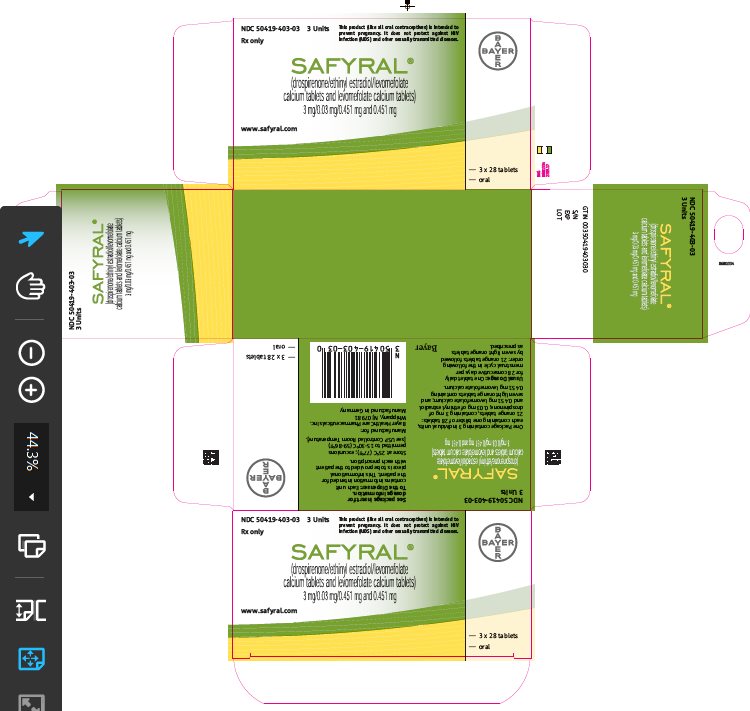
Safyral Drospirenone/ethinyl estradiol/levomefolate calcium and levomefolate Kit — NDC 50419-403-75 (Billing 50419-0403-75)
This is a package of Safyral Drospirenone/ethinyl estradiol/levomefolate calcium and levomefolate Kit from Bayer HealthCare Pharmaceuticals Inc., marketed since Feb 2012 and currently FDA-listed.
NDC database record
One package, one record: these facts belong to NDC 50419-403-75 alone.
- Record
- FDA NDC Directory package listing · Human prescription drug
- Code segments
- 50419 labeler · 403 product · 75 package
- Package marketed since
- Feb 13, 2012
- Sample package
- No — commercial package
- Listing certified through
- Dec 31, 2027
- Barcode (UPC-A, from the NDC)
- 3 5041940375 7
- FDA record last changed
- Jul 24, 2026
Identity & classification
Regulatory identifiers FDA, NLM and CMS codes for this package
Drug-database identifiers Medi-Span GPI and First Databank GCN / HICL / AHFS classification
- GSN (GCN sequence number): 066947
- GCN: 29382
- GPI-14 (Medi-Span): 25990003200330
- HICL (First Databank): 037200
- AHFS class code: 68:12.00.00
- RxCUI (RxNorm): 1013628
Where does this data come from?
- FDA openFDA NDC Directory · synced Oct 8, 2026
- FDA label on DailyMed · label index refreshed Oct 8, 2026
- RxNorm (NLM RxNav) · catalog refreshed Oct 1, 2026
- Medi-Span GPI (licensed)
- First Databank (licensed) · refreshed Oct 8, 2026
RxNorm drug class
This medicine belongs to the Folate Analog class.
Where does this data come from?
- RxClass (NLM) · catalog refreshed Oct 1, 2026
Clinical
- It prevents pregnancy and adds folate, which lowers the risk of neural tube birth defects if you become pregnant. Beyaz and the generic versions can also treat PMDD symptoms and mo...
- Take one pill by mouth at the same time every day, in pack order. You can take it with or without food. Take the folate-only tablets too, and start the next pack right after the la...
- Take a single missed hormone pill as soon as you remember, then take the next at your usual time. Missing more than one means you may need back-up birth control, so check your leaf...
- Headache, nausea, breast tenderness, and spotting are the most common. Spotting and nausea often fade within the first few packs. Call if they don't go away.
Patient education
Supplement & herbal interactions
Where does this data come from?
- MedlinePlus (NLM) · refreshed Oct 8, 2026
- FDA label on DailyMed · label index refreshed Oct 8, 2026
Ask a licensed pharmacist directly — free, answered by our team.
Pricing
A drug doesn't have one price. Each row is a different public payment system, and none is what you'd pay at the counter — that depends on your insurance. The ⓘ on each row explains what it measures.
| Price system | Per each | Per package |
|---|---|---|
| Retail pharmacies payNADAC · weekly | Not in the retail survey — common for institutional, discontinued, or low-volume packs. | |
| Medicaid paysCMS SDUD · 12 mo | No recent Medicaid claims on file for this NDC — rare and low-volume NDCs are suppressed in the public data. | |
| Medicare drug plans payPart D · Q2 2026 | $7.03 | $421.78 / 60 kit |
Where does this data come from?
- CMS NADAC weekly file
- CMS ASP pricing files · refreshed Sep 20, 2026
- CMS Medicaid State Drug Utilization Data · refreshed Oct 8, 2026
- CMS Part D plan pricing files · refreshed Sep 24, 2026
- VA National Acquisition Center price file
Packaging — all sizes for this product
| Package NDC | Description | Marketing start | Marketing end | Status |
|---|---|---|---|---|
| 50419-0403-00 50419-403-00 Main listing | 90 BLISTER PACK in 1 PACKAGE / 1 KIT in 1 BLISTER PACK | 2012-02-13 | — | Active |
| 50419-0403-03 50419-403-03 | 3 BLISTER PACK in 1 PACKAGE / 1 KIT in 1 BLISTER PACK | 2012-02-13 | — | Active |
| 50419-0403-70 50419-403-70 | 90 BLISTER PACK in 1 PACKAGE / 1 KIT in 1 BLISTER PACK | 2012-02-13 | — | Active |
| 50419-0403-75 You're viewing this | 12 PACKAGE in 1 CARTON / 5 BLISTER PACK in 1 PACKAGE / 1 KIT in 1 BLISTER PACK | 2012-02-13 | — | Active |
Pack size FAQ
What quantity is in this package?
What NDC number is used to bill for this package of Safyral Drospirenone/ethinyl estradiol/levomefolate calcium and levomefolate Kit?
Therapeutic equivalents
| Product | Labeler | Pack | NADAC/unit | TE | Status | Price vs. this |
|---|---|---|---|---|---|---|
| Drospirenone/Ethinyl Estradiol/Levomefolate Calcium and Levomefolate Calcium 00781-4075-15 | Sandoz | 1 kit | $1.382 | AB | Availability likely | — |
| Drospirenone/ethinyl estradiol/levomefolate calcium and levomefolate calcium 00781-4103-52 | Sandoz | 1 kit | $2.960 | AB | Availability likely | — |
| Beyaz 50419-0407-00 | Bayer | 1 kit | — | AB | FDA listed | — |
| Safyralthis 50419-0403-75 | Bayer | 1 kit | — | AB | FDA listed | — |
Where does this data come from?
- FDA openFDA NDC Directory · synced Oct 8, 2026
- FDA Orange Book · refreshed Oct 3, 2026
- CMS NADAC weekly file
Availability & generic status
The FDA lists approved generic versions of this medicine, but that does not always mean a pharmacy can get one today. Patent rules, launch agreements, supply and pricing can affect when generics actually arrive.
Why the date isn’t exact: Generic timing can change because patents may be challenged, settled, licensed, added, removed, or worked around with a narrower label — and FDA approval does not always mean a pharmacy can get the generic today.
🛈 What do these terms mean?
- Patent
- Legal protection listed in the Orange Book that may delay generic approval or launch. Issued by the U.S. Patent & Trademark Office.
- Substance patent
- Covers the active drug molecule itself — the hardest to design around. A generic generally can’t launch until it expires.
- Formulation (product) patent
- Covers a specific formulation or dosage form. A generic can sometimes work around it with a different formulation.
- Method-of-use patent
- A patent covering one specific approved use of the drug — not necessarily the whole molecule. A generic can sometimes launch with a “skinny label” that carves out the protected use and keeps the others.
- Skinny label
- A generic label that omits a still-patented use when the FDA allows it — letting a generic reach the market for the unprotected uses.
- Exclusivity
- FDA-granted marketing protection, separate from patents — e.g. 5-yr new chemical entity, 7-yr orphan drug, or a +6-month pediatric extension.
- Paragraph IV
- A generic applicant’s formal challenge to a listed patent. It can potentially lead to earlier generic entry, but often involves litigation or a settlement.
- RLD / RS
- Reference Listed Drug — the brand product the FDA uses as the reference for generic applications. Reference Standard — the product the FDA expects generics to compare against in bioequivalence testing.
- TE / AB rating
- FDA therapeutic-equivalence rating. An AB rating generally means the FDA considers a generic therapeutically equivalent to — and substitutable for — the brand.
- LOE (loss of exclusivity)
- The latest patent or exclusivity currently listed — the loss-of-exclusivity / latest-listed-protection date shown on this page. Paragraph-IV challenges and settlements can move the real date earlier; FDA approval and a manufacturer’s decision to market can move it later.
Built from the FDA Orange Book. The bars above are scaled to each protection’s expiry; the red LOE marker is the last one to lapse.
| Patent | Type | Use code | Expires |
|---|---|---|---|
| US 11617751 ↗ | Method of use | U-1 | Jul 17, 2030 |
| US 11617751 ↗ | Method of use | U-3572 | Jul 17, 2030 |
| US 8617597 ↗ | Drug product | — | Feb 8, 2030 |
Is there a generic version of SAFYRAL TABLET?
The FDA approved a generic — why can’t I get it at my pharmacy yet?
Why do different websites show different generic release dates?
What does “FDA listed” mean?
What does a patent or protection date mean here?
What does “current Orange Book estimate” mean?
Can a generic come out before the last patent expires?
Can a generic come out after the listed dates?
What is the difference between patents and exclusivity?
Why are there multiple patent dates?
Where does this data come from?
- FDA Orange Book · refreshed Oct 3, 2026
What it looks like
Where does this data come from?
- FDA label on DailyMed · label index refreshed Oct 8, 2026
Inactive Ingredients / Excipients
Inactive ingredients, also called excipients, are components of the drug product other than the active ingredient. They may include fillers, dyes, coatings, preservatives, flavors, or other formulation ingredients.
🧪 Avoiding an ingredient? See Drospirenone / Ethinyl Estradiol / Levomefolate inactive ingredients by manufacturer: every current product's list side by side, so you can ask your pharmacy for the version that does not list it.
Where does this data come from?
IACT rows and label-wide narrative are kept separate; availability and product-level specificity depend on the submitted label.- FDA label on DailyMed · label index refreshed Oct 8, 2026
- FDA openFDA NDC Directory · synced Oct 8, 2026
Inactive ingredient FAQ
Are inactive ingredients the same for every manufacturer?
Why might an inactive ingredient be missing?
Can inactive ingredients matter?
Manufacturer & labeler
More NDCs from Bayer HealthCare Pharmaceuticals Inc. labeler code 50419
- Vitrakvi Larotrectinib 100 mg Capsule NDC 50419-391-01
- VITRAKVI LAROTRECTINIB 20 mg/mL Solution, Concentrate NDC 50419-392-01
- VITRAKVI LAROTRECTINIB 20 mg/mL Solution, Concentrate NDC 50419-393-03
- Nubeqa darolutamide 300 mg Tablet, Film Coated NDC 50419-395-01
- Hyrnuo Sevabertinib 10 mg Tablet, Film Coated NDC 50419-397-01
- Yasmin drospirenone and ethinyl estradiol Kit NDC 50419-402-03
- Yaz Drospirenone and ethinyl estradiol Kit NDC 50419-405-03
- Beyaz Drospirenone/ethinyl estradiol/levomefolate calcium and levomefolate Kit NDC 50419-407-00
- Natazia estradiol valerate and estradiol valerate/dienogest Kit NDC 50419-409-00
- Skyla Levonorgestrel 13.5 mg Intrauterine Device NDC 50419-422-01
- Mirena Levonorgestrel 52 mg Intrauterine Device NDC 50419-423-01
- Kyleena Levonorgestrel 19.5 mg Intrauterine Device NDC 50419-424-01
Where does this data come from?
- FDA openFDA NDC Directory · synced Oct 8, 2026
- Drugs@FDA
Full prescribing information FDA SPL
🚨 Boxed Warning ▾
WARNING: CIGARETTE SMOKING AND SERIOUS CARDIOVASCULAR EVENTS Cigarette smoking increases the risk of serious cardiovascular events from combination oral contraceptives (COC) use. This risk increases with age, particularly in women over 35 years of age, and with the number of cigarettes smoked. For this reason, COCs should not be used by women who are over 35 years of age and smoke [ see Contraindications ( 4 ) ].
WARNING: CIGARETTE SMOKING AND SERIOUS CARDIOVASCULAR EVENTS See full prescribing information for complete boxed warning. • Women over 35 years old who smoke should not use Safyral. ( 4 ) • Cigarette smoking increases the risk of serious cardiovascular events from combination oral contraceptive (COC) use. ( 4 )
🎯 Indications and Usage ▾
1 INDICATIONS AND USAGE Safyral is a combination of drospirenone, a progestin and ethinyl estradiol, an estrogen containing a folate, indicated for use by females of reproductive potential to: • Prevent pregnancy. ( 1.1 ) • Raise folate levels in females of reproductive potential who choose to use an oral contraceptive for contraception. ( 1.2 )
1.1Oral Contraceptive Safyral is indicated for use by females of reproductive potential to prevent pregnancy.
1.2Folate Supplementation Safyral is indicated in females of reproductive potential who choose to use an oral contraceptive as their method of contraception, to raise folate levels for the purpose of reducing the risk of a neural tube defect in a pregnancy conceived while taking the product or shortly after discontinuing the product.
⏱️ Dosage and Administration ▾
2 DOSAGE AND ADMINISTRATION • Take one tablet daily by mouth at the same time every day. ( 2.1 ) • Tablets must be taken in the order directed on the blister pack. ( 2.1 )
2.1How to Take Safyral Take one tablet by mouth at the same time every day. The failure rate may increase when pills are missed or taken incorrectly. To achieve maximum contraceptive effectiveness, Safyral must be taken as directed, in the order directed on the blister pack. Single missed pills should be taken as soon as remembered.
2.2How to Start Safyral Instruct the patient to begin taking Safyral either on the first day of her menstrual period (Day 1 Start) or on the first Sunday after the onset of her menstrual period (Sunday Start). Day 1 Start During the first cycle of Safyral use, instruct the patient to take one orange Safyral daily, beginning on Day 1 of her menstrual cycle. (The first day of menstruation is Day 1.) She should take one orange Safyral daily for 21 consecutive days, followed by one light orange tablet, containing levomefolate alone, daily on Days 22 through 28.
Safyral should be taken in the order directed on the package at the same time each day, preferably after the evening meal or at bedtime with some liquid, as needed. Safyral can be taken without regard to meals. If Safyral is first taken later than the first day of the menstrual cycle, Safyral should not be considered effective as a contraceptive until after the first 7 consecutive days of product administration.
Instruct the patient to use a non-hormonal contraceptive as back-up during the first 7 days. The possibility of ovulation and conception prior to initiation of medication should be considered. Sunday Start During the first cycle of Safyral use, instruct the patient to take one orange Safyral daily, beginning on the first Sunday after the onset of her menstrual period.
She should take one orange Safyral daily for 21 consecutive days, followed by one light orange tablet, containing levomefolate alone, daily on Days 22 through 28. Safyral should be taken in the order directed on the package at the same time each day, preferably after the evening meal or at bedtime with some liquid, as needed. Safyral can be taken without regard to meals.
Safyral should not be considered effective as a contraceptive until after the first 7 consecutive days of product administration. Instruct the patient to use a non-hormonal contraceptive as back-up during the first 7 days. The possibility of ovulation and conception prior to initiation of medication should be considered.
The patient should begin her next and all subsequent 28-day regimens of Safyral on the same day of the week that she began her first regimen, following the same schedule. She should begin taking her orange tablets on the next day after ingestion of the last light orange folate tablet, regardless of whether or not a menstrual period has occurred or is still in progress. Anytime a subsequent cycle of Safyral is started later than the day following administration of the last light orange tablet, the patient should use another method of contraception until she has taken an orange Safyral daily for seven consecutive days.
When switching from a different birth control pill When switching from another birth control pill, Safyral should be started on the same day that a new pack of the previous oral contraceptive would have been started. When switching from a method other than a birth control pill When switching from a transdermal patch or vaginal ring, Safyral should be started when the next application would have been due. When switching from an injection, Safyral should be started when the next dose would have been due.
When switching from an intrauterine contraceptive or an implant, Safyral should be started on the day of removal. Withdrawal bleeding usually occurs within 3 days following the last orange tablet. If spotting or breakthrough bleeding occurs while taking Safyral, instruct the patient to continue taking Safyral… [Excerpted — this section continues on DailyMed.]
💊 Dosage Forms and Strengths ▾
3 DOSAGE FORMS AND STRENGTHS Safyral (drospirenone/ethinyl estradiol/levomefolate calcium tablets and levomefolate calcium tablets) is available in blister packs. Each blister pack contains 28 film-coated, round, bi-convex tablets in the following order: • 21 orange tablets each containing 3 mg drospirenone (DRSP), 0.03 mg ethinyl estradiol (EE) as betadex clathrate and 0.451 mg levomefolate calcium embossed with a “Y+” in a regular hexagon on one side • 7 light orange tablets each containing 0.451 mg levomefolate calcium embossed with a “M+” in a regular hexagon on one side Safyral consists of 28 film-coated, biconvex tablets in the following order ( 3 ): • 21 orange tablets, each containing 3 mg drospirenone (DRSP), 0.03 mg ethinyl estradiol (EE) as betadex clathrate and 0.451 mg levomefolate calcium • 7 light orange tablets, each containing 0.451 mg levomefolate calcium
⛔ Contraindications ▾
4 CONTRAINDICATIONS Safyral is contraindicated in females who are known to have or develop the following conditions: • Renal impairment • Adrenal insufficiency • A high risk of arterial or venous thrombotic diseases. Examples include women who are known to: • Smoke, if over age 35 [see Boxed Warning and Warnings and Precautions ( 5.1 )] • Have deep vein thrombosis or pulmonary embolism, now or in the past [see Warnings and Precautions ( 5.1 ) ] • Have cerebrovascular disease [see Warnings and Precautions ( 5.1 )] • Have coronary artery disease [see Warnings and Precautions ( 5.1 )] • Have thrombogenic valvular or thrombogenic rhythm diseases of the heart (for example, subacute bacterial endocarditis with valvular disease, or atrial fibrillation) [see Warnings and Precautions ( 5.1 )] • Have inherited or acquired hypercoagulopathies [see Warnings and Precautions ( 5.1 )] • Have uncontrolled hypertension [see Warnings and Precautions ( 5.6 )] • Have diabetes mellitus with vascular disease [see Warnings and Precautions ( 5.8 )] • Have headaches with focal neurological symptoms or have migraine headaches with or without aura if over age 35 [see Warnings and Precautions ( 5.9 )] • Undiagnosed abnormal uterine bleeding [see Warnings and Precautions ( 5.10 )] • Current diagnosis of, or history of, breast cancer, which may be hormone-sensitive [see Warnings and Precautions ( 5.3 )] • Liver tumor (benign or malignant) or liver disease [see Warnings and Precautions ( 5.4 ) and Use in Specific Populations ( 8.7 )] • Use of Hepatitis C drug combinations containing ombitasvir/paritaprevir/ritonavir, with or without dasabuvir due to the potential for ALT elevations [see Warnings and Precautions ( 5.5 ) and Drug Interactions ( 7.3 )]. • Renal impairment ( 4 ) • Adrenal insufficiency ( 4 ) • A high risk of arterial or venous thrombotic diseases ( 4 ) • Undiagnosed abnormal uterine bleeding ( 4 ) • Breast cancer ( 4 ) • Liver tumors or liver disease ( 4 ) • Co-administration with Hepatitis C drug combinations containing ombitasvir, paritaprevir/ritonavir, with or without dasabuvir ( 4 )
⚠️ Warnings and Cautions ▾
5 WARNINGS AND PRECAUTIONS • Vascular risks: Stop Safyral if a thrombotic event occurs. Stop at least 4 weeks before and through 2 weeks after major surgery. Start no earlier than 4 weeks after delivery, in women who are not breastfeeding.
( 5.1 ) COCs containing DRSP may be associated with a higher risk of venous thromboembolism (VTE) than COCs containing levonorgestrel or some other progestins. Before initiating Safyral in a new COC user or a woman who is switching from a contraceptive that does not contain DRSP, consider the risks and benefits of a DRSP-containing COC in light of her risk of a VTE. ( 5.1 ) • Hyperkalemia: DRSP has anti-mineralocorticoid activity.
Do not use in patients predisposed to hyperkalemia. Check serum potassium concentration during the first treatment cycle in women on long-term treatment with medications that may increase serum potassium concentration. ( 5.2 , 7.1 , 7.2 ) • Liver disease: Discontinue Safyral if jaundice occurs.
( 5.4 ) • High blood pressure: Do not prescribe Safyral for women with uncontrolled hypertension or hypertension with vascular disease. ( 5.6 ) • Carbohydrate and lipid metabolic effects: Monitor prediabetic and diabetic women taking Safyral. Consider an alternate contraceptive method for women with uncontrolled dyslipidemia.
( 5.8 ) • Headache: Evaluate significant change in headaches and discontinue Safyral if indicated. ( 5.9 ) • Uterine bleeding: Evaluate irregular bleeding or amenorrhea. ( 5.10 )
5.1Thromboembolic Disorders and Other Vascular Problems Stop Safyral if an arterial or venous thrombotic (VTE) event occurs. Based on presently available information on DRSP-containing COCs with 0.03 mg ethinyl estradiol (that is, Yasmin), DRSP-containing COCs may be associated with a higher risk of venous thromboembolism (VTE) than COCs containing the progestin levonorgestrel or some other progestins. Epidemiologic studies that compared the risk of VTE reported that the risk ranged from no increase to a three-fold increase.
Before initiating use of Safyral in a new COC user or a woman who is switching from a contraceptive that does not contain DRSP, consider the risks and benefits of a DRSP-containing COC in light of her risk of a VTE. Known risk factors for VTE include smoking, obesity, and family history of VTE, in addition to other factors that contraindicate use of COCs [see Contraindications ( 4 )] . A number of studies have compared the risk of VTE for users of Yasmin (which contains 0.03 mg of EE and 3 mg of DRSP) to the risk for users of other COCs, including COCs containing levonorgestrel.
Those that were required or sponsored by regulatory agencies are summarized in Table 2. Table 2: Estimates (Hazard Ratios) of Venous Thromboembolism Risk in Current Users of Yasmin Compared to Users of Oral Contraceptives that Contain Other Progestins Epidemiologic Study (Author, Year of Publication) Population Studied Comparator Product (all are low-dose COCs; with ≤ 0.04 mg of EE) Hazard Ratio (HR) (95% CI) i3 Ingenix (Seeger 2007) Initiators, including new users "New users" - no use of combination hormonal contraception for at least the prior 6 months All COCs available in the US during the conduct of the study Includes low-dose COCs containing the following progestins: norgestimate, norethindrone, levonorgestrel, desogestrel, norgestrel, medroxyprogesterone, or ethynodiol diacetate HR: 0.9 (0.5-1.6) EURAS (Dinger 2007) Initiators, including new users All COCs available in Europe during the conduct of the study Includes low-dose COCs containing the following progestins: levonorgestrel, desogestrel, dienogest, chlormadinone acetate, gestodene, cyproterone acetate, norgestimate, or norethindrone HR: 0.9 (0.6-1.4) Levonorgestrel/EE HR: 1.0 (0.6-1.8) FDA-funded study” (2011) New users Other COCs available during the course of the study Includes low-dose COCs containing the following progestins: norgestimate, norethindrone, or levonorgestrel HR: 1.8 (1.3-2.4) Levonorgestrel/0.03 mg E… [Excerpted — this section continues on DailyMed.]
🤒 Adverse Reactions ▾
6 ADVERSE REACTIONS The following serious adverse reactions with the use of COCs are discussed elsewhere in the labeling: • Serious cardiovascular events and stroke [see Boxed Warning and Warnings and Precautions ( 5.1 )] • Vascular events [see Warnings and Precautions ( 5.1 )] • Liver disease [see Warnings and Precautions ( 5.4 )] • The most frequent adverse reactions (≥ 2%) in contraception and folate clinical trials are premenstrual syndrome (12.4%), headache /migraine (10.3%), breast pain/tenderness/discomfort (8.1%), nausea/vomiting (4.4%), mood changes (2.3%) and abdominal pain/tenderness/discomfort (2.2%).
( 6.1 ) To report SUSPECTED ADVERSE REACTIONS, contact Bayer HealthCare Pharmaceuticals Inc. at 1-888-842-2937 or FDA at 1-800-FDA-1088 or www.fda.gov/medwatch
6.1Clinical Trials Experience Because clinical trials are conducted under widely varying conditions, the adverse reaction rates observed cannot be directly compared to rates in other clinical trials and may not reflect the rates observed in practice. Contraception and Folate Supplementation Clinical Trials The data provided reflect the experience with the use of Yasmin (3 mg DRSP/0.03 mg EE) in the adequate and well-controlled studies for contraception (N=2,837) and folate supplementation (N=172). For contraception, the US pivotal clinical study (N=326) for the oral contraception indication for Yasmin was a multicenter, open-label trial in healthy women aged 18–35 who were treated with Yasmin for up to 13 cycles.
The second contraceptive pivotal study (N=442) was a multicenter, randomized, open-label comparative European study of Yasmin vs. 0.150 mg desogestrel/0.03 mg EE conducted in healthy women aged 17–40 who were treated for up to 26 cycles. The primary efficacy study using Safyral for folate supplementation was a randomized, single-center European trial in 172 healthy, female subjects aged 18–40 years comparing the pharmacodynamic effects of Yasmin + 0.451 mg levomefolate calcium to Yasmin co-administered with folic acid during 24 weeks of treatment followed by 20 weeks of open-label Yasmin.
The adverse reactions seen across the 2 indications overlapped and are reported using the frequencies from the pooled dataset. The most common adverse reactions (≥ 2% of users) were: premenstrual syndrome (12.4%), headache/migraine (10.3%), breast pain/tenderness/discomfort (8.1%), nausea/vomiting (4.4%), mood changes (depression, depressed mood, irritability, mood swings, mood altered and affect lability (2.3%), and abdominal pain/discomfort/tenderness (2.2%). Adverse Reactions (≥1%) Leading to Study Discontinuation Contraception Clinical Trials Of 2,837 women, 6.7% discontinued from the clinical trials due to an adverse reaction; the most frequent adverse reaction leading to discontinuation was headache/migraine (1.5%).
Folate Clinical Trial There were no subjects who discontinued due to an adverse reaction. Serious Adverse Reactions: Contraception Clinical Trials: depression, pulmonary embolism, toxic skin eruption, and uterine leiomyoma. Folate Supplementation Clinical Trial: none reported in the clinical trial
6.2Postmarketing Experience Five studies that compared breast cancer risk between ever-users (current or past use) of COCs and never-users of COCs reported no association between ever use of COCs and breast cancer risk, with effect estimates ranging from 0.90 - 1.12 (Figure 3). Three studies compared breast cancer risk between current or recent COC users (<6 months since last use) and never users of COCs (Figure 3). One of these studies reported no association between breast cancer risk and COC use.
The other two studies found an increased relative risk of 1.19 - 1.33 with current or recent use. Both of these studies found an increased risk of breast cancer with current use of longer duration, with relative risks ranging from 1.03 with less than one year of COC use to approximately 1.4 with more than 8-10 years of COC use. Figure 3: Relative Studies of Ri… [Excerpted — this section continues on DailyMed.]
🔄 Drug Interactions ▾
7 DRUG INTERACTIONS Consult the labeling of all concurrently-used drugs to obtain further information about interactions with hormonal contraceptives or the potential for enzyme alterations . • Drugs or herbal products that induce certain enzymes (for example, CYP3A4) may decrease the effectiveness of COCs or increase breakthrough bleeding. Counsel patients to use a back-up or alternative method of contraception when enzyme inducers are used with COCs. ( 7.1 )
7.1Effects of Other Drugs on Combined Oral Contraceptives Substances diminishing the efficacy of COCs: Drugs or herbal products that induce certain enzymes, including cytochrome P450 3A4 (CYP3A4), may decrease the effectiveness of COCs or increase breakthrough bleeding. Some drugs or herbal products that may decrease the effectiveness of hormonal contraceptives include phenytoin, barbiturates, carbamazepine, bosentan, felbamate, griseofulvin, oxcarbazepine, rifampin, topiramate and products containing St. John’s wort.
Interactions between oral contraceptives and other drugs may lead to breakthrough bleeding and/or contraceptive failure. Counsel women to use an alternative method of contraception or a back-up method when enzyme inducers are used with COCs, and to continue back-up contraception for 28 days after discontinuing the enzyme inducer to ensure contraceptive reliability. Substances increasing the plasma concentrations of COCs : Co-administration of atorvastatin with certain COCs containing EE increase AUC values for EE by approximately 20%.
Ascorbic acid and acetaminophen may increase plasma EE concentrations, possibly by inhibition of conjugation. Concomitant administration of moderate or strong CYP3A4 inhibitors such as azole antifungals (e.g., ketoconazole, itraconazole, voriconazole, fluconazole), verapamil, macrolides (e.g., clarithromycin, erythromycin), diltiazem, and grapefruit juice can increase the plasma concentrations of the estrogen or the progestin or both. In a clinical drug-drug interaction study conducted in premenopausal women, once daily co-administration of DRSP 3 mg/EE 0.02 mg containing tablets with strong CYP3A4 inhibitor, ketoconazole 200 mg twice daily for 10 days resulted in a moderate increase of DRSP systemic exposure.
The exposure of EE was increased mildly [see Warnings and Precautions ( 5.2 ) and Clinical Pharmacology ( 12.3 )] . Human immunodeficiency virus (HIV)/Hepatitis C virus (HCV) protease inhibitors and non-nucleoside reverse transcriptase inhibitors : Significant changes (increase or decrease) in the plasma concentrations of estrogen and progestin have been noted in some cases of co-administration with HIV/HCV protease inhibitors or with non-nucleoside reverse transcriptase inhibitors. Antibiotics : There have been reports of pregnancy while taking hormonal contraceptives and antibiotics, but clinical pharmacokinetic studies have not shown consistent effects of antibiotics on plasma concentrations of synthetic steroids.
7.2Effects of Combined Oral Contraceptives on Other Drugs COCs containing EE may inhibit the metabolism of other compounds. COCs have been shown to significantly decrease plasma concentrations of lamotrigine, likely due to induction of lamotrigine glucuronidation. This may reduce seizure control; therefore, dosage adjustments of lamotrigine may be necessary.
Consult the labeling of the concurrently-used drug to obtain further information about interactions with COCs or the potential for enzyme alterations. COCs Increasing the Plasma Concentrations of CYP450 Enzymes : In clinical studies, administration of a hormonal contraceptive containing EE did not lead to any increase or only to a weak increase in plasma concentrations of CYP3A4 substrates (e.g., midazolam) while plasma concentrations of CYP2C19 substrates (e.g., omeprazole and voriconazole) and CYP1A2 substrates (e.g., theophylline and tizanidine) can have a weak or moderate increase.
Clinical studies did not indicate an inhibitory potential of DRSP t… [Excerpted — this section continues on DailyMed.]
👥 Use in Specific Populations ▾
8 USE IN SPECIFIC POPULATIONS Lactation: Can reduce milk production in breast-feeding females ( 8.2 )
8.1Pregnancy Risk Summary There is no use for contraception in pregnancy; therefore, Safyral should be discontinued during pregnancy. Epidemiologic studies and meta-analyses have not found an increased risk of genital or non-genital birth defects (including cardiac anomalies and limb-reduction defects) following exposure to CHCs before conception or during early pregnancy. In the U.S. general population, the estimated background risk of major birth defects and miscarriage in clinically recognized pregnancies is 2 to 4 percent and 15 to 20 percent, respectively.
Data Human Data A retrospective database study of women in Norway, that included 44,734 pregnancies of which 368 were women who inadvertently took drospirenone/ethinyl estradiol during the first trimester of a pregnancy, found there were no adverse effects on pre-term birth, small for gestational age, or birth weight Z-scores. Post-marketing adverse event data on the use of Safyral in pregnant women suggest that frequencies of miscarriage and congenital anomalies were not higher than the estimated background risk in the general population.
8.2Lactation Risk Summary DRSP is present in human milk. After a single oral administration of 3 mg DRSP/0.03 mg EE tablets, DRSP concentration in breast milk over the 24-h period ranged from 1.4 to 7.0 ng/mL, with a mean ± standard deviation value of 3.7 ± 1.9 ng/mL. The estimated mean infant dose was 0.003 mg/day, which is about 0.1% of maternal dose (see Data).
There is limited information on the effects of Safyral on the breast-fed infant. CHCs can reduce milk production in breast-feeding females. This reduction can occur at any time but is less likely to occur once breast-feeding is well-established.
When possible, advise the nursing female to use other methods of contraception until she discontinues breast-feeding [See also Dosage and Administration ( 2.2 )]. Increase in folate concentration in milk is not expected (see Data). The developmental and health benefits of breast-feeding should be considered along with the mother’s clinical need for Safyral and any potential adverse effects on the breast-fed child from Safyral or from the underlying maternal condition.
Data Human Data An open-label study evaluated the degree of DRSP transfer into milk within 72 hours following a single oral administration of 3 mg DRSP/0.03 mg EE tablets to 6 healthy lactating women who were 1 week to 3 months post-partum. DRSP was present in breast milk with a mean C max of 13.5 ng/mL, while the mean C max in serum of lactating women was 30.8 ng/mL. The DRSP concentration in breast milk over the 24-hour period following dosing ranged from 1.4 to 7.0 ng/mL, with a mean ± standard deviation value of 3.7 ± 1.9 ng/mL.
Based on single dose data, the maximal daily infant dose of DRSP was calculated to be 0.003 mg/day, which represented a mean of 0.1% of the maternal dose. A study in approximately 60 lactating women demonstrated no significant differences in folate concentrations in milk between women who received 416 mcg/day [6S]-5-methyltetrahydrofolate or 400 mcg/day folic acid and women who received placebo over a 16-week period. Studies to date indicate there is no adverse effect of folate on nursing infants.
8.4Pediatric Use Safety and efficacy of Safyral has been established in women of reproductive age. Efficacy is expected to be the same for postpubertal adolescents under the age of 18 and for users 18 years and older. Use of this product before menarche is not indicated.
8.5Geriatric Use Safyral has not been studied in postmenopausal women and is not indicated in this population.
8.6Patients with Renal Impairment Safyral is contraindicated in patients with renal impairment [see Contraindications ( 4 ) and Warnings and Precautions ( 5.2 )] . In subjects with creatinine clearance (CLcr) of 50–79 mL/min, serum DRSP concentrations were comparable… [Excerpted — this section continues on DailyMed.]
🤰 Pregnancy ▾
8.1Pregnancy Risk Summary There is no use for contraception in pregnancy; therefore, Safyral should be discontinued during pregnancy. Epidemiologic studies and meta-analyses have not found an increased risk of genital or non-genital birth defects (including cardiac anomalies and limb-reduction defects) following exposure to CHCs before conception or during early pregnancy. In the U.S. general population, the estimated background risk of major birth defects and miscarriage in clinically recognized pregnancies is 2 to 4 percent and 15 to 20 percent, respectively.
Data Human Data A retrospective database study of women in Norway, that included 44,734 pregnancies of which 368 were women who inadvertently took drospirenone/ethinyl estradiol during the first trimester of a pregnancy, found there were no adverse effects on pre-term birth, small for gestational age, or birth weight Z-scores. Post-marketing adverse event data on the use of Safyral in pregnant women suggest that frequencies of miscarriage and congenital anomalies were not higher than the estimated background risk in the general population.
🧒 Pediatric Use ▾
8.4Pediatric Use Safety and efficacy of Safyral has been established in women of reproductive age. Efficacy is expected to be the same for postpubertal adolescents under the age of 18 and for users 18 years and older. Use of this product before menarche is not indicated.
🧓 Geriatric Use ▾
8.5Geriatric Use Safyral has not been studied in postmenopausal women and is not indicated in this population.
🆘 Overdosage ▾
10 OVERDOSAGE There have been no reports of serious ill effects from overdose, including ingestion by children. Overdosage may cause withdrawal bleeding in females and nausea. DRSP is a spironolactone analogue which has anti-mineralocorticoid properties.
Serum concentration of potassium and sodium, and evidence of metabolic acidosis, should be monitored in cases of overdose. Levomefolate calcium doses of 17 mg/day (37-fold higher than the levomefolate calcium dose of Safyral) were well tolerated after long-term treatment up to 12 weeks.
🧬 Clinical Pharmacology ▾
12 CLINICAL PHARMACOLOGY
12.1Mechanism of Action COCs lower the risk of becoming pregnant primarily by suppressing ovulation.
12.2Pharmacodynamics Drospirenone is a spironolactone analogue with anti-mineralocorticoid activity. The estrogen in Safyral is ethinyl estradiol (EE). Contraception No specific pharmacodynamic studies were conducted with Safyral.
Folate Supplementation Two studies evaluated the impact of Safyral on plasma folate and red blood cell (RBC) folate levels. A randomized, double-blind, active-controlled, parallel group study compared plasma folate and RBC folate levels during a 24-week treatment with 3 mg DRSP/0.02 mg EE (YAZ)+0.451 mg levomefolate calcium as compared to YAZ alone in a U.S. population. The pharmacodynamic effect on plasma folate, RBC folate, and the profile of circulating folate metabolites was assessed during 24 weeks of treatment with 0.451 mg levomefolate calcium or with 0.4 mg folic acid (equimolar dose to 0.451 mg levomefolate calcium), both in combination with 3 mg DRSP/0.03 mg EE (Yasmin) followed by 20 weeks of open-label treatment with Yasmin only (elimination phase). [See Clinical Studies, ( 14.2 ).]
12.3Pharmacokinetics Absorption Safyral and Yasmin are bioequivalent with respect to DRSP and EE. The absolute bioavailability of DRSP from a single entity tablet is about 76%. The absolute bioavailability of EE is approximately 40% as a result of presystemic conjugation and first-pass metabolism.
The absolute bioavailability of Safyral, which is a combination tablet of DRSP and EE stabilized by betadex as a clathrate (molecular inclusion complex), has not been evaluated. The bioavailability of EE is similar when dosed via a betadex clathrate formulation compared to when it is dosed as a free steroid. Serum concentrations of DRSP and EE reached peak levels within 1–2 hours after administration of Safyral.
The pharmacokinetics of DRSP are dose proportional following single doses ranging from 1-10 mg. Following daily dosing of Yasmin, steady state DRSP concentrations were observed after 8 days. There was about 2 to 3 fold accumulation in serum C max and AUC (0–24h) values of DRSP following multiple dose administration of Yasmin (see Table 3).
For EE, steady-state conditions are reported during the second half of a treatment cycle. Following daily administration of Yasmin serum C max and AUC (0-24h) values of EE accumulate by a factor of about 1.5 to 2 (see Table 3). Levomefolate calcium is structurally identical to L-5-methyltetrahydrofolate (L-5-methyl-THF), a metabolite of vitamin B 9 .
Mean baseline concentrations of about 15 nmol/L are reached in populations without folate food fortification under normal nutritional conditions. Orally administered levomefolate calcium is absorbed and is incorporated into the body folate pool. Peak plasma concentrations of about 50 nmol/L above baseline are reached within 0.5–1.5 hours after single oral administration of 0.451 mg levomefolate calcium.
Steady state conditions for total folate in plasma after intake of 0.451 mg levomefolate calcium are reached after about 8–16 weeks depending on the baseline levels. In red blood cells achievement of steady state is delayed due to the long life-span of red blood cells of about 120 days. Table 3: Mean Pharmacokinetic Parameters of Yasmin (DRSP 3 mg and EE 0.03 mg) DRSP Mean (%CV) Values Cycle / Day No. of Subjects C max (ng/mL) T max (h) AUC(0-24h) (ng•h/mL) t 1/2 (h) 1/1 12 36.9 (13) 1.7 (47) 288 (25) NA NA - Not available 1/21 12 87.5 (59) 1.7 (20) 827 (23) 30.9 (44) 6/21 12 84.2 (19) 1.8 (19) 930 (19) 32.5 (38) 9/21 12 81.3 (19) 1.6 (38) 957 (23) 31.4 (39) 13/21 12 78.7 (18) 1.6 (26) 968 (24) 31.1 (36) EE Mean (%CV) Values Cycle/Day No. of Subjects C max (pg/mL) T max (h) AUC(0-24h) (pg•h/mL) t 1/2 (h) 1/1 11 53.5 (43) 1.9 (45) 280 (87) NA 1/21 11 92.1 (35) 1.5 (40) 461 (94) NA 6/21 11 99.1 (45) 1.5 (47) 346 (74) NA 9/21 11 87 (43) 1.5 (42) 485 (92) NA 13/21 10 90.5 (45) 1.6 (38) 469 (83) NA Food Eff… [Excerpted — this section continues on DailyMed.]
🧬 Mechanism of Action ▾
12.1Mechanism of Action COCs lower the risk of becoming pregnant primarily by suppressing ovulation.
📦 How Supplied / Storage and Handling ▾
16 HOW SUPPLIED/STORAGE AND HANDLING
16.1How Supplied Safyral (drospirenone/ethinyl estradiol/levomefolate calcium tablets and levomefolate calcium tablets) is available in packages of three blister packs (NDC 50419-403-03). The film-coated tablets are rounded with biconvex faces, one side is embossed with a regular hexagon shape with Y+ or M+. Each blister pack contains 28 film-coated tablets in the following order: • 21 round, biconvex, orange, film-coated tablets with embossed “Y+” in a regular hexagon on one side each containing 3 mg drospirenone, 0.03 mg ethinyl estradiol, and 0.451 mg levomefolate calcium • 7 round, biconvex, light orange, film-coated tablets with embossed “M+” in a regular hexagon on one side each containing 0.451 mg levomefolate calcium
16.2Storage Store at 25ºC (77°F); excursions permitted to 15–30ºC (59–86ºF) [see USP Controlled Room Temperature].
📋 Description ▾
11 DESCRIPTION Safyral (drospirenone/ethinyl estradiol/levomefolate calcium tablets and levomefolate calcium tablets) provides an oral contraceptive regimen consisting of 28 film-coated tablets that contain the active ingredients specified for each tablet below: • 21 orange tablets each containing 3 mg DRSP, 0.03 mg EE as betadex clathrate, and 0.451 mg levomefolate calcium • 7 light orange tablets each containing 0.451 mg levomefolate calcium The inactive ingredients in the orange tablets are lactose monohydrate NF, microcrystalline cellulose NF, croscarmellose sodium NF, hydroxypropyl cellulose USP, magnesium stearate NF, hypromellose USP, titanium dioxide USP, talc USP, polyethylene glycol NF, ferric oxide pigment, yellow NF, and ferric oxide pigment, red NF.
The light orange film-coated tablets contain 0.451 mg of levomefolate calcium. The inactive ingredients in the light orange tablets are lactose monohydrate NF, microcrystalline cellulose NF, croscarmellose sodium NF, hydroxypropyl cellulose NF, magnesium stearate NF, hypromellose USP, titanium dioxide USP, talc USP, polyethylene glycol NF and ferric oxide pigment, yellow NF, and ferric oxide pigment, red NF. Drospirenone (6R,7R,8R,9S,10R,13S,14S,15S,16S,17S)-1,3',4',6,6a,7,8,9,10,11,12,13, 14,15,15a,16-hexadecahydro-10,13-dimethylspiro-[17H-dicyclopropa-[6,7:15,16] cyclopenta[a]phenanthrene-17,2'(5H)-furan]-3,5'(2H)-dione) is a synthetic progestational compound and has a molecular weight of 366.5 and a molecular formula of C 24 H 30 O 3 .
Ethinyl estradiol (19-nor-17α-pregna 1,3,5(10)-triene-20-yne-3,17-diol) is a synthetic estrogenic compound and has a molecular weight of 296.4 and a molecular formula of C 20 H 24 O 2 . Levomefolate calcium (N-[4-[[(2-amino-1,4,5,6,7,8-hexahydro-5-methyl-4-oxo-(6S)-pteridinyl)methyl]amino]benzoyl]-L-glutamic acid, calcium salt) is a synthetic calcium salt of L-5-methyltetrahydrofolate (L-5-methyl-THF), which is a metabolite of vitamin B 9 and has a molecular weight of 497.5 and a molecular formula of C 20 H 23 CaN 7 O 6.
The structural formulas are as follows: structural formula
💬 Information for Patients ▾
17 PATIENT COUNSELING INFORMATION Advise the patient to read the FDA-approved patient labeling (Patient Information). • Counsel patients that cigarette smoking increases the risk of serious cardiovascular events from COC use, and that women who are over 35 years old and smoke should not use COCs. • Counsel patients that the increased risk of VTE compared to non-users of COCs is greatest after initially starting a COC or restarting (following a 4-week or greater pill-free interval) the same or a different COC. • Counsel patients about the information regarding the risk of VTE with DRSP-containing COCs compared to COCs that contain levonorgestrel or some other progestins. • Counsel patients that Safyral does not protect against HIV-infection (AIDS) and other sexually transmitted diseases. • Counsel patients on Warnings and Precautions associated with COCs. • Counsel patients that Safyral contains DRSP.
Drospirenone may increase potassium. Patients should be advised to inform their healthcare provider if they have kidney, liver or adrenal disease because the use of Safyral in the presence of these conditions could cause serious heart and health problems. They should also inform their healthcare provider if they are currently on daily, long-term treatment (NSAIDs, potassium-sparing diuretics, potassium supplementation, ACE inhibitors, angiotensin-II receptor antagonists, heparin or aldosterone antagonists) for a chronic condition or taking strong CYP3A4 inhibitors. • Inform patients that Safyral is not indicated during pregnancy.
If pregnancy occurs during treatment with Safyral, instruct the patient to stop further intake. However, women should be advised on the continued need of sufficient folate intake. • Counsel patients to take one tablet daily by mouth at the same time every day. Instruct patients what to do in the event pills are missed. • Counsel patients to use a back-up or alternative method of contraception when enzyme inducers are used with COCs. • Counsel patients who are breastfeeding or who desire to breastfeed that COCs may reduce breast milk production.
This is less likely to occur if breastfeeding is well established. • Counsel any patient who starts COCs postpartum, and who has not yet had a period, to use an additional method of contraception until she has taken an orange tablet for 7 consecutive days. • Counsel patients that amenorrhea may occur. Rule out pregnancy in the event of amenorrhea in two or more consecutive cycles. • Counsel patients to report whether they are taking folate supplements. Safyral contains the equivalent of 0.4 mg (400 mcg) of folic acid. • Counsel patients to maintain folate supplementation if they discontinue Safyral due to pregnancy.
🧬 Pharmacokinetics ▾
12.3Pharmacokinetics Absorption Safyral and Yasmin are bioequivalent with respect to DRSP and EE. The absolute bioavailability of DRSP from a single entity tablet is about 76%. The absolute bioavailability of EE is approximately 40% as a result of presystemic conjugation and first-pass metabolism.
The absolute bioavailability of Safyral, which is a combination tablet of DRSP and EE stabilized by betadex as a clathrate (molecular inclusion complex), has not been evaluated. The bioavailability of EE is similar when dosed via a betadex clathrate formulation compared to when it is dosed as a free steroid. Serum concentrations of DRSP and EE reached peak levels within 1–2 hours after administration of Safyral.
The pharmacokinetics of DRSP are dose proportional following single doses ranging from 1-10 mg. Following daily dosing of Yasmin, steady state DRSP concentrations were observed after 8 days. There was about 2 to 3 fold accumulation in serum C max and AUC (0–24h) values of DRSP following multiple dose administration of Yasmin (see Table 3).
For EE, steady-state conditions are reported during the second half of a treatment cycle. Following daily administration of Yasmin serum C max and AUC (0-24h) values of EE accumulate by a factor of about 1.5 to 2 (see Table 3). Levomefolate calcium is structurally identical to L-5-methyltetrahydrofolate (L-5-methyl-THF), a metabolite of vitamin B 9 .
Mean baseline concentrations of about 15 nmol/L are reached in populations without folate food fortification under normal nutritional conditions. Orally administered levomefolate calcium is absorbed and is incorporated into the body folate pool. Peak plasma concentrations of about 50 nmol/L above baseline are reached within 0.5–1.5 hours after single oral administration of 0.451 mg levomefolate calcium.
Steady state conditions for total folate in plasma after intake of 0.451 mg levomefolate calcium are reached after about 8–16 weeks depending on the baseline levels. In red blood cells achievement of steady state is delayed due to the long life-span of red blood cells of about 120 days. Table 3: Mean Pharmacokinetic Parameters of Yasmin (DRSP 3 mg and EE 0.03 mg) DRSP Mean (%CV) Values Cycle / Day No. of Subjects C max (ng/mL) T max (h) AUC(0-24h) (ng•h/mL) t 1/2 (h) 1/1 12 36.9 (13) 1.7 (47) 288 (25) NA NA - Not available 1/21 12 87.5 (59) 1.7 (20) 827 (23) 30.9 (44) 6/21 12 84.2 (19) 1.8 (19) 930 (19) 32.5 (38) 9/21 12 81.3 (19) 1.6 (38) 957 (23) 31.4 (39) 13/21 12 78.7 (18) 1.6 (26) 968 (24) 31.1 (36) EE Mean (%CV) Values Cycle/Day No. of Subjects C max (pg/mL) T max (h) AUC(0-24h) (pg•h/mL) t 1/2 (h) 1/1 11 53.5 (43) 1.9 (45) 280 (87) NA 1/21 11 92.1 (35) 1.5 (40) 461 (94) NA 6/21 11 99.1 (45) 1.5 (47) 346 (74) NA 9/21 11 87 (43) 1.5 (42) 485 (92) NA 13/21 10 90.5 (45) 1.6 (38) 469 (83) NA Food Effect The rate of absorption of DRSP and EE following single administration of a formulation similar to Safyral was slower under fed (high fat meal) conditions with the serum C max being reduced about 40% for both components.
The extent of absorption of DRSP, however, remained unchanged. In contrast, the extent of absorption of EE was reduced by about 20% under fed conditions. The effect of food on absorption of levomefolate calcium following administration of Safyral has not been evaluated.
Distribution DRSP and EE serum concentrations decline in two phases. The apparent volume of distribution of DRSP is approximately 4 L/kg and that of EE is reported to be approximately 4–5 L/kg. DRSP does not bind to sex hormone binding globulin (SHBG) or corticosteroid binding globulin (CBG) but binds about 97% to other serum proteins.
Multiple dosing over 3 cycles resulted in no change in the free fraction (as measured at trough concentrations). EE is reported to be highly but non-specifically bound to serum albumin (approximately 98.5 %) and induces an increase in the serum concentrations of both SHBG and CBG. EE induced effects on SHBG and CBG were not affect… [Excerpted — this section continues on DailyMed.]
🧬 Pharmacodynamics ▾
12.2Pharmacodynamics Drospirenone is a spironolactone analogue with anti-mineralocorticoid activity. The estrogen in Safyral is ethinyl estradiol (EE). Contraception No specific pharmacodynamic studies were conducted with Safyral.
Folate Supplementation Two studies evaluated the impact of Safyral on plasma folate and red blood cell (RBC) folate levels. A randomized, double-blind, active-controlled, parallel group study compared plasma folate and RBC folate levels during a 24-week treatment with 3 mg DRSP/0.02 mg EE (YAZ)+0.451 mg levomefolate calcium as compared to YAZ alone in a U.S. population. The pharmacodynamic effect on plasma folate, RBC folate, and the profile of circulating folate metabolites was assessed during 24 weeks of treatment with 0.451 mg levomefolate calcium or with 0.4 mg folic acid (equimolar dose to 0.451 mg levomefolate calcium), both in combination with 3 mg DRSP/0.03 mg EE (Yasmin) followed by 20 weeks of open-label treatment with Yasmin only (elimination phase). [See Clinical Studies, ( 14.2 ).]
🔬 Clinical Studies ▾
14 CLINICAL STUDIES
14.1Oral Contraceptive Clinical Trial In the clinical efficacy studies of Yasmin (3 mg DRSP/0.03 mg EE) of up to 2 years duration, 2,629 subjects completed 33,160 cycles of use without any other contraception. The mean age of the subjects was 25.5 ± 4.7 years. The age range was 16 to 37 years.
The racial demographic was: 83% Caucasian, 1% Hispanic, 1% Black, <1% Asian, <1% other, <1% missing data, 14% not inquired and <1% unspecified. Pregnancy rates in the clinical trials were less than one per 100 woman-years of use.
14.2Folate Supplementation Clinical Trials The development program for Safyral (Yasmin + levomefolate calcium) consisted of two clinical trials. One study was a multicenter, randomized, double-blind, active-controlled, parallel group US study. Plasma folate and red blood cell folate levels were investigated during a 24-week treatment with 3 mg DRSP/0.02 mg EE (YAZ) + 0.451 mg levomefolate calcium as compared to YAZ alone in a U.S. population that consumed folate fortified food.
A total of 379 healthy women between 18 and 40 years of age with no restrictions on folate supplementation received YAZ + levomefolate calcium (N= 285) or YAZ (N=94). The plasma and RBC folate concentrations at Week 24 were the co-primary endpoints. Figures 4 and 5 display the results for plasma and RBC folate concentrations, respectively, among evaluable subjects in each arm of the study.
Figure 4: US Study: Mean trough concentration-time curves (and SD) of plasma folates after daily oral administration of YAZ + levomefolate calcium and YAZ Arithmetic mean values based on 4‑weekly measurements are displayed with arithmetic standard deviations which are shown in only one direction to improve readability. Data are based on the per protocol analysis populations. The SD bars shown represent one SD.
Figure 5: US Study: Mean concentration-time curves (and SD) of RBC folates after daily oral administration of YAZ + levomefolate calcium and YAZ Arithmetic mean values based on 4‑weekly measurements are displayed with arithmetic standard deviations which are shown in only one direction to improve readability. Data are based on the per protocol analysis populations. The SD bars shown represent one SD.
In the second study, the pharmacodynamic effect on plasma folate, RBC folate, and the profile of circulating folate metabolites was assessed during 24 weeks of treatment with 0.451 mg levomefolate calcium or with 0.4 mg folic acid (equimolar dose to 0.451 mg levomefolate calcium), both in combination with 3 mg DRSP/0.03 mg EE (Yasmin) followed by 20 weeks of open-label treatment with Yasmin only (elimination phase). One-hundred and seventy-two healthy women between 18 to 40 years of age from a German population that consumed food without folate fortification and without concomitant intake of folate supplements were randomized to one of the two treatments.
Figures 6 and 7 display the results for plasma and RBC folate concentrations, respectively, among evaluable subjects in the levomefolate arm of the study. Figure 6: German Study: Mean trough concentration-time curve (and SD) of plasma folates after daily oral administration of Yasmin + levomefolate calcium Arithmetic mean values based on biweekly measurements are displayed with arithmetic standard deviations. In the treatment phase, women received Yasmin + levomefolate calcium; in the elimination phase, all women received Yasmin only.
Data are based on the per protocol analysis population. The SD bars shown represent one SD. Figure 7: German Study: Mean concentration-time curves (and SD) of RBC folates after daily oral administration of Yasmin + levomefolate calcium Arithmetic mean values based on biweekly measurements are displayed with arithmetic standard deviations.
In the treatment phase, women received Yasmin + levomefolate calcium; in the elimination phase, all women received Yasmin only. Data are based on the per protocol analysis population. The SD bars shown represent o… [Excerpted — this section continues on DailyMed.]
🧪 Nonclinical Toxicology ▾
13 NONCLINICAL TOXICOLOGY
13.1Carcinogenesis, Mutagenesis, Impairment of Fertility In a 24 month oral carcinogenicity study in mice dosed with 10 mg/kg/day DRSP alone or 1 + 0.01, 3+ 0.03 and 10 + 0.1 mg/kg/day of DRSP and EE, 0.1 to 2 times the exposure (AUC of DRSP) of women taking a contraceptive dose, there was an increase in carcinomas of the harderian gland in the group that received the high dose of DRSP alone. In a similar study in rats given 10 mg/kg/day DRSP alone or 0.3 + 0.003, 3 + 0.03 and 10 + 0.1 mg/kg/day DRSP and EE, 0.8 to 10 times the exposure of women taking a contraceptive dose, there was an increased incidence of benign and total (benign and malignant) adrenal gland pheochromocytomas in the group receiving the high dose of DRSP.
Mutagenesis studies for DRSP were conducted in vivo and in vitro and no evidence of mutagenic activity was observed [see Warnings and Precautions ( 5.3 , 5.4 )] . Long-term animal studies have not been conducted to evaluate the carcinogenic potential of levomefolate. Mutagenesis studies for levomefolate were conducted in vitro and in vivo and no evidence of mutagenic activity was observed.
📄 Carcinogenesis, Mutagenesis, Impairment of Fertility ▾
13.1Carcinogenesis, Mutagenesis, Impairment of Fertility In a 24 month oral carcinogenicity study in mice dosed with 10 mg/kg/day DRSP alone or 1 + 0.01, 3+ 0.03 and 10 + 0.1 mg/kg/day of DRSP and EE, 0.1 to 2 times the exposure (AUC of DRSP) of women taking a contraceptive dose, there was an increase in carcinomas of the harderian gland in the group that received the high dose of DRSP alone. In a similar study in rats given 10 mg/kg/day DRSP alone or 0.3 + 0.003, 3 + 0.03 and 10 + 0.1 mg/kg/day DRSP and EE, 0.8 to 10 times the exposure of women taking a contraceptive dose, there was an increased incidence of benign and total (benign and malignant) adrenal gland pheochromocytomas in the group receiving the high dose of DRSP.
Mutagenesis studies for DRSP were conducted in vivo and in vitro and no evidence of mutagenic activity was observed [see Warnings and Precautions ( 5.3 , 5.4 )] . Long-term animal studies have not been conducted to evaluate the carcinogenic potential of levomefolate. Mutagenesis studies for levomefolate were conducted in vitro and in vivo and no evidence of mutagenic activity was observed.
📚 References ▾
15 REFERENCES 1. US Preventive Services Task Force. Folic Acid for the Prevention of Neural Tube Defects: US Preventive Services Task Force Recommendation Statement.
Ann Intern Med 2009;150:626-631. 2. Seeger, J.D., Loughlin, J., Eng, P.M., Clifford, C.R., Cutone, J., and Walker, A.M.
(2007). Risk of thromboembolism in women taking ethinylestradiol/drospirenone and other oral contraceptives. Obstet Gynecol 110 , 587-593.
3. Dinger, J.C., Heinemann, L.A., and Kuhl-Habich, D. (2007).
The safety of a drospirenone-containing oral contraceptive: final results from the European Active Surveillance Study on oral contraceptives based on 142,475 women-years of observation. Contraception 75 , 344-354. 4.
Combined hormonal contraceptives (CHCs) and the risk of cardiovascular endpoints. Sidney, S. (primary author) http://www.fda.gov/downloads/Drugs/DrugSafety/UCM277384.pdf , accessed Oct 27, 2011.
5. Lidegaard, O., Lokkegaard, E., Svendsen, A.L., and Agger, C. (2009).
Hormonal contraception and risk of venous thromboembolism: national follow-up study. BMJ 339 , b2890. 6.
Lidegaard, O., Nielsen, L.H., Skovlund, C.W., Skjeldestad, F.E., and Lokkegaard, E. (2011). Risk of venous thromboembolism from use of oral contraceptives containing different progestogens and oestrogen doses: Danish cohort study, 2001-9.
BMJ 343 , d6423. 7. van Hylckama Vlieg, A., Helmerhorst, F.M., Vandenbroucke, J.P., Doggen, C.J., and Rosendaal, F.R. (2009).
The venous thrombotic risk of oral contraceptives, effects of oestrogen dose and progestogen type: results of the MEGA case-control study. BMJ 339 , b2921. 8.
Dinger, J., Assmann, A., Mohner, S., and Minh, T.D. (2010). Risk of venous thromboembolism and the use of dienogest- and drospirenone-containing oral contraceptives: results from a German case-control study.
J Fam Plann Reprod Health Care 36 , 123-129. 9. Jick, S.S., and Hernandez, R.K.
(2011). Risk of non-fatal venous thromboembolism in women using oral contraceptives containing drospirenone compared with women using oral contraceptives containing levonorgestrel: case-control study using United States claims data. BMJ 342 , d2151.
10. Parkin, L., Sharples, K., Hernandez, R.K., and Jick, S.S. (2011).
Risk of venous thromboembolism in users of oral contraceptives containing drospirenone or levonorgestrel: nested case-control study based on UK General Practice Research Database. BMJ 342 , d2139. 11.
Centers for Disease Control. Recommendations for the use of folic acid to reduce the number of cases of spina bifida and other neural tube defects. MMWR 1992;41(No.
RR-14).
📄 Patient Package Insert ▾
FDA Approved Patient Labeling Guide for Using Safyral WARNING TO WOMEN WHO SMOKE Do not use Safyral if you smoke cigarettes and are over 35 years old. Smoking increases your risk of serious cardiovascular side effects (heart and blood vessel problems) from birth control pills, including death from heart attack, blood clots or stroke. This risk increases with age and the number of cigarettes you smoke.
Birth control pills help to lower the chances of becoming pregnant when taken as directed. They do not protect against HIV infection (AIDS) and other sexually transmitted diseases. What Is Safyral?
Safyral is a birth control pill. It contains two female hormones, a synthetic estrogen called ethinyl estradiol and a progestin called drospirenone. Safyral also contains levomefolate calcium, which is a B vitamin.
The progestin drospirenone may increase potassium. Therefore, you should not take Safyral if you have kidney, liver or adrenal disease because this could cause serious heart and health problems. Other drugs may also increase potassium.
If you are currently on daily, long-term treatment for a chronic condition with any of the medications below, you should consult your healthcare provider about whether Safyral is right for you, and during the first month that you take Safyral, you should have a blood test to check your potassium level. • NSAIDs (ibuprofen [Motrin, Advil], naproxen [Aleve and others] when taken long-term and daily for treatment of arthritis or other problems) • Potassium-sparing diuretics (spironolactone and others) • Potassium supplementation • ACE inhibitors (Capoten, Vasotec, Zestril and others) • Angiotensin-II receptor antagonists (Cozaar, Diovan, Avapro and others) • Heparin • Aldosterone antagonists Safyral may also be taken by women who elect to use an oral contraceptive, to provide folate supplementation.
It is recommended that women of reproductive age supplement their diet with 0.4 mg (400 mcg) of folic acid daily to lower their risk of having a pregnancy with a rare type of birth defect (known as a neural tube defect). The amount of folate contained in Safyral supplements folate in the diet to lower this risk should you become pregnant while taking the drug or shortly after stopping it. How Well Does Safyral Work?
Your chance of getting pregnant depends on how well you follow the directions for taking your birth control pills. The better you follow the directions, the less chance you have of getting pregnant. Based on the results of two clinical studies, about1 woman out of 100 women, may get pregnant during the first year they use Safyral.
The following chart shows the chance of getting pregnant for women who use different methods of birth control. Each box on the chart contains a list of birth control methods that are similar in effectiveness. The most effective methods are at the top of the chart.
The box on the bottom of the chart shows the chance of getting pregnant for women who do not use birth control and are trying to get pregnant. How Do I Take Safyral? 1.
Be sure to read these directions before you start taking your pills or anytime you are not sure what to do. 2. The right way to take the pill is to take one pill every day at the same time in the order directed on the package.
Preferably, take the pill after the evening meal or at bedtime, with some liquid, as needed. Safyral can be taken without regard to meals. If you miss pills you could get pregnant.
This includes starting the pack late. The more pills you miss, the more likely you are to get pregnant. See "WHAT TO DO IF YOU MISS PILLS” below.
3. Many women have spotting or light bleeding at unexpected times, or may feel sick to their stomach during the first 1-3 packs of pills. If you do have spotting or light bleeding or feel sick to your stomach, do not stop taking the pill.
The problem will usually go away. If it does not go away, check with your healthcare provider. 4.
Missing pills can also cause spotting or light bleeding, eve… [Excerpted — this section continues on DailyMed.]
📄 Recent Major Changes ▾
Dosage and Administration ( 2.3) 5/2023 Contraindications, Pregnancy ( 4 ) Removed 5/2023 Warnings and Precautions ( 5.11 ) Removed 5/2023
📄 Package Label / Principal Display Panel ▾
PACKAGE/LABEL PRINCIPAL DISPLAY PANEL SAFYRAL Trade Carton NDA 50419-403-01 1 Unit Rx only This product (like all oral contraceptives) in intended to prevent pregnancy. It does not protect against HIV infection (AIDS) and other sexually transmitted diseases. SAFYRAL™ (drospirenone/ethinyl estradiol/levomefolate calcium tablets and levomefolate calcium tablets) 3mg/0.03 mg/0.451 mg and 0.451 mg 28 tablets Oral Serialized Cartob
Medicare Part D spend CMS · PART D · 2025 (Q1-Q4)
About this NDC listing & data coverage
Kit / multi-component package
This NDC identifies a kit — a package containing more than one component. Structured data (pricing, ingredients, equivalents) is often reported per component rather than for the kit NDC itself, which can make this page look thinner than the components' own pages.
What data is (and isn’t) available for this NDC — tap to expand
| NDC identity (package / product / labeler codes) | ✓ Available |
| Labeler | ✓ Available |
| Product & package description | ✓ Available |
| Marketing category & status | ✓ Available |
| Active ingredient / dosage form / route | ✓ Available |
| FDA label (SPL via DailyMed) | ✓ Available |
| Package photos | ✓ Available |
| Inactive ingredients (structured) | — Not published for this NDC The labeler did not submit a structured excipient list, or no SPL is available. |
| NADAC pharmacy acquisition price (CMS) | — Not published for this NDC CMS publishes NADAC only for NDCs reported in its retail-pharmacy survey. |
| Orange Book / therapeutic-equivalence data | ✓ Available |
| HCPCS J-code billing crosswalk | — Not published for this NDC Most self-administered / retail products have no J-code — that is normal. |
| Medicaid utilization (CMS SDUD) | — Not published for this NDC CMS reports utilization only for NDCs with Medicaid claims above its privacy threshold. |