
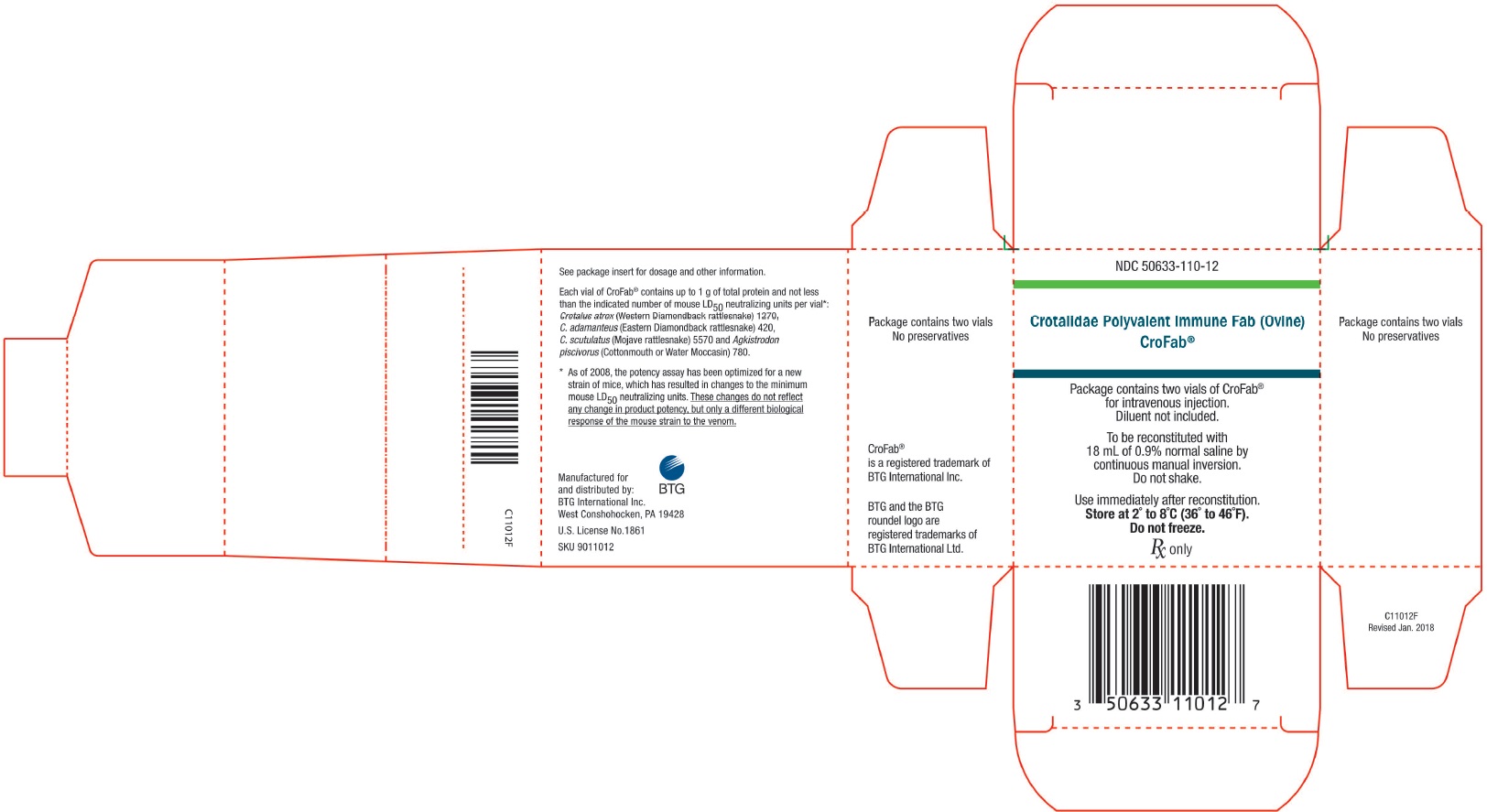
CroFab ovine crotalidae venoms immune fab 1 g; 1 g; 1 g; 1 g Injection, Powder, Lyophilized, For Solution, 2 vials — NDC 50633-110-12 (Billing 50633-0110-12)
This is a package of 2 vials of CroFab ovine crotalidae venoms immune fab 1 g; 1 g; 1 g; 1 g Injection, Powder, Lyophilized, For Solution from BTG International Inc., marketed since Oct 2000 and currently FDA-listed. It is this product's only package size.
NDC database record
One package, one record: these facts belong to NDC 50633-110-12 alone.
- Record
- FDA NDC Directory package listing · Plasma derivative
- Code segments
- 50633 labeler · 110 product · 12 package
- Package marketed since
- Oct 2, 2000
- Sample package
- No — commercial package
- Listing certified through
- Dec 31, 2027
- Billing quantity
- 2 EA per package
- Barcode (UPC-A, from the NDC)
- 3 5063311012 7
- FDA record last changed
- Oct 8, 2026
Identity & classification
Regulatory identifiers FDA, NLM and CMS codes for this package
Drug-database identifiers Medi-Span GPI and First Databank GCN / HICL / AHFS classification
- GSN (GCN sequence number): 048317
- GCN: 47613
- GPI-14 (Medi-Span): 19200021002120
- HICL (First Databank): 022818
- AHFS class code: 80:04.00.00
Where does this data come from?
- FDA openFDA NDC Directory · synced Oct 8, 2026
- FDA label on DailyMed · label index refreshed Oct 8, 2026
- RxNorm (NLM RxNav) · catalog refreshed Oct 8, 2026
- Medi-Span GPI (licensed)
- First Databank (licensed) · refreshed Oct 8, 2026
Clinical
Patient education
Supplement & herbal interactions
Where does this data come from?
- MedlinePlus (NLM) · refreshed Oct 8, 2026
- FDA label on DailyMed · label index refreshed Oct 8, 2026
Ask a licensed pharmacist directly — free, answered by our team.
Pricing
A drug doesn't have one price. Each row is a different public payment system, and none is what you'd pay at the counter — that depends on your insurance. The ⓘ on each row explains what it measures.
| Price system | Per mL | Per package |
|---|---|---|
| Retail pharmacies payNADAC · weekly | Not in the retail survey — common for institutional, discontinued, or low-volume packs. | |
| Medicaid paysCMS SDUD · 12 mo | No recent Medicaid claims on file for this NDC — rare and low-volume NDCs are suppressed in the public data. | |
| Medicare drug plans payPart D · quarterly | No Part D plan price is available for this NDC in our data. | |
| Medicare Part B allowsASP · J0840 | $1,906.906 / J0840 unit | — |
Where does this data come from?
- CMS NADAC weekly file
- CMS ASP pricing files · refreshed Sep 20, 2026
- CMS Medicaid State Drug Utilization Data · refreshed Oct 9, 2026
- CMS Part D plan pricing files · refreshed Sep 24, 2026
- VA National Acquisition Center price file
Billing & reimbursement
Where does this data come from?
- CMS ASP NDC-HCPCS crosswalk · refreshed Sep 22, 2026
- DMEPDAC NDC-HCPCS crosswalk
- openFDA NSDE billing units · refreshed Oct 7, 2026
Packaging — all sizes for this product
| Package NDC | Description | Marketing start | Marketing end | Status |
|---|---|---|---|---|
| 50633-0110-12 You're viewing this Main listing | 2 VIAL, GLASS in 1 CARTON / 1 INJECTION, POWDER, LYOPHILIZED, FOR SOLUTION in 1 VIAL, GLASS | 2000-02-10 | — | Active |
Therapeutic equivalents
| Product | Labeler | Pack | NADAC/unit | TE | Status | Price vs. this |
|---|---|---|---|---|---|---|
| CroFab 1 g/1; 1 g/1; 1 g/1; 1 gthis 50633-0110-12 | BTG | 2 vials | — | — | FDA listed | — |
Where does this data come from?
- FDA openFDA NDC Directory · synced Oct 8, 2026
- FDA Purple Book · refreshed Oct 5, 2026
- CMS NADAC weekly file
Availability & biosimilar status
Biologics have no small-molecule generics; biosimilar competition is tracked in the FDA Purple Book.
Where does this data come from?
- FDA Purple Book · refreshed Oct 5, 2026
Inactive Ingredients / Excipients
Inactive ingredients, also called excipients, are components of the drug product other than the active ingredient. They may include fillers, dyes, coatings, preservatives, flavors, or other formulation ingredients.
💡 Tap an ingredient (hover on desktop) to see what it is and why it’s used.
-
UNII 451W47IQ8X
Sodium chloride is common table salt. It's used in medicines as a buffer to maintain proper pH, as a filler to add bulk, or to adjust the osmotic balance in liquid formulations.
-
UNII 22ADO53M6F
A mineral salt derived from phosphoric acid, used as a buffer to maintain the pH balance of the medication and help stabilize the active ingredients.
2 inactive ingredients listed in the exact product block matched to this NDC.
Where does this data come from?
ingredient classCode="IACT" elements from the exact product block matched by this NDC. Label-section narrative from DailyMed / the openFDA label index is shown separately when available.- FDA label on DailyMed · label index refreshed Oct 8, 2026
- FDA openFDA NDC Directory · synced Oct 8, 2026
Inactive ingredient FAQ
Are inactive ingredients the same for every manufacturer?
Why might an inactive ingredient be missing?
Can inactive ingredients matter?
Manufacturer & labeler
More NDCs from BTG International Inc. labeler code 50633
- DigiFab ovine digoxin immune fab 40 mg Injection, Powder, Lyophilized, For Solution NDC 50633-120-11
- Voraxaze glucarpidase 1000 [USP'U]/1 Injection, Powder, For Solution NDC 50633-210-11
- Vistogard uridine triacetate 951 mg/g Granule NDC 50633-220-04
- DANYELZA Naxitamab 40 mg/10mL Injection NDC 50633-230-01
- Cyanokit Hydroxocobalamin 5 g/250mL Injection, Powder, Lyophilized, For Solution NDC 50633-310-11
- Xuriden uridine triacetate 951 mg/g Granule NDC 50633-330-30
Where does this data come from?
- FDA openFDA NDC Directory · synced Oct 8, 2026
- Drugs@FDA
Full FDA label FDA SPL
🎯 Indications and Usage ▾
1 INDICATIONS AND USAGE CROFAB is indicated for the management of adult and pediatric patients with North American crotalid envenomation. The term crotalid is used to describe the Crotalinae subfamily (formerly known as Crotalidae) of venomous snakes which includes rattlesnakes, copperheads and cottonmouths/water moccasins. CROFAB is a sheep-derived antivenin indicated for the management of adult and pediatric patients with North American crotalid envenomation.
( 1 )
⏱️ Dosage and Administration ▾
2 DOSAGE AND ADMINISTRATION For intravenous use only For intravenous use only Initiate administration as soon as possible after snake bite in patients who develop signs of envenomation (e.g. local injury, coagulation abnormality or systemic signs of envenomation) Dose: ( 2.1 ) Recommended initial dose is between 4 and 6 vials Observe patient for up to one hour after the initial dose and give an additional 4-6 vial dose as needed to gain initial control of envenomation After initial control is established, administer additional 2-vial doses every 6 hours for 18 hours (total of 3 doses) Administration: ( 2.2 ) Reconstitute each vial of CROFAB with 18 mL of 0.9% Sodium Chloride and mix by continuous manual inversion until no solid material is visible in the vial Do not shake Further dilute the entire dose with 0.9% Sodium Chloride to a total volume of 250 mL Infuse each dose intravenously over at least 1 hour
2.1Dosage Administer CROFAB as soon as possible in patients who develop any signs of envenomation (e.g., local injury, coagulation abnormality or systemic signs of envenomation) to prevent clinical deterioration. CROFAB was shown in clinical studies to be effective when given within 6 hours of snakebite. Antivenin dosage requirements are contingent upon an individual patient’s response.
Based on clinical experience with CROFAB, the recommended initial dose is 4 to 6 vials; however, the starting dose may vary from a minimum of 4 vials to a maximum of 12 vials based on clinical judgment and severity of envenomation [ 3 ]. Observe the patient for up to 1 hour following completion of the first dose to determine if initial control of envenomation has been achieved. Initial control is achieved when local signs of envenomation are arrested (leading edge of local injury is not progressing), systemic symptoms are resolved and coagulation parameters have normalized or are trending toward normal.
If initial control is not achieved by the first dose, an additional dose of 4 to 6 vials should be administered repeatedly until initial control of the envenomation syndrome has been achieved. Once initial control has been achieved, additional 2-vial doses of CROFAB every 6 hours for up to 18 hours (3 doses) are recommended. Optimal dosing following the 18-hour scheduled dose of CROFAB has not been determined.
Additional 2-vial doses may be administered as deemed necessary by the treating physician, based on the patient’s clinical course. Infusion reactions, such as fever, low back pain, wheezing and nausea, may be related to the rate of infusion and can be controlled by decreasing the rate of administration of the solution [ 12 ]. Poison control centers are a helpful resource for individual treatment advice.
2.2Preparation and Administration Parenteral drug products should be inspected visually for particulate matter and discoloration prior to administration, whenever solution and container permit. Reconstitute each vial of CROFAB with 18 mL of 0.9% Sodium Chloride (diluent not included) and mix by continuous manual inversion until no solid material is visible in the vial. Do not shake.
Further dilute the contents of all of the reconstituted vials to a total volume of 250 mL with 0.9% Sodium Chloride and mix by gently swirling. Use the reconstituted and diluted product within 4 hours. Infuse the dose intravenously over 60 minutes.
However, the infusion should proceed slowly over the first 10 minutes at a 25- 50 mL/hour rate with careful observation for any allergic reaction. If no such reaction occurs, the infusion rate may be increased to the full 250 mL/hour rate until completion. Close patient monitoring is necessary.
💊 Dosage Forms and Strengths ▾
3 DOSAGE FORMS AND STRENGTHS CROFAB is available as a sterile, nonpyrogenic, purified, lyophilized powder. Each vial contains up to 1 gram of total protein, a maximum of 0.03 mg of mercury and not less than the indicated number of mouse LD 50 neutralizing units * : * As of 2008, the potency assay has been optimized for a new strain of mice, which has resulted in changes to the minimum mouse LD 50 neutralizing units. These changes do not reflect any change in product potency, but only a different biological response of the mouse strain to the venom.
Snake Species Used for Antivenin Component Minimum mouse LD 50 Units per vial C. atrox (Western Diamondback rattlesnake) 1270 C. adamanteus (Eastern Diamondback rattlesnake) 420 C. scutulatus (Mojave rattlesnake) 5570 A. piscivorus (Cottonmouth or Water Moccasin) 780 CROFAB is available as lyophilized powder. Each vial contains up to 1 gram of total protein, a maximum of 0.03 mg of mercury, and not less than the indicated number of mouse LD 50 neutralizing units: Snake Species Used for Antivenin Component Minimum mouse LD 50 Units per vial C. atrox (Western Diamondback rattlesnake) 1270 C. adamanteus (Eastern Diamondback rattlesnake) 420 C. scutulatus (Mojave rattlesnake) 5570 A. piscivorus (Cottonmouth or Water Moccasin) 780
⛔ Contraindications ▾
4 CONTRAINDICATIONS Do not administer CROFAB to patients with a known history of hypersensitivity to papaya or papain unless the benefits outweigh the risks and appropriate management for anaphylactic reactions is readily available. Do not administer CROFAB to patients with a known history of hypersensitivity to any of its components, or to papaya or papain unless the benefits outweigh the risks and appropriate management for anaphylactic reactions is readily available. ( 4 )
⚠️ Warnings and Cautions ▾
5 WARNINGS AND PRECAUTIONS Monitor patients for recurrent coagulopathy for one week or longer following treatment of the bite ( 5.1 ) Hypersensitivity reactions, including anaphylaxis, may occur. Patients allergic to papain, chymopapain, papaya extracts, or bromelain (pineapple enzyme), may react to CROFAB ( 5.2 ) Treatment with the maximum dose of CROFAB used in clinical trials (18 vials) will deliver up to 0.6 mg of ethyl mercury (thimerosol) to a patient ( 5.3 )
5.1Coagulopathy Coagulopathy is a complication noted in many victims of crotalid envenomation that arises due to the ability of the snake venom to interfere with the blood coagulation cascad [ 5 , 9 , 10 ], and is seen more frequently in severely envenomated patients. In clinical trials with CROFAB, recurrent coagulopathy (the return of a coagulation abnormality after it has been successfully treated with antivenin), characterized by decreased fibrinogen, decreased platelets and elevated prothrombin time, occurred in approximately half of patients studied.
The clinical significance of these recurrent abnormalities is not known; however, one systematic review of the literature showed that medically significant bleeding following treatment of Crotaline snake envenomation is uncommon, occurring with an estimated frequency of 0.5% [ 13 ]. Recurrent coagulation abnormalities were observed only in patients who experienced coagulation abnormalities during their initial hospitalization, although coagulopathy can initially appear at any time before, during or after treatment. Optimal dosing to completely prevent recurrent coagulopathy has not been determined.
Because CROFAB has a shorter persistence in the blood than the snake venoms that can leak from depot sites over a prolonged period of time, repeat dosing to prevent or treat such recurrence may be necessary [see Dosage and Administration ( 2 )] . Recurrent coagulopathy may persist for 1 to 2 weeks or more. Patients who experience coagulopathy due to snakebite during hospitalization for initial treatment should be monitored for signs and symptoms of recurrent coagulopathy for up to 1 week or longer at the physician’s discretion.
During this period, the physician should carefully assess the need for re-treatment with CROFAB and use of any type of anticoagulant or anti-platelet drug. Because snake envenomation can cause coagulation abnormalities, the following conditions, which are also associated with coagulation defects, should be considered: cancer, collagen disease, congestive heart failure, diarrhea, elevated temperature, hepatic disorders, hyperthyroidism, poor nutritional state, steatorrhea, vitamin K deficiency.
5.2Hypersensitivity Reactions Severe hypersensitivity reactions may occur with CROFAB. In case of acute hypersensitivity reactions, including anaphylaxis and anaphylactoid reactions, discontinue infusion and institute appropriate emergency treatment. CROFAB contains purified immunoglobulin fragments from the blood of sheep that have been immunized with snake venoms [see Description ( 11 )] .
Injection of heterologous animal proteins can cause severe acute and delayed hypersensitivity reactions (late serum reaction or serum sickness) and a possible febrile response to immune complexes formed by animal antibodies and neutralized venom components [ 11 ]. Papain is used to cleave antibodies into fragments during the processing of CROFAB, and trace amounts of papain or inactivated papain residues may be present. Patients allergic to papain, chymopapain, other papaya extracts, or the pineapple enzyme bromelain may also have an allergic reaction to CROFAB.
Some dust mite allergens and some latex allergens share antigenic structures with papain and patients with these allergies may be allergic to papain [ 7 , 8 ]. Use the following precautions to manage hypersensitivity reactions: Emergency medical care (e.g., epinephrine, intravenous antihistamines and/or albuterol) should be readily available. Carefully monitor… [Excerpted — this section continues on DailyMed.]
🤒 Adverse Reactions ▾
6 ADVERSE REACTIONS Most common adverse reactions (incidence ≥5% of subjects) were urticaria, rash, nausea, pruritus and back pain. The following clinically significant adverse reactions are described elsewhere in the labeling: Hypersensitivity Reactions [see Warnings and Precautions ( 5.2 )] Most common adverse reactions (incidence ≥5% of subjects): urticaria, rash, nausea, pruritus and back pain. Allergic reaction (severe hives and a severe rash and pruritus) has occurred following treatment.
Recurrent coagulopathy due to envenomation and requiring additional treatment may occur. ( 6.1 ) To report SUSPECTED ADVERSE REACTIONS, contact 1-877-377-3784 or FDA at 1-800-FDA-1088 or www.fda.gov/medwatch .
6.1Clinical Trials Experience Because clinical trials are conducted under widely varying conditions, adverse reaction rates observed in the clinical trials of a drug cannot be directly compared to rates in the clinical trials of another drug and may not reflect the rates observed in clinical practice. The safety of CROFAB was evaluated in 289 patients who received CROFAB for crotalid envenomation. Forty-two patients were from two prospective clinical trials in patients who experienced mild to moderate crotalid envenomation; 247 patients were from a retrospective study in patients who experienced mild, moderate or severe envenomation.
There also were safety information extracted from literature review of publications on CROFAB that contained patient exposure data. Premarketing Prospective Clinical Trials A total 42 patients received CROFAB for treatment of mild to moderate crotalid envenomation in two clinical studies. The patients were aged 11 to 76 years, and 34 were male and 8 were female.
Nineteen patients experienced an adverse reaction for a total of 26 adverse reactions. Adverse reactions involving the skin and appendages (primarily rash, urticaria, and pruritus) were reported in 12 of the 42 patients (see Table 1 ). One patient discontinued CROFAB therapy due to an allergic reaction.
Of the 19 patients who experienced adverse reactions, 3 patients experienced severe or serious adverse reactions. 1 patient who experienced a serious adverse reaction had recurrent coagulopathy due to envenomation, which required re-hospitalization and additional antivenin administration. This patient eventually made a complete recovery.
2 patients had severe adverse reactions that consisted of 1 patient who developed severe urticaria following treatment and 1 patient who developed a severe rash and pruritus several days following treatment. Both patients recovered following treatment with antihistamines and prednisone. Table 1 Incidence of Adverse Reactions by Body System in Premarketing Clinical Trials † Allergic reaction consisted of urticaria, dyspnea and wheezing in 1 patient.
Adverse Reaction n=42 Number of Reactions Body as a Whole Back pain 2 Allergic reaction† 1 Serum sickness 1 Skin and Appendages Urticaria 7 Rash 3 Pruritus 2 Subcutaneous nodule 1 Respiratory System Cough 1 Digestive System Nausea 3 Anorexia 1 Hematologic/Lymphatic Coagulation disorder 1 Ecchymosis 1 Musculoskeletal Myalgia 1 Nervous System Nervousness 1 Six of 42 patients experienced an adverse reaction associated with an early serum reaction and 4 experienced an adverse reaction associated with a late serum reaction.
Two additional patients were considered to have experienced a late serum reaction by the investigator, although no associated adverse reaction was reported. Serum reactions are defined as reactions associated with CROFAB infusion. They consisted mainly of urticaria and rash, and all patients recovered without sequelae.
Table 2 lists the incidence of early and late serum reactions. There were 7 events classified as early serum reactions and 5 events classified as late serum reactions; none was serious. Table 2 Incidence of Early and Late Serum Reactions in Premarketing Clinical Trials ** Allergic reaction consisted of urticaria, dyspnea and wheezing in… [Excerpted — this section continues on DailyMed.]
👥 Use in Specific Populations ▾
8 USE IN SPECIFIC POPULATIONS
8.1Pregnancy Risk Summary Animal reproduction studies have not been conducted with CROFAB. It is also not known whether CROFAB can cause fetal harm when administered to a pregnant woman or can affect reproduction capacity. CROFAB should be given to a pregnant woman only if clearly needed.
In the U.S. general population, the estimated background risk of major birth defects and miscarriage in clinically recognized pregnancies is 2-4% and 15-20%, respectively. Clinical Considerations CROFAB contains mercury in the form of ethyl mercury from thimerosal [see Warnings and Precautions, Mercury ( 5.3 )] . Although there are limited toxicology data on ethyl mercury, high dose and acute exposures to methyl mercury have been associated with neurological and renal toxicities.
Developing fetuses and very young children are most susceptible and therefore, at greater risk.
8.2Lactation Risk Summary It is not known whether CROFAB is excreted in human breast milk. Because many drugs are excreted in human milk, caution should be exercised when CROFAB is administered to a nursing woman.
8.4Pediatric Use Thirty-two percent (78/247) of patients studied in a post-marketing retrospective study of CROFAB were 16 years of age or younger (median 8.5 years [range 1 to 16 years]). Initial control of envenomation was achieved in 64/72 (89%) of pediatric patients, which was similar to the initial control rate in adults (103/128, 80%). Changes in severity score, recurrence and incidence adverse reactions were similar between pediatric and adult patients, indicating safety and efficacy in the pediatric population are comparable to that in adults.
Limited published clinical experience has not shown that a dosage adjustment for age should be made [ 14 , 15 ]. CROFAB contains mercury in the form of ethyl mercury from thimerosal [see Warnings and Precautions, Mercury ( 5.3 )] . Although there are limited toxicology data on ethyl mercury, high dose and acute exposures to methyl mercury have been associated with neurological and renal toxicities.
Developing fetuses and very young children are most susceptible and therefore, at greater risk.
8.5Geriatric Use Five percent (13/247) of patients studied in a post-marketing retrospective study of CROFAB were over 65 years of age (median 72 years [range 67 to 91 years]). The efficacy and safety of CROFAB in the geriatric population appears comparable to the overall population.
🤰 Pregnancy ▾
8.1Pregnancy Risk Summary Animal reproduction studies have not been conducted with CROFAB. It is also not known whether CROFAB can cause fetal harm when administered to a pregnant woman or can affect reproduction capacity. CROFAB should be given to a pregnant woman only if clearly needed.
In the U.S. general population, the estimated background risk of major birth defects and miscarriage in clinically recognized pregnancies is 2-4% and 15-20%, respectively. Clinical Considerations CROFAB contains mercury in the form of ethyl mercury from thimerosal [see Warnings and Precautions, Mercury ( 5.3 )] . Although there are limited toxicology data on ethyl mercury, high dose and acute exposures to methyl mercury have been associated with neurological and renal toxicities.
Developing fetuses and very young children are most susceptible and therefore, at greater risk.
🧒 Pediatric Use ▾
8.4Pediatric Use Thirty-two percent (78/247) of patients studied in a post-marketing retrospective study of CROFAB were 16 years of age or younger (median 8.5 years [range 1 to 16 years]). Initial control of envenomation was achieved in 64/72 (89%) of pediatric patients, which was similar to the initial control rate in adults (103/128, 80%). Changes in severity score, recurrence and incidence adverse reactions were similar between pediatric and adult patients, indicating safety and efficacy in the pediatric population are comparable to that in adults.
Limited published clinical experience has not shown that a dosage adjustment for age should be made [ 14 , 15 ]. CROFAB contains mercury in the form of ethyl mercury from thimerosal [see Warnings and Precautions, Mercury ( 5.3 )] . Although there are limited toxicology data on ethyl mercury, high dose and acute exposures to methyl mercury have been associated with neurological and renal toxicities.
Developing fetuses and very young children are most susceptible and therefore, at greater risk.
🧓 Geriatric Use ▾
8.5Geriatric Use Five percent (13/247) of patients studied in a post-marketing retrospective study of CROFAB were over 65 years of age (median 72 years [range 67 to 91 years]). The efficacy and safety of CROFAB in the geriatric population appears comparable to the overall population.
🧬 Clinical Pharmacology ▾
12 CLINICAL PHARMACOLOGY
12.1Mechanism of Action CROFAB is a venom-specific Fab fragment of immunoglobulin G (IgG) that works by binding and neutralizing venom toxins, facilitating their redistribution away from target tissues and their elimination from the body.
12.3Pharmacokinetics A limited number of samples were collected from three patients in the pharmacokinetic study of CROFAB. Based on these data, estimates of elimination half-life were made. The elimination half life for total Fab ranged from approximately 12 to 23 hours.
These limited pharmacokinetic estimates of half-life are augmented by data obtained with an analogous ovine Fab product produced by BTG International Inc. using a similar production process. In that study, 8 healthy subjects were given 1 mg of intravenous digoxin followed by an approximately equimolar neutralizing dose of 76 mg of digoxin immune Fab (ovine). Total Fab was shown to have a volume of distribution of
0.3L/kg, a systemic clearance of 32 mL/min (approximately 0.4 mL/min/kg) and an elimination half-life of approximately 15 hours.
🧬 Mechanism of Action ▾
12.1Mechanism of Action CROFAB is a venom-specific Fab fragment of immunoglobulin G (IgG) that works by binding and neutralizing venom toxins, facilitating their redistribution away from target tissues and their elimination from the body.
12.3Pharmacokinetics A limited number of samples were collected from three patients in the pharmacokinetic study of CROFAB. Based on these data, estimates of elimination half-life were made. The elimination half life for total Fab ranged from approximately 12 to 23 hours.
These limited pharmacokinetic estimates of half-life are augmented by data obtained with an analogous ovine Fab product produced by BTG International Inc. using a similar production process. In that study, 8 healthy subjects were given 1 mg of intravenous digoxin followed by an approximately equimolar neutralizing dose of 76 mg of digoxin immune Fab (ovine). Total Fab was shown to have a volume of distribution of
0.3L/kg, a systemic clearance of 32 mL/min (approximately 0.4 mL/min/kg) and an elimination half-life of approximately 15 hours.
📦 How Supplied / Storage and Handling ▾
16 HOW SUPPLIED/STORAGE AND HANDLING How Supplied CROFAB is supplied as a carton that contains 2 vials of product (diluent not included) [NDC 50633-110-12]. Each vial of CROFAB contains up to 1 gram of lyophilized total protein and not less than the indicated number of mouse LD 50 neutralizing units: Snake Species Used for Antivenin Component Minimum mouse LD 50 Units per vial C. atrox (Western Diamondback rattlesnake) 1270 C. adamanteus (Eastern Diamondback rattlesnake) 420 C. scutulatus (Mojave rattlesnake) 5570 A. piscivorus (Cottonmouth or Water Moccasin) 780 Storage and Handling Store vials at 2° to 8°C (36° to 46°F).
A temperature excursion for no longer than 7 days within the range of -20° to 25°C (-4° to 77°F) is permitted. Do not freeze. Use within 4 hours after reconstitution.
📋 Description ▾
11 DESCRIPTION CROFAB [Crotalidae Polyvalent Immune Fab (Ovine)] is a sterile, nonpyrogenic, purified, lyophilized preparation of ovine Fab (monovalent) immunoglobulin fragments obtained from the blood of healthy sheep flocks immunized with one of the following North American snake venoms: Crotalus atrox (Western Diamondback rattlesnake), Crotalus adamanteus (Eastern Diamondback rattlesnake), Crotalus scutulatus (Mojave rattlesnake), and Agkistrodon piscivorus (Cottonmouth or Water Moccasin). To obtain the final antivenin product, the four different monospecific antivenins are mixed.
Each monospecific antivenin is prepared by fractionating the immunoglobulin from the ovine serum, digesting it with papain, and isolating the venom specific Fab fragments on ion exchange and affinity chromatography columns. CROFAB is standardized by its ability to neutralize the lethal action of each of the four venom immunogens following intravenous injection in mice. The potency of the product will vary from batch to batch; however, a minimum number of mouse LD 50 neutralizing units against each of the four venoms is included in every vial of final product, as shown in Table 3.
Table 3 Minimum Mouse LD 50 Neutralizing Units 1 for Each Venom Component 1 One neutralizing unit is determined as the amount of the mixed monospecific Fab proteins necessary to neutralize one LD 50 of each of the four venoms, where the LD 50 is the amount of venom that would be lethal in 50% of mice. 2 As of 2008, the potency assay has been optimized for a new strain of mice, which has resulted in changes to the minimum mouse LD 50 neutralizing units. These changes do not reflect any change in product potency, but only a different biological response of the mouse strain to the venom.
Venom Minimum Potency per Vial of CROFAB 2 Crotalus atrox ≥ 1270 Crotalus adamanteus ≥ 420 Crotalus scutulatus ≥ 5570 Agkistrodon piscivorus ≥ 780 Each vial of CROFAB contains up to 1 gram of total protein and sodium phosphate buffer consisting of dibasic sodium phosphate USP and sodium chloride USP. Thimerosal is used as a preservative in the manufacturing process, and as such, mercury is carried over into the final product at an amount no greater than 30 mcg per vial, which amounts to no more than 0.6 mg of mercury per dose (based on the maximum dose of 18 vials used in clinical studies of CROFAB).
The product is intended for intravenous administration after reconstitution with 18 mL of 0.9% Sodium Chloride.
💬 Information for Patients ▾
17 PATIENT COUNSELING INFORMATION Advise patients to contact their physician immediately if they experience unusual bruising or bleeding (e.g., nosebleeds, excessive bleeding after brushing teeth, the appearance of blood in stools or urine, excessive menstrual bleeding, petechiae, excessive bruising or persistent oozing from superficial injuries) after hospital discharge.Such bruising or bleeding may occur for up to 1 week or longer following initial treatment. Advise patients to contact their physician immediately if they experience any signs and symptoms of delayed allergic reactions or serum sickness (e.g., rash, pruritus, urticaria) after hospital discharge.
Manufactured for and distributed by: BTG International Inc. West Conshohocken, PA 19428 U.S. License No.
1861 CroFab® is a registered trademark of BTG International Inc. BTG and the BTG roundel logo are registered trademarks of BTG International Ltd. P11012E
🔬 Clinical Studies ▾
14 CLINICAL STUDIES The safety and efficacy of CROFAB in crotalid envenomation were evaluated in two premarketing prospective and one postmarketing retrospective studies. The prospective studies evaluated patients suffering from minimal to moderate North American crotalid envenomation. The postmarketing study evaluated patients suffering from mild, moderate or severe envenomation.
The definition of minimal, moderate, and severe envenomation in clinical studies of CROFAB is provided in Table 5 . Table 5 Definition of Minimal, Moderate, and Severe Crotalid Envenomation Envenomation Severity Definition Minimal Swelling, pain, and ecchymosis limited to the immediate bite site; Systemic signs and symptoms absent; Coagulation parameters normal with no clinical evidence of bleeding Moderate Swelling, pain, and ecchymosis involving less than a full extremity or, if bite was sustained on the trunk, head or neck, extending less than 50 cm; Systemic signs and symptoms may be present but not life threatening, including but not limited to nausea, vomiting, oral paresthesia or unusual tastes, mild hypotension (systolic blood pressure >90 mmHg), mild tachycardia (heart rate <150), and tachypnea Coagulation parameters may be abnormal, but no clinical evidence of bleeding present.
(Minor hematuria, gum bleeding and nosebleeds are allowed if they are not considered severe in the investigator’s judgment) Severe Swelling, pain, and ecchymosis involving more than an entire extremity or threatening the airway Systemic signs and symptoms are markedly abnormal, including severe alteration of mental status, severe hypotension, severe tachycardia, tachypnea, or respiratory insufficiency Coagulation parameters are abnormal, with serious bleeding or severe threat of bleeding Premarketing Prospective Studies Two premarketing prospectively defined, open label, multi-center trials were conducted in otherwise healthy patients 11 years of age or older who had experienced minimal or moderate North American crotalid envenomation that showed evidence of progression.
Progression was defined as the worsening of any evaluation parameter used in the grading of an envenomation: local injury, laboratory abnormality or symptoms and signs attributable to crotalid snake venom poisoning. Both clinical trials excluded patients with Copperhead envenomation. Efficacy was determined using a Snakebite Severity Score (SSS) [ 2 ] (referred to as the efficacy score or ES) and an investigator’s clinical assessment (ICA) of efficacy.
The SSS is a tool used to measure the severity of envenomation based on six body categories: local wound (e.g., pain, swelling and ecchymosis), pulmonary, cardiovascular, gastrointestinal, hematological and nervous system effects. A higher score indicates worse symptoms.. CROFAB was required to prevent an increase in the ES in order to demonstrate efficacy.
The ICA was based on the investigator’s clinical judgment as to whether the patient had a: Clinical response (pre-treatment signs and symptoms of envenomation were arrested or improved after treatment) Partial response (signs and symptoms of envenomation worsened, but at a slower rate than expected after treatment) Non-response (the patient’s condition was not favorably affected by the treatment) Safety was assessed during CROFAB infusion by monitoring for early allergic events, such as anaphylaxis and early serum reactions, and late events, such as late serum reactions [see Adverse Reactions ( 6.1 )] In clinical study 1, 11 patients received an intravenous dose of 4 vials of CROFAB over 60 minutes.
An additional 4-vial dose of CROFAB was administered after completion of the first CROFAB infusion, if deemed necessary by the investigator. At the 1-hour assessment, 10 out of 11 patients had no change or a decrease in their ES. Ten of 11 patients were also judged to have a clinical response by the ICA.
After initial clinical response, two patients demonstrated a need for additional antivenom to stem pr… [Excerpted — this section continues on DailyMed.]
🧪 Nonclinical Toxicology ▾
13 NONCLINICAL TOXICOLOGY
13.2Animal Toxicology and/or Pharmacology CROFAB was effective in neutralizing the venoms of 10 clinically important North American crotalid snakes in a murine lethality model (see Table 4 ) [ 1 ]. In addition, preliminary data from experiments in mice using whole IgG from the sheep immunized for CROFAB production suggest that CROFAB might possess antigenic cross-reactivity against the venoms of some Middle Eastern and North African snakes; however, there are no clinical data available to confirm these findings. Table 4 Average ED 50 Values for CROFAB in Mice Study Objective & Design Endpoint Measured Major Findings and Conclusions To determine the cross-neutralizing ability of CROFAB to protect mice from the lethal effects of venom from clinically important species.
Separate groups of mice were injected with increasing doses of CROFAB pre-mixed with two LD 50 of each venom tested. ED 50 for each venom (Note: Lower numbers represent increased potency against venoms listed) Challenge Venom ED 50 (mg antivenin/mg venom) C. atrox 3 C. adamanteus 18 C. scutulatus 8 A. piscivorus 4 C. h. atricaudatus 11 C. v. helleri 6 C. m. molossus 5 A. c. contortrix 8 S. m. barbouri 12 C. h. horridus 6 Based on data from studies in mice, CROFAB has relatively good cross-protection against venoms not used in the immunization of flocks used to produce it.
For C. v. helleri and C. m. molossus , higher doses may be required based on historical data.
📚 References ▾
15 REFERENCES Consroe P, Egen NB, Russell FE, Gerrish K, Smith DC, Sidki A, et al. Comparison of a new ovine antigen binding fragment (Fab) antivenin for United States Crotalidae with the commercial antivenin for protection against venom induced lethality in mice. J Trop Med Hyg 1995; 53(5):507 510.
Dart RC, Hurlbut KM, Garcia R, Boren J. Validation of a severity score for the assessment of Crotalid snakebite. Ann Emerg Med 1996; 27(3):321 326.
Lavonas EJ, Ruha AM, Banner W, Bebarta V, Bernstein JN, Bush SP, Kerns WP, Richardson WH, Seifert SA, Tanen DA, Curry SC, Dart RC. Unified treatment algorithm for the management of crotaline snakebite in the United States: results of an evidence-informed consensus workshop. BMC Emerg Med February 3 2011;11:2 ( http://www.biomedcentral.com/1471-227X/11/2 ).
La Grange RG and Russell FE. Blood platelet studies in man and rabbits following Crotalus envenomation. Proc West Pharmacol Soc 1970;13:99-105.
Lyons WJ. Profound thrombocytopenia associated with Crotalus ruber ruber envenomation: a clinical case. Toxicon 1971; 9:237 240.
Tallon RW, Koch KL, Barnes SG, Ballard JO. Letter to Editor. N Engl J Med 1981;305:1347.
Quarre JP, Lecomte J, Lauwers D, Gilbert P, Thiriaux J. Allergy to latex and papain. J Allergy Clin Immunol 1995; 95(4):922.
Baur X, Chen Z, Rozynek P, Düser D, Raulf Heimsoth M. Cross reacting IgE antibodies recognizing latex allergens, including Hev b 1, as well as papain. Allergy 1995; 50(7):604 609.
Furlow TG, Brennan LV. Purpura following timber rattlesnake (Crotalus horridus horridus) envenomation. Cutis 1985; 35:234 236.
Budzynski AZ, Pandya BV, Rubin RN, Brizuela BS, Soszka T, Stewart GJ. Fibrinogenolytic afibrinogenemia after envenomation by western diamondback rattlesnake (Crotalus atrox). Blood 1984; 63(1):1 14.
Kojis FG. Serum sickness and anaphylaxis. Am J Dis Child 1997;93 350.
Kirkpatrick CH, The Digibind Study Advisory Panel. Allergic histories and reactions of patients treated with digoxin immune Fab (ovine) antibody. Am J Emerg Med 1991; 9(2 Suppl 1):7 10.
Lavonas EJ, Khatri V, Daugherty C, Bucher-Bartelson B, King T, Dart RC. Medically significant late bleeding after treated Crotaline envenomation: A systematic review. Ann Emerg Med 2014;63(1):71-78.
Pizon AF, Riley BD, LoVecchio F, and Gill R. Safety and Efficacy of Crotalidae Polyvalent Immune Fab in Pediatric Crotaline Envenomations. Acad Emerg Med 2007;14:373-376.
Offerman SR, Bush SP, Moynihan JA, Clark RF. Crotaline Fab Antivenom for the Treatment of Children with Rattlesnake Envenomation. Pediatrics 2002; 110(5):968-971.
📄 Package Label / Principal Display Panel ▾
PRINCIPAL DISPLAY PANEL - NDC 50633-111-11 - Vial Label Vial-Label
PRINCIPAL DISPLAY PANEL - NDC 50633-110-12 - Carton Label Carton-Label
About this NDC listing & data coverage
What data is (and isn’t) available for this NDC — tap to expand
| NDC identity (package / product / labeler codes) | ✓ Available |
| Labeler | ✓ Available |
| Product & package description | ✓ Available |
| Marketing category & status | ✓ Available |
| Active ingredient / dosage form / route | ✓ Available |
| FDA label (SPL via DailyMed) | ✓ Available |
| Package photos | ✓ Available |
| Inactive ingredients (structured) | ✓ Available |
| NADAC pharmacy acquisition price (CMS) | — Not published for this NDC CMS publishes NADAC only for NDCs reported in its retail-pharmacy survey. |
| Orange Book / therapeutic-equivalence data | — Not published for this NDC Applies only to products approved under an NDA/ANDA; many listings are out of scope. |
| HCPCS J-code billing crosswalk | ✓ Available |
| Medicaid utilization (CMS SDUD) | — Not published for this NDC CMS reports utilization only for NDCs with Medicaid claims above its privacy threshold. |