
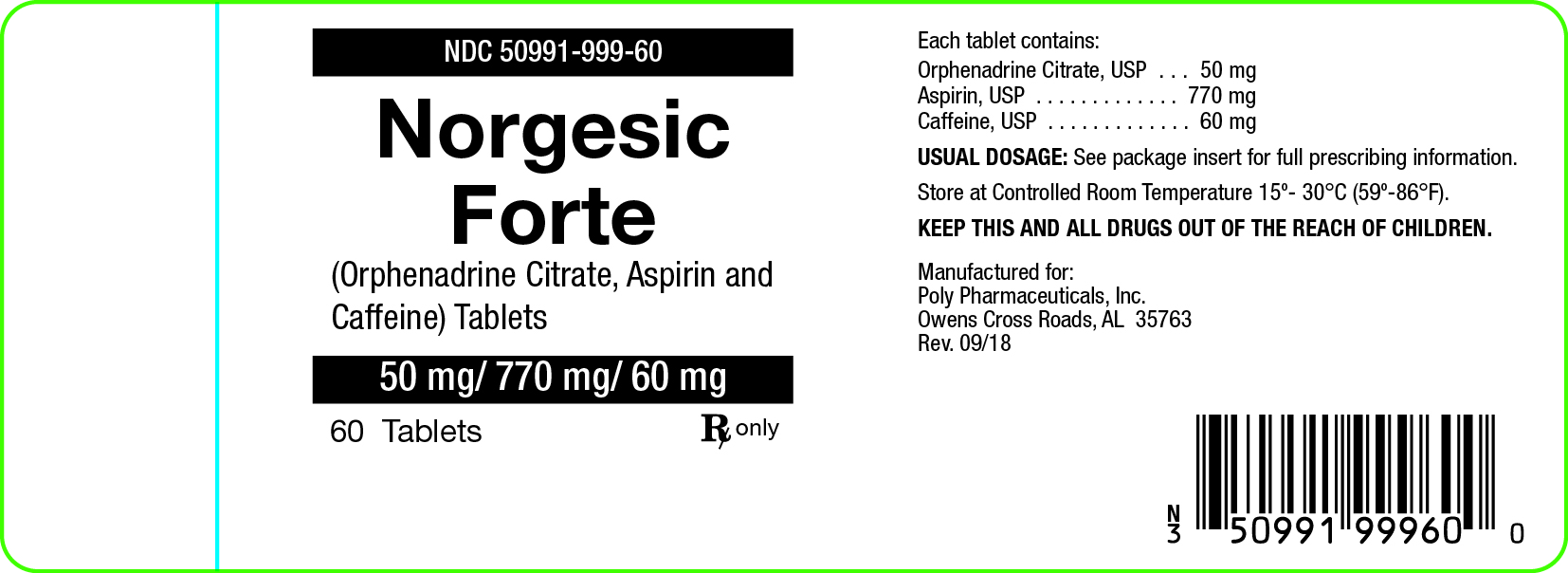
Norgesic Forte Orphenadrine Citrate, Aspirin and Caffeine 50 mg; 770 mg; 60 mg Tablet, Multilayer, 60-count
🆔 Identity & classification
Where does this data come from?
🏷️ RxNorm drug class
This medicine belongs to the Platelet Aggregation Inhibitor class.
Where does this data come from?
🏭 Manufacturer & labeler
Where does this data come from?
🩺 Clinical
Patient education
Supplement & herbal interactions
Where does this data come from?
Ask a licensed pharmacist directly — free, answered by our team.
💊 What it looks like
Where does this data come from?
🧪 Inactive Ingredients / Excipients
Inactive ingredients, also called excipients, are components of the drug product other than the active ingredient. They may include fillers, dyes, coatings, preservatives, flavors, or other formulation ingredients.
💡 Tap an ingredient (hover on desktop) to see what it is and why it’s used.
-
UNII 3SY5LH9PMK
Anhydrous lactose is a milk sugar with no water content. It acts as a filler and binder in tablets and capsules, adding bulk and helping ingredients stick together.
-
UNII OP1R32D61U
Microcrystalline cellulose is a purified form of cellulose, a natural fiber from plant sources. It acts as a binder and filler in tablets and capsules, helping hold ingredients together and give the medicine its shape and size.
-
UNII M28OL1HH48
Croscarmellose sodium is a plant-based substance derived from cellulose. It acts as a disintegrant, helping tablets and capsules break down quickly in the digestive system so the medicine can be absorbed.
-
UNII 35SW5USQ3G
A synthetic yellow dye used to color medicines. It helps make tablets, capsules, and liquids visually distinct so patients can easily identify their medication.
-
UNII H3R47K3TBD
FD&C Blue No. 1 is a synthetic blue dye approved for use in foods and medicines. It serves as a colorant to give the medication its distinctive appearance and help with product identification.
-
UNII FZ989GH94E
Povidone is a synthetic polymer made from a plastic-like material. It acts as a binder to hold tablet ingredients together and as a disintegrant to help the tablet break apart in your stomach so the medicine can be absorbed.
-
UNII ETJ7Z6XBU4
Silicon dioxide is a naturally occurring mineral used as a glidant and anti-caking agent. It helps powder ingredients flow smoothly and prevents clumping during manufacturing and storage.
-
UNII 368GB5141J
A detergent and foaming agent derived from coconut or palm oil. In medications, it helps break down and mix oil and water-based ingredients, aids in tablet disintegration, and improves how the drug dissolves and spreads in the mouth or digestive system.
-
UNII O8232NY3SJ
A plant-based carbohydrate derived from corn kernels. It acts as a filler to add bulk, a binder to hold ingredients together, and a disintegrant to help the tablet break apart in your stomach for absorption.
-
UNII 4ELV7Z65AP
Stearic acid is a fatty acid derived from plant or animal sources. It acts as a binder and lubricant in tablets and capsules, helping them hold together and flow smoothly during manufacturing.
10 inactive ingredients listed in the exact product block matched to this NDC.
Where does this data come from?
ingredient classCode="IACT" elements from the exact product block matched by this NDC. Label-section narrative from DailyMed / the openFDA label index is shown separately when available.Inactive ingredient FAQ
Are inactive ingredients the same for every manufacturer?
Why might an inactive ingredient be missing?
Can inactive ingredients matter?
💲 Pricing
A drug doesn't have one price. Each row is a different public payment system, and none is what you'd pay at the counter — that depends on your insurance. The ⓘ on each row explains what it measures.
| Price system | Per each | Per package |
|---|---|---|
| Retail pharmacies payNADAC · weekly | Not in the retail survey — common for institutional, discontinued, or low-volume packs. | |
| Medicaid paysCMS SDUD · 12 mo | $20.79 | $1,247.58 / 60 tablets |
| Medicare drug plans payPart D · quarterly | No Part D plan price is available for this NDC in our data. | |
Where does this data come from?
🔁 Therapeutic equivalents
| Product | Labeler | Pack | NADAC/unit | TE | Status | Price vs. this |
|---|---|---|---|---|---|---|
| Norgesic Forte 50 mg/1; 770 mg/1; 60 mgthis 50991-0999-60 | Poly | 60 tablets | — | — | FDA listed | — |
| Orphengesic Forte 50 mg/1; 770 mg/1; 60 mg 61825-0302-60 | Galt | 60 tablets | — | — | FDA listed | — |
| Orphenadrine Citrate, Aspirin and Caffeine 50 mg/1; 770 mg/1; 60 mg 71993-0307-60 | Atland | 60 tablets | — | — | FDA listed | — |
Where does this data come from?
⏳ Availability & generic status
This product is an FDA-approved generic. Other versions of the same drug are listed under Therapeutic equivalents, least expensive first.
Where does this data come from?
🗺️ Medicaid utilization & spend
💊 Medicaid utilization by pack size
📊 Medicare Part D spend CMS · PART D · 2026 (Q1)
🔬 Reported adverse events (FAERS)
Top reported reactions
Reporter sex
Serious outcomes
Where does this data come from?
📦 Packaging — all sizes for this product
| Package NDC | Description | Marketing start | Status |
|---|---|---|---|
| 50991-0999-06 | 6 TABLET, MULTILAYER in 1 CARTON (50991-999-06) | 2022-03-28 | Discontinued by firm |
| 50991-0999-60 You're viewing this | 60 TABLET, MULTILAYER in 1 BOTTLE (50991-999-60) | 2019-04-01 | Active |
You're viewing the largest of 2 pack sizes for this product.
In Medicaid, this is the most-dispensed pack of this product — about 100% of fills over the last four reported quarters. See all packs ↓
Pack size FAQ
What quantity is in NDC 50991-0999-60?
What is the difference between NDC 50991-0999-60 and NDC 50991-0999-06?
What NDC number is used to bill for this package of Norgesic Forte Orphenadrine Citrate, Aspirin and Caffeine 50 mg; 770 mg; 60 mg Tablet, Multilayer?
🧭 About this NDC listing & data coverage
What data is (and isn’t) available for this NDC — tap to expand
| NDC identity (package / product / labeler codes) | ✓ Available |
| Labeler | ✓ Available |
| Product & package description | ✓ Available |
| Marketing category & status | ✓ Available |
| Active ingredient / dosage form / route | ✓ Available |
| FDA label (SPL via DailyMed) | ✓ Available |
| Package photos | ✓ Available |
| Inactive ingredients (structured) | ✓ Available |
| NADAC pharmacy acquisition price (CMS) | — Not published for this NDC CMS publishes NADAC only for NDCs reported in its retail-pharmacy survey. |
| Orange Book / therapeutic-equivalence data | — Not published for this NDC Applies only to products approved under an NDA/ANDA; many listings are out of scope. |
| HCPCS J-code billing crosswalk | — Not published for this NDC Most self-administered / retail products have no J-code — that is normal. |
| Medicaid utilization (CMS SDUD) | ✓ Available |
Questions about this listing
Why is there no price listed?
Is the NDC printed on the package the same as the 11-digit billing NDC?
What do the three segments of this NDC mean?
Is this package still being marketed?
Does this product come in other package sizes?
Who lists this product with the FDA?
Do I need a prescription for this product?
Where does this data come from?
📄 Full prescribing information FDA SPL
🎯 Indications and Usage ▾
INDICATIONS AND USAGE Norgesic Forte 50 mg/770mg/60 mg Tablets are indicated in: Symptomatic relief of mild to moderate pain of acute musculoskeletal disorders. The orphenadrine component is indicated as an adjunct to rest, physical therapy, and other measures for the relief of discomfort associated with acute painful musculoskeletal conditions. The mode of action of orphenadrine has not been clearly identified, but may be related to its analgesic properties.
Norgesic Forte Tablets do not directly relax tense skeletal muscles in man.
⏱️ Dosage and Administration ▾
DOSAGE AND ADMINISTRATION Norgesic Forte Tablets: Adults 1/2 to 1 tablet 3 to 4 times daily.
⛔ Contraindications ▾
CONTRAINDICATIONS Because of the mild anti-cholinergic effect of orphenadrine, Norgesic Forte Tablets should not be used in patients with glaucoma, pyloric or duodenal obstruction, achalasia, prostatic hypertrophy, or obstructions at the bladder neck. Norgesic Forte Tablets are also contraindicated in patients with myasthenia gravis and in patients known to be sensitive to aspirin or caffeine. The drug is contraindicated in patients who have demonstrated a previous hypersensitivity to the drug.
⚠️ Warnings ▾
WARNINGS Reye’s Syndrome may develop in individuals who have chicken pox, influenza, or flu symptoms. Some studies suggest possible association between the development of Reye’s Syndrome and the use of medicines containing salicylate or aspirin. Norgesic Forte Tablets 50mg/770mg/60mg contain aspirin and therefore are not recommended for use in patients with chicken pox, influenza, or flu symptoms.
Norgesic Forte Tablets may impair the ability of the patient to engage in potentially hazardous activities such as operating machinery or driving a motor vehicle: ambulatory patients should therefore be cautioned accordingly. Aspirin should be used with extreme caution in the presence of peptic ulcers and coagulation abnormalities. Usage in Pregnancy Risk Summary Use of NSAIDs, including aspirin, can cause premature closure of the fetal ductus arteriosus and fetal renal dysfunction leading to oligohydramnios and, in some cases, neonatal renal impairment.
Because of these risks, limit dose and duration of Orphengesic Forte Tablets use between about 20 and 30 weeks of gestation, and avoid Orphengesic Forte Tablets use at about 30 weeks of gestation and later in pregnancy [see WARNINGS; Fetal Toxicity]. Premature Closure of Fetal Ductus Arteriosus Use of NSAIDs, including aspirin, at about 30 weeks gestation or later in pregnancy increases the risk of premature closure of the fetal ductus arteriosus. Oligohydramnios/Neonatal Renal Impairment Use of NSAIDs at about 20 weeks gestation or later in pregnancy has been associated with cases of fetal renal dysfunction leading to oligohydramnios, and in some cases, neonatal renal impairment.
Data from observational studies regarding other potential embryofetal risks of NSAID use in women in the first or second trimesters of pregnancy are inconclusive. Based on animal data, prostaglandins have been shown to have an important role in endometrial vascular permeability, blastocyst implantation, and decidualization. In animal studies, administration of prostaglandin synthesis inhibitors such as aspirin, resulted in increased pre- and post-implantation loss.
Prostaglandins also have been shown to have an important role in fetal kidney development. In published animal studies, prostaglandin synthesis inhibitors have been reported to impair kidney development when administered at clinically relevant doses. The estimated background risk of major birth defects and miscarriage for the indicated population(s) is unknown.
All pregnancies have a background risk of birth defect, loss, or other adverse outcomes. In the U.S. general population, the estimated background risk of major birth defects and miscarriage in clinically recognized pregnancies is 2-4% and 15-20%, respectively. Clinical Considerations Fetal/Neonatal Adverse Reactions Premature Closure of Fetal Ductus Arteriosus: Avoid use of NSAIDs in women at about 30 weeks gestation and later in pregnancy, because NSAIDs, including Orphengesic Forte Tablets, can cause premature closure of the fetal ductus arteriosus (see WARNINGS; Fetal Toxicity).
Oligohydramnios/Neonatal Renal Impairment If an NSAID is necessary at about 20 weeks gestation or later in pregnancy, limit the use to the lowest effective dose and shortest duration possible. If Orphengesic Forte Tablets treatment extends beyond 48 hours, consider monitoring with ultrasound for oligohydramnios. If oligohydramnios occurs, discontinue Orphengesic Forte Tablets and follow up according to clinical practice (see WARNINGS; Fetal Toxicity).
Data Human Data Premature Closure of Fetal Ductus Arteriosus : Published literature reports that the use of NSAIDs at about 30 weeks of gestation and later in pregnancy may cause premature closure of the fetal ductus arteriosus. Oligohydramnios/Neonatal Renal Impairment: Published studies and postmarketing reports describe maternal NSAID use at about 20 weeks gestation or later in pregnancy associated with fetal renal dysfunction leading to oligohydramnios, and in…
🤒 Adverse Reactions ▾
ADVERSE REACTIONS Side effects of Norgesic Forte Tablets are those seen with aspirin and caffeine or those usually associated with mild anticholinergic agents. These may include tachycardia, palpitation, urinary hesitancy or retention, dry mouth, blurred vision, dilation of the pupil, increased intraocular tension, weakness, nausea, vomiting, headache, dizziness, constipation, drowsiness, and rarely, urticaria and other dermatoses. Infrequently, an elderly patient may experience some degree of confusion.
Mild central excitation and occasional hallucinations may be observed. These mild side effects can usually be eliminated by reduction in dosage. One case of aplastic anemia associated with the use of Orphenadrine Citrate, Aspirin, and Caffeine Tablets has been reported.
No causal relationship has been established. Rare G.I. hemorrhage due to aspirin content may be associated with the administration of Norgesic Forte Tablets. Some patients may experience transient episodes of lightheadedness, dizziness or syncope.
🧬 Clinical Pharmacology ▾
CLINICAL PHARMACOLOGY Orphenadrine citrate is a centrally acting (brain stem) compound which in animals selectively blocks facilitatory functions of the reticular formulation. Orphenadrine does not produce myoneural block, nor does it affect crossed extensor reflexes. Orphenadrine prevents nicotine-induced convulsions but not those produced by strychnine.
Chronic administration of Orphenadrine Citrate, Aspirin, and Caffeine to dogs and rats has revealed no drug-related toxicity. No blood or urine changes were observed, nor were there any macroscopic or microscopic pathological changes detected. Extensive experience with combinations containing aspirin and caffeine has established them as safe agents.
The addition of orphenadrine citrate does not alter the toxicity of aspirin and caffeine. The mode of therapeutic action of orphenadrine has not been clearly identified, but may be related to its analgesic properties. Orphenadrine citrate also possesses anticholinergic actions.
📦 How Supplied / Storage and Handling ▾
HOW SUPPLIED Norgesic Forte Tablets (Orphenadrine Citrate 50mg, Aspirin 770mg, and Caffeine 60mg) Two-layered, white/green capsule shaped, bisected tablets debossed "GA" and "473" with bisect on the white side and plain on the green side are available in bottles of 60 tablets (NDC 50991-999-60). Store below 30°C (86°F) Rx Only Storage Store at 20°-25°C (68°-77° F) (see USP Controlled Room Temperature). Protect from moisture.
📦 Storage and Handling ▾
Storage Store at 20°-25°C (68°-77° F) (see USP Controlled Room Temperature). Protect from moisture.
📋 Description ▾
DESCRIPTION Each Norgesic Forte tablet, for oral administration, contains Orphenadrine Citrate 50 mg, Aspirin 770 mg, Caffeine 60 mg. In addition, each tablet contains the following inactive ingredients, anhydrous lactous, colloidal silicon dioxide, D&C yellow #10, FD&C blue #1, zinc stearate, providone, pregetanized starch, and stearic acid. Orphenadrine citrate, (2-dimethylaminoethyl 2-methybenzhydryl ether citrate).
It is as a white, practically odorless, crystalline powder, having a bitter taste. It is sparingly soluble in water, slightly soluble in alcohol. It has the following structural formula: Aspirin, salicylic acid acetate, is a non-opiate analgesic, anti-inflammatory and antipyretic agent.
It occurs as a white, crystalline tabular or needle like powder and is odorless or has a faint odor. It is sparingly soluble in water, freely soluble in alcohol and chloroform. It has the following structural formula: Caffeine is a central nervous system stimulant which occurs as a white powder or white glistening needles, usually matted together.
It is sparingly soluble in alcohol, and freely soluble in chloroform. The chemical name for caffeine is 1,3,7-Trimethylxanthine. It has the following structural formula: formula1 formula2 formula3