
Athletes Foot Butenafine Hydrochloride 10 mg/g Cream — NDC 51672-2100-2 (Billing 51672-2100-02)
This is a package of Athletes Foot Butenafine Hydrochloride 10 mg/g Cream from Sun Pharmaceutical Industries, Inc., marketed since Nov 2017 and currently FDA-listed; retail pharmacies pay about $0.3070 per g (NADAC). It is the main listing for this product, which comes in 4 package sizes.
NDC database record
One package, one record: these facts belong to NDC 51672-2100-2 alone.
- Record
- FDA NDC Directory package listing · Human OTC drug
- Code segments
- 51672 labeler · 2100 product · 2 package
- Package marketed since
- Nov 17, 2017
- Sample package
- No — commercial package
- Listing certified through
- Dec 31, 2026
- Barcode (UPC-A, from the NDC)
- 3 5167221002 1
- Medicaid fills, this package
- 1,795 prescriptions in the last four reported quarters
- FDA record last changed
- Jul 24, 2026
Identity & classification
Regulatory identifiers FDA, NLM and CMS codes for this package
Drug-database identifiers Medi-Span GPI and First Databank GCN / HICL / AHFS classification
- GSN (GCN sequence number): 029333
- GCN: 37521
- GPI-14 (Medi-Span): 90150026103720
- HICL (First Databank): 012258
- AHFS class code: 84:04.08.12
- RxCUI (RxNorm): 1298448
Where does this data come from?
- FDA openFDA NDC Directory · synced Oct 1, 2026
- FDA label on DailyMed · label index refreshed Oct 5, 2026
- RxNorm (NLM RxNav) · catalog refreshed Oct 1, 2026
- Medi-Span GPI (licensed)
- First Databank (licensed) · refreshed Oct 1, 2026
RxNorm drug class
This medicine belongs to the Benzylamine Antifungal class.
Where does this data come from?
- RxClass (NLM) · catalog refreshed Oct 1, 2026
Clinical
- It treats fungal skin infections. Depending on the product, that means athlete's foot between the toes, jock itch and ringworm. It also relieves itching, burning, cracking and scal...
- Wash the area with soap and water and dry it completely. Then apply the cream as your product directs. Wash your hands afterward. Jock itch and ringworm are usually once a day for...
- On products labeled for athlete's foot, the directions are twice a day for 1 week or once a day for 4 weeks, or as your doctor directs. Wear well-fitting, ventilated shoes and chan...
- How long do I use it for athlete's foot?
Patient education
Supplement & herbal interactions
Where does this data come from?
- MedlinePlus (NLM) · refreshed Oct 1, 2026
- FDA label on DailyMed · label index refreshed Oct 5, 2026
Ask a licensed pharmacist directly — free, answered by our team.
Pricing
A drug doesn't have one price. Each row is a different public payment system, and none is what you'd pay at the counter — that depends on your insurance. The ⓘ on each row explains what it measures.
| Price system | Per g | Per package |
|---|---|---|
| Retail pharmacies payNADAC · weekly | $0.307 | $9.21 / 30 g |
| Medicaid paysCMS SDUD · 12 mo | $0.5200 | $15.60 / 30 g |
| Medicare drug plans payPart D · quarterly | No Part D plan price is available for this NDC in our data. | |
Where does this data come from?
- CMS NADAC weekly file · file of Sep 30, 2026
- CMS ASP pricing files · refreshed Sep 20, 2026
- CMS Medicaid State Drug Utilization Data · through Q1 2026
- CMS Part D plan pricing files · refreshed Sep 24, 2026
- VA National Acquisition Center price file
Packaging — all sizes for this product
| Package NDC | Description | Per unit | Per pack | Marketing start | Marketing end | Status |
|---|---|---|---|---|---|---|
| 51672-2100-01 51672-2100-1 | 1 TUBE in 1 CARTON / 15 g in 1 TUBE | — | — | 2017-11-17 | — | Active |
| 51672-2100-02 You're viewing this Main listing | 1 TUBE in 1 CARTON / 30 g in 1 TUBE | $0.3070 / g | $9.21 | 2017-11-17 | — | Active |
| 51672-2100-08 51672-2100-8 | 1 TUBE in 1 CARTON / 12 g in 1 TUBE | $0.5301 / g | $6.36 | 2017-11-17 | — | Active |
| 51672-2100-09 51672-2100-9 | 1 TUBE in 1 CARTON / 24 g in 1 TUBE | — | — | 2017-11-17 | — | Active |
This pack has the lowest per-g cost of the 2 priced pack sizes ($0.3070 NADAC).
In Medicaid, this is the most-dispensed pack of this product — about 90% of fills over the last four reported quarters. See all packs ↓
Pack size FAQ
What quantity is in this package?
What NDC number is used to bill for this package of Athletes Foot Butenafine Hydrochloride 10 mg/g Cream?
Prices are the latest CMS NADAC pharmacy acquisition cost per NDC; per-pack figures are per-unit × pack quantity, shown only when the pack is denominated in the same measure NADAC prices.
Therapeutic equivalents
| Product | Labeler | Pack | NADAC/unit | TE | Status | Price vs. this |
|---|---|---|---|---|---|---|
| Athletes Foot 10 mg/gthis 51672-2100-02 | Sun | 1 tube | $0.307 | — | Availability likely | — |
| Athletes Foot 10 mg/g 70677-1269-01 | STRATEGIC | 1 tube | $0.307 | — | Availability likely | — |
| Athletes Foot 10 mg/g 00363-2100-02 | Walgreen | 1 tube | — | — | FDA listed | — |
| Jock Itch 10 mg/g 00363-2101-08 | Walgreen | 1 tube | — | — | FDA listed | — |
| Lotrimin Ultra 1 g/100g 11523-0082-01 | Bayer | 1 tube | — | — | FDA listed | — |
| Lotrimin Ultra Ringworm 1 g/100g 11523-0158-02 | Bayer | 1 tube | — | — | FDA listed | — |
| Lotrimin Ultra Athletes Foot 1 g/100g 11523-4338-01 | Bayer | 1 tube | — | — | FDA listed | — |
| Lotrimin Ultra Jock Itch 1 g/100g 11523-4339-01 | Bayer | 1 tube | — | — | FDA listed | — |
| Athletes Foot 10 mg/g 11673-0016-02 | Target | 1 tube | — | — | FDA listed | — |
| Jock Itch Cream 10 mg/g 11673-0436-01 | TARGET | 1 tube | — | — | FDA listed | — |
| Athletes Foot 10 mg/g 11822-2100-02 | Rite | 1 tube | — | — | FDA listed | — |
| Butenafine Hydrochloride 10 mg/g 21130-0965-01 | Albertsons | 1 tube | — | — | FDA listed | — |
| Butenafine Hydrochloride Athletes Foot 10 mg/g 30142-0210-02 | Kroger | 1 tube | — | — | FDA listed | — |
| Athletes Foot 10 mg/g 36800-0049-01 | TOPCO | 1 tube | — | — | FDA listed | — |
| Athletes Foot Ultra 10 mg/g 37808-0013-02 | H | 1 tube | — | — | FDA listed | — |
| Butenafine Hydrochloride Jock Itch 10 mg/g 49035-0178-08 | Wal-Mart | 1 tube | — | — | FDA listed | — |
| Athletes Foot Ultra 10 mg/g 49035-0225-08 | Wal-Mart | 1 tube | — | — | FDA listed | — |
| Jock Itch 10 mg/g 51672-2101-01 | Sun | 1 tube | — | — | FDA listed | — |
| Athletes Foot 10 mg/g 69842-0986-02 | CVS | 1 tube | — | — | FDA listed | — |
| Butenafine Hydrochloride 1% 10 mg/g 69842-0989-08 | CVS | 1 tube | — | — | FDA listed | — |
| Butenafine Hydrochloride 10 mg/g 73581-0210-02 | YYBA | 1 tube | — | — | FDA listed | — |
| Butenafine Hydrochloride 10 mg/g 79481-0086-01 | MEIJER | 1 tube | — | — | FDA listed | — |
Where does this data come from?
- FDA openFDA NDC Directory · synced Oct 1, 2026
- FDA Orange Book · refreshed Oct 3, 2026
- CMS NADAC weekly file · file of Sep 30, 2026
Availability & generic status
This product is an FDA-approved generic. Other versions of the same drug are listed under Therapeutic equivalents, least expensive first.
Where does this data come from?
- FDA Orange Book · refreshed Oct 3, 2026
What it looks like
Where does this data come from?
- FDA label on DailyMed · label index refreshed Oct 5, 2026
Inactive Ingredients / Excipients
Inactive ingredients, also called excipients, are components of the drug product other than the active ingredient. They may include fillers, dyes, coatings, preservatives, flavors, or other formulation ingredients.
🧪 Avoiding an ingredient? See Butenafine inactive ingredients by manufacturer: every current product's list side by side, so you can ask your pharmacy for the version that does not list it.
💡 Tap an ingredient (hover on desktop) to see what it is and why it’s used.
-
UNII LKG8494WBH
Benzyl alcohol is a clear liquid used as a preservative and solvent in medicines. It helps prevent bacterial and fungal growth and dissolves other ingredients to create uniform liquid formulations.
-
UNII 495CTZ441V
Ceteth-23 is a synthetic emulsifier made by combining cetyl alcohol with ethylene oxide. It helps mix oil and water in liquid formulations and improves how the medicine spreads on skin or is absorbed.
-
UNII 936JST6JCN
Cetyl alcohol is a waxy, fatty substance derived from plant or animal sources. It acts as an emulsifier and thickener in medicines, helping blend oil and water components and giving products a smooth, creamy texture.
-
UNII PDC6A3C0OX
Glycerin is a clear, thick liquid derived from plant oils or fats. It acts as a humectant to retain moisture, a sweetener, and a solvent in medications.
-
UNII 4T6H12BN9U
Petrolatum is a purified mineral oil-based jelly derived from petroleum. In medicines, it acts as an emollient, lubricant, and moisture barrier to soften skin, reduce friction, and help prevent water loss from formulations.
-
UNII 581437HWX2
A synthetic oily liquid made from propylene glycol and fatty acids. It works as an emollient and solubilizer in medicines, helping dissolve active ingredients and improve how the product spreads or absorbs.
-
UNII OJ245FE5EU
Sodium benzoate is a salt derived from benzoic acid, a preservative. It's added to medicines to prevent growth of bacteria, fungi, and other microorganisms that could spoil the product.
-
UNII 4ELV7Z65AP
Stearic acid is a fatty acid derived from plant or animal sources. It acts as a binder and lubricant in tablets and capsules, helping them hold together and flow smoothly during manufacturing.
-
UNII 9O3K93S3TK
Trolamine is an alkaline compound used as a pH buffer and emulsifier in medicines. It helps neutralize acids, stabilize formulations, and enable mixing of oil and water-based ingredients.
-
UNII 059QF0KO0R
Water is a liquid solvent that dissolves and mixes ingredients together in liquid medicines, syrups, and injections. It helps distribute the active drug evenly throughout the product.
10 inactive ingredients listed in the exact product block matched to this NDC.
Label-section wording can be broader than the structured product block and may mention additional formulation ingredients.
Where does this data come from?
ingredient classCode="IACT" elements from the exact product block matched by this NDC. Label-section narrative from DailyMed / the openFDA label index is shown separately when available.- FDA label on DailyMed · label index refreshed Oct 5, 2026
- FDA openFDA NDC Directory · synced Oct 1, 2026
Inactive ingredient FAQ
Are inactive ingredients the same for every manufacturer?
Why might an inactive ingredient be missing?
Can inactive ingredients matter?
Manufacturer & labeler
More NDCs from Sun Pharmaceutical Industries, Inc. labeler code 51672
- Miconazole Nitrate 40 mg/g Cream NDC 51672-2070-9
- Childrens Loratadine 5 mg/5mL Solution NDC 51672-2073-4
- Bacitracin Zinc 500 [USP'U]/g Ointment NDC 51672-2075-1
- Terbinafine Hydrochloride 1 g/100g Cream NDC 51672-2080-1
- Childrens Loratadine 5 mg/5mL Solution NDC 51672-2085-1
- Diphenhydramine Hydrochloride and Zinc Acetate 20 mg/g; 1 mg/g Cream NDC 51672-2089-2
- Jock Itch Butenafine Hydrochloride 10 mg/g Cream NDC 51672-2101-1
- Childrens Cetirizine Hydrochloride Sugar Free Grape 1 mg/mL Solution NDC 51672-2102-1
- Polyethylene Glycol 3350 3350 17 g/17g Powder, For Solution NDC 51672-2104-3
- Cetirizine Hydrochloride 1 mg/mL Solution NDC 51672-2106-1
- Childrens Loratadine Sugar Free 5 mg/5mL Solution NDC 51672-2108-1
- Feverall Infants Acetaminophen 80 mg Suppository NDC 51672-2114-2
Where does this data come from?
- FDA openFDA NDC Directory · synced Oct 1, 2026
- Drugs@FDA
FDA label — Drug Facts FDA SPL
🎯 Indications and Usage ▾
Uses cures most athlete's foot between the toes. Effectiveness on the bottom or sides of foot is unknown. cures most jock itch and ringworm relieves itching, burning, cracking, and scaling which accompany these conditions
⏱️ Dosage and Administration ▾
Directions adults and children 12 years and older: use the tip of the cap to break the seal and open the tube wash the affected skin with soap and water and dry completely before applying for athlete's foot between the toes: apply to affected skin between and around the toes twice a day for 1 week (morning and night), or once a day for 4 weeks, or as directed by a doctor. Wear well-fitting, ventilated shoes. Change shoes and socks at least once daily.
Apply between and around the toes for jock itch and ringworm: apply once a day to affected skin for 2 weeks or as directed by a doctor. wash hands after each use children under 12 years: ask a doctor Figure
⚠️ Warnings ▾
Warnings For external use only Do not use on nails or scalp in or near the mouth or the eyes for vaginal yeast infections When using this product do not get into the eyes. If eye contact occurs, rinse thoroughly with water. Stop use and ask a doctor if too much irritation occurs or irritation gets worse Keep out of reach of children. If swallowed, get medical help or contact a Poison Control Center right away.
📦 Storage and Handling ▾
Other information do not use if seal on tube is broken or not visible store between 20° to 25° C (68° to 77° F)
🧪 Active Ingredient ▾
Active ingredient Butenafine hydrochloride 1%
🧪 Inactive Ingredients ▾
Inactive ingredients benzyl alcohol, cetyl alcohol, glycerin, glyceryl monostearate SE, polyoxyethylene (23) cetyl ether, propylene glycol dicaprylate, purified water, sodium benzoate, stearic acid, trolamine, white petrolatum
🎯 Purpose ▾
Purpose Antifungal
📄 Do Not Use ▾
Do not use on nails or scalp in or near the mouth or the eyes for vaginal yeast infections
📄 When Using This Product ▾
When using this product do not get into the eyes. If eye contact occurs, rinse thoroughly with water.
📄 Stop Use and Ask a Doctor If ▾
Stop use and ask a doctor if too much irritation occurs or irritation gets worse
📄 Keep Out of Reach of Children ▾
Keep out of reach of children. If swallowed, get medical help or contact a Poison Control Center right away.
📄 Questions or Comments ▾
Questions? Call 1-866-923-4914
📄 Package Label / Principal Display Panel ▾
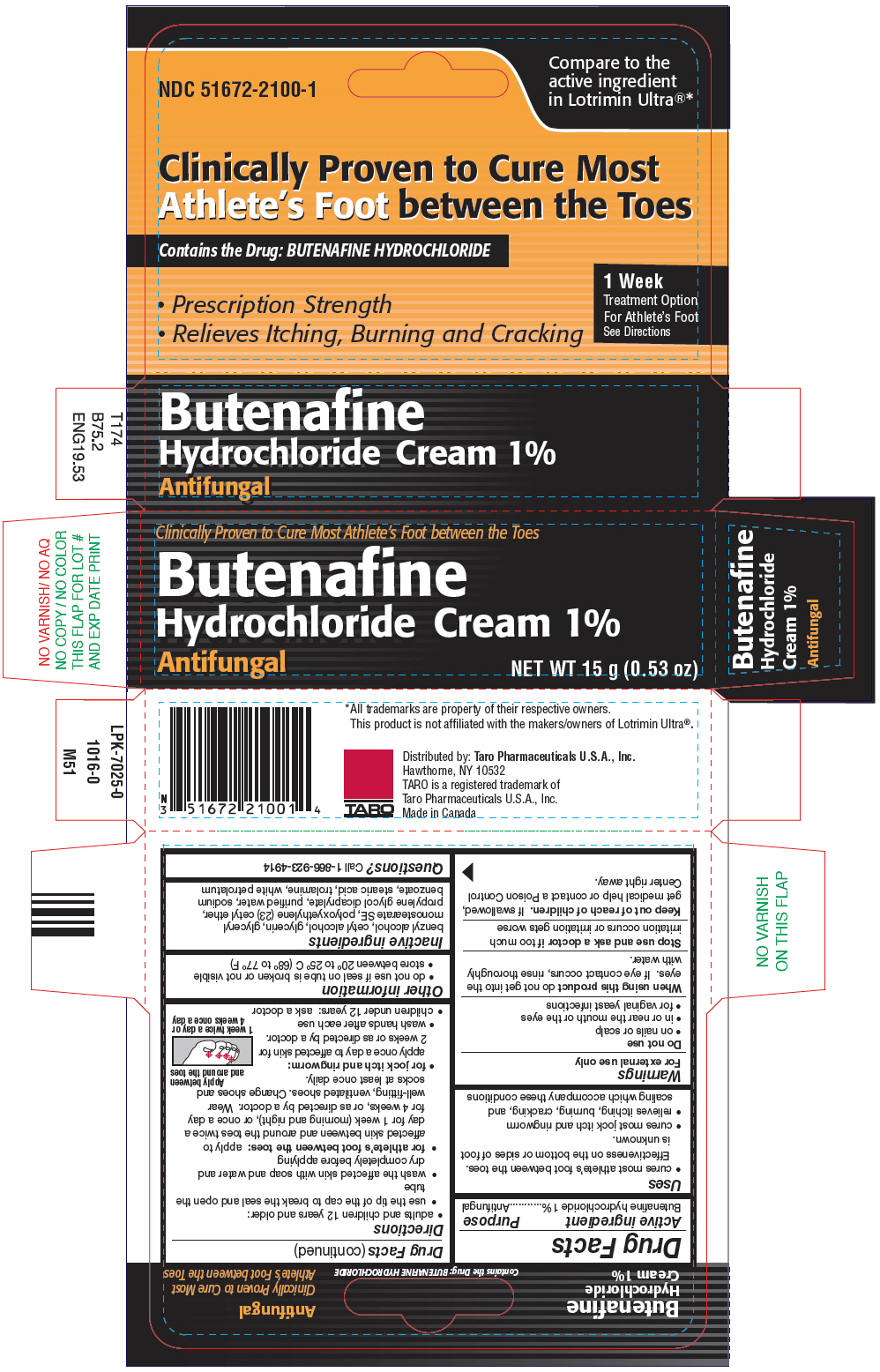
PRINCIPAL DISPLAY PANEL - 15 g Tube Carton Clinically Proven to Cure Most Athlete's Foot between the Toes Butenafine Hydrochloride Cream 1% Antifungal NET WT 15 g (0.53 oz) Principal Display Panel - 15 g Tube Carton