
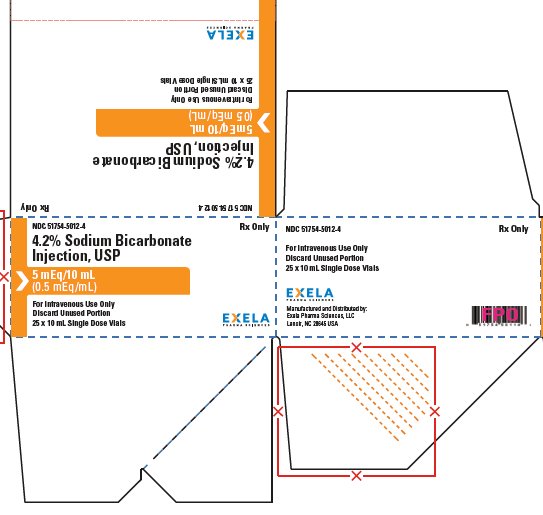
Sodium Bicarbonate 42 mg/mL Injection, Solution — NDC 51754-5012-4 (Billing 51754-5012-04)
This is a package of Sodium Bicarbonate 42 mg/mL Injection, Solution from Exela Pharma Sciences, LLC, marketed since Sep 2018 and currently FDA-listed. It is this product's only package size.
NDC database record
One package, one record: these facts belong to NDC 51754-5012-4 alone.
- Record
- FDA NDC Directory package listing · Human prescription drug
- Code segments
- 51754 labeler · 5012 product · 4 package
- Package marketed since
- Sep 27, 2018
- Sample package
- No — commercial package
- Listing certified through
- Dec 31, 2026
- Barcode (UPC-A, from the NDC)
- 3 5175450124 5
- Medicaid fills, this package
- 270 prescriptions in the last four reported quarters
- FDA record last changed
- Jul 24, 2026
Other active recalls for Sodium Bicarbonate (different manufacturers) — 2 · tap to view
Past resolved recalls for this product (2)
Identity & classification
Regulatory identifiers FDA, NLM and CMS codes for this package
Drug-database identifiers Medi-Span GPI and First Databank GCN / HICL / AHFS classification
- GSN (GCN sequence number): 001182
- GCN: 02790
- GPI-14 (Medi-Span): 79050020002010
- HICL (First Databank): 000523
- AHFS class code: 40:08.00.00
- RxCUI (RxNorm): 807284
Where does this data come from?
- FDA openFDA NDC Directory · synced Oct 1, 2026
- FDA label on DailyMed · label index refreshed Oct 6, 2026
- RxNorm (NLM RxNav) · catalog refreshed Oct 1, 2026
- Medi-Span GPI (licensed)
- First Databank (licensed) · refreshed Oct 1, 2026
RxNorm drug class
This medicine belongs to the Salt solutions class.
Where does this data come from?
- RxClass (NLM) · catalog refreshed Oct 1, 2026
Clinical
- It depends on the product. By mouth, it relieves heartburn, sour stomach and acid indigestion. On the skin, some products ease itching from insect bites and poison ivy. The injecti...
- Labels for products like Rapidol and De La Cruz Sodium Bicarbonate Antacid say to dissolve it completely in water and drink it. It can be repeated every couple of hours up to a dai...
- Don't use the maximum dose for more than 2 weeks unless a doctor tells you to. If your symptoms last longer than 2 weeks, stop and see your doctor.
- Antacids can interact with some prescription drugs. Please check with me or your doctor before using it if you take any.
Patient education
Supplement & herbal interactions
Some supplements/herbs that may interact with Sodium Bicarbonate (OTC Drug) — tap one for details:
Sodium Bicarbonate (OTC Drug) may be associated with lower levels of 4 nutrients — worth a chat with your pharmacist, not a cause for alarm.
Where does this data come from?
- MedlinePlus (NLM) · refreshed Oct 1, 2026
- FDA label on DailyMed · label index refreshed Oct 6, 2026
Ask a licensed pharmacist directly — free, answered by our team.
Pricing
A drug doesn't have one price. Each row is a different public payment system, and none is what you'd pay at the counter — that depends on your insurance. The ⓘ on each row explains what it measures.
| Price system | Per mL | Per package |
|---|---|---|
| Retail pharmacies payNADAC · weekly | Not in the retail survey — common for institutional, discontinued, or low-volume packs. | |
| Medicaid paysCMS SDUD · 12 mo | $9.80 | $2,450.70 / 250 ml |
| Medicare drug plans payPart D · quarterly | No Part D plan price is available for this NDC in our data. | |
Where does this data come from?
- CMS NADAC weekly file
- CMS ASP pricing files · refreshed Sep 20, 2026
- CMS Medicaid State Drug Utilization Data · through Q1 2026
- CMS Part D plan pricing files · refreshed Sep 24, 2026
- VA National Acquisition Center price file
Packaging — all sizes for this product
| Package NDC | Description | Marketing start | Marketing end | Status |
|---|---|---|---|---|
| 51754-5012-04 You're viewing this Main listing | 25 VIAL in 1 CARTON / 10 mL in 1 VIAL | 2018-09-27 | — | Active |
Therapeutic equivalents
| Product | Labeler | Pack | NADAC/unit | TE | Status | Price vs. this |
|---|---|---|---|---|---|---|
| Sodium Bicarbonate 42 mg/mLthis 51754-5012-04 | Exela | 25 vials | — | AP | FDA listed | — |
| Sodium Bicarbonate 42 mg/mL 51662-1497-01 | HF | 5 ml | — | AP | FDA listed | — |
| Sodium Bicarbonate 42 mg/mL 51662-1400-01 | HF | 5 ml | — | — | FDA listed | — |
| Sodium Bicarbonate 42 mg/mL 00404-9951-05 | Henry | 1 vial | — | AP | FDA listed | — |
| Sodium Bicarbonate 42 mg/mL 00409-5555-01 | Hospira, | 25 vials | — | AP | FDA listed | — |
| Sodium Bicarbonate 42 mg/mL 63323-0083-05 | Fresenius | 25 vials | — | AP | FDA listed | — |
Where does this data come from?
- FDA openFDA NDC Directory · synced Oct 1, 2026
- FDA Orange Book · refreshed Oct 3, 2026
- CMS NADAC weekly file
Availability & generic status
This product is an FDA-approved generic. Other versions of the same drug are listed under Therapeutic equivalents, least expensive first.
Where does this data come from?
- FDA Orange Book · refreshed Oct 3, 2026
Inactive Ingredients / Excipients
Inactive ingredients, also called excipients, are components of the drug product other than the active ingredient. They may include fillers, dyes, coatings, preservatives, flavors, or other formulation ingredients.
🧪 Avoiding an ingredient? See Sodium Bicarbonate inactive ingredients by manufacturer: every current product's list side by side, so you can ask your pharmacy for the version that does not list it.
💡 Tap an ingredient (hover on desktop) to see what it is and why it’s used.
-
UNII 059QF0KO0R
Water is a liquid solvent that dissolves and mixes ingredients together in liquid medicines, syrups, and injections. It helps distribute the active drug evenly throughout the product.
1 inactive ingredient listed in the exact product block matched to this NDC.
Where does this data come from?
ingredient classCode="IACT" elements from the exact product block matched by this NDC. Label-section narrative from DailyMed / the openFDA label index is shown separately when available.- FDA label on DailyMed · label index refreshed Oct 6, 2026
- FDA openFDA NDC Directory · synced Oct 1, 2026
Inactive ingredient FAQ
Are inactive ingredients the same for every manufacturer?
Why might an inactive ingredient be missing?
Can inactive ingredients matter?
Manufacturer & labeler
More NDCs from Exela Pharma Sciences, LLC labeler code 51754
- Potassium Acetate 200 meq/100mL Injection NDC 51754-2004-1
- Akovaz ephedrine sulfate 50 mg/mL Injection NDC 51754-4200-4
- Akovaz ephedrine sulfate 5 mg/mL Injection NDC 51754-4250-3
- Sodium Bicarbonate 84 mg/mL Injection, Solution NDC 51754-5001-4
- Sodium Bicarbonate 75 mg/mL Injection, Solution NDC 51754-5002-5
- Sodium Bicarbonate 84 mg/mL Injection, Solution NDC 51754-5011-4
- GLYRX-PF glycopyrrolate .2 mg/mL Injection, Solution NDC 51754-6000-4
- GLYRX-PF glycopyrrolate .2 mg/mL Injection, Solution NDC 51754-6001-4
- GLYRX-PF glycopyrrolate .2 mg/mL Injection, Solution NDC 51754-6013-3
- GLYRX-PF glycopyrrolate .2 mg/mL Injection, Solution NDC 51754-6015-3
- Sodium Bicarbonate 84 mg/mL Injection, Solution NDC 51754-8020-4
- Sodium Bicarbonate 84 mg/mL Injection, Solution NDC 51754-8888-4
Where does this data come from?
- FDA openFDA NDC Directory · synced Oct 1, 2026
- Drugs@FDA
Full prescribing information FDA SPL
🎯 Indications and Usage ▾
INDICATIONS AND USAGE Sodium Bicarbonate Injection, USP is indicated in the treatment of metabolic acidosis which may occur in severe renal disease, uncontrolled diabetes, circulatory insufficiency due to shock or severe dehydration, extracorporeal circulation of blood, cardiac arrest and severe primary lactic acidosis. Sodium bicarbonate is further indicated in the treatment of certain drug intoxications, including barbiturates (where dissociation of the barbiturate-protein complex is desired), in poisoning by salicylates or methyl alcohol and in hemolytic reactions requiring alkalinization of the urine to diminish nephrotoxicity of hemoglobin and its breakdown products.
Sodium bicarbonate also is indicated in severe diarrhea which is often accompanied by a significant loss of bicarbonate. Treatment of metabolic acidosis should, if possible, be superimposed on measures designed to control the basic cause of the acidosis - e.g., insulin in uncomplicated diabetes, blood volume restoration in shock. But since an appreciable time interval may elapse before all of the ancillary effects are brought about, bicarbonate therapy is indicated to minimize risks inherent to the acidosis itself.
Vigorous bicarbonate therapy is required in any form of metabolic acidosis where a rapid increase in plasma total CO 2 content is crucial - e.g., cardiac arrest, circulatory insufficiency due to shock or severe dehydration, and in severe primary lactic acidosis or severe diabetic acidosis.
⏱️ Dosage and Administration ▾
DOSAGE AND ADMINISTRATION Sodium Bicarbonate Injection, USP is administered by the intravenous route. In cardiac arrest, a rapid intravenous dose of one to two 50 mL vials (44.6 to 100 mEq) may be given initially and continued at a rate of 50 mL (44.6 to 50 mEq) every 5 to 10 minutes if necessary (as indicated by arterial pH and blood gas monitoring) to reverse the acidosis. Caution should be observed in emergencies where very rapid infusion of large quantities of bicarbonate is indicated.
Bicarbonate solutions are hypertonic and may produce an undesirable rise in plasma sodium concentration in the process of correcting the metabolic acidosis. In cardiac arrest, however, the risks from acidosis exceed those of hypernatremia. In less urgent forms of metabolic acidosis, Sodium Bicarbonate Injection, USP may be added to other intravenous fluids.
The amount of bicarbonate to be given to older children and adults over a four-to-eight-hour period is approximately 2 to 5 mEq/kg of body weight - depending upon the severity of the acidosis as judged by the lowering of total CO 2 content, blood pH and clinical condition of the patient. In metabolic acidosis associated with shock, therapy should be monitored by measuring blood gases, plasma osmolarity, arterial blood lactate, hemodynamics and cardiac rhythm. Bicarbonate therapy should always be planned in a stepwise fashion since the degree of response from a given dose is not precisely predictable.
Initially an infusion of 2 to 5 mEq/kg body weight over a period of 4 to 8 hours will produce a measurable improvement in the abnormal acid-base status of the blood. The next step of therapy is dependent upon the clinical response of the patient. If severe symptoms have abated, then the frequency of administration and the size of the dose may be reduced.
In general, it is unwise to attempt full correction of a low total CO 2 content during the first 24 hours of therapy, since this may be accompanied by an unrecognized alkalosis because of a delay in the readjustment of ventilation to normal. Owing to this lag, the achievement of total CO 2 content of about 20 mEq/liter at the end of the first day of therapy will usually be associated with a normal blood pH. Further modification of the acidosis to completely normal values usually occurs in the presence of normal kidney function when and if the cause of the acidosis can be controlled.
Values for total CO 2 which are brought to normal or above normal within the first day of therapy are very likely to be associated with grossly alkaline values for blood pH, with ensuing undesired side effects. Parenteral drug products should be inspected visually for particulate matter and discoloration prior to administration, whenever solution and container permit. See PRECAUTIONS .
⛔ Contraindications ▾
CONTRAINDICATIONS Sodium Bicarbonate Injection, USP is contraindicated in patients who are losing chloride by vomiting or from continuous gastrointestinal suction, and in patients receiving diuretics known to produce a hypochloremic alkalosis.
⚠️ Warnings ▾
WARNINGS Solutions containing sodium ions should be used with great care, if at all, in patients with congestive heart failure, severe renal insufficiency and in clinical states in which there exists edema with sodium retention. In patients with diminished renal function, administration of solutions containing sodium ions may result in sodium retention. The intravenous administration of these solutions can cause fluid and/or solute overloading resulting in dilution of serum electrolyte concentrations, overhydration, congested states or pulmonary edema.
Extravascular infiltration should be avoided, see ADVERSE REACTIONS .
🤒 Adverse Reactions ▾
ADVERSE REACTIONS Overly aggressive therapy with Sodium Bicarbonate Injection, USP can result in metabolic alkalosis (associated with muscular twitchings, irritability and tetany) and hypernatremia. Inadvertent extravasation of intravenously administered hypertonic solutions of sodium bicarbonate have been reported to cause chemical cellulitis because of their alkalinity, with tissue necrosis, ulceration or sloughing at the site of infiltration. Prompt elevation of the part, warmth and local injection of lidocaine or hyaluronidase are recommended to reduce the likelihood of tissue sloughing from extravasated I.V. solutions.
🔄 Drug Interactions ▾
Drug Interactions Additives may be incompatible; norepinephrine and dobutamine are incompatible with sodium bicarbonate solution. The addition of sodium bicarbonate to parenteral solutions containing calcium should be avoided, except where compatibility has been previously established. Precipitation or haze may result from sodium bicarbonate-calcium admixtures.
NOTE: Do not use the injection if it contains precipitate. Additives may be incompatible. Consult with pharmacist, if available.
When introducing additives, consult with pharmacist, if available. When introducing additives, use aseptic technique, mix thoroughly and do not store.
🤰 Pregnancy ▾
Pregnancy: Teratogenic Effects Pregnancy Category C Animal reproduction studies have not been conducted with sodium bicarbonate. It is also not known whether sodium bicarbonate can cause fetal harm when administered to a pregnant woman or can affect reproduction capacity. Sodium bicarbonate should be given to a pregnant woman only if clearly needed.
🧒 Pediatric Use ▾
Pediatric Rapid injection (10 mL/min) of hypertonic Sodium Bicarbonate Injection, USP solutions into neonates and children under two years of age may produce hypernatremia, a decrease in cerebrospinal fluid pressure and possible intracranial hemorrhage. The rate of administration in such patients should therefore be limited to no more than 8 mEq/kg/day. A 4.2% solution may be preferred for such slow administration.
In emergencies such as cardiac arrest, the risk of rapid infusion must be weighed against the potential for fatality due to acidosis.
🧓 Geriatric Use ▾
Geriatric Clinical studies of Sodium Bicarbonate Injection, USP did not include sufficient numbers of subjects aged 65 and over to determine whether they respond differently from younger subjects. Other reported clinical experience has not identified differences in responses between the elderly and younger patients. In general, dose selection for an elderly patient should be cautious, usually starting at the low end of the dosing range, reflecting the greater frequency of decreased hepatic, renal, or cardiac function and of concomitant disease or other drug therapy.
🆘 Overdosage ▾
OVERDOSAGE Should alkalosis result, the bicarbonate should be stopped and the patient managed according to the degree of alkalosis present. 0.9% sodium chloride injection intravenous may be given; potassium chloride also may be indicated if there is hypokalemia. Severe alkalosis may be accompanied by hyperirritability or tetany and these symptoms may be controlled by calcium gluconate.
An acidifying agent such as ammonium chloride may also be indicated in severe alkalosis. See WARNINGS and PRECAUTIONS.
🧬 Clinical Pharmacology ▾
CLINICAL PHARMACOLOGY Intravenous sodium bicarbonate therapy increases plasma bicarbonate, buffers excess hydrogen ion concentration, raises blood pH and reverses the clinical manifestations of acidosis. Sodium bicarbonate in water dissociates to provide sodium (Na + ) and bicarbonate (HCO 3 - ) ions. Sodium (Na + ) is the principal cation of the extracellular fluid and plays a large part in the therapy of fluid and electrolyte disturbances.
Bicarbonate (HCO 3 - ) is a normal constituent of body fluids and the normal plasma level ranges from 24 to 31 mEq/liter. Plasma concentration is regulated by the kidney through acidification of the urine when there is a deficit or by alkalinization of the urine when there is an excess. Bicarbonate anion is considered "labile" since at a proper concentration of hydrogen ion (H + ) it may be converted to carbonic acid (H 2 CO 3 ) and thence to its volatile form, carbon dioxide (CO 2 ) excreted by the lung.
Normally a ratio of 1:20 (carbonic acid: bicarbonate) is present in the extracellular fluid. In a healthy adult with normal kidney function, practically all the glomerular filtered bicarbonate ion is reabsorbed; less than 1% is excreted in the urine.
📦 How Supplied / Storage and Handling ▾
HOW SUPPLIED Sodium Bicarbonate Injection, USP is supplied in the following dosage forms: NDC Code: Conc % mg/mL (NaHCO 3 ) mEq/mL (Na + ) mEq/mL (HCO 3 - ) mEq/Container size (mL) mOsmol 51754-5001-4 51754-5001-5 8.4 84 1 1 50/50 2/mL 51754-5011-4 8.4 84 1 1 10/10 2/mL 51754-5002-5 7.5 75 0.9 0.9 44.6/50 1.79/mL 51754-5012-4 4.2 42 0.5 0.5 5/10 1/mL The 50 mL Sodium Bicarbonate Injection vials are supplied as either 20 vials per carton, or 25 vials per carton, with a single package insert and the 10 mL Sodium Bicarbonate Injection vials are supplied as 25 vials per carton with a single package insert.
Exposure of pharmaceutical products to heat should be minimized. Avoid excessive heat. Protect from freezing.
Store at 20°C to 25°C (68°F to 77°F). [See USP Controlled Room Temperature.] Revised: August 2022 Manufactured by: Exela Pharma Sciences, LLC Lenoir, NC 28645 Exela logo
📋 Description ▾
DESCRIPTION Sodium Bicarbonate Injection, USP is a sterile, nonpyrogenic, hypertonic solution of sodium bicarbonate (NaHCO 3 ) in water for injection for administration by the intravenous route as an electrolyte replenisher and systemic alkalizer. Solutions are offered in concentrations of 4.2%, 7.5% and 8.4%. See table in HOW SUPPLIED section for contents and characteristics.
The solutions contain no bacteriostat, antimicrobial agent or added buffer and are intended only for use as a single-dose injection, the approximate pH of the solutions is 8. When smaller doses are required, the unused portion should be discarded. Sodium bicarbonate, 84 mg is equal to one milliequivalent each of Na + and HCO 3 - .
Sodium Bicarbonate, USP is chemically designated NaHCO 3 , a white crystalline powder soluble in water. Water for Injection, USP is chemically designated H 2 O.
⚠️ Precautions ▾
PRECAUTIONS General Do not use unless solution is clear and the container or seal is intact. Discard unused portion. The potentially large loads of sodium given with bicarbonate require that caution be exercised in the use of sodium bicarbonate in patients with congestive heart failure or other edematous or sodium-retaining states, as well as in patients with oliguria or anuria.
See table in HOW SUPPLIED section for amounts of sodium present in solutions. Caution must be exercised in the administration of parenteral fluids, especially those containing sodium ions, to patients receiving corticosteroids or corticotropin. Potassium depletion may predispose to metabolic alkalosis and coexistent hypocalcemia may be associated with carpopedal spasm as the plasma pH rises.
These dangers can be minimized if such electrolyte imbalances are appropriately treated prior to or concomitantly with bicarbonate infusion. Laboratory Tests The aim of all bicarbonate therapy is to produce a substantial correction of the low total CO 2 content and blood pH, but the risks of overdosage and alkalosis should be avoided. Hence, repeated fractional doses and periodic monitoring by appropriate laboratory tests are recommended to minimize the possibility of overdosage.
Drug Interactions Additives may be incompatible; norepinephrine and dobutamine are incompatible with sodium bicarbonate solution. The addition of sodium bicarbonate to parenteral solutions containing calcium should be avoided, except where compatibility has been previously established. Precipitation or haze may result from sodium bicarbonate-calcium admixtures.
NOTE: Do not use the injection if it contains precipitate. Additives may be incompatible. Consult with pharmacist, if available.
When introducing additives, consult with pharmacist, if available. When introducing additives, use aseptic technique, mix thoroughly and do not store. Pregnancy: Teratogenic Effects Pregnancy Category C Animal reproduction studies have not been conducted with sodium bicarbonate.
It is also not known whether sodium bicarbonate can cause fetal harm when administered to a pregnant woman or can affect reproduction capacity. Sodium bicarbonate should be given to a pregnant woman only if clearly needed. Pediatric Rapid injection (10 mL/min) of hypertonic Sodium Bicarbonate Injection, USP solutions into neonates and children under two years of age may produce hypernatremia, a decrease in cerebrospinal fluid pressure and possible intracranial hemorrhage.
The rate of administration in such patients should therefore be limited to no more than 8 mEq/kg/day. A 4.2% solution may be preferred for such slow administration. In emergencies such as cardiac arrest, the risk of rapid infusion must be weighed against the potential for fatality due to acidosis.
Geriatric Clinical studies of Sodium Bicarbonate Injection, USP did not include sufficient numbers of subjects aged 65 and over to determine whether they respond differently from younger subjects. Other reported clinical experience has not identified differences in responses between the elderly and younger patients. In general, dose selection for an elderly patient should be cautious, usually starting at the low end of the dosing range, reflecting the greater frequency of decreased hepatic, renal, or cardiac function and of concomitant disease or other drug therapy.
📄 Package Label / Principal Display Panel ▾
PACKAGE/LABEL PRINCIPAL DISPLAY PANEL-4.2% Vial Label NDC 51754-5012-1 Rx Only 4.2% Sodium Bicarbonate Injection, USP 5 mEq/10 mL (0.5 mEq/mL) For Intravenous Use Only 10 mL Single Dose Vial 4.2% vial label
PACKAGE/LABEL PRINCIPAL DISPLAY PANEL4.2% Vial Carton Label NDC 51754-5012-4 Rx Only 4.2% Sodium Bicarbonate Injection, USP 5 mEq/10 mL (0.5 mEq/mL) For Intravenous Use Only Discard Unused Portion 20 x 10 mL Single Dose Vials 4.2% vial carton label
PACKAGE/LABEL PRINCIPAL DISPLAY PANEL-7.5% Vial Label NDC 51754-5002-1 Rx Only 7.5% Sodium Bicarbonate Injection, USP 44.6 mEq/50 mL (0.9 mEq/mL) For Intravenous Use Only 50 mL Single Dose Vial 7.5% vial label
PACKAGE/LABEL PRINCIPAL DISPLAY PANEL-7.5% Vial Carton Label NDC 51754-5002-5 Rx Only 7.5% Sodium Bicarbonate Injection, USP 44.6 mEq/50 mL (0.9 mEq/mL) For Intravenous Use Only. Discard Unused Portion. 20 x 50 mL Single Dose Vials 7.5 carton
PACKAGE/LABEL PRINCIPAL DISPLAY PANEL-8.4% Vial Label NDC 51754-5001-5 Rx Only 8.4% Sodium Bicarbonate Injection, USP 50 mEq/50 mL (1 mEq/mL) For Intravenous Use Only. Discard Unused Portion. 50 mL Single Dose Vial 8.4% vial label
PACKAGE/LABEL PRINCIPAL DISPLAY PANEL-8.4% Vial Carton Label NDC 51754-5001-5 Rx Only 8.4% Sodium Bicarbonate Injection, USP 50 mEq/50 mL (1 mEq/mL) For Intravenous Use Only 20 x 50 mL Single Dose Vials PACKAGE/LABEL PRINCIPAL DISPLAY PANEL-8.4% Vial Carton Label NDC 51754-5001-4 Rx Only 8.4% Sodium Bicarbonate Injection, USP 50 mEq/50 mL (1 mEq/mL) For Intravenous Use Only 25 x 50 mL Single Dose Vials 50 mL Vial, 25 ct. Carton 8.4 carton
Medicaid utilization & spend
Medicare Part D spend CMS · PART D · 2026 (Q1)
About this NDC listing & data coverage
What data is (and isn’t) available for this NDC — tap to expand
| NDC identity (package / product / labeler codes) | ✓ Available |
| Labeler | ✓ Available |
| Product & package description | ✓ Available |
| Marketing category & status | ✓ Available |
| Active ingredient / dosage form / route | ✓ Available |
| FDA label (SPL via DailyMed) | ✓ Available |
| Package photos | ✓ Available |
| Inactive ingredients (structured) | ✓ Available |
| NADAC pharmacy acquisition price (CMS) | — Not published for this NDC CMS publishes NADAC only for NDCs reported in its retail-pharmacy survey. |
| Orange Book / therapeutic-equivalence data | ✓ Available |
| HCPCS J-code billing crosswalk | — Not published for this NDC Most self-administered / retail products have no J-code — that is normal. |
| Medicaid utilization (CMS SDUD) | ✓ Available |