
AMMONIA N-13 260 mCi/mL Injection, Solution, 3 mL — NDC 52768-100-03 (Billing 52768-0100-03)
This is a package of 3 mL of AMMONIA N-13 260 mCi/mL Injection, Solution from Precision Nuclear LLC, marketed since Oct 2010 and currently FDA-listed. It is the main listing for this product, which comes in 4 package sizes.
NDC database record
One package, one record: these facts belong to NDC 52768-100-03 alone.
- Record
- FDA NDC Directory package listing · Human prescription drug
- Code segments
- 52768 labeler · 100 product · 03 package
- Package marketed since
- Oct 1, 2017
- Sample package
- No — commercial package
- Listing certified through
- Dec 31, 2026
- Barcode (UPC-A, from the NDC)
- 3 5276810003 5
- FDA record last changed
- Jul 24, 2026
Identity & classification
Regulatory identifiers FDA, NLM and CMS codes for this package
Drug-database identifiers Medi-Span GPI and First Databank GCN / HICL / AHFS classification
- GSN (GCN sequence number): 080503
- GCN: 47367
- HICL (First Databank): 045976
- AHFS class code: 36:18.00.00
Where does this data come from?
- FDA openFDA NDC Directory · synced Oct 8, 2026
- FDA label on DailyMed · label index refreshed Oct 8, 2026
- RxNorm (NLM RxNav) · catalog refreshed Oct 1, 2026
- Medi-Span GPI (licensed)
- First Databank (licensed) · refreshed Oct 8, 2026
Clinical
Patient education
Supplement & herbal interactions
Where does this data come from?
- MedlinePlus (NLM) · refreshed Oct 8, 2026
- FDA label on DailyMed · label index refreshed Oct 8, 2026
Ask a licensed pharmacist directly — free, answered by our team.
Pricing
A drug doesn't have one price. Each row is a different public payment system, and none is what you'd pay at the counter — that depends on your insurance. The ⓘ on each row explains what it measures.
| Price system | Per mL | Per package |
|---|---|---|
| Retail pharmacies payNADAC · weekly | Not in the retail survey — common for institutional, discontinued, or low-volume packs. | |
| Medicaid paysCMS SDUD · 12 mo | No recent Medicaid claims on file for this NDC — rare and low-volume NDCs are suppressed in the public data. | |
| Medicare drug plans payPart D · quarterly | No Part D plan price is available for this NDC in our data. | |
Where does this data come from?
- CMS NADAC weekly file
- CMS ASP pricing files · refreshed Sep 20, 2026
- CMS Medicaid State Drug Utilization Data · refreshed Oct 8, 2026
- CMS Part D plan pricing files · refreshed Sep 24, 2026
- VA National Acquisition Center price file
Packaging — all sizes for this product
| Package NDC | Description | Marketing start | Marketing end | Status |
|---|---|---|---|---|
| 52768-0100-03 You're viewing this Main listing | 3 mL in 1 SYRINGE | 2017-10-01 | — | Active |
| 52768-0100-05 52768-100-05 | 5 mL in 1 SYRINGE | 2017-10-01 | — | Active |
| 52768-0100-30 52768-100-30 | 30 mL in 1 VIAL, MULTI-DOSE | 2010-10-10 | — | Active |
| 52768-0100-50 52768-100-50 | 50 mL in 1 VIAL, MULTI-DOSE | 2010-10-10 | — | Active |
You're viewing the smallest of 4 pack sizes for this product.
Pack size FAQ
What quantity is in this package?
How does this package differ from NDC 52768-0100-05?
What NDC number is used to bill for this package of AMMONIA N-13 260 mCi/mL Injection, Solution?
Therapeutic equivalents
| Product | Labeler | Pack | NADAC/unit | TE | Status | Price vs. this |
|---|---|---|---|---|---|---|
| Ammonia N-13 260 mCi/mL 69864-0002-30 | The | 6 ml | — | AP | FDA listed | — |
| Ammonia N 13 260 mCi/mL 49609-0003-01 | SOFIE | 30 ml | — | AP | FDA listed | — |
| Ammonia N-13 260 mCi/mLthis 52768-0100-03 | Precision | 3 ml | — | AP | FDA listed | — |
| Ammonia N 13 260 mCi/mL 40028-0514-50 | PETNET | 50 ml | — | AP | FDA listed | — |
Where does this data come from?
- FDA openFDA NDC Directory · synced Oct 8, 2026
- FDA Orange Book · refreshed Oct 3, 2026
- CMS NADAC weekly file
Availability & generic status
This product is an FDA-approved generic. Other versions of the same drug are listed under Therapeutic equivalents, least expensive first.
Where does this data come from?
- FDA Orange Book · refreshed Oct 3, 2026
Inactive Ingredients / Excipients
Inactive ingredients, also called excipients, are components of the drug product other than the active ingredient. They may include fillers, dyes, coatings, preservatives, flavors, or other formulation ingredients.
💡 Tap an ingredient (hover on desktop) to see what it is and why it’s used.
-
9 mg / 1 mL
UNII 451W47IQ8X
Sodium chloride is common table salt. It's used in medicines as a buffer to maintain proper pH, as a filler to add bulk, or to adjust the osmotic balance in liquid formulations.
1 inactive ingredient listed in the exact product block matched to this NDC.
Where does this data come from?
ingredient classCode="IACT" elements from the exact product block matched by this NDC. Label-section narrative from DailyMed / the openFDA label index is shown separately when available.- FDA label on DailyMed · label index refreshed Oct 8, 2026
- FDA openFDA NDC Directory · synced Oct 8, 2026
Inactive ingredient FAQ
Are inactive ingredients the same for every manufacturer?
Why might an inactive ingredient be missing?
Can inactive ingredients matter?
Manufacturer & labeler
More NDCs from Precision Nuclear LLC labeler code 52768
Where does this data come from?
- FDA openFDA NDC Directory · synced Oct 8, 2026
- Drugs@FDA
Full prescribing information FDA SPL
🎯 Indications and Usage ▾
1 INDICATIONS AND USAGE Ammonia N 13 Injection USP is indicated for diagnostic Positron Emission Tomography (PET) imaging of the myocardium under rest or pharmacologic stress conditions to evaluate myocardial perfusion in patients with suspected or existing coronary artery disease. Ammonia N 13 Injection USP is a radioactive diagnostic agent for Positron Emission Tomography (PET) indicated for diagnostic PET imaging of the myocardium under rest or pharmacologic stress conditions to evaluate myocardial perfusion in patients with suspected or existing coronary artery disease ( 1 ).
⏱️ Dosage and Administration ▾
2 DOSAGE AND ADMINISTRATION Rest Imaging Study ( 2.1 ): Aseptically withdraw Ammonia N 13 Injection from its container (if applicable) and administer 10 to 20 mCi (0.368 to 0.736 GBq) as a bolus through a catheter inserted into a large peripheral vein. Start imaging 3 minutes after the injection and acquire images for a total of 10 to 20 minutes. Stress Imaging Study ( 2.2 ): If a rest imaging study is performed, begin the stress imaging study 40 minutes or more after the first Ammonia N13 injection to allow sufficient isotope decay.
Administer a pharmacologic stress-inducing drug in accordance with its labeling. Aseptically withdraw Ammonia N 13 Injection from its container (if applicable) and administer 10 to 20 mCi (0.368 to 0.736 GBq) of Ammonia N 13 Injection as a bolus at 8 minutes after the administration of the pharmacologic stress-inducing drug. Start imaging 3 minutes after the Ammonia N 13 Injection and acquire images for a total of 10 to 20 minutes.
Patient Preparation ( 2.3 ): To increase renal clearance of radioactivity and to minimize radiation dose to the bladder, hydrate the patient before the procedure and encourage voiding as soon as each image acquisition is completed and as often as possible thereafter for at least one hour.
2.1Rest Imaging Study Aseptically withdraw Ammonia N 13 Injection from its container (if applicable) and administer 10 to 20 mCi (0.368 to 0.736 GBq) as a bolus through a catheter inserted into a large peripheral vein. Start imaging 3 minutes after the injection and acquire images for a total of 10 to 20 minutes.
2.2Stress Imaging Study If a rest imaging study is performed, begin the stress imaging study 40 minutes or more after the first Ammonia N 13 injection to allow sufficient isotope decay. Administer a pharmacologic stress-inducing drug in accordance with its labeling. Aseptically withdraw Ammonia N 13 Injection from its container (if applicable) and administer 10 to 20 mCi (0.368 to 0.736 GBq) of Ammonia N 13 Injection as a bolus at 8 minutes after the administration of the pharmacologic stress-inducing drug.
Start imaging 3 minutes after the Ammonia N 13 Injection and acquire images for a total of 10 to 20 minutes.
2.3Patient Preparation To increase renal clearance of radioactivity and to minimize radiation dose to the bladder, ensure that the patient is well hydrated before the procedure and encourage voiding as soon as a study is completed and as often as possible thereafter for at least one hour.
2.4Radiation Dosimetry The converted radiation absorbed doses in rem/mCi are shown in Table 1. These estimates are calculated from the Task Group of Committee 2 of the International Commission on Radiation Protection.1 Table 1: N 13 Absorbed Radiation Dose Per Unit Activity (rem/mCi) for Adults and Pediatric Groups Organ Age (Years) Adult 15 10 5 1 Adrenals 0.0085 0.0096 0.016 0.025 0.048 Bladder wall 0.030 0.037 0.056 0.089
0.17Bone surfaces 0.0059 0.0070 0.011 0.019 0.037 Brain 0.016 0.016 0.017 0.019 0.027 Breast 0.0067 0.0067 0.010 0.017 0.033 Stomach wall 0.0063 0.0078 0.012 0.019 0.037 Small intestine 0.0067 0.0081 0.013 0.021 0.041 Upper large intestine ULI 0.0067 0.0078 0.013 0.021 0.037 Lower large intestine LLI 0.0070 0.0078 0.013 0.020 0.037 Heart 0.0078 0.0096 0.015 0.023 0.041 Kidneys 0.017 0.021 0.031 0.048 0.089 Liver 0.029 0.044 0.085 Lungs 0.0093 0.011 0.018 0.029 0.056 Ovaries 0.0063 0.0085 0.014 0.021 0.041 Pancreas 0.0070 0.0085 0.014 0.021 0.041 Red marrow 0.0063 0.0078 0.012 0.020 0.037 Spleen 0.0093 0.011 0.019 0.030 0.056 Testes 0.0067 0.0070 0.011 0.018 0.035 Thyroid 0.0063 0.0081 0.013 0.021 0.041 Uterus 0.0070 0.0089 0.014 0.023 0.041 Other tissues 0.0059 0.0070 0.011 0.018 0.035
2.5Drug Handling Inspect Ammonia N 13 Injection visually for particulate matter and discoloration before administration, whenever solution and container permit. Do not administer Ammonia N 13 Injection containing particulate matter or discoloration; dispose of these unaccept… [Excerpted — this section continues on DailyMed.]
💊 Dosage Forms and Strengths ▾
3 DOSAGE FORMS AND STRENGTHS Glass vial (30 or 50 mL) or syringe (3 or 5 mL) containing 0.138 to
9.62GBq (3.75 to 260 mCi/mL) of Ammonia N 13 Injection in aqueous 0.9% sodium chloride solution (approximately 1 to 5 mL volume) that is suitable for intravenous administration. Glass vial or syringe containing 0.138 to
9.62GBq (3.75 to 260 mCi/mL) of Ammonia N 13 Injection in aqueous 0.9% sodium chloride solution (approximately 1 to 5 mL volume) ( 3 ).
⛔ Contraindications ▾
4 CONTRAINDICATIONS None None ( 4 )
⚠️ Warnings and Cautions ▾
5 WARNINGS AND PRECAUTIONS Ammonia N 13 Injection may increase the risk of cancer. Use the smallest dose necessary for imaging and ensure safe handling to protect the patient and health care worker ( 5 ).
5.1Radiation Risks Ammonia N 13 Injection may increase the risk of cancer. Use the smallest dose necessary for imaging and ensure safe handling to protect the patient and health care worker [ see Dosage and Administration (2.4) ].
🤒 Adverse Reactions ▾
6 ADVERSE REACTIONS No adverse reactions have been reported for Ammonia N 13 Injection based on a review of the published literature, publicly available reference sources, and adverse drug reaction reporting systems. However, the completeness of these sources is not known. No adverse reactions have been reported for Ammonia N 13 Injection based on a review of the published literature, publicly available reference sources, and adverse drug reaction reporting system ( 6 ).
To report SUSPECTED ADVERSE REACTIONS, contact Precision Nuclear, LLC at 423-467-0050 or FDA at 1-800-FDA-1088 or www.fda.gov/medwatch.
🔄 Drug Interactions ▾
7 DRUG INTERACTIONS The possibility of interactions of Ammonia N 13 Injection with other drugs taken by patients undergoing PET imaging has not been studied.
👥 Use in Specific Populations ▾
8 USE IN SPECIFIC POPULATIONS It is not known whether this drug is excreted in human milk. Alternatives to breastfeeding (e.g., using stored breast milk or infant formula) should be used for 2 hours (> 10 half-lives of radioactive decay for N 13 isotope) after administration of Ammonia N 13 Injection ( 8.3 ). The safety and effectiveness of Ammonia N 13 Injection has been established in pediatric patients ( 8.4 ).
8.1Pregnancy Pregnancy Category C Animal reproduction studies have not been conducted with Ammonia N 13 Injection. It is also not known whether Ammonia N 13 Injection can cause fetal harm when administered to a pregnant woman or can affect reproduction capacity. Ammonia N 13 Injection should be given to a pregnant woman only if clearly needed.
8.3Nursing Mothers It is not known whether this drug is excreted in human milk. Because many drugs are excreted in human milk and because of the potential for radiation exposure to nursing infants from Ammonia N 13 Injection, use alternative infant nutrition sources (e.g., stored breast milk or infant formula) for 2 hours (> 10 half-lives of radioactive decay for N 13 isotope) after administration of the drug or avoid use of the drug, taking into account the importance of the drug to the mother.
8.4Pediatric Use The safety and effectiveness of Ammonia N 13 Injection has been established in pediatric patients based on known metabolism of ammonia, radiation dosimetry in the pediatric population, and clinical studies in adults [ see Dosage and Administration (2.4) ].
🤰 Pregnancy ▾
8.1Pregnancy Pregnancy Category C Animal reproduction studies have not been conducted with Ammonia N 13 Injection. It is also not known whether Ammonia N 13 Injection can cause fetal harm when administered to a pregnant woman or can affect reproduction capacity. Ammonia N 13 Injection should be given to a pregnant woman only if clearly needed.
🧒 Pediatric Use ▾
8.4Pediatric Use The safety and effectiveness of Ammonia N 13 Injection has been established in pediatric patients based on known metabolism of ammonia, radiation dosimetry in the pediatric population, and clinical studies in adults [ see Dosage and Administration (2.4) ].
🧬 Clinical Pharmacology ▾
12 CLINICAL PHARMACOLOGY
12.1Mechanism of Action Ammonia N 13 Injection is a radiolabeled analog of ammonia that is distributed to all organs of the body after intravenous administration. It is extracted from the blood in the coronary capillaries into the myocardial cells where it is metabolized to glutamine N 13 and retained in the cells. The presence of ammonia N 13 and glutamine N 13 in the myocardium allows for PET imaging of the myocardium.
12.2Pharmacodynamics Following intravenous injection, ammonia N 13 enters the myocardium through the coronary arteries. The PET technique measures myocardial blood flow based on the assumption of a three- compartmental disposition of intravenous ammonia N 13 in the myocardium. In this model, the value of the rate constant, which represents the delivery of blood to myocardium, and the fraction of ammonia N 13 extracted into the myocardial cells, is a measure of myocardial blood flow.
Optimal PET imaging of the myocardium is generally achieved between 10 to 20 minutes after administration.
12.3Pharmacokinetics Following intravenous injection, Ammonia N 13 Injection is cleared from the blood with a biologic half-life of about 2.84 minutes (effective half-life of about 2.21 minutes). In the myocardium, its biologic half-life has been estimated to be less than 2 minutes (effective half-life less than 1.67 minutes). The mass dose of Ammonia N 13 Injection is very small as compared to the normal range of ammonia in the blood (0.72 to 3.30 mg) in a healthy adult man [ see Description (11.1) ].
Plasma protein binding of ammonia N 13 or its N 13 metabolites has not been studied. Ammonia N 13 undergoes a five-enzyme step metabolism in the liver to yield urea N 13 (the main circulating metabolite). It is also metabolized to glutamine N 13 (the main metabolite in tissues) by glutamine synthesis in the skeletal muscles, liver, brain, myocardium, and other organs.
Other metabolites of ammonia N 13 include small amounts of N 13 amino acid anions (acidic amino acids) in the forms of glutamate N 13 or aspartate N 13. Ammonia N 13 is eliminated from the body by urinary excretion mainly as urea N 13. The pharmacokinetics of Ammonia N 13 Injection have not been studied in renally impaired, hepatically impaired, or pediatric patients.
🧬 Mechanism of Action ▾
12.1Mechanism of Action Ammonia N 13 Injection is a radiolabeled analog of ammonia that is distributed to all organs of the body after intravenous administration. It is extracted from the blood in the coronary capillaries into the myocardial cells where it is metabolized to glutamine N 13 and retained in the cells. The presence of ammonia N 13 and glutamine N 13 in the myocardium allows for PET imaging of the myocardium.
📦 How Supplied / Storage and Handling ▾
16 HOW SUPPLIED/STORAGE AND HANDLING Ammonia N 13 Injection is packaged in 30 or 50 mL multiple dose glass vial, or in a single-dose 3 mL or 5 mL syringe containing between
1.11 GBq to
48.1GBq (30 mCi to 1300 mCi) of [13N] ammonia, at the end of synthesis (EOS) reference time, in 0.9% sodium chloride injection solution in approximately 1 to 5 mL volume. The recommended dose of radioactivity (10 to 20 mCi) is associated with a theoretical mass dose of 0.5 to 1.0 picomoles (8.47 to 16.94 picograms) of Ammonia.
16.1Storage Store at 25°C (77°F); excursions permitted to 15 to 30°C (59 to 86°F) [ See USP Controlled Room Temperature ]. Use the solution within 60 minutes of the End of Synthesis (EOS) calibration.
📦 Storage and Handling ▾
16.1Storage Store at 25°C (77°F); excursions permitted to 15 to 30°C (59 to 86°F) [ See USP Controlled Room Temperature ]. Use the solution within 60 minutes of the End of Synthesis (EOS) calibration.
📋 Description ▾
11 DESCRIPTION
11.1Chemical Characteristics Ammonia N 13 Injection USP is a positron emitting radiopharmaceutical that is used for diagnostic purposes in conjunction with positron emission tomography (PET) imaging. The active ingredient, [13N] ammonia, has the molecular formula of 13NH3 with a molecular weight of 16.02 and has the following chemical structure: Ammonia N 13 Injection USP is provided as a ready to use sterile, pyrogen-free, clear and colorless solution. Each mL of the solution contains between 0.138 to
9.62GBq (3.75 to 260 mCi) of [13N] ammonia, at the end of synthesis (EOS) reference time, in 0.9% aqueous sodium chloride. The pH of the solution is between 4.5 to 7.5. The recommended dose of radioactivity (10 to 20 mCi) is associated with a theoretical mass dose of 0.5 to 1.0 picomoles (8.47 to 16.94 picograms) of ammonia. Chemical Structure
11.2Physical Characteristics Nitrogen N13 decays by emitting positron to Carbon C13 (stable) and has a physical half-life of 9.96 minutes. The principal photons useful for imaging are the dual 511 keV gamma photons that are produced and emitted simultaneously in opposite direction when the positron interacts with an electron (Table 2). Table 2: Principal Radiation Emission Data for Nitrogen 13 Radiation/Emission % Per Disintegration Energy Positron(β + ) 100 1190 keV (Max.) Gamma(±) Produced by positron annihilation 200 511 keV The specific gamma ray constant (point source air kerma coefficient) for nitrogen N13 is
5.9R/hr/mCi (1.39 × 10⁻⁶ Gy/hr/kBq) at 1 cm. The half-value layer (HVL) of lead (Pb) for 511 keV photons is 4 mm. Selected coefficients of attenuation are listed in Table 3 as a function of lead shield thickness.
For example, the use of 39 mm thickness of lead will attenuate the external radiation by a factor of about 1000. Table 3: Radiation Attenuation of 511 keV Photons by Lead (Pb) Shielding Shield Thickness (Pb) mm Coefficient of Attenuation 4 0.5 8 0.25 13 0.1 26 0.01 39 0.001 52 0.0001 Table 4 lists fractions remaining at selected time intervals from the calibration time. This information may be used to correct for physical decay of the radionuclide.
Table 4: Physical Decay Chart for Nitrogen N 13 Minutes Fraction Remaining 0 Calibration time 1.000 5 0.706 10 0.499 15 0.352 20 0.249 25 0.176 30 0.124
💬 Information for Patients ▾
17 PATIENT COUNSELING INFORMATION
17.1Pre-study Hydration Instruct patients to drink plenty of water or other fluids (as tolerated) in the 4 hours before their PET study.
17.2Post-study Voiding Instruct patients to void after completion of each image acquisition session and as often as possible for one hour after the PET scan ends.
17.3Post-study Breastfeeding Avoidance Instruct nursing patients to substitute stored breast milk or infant formula for breast milk for 2 hours after administration of Ammonia N 13 Injection.
🍼 Nursing Mothers ▾
8.3Nursing Mothers It is not known whether this drug is excreted in human milk. Because many drugs are excreted in human milk and because of the potential for radiation exposure to nursing infants from Ammonia N 13 Injection, use alternative infant nutrition sources (e.g., stored breast milk or infant formula) for 2 hours (> 10 half-lives of radioactive decay for N 13 isotope) after administration of the drug or avoid use of the drug, taking into account the importance of the drug to the mother.
🧬 Pharmacokinetics ▾
12.3Pharmacokinetics Following intravenous injection, Ammonia N 13 Injection is cleared from the blood with a biologic half-life of about 2.84 minutes (effective half-life of about 2.21 minutes). In the myocardium, its biologic half-life has been estimated to be less than 2 minutes (effective half-life less than 1.67 minutes). The mass dose of Ammonia N 13 Injection is very small as compared to the normal range of ammonia in the blood (0.72 to 3.30 mg) in a healthy adult man [ see Description (11.1) ].
Plasma protein binding of ammonia N 13 or its N 13 metabolites has not been studied. Ammonia N 13 undergoes a five-enzyme step metabolism in the liver to yield urea N 13 (the main circulating metabolite). It is also metabolized to glutamine N 13 (the main metabolite in tissues) by glutamine synthesis in the skeletal muscles, liver, brain, myocardium, and other organs.
Other metabolites of ammonia N 13 include small amounts of N 13 amino acid anions (acidic amino acids) in the forms of glutamate N 13 or aspartate N 13. Ammonia N 13 is eliminated from the body by urinary excretion mainly as urea N 13. The pharmacokinetics of Ammonia N 13 Injection have not been studied in renally impaired, hepatically impaired, or pediatric patients.
🧬 Pharmacodynamics ▾
12.2Pharmacodynamics Following intravenous injection, ammonia N 13 enters the myocardium through the coronary arteries. The PET technique measures myocardial blood flow based on the assumption of a three- compartmental disposition of intravenous ammonia N 13 in the myocardium. In this model, the value of the rate constant, which represents the delivery of blood to myocardium, and the fraction of ammonia N 13 extracted into the myocardial cells, is a measure of myocardial blood flow.
Optimal PET imaging of the myocardium is generally achieved between 10 to 20 minutes after administration.
🔬 Clinical Studies ▾
14 CLINICAL STUDIES In a descriptive, prospective, blinded image interpretation study 2 of adult patients with known or suspected coronary artery disease, myocardial perfusion deficits in stress and rest PET images obtained with Ammonia N 13 (N = 111) or Rubidium 82 (N = 82) were compared to changes in stenosis flow reserve (SFR) as determined by coronary angiography. The principal outcome of the study was the evaluation of PET defect severity relative to SFR. PET perfusion defects at rest and stress for seven cardiac regions (anterior, apical, anteroseptal, posteroseptal, anterolateral, posterolateral, and inferior walls) were graded on a 0 to 5 scale defined as normal (0), possible (1), probable (2), mild (3), moderate (4), and severe (5) defects.
Coronaryangiograms were used to measure absolute and relative stenosis dimensions and to calculate stenosis flow reserve defined as the maximum value of flow at maximum coronary vasodilatation relative to rest flow under standardized hemodynamic conditions. SFR scores ranged from 0 (total occlusion) to 5 (normal). With increasing impairment of flow reserve, the subjective PET defect severity increased.
A PET defect score of 2 or higher was positively correlated with flow reserve impairment (SFR< 3).
🧪 Nonclinical Toxicology ▾
13 NONCLINICAL TOXICOLOGY
13.1Carcinogenesis, Mutagenesis, Impairment of Fertility Long term animal studies have not been performed to evaluate the carcinogenic potential of Ammonia N 13 Injection. Genotoxicity assays and impairment of male and female fertility studies with Ammonia N 13 Injection have not been performed.
📄 Carcinogenesis, Mutagenesis, Impairment of Fertility ▾
13.1Carcinogenesis, Mutagenesis, Impairment of Fertility Long term animal studies have not been performed to evaluate the carcinogenic potential of Ammonia N 13 Injection. Genotoxicity assays and impairment of male and female fertility studies with Ammonia N 13 Injection have not been performed.
📚 References ▾
15 REFERENCES 1 Annals of the ICRP. Publication 53. Radiation dose to patients from radiopharmaceuticals. New York: Pergamon Press, 1988. 2 L.L.Demer, K.L.Gould, R.A.Goldstein, R.L.Kirkeeide, N.A.Mullani, R.W. Smalling, A.Nishikawa, and M.E.Merhige. Assessment of coronary artery disease severity by PET: Comparison with quantitative arteriography in 193 patients. Circulation 1989; 79: 825-35.
📄 Package Label / Principal Display Panel ▾
PRINCIPAL DISPLAY PANEL - 30 mL Vial Label Ammonia N 13 Injection Diagnostic – For Intravenous Use Only Caution: Rx Only NDC#: 52768-100-30 Sterile, Non-pyrogenic Multiple-Dose Vial Lot #: ________________ Calibration: Date ________________ Time________________ (EOS*) Expiration Date/Time: ________________ / ________________ (Expires 60 minutes after EOS*) Activity @ EOS*: ____________ mCi in ____________ mL = ____________ mCi/mL Each mL contains 0.139 GBq to 9.620 GBq (3.75 mCi to 260 mCi), of no carrier added ammonia N 13 @ EOS* and 9 mg of sodium chloride.
Store upright in a shielded container at 25°C (77°F), excursions permitted to 15°C to 30°C (59°F to 86°F). Aseptically withdraw and handle doses. Do not use if cloudy or contains particulate matter. [ 13 N] Half-life = 9.96 minutes.
Calculate correct dosage from date and time of calibration. (*EOS = End of Synthesis) Caution Radioactive Materials Manufactured For: Precision Nuclear, LLC 830 Suncrest Dr Johnson City, TN 37615 423-467-0050 PRINCIPAL DISPLAY PANEL - 30 mL Vial Label
PRINCIPAL DISPLAY PANEL - 50 mL Vial Label Ammonia N 13 Injection Diagnostic – For Intravenous Use Only Caution: Rx Only NDC#: 52768-100-50 Sterile, Non-pyrogenic Multiple-Dose Vial Lot #: ________________ Calibration: Date ________________ Time________________ (EOS*) Expiration Date/Time: ________________ / ________________ (Expires 60 minutes after EOS*) Activity @ EOS*: ____________ mCi in ____________ mL = ____________ mCi/mL Each mL contains 0.139 GBq to 9.620 GBq (3.75 mCi to 260 mCi), of no carrier added ammonia N 13 @ EOS* and 9 mg of sodium chloride.
Store upright in a shielded container at 25°C (77°F), excursions permitted to 15°C to 30°C (59°F to 86°F). Aseptically withdraw and handle doses. Do not use if cloudy or contains particulate matter. [ 13 N] Half-life = 9.96 minutes.
Calculate correct dosage from date and time of calibration. (*EOS = End of Synthesis) Caution Radioactive Materials Manufactured For: Precision Nuclear, LLC 830 Suncrest Dr Johnson City, TN 37615 423-467-0050 PRINCIPAL DISPLAY PANEL - 50 mL Vial Label
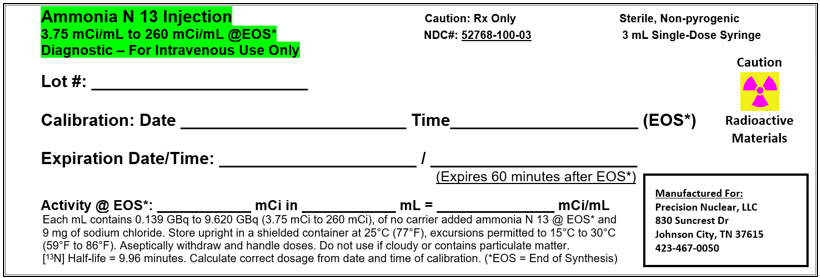
PRINCIPAL DISPLAY PANEL - 3 mL Syringe Label Ammonia N 13 Injection 3.75 mCi/mL to 260 mCi/mL @EOS* Diagnostic – For Intravenous Use Only Caution: Rx Only NDC#: 52768-100-03 Sterile, Non-pyrogenic 3 mL Single-Dose Syringe Lot #: ________________ Calibration: Date ________________ Time________________ (EOS*) Expiration Date/Time: ________________ / ________________ (Expires 60 minutes after EOS*) Activity @ EOS*: ____________ mCi in ____________ mL = ____________ mCi/mL Each mL contains 0.139 GBq to 9.620 GBq (3.75 mCi to 260 mCi), of no carrier added ammonia N 13 @ EOS* and 9 mg of sodium chloride.
Store upright in a shielded container at 25°C (77°F), excursions permitted to 15°C to 30°C (59°F to 86°F). Aseptically withdraw and handle doses. Do not use if cloudy or contains particulate matter. [ 13 N] Half-life = 9.96 minutes.
Calculate correct dosage from date and time of calibration. (*EOS = End of Synthesis) Caution Radioactive Materials Manufactured For: Precision Nuclear, LLC 830 Suncrest Dr Johnson City, TN 37615 423-467-0050 PRINCIPAL DISPLAY PANEL - 3 mL Syringe Label
PRINCIPAL DISPLAY PANEL - 5 mL Syringe Label Ammonia N 13 Injection 3.75 mCi/mL to 260 mCi/mL @EOS* Diagnostic – For Intravenous Use Only Caution: Rx Only NDC#: 52768-100-05 Sterile, Non-pyrogenic 5 mL Single-Dose Syringe Lot #: ________________ Calibration: Date ________________ Time________________ (EOS*) Expiration Date/Time: ________________ / ________________ (Expires 60 minutes after EOS*) Activity @ EOS*: ____________ mCi in ____________ mL = ____________ mCi/mL Each mL contains 0.139 GBq to 9.620 GBq (3.75 mCi to 260 mCi), of no carrier added ammonia N 13 @ EOS* and 9 mg of sodium chloride.
Store upright in a shielded container at 25°C (77°F), excursions permitted to 15°C to 30°C (59°F to 86°F). Aseptically withdraw and handle doses. Do not use if cloudy or contains particulate matte… [Excerpted — this section continues on DailyMed.]
About this NDC listing & data coverage
What data is (and isn’t) available for this NDC — tap to expand
| NDC identity (package / product / labeler codes) | ✓ Available |
| Labeler | ✓ Available |
| Product & package description | ✓ Available |
| Marketing category & status | ✓ Available |
| Active ingredient / dosage form / route | ✓ Available |
| FDA label (SPL via DailyMed) | ✓ Available |
| Package photos | ✓ Available |
| Inactive ingredients (structured) | ✓ Available |
| NADAC pharmacy acquisition price (CMS) | — Not published for this NDC CMS publishes NADAC only for NDCs reported in its retail-pharmacy survey. |
| Orange Book / therapeutic-equivalence data | ✓ Available |
| HCPCS J-code billing crosswalk | — Not published for this NDC Most self-administered / retail products have no J-code — that is normal. |
| Medicaid utilization (CMS SDUD) | — Not published for this NDC CMS reports utilization only for NDCs with Medicaid claims above its privacy threshold. |