
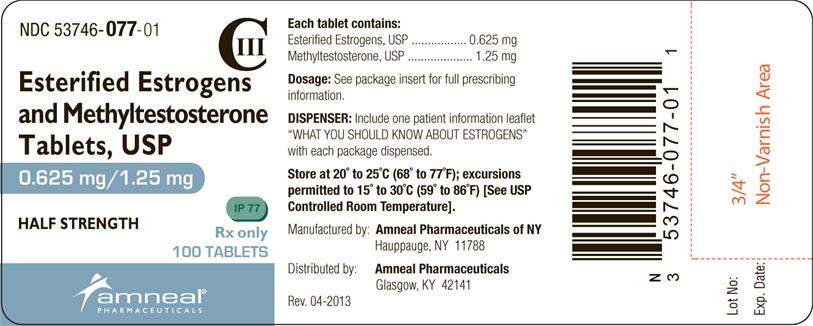
Esterified Estrogens and Methyltestosterone .625 mg; 1.25 mg Tablet, 100-count — NDC 53746-077-01 (Billing 53746-0077-01)
This is a package of 100 tablets of Esterified Estrogens and Methyltestosterone .625 mg; 1.25 mg Tablet from Amneal Pharmaceuticals of New York LLC, marketed since Sep 2010 and currently FDA-listed. It is this product's only package size.
NDC database record
One package, one record: these facts belong to NDC 53746-077-01 alone.
- Record
- FDA NDC Directory package listing · Human prescription drug
- Code segments
- 53746 labeler · 077 product · 01 package
- Package marketed since
- Sep 22, 2010
- Sample package
- No — commercial package
- Listing certified through
- Dec 31, 2026
- Billing quantity
- 100 EA per package
- Barcode (UPC)
- 0353746078018, 0353746077011
- FDA record last changed
- Sep 17, 2026
Identity & classification
Regulatory identifiers FDA, NLM and CMS codes for this package
Drug-database identifiers Medi-Span GPI and First Databank GCN / HICL / AHFS classification
- GSN (GCN sequence number): 003257
- GCN: 68030
- HICL (First Databank): 001438
- AHFS class code: 68:08.00.00
- RxCUI (RxNorm): 197670
Where does this data come from?
- FDA openFDA NDC Directory · synced Oct 1, 2026
- FDA label on DailyMed · label index refreshed Oct 5, 2026
- RxNorm (NLM RxNav) · catalog refreshed Oct 1, 2026
- Medi-Span GPI (licensed)
- First Databank (licensed) · refreshed Oct 1, 2026
Clinical
This is an oral tablet containing esterified estrogens and methyltestosterone. Esterified estrogens are a form of estrogen hormone typically used in hormone replacement therapy. Methyltestosterone is an androgen (male hormone) typically used to address low testosterone levels or certain hormone-related conditions. This product is a prescription medication marketed without an approved FDA application.
Patient education
Supplement & herbal interactions
Where does this data come from?
- MedlinePlus (NLM) · refreshed Oct 1, 2026
- FDA label on DailyMed · label index refreshed Oct 5, 2026
Ask a licensed pharmacist directly — free, answered by our team.
Pricing
A drug doesn't have one price. Each row is a different public payment system, and none is what you'd pay at the counter — that depends on your insurance. The ⓘ on each row explains what it measures.
| Price system | Per each | Per package |
|---|---|---|
| Retail pharmacies payNADAC · weekly | Not in the retail survey — common for institutional, discontinued, or low-volume packs. | |
| Medicaid paysCMS SDUD · 12 mo | No recent Medicaid claims on file for this NDC — rare and low-volume NDCs are suppressed in the public data. | |
| Medicare drug plans payPart D · quarterly | No Part D plan price is available for this NDC in our data. | |
Where does this data come from?
- CMS NADAC weekly file
- CMS ASP pricing files · refreshed Sep 20, 2026
- CMS Medicaid State Drug Utilization Data · refreshed Oct 5, 2026
- CMS Part D plan pricing files · refreshed Sep 24, 2026
- VA National Acquisition Center price file
Packaging — all sizes for this product
| Package NDC | Description | Marketing start | Marketing end | Status |
|---|---|---|---|---|
| 53746-0077-01 You're viewing this Main listing | 100 TABLET in 1 BOTTLE | 2010-09-22 | — | Active |
Therapeutic equivalents
Where does this data come from?
- FDA openFDA NDC Directory · synced Oct 1, 2026
- FDA Orange Book · refreshed Oct 3, 2026
- CMS NADAC weekly file
Availability & generic status
We did not find an FDA-approved generic match for this exact strength, form and route.
Where does this data come from?
- FDA Orange Book · refreshed Oct 3, 2026
What it looks like
Where does this data come from?
- FDA label on DailyMed · label index refreshed Oct 5, 2026
Inactive Ingredients / Excipients
Inactive ingredients, also called excipients, are components of the drug product other than the active ingredient. They may include fillers, dyes, coatings, preservatives, flavors, or other formulation ingredients.
💡 Tap an ingredient (hover on desktop) to see what it is and why it’s used.
-
UNII 3SY5LH9PMK
Anhydrous lactose is a milk sugar with no water content. It acts as a filler and binder in tablets and capsules, adding bulk and helping ingredients stick together.
-
UNII OP1R32D61U
Microcrystalline cellulose is a purified form of cellulose, a natural fiber from plant sources. It acts as a binder and filler in tablets and capsules, helping hold ingredients together and give the medicine its shape and size.
-
UNII 35SW5USQ3G
A synthetic yellow dye used to color medicines. It helps make tablets, capsules, and liquids visually distinct so patients can easily identify their medication.
-
UNII H3R47K3TBD
FD&C Blue No. 1 is a synthetic blue dye approved for use in foods and medicines. It serves as a colorant to give the medication its distinctive appearance and help with product identification.
-
UNII 70097M6I30
Magnesium stearate is a salt made from magnesium and stearic acid, a fatty substance. It's used in tablets and capsules as a lubricant and glidant to help ingredients flow smoothly during manufacturing and prevent sticking.
-
UNII 3WJQ0SDW1A
Polyethylene glycol is a synthetic liquid or solid polymer used in medicines as a solvent, lubricant, and humectant. It helps dissolve active ingredients, reduces friction during manufacturing, and retains moisture in the final product.
-
UNII 532B59J990
Polyvinyl alcohol is a synthetic polymer made from plant-derived materials. It's used as a binder to hold ingredients together, a film-former in coatings, and a thickener in liquid formulations.
-
UNII ETJ7Z6XBU4
Silicon dioxide is a naturally occurring mineral used as a glidant and anti-caking agent. It helps powder ingredients flow smoothly and prevents clumping during manufacturing and storage.
-
UNII 8MDF5V39QO
A white powder form of baking soda that acts as a buffer and pH regulator in medicines. It helps maintain the right acid-base balance and may aid tablet disintegration.
-
UNII 7SEV7J4R1U
A powder made from a naturally occurring mineral. In medicines, talc works as a glidant and anti-caking agent, helping tablets and capsules flow smoothly during manufacturing and preventing clumping.
-
UNII 15FIX9V2JP
Titanium dioxide is a bright white mineral powder commonly used as a colorant and opacifying agent. It makes pills and tablets white or lighter in color and helps make coatings non-transparent.
11 inactive ingredients listed in the exact product block matched to this NDC.
Where does this data come from?
ingredient classCode="IACT" elements from the exact product block matched by this NDC. Label-section narrative from DailyMed / the openFDA label index is shown separately when available.- FDA label on DailyMed · label index refreshed Oct 5, 2026
- FDA openFDA NDC Directory · synced Oct 1, 2026
Inactive ingredient FAQ
Are inactive ingredients the same for every manufacturer?
Why might an inactive ingredient be missing?
Can inactive ingredients matter?
Manufacturer & labeler
More NDCs from Amneal Pharmaceuticals of New York LLC labeler code 53746
- Escitalopram Oxalate 5 mg Tablet, Film Coated NDC 53746-019-05
- Escitalopram Oxalate 10 mg Tablet, Film Coated NDC 53746-020-05
- Escitalopram Oxalate 20 mg Tablet, Film Coated NDC 53746-021-05
- Esterified Estrogens and Methyltestosterone 1.25 mg; 2.5 mg Tablet NDC 53746-078-01
- Lurasidone Hydrochloride 60 mg Tablet, Coated NDC 53746-082-30
- Gabapentin 100 mg Capsule NDC 53746-101-01
- Gabapentin 300 mg Capsule NDC 53746-102-01
- Gabapentin 400 mg Capsule NDC 53746-103-01
- Hydrocodone Bitartrate and Acetaminophen 5 mg; 325 mg Tablet NDC 53746-109-01
Where does this data come from?
- FDA openFDA NDC Directory · synced Oct 1, 2026
- Drugs@FDA
Full prescribing information FDA SPL
🚨 Boxed Warning ▾
ESTROGENS INCREASE THE RISK OF ENDOMETRIAL CANCER Close clinical surveillance of all women taking estrogens is important. Adequate diagnostic measures, including endometrial sampling when indicated, should be undertaken to rule out malignancy in all cases of undiagnosed persistent or recurring abnormal vaginal bleeding. There is no evidence that the use of “natural” estrogens results in a different endometrial risk profile than synthetic estrogens at equivalent estrogen doses.
(See WARNINGS, Malignant Neoplasms, Endometrial Cancer .) CARDIOVASCULAR AND OTHER RISKS Estrogens with or without progestins should not be used for the prevention of cardiovascular disease. (See WARNINGS, Cardiovascular Disorders .) The Women’s Health Initiative (WHI) study reported increased risks of myocardial infarction, stroke, invasive breast cancer, pulmonary emboli, and deep vein thrombosis in postmenopausal women (50 to 79 years of age) during 5 years of treatment with oral conjugated estrogens (CE 0.625 mg) combined with medroxyprogesterone acetate (MPA 2.5 mg) relative to placebo.
(See CLINICAL PHARMACOLOGY, Clinical Studies .) The Women’s Health Initiative Memory Study (WHIMS), a substudy of WHI, reported increased risk of developing probable dementia in postmenopausal women 65 years of age or older during 4 years of treatment with oral conjugated estrogens plus medroxyprogesterone acetate relative to placebo. It is unknown whether this finding applies to younger postmenopausal women or to women taking estrogen alone therapy. (See CLINICAL PHARMACOLOGY, Clinical Studies .) Other doses of oral conjugated estrogens with medroxyprogesterone acetate, and other combinations and dosage forms of estrogens and progestins were not studied in the WHI clinical trials and, in the absence of comparable data, these risks should be assumed to be similar.
Because of these risks, estrogens with or without progestins should be prescribed at the lowest effective doses and for the shortest duration consistent with treatment goals and risks for the individual woman.
🎯 Indications and Usage ▾
INDICATIONS AND USAGE Esterified Estrogens and Methyltestosterone Tablets and Esterified Estrogens and Methyltestosterone Tablets H.S. are indicated in the: Treatment of moderate to severe vasomotor symptoms associated with the menopause in those patients not improved by estrogens alone. (There is no evidence that estrogens are effective for nervous symptoms or depression without associated vasomotor symptoms, and they should not be used to treat such conditions.) Esterified Estrogens and Methyltestosterone Tablets and Esterified Estrogens and Methyltestosterone Tablets H.S. have not been shown to be effective for any purpose during pregnancy and its use may cause severe harm to the fetus.
⏱️ Dosage and Administration ▾
DOSAGE AND ADMINISTRATION When estrogen is prescribed for a postmenopausal woman with a uterus, a progestin should also be initiated to reduce the risk of endometrial cancer. A woman without a uterus does not need progestin. Use of estrogen, alone or in combination with a progestin, should be with the lowest effective dose and for the shortest duration consistent with treatment goals and risks for the individual woman.
Patients should be reevaluated periodically as clinically appropriate (e.g., 3-month to 6-month intervals) to determine if treatment is still necessary. (See BOXED WARNINGS and WARNINGS .) For women who have a uterus, adequate diagnostic measures, such as endometrial sampling, when indicated, should be undertaken to rule out malignancy in cases of undiagnosed persistent or recurring abnormal vaginal bleeding. Given cyclically for short-term use only: For treatment of moderate to severe vasomotor symptoms associated with the menopause in patients not improved by estrogen alone.
The lowest dose that will control symptoms should be chosen and medication should be discontinued as promptly as possible. Administration should be cyclic (e.g., three weeks on and one week off). Attempts to discontinue or taper medication should be made at three- to six month intervals.
Usual Dosage Range: 1 tablet of Esterified Estrogens and Methyltestosterone Tablets or 1 to 2 tablets of Esterified Estrogens and Methyltestosterone Tablets H.S. daily as recommended by the physician. Treated patients with an intact uterus should be monitored closely for signs of endometrial cancer and appropriate diagnostic measures should be taken to rule out malignancy in the event of persistent or recurring abnormal vaginal bleeding.
⛔ Contraindications ▾
CONTRAINDICATIONS Esterified Estrogens and Methyltestosterone Tablets and Esterified Estrogens and Methyltestosterone Tablets H.S. should not be used in women with any of the following conditions: 1. Undiagnosed abnormal genital bleeding. 2.
Known, suspected, or history of cancer of the breast. 3. Known or suspected estrogen-dependent neoplasia.
4. Active deep vein thrombosis, pulmonary embolism or history of these conditions. 5.
Active or recent (e.g., within the past year) arterial thromboembolic disease (e.g., stroke, myocardial infarction). 6. Liver dysfunction or disease.
7. Esterified Estrogens and Methyltestosterone Tablets and Esterified Estrogens and Methyltestosterone Tablets H.S. should not be used in patients with known hypersensitivity to its ingredients. 8.
Known or suspected pregnancy. There is no indication for Esterified Estrogens and Methyltestosterone Tablets and Esterified Estrogens and Methyltestosterone Tablets H.S. in pregnancy. There appears to be little or no increased risk of birth defects in children born to women who have used estrogens and progestins from oral contraceptives inadvertently during early pregnancy.
(See PRECAUTIONS . ) Methyltestosterone should not be used in: 1. The presence of severe liver damage. 2.
Pregnancy and in breast-feeding mothers because of the possibility of masculinization of the female fetus or breast-fed infant.
⚠️ Warnings ▾
WARNINGS See BOXED WARNINGS . Warnings Associated with Estrogens Cardiovascular Disorders Estrogen and estrogen/progestin therapy has been associated with an increased risk of cardiovascular events such as myocardial infarction and stroke, as well as venous thrombosis and pulmonary embolism (venous thromboembolism or VTE). Should any of these occur or be suspected, estrogens should be discontinued immediately.
Risk factors for arterial vascular disease (e.g., hypertension, diabetes mellitus, tobacco use, hypercholesterolemia, and obesity) and/or venous thromboembolism (e.g., personal history or family history of VTE, obesity, and systemic lupus erythematosus) should be managed appropriately. Coronary Heart Disease and Stroke: In the Women’s Health Initiative (WHI) study, an increase in the number of myocardial infarctions and strokes was observed in women receiving CE compared to placebo. The CE-only substudy has concluded.
The impact of those results are under review. (See CLINICAL PHARMACOLOGY, Clinical Studies . ) In the CE/MPA substudy of WHI, an increased risk of coronary heart disease (CHD) events (defined as nonfatal myocardial infarction and CHD death) was observed in women receiving CE/MPA compared to women receiving placebo (37 versus 30 per 10,000 women-years). The increase in risk was observed in year 1 and persisted.
In the same substudy of WHI, an increased risk of stroke was observed in women receiving CE/MPA compared to women receiving placebo (29 versus 21 per 10,000 women-years). The increase in risk was observed after the first year and persisted. In postmenopausal women with documented heart disease (n = 2,763, average age 66.7 years) a controlled clinical trial of secondary prevention of cardiovascular disease (Heart and Estrogen/Progestin Replacement Study; HERS) treatment with CE/MPA (0.625 mg/2.5 mg per day) demonstrated no cardiovascular benefit.
During an average follow-up of 4.1 years, treatment with CE/MPA did not reduce the overall rate of CHD events in postmenopausal women with established coronary heart disease. There were more CHD events in the CE/MPA-treated group than in the placebo group in year 1, but not during the subsequent years. Two thousand three hundred and twenty one women from the original HERS trial agreed to participate in an open-label extension of HERS, HERS II.
Average follow-up in HERS II was an additional 2.7 years, for a total of 6.8 years overall. Rates of CHD events were comparable among women in the CE/MPA group and the placebo group in HERS, HERS II, and overall. Large doses of estrogen (5 mg conjugated estrogens per day), comparable to those used to treat cancer of the prostate and breast, have been shown in a large prospective clinical trial in men to increase the risks of nonfatal myocardial infarction, pulmonary embolism, and thrombophlebitis.
Venous Thromboembolism (VTE.): In the Women’s Health Initiative (WHI) study, an increase in VTE was observed in women receiving CE compared to placebo. The CE-only substudy has concluded. The impact of those results are under review.
(See CLINICAL PHARMACOLOGY, Clinical Studies . ) In the CE/MPA substudy of WHI, a 2-fold greater rate of VTE, including deep venous thrombosis and pulmonary embolism, was observed in women receiving CE/MPA compared to women receiving placebo. The rate of VTE was 34 per 10,000 women-years in the CE/MPA group compared to 16 per 10,000 women-years in the placebo group. The increase in VTE risk was observed during the first year and persisted.
If feasible, estrogens should be discontinued at least 4 to 6 weeks before surgery of the type associated with an increased risk of thromboembolism, or during periods of prolonged immobilization. Malignant Neoplasms Endometrial Cancer: The use of unopposed estrogens in women with intact uteri has been associated with an increased risk of endometrial cancer. The reported endometrial cancer risk among unopposed estrogen users is about 2- to 12-fold greater than in… [Excerpted — this section continues on DailyMed.]
🤒 Adverse Reactions ▾
ADVERSE REACTIONS See BOXED WARNINGS , WARNINGS and PRECAUTIONS . Because clinical trials are conducted under widely varying conditions, adverse reaction rates observed in the clinical trials of a drug cannot be directly compared to rates in the clinical trials of another drug and may not reflect the rates observed in practice. The adverse reaction information from clinical trials does, however, provide a basis for identifying the adverse events that appear to be related to drug use and for approximating rates.
Associated with Estrogens (See WARNINGS regarding induction of neoplasia, adverse effects on the fetus, increased incidence of gallbladder disease, and adverse effects similar to those of oral contraceptives, including thromboembolism). The following additional adverse reactions have been reported with estrogen and/or progestin therapy. Genitourinary System: Changes in vaginal bleeding pattern and abnormal withdrawal bleeding or flow; breakthrough bleeding; spotting; dysmenorrhea, increase in size of uterine leiomyomata; vaginitis, including vaginal candidiasis; change in amount of cervical secretion; changes in cervical ectropion; ovarian cancer; endometrial hyperplasia; endometrial cancer; cystitis-like syndrome.
Breasts: Tenderness; enlargement; pain, nipple discharge, galactorrhea; fibrocystic breast changes; breast cancer. Cardiovascular: Deep and superficial venous thrombosis; pulmonary embolism; thrombophlebitis; myocardial infarction; stroke; increase in blood pressure. Gastrointestinal: Nausea; vomiting; abdominal cramps; bloating; cholestatic jaundice; increased incidence of gallbladder disease; pancreatitis, enlargement of hepatic hemangiomas.
Skin: Chloasma or melasma that may persist when drug is discontinued; erythema multiforme; erythema nodosum; hemorrhagic eruption; loss of scalp hair; hirsutism; pruritus, rash. Eyes: Retinal vascular thrombosis, steepening of corneal curvature, intolerance to contact lenses. Central Nervous System: Headache, migraine, dizziness; mental depression; chorea; nervousness; mood disturbances; irritability; exacerbation of epilepsy, dementia.
Miscellaneous: Increase or decrease in weight; reduced carbohydrate tolerance; aggravation of porphyria; edema; arthralgias; leg cramps; changes in libido; urticaria, angioedema, anaphylactoid/anaphylactic reactions; hypocalcemia; exacerbation of asthma; increased triglycerides. Associated with Methyltestosterone Endocrine and Urogenital Female: The most common side effects of androgen therapy are amenorrhea and other menstrual irregularities, inhibition of gonadotropin secretion, and virilization, including deepening of the voice and clitoral enlargement.
The latter usually is not reversible after androgens are discontinued. When administered to a pregnant woman, androgens cause virilization of external genitalia of the female fetus. Skin and Appendages: Hirsutism, male pattern of baldness, and acne.
Fluid and Electrolyte Disturbances: Retention of sodium, chloride, water, potassium, calcium, and inorganic phosphates. Gastrointestinal: Nausea, cholestatic jaundice, alterations in liver function test, rarely hepatocellular neoplasms, and peliosis hepatis. (See WARNINGS .) Hematologic: Suppression of clotting factors II, V, VII, and X, bleeding in patients on concomitant anticoagulant therapy, and polycythemia.
Central Nervous System: Increased or decreased libido, headache, anxiety, depression, and generalized paresthesia. Metabolic: Increased serum cholesterol. Miscellaneous: Inflammation and pain at the site of intramuscular injection or subcutaneous implantation of testosterone containing pellets, stomatitis with buccal preparations, and rarely anaphylactoid reactions.
🆘 Overdosage ▾
OVERDOSAGE Serious ill effects have not been reported following acute ingestion of large doses of estrogen-containing drug products by young children. Overdosage of estrogen may cause nausea and vomiting, and withdrawal bleeding may occur in females. There have been no reports of acute overdosage with the androgens.
🧬 Clinical Pharmacology ▾
CLINICAL PHARMACOLOGY Estrogens: Endogenous estrogens are largely responsible for the development and maintenance of the female reproductive system and secondary sexual characteristics. Although circulating estrogens exist in a dynamic equilibrium of metabolic interconversions, estradiol is the principal intracellular human estrogen and is substantially more potent than its metabolites, estrone and estriol at the receptor level. The primary source of estrogen in normally cycling adult women is the ovarian follicle, which secretes 70 to 500 mcg of estradiol daily, depending on the phase of the menstrual cycle.
After menopause, most endogenous estrogen is produced by conversion of androstenedione, secreted by the adrenal cortex, to estrone by peripheral tissues. Thus, estrone and the sulfate conjugated form, estrone sulfate, are the most abundant circulating estrogens in postmenopausal women. Estrogens act through binding to nuclear receptors in estrogen-responsive tissues.
To date, two estrogen receptors have been identified. These vary in proportion from tissue to tissue. Circulating estrogens modulate the pituitary secretion of the gonadotropins, luteinizing hormone (LH) and follicle stimulating hormone (FSH), through a negative feedback mechanism.
Estrogens act to reduce the elevated levels of these hormones seen in postmenopausal women. Estrogen Pharmacokinetics Distribution The distribution of exogenous estrogens is similar to that of endogenous estrogens. Estrogens are widely distributed in the body and are generally found in higher concentrations in the sex hormone target organs.
Estrogens circulate in the blood largely bound to sex hormone binding globulin (SHBG) and albumin. Metabolism Exogenous estrogens are metabolized in the same manner as endogenous estrogens. Circulating estrogens exist in a dynamic equilibrium of metabolic interconversions.
These transformations take place mainly in the liver. Estradiol is converted reversibly to estrone, and both can be converted to estriol, which is the major urinary metabolite. Estrogens also undergo enterohepatic recirculation via sulfate and glucuronide conjugation in the liver, biliary secretion of conjugates into the intestine, and hydrolysis in the gut followed by reabsorption.
In postmenopausal women, a significant proportion of the circulating estrogens exist as sulfate conjugates, especially estrone sulfate, which serves as a circulating reservoir for the formation of more active estrogens. Excretion Estradiol, estrone, and estriol are excreted in the urine along with glucuronide and sulfate conjugates. Drug Interactions In vitro and in vivo studies have shown that estrogens are metabolized partially by cytochrome P450 3A4 (CYP3A4).
Therefore, inducers or inhibitors of CYP3A4 may affect estrogen drug metabolism. Inducers of CYP3A4 such as St. John’s Wort preparations (Hypericum perforatum), phenobarbital, carbamazepine, and rifampin may reduce plasma concentrations of estrogens, possibly resulting in a decrease in therapeutic effects and/or changes in the uterine bleeding profile.
Inhibitors of CYP3A4 such as erythromycin, clarithromycin, ketoconazole, itraconazole, ritonavir and grapefruit juice may increase plasma concentrations of estrogens and may result in side effects. Clinical Studies Women’s Health Initiative Studies The Women’s Health Initiative (WHI) enrolled a total of 27,000 predominantly healthy postmenopausal women to assess the risks and benefits of either the use of oral 0.625 mg conjugated estrogens (CE) per day alone or the use of oral 0.625 mg conjugated estrogens plus 2.5 mg medroxyprogesterone acetate (MPA) per day compared to placebo in the prevention of certain chronic diseases.
The primary endpoint was the incidence of coronary heart disease (CHD) (nonfatal myocardial infarction and CHD death), with invasive breast cancer as the primary adverse outcome studied. A “global index” included the earliest occurrence of CHD, invasive breast cancer, str… [Excerpted — this section continues on DailyMed.]
📦 How Supplied / Storage and Handling ▾
HOW SUPPLIED Esterified Estrogens and Methyltestosterone Tablets, a combination of Esterified Estrogens and Methyltestosterone. Each green, oval, aqueous film coated tablet debossed “IP 78” on obverse and plain on the reverse contains: 1.25 mg of Esterified Estrogens, USP and 2.5 mg of Methyltestosterone, USP. Available in bottles of 100 Esterified Estrogens and Methyltestosterone Tablets H.S. “Half Strength”, a combination of Esterifed Estrogens and Methyltestosterone.
Each light blue, capsule- shaped, aqueous film coated tablet debossed “IP 77” on obverse and plain on the reverse contains: 0.625 mg of Esterified Estrogens, USP and 1.25 mg of Methyltestosterone, USP. Available in bottles of 100 Keep Esterified Estrogens and Methyltestosterone Tablets and Esterified Estrogens and Methyltestosterone Tablets H.S. out of reach of children. Store at 20° to 25°C (68° to 77°F); excursions permitted to 15° to 30°C (59° to 86°F). [ See USP Controlled Room Temperature.] Manufactured by: Amneal Pharmaceuticals of NY Hauppauge, NY 11788 Distributed by: Amneal Pharmaceuticals Glasgow, KY 42141 Rev.
04-2013
📋 Description ▾
DESCRIPTION Esterified Estrogens and Methyltestosterone Tablets: Each green, oval, aqueous film coated tablet debossed “IP 78” on obverse and plain on the reverse contains: 1.25 mg of Esterified Estrogens, USP and 2.5 mg of Methyltestosterone, USP. Esterified Estrogens and Methyltestosterone Tablets H.S. (Half Strength): Each light blue, capsule-shaped, aqueous film coated tablet debossed “IP 77” on obverse and plain on the reverse contains: 0.625 mg of Esterified Estrogens, USP and 1.25 mg of Methyltestosterone, USP.
Esterified Estrogens Esterified Estrogens, USP is a mixture of the sodium salts of the sulfate esters of the estrogenic substances, principally estrone, that are of the type excreted by pregnant mares. Esterified Estrogens contain not less than 75.0 percent and not more than 85.0 percent of sodium estrone sulfate, and not less than 6.0 percent and not more than 15.0 percent of sodium equilin sulfate, in such proportion that the total of these two components is not less than 90.0 percent. Methyltestosterone Methyltestosterone, USP is an androgen.
Androgens are derivatives of cyclopentano-perhydrophenanthrene. Endogenous androgens are C-19 steroids with a side chain at C-17, and with two angular methyl groups. Testosterone is the primary endogenous androgen.
Fluoxymesterone and methyltestosterone are synthetic derivatives of testosterone. Methyltestosterone is a white to light yellow crystalline substance that is virtually insoluble in water but soluble in organic solvents. It is stable in air but decomposes in light.
Methyltestosterone structural formula: Esterified Estrogens and Methyltestosterone Tablets and Esterified Estrogens and Methyltestosterone Tablets H.S. contain the following inactive ingredients: Anhydrous Lactose, Colloidal Silicon Dioxide, D&C Yellow #10 Aluminum Lake, FD&C Blue #1 Aluminum Lake, Magnesium Stearate, Microcrystalline Cellulose, Polyethylene Glycol, Polyvinyl Alcohol, Sodium Bicarbonate, Talc and Titanium Dioxide. ab03b87f-figure-01
⚠️ Precautions ▾
PRECAUTIONS General Precautions Associated with Estrogens Addition of a progestin when a woman has not had a hysterectomy: Studies of the addition of a progestin for 10 or more days of a cycle of estrogen administration, or daily with estrogen in a continuous regimen, have reported a lowered incidence of endometrial hyperplasia than would be induced by estrogen treatment alone. Endometrial hyperplasia may be a precursor to endometrial cancer. There are, however, possible risks that may be associated with the use of progestins with estrogens compared to estrogen-alone regimens.
These include a possible increased risk of breast cancer. Elevated blood pressure: In a small number of case reports, substantial increases in blood pressure have been attributed to idiosyncratic reactions to estrogens. In a large, randomized, placebo-controlled clinical trial, a generalized effect of estrogens on blood pressure was not seen.
Blood pressure should be monitored at regular intervals with estrogen use. Hypertriglyceridemia: In patients with pre-existing hypertriglyceridemia, estrogen therapy may be associated with elevations of plasma triglycerides leading to pancreatitis and other complications. Impaired liver function and past history of cholestatic jaundice: Estrogens may be poorly metabolized in patients with impaired liver function.
For patients with a history of cholestatic jaundice associated with past estrogen use or with pregnancy, caution should be exercised and in the case of recurrence, medication should be discontinued. Hypothyroidism: Estrogen administration leads to increased thyroid-binding globulin (TBG) levels. Patients with normal thyroid function can compensate for the increased TBG by making more thyroid hormone, thus maintaining free T4 and T3 serum concentrations in the normal range.
Patients dependent on thyroid hormone replacement therapy who are also receiving estrogens may require increased doses of their thyroid replacement therapy. These patients should have their thyroid function monitored in order to maintain their free thyroid hormone levels in an acceptable range. Fluid retention: Because estrogens may cause some degree of fluid retention, patients with conditions that might be influenced by this factor, such as a cardiac or renal dysfunction, warrant careful observation when estrogens are prescribed.
Hypocalcemia: Estrogens should be used with caution in individuals with severe hypocalcemia. Ovarian cancer: The CE/MPA substudy of WHI reported that estrogen plus progestin increased the risk of ovarian cancer. After an average follow-up of 5.6 years, the relative risk for ovarian cancer for CE/MPA versus placebo was 1.58 (95% confidence interval 0.77 – 3.24) but was not statistically significant.
The absolute risk for CE/MPA versus placebo was 4.2 versus 2.7 cases per 10,000 women-years. In some epidemiologic studies, the use of estrogen alone, in particular for 10 or more years, has been associated with an increased risk of ovarian cancer. Other epidemiologic studies have not found these associations.
Exacerbation of endometriosis: Endometriosis may be exacerbated with administration of estrogens. A few cases of malignant transformation of residual endometrial implants have been reported in women treated post-hysterectomy with estrogen alone therapy. For patients known to have residual endometriosis post-hysterectomy, the addition of progestin should be considered.
Exacerbation of other conditions: Estrogens may cause an exacerbation of asthma, diabetes mellitus, epilepsy, migraine or porphyria, systemic lupus erythematosus, and hepatic hemangiomas and should be used with caution in women with these conditions. General Precautions Associated with Methyltestosterone 1. Women should be observed for signs of virilization (deepening of the voice, hirsutism, acne, clitoromegaly, and menstrual irregularities).
Discontinuation of drug therapy at the time of evidence of mild virilism is necessary to prevent irrevers… [Excerpted — this section continues on DailyMed.]
📄 Patient Package Insert ▾
Patient Package Insert INFORMATION FOR THE PATIENT‡ WHAT YOU SHOULD KNOW ABOUT ESTROGENS Read this PATIENT INFORMATION before you start taking Esterified Estrogens and Methyltestosterone Tablets and Esterified Estrogens and Methyltestosterone Tablets H.S. and read what you get each time you refill Esterified Estrogens and Methyltestosterone Tablets and Esterified Estrogens and Methyltestosterone Tablets H.S. There may be new information. This information does not take the place of talking to your healthcare provider about your medical condition or your treatment.
WHAT IS THE MOST IMPORTANT INFORMATION I SHOULD KNOW ABOUT ESTERIFIED ESTROGENS AND METHYLTESTOSTERONE TABLETS AND ESTERIFIED ESTROGENS AND METHYLTESTOSTERONE TABLETS H.S. (A COMBINATION OF ESTROGEN AND ANDROGEN HORMONES)? • Estrogens increase the chances of getting cancer of the uterus.Report any unusual vaginal bleeding right away while you are taking estrogens. Vaginal bleeding after menopause may be a warning sign of cancer of the uterus (womb).
Your healthcare provider should check any unusual vaginal bleeding to find out the cause. • Do not use estrogens with or without progestins to prevent heart disease, heart attacks, or strokes.Using estrogens with or without progestins may increase your chances of getting heart attacks, strokes, breast cancer, and blood clots. Using estrogens with progestins may increase your risk of dementia. You and your healthcare provider should talk regularly about whether you still need treatment with Esterified Estrogens and Methyltestosterone Tablets and Esterified Estrogens and Methyltestosterone Tablets H.S.
What are Esterified Estrogens and Methyltestosterone Tablets and Esterified Estrogens and Methyltestosterone Tablets H.S.? Esterified Estrogens and Methyltestosterone Tablets and Esterified Estrogens and Methyltestosterone Tablets H.S. are medicines that contain estrogen and androgen hormones. What are Esterified Estrogens and Methyltestosterone Tablets and Esterified Estrogens and Methyltestosterone Tablets H.S. used for?
Esterified Estrogens and Methyltestosterone Tablets and Esterified Estrogens and Methyltestosterone Tablets H.S. are used after menopause to: • reduce moderate to severe hot flashes. Estrogens are hormones made by a woman’s ovaries. The ovaries normally stop making estrogens when a woman is between 45 to 55 years old.
This drop in body estrogen levels causes the “change of life” or menopause (the end of monthly menstrual periods). Sometimes, both ovaries are removed during an operation before natural menopause takes place. The sudden drop in estrogen levels causes “surgical menopause.” When the estrogen levels begin dropping, some women develop very uncomfortable symptoms, such as feelings of warmth in the face, neck, and chest, or sudden strong feelings of heat and sweating (“hot flashes” or “hot flushes”).
In some women, the symptoms are mild, and they will not need estrogens. In other women, symptoms can be more severe. You and your healthcare provider should talk regularly about whether you still need treatment with Esterified Estrogens and Methyltestosterone Tablets and Esterified Estrogens and Methyltestosterone Tablets H.S. • treat moderate to severe dryness, itching, and burning in and around the vagina.
You and your healthcare provider should talk regularly about whether you still need treatment with Esterified Estrogens and Methyltestosterone Tablets and Esterified Estrogens and Methyltestosterone Tablets H.S. to control these problems. If you use Esterified Estrogens and Methyltestosterone Tablets and Esterified Estrogens and Methyltestosterone Tablets H.S. only to treat your dryness, itching, and burning in and around your vagina, talk with your healthcare provider about whether a topical vaginal product would be better for you.
Who should not take Esterified Estrogens and Methyltestosterone Tablets and Esterified Estrogens and Methyltestosterone Tablets H.S.? Do not start taking Esterified Estro… [Excerpted — this section continues on DailyMed.]
📄 Package Label / Principal Display Panel ▾
PACKAGE LABEL.PRINCIPAL DISPLAY PANEL 0.625mg 1.25mg Label
PACKAGE LABEL.PRINCIPAL DISPLAY PANEL 1.25mg 2.5mg Label
About this NDC listing & data coverage
Listed without an FDA application
This product's marketing category indicates it is marketed without an approved FDA application (no NDA, ANDA, or BLA on file). Having an NDC does not by itself establish FDA approval — the NDC Directory is a listing system, not an approval decision. Approval-linked data such as Orange Book therapeutic-equivalence ratings therefore does not apply.
What data is (and isn’t) available for this NDC — tap to expand
| NDC identity (package / product / labeler codes) | ✓ Available |
| Labeler | ✓ Available |
| Product & package description | ✓ Available |
| Marketing category & status | ✓ Available |
| Active ingredient / dosage form / route | ✓ Available |
| FDA label (SPL via DailyMed) | ✓ Available |
| Package photos | ✓ Available |
| Inactive ingredients (structured) | ✓ Available |
| NADAC pharmacy acquisition price (CMS) | — Not published for this NDC CMS publishes NADAC only for NDCs reported in its retail-pharmacy survey. |
| Orange Book / therapeutic-equivalence data | — Not published for this NDC Applies only to products approved under an NDA/ANDA; many listings are out of scope. |
| HCPCS J-code billing crosswalk | — Not published for this NDC Most self-administered / retail products have no J-code — that is normal. |
| Medicaid utilization (CMS SDUD) | — Not published for this NDC CMS reports utilization only for NDCs with Medicaid claims above its privacy threshold. |