
ETOMIDATE 40 mg/20mL Injection, Solution — NDC 55150-222-20 (Billing 55150-0222-20)
This is a package of ETOMIDATE 40 mg/20mL Injection, Solution from Eugia US LLC, marketed since Feb 2017 and currently FDA-listed. It is this product's only package size.
NDC database record
One package, one record: these facts belong to NDC 55150-222-20 alone.
- Record
- FDA NDC Directory package listing · Human prescription drug
- Code segments
- 55150 labeler · 222 product · 20 package
- Package marketed since
- Feb 24, 2017
- Sample package
- No — commercial package
- Listing certified through
- Dec 31, 2026
- Barcode (UPC)
- 0355150221103
- Medicaid fills, this package
- 99 prescriptions in the last four reported quarters
- FDA record last changed
- Jul 24, 2026
Identity & classification
Regulatory identifiers FDA, NLM and CMS codes for this package
Drug-database identifiers Medi-Span GPI and First Databank GCN / HICL / AHFS classification
- GSN (GCN sequence number): 030871
- GCN: 12831
- GPI-14 (Medi-Span): 70400010002020
- HICL (First Databank): 001554
- AHFS class code: 28:04.08.00
- RxCUI (RxNorm): 1654006
Where does this data come from?
- FDA openFDA NDC Directory · synced Oct 1, 2026
- FDA label on DailyMed · label index refreshed Oct 6, 2026
- RxNorm (NLM RxNav) · catalog refreshed Oct 1, 2026
- Medi-Span GPI (licensed)
- First Databank (licensed) · refreshed Oct 1, 2026
RxNorm drug class
This medicine belongs to the General Anesthetic class.
Where does this data come from?
- RxClass (NLM) · catalog refreshed Oct 1, 2026
Clinical
- Etomidate is a fast-acting anesthetic given through an IV to put you into a deep sleep before surgery or another procedure. One of its biggest advantages is that it has very little...
- What exactly is etomidate, and why did my doctor choose it for my procedure?
- Some people notice a brief burning or pain sensation in the vein where the IV is placed — this is common and usually mild. You may also experience some involuntary muscle twitching...
- Will I feel anything during the injection, and what should I expect right after?
Patient education
Supplement & herbal interactions
Some supplements/herbs that may interact with Etomidate — tap one for details:
Where does this data come from?
- MedlinePlus (NLM) · refreshed Oct 1, 2026
- FDA label on DailyMed · label index refreshed Oct 6, 2026
Ask a licensed pharmacist directly — free, answered by our team.
Pricing
A drug doesn't have one price. Each row is a different public payment system, and none is what you'd pay at the counter — that depends on your insurance. The ⓘ on each row explains what it measures.
| Price system | Per mL | Per package |
|---|---|---|
| Retail pharmacies payNADAC · weekly | Not in the retail survey — common for institutional, discontinued, or low-volume packs. | |
| Medicaid paysCMS SDUD · 12 mo | $93.59 | $18,718.10 / 200 ml |
| Medicare drug plans payPart D · quarterly | No Part D plan price is available for this NDC in our data. | |
Where does this data come from?
- CMS NADAC weekly file
- CMS ASP pricing files · refreshed Sep 20, 2026
- CMS Medicaid State Drug Utilization Data · through Q1 2026
- CMS Part D plan pricing files · refreshed Sep 24, 2026
- VA National Acquisition Center price file
Packaging — all sizes for this product
| Package NDC | Description | Marketing start | Marketing end | Status |
|---|---|---|---|---|
| 55150-0222-20 You're viewing this Main listing | 10 VIAL, SINGLE-DOSE in 1 CARTON / 20 mL in 1 VIAL, SINGLE-DOSE | 2017-02-24 | — | Active |
Therapeutic equivalents
| Product | Labeler | Pack | NADAC/unit | TE | Status | Price vs. this |
|---|---|---|---|---|---|---|
| Etomidate 2 mg/mL 00143-9311-10 | Hikma | 10 vials | — | AP | FDA listed | — |
| Etomidate 2 mg/mL 00143-9507-10 | Hikma | 10 vials | — | AP | FDA listed | — |
| Amidate 2 mg/mL 00409-6695-01 | Hospira, | 10 vials | — | AP | FDA listed | — |
| Etomidate 40 mg/20mL 51662-1542-01 | HF | 20 ml | — | AP | FDA listed | — |
| Etomidate 40 mg/20mLthis 55150-0222-20 | Eugia | 10 vials | — | AP | FDA listed | — |
| Etomidate 2 mg/mL 65145-0128-10 | Caplin | 10 vials | — | AP | FDA listed | — |
| Etomidate 2 mg/mL 65219-0447-20 | Fresenius | 10 vials | — | AP | FDA listed | — |
| Etomidate 2 mg/mL 67457-0903-20 | Mylan | 10 vials | — | AP | FDA listed | — |
| Etomidate 2 mg/mL 68083-0235-10 | Gland | 10 vials | — | AP | FDA listed | — |
| Etomidate 2 mg/mL 72266-0147-10 | Fosun | 10 vials | — | AP | FDA listed | — |
| Etomidate 2 mg/mL 72485-0509-10 | Armas | 10 vials | — | AP | FDA listed | — |
| Etomidate 2 mg/mL 72572-0161-10 | Civica, | 10 vials | — | AP | FDA listed | — |
Where does this data come from?
- FDA openFDA NDC Directory · synced Oct 1, 2026
- FDA Orange Book · refreshed Oct 3, 2026
- CMS NADAC weekly file
Availability & generic status
This product is an FDA-approved generic. Other versions of the same drug are listed under Therapeutic equivalents, least expensive first.
Where does this data come from?
- FDA Orange Book · refreshed Oct 3, 2026
Inactive Ingredients / Excipients
Inactive ingredients, also called excipients, are components of the drug product other than the active ingredient. They may include fillers, dyes, coatings, preservatives, flavors, or other formulation ingredients.
🧪 Avoiding an ingredient? See Etomidate inactive ingredients by manufacturer: every current product's list side by side, so you can ask your pharmacy for the version that does not list it.
💡 Tap an ingredient (hover on desktop) to see what it is and why it’s used.
-
UNII 6DC9Q167V3
Propylene glycol is a clear liquid derived from petroleum or vegetable sources. It acts as a solvent, humectant, and preservative in medicines, helping dissolve active ingredients and maintain product stability.
-
UNII 059QF0KO0R
Water is a liquid solvent that dissolves and mixes ingredients together in liquid medicines, syrups, and injections. It helps distribute the active drug evenly throughout the product.
2 inactive ingredients listed in the exact product block matched to this NDC.
Where does this data come from?
ingredient classCode="IACT" elements from the exact product block matched by this NDC. Label-section narrative from DailyMed / the openFDA label index is shown separately when available.- FDA label on DailyMed · label index refreshed Oct 6, 2026
- FDA openFDA NDC Directory · synced Oct 1, 2026
Inactive ingredient FAQ
Are inactive ingredients the same for every manufacturer?
Why might an inactive ingredient be missing?
Can inactive ingredients matter?
Manufacturer & labeler
More NDCs from Eugia US LLC labeler code 55150
- Atracurium Besylate 50 mg/5mL Injection, Solution NDC 55150-216-05
- Atracurium Besylate 100 mg/10mL Injection, Solution NDC 55150-217-10
- Eptifibatide 75 mg/100mL Injection NDC 55150-218-99
- Eptifibatide 20 mg/10mL Injection NDC 55150-219-10
- Eptifibatide 200 mg/100mL Injection NDC 55150-220-99
- ETOMIDATE 20 mg/10mL Injection, Solution NDC 55150-221-10
- Methocarbamol 1000 mg/10mL Injection, Solution NDC 55150-223-10
- Rocuronium Bromide 50 mg/5mL Injection, Solution NDC 55150-225-05
- Rocuronium Bromide 100 mg/10mL Injection, Solution NDC 55150-226-10
- Tigecycline 50 mg Injection, Powder, Lyophilized, For Solution NDC 55150-228-10
- FONDAPARINUX SODIUM 2.5 mg/.5mL Injection, Solution NDC 55150-230-02
- FONDAPARINUX SODIUM 5 mg/.4mL Injection, Solution NDC 55150-231-02
Where does this data come from?
- FDA openFDA NDC Directory · synced Oct 1, 2026
- Drugs@FDA
Full prescribing information FDA SPL
🎯 Indications and Usage ▾
INDICATIONS AND USAGE Etomidate Injection is indicated by intravenous injection for the induction of general anesthesia. When considering use of Etomidate Injection, the usefulness of its hemodynamic properties (see CLINICAL PHARMACOLOGY ) should be weighed against the high frequency of transient skeletal muscle movements (see ADVERSE REACTIONS ). Intravenous Etomidate Injection is also indicated for the supplementation of subpotent anesthetic agents, such as nitrous oxide in oxygen, during maintenance of anesthesia for short operative procedures such as dilation and curettage or cervical conization.
⏱️ Dosage and Administration ▾
DOSAGE AND ADMINISTRATION Do not administer unless solution is clear and container is undamaged. Discard unused portion (see DOSAGE AND ADMINISTRATION ). Etomidate Injection is intended for administration only by the intravenous route (see CLINICAL PHARMACOLOGY ).
The dose for induction of anesthesia in adult patients and in pediatric patients above the age of ten (10) years will vary between 0.2 mg/kg and 0.6 mg/kg of body weight, and it must be individualized in each case. The usual dose for induction in these patients is 0.3 mg/kg, injected over a period of 30 to 60 seconds. There are inadequate data to make dosage recommendations for induction of anesthesia in patients below the age of ten (10) years; therefore, such use is not recommended.
Geriatric patients may require reduced doses of etomidate. Smaller increments of intravenous etomidate may be administered to adult patients during short operative procedures to supplement subpotent anesthetic agents, such as nitrous oxide. The dosage employed under these circumstances, although usually smaller than the original induction dose, must be individualized.
There are insufficient data to support this use of etomidate for longer adult procedures or for any procedures in pediatric patients; therefore, such use is not recommended. The use of intravenous fentanyl and other neuroactive drugs employed during the conduct of anesthesia may alter the etomidate dosage requirements. Consult the prescribing information for all other such drugs before using.
Premedication: Etomidate Injection is compatible with commonly administered pre-anesthetic medications, which may be employed as indicated. See also CLINICAL PHARMACOLOGY , ADVERSE REACTIONS , and dosage recommendations for maintenance of anesthesia. Etomidate Injection anesthesia does not significantly alter the usual dosage requirements of neuromuscular blocking agents employed for endotracheal intubation or other purposes shortly after induction of anesthesia.
Parenteral drug products should be inspected visually for particulate matter and discoloration prior to administration, whenever solution and container permit. To prevent needle-stick injuries, needles should not be recapped, purposely bent, or broken by hand.
⛔ Contraindications ▾
CONTRAINDICATIONS Etomidate is contraindicated in patients who have shown hypersensitivity to it.
⚠️ Warnings ▾
WARNINGS INTRAVENOUS ETOMIDATE SHOULD BE ADMINISTERED ONLY BY PERSONS TRAINED IN THE ADMINISTRATION OF GENERAL ANESTHETICS AND IN THE MANAGEMENT OF COMPLICATIONS ENCOUNTERED DURING THE CONDUCT OF GENERAL ANESTHESIA. BECAUSE OF THE HAZARDS OF PROLONGED SUPPRESSION OF ENDOGENOUS CORTISOL AND ALDOSTERONE PRODUCTION, THIS FORMULATION IS NOT INTENDED FOR ADMINISTRATION BY PROLONGED INFUSION. Pediatric Neurotoxicity: Published animal studies demonstrate that the administration of anesthetic and sedation drugs that block NMDA receptors and/or potentiate GABA activity increase neuronal apoptosis in the developing brain and result in long-term cognitive deficits when used for longer than 3 hours.
The clinical significance of these findings is not clear. However, based on the available data, the window of vulnerability to these changes is believed to correlate with exposures in the third trimester of gestation through the first several months of life, but may extend out to approximately three years of age in humans (see PRECAUTIONS/Pregnancy, Pediatric Use, ANIMAL TOXICOLOGY AND/OR PHARMACOLOGY ). Some published studies in children suggest that similar deficits may occur after repeated or prolonged exposures to anesthetic agents early in life and may result in adverse cognitive or behavioral effects.
These studies have substantial limitations, and it is not clear if the observed effects are due to the anesthetic/sedation drug administration or other factors such as the surgery or underlying illness. Anesthetic and sedation drugs are a necessary part of the care of children needing surgery, other procedures, or tests that cannot be delayed, and no specific medications have been shown to be safer than any other. Decisions regarding the timing of any elective procedures requiring anesthesia should take into consideration the benefits of the procedure weighed against the potential risks.
🤒 Adverse Reactions ▾
ADVERSE REACTIONS The most frequent adverse reactions associated with use of intravenous etomidate are transient venous pain on injection and transient skeletal muscle movements, including myoclonus: 1. Transient venous pain was observed immediately following intravenous injection of etomidate in about 20% of the patients, with considerable difference in the reported incidence (1.2% to 42%). This pain is usually described as mild to moderate in severity but it is occasionally judged disturbing.
The observation of venous pain is not associated with a more than usual incidence of thrombosis or thrombophlebitis at the injection site. Pain also appears to be less frequently noted when larger, more proximal arm veins are employed and it appears to be more frequently noted when smaller, more distal, hand or wrist veins are employed. 2.
Transient skeletal muscle movements were noted following use of intravenous etomidate in about 32% of the patients, with considerable difference in the reported incidence (22.7% to 63%). Most of these observations were judged mild to moderate in severity but some were judged disturbing. The incidence of disturbing movements was less when 0.1 mg of fentanyl was given immediately before induction.
These movements have been classified as myoclonic in the majority of cases (74%), but averting movements (7%), tonic movements (10%), and eye movements (9%) have also been reported. No exact classification is available, but these movements may also be placed into three groups by location: a. Most movements are bilateral.
The arms, legs, shoulders, neck, chest wall, trunk and all four extremities have been described in some cases, with one or more of these muscle groups predominating in each individual case. Results of electroencephalographic studies suggest that these muscle movements are a manifestation of disinhibition of cortical activity; cortical electroencephalograms, taken during periods when these muscle movements were observed, have failed to reveal seizure activity. b. Other movements are described as either unilateral or having a predominance of activity of one side over the other.
These movements sometimes resemble a localized response to some stimuli, such as venous pain on injection, in the lightly anesthetized patient (averting movements). Any muscle group or groups may be involved, but a predominance of movement of the arm in which the intravenous infusion is started is frequently noted. c. Still other movements probably represent a mixture of the first two types.
Skeletal muscle movements appear to be more frequent in patients who also manifest venous pain on injection. Other Adverse Observations Respiratory System: Hyperventilation, hypoventilation, apnea of short duration (5 to 90 seconds with spontaneous recovery); laryngospasm, hiccup and snoring suggestive of partial upper airway obstruction have been observed in some patients. These conditions were managed by conventional countermeasures.
Circulatory System: Hypertension, hypotension, tachycardia, bradycardia and other arrhythmias have occasionally been observed during induction and maintenance of anesthesia. One case of severe hypotension and tachycardia, judged to be anaphylactoid in character, has been reported. Geriatric patients, particularly those with hypertension, may be at increased risk for the development of cardiac depression following etomidate administration (see CLINICAL PHARMACOLOGY ).
Gastrointestinal System: Postoperative nausea and/or vomiting following induction of anesthesia with etomidate is probably no more frequent than the general incidence. When etomidate was used for both induction and maintenance of anesthesia in short procedures such as dilation and curettage, or when insufficient analgesia was provided, the incidence of postoperative nausea and/or vomiting was higher than that noted in control patients who received thiopental.
🆘 Overdosage ▾
OVERDOSAGE Overdosage may occur from too rapid or repeated injections. Too rapid injection may be followed by a fall in blood pressure. No adverse cardiovascular or respiratory effects attributable to etomidate overdose have been reported. In the event of suspected or apparent overdosage, the drug should be discontinued, a patent airway established (intubate, if necessary) or maintained and oxygen administered with assisted ventilation, if necessary.
🧬 Clinical Pharmacology ▾
CLINICAL PHARMACOLOGY Etomidate is a general anesthetic without analgesic activity. Intravenous injection of etomidate produces anesthesia characterized by a rapid onset of action, usually within one minute. Duration of anesthesia is dose dependent but relatively brief, usually three to five minutes when an average dose of 0.3 mg/kg is employed.
Immediate recovery from anesthesia (as assessed by awakening time, time needed to follow simple commands and time to perform simple tests after anesthesia as well as they were performed before anesthesia), based upon data derived from short operative procedures where intravenous etomidate was used for both induction and maintenance of anesthesia, is about as rapid as, or slightly faster than, immediate recovery after similar use of thiopental. These same data revealed that the immediate recovery period will usually be shortened in adult patients by the intravenous administration of approximately 0.1 mg of intravenous fentanyl, one or two minutes before induction of anesthesia, probably because less etomidate is generally required under these circumstances (consult the package insert for fentanyl before using).
The most characteristic effect of intravenous etomidate on the respiratory system is a slight elevation in arterial carbon dioxide tension (PaCO 2 ) (see ADVERSE REACTIONS ). Reduced cortisol plasma levels have been reported with induction doses of 0.3 mg/kg etomidate. These persist for approximately 6 to 8 hours and appear to be unresponsive to ACTH administration.
The intravenous administration of up to 0.6 mg/kg of etomidate to patients with severe cardiovascular disease has little or no effect on myocardial metabolism, cardiac output, peripheral circulation or pulmonary circulation. The hemodynamic effects of etomidate have in most cases been qualitatively similar to those of thiopental sodium, except that the heart rate tended to increase by a moderate amount following administration of thiopental under conditions where there was little or no change in heart rate following administration of etomidate.
However, clinical data indicates that etomidate administration in geriatric patients, particularly those with hypertension, may result in decreases in heart rate, cardiac index, and mean arterial blood pressure. There are insufficient data concerning use of etomidate in patients with recent severe trauma or hypovolemia to predict cardiovascular response under such circumstances. Clinical experience and special studies to date suggest that standard doses of intravenous etomidate ordinarily neither elevate plasma histamine nor cause signs of histamine release.
Limited clinical experience, as well as animal studies, suggests that inadvertent intra-arterial injection of etomidate, unlike thiobarbiturates, will not usually be followed by necrosis of tissue distal to the injection site. Intra-arterial injection of etomidate is, however, not recommended. Etomidate induction is associated with a transient 20% to 30% decrease in cerebral blood flow.
This reduction in blood flow appears to be uniform in the absence of intracranial space occupying lesions. As with other intravenous induction agents, reduction in cerebral oxygen utilization is roughly proportional to the reduction in cerebral blood flow. In patients with and without intracranial space occupying lesions, etomidate induction is usually followed by a moderate lowering of intracranial pressure, lasting several minutes.
All of these studies provided for avoidance of hypercapnia. Information concerning regional cerebral perfusion in patients with intracranial space occupying lesions is too limited to permit definitive conclusions. Preliminary data suggests that etomidate will usually lower intraocular pressure moderately.
Etomidate is rapidly metabolized in the liver. Minimal anesthetic plasma levels of unchanged drug are equal to or higher than 0.23 mcg/mL; they decrease rapidly up to 30 minutes following injection and thereaft… [Excerpted — this section continues on DailyMed.]
📦 How Supplied / Storage and Handling ▾
HOW SUPPLIED Etomidate Injection, USP is a sterile, non-pyrogenic, clear, colorless solution, free from visible particles and is supplied as follows: 20 mg per 10 mL (2 mg / mL) 10 mL Single-Dose Vials in a Carton of 10 NDC 55150-221-10 40 mg per 20 mL (2 mg / mL) 20 mL Single-Dose Vials in a Carton of 10 NDC 55150-222-20 Store at 20° to 25°C (68° to 77°F) [see USP Controlled Room Temperature]. The vial stoppers are not made with natural rubber latex.
📋 Description ▾
DESCRIPTION Etomidate Injection, USP is a sterile, non-pyrogenic, clear, colorless solution, free from visible particles. Each milliliter contains etomidate USP 2 mg, propylene glycol 35% v/v. The pH is 6.0 (4.0 to 7.0).
It is intended for the induction of general anesthesia by intravenous injection. The drug etomidate is chemically identified as (R)-(+)-ethyl-1-(1-phenylethyl)-1H-imidazole-5-carboxylate and has the following structural formula: Etomidate USP is a white or almost white powder. Etomidate Chemical Structure
⚠️ Precautions ▾
PRECAUTIONS Carcinogenesis, Mutagenesis, Impairment of Fertility: Carcinogenesis Long-term animal studies to evaluate the carcinogenic potential of etomidate have not been completed. Mutagenesis Studies to evaluate the mutagenic potential of etomidate have not been completed. Impairment of Fertility In a fertility and early embryonic development study in which male and female rats were treated intravenously with 0.31, 1.25, and 5 mg/kg/day etomidate (0.17, 0.68, and 2.7 times the human induction dose of 0.3 mg/kg based on body surface area) prior to mating, no adverse effects on fertility were noted.
Pregnancy Risk Summary There are no adequate and well-controlled studies in pregnant women. In animal reproduction studies, fetal deaths and reduced pup survival were noted after intravenous administration of etomidate to pregnant rats at doses 0.17 times the human induction dose of 0.3 mg/kg. Reduced pup survival was noted after intravenous administration of etomidate to pregnant rabbits at 1.6 times the human induction dose.
Published studies in pregnant primates demonstrate that the administration of anesthetic and sedation drugs that block NMDA receptors and/or potentiate GABA activity during the period of peak brain development increases neuronal apoptosis in the developing brain of the offspring when used for longer than 3 hours. There are no data on pregnancy exposures in primates corresponding to periods prior to the third trimester in humans. [See Data] The estimated background risk of major birth defects and miscarriage for the indicated population is unknown.
All pregnancies have a background risk of birth defect, loss, or other adverse outcomes. In the U.S. general population, the estimated background risk of major birth defects and miscarriage in clinically recognized pregnancies is 2% to 4% and 15% to 20%, respectively. Data Animal Data No malformations or adverse fetal effects were noted in a study in which pregnant rats were intravenously administered 0.31, 1.25, or 5 mg/kg/day etomidate (0.17, 0.68, or 2.7 times the human induction dose of 0.3 mg/kg based on body surface area) during organogenesis (Gestation Days 6 to 15).
Reduced pup survival was noted in all doses tested in a study in which pregnant rabbits were intravenously administered 1.5 or 4.5 mg/kg/day etomidate (1.6 or 4.9 times the human induction dose of 0.3 mg/kg based on body surface area) during organogenesis (Gestation Day 6 to 18). These doses also produced maternal toxicity (increased mortality). Increased still born fetuses and decreased pup survival was noted at all doses tested in a study where pregnant rats were intravenously administered 0.31, 1.25, or 5 mg/kg/day etomidate (0.17, 0.68, or 2.7 times the human induction dose of 0.3 mg/kg based on body surface area) during gestation and throughout lactation (Gestation Day 16 through Lactation Day 21).
These doses also produced maternal toxicity (decreased food consumption and increased mortality). In this study, offspring were not evaluated for sexual maturation, neurobehavioral function including learning and memory, or reproductive function. In a published study in primates, administration of an anesthetic dose of ketamine for 24 hours on Gestation Day 122 increased neuronal apoptosis in the developing brain of the fetus.
In other published studies, administration of either isoflurane or propofol for 5 hours on Gestation Day 120 resulted in increased neuronal and oligodendrocyte apoptosis in the developing brain of the offspring. With respect to brain development, this time period corresponds to the third trimester of gestation in the human. The clinical significance of these findings is not clear; however, studies in juvenile animals suggest neuroapoptosis correlates with long-term cognitive deficits (See WARNINGS/Pediatric Neurotoxicity, PRECAUTIONS/Pregnancy, ANIMAL TOXICOLOGY AND/OR PHARMACOLOGY ).
Labor and Delivery There are insufficient data to support use of intravenous etomidate in… [Excerpted — this section continues on DailyMed.]
📄 Package Label / Principal Display Panel ▾
PACKAGE LABEL-PRINCIPAL DISPLAY PANEL - 20 mg per 10 mL (2 mg / mL) - Container Label Rx only NDC 55150-221-10 Etomidate Injection, USP 20 mg per 10 mL (2 mg / mL) FOR INTRAVENOUS USE ONLY 10 mL Single Dose Vial PACKAGE LABEL-PRINCIPAL DISPLAY PANEL - 20 mg per 10 mL (2 mg / mL) - Container Label
PACKAGE LABEL-PRINCIPAL DISPLAY PANEL - 20 mg per 10 mL (2 mg / mL) - Container-Carton (10 Vials) Rx only NDC 55150-221-10 Etomidate Injection, USP 20 mg per 10 mL (2 mg / mL) FOR INTRAVENOUS USE ONLY Sterile 10 x 10 mL Nonpyrogenic Single Dose Vials eugia PACKAGE LABEL-PRINCIPAL DISPLAY PANEL - 20 mg per 10 mL (2 mg / mL) - Container-Carton (10 Vials)
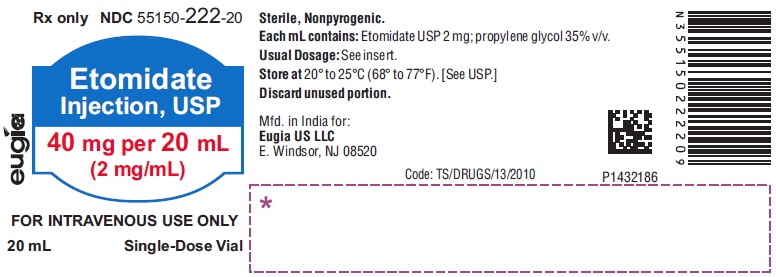
PACKAGE LABEL-PRINCIPAL DISPLAY PANEL - 40 mg per 20 mL (2 mg / mL) - Container Label Rx only NDC 55150-222-20 Etomidate Injection, USP 40 mg per 20 mL (2 mg / mL) FOR INTRAVENOUS USE ONLY 20 mL Single Dose Vial PACKAGE LABEL-PRINCIPAL DISPLAY PANEL - 40 mg per 20 mL (2 mg / mL) - Container Label
PACKAGE LABEL-PRINCIPAL DISPLAY PANEL - 40 mg per 20 mL (2 mg / mL) - Container-Carton (10 Vials) Rx only NDC 55150-222-20 Etomidate Injection, USP 40 mg per 20 mL (2 mg / mL) FOR INTRAVENOUS USE ONLY Sterile 10 x 20 mL Nonpyrogenic Single Dose Vials eugia PACKAGE LABEL-PRINCIPAL DISPLAY PANEL - 40 mg per 20 mL (2 mg / mL) - Container-Carton (10 Vials)
Medicaid utilization & spend
Reported adverse events (FAERS)
Top reported reactions
Age at onset
Reporter sex
Serious outcomes
Where does this data come from?
About this NDC listing & data coverage
What data is (and isn’t) available for this NDC — tap to expand
| NDC identity (package / product / labeler codes) | ✓ Available |
| Labeler | ✓ Available |
| Product & package description | ✓ Available |
| Marketing category & status | ✓ Available |
| Active ingredient / dosage form / route | ✓ Available |
| FDA label (SPL via DailyMed) | ✓ Available |
| Package photos | ✓ Available |
| Inactive ingredients (structured) | ✓ Available |
| NADAC pharmacy acquisition price (CMS) | — Not published for this NDC CMS publishes NADAC only for NDCs reported in its retail-pharmacy survey. |
| Orange Book / therapeutic-equivalence data | ✓ Available |
| HCPCS J-code billing crosswalk | — Not published for this NDC Most self-administered / retail products have no J-code — that is normal. |
| Medicaid utilization (CMS SDUD) | ✓ Available |