
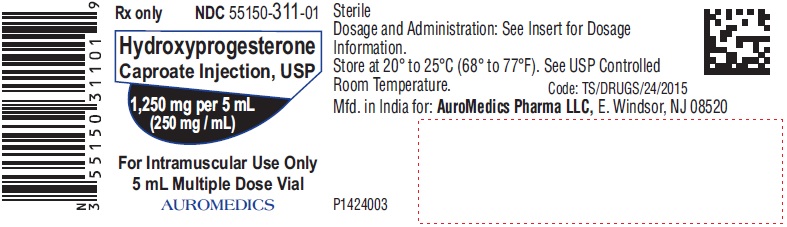
Hydroxyprogesterone Caproate 1250 mg/5mL Injection — NDC 55150-311-01 (Billing 55150-0311-01)
This is a package of Hydroxyprogesterone Caproate 1250 mg/5mL Injection from Eugia US LLC, marketed since May 2019 and currently FDA-listed. It is the main listing for this product, which comes in 2 package sizes.
NDC database record
One package, one record: these facts belong to NDC 55150-311-01 alone.
- Record
- FDA NDC Directory package listing · Human prescription drug
- Code segments
- 55150 labeler · 311 product · 01 package
- Package marketed since
- May 9, 2019
- Sample package
- No — commercial package
- Listing certified through
- Dec 31, 2027
- Barcode (UPC-A, from the NDC)
- 3 5515031101 9
- FDA record last changed
- Jul 24, 2026
Identity & classification
Regulatory identifiers FDA, NLM and CMS codes for this package
- RxCUI (RxNorm): 1087964
Where does this data come from?
- FDA openFDA NDC Directory · synced Oct 1, 2026
- FDA label on DailyMed · label index refreshed Oct 1, 2026
- RxNorm (NLM RxNav) · catalog refreshed Oct 1, 2026
- Medi-Span GPI (licensed)
- First Databank (licensed) · refreshed Oct 1, 2026
RxNorm drug class
This medicine belongs to the Progestin class.
Where does this data come from?
- RxClass (NLM) · catalog refreshed Oct 1, 2026
Clinical
Patient education
Supplement & herbal interactions
Where does this data come from?
- MedlinePlus (NLM) · refreshed Oct 1, 2026
- FDA label on DailyMed · label index refreshed Oct 1, 2026
Ask a licensed pharmacist directly — free, answered by our team.
Pricing
A drug doesn't have one price. Each row is a different public payment system, and none is what you'd pay at the counter — that depends on your insurance. The ⓘ on each row explains what it measures.
| Price system | Per each | Per package |
|---|---|---|
| Retail pharmacies payNADAC · weekly | Not in the retail survey — common for institutional, discontinued, or low-volume packs. | |
| Medicaid paysCMS SDUD · 12 mo | No recent Medicaid claims on file for this NDC — rare and low-volume NDCs are suppressed in the public data. | |
| Medicare drug plans payPart D · quarterly | No Part D plan price is available for this NDC in our data. | |
Where does this data come from?
- CMS NADAC weekly file
- CMS ASP pricing files · refreshed Sep 20, 2026
- CMS Medicaid State Drug Utilization Data · refreshed Oct 3, 2026
- CMS Part D plan pricing files · refreshed Sep 24, 2026
- VA National Acquisition Center price file
Packaging — all sizes for this product
| Package NDC | Description | Marketing start | Marketing end | Status |
|---|---|---|---|---|
| 55150-0311-01 You're viewing this Main listing | 1 VIAL in 1 CARTON / 5 mL in 1 VIAL | 2019-05-09 | — | Active |
| 55150-0311-05 55150-311-05 | 5 VIAL in 1 CARTON / 5 mL in 1 VIAL | 2019-05-09 | — | Active |
Pack size FAQ
What quantity is in this package?
What NDC number is used to bill for this package of Hydroxyprogesterone Caproate 1250 mg/5mL Injection?
Therapeutic equivalents
| Product | Labeler | Pack | NADAC/unit | TE | Status | Price vs. this |
|---|---|---|---|---|---|---|
| Hydroxyprogesterone Caproate 1250 mg/5mLthis 55150-0311-01 | Eugia | 1 vial | — | — | FDA listed | — |
Where does this data come from?
- FDA openFDA NDC Directory · synced Oct 1, 2026
- FDA Orange Book · refreshed Oct 3, 2026
- CMS NADAC weekly file
Availability & generic status
This product is an FDA-approved generic. Other versions of the same drug are listed under Therapeutic equivalents, least expensive first.
Where does this data come from?
- FDA Orange Book · refreshed Oct 3, 2026
Inactive Ingredients / Excipients
Inactive ingredients, also called excipients, are components of the drug product other than the active ingredient. They may include fillers, dyes, coatings, preservatives, flavors, or other formulation ingredients.
Where does this data come from?
IACT rows and label-wide narrative are kept separate; availability and product-level specificity depend on the submitted label.- FDA label on DailyMed · label index refreshed Oct 1, 2026
- FDA openFDA NDC Directory · synced Oct 1, 2026
Inactive ingredient FAQ
Are inactive ingredients the same for every manufacturer?
Why might an inactive ingredient be missing?
Can inactive ingredients matter?
Manufacturer & labeler
More NDCs from Eugia US LLC labeler code 55150
- PHENYLEPHRINE HYDROCHLORIDE 10 mg/mL Injection NDC 55150-302-01
- Dexamethasone Sodium Phosphate 10 mg/mL Injection NDC 55150-304-25
- Dexamethasone Sodium Phosphate 100 mg/10mL Injection NDC 55150-305-10
- Progesterone 50 mg/mL Injection, Solution NDC 55150-306-10
- Acetaminophen 10 mg/mL Injection, Solution NDC 55150-307-24
- Olanzapine 10 mg Injection, Powder, Lyophilized, For Solution NDC 55150-308-01
- Methylprednisolone Acetate 40 mg/mL Injection, Suspension NDC 55150-313-01
- Methylprednisolone Acetate 80 mg/mL Injection, Suspension NDC 55150-314-01
- SUCCINYLCHOLINE CHLORIDE 20 mg/mL Injection, Solution NDC 55150-315-25
- Isoproterenol Hydrochloride .2 mg/mL Injection, Solution NDC 55150-316-25
- Isoproterenol Hydrochloride 1 mg/5mL Injection, Solution NDC 55150-317-10
- CHLORPROMAZINE HYDROCHLORIDE 25 mg/mL Injection NDC 55150-318-25
Where does this data come from?
- FDA openFDA NDC Directory · synced Oct 1, 2026
- Drugs@FDA
Full prescribing information FDA SPL
🎯 Indications and Usage ▾
INDICATIONS AND USAGE Hydroxyprogesterone Caproate Injection, USP is indicated in non-pregnant women: for the treatment of advanced adenocarcinoma of the uterine corpus (Stage III or IV); in the management of amenorrhea (primary and secondary) and abnormal uterine bleeding due to hormonal imbalance in the absence of organic pathology, such as submucous fibroids or uterine cancer; as a test for endogenous estrogen production and for the production of secretory endometrium and desquamation.
⏱️ Dosage and Administration ▾
DOSAGE AND ADMINISTRATION Suggested dosages are presented in the therapy guide. Because of the low viscosity of the vehicle, Hydroxyprogesterone Caproate Injection, USP may be administered with a small gauge needle. Care should be taken to inject the preparation deeply into the upper outer quadrant of the gluteal muscle following the usual precautions for intramuscular injection.
Since the 250 mg potency provides a high concentration in a small volume, particular care should be observed to administer the full dose. Note: Use of a wet needle or syringe may cause the solution to become cloudy; however, this does not affect the potency of the material. Parenteral drug products should be inspected visually for particulate matter and discoloration prior to administration, whenever solution and container permit.
Protect from light. Store vial in its box. Store upright.
Discard any unused product within 5 weeks after first use. THERAPY GUIDE CYCLIC THERAPY SCHEDULE: (28-day cycle; repeated every 4 weeks); Day 1 of each cycle: 20 mg Estradiol Valerate Injection, USP 2 weeks after Day 1: 250 mg Hydroxyprogesterone Caproate Injection, USP and 5 mg Estradiol Valerate Injection, USP 4 weeks after Day 1. This is Day 1 of next cycle SUGGESTED CYCLIC REGIMEN Indications Dosage Started Repeated Stopped Comments Amenorrhea (primary and secondary): Abnormal uterine bleeding due to hormonal imbalance in the absence of organicpathology, such as submucous fibroids or uterine cancer.
375 mg Any time - - Genital malignancy should be excluded before hormone therapy is started. Hydroxyprogesterone caproate is used as a “Medical D and C” to eliminate any proliferated endometrium from previous estrogenic action by conversion to secretory endometrium and desquamation. To determine onset of normal cyclic functions, patient should be observed for 2 or 3 cycles after cessation of therapy.
Cyclic Therapy Schedule After 4 days of desquamation or, if there is no bleeding, 21 days after Hydroxyprogesterone Caproate Injection, USP alone Every 4 weeks After 4 cycles Production of secretory endometrium and desquamation Patients not on estrogen therapy: Cyclic Therapy Schedule Any time Every 4 weeks When cyclic therapy is no longer required If estrogen deficiency has been prolonged, menstruation may not occur until estrogen has been given for several months. Patients currently on estrogen therapy: 375 mg Hydroxy progesterone Caproate Injection, USP Any time - - Cyclic Therapy Schedule After 4 days of desquamation or, if there is no bleeding, 21 days after Hydroxyprogesterone Caproate Injection, USP alone Every 4 weeks When cyclic therapy is no longer required SUGGESTED NON-CYCLIC REGIMEN Indications Dosage Started Repeated Stopped Comments Adenocarcinoma of uterine corpus in advanced stage (Stage III or IV) 1,000 mg or more At once 1 or more times each week (1 to 7 g per week) When relapse occurs, or after 12 weeks with no objective response Should not be used in early stage (Stage I or II) in place of established anticancer therapy.
May be used in advanced stage concomitantly with other anticancer therapy (surgery, α radiation, or chemotherapy, or combination of these). Treatment results reported to date have been better in histologically well-differentiated forms of endometrial adenocarcinoma. (The drug has not been adequately studied in non-endometrioid adenocarcinoma of the uterine corpus).
Test for endogenous estrogen production ("Medical D and C") 250 mg Any time For confirmation, 4 weeks after 1 st injection After 2 nd injection Non-pregnant patient with responsive endometrium; bleeding 7 to14 days after injection indicates endogenous estrogen.
⛔ Contraindications ▾
CONTRAINDICATIONS Hydroxyprogesterone caproate is contraindicated in patients with known or suspected carcinoma of the breast, other hormone-sensitive cancer, or history of these conditions; undiagnosed abnormal vaginal bleeding; liver dysfunction or disease; missed abortion, and in those with a history of hypersensitivity to the drug. Hydroxyprogesterone caproate is also contraindicated as a diagnostic test for pregnancy and in patients with current or history of thrombotic or thromboembolic disorders.
⚠️ Warnings ▾
WARNINGS Thrombotic and Thromboembolic Events Discontinue the medication pending examination if there is a sudden partial or complete loss of vision or if there is a sudden onset of proptosis, diplopia, or migraine. Medication should be stopped if examination reveals papilledema or retinal vascular lesions. Allergic reactions Hypersensitivity reaction to progestins have been reported.
Hydroxyprogesterone caproate is contraindicated in women with a history of hypersensitivity to a progestin. Glucose tolerance Progestins may decrease glucose tolerance and the blood glucose concentration should be monitored in diabetic users.
🤒 Adverse Reactions ▾
ADVERSE REACTIONS A. Serious arterial thrombotic and venous thromboembolic events, including cases of pulmonary emboli (some fatal), deep vein thrombosis, myocardial infarction, and strokes, have been reported in women using progestins. B. neuroocular lesions (e.g., retinal thrombosis and optic neuritis); nausea; vomiting; gastrointestinal symptoms (such as abdominal cramps or bloating); edema; breakthrough bleeding, spotting, or withdrawal bleeding; breast tenderness; changes in body weight (increase or decrease); headache; increase in cervical mucus; allergic rash; abscess; pain at the injection site; migraine headaches.
C. chloasma or melasma, cholestatic jaundice, rise in blood pressure, mental depression, and amenorrhea during or after treatment. D. posttreatment anovulation, cystitis, hirsutism, loss of scalp hair, changes in libido, changes in appetite, dizziness, fatigue, backache, itching, or amenorrhea. E.
The following laboratory tests may be affected by progestins: hepatic function (increased sulfobromophthalein retention and other tests); coagulation tests (increased in prothrombin and Factors VII, VIII, IX, and X); thyroid function tests (increase in PBI and butanol extractable protein-bound iodine, decrease in T3 uptake values. A few instances of coughing, dyspnea, constriction of the chest, and/or allergic-like reactions have occurred following hydroxyprogesterone caproate therapy; the likelihood of these occurring may be increased at higher dosage levels.
🧬 Clinical Pharmacology ▾
CLINICAL PHARMACOLOGY Hydroxyprogesterone is a potent, long-acting, progestational steroid ester which transforms proliferative endothelium into secretory endothelium, induces mammary gland duct development, and inhibits the production and/or release of gonadotropic hormone; it also shows slight estrogenic, androgenic, or corticoid effects as well, but should not be relied upon for these effects. In advanced adenocarcinoma of the uterine corpus, Hydroxyprogesterone Caproate Injection, USP in a dosage of 1,000 mg or more, one or more times each week, often induces regressive changes.
Absorption : Peak serum levels of hydroxyprogesterone caproate appeared after 3 to 7 days in non-pregnant female subjects following a single intramuscular injection of 1,000 mg hydroxyprogesterone caproate. The pharmacokinetics of the 250 mg dose of hydroxyprogesterone caproate has not been evaluated in a study. Metabolism : The conjugated metabolites include sulfated and glucuronidated products.
In vitro data indicate that the metabolism of hydroxyprogesterone caproate is predominantly mediated by CYP3A4 and CYP3A5. Excretion : Both conjugated metabolites and free steroids are excreted in the urine and feces, with the conjugated metabolites being prominent. Hepatic Impairment The effect of hepatic impairment on the pharmacokinetics of hydroxyprogesterone caproate has not been evaluated.
Hydroxyprogesterone caproate is extensively metabolized and hepatic impairment may reduce the elimination of hydroxyprogesterone caproate. Renal Impairment The effect of renal impairment on the pharmacokinetics of hydroxyprogesterone caproate has not been evaluated.
📦 How Supplied / Storage and Handling ▾
HOW SUPPLIED Hydroxyprogesterone Caproate Injection, USP is available in vials providing hydroxyprogesterone caproate with a potency of 250 mg per mL. The product is formulated in castor oil and 46% benzyl benzoate and containing 2% (v/v) benzyl alcohol as a preservative. Hydroxyprogesterone Caproate Injection, USP is a sterile, clear pale yellow to yellow color oily solution and is supplied as follows: 5 mL Multiple-Dose Vial Packaged Individually NDC 55150-311-01 5 mL Multiple-Dose Vials in a carton of 5 NDC 55150-311-05 Storage Hydroxyprogesterone Caproate Injection, USP should be stored at controlled room temperature 20° to 25° C (68° to 77° F).
Storage at low temperatures may result in the separation of some crystalline material which redissolves readily on heating in boiling water. Protect from light. Store vial in its box.
Store upright. Discard any unused product within 5 weeks after first use. The vial stopper is not made with natural rubber latex.
Distributed by: AuroMedics Pharma LLC 279 Princeton-Hightstown Road E.Windsor, NJ 08520 Manufactured by: Eugia Pharma Specialities Limited Hyderabad – 500032 India Revised: June 2022
📋 Description ▾
DESCRIPTION Hydroxyprogesterone Caproate Injection, USP is a sterile, long-acting preparation of the caproate ester of the naturally- occurring progestational hormone, hydroxyprogesterone, in an oil solution for intramuscular use. The chemical name for hydroxyprogesterone caproate is pregn-4-ene-3,20-dione, 17[(1-oxohexyl)oxy]. It has a molecular formula of C 27 H 40 O 4 and a molecular weight of 428.60.
Hydroxyprogesterone caproate exists as white or creamy white crystalline powder. The structural formula is: Each 5 mL multiple-dose vial contains hydroxyprogesterone caproate, 250 mg/mL, in castor oil (28.6% v/v) and benzyl benzoate (46 % v/v) with the preservative benzyl alcohol (2% v/v). Chemical Structure
💬 Information for Patients ▾
Information for The Patient Counsel patients that hydroxyprogesterone caproate injections may cause pain, soreness, swelling, itching or bruising. Inform the patient to contact her physician if she notices increased discomfort over time, oozing of blood or fluid, or inflammatory reactions at the injection site.
⚠️ Precautions ▾
PRECAUTIONS Detectable amounts of progestins have been identified in the milk of mothers receiving the drug. Many studies have found no adverse effects of progestins on breastfeeding performance, or on the health, growth, or development of the infant. Because progestational drugs may cause some degree of fluid retention, conditions that might be influenced by this effect, such as asthma, migraine, epilepsy, or cardiac or renal dysfunction require careful observation.
The pretreatment physical examination should include examination of the breasts and pelvic organs and a Papanicolaou smear. In relation to irregular bleeding which does not respond predictably to the hormone therapy, nonfunctional causes should be borne in mind and adequate diagnostic measures instituted. Any influence of prolonged sex hormone medication on pituitary, ovarian, adrenal, hepatic, or uterine function awaits further study.
The pathologist should be advised of progesterone therapy when relevant specimens are submitted. Patients who have a history of psychic depression should be carefully observed and the drug discontinued if the depression recurs to a serious degree. Information for The Patient Counsel patients that hydroxyprogesterone caproate injections may cause pain, soreness, swelling, itching or bruising.
Inform the patient to contact her physician if she notices increased discomfort over time, oozing of blood or fluid, or inflammatory reactions at the injection site.
📄 Package Label / Principal Display Panel ▾
PACKAGE LABEL-PRINCIPAL DISPLAY PANEL - 1,250 mg per 5 mL (250 mg / mL) - Container Label Rx only NDC 55150-311-01 Hydroxyprogesterone Caproate Injection, USP 1,250 mg per 5 mL (250 mg / mL) For Intramuscular Use Only 5 mL Multiple Dose Vial AUROMEDICS PACKAGE LABEL-PRINCIPAL DISPLAY PANEL - 1,250 mg per 5 mL (250 mg / mL) - Container Label
PACKAGE LABEL-PRINCIPAL DISPLAY PANEL - 1,250 mg per 5 mL (250 mg / mL) – Container-Carton (1 vial) Rx only NDC 55150-311-01 Hydroxyprogesterone Caproate Injection, USP 1,250 mg per 5 mL (250 mg / mL) For Intramuscular Use Only 5 mL Multiple Dose Vial AUROMEDICS PACKAGE LABEL-PRINCIPAL DISPLAY PANEL - 1,250 mg per 5 mL (250 mg / mL) – Container-Carton (1 vial)
PACKAGE LABEL-PRINCIPAL DISPLAY PANEL - 1,250 mg per 5 mL (250 mg / mL) – Container-Carton (5 vials) Rx only NDC 55150-311-05 Hydroxyprogesterone Caproate Injection, USP 1,250 mg per 5 mL (250 mg / mL) For Intramuscular Use Only 5 x 5 mL Multiple Dose Vials AUROMEDICS PACKAGE LABEL-PRINCIPAL DISPLAY PANEL - 1,250 mg per 5 mL (250 mg / mL) – Container-Carton (5 vials)
About this NDC listing & data coverage
What data is (and isn’t) available for this NDC — tap to expand
| NDC identity (package / product / labeler codes) | ✓ Available |
| Labeler | ✓ Available |
| Product & package description | ✓ Available |
| Marketing category & status | ✓ Available |
| Active ingredient / dosage form / route | ✓ Available |
| FDA label (SPL via DailyMed) | ✓ Available |
| Package photos | ✓ Available |
| Inactive ingredients (structured) | — Not published for this NDC The labeler did not submit a structured excipient list, or no SPL is available. |
| NADAC pharmacy acquisition price (CMS) | — Not published for this NDC CMS publishes NADAC only for NDCs reported in its retail-pharmacy survey. |
| Orange Book / therapeutic-equivalence data | — Not published for this NDC Applies only to products approved under an NDA/ANDA; many listings are out of scope. |
| HCPCS J-code billing crosswalk | — Not published for this NDC Most self-administered / retail products have no J-code — that is normal. |
| Medicaid utilization (CMS SDUD) | — Not published for this NDC CMS reports utilization only for NDCs with Medicaid claims above its privacy threshold. |