
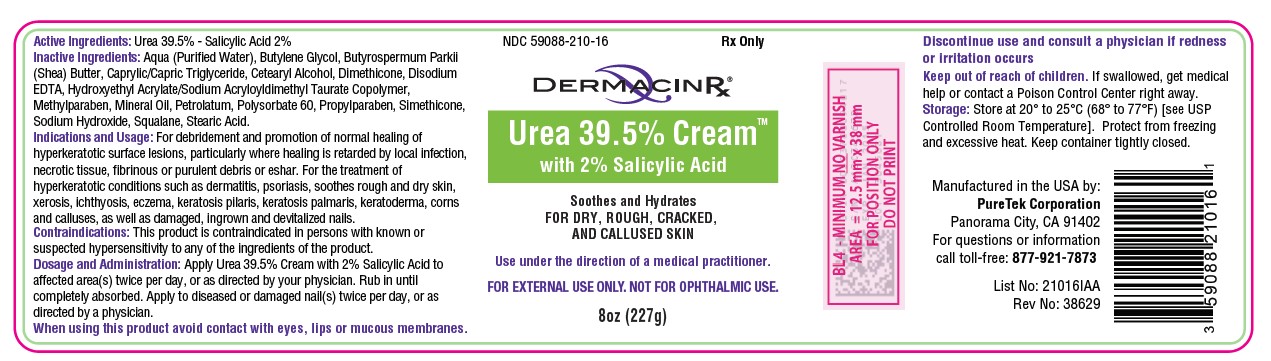
Urea 39.5% with 2% Salicylic Acid 39.5 g/100g; 2 g/100g Cream, 227 g — NDC 59088-210-16 (Billing 59088-0210-16)
This is a package of 227 g of Urea 39.5% with 2% Salicylic Acid 39.5 g/100g; 2 g/100g Cream from PureTek Corporation, marketed since Mar 2023 and currently FDA-listed. It is this product's only package size.
NDC database record
One package, one record: these facts belong to NDC 59088-210-16 alone.
- Record
- FDA NDC Directory package listing · Human prescription drug
- Code segments
- 59088 labeler · 210 product · 16 package
- Package marketed since
- Mar 24, 2023
- Sample package
- No — commercial package
- Listing certified through
- Dec 31, 2026
- Billing quantity
- 227 g per package
- Barcode (UPC)
- 0359088210161
- FDA record last changed
- Aug 27, 2026
Identity & classification
Regulatory identifiers FDA, NLM and CMS codes for this package
Drug-database identifiers Medi-Span GPI and First Databank GCN / HICL / AHFS classification
- GPI-14 (Medi-Span): 90759902353730
- RxCUI (RxNorm): 2632843
Where does this data come from?
- FDA openFDA NDC Directory · synced Oct 8, 2026
- FDA label on DailyMed · label index refreshed Oct 8, 2026
- RxNorm (NLM RxNav) · catalog refreshed Oct 8, 2026
- Medi-Span GPI (licensed)
- First Databank (licensed) · refreshed Oct 8, 2026
RxNorm drug class
This medicine belongs to the Helicobacter pylori Diagnostic class.
Where does this data come from?
- RxClass (NLM) · catalog refreshed Oct 8, 2026
Clinical
This is an unapproved topical cream containing urea and salicylic acid. Urea is commonly used in skin products to help soften and hydrate thickened skin. Salicylic acid is typically used to help break down keratin and reduce buildup on the skin surface. Together, these ingredients are found in products intended for conditions involving hardened or thickened skin patches.
Patient education
Supplement & herbal interactions
Where does this data come from?
- MedlinePlus (NLM) · refreshed Oct 8, 2026
- FDA label on DailyMed · label index refreshed Oct 8, 2026
Ask a licensed pharmacist directly — free, answered by our team.
Pricing
A drug doesn't have one price. Each row is a different public payment system, and none is what you'd pay at the counter — that depends on your insurance. The ⓘ on each row explains what it measures.
| Price system | Per g | Per package |
|---|---|---|
| Retail pharmacies payNADAC · weekly | Not in the retail survey — common for institutional, discontinued, or low-volume packs. | |
| Medicaid paysCMS SDUD · 12 mo | No recent Medicaid claims on file for this NDC — rare and low-volume NDCs are suppressed in the public data. | |
| Medicare drug plans payPart D · quarterly | No Part D plan price is available for this NDC in our data. | |
Where does this data come from?
- CMS NADAC weekly file
- CMS ASP pricing files · refreshed Sep 20, 2026
- CMS Medicaid State Drug Utilization Data · refreshed Oct 9, 2026
- CMS Part D plan pricing files · refreshed Sep 24, 2026
- VA National Acquisition Center price file
Packaging — all sizes for this product
| Package NDC | Description | Marketing start | Marketing end | Status |
|---|---|---|---|---|
| 59088-0210-16 You're viewing this Main listing | 227 g in 1 JAR | 2023-03-24 | — | Active |
Therapeutic equivalents
| Product | Labeler | Pack | NADAC/unit | TE | Status | Price vs. this |
|---|---|---|---|---|---|---|
| Urea 39.5% with 2% Salicylic Acid 39.5 g/100g; 2 g/100gthis 59088-0210-16 | PureTek | 227 g | — | — | FDA listed | — |
Where does this data come from?
- FDA openFDA NDC Directory · synced Oct 8, 2026
- FDA Orange Book · refreshed Oct 3, 2026
- CMS NADAC weekly file
Availability & generic status
We did not find an FDA-approved generic match for this exact strength, form and route.
Where does this data come from?
- FDA Orange Book · refreshed Oct 3, 2026
Inactive Ingredients / Excipients
Inactive ingredients, also called excipients, are components of the drug product other than the active ingredient. They may include fillers, dyes, coatings, preservatives, flavors, or other formulation ingredients.
💡 Tap an ingredient (hover on desktop) to see what it is and why it’s used.
-
UNII 3XUS85K0RA
Butylene glycol is a clear liquid derived from petroleum or plants that acts as a humectant, solvent, and preservative booster in medicines. It helps keep formulations stable, dissolve active ingredients, and maintain moisture in topical products.
-
UNII 2DMT128M1S
A waxy solid derived from plant or animal sources. It acts as an emulsifier to blend oil and water components, and also thickens the medicine to give it the right texture and consistency.
-
UNII 92RU3N3Y1O
Dimethicone is a silicone-based oil that acts as an anti-foaming agent and lubricant in medicines. It reduces gas bubbles in liquid formulations and helps coat and protect the stomach lining when ingested.
-
UNII 8NLQ36F6MM
Edetate disodium anhydrous is a chemical compound that binds to metal ions in a medicine. It's used as a stabilizer to prevent unwanted chemical reactions and help keep the drug product effective during storage.
-
UNII 86FQE96TZ4
A synthetic polymer, this ingredient acts as a thickener and suspending agent in liquid formulations. It helps maintain uniform consistency and keeps particles evenly distributed throughout the medicine.
-
UNII C9H2L21V7U
A fat derived from coconut or palm oil containing shorter fatty acid chains. It serves as a solvent and carrier to help dissolve or suspend active ingredients, improving absorption and stability in liquid formulations.
-
UNII A2I8C7HI9T
Methylparaben is a preservative derived from benzoic acid that prevents growth of bacteria, fungi, and mold in medicines. It extends the product's shelf life and maintains safety during storage.
-
UNII T5L8T28FGP
Mineral oil is a clear, odorless liquid derived from crude oil. It acts as a lubricant and emollient in medications, helping pills slide smoothly during manufacturing and aiding moisture retention in topical products.
-
UNII 4T6H12BN9U
Petrolatum is a purified mineral oil-based jelly derived from petroleum. In medicines, it acts as an emollient, lubricant, and moisture barrier to soften skin, reduce friction, and help prevent water loss from formulations.
-
UNII CAL22UVI4M
A synthetic emulsifier derived from sorbitol and fatty acids. It helps mix oil and water-based ingredients together and improves the texture and stability of the medicine.
-
UNII Z8IX2SC1OH
Propylparaben is a chemical preservative used to prevent bacterial and fungal growth in medicines and personal care products. It helps extend shelf life and maintain product safety during storage.
-
UNII K49155WL9Y
Shea butter is a fat extracted from shea tree nuts. It's used in medicines as an emollient and lubricant to soften the product, improve texture, and help ingredients blend smoothly together.
-
UNII ETJ7Z6XBU4
Silicon dioxide is a naturally occurring mineral used as a glidant and anti-caking agent. It helps powder ingredients flow smoothly and prevents clumping during manufacturing and storage.
-
UNII 55X04QC32I
A strong alkaline chemical used to adjust and maintain the pH balance of liquid medicines. It helps keep the medicine stable and ensures it stays effective during storage.
-
UNII GW89575KF9
Squalane is a lightweight oil derived from plant sources or synthesized. It acts as an emollient and lubricant in formulations, helping ingredients blend smoothly and improving product texture and spreadability.
-
UNII 4ELV7Z65AP
Stearic acid is a fatty acid derived from plant or animal sources. It acts as a binder and lubricant in tablets and capsules, helping them hold together and flow smoothly during manufacturing.
-
UNII 059QF0KO0R
Water is a liquid solvent that dissolves and mixes ingredients together in liquid medicines, syrups, and injections. It helps distribute the active drug evenly throughout the product.
17 inactive ingredients listed in the exact product block matched to this NDC.
Where does this data come from?
ingredient classCode="IACT" elements from the exact product block matched by this NDC. Label-section narrative from DailyMed / the openFDA label index is shown separately when available.- FDA label on DailyMed · label index refreshed Oct 8, 2026
- FDA openFDA NDC Directory · synced Oct 8, 2026
Inactive ingredient FAQ
Are inactive ingredients the same for every manufacturer?
Why might an inactive ingredient be missing?
Can inactive ingredients matter?
Manufacturer & labeler
More NDCs from PureTek Corporation labeler code 59088
- Menticam Camphor,Menthol, Methyl Salicylate 4 g/85g; 7.5 g/85g; 10 g/85g Cream NDC 59088-202-07
- Menticam Camphor, Menthol, Methyl Salicylate 10 g/100g; 30 g/100g; 4 g/100g Gel NDC 59088-203-07
- Lidotral 5% Gel Lidocaine HCl 50 mg/g Gel NDC 59088-204-07
- Lasolex AG MICONAZOLE NITRATE 2 g/100g Gel NDC 59088-207-07
- Hydroxym Cream HYDROCORTISONE 2% 20 mg/g Cream NDC 59088-208-03
- Hydroxym HYDROCORTISONE 2 g/100g Gel NDC 59088-209-03
- Exemax Cream Dimethicone, Allantoin 2 g/100g; 5 g/100g Cream NDC 59088-212-07
- Salicate Salicylic Acid 10% 10 mg/100mL Gel NDC 59088-214-03
- Mencylate Pain Relieving Menthol, Methyl Salicylate 100 mg/mL; 20 mg/mL Cream NDC 59088-215-05
- Salicylic Acid 6% Gel 6 g/100g Gel NDC 59088-216-03
- Capsaicin 0.025% Cream .025 mg/g Cream NDC 59088-220-08
- Lidoease 2% Lidocaine HCl 20 mg/g Gel NDC 59088-221-03
Where does this data come from?
- FDA openFDA NDC Directory · synced Oct 8, 2026
- Drugs@FDA
Full prescribing information FDA SPL
🎯 Indications and Usage ▾
INDICATIONS & USAGE For debridement and promotion of normal healing of hyperkeratotic surface lesions, particularly where healing is retarded by local infection, necrotic tissue, fibrinous or purulent debris or eshar. Urea is useful for the treatment of hyperkeratotic conditions such as dermatitis, psoriasis, soothes rough and dry skin, xerosis, ichthyosis, eczema, keratosis pilaris, keratosis palmaris, keratoderma, corns and calluses, as well as damaged, ingrown and devitalized nails.
⏱️ Dosage and Administration ▾
DOSAGE AND ADMINISTRATION Apply Urea 39.5% Cream with 2% Salicylic Acid to affected skin twice per day, or as directed by your physician. Rub in until completely absorbed. Apply to diseased or damaged nail(s) twice per day, or as directed by a physician.
⛔ Contraindications ▾
CONTRAINDICATIONS This product is contraindicated in persons with known or suspected hypersensitivity to any of the ingredients of the product.
⚠️ Warnings ▾
WARNINGS FOR EXTERNAL USE ONLY. NOT FOR OPHTHALMIC USE. KEEP OUT OF REACH OF CHILDREN.
Avoid contact with eyes, lips and mucous membranes.When using this product skin irritation and dryness is more likely to occur. General This product is to be used as directed by a physician and should not be used to treat any condition other than that for which it was prescribed. If redness or irritation occurs, discontinue use and consult a physician.
Information for Patients Patients should discontinue the use of this product if the condition becomes worse or if a rash develops in the area being treated or elsewhere. Avoid contact with eyes, lips and mucous membranes. Carcinogenesis, Mutagenesis and Impairment of Fertility: Long-term animal studies for carcinogenic potential have not been performed on this product to date.
Studies on reproduction and fertility also have not been performed. Pregnancy: Category C . Animal reproduction studies have not been conducted with this product.
It is also not known whether this product can affect reproduction capacity or cause fetal harm when administered to a pregnant woman. This product should be used by a pregnant woman only if clearly needed or when potential benefits outweigh potential hazards to the fetus. Nursing Mothers: It is not known whether this drug is excreted in human milk.
Because many drugs are excreted in human milk, caution should be exercised when this product is administered to a nursing woman.
🤒 Adverse Reactions ▾
ADVERSE REACTIONS: Transient stinging, burning, itching or irritation may occur and normally disappear upon discontinuing the medication.
🤰 Pregnancy ▾
Pregnancy: Category C . Animal reproduction studies have not been conducted with this product. It is also not known whether this product can affect reproduction capacity or cause fetal harm when administered to a pregnant woman. This product should be used by a pregnant woman only if clearly needed or when potential benefits outweigh potential hazards to the fetus.
🧬 Clinical Pharmacology ▾
CLINICAL PHARMACOLOGY Urea gently dissolves the intracellular matrix which results in loosening of the horny layer of the skin and shedding of scaly skin at regular intervals, thereby softening hyperkeratotic areas of the skin. Pharmacokinetics The mechanism of action of topically applied urea is not yet known.
📦 How Supplied / Storage and Handling ▾
HOW SUPPLIED Urea 39.5% Cream with 2% Salicylic Acid 8 oz. (227 g): NDC 59088-210-16
📋 Description ▾
DESCRIPTION Urea 39.5% Cream with 2% Salicylic Acid is a keratolytic emollient which is a gentle, yet potent, tissue softener for nails and/or skin space. Each gram contains 395 mg of urea, 20 mg of Salicylic Acid in vehicle consisting of: Aqua (Purified Water), Butylene Glycol, Butyrospermum Parkii (Shea) Butter, Caprylic/Capric Triglyceride, Cetearyl Alcohol, Dimethicone, Disodium EDTA, Hydroxyethyl Acrylate/Sodium Acryloyldimethyl Taurate Copolymer, Methylparaben, Mineral Oil, Petrolatum, Polysorbate 60, Propylparaben, Simethicone, Sodium Hydroxide, Squalane, Stearic Acid.
Urea is a diamide of carbonic acid with the following chemical structure: Chemical Structure
💬 Information for Patients ▾
Information for Patients Patients should discontinue the use of this product if the condition becomes worse or if a rash develops in the area being treated or elsewhere. Avoid contact with eyes, lips and mucous membranes.
🍼 Nursing Mothers ▾
Nursing Mothers: It is not known whether this drug is excreted in human milk. Because many drugs are excreted in human milk, caution should be exercised when this product is administered to a nursing woman.
🧬 Pharmacokinetics ▾
Pharmacokinetics The mechanism of action of topically applied urea is not yet known.
📄 Carcinogenesis, Mutagenesis, Impairment of Fertility ▾
Carcinogenesis, Mutagenesis and Impairment of Fertility: Long-term animal studies for carcinogenic potential have not been performed on this product to date. Studies on reproduction and fertility also have not been performed.
📄 Package Label / Principal Display Panel ▾
Urea 39.5% Cream™ with 2% Salicylic Acid Manufactured in the USA by: PureTek Corporation Panorama City, CA 91402 For questions or information call toll-free: 877-921-7873 Label
About this NDC listing & data coverage
Listed without an FDA application
This product's marketing category indicates it is marketed without an approved FDA application (no NDA, ANDA, or BLA on file). Having an NDC does not by itself establish FDA approval — the NDC Directory is a listing system, not an approval decision. Approval-linked data such as Orange Book therapeutic-equivalence ratings therefore does not apply.
What data is (and isn’t) available for this NDC — tap to expand
| NDC identity (package / product / labeler codes) | ✓ Available |
| Labeler | ✓ Available |
| Product & package description | ✓ Available |
| Marketing category & status | ✓ Available |
| Active ingredient / dosage form / route | ✓ Available |
| FDA label (SPL via DailyMed) | ✓ Available |
| Package photos | ✓ Available |
| Inactive ingredients (structured) | ✓ Available |
| NADAC pharmacy acquisition price (CMS) | — Not published for this NDC CMS publishes NADAC only for NDCs reported in its retail-pharmacy survey. |
| Orange Book / therapeutic-equivalence data | — Not published for this NDC Applies only to products approved under an NDA/ANDA; many listings are out of scope. |
| HCPCS J-code billing crosswalk | — Not published for this NDC Most self-administered / retail products have no J-code — that is normal. |
| Medicaid utilization (CMS SDUD) | — Not published for this NDC CMS reports utilization only for NDCs with Medicaid claims above its privacy threshold. |