
HomeNDC LookupIngredientsLidocaine Hcl › 59088-0466-07
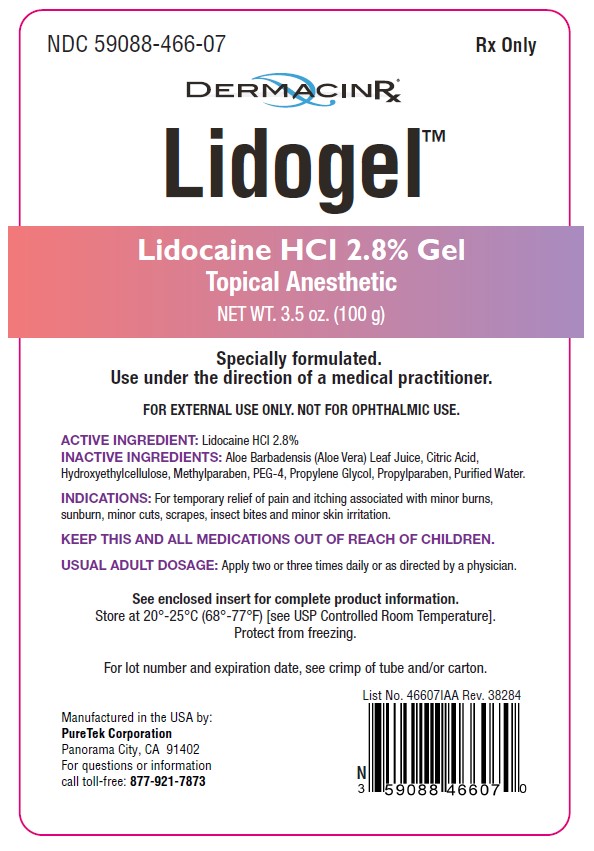
Lidogel Lidocaine HCl 28 mg/g Gel, 100 g — NDC 59088-0466-07 package photo

Lidogel Lidocaine HCl 28 mg/g Gel, 100 g

by PureTek Corporation · 100 g in 1 TUBE (59088-466-07)
NDC 59088-0466-07
🏷️ FDA NDC (as labeled) 59088-466-07 billing pads the product segment with a zero
Rx only On market Non-controlled
🗂️ Data synced Jul 24, 2026 · sources: openFDA · FDA label (DailyMed) · FDA Orange & Purple Book · First Databank · CMS NADAC, ASP, Medicare & Medicaid · RxNorm
📋 All sources & update times →

🆔 Identity & classification

FDA NDC (as labeled) 59088-466-07
Product NDC 59088-466
11-digit billing NDC 59088046607
NCPDP billing unit GM — per gram (weight)
RxCUI 2562183
UNII V13007Z41A
UPC 0359088466070
SPL Set ID c7a7bf74-d67e-cc5a-e053-2a95a90a2957
Established class (EPC) Amide Local Anesthetic; Antiarrhythmic
Physiologic effect Local Anesthesia
Chemical class Amides
DEA schedule Non-controlled
Marketing category UNAPPROVED DRUG OTHER
Marketing status On market
FDA listing status Listed (active directory)
Marketing start 2021-07-21
Route TOPICAL
Dosage form GEL
Substance LIDOCAINE HYDROCHLORIDE
GPI-14 90850060104009
GPI class DermacinRx Lidogel
GCN Seq No 082619
GCN 50276
HICL code 001478
Ingredient (HICL) Lidocaine Hcl
HIC1 code Q
Therapeutic class — broad (HIC1) Ear/Eye/Nose/Rectum/Topical/Vagina/Other
HIC2 code Q5
Therapeutic class — intermediate (HIC2) Agents Acting Principally On The Skin
HIC3 code Q5H
Therapeutic class — specific (HIC3) Topical Local Anesthetics
AHFS code 72:00.00.00
AHFS class Local Anesthetics
FDB label name DERMACINRX LIDOGEL 2.8% GEL
FDB brand name Dermacinrx Lidogel
Legend status F — Federal legend — prescription drug or device
Why two NDCs? The FDA registers this code as 59088-466-07 — a 5-3-2 layout, and that's what's printed on the package and shown on DailyMed. For insurance claims, every NDC is standardized to a uniform 11-digit 5-4-2 format by adding a zero to the product segment → 59088-0466-07. Same drug, same package — only the format differs.
Where does this data come from?
Identifiers from the FDA openFDA NDC Directory and Structured Product Labeling; RxCUI from RxNorm (NLM); GPI from Medi-Span; GCN / HIC / AHFS / legend from First Databank.

🏷️ RxNorm drug class

This medicine belongs to the Antiarrhythmic class.

Pharmacologic class Antiarrhythmic, Amide Local Anesthetic
Drug family (ATC) Antiarrhythmics, class Ib, Local anesthetics, Anesthetics for topical use
Where does this data come from?
Therapeutic classes from RxNorm RxClass (U.S. National Library of Medicine) — Established Pharmacologic Class (FDA), ATC drug family (WHO) and mechanism of action, matched by this product’s RxCUI.

🏭 Manufacturer & labeler

LabelerPureTek Corporation
Labeler code59088
First marketedJul 2021
Product typeHuman Prescription Drug
Portfolio178 products on file
The labeler markets the product; the application holder owns the FDA approval. They’re often the same company but can differ (e.g. a repackager or an authorized generic). A mailing address / phone appears here when the manufacturer includes it in the product’s FDA label (not all do).
Where does this data come from?
Labeler, application holder and registered establishment from the FDA openFDA NDC Directory and Drugs@FDA; address/contact from the product’s FDA label.

🩺 Clinical

Label name DERMACINRX LIDOGEL 2.8% GEL Ingredient Lidocaine Hcl
📗 Our plain-language guide HelloPharmacist
  • It's best to avoid using two lidocaine products at the same time unless your doctor says it's okay. When you use multiple products containing a local anesthetic, the total amount a...
  • Can I use a lidocaine patch and a lidocaine cream at the same time?
  • No — please don't do this. Heat significantly increases how much lidocaine is absorbed through your skin, which can push drug levels in your blood higher than they should be. Stick...
  • Can I put a heating pad on the area where I applied a lidocaine patch?
📖 Read our full Lidocaine guide →
Where does this data come from?
Plain-language summary from MedlinePlus (U.S. National Library of Medicine); supplement & herbal interactions and nutrient depletion data from the Natural Medicines database; our full guide is HelloPharmacist editorial content.

🧪 Inactive Ingredients / Excipients

Inactive ingredients, also called excipients, are components of the drug product other than the active ingredient. They may include fillers, dyes, coatings, preservatives, flavors, or other formulation ingredients.

💡 Tap an ingredient (hover on desktop) to see what it is and why it’s used.

  • UNII ZY81Z83H0X
    Aloe vera leaf is a plant extract derived from the aloe plant. It is used in medicines as a natural moisturizer and skin-soothing agent in topical formulations.
  • UNII XF417D3PSL
    Anhydrous citric acid is a sour, crystalline powder derived from citric acid with water removed. In medicines, it acts as a buffer to control pH, adds tartness to improve taste, and helps tablets disintegrate.
  • UNII T4V6TWG28D
    A plant-derived thickening agent made from cellulose. It increases viscosity and helps form a gel or paste consistency in medications, and may serve as a binder or coating material in various formulations.
  • UNII A2I8C7HI9T
    Methylparaben is a preservative derived from benzoic acid that prevents growth of bacteria, fungi, and mold in medicines. It extends the product's shelf life and maintains safety during storage.
  • UNII R95B8J264J
    Polyethylene glycol 200 is a clear, colorless liquid made from petroleum. It acts as a solvent and humectant in medicines, helping dissolve active ingredients and retain moisture to keep the product stable.
  • UNII 6DC9Q167V3
    Propylene glycol is a clear liquid derived from petroleum or vegetable sources. It acts as a solvent, humectant, and preservative in medicines, helping dissolve active ingredients and maintain product stability.
  • UNII Z8IX2SC1OH
    Propylparaben is a chemical preservative used to prevent bacterial and fungal growth in medicines and personal care products. It helps extend shelf life and maintain product safety during storage.
  • UNII 059QF0KO0R
    Water is a liquid solvent that dissolves and mixes ingredients together in liquid medicines, syrups, and injections. It helps distribute the active drug evenly throughout the product.

8 inactive ingredients listed in the exact product block matched to this NDC.

Where does this data come from?
Data sourced from official FDA Structured Product Labeling (SPL) via DailyMedingredient classCode="IACT" elements from the exact product block matched by this NDC. Label-section narrative from DailyMed / the openFDA label index is shown separately when available.

Inactive ingredient FAQ

Are inactive ingredients the same for every manufacturer?
No. Inactive ingredients can differ by manufacturer, dosage form, strength, and package / product version.
Why might an inactive ingredient be missing?
Some SPLs do not provide a complete structured inactive-ingredient list, and older or unusual labels may only include the information in narrative text.
Can inactive ingredients matter?
Yes. They can matter for allergies, intolerances, dyes, gluten / lactose concerns, preservatives, and formulation differences — but confirm with a pharmacist or the manufacturer when it’s clinically important.

💲 Pricing

A drug doesn't have one price. Each row is a different public payment system, and none is what you'd pay at the counter — that depends on your insurance. The ⓘ on each row explains what it measures.

Price systemPer gPer package
Retail pharmacies payNADAC · weekly Not in the retail survey — common for institutional, discontinued, or low-volume packs.
Medicaid paysCMS SDUD · 12 mo $15.24 $1,523.65 / 100 g
Medicare drug plans payPart D · quarterly No Part D plan price is available for this NDC in our data.
Where does this data come from?
NADAC (National Average Drug Acquisition Cost) is the CMS weekly pharmacy-acquisition-cost survey — what pharmacies pay. ASP (Average Sales Price) is the CMS Medicare Part B drug-payment file, published quarterly. Medicaid pays is computed by us from CMS State Drug Utilization Data (total reimbursed ÷ units, trailing 12 months) — gross of rebates and inclusive of dispensing fees, so it reflects what Medicaid paid, not an acquisition cost. Medicare drug plans pay is the median negotiated point-of-sale unit cost across plans listing this NDC in the CMS quarterly Prescription Drug Plan pricing files, before rebates. The VA pays is the federal contract price (FSS, and the statutory Big 4 ceiling where listed) from the VA National Acquisition Center pharmaceutical price file. All are free public government data; each measures a different payer, so the figures are not directly comparable.

🔁 Therapeutic equivalents

ProductLabelerPackNADAC/unitTEStatusPrice vs. this
Lidogel 28 mg/gthis 59088-0466-07 PureTek 100 g FDA listed
Lidorex 28 mg/g 59088-0475-07 PureTek 100 g FDA listed
Trilogel 28 mg/g 73352-0620-01 Trifluent 1 tube FDA listed
Lidogel 28 mg/g 80425-0372-01 Advanced 100 g FDA listed
Lidovara 28 mg/g 85477-0303-07 Oncora 100 g FDA listed
About this product: other versions of the same ingredient, strength and form are listed above, least expensive first, with FDA equivalence ratings where available.
Where does this data come from?
Equivalents are other NDCs of the same ingredient, form and route from the openFDA NDC Directory, ranked least-expensive-first by NADAC. Therapeutic-equivalence (AB) ratings come from the FDA Orange Book; biologics use the FDA Purple Book for biosimilar & interchangeable status.

Availability & generic status

🏛️
2021
On the market since
Jul 2021
📍
2026
Currently FDA-listed
5 years listed
🔒
·
No generic listed yet
brand only
ℹ️No FDA-approved generic found

We did not find an FDA-approved generic match for this exact strength, form and route.

Where does this data come from?
Patents and exclusivity from the FDA Orange Book (small-molecule drugs), refreshed from public FDA data. Generic launch timing is an estimate, not a guarantee.

🗺️ Medicaid utilization & spend

📍 This exact package only: Medicaid data is reported per full 11-digit NDC — labeler, product and pack size — so every number here is for 59088-0466-07, not the drug overall. Other pack sizes report separately.
💊 Pharmacy benefit only: These are Medicaid outpatient pharmacy claims, billed by NDC. They exclude the medical benefit — clinic- or hospital-administered drugs billed under HCPCS J-codes — so drugs used mostly that way (e.g. Avastin, Lucentis, Keytruda) can look low or missing here. That’s expected, not an error.
📅 Q1 2025 – Q4 2025 · 4 quarters of data
ⓘ The newest quarter is usually incomplete when first published; states restate recent quarters in later CMS releases, so the latest figures typically revise upward. State coverage-policy changes can also shift quarter-to-quarter totals.
Prescriptions last 4 qtrs
487
Units reimbursed last 4 qtrs
49.6K
Gross reimbursed last 4 qtrs
$755.5K
Avg / prescription
$1,551.34
Avg / unit
$15.2364
Latest quarter Q4 2025
90Rx
Fee-for-service vs managed care
28% FFS 72% MCO
Fee-for-service · 136 Rx Managed care · 351 Rx
State Medicaid map
Alaska: no data reported AK Maine: no data reported ME Washington: no data reported WA Idaho: no data reported ID Montana: no data reported MT North Dakota: no data reported ND Minnesota: no data reported MN Wisconsin: no data reported WI Michigan: no data reported MI New York: no data reported NY Vermont: no data reported VT New Hampshire: no data reported NH Oregon: no data reported OR Nevada: no data reported NV Wyoming: no data reported WY South Dakota: no data reported SD Iowa: no data reported IA Illinois: no data reported IL Indiana: no data reported IN Ohio: no data reported OH Pennsylvania: no data reported PA New Jersey: no data reported NJ Massachusetts: no data reported MA California: no data reported CA Utah: no data reported UT Colorado: no data reported CO Nebraska: no data reported NE Missouri: no data reported MO Kentucky: no data reported KY West Virginia: no data reported WV Virginia: no data reported VA Maryland: no data reported MD Connecticut: 12,085 units · 334 per 100k residents CT Rhode Island: no data reported RI Arizona: no data reported AZ New Mexico: no data reported NM Kansas: no data reported KS Arkansas: no data reported AR Tennessee: no data reported TN North Carolina: no data reported NC South Carolina: no data reported SC Delaware: no data reported DE Oklahoma: no data reported OK Louisiana: 37,500 units · 820 per 100k residents LA Mississippi: no data reported MS Alabama: no data reported AL Georgia: no data reported GA D.C.: no data reported DC Hawaii: no data reported HI Texas: no data reported TX Florida: no data reported FL
Units reimbursed · per 100k residents
334820
gray = no data reported
Colors are per 100,000 residents, so big states don’t automatically dominate. Tap or hover a state for its actual totals.
Tap or hover a state
…for its Medicaid breakdown
🏆 Top states by units · per 100k residents
1 Louisiana 820 /100k
2 Connecticut 334 /100k
National units — by quarter
💵 About the dollar figures: “reimbursed” is what Medicaid paid pharmacies before confidential manufacturer rebates, so the program’s real net cost is lower than these numbers. Fee-for-service and managed-care claims are combined unless split above. Source: CMS State Drug Utilization Data; per-100k rates use 2023 Census population estimates.

📊 Medicare Part D spend CMS · PART D · 2026 (Q1)

Medicare Part D (outpatient prescription) spending for Lidocaine HCl Viscous (matched by generic name) — the program that covers self-administered drugs. 4 manufacturers.
⚠️ Drug-level data: CMS publishes Part D spending by drug, not by NDC — these figures combine every manufacturer, strength and package size sold under the name Lidocaine HCl Viscous. CMS lists 5 products for this generic; we show the highest-spend one. That’s a different level of aggregation than the Medicaid card above, which is specific to this exact 11-digit NDC (pack size included), so the two aren’t directly comparable.
Period
Total Part D spend
$2.02M
Claims incl. refills
110.4K
Beneficiaries
87.1K
Spend / beneficiary
$23.19
Spend / claim
$18.30
Trend by period
💵 About the dollar figures: spending is what Part D plans paid before confidential manufacturer rebates, so the program’s real net cost is lower. A blank patient count means fewer than 11 people — CMS hides counts that small to protect privacy. Source: CMS Medicare Quarterly Part D Spending by Drug (data.cms.gov), updated quarterly.

🔬 Reported adverse events (FAERS)

Read carefully: FAERS reports are voluntary and unverified. Counts are not incidence, do not establish causation, are subject to reporting bias, and cannot be used to compare one drug to another. Shown for signal context only. Reports for Lidogel (this brand).

Top reported reactions

Drug Hypersensitivity412
Pain121
Toxicity To Various Agents89
Cardiac Arrest67
Nausea64
Dizziness63
Hypotension59

Reporter sex

0 reports

Serious outcomes

Death204
Disabling36
Reports over time (by year) — tap or hover for the count & year
2019 2021 2023 2026 316 0
Most recent year is provisional (FAERS lags ~3 months).
Where does this data come from?
Adverse-event reports from the FDA Adverse Event Reporting System (FAERS) via openFDA. FAERS reports are voluntary and unverified — counts are not incidence and don’t establish causation.

📦 Packaging — all sizes for this product

Package NDCDescription Marketing startStatus
59088-0466-07 You're viewing this 100 g in 1 TUBE (59088-466-07) 2021-07-21 Active

🧭 About this NDC listing & data coverage

Finished prescription product Marketed without an FDA application

Listed without an FDA application

This product's marketing category indicates it is marketed without an approved FDA application (no NDA, ANDA, or BLA on file). Having an NDC does not by itself establish FDA approval — the NDC Directory is a listing system, not an approval decision. Approval-linked data such as Orange Book therapeutic-equivalence ratings therefore does not apply.

What data is (and isn’t) available for this NDC — tap to expand
NDC identity (package / product / labeler codes) ✓ Available
Labeler ✓ Available
Product & package description ✓ Available
Marketing category & status ✓ Available
Active ingredient / dosage form / route ✓ Available
FDA label (SPL via DailyMed) ✓ Available
Package photos ✓ Available
Inactive ingredients (structured) ✓ Available
NADAC pharmacy acquisition price (CMS) — Not published for this NDC CMS publishes NADAC only for NDCs reported in its retail-pharmacy survey.
Orange Book / therapeutic-equivalence data — Not published for this NDC Applies only to products approved under an NDA/ANDA; many listings are out of scope.
HCPCS J-code billing crosswalk — Not published for this NDC Most self-administered / retail products have no J-code — that is normal.
Medicaid utilization (CMS SDUD) ✓ Available
“Not published” reflects what the public FDA / CMS / NLM sources provide for this exact package code — it is a property of the data feeds, not a judgment about the product.

Questions about this listing

Is this NDC FDA-approved?
An NDC listing does not by itself establish FDA approval — the NDC Directory records that a product is listed with FDA, not that it was reviewed and approved. This listing's marketing category is "Unapproved Drug Other". Products approved under an application carry an NDA, ANDA, or BLA number.
Why is there no price listed?
The pricing shown on our NDC pages comes from CMS NADAC, a voluntary survey of retail community pharmacy invoices. CMS does not publish a NADAC for every NDC — packages outside the retail survey (institutional and hospital products, bulk packages, discontinued items, and many OTC items) may never receive one. A missing price reflects the survey's scope, not this product's actual cost, and does not mean the product is free or unavailable.
Is the NDC printed on the package the same as the 11-digit billing NDC?
Yes, they identify this exact package in different formats. The FDA registers it as 59088-466-07, which is what is printed on the packaging and shown on DailyMed. Insurance claims use a fixed 11-digit 5-4-2 format, so the short segment is padded with a leading zero: 59088-0466-07, written without dashes as 59088046607. The Identity section at the top of this page lists every form of this code.
What do the three segments of this NDC mean?
In 59088-0466-07, the first segment (59088) is the labeler code FDA assigned to PureTek Corporation; the middle segment (0466) identifies this specific product — its ingredient, strength, and dosage form; and the last segment (07) identifies this exact package size and type. Together they name one specific package of one specific product.
Is this package still being marketed?
Yes, per the latest FDA NDC Directory data on this page: this package is listed as actively marketed, with no marketing end date reported by PureTek Corporation. Listing status can change — the directory data on this page refreshes weekly.
Who lists this product with the FDA?
PureTek Corporation is the labeler of record for this NDC — the company under whose FDA-assigned code the package is listed. The labeler may be the manufacturer itself or a distributor marketing the product under its own code.
Do I need a prescription for this product?
This NDC is listed with FDA as a prescription product, so it is dispensed under a prescriber's order. Your pharmacist can tell you whether any over-the-counter forms of the same medication exist.
This page identifies an FDA-listed package (the NDC) and reports public regulatory and pricing data about the listing. It is reference information, not a medical recommendation — talk to your pharmacist or prescriber about your own medication.
Where does this data come from?
Listing facts (marketing category, packager status, marketing dates) from the FDA openFDA NDC Directory; label availability from DailyMed; pricing coverage from CMS NADAC; equivalence scope from the FDA Orange Book.

📄 Full prescribing information FDA SPL

The complete FDA label for this product — the official prescribing information, verbatim, section by section. Jump with a chip, search within the label, or expand everything.
🎯 Indications and Usage 22 words

INDICATIONS: For temporary relief of pain and itching associated with minor burns, sunburn, minor cuts, scrapes, insect bites, and minor skin irritation.

⏱️ Dosage and Administration 22 words

DOSAGE AND ADMINISTRATION: Apply a thin film to the affected area two or three times daily or as directed by a physician.

Contraindications 43 words

CONTRAINDICATIONS: Tuberculous or fungal lesions of skin vaccinia, varicella, and acute herpes simplex and in persons who have shown hypersensitivity to any of its components. Lidocaine is contraindicated in patients with a known history of hypersensitivity to local anesthetics of the amide type.

⚠️ Warnings 15 words

WARNINGS: For external use only. Not for ophthalmic use. Keep out of reach of children.

🤒 Adverse Reactions 27 words

ADVERSE REACTIONS: During or immediately after treatment, the skin at the site of treatment may develop erythema or edema or may be the locus of abnormal sensation.

🤰 Pregnancy 85 words

USE IN PREGNANCY Teratogenic Effects; Pregnancy Category B. Reproduction studies have been performed for Lidocaine in rats at doses up to 6.6 times the human dose and have revealed no evidence of harm to the fetus caused by Lidocaine. There are, however, no adequate and well-controlled studies in pregnant women.

Animal reproduction studies are not always predictive of human response. General consideration should be given to this fact before administering Lidocaine to women of childbearing potential, especially during early pregnancy when maximum organogenesis takes place.

🧒 Pediatric Use 17 words

PEDIATRIC USE: Dosage in pediatric patients would be reduced commensurate with age, body weight, and physical condition.

🧬 Clinical Pharmacology ~2 min read

CLINICAL PHARMACOLOGY: MECHANISM OF ACTION: Lidogel™ 2.8% Gel releases Lidocaine from a mild acidic vehicle to stabilize the neuronal membrane by inhibiting the ionic fluxes required for initiation and conduction of impulses, thereby affecting local anesthetic action. A mild acidic vehicle lowers pH to increase protection against alkaline irritants and to provide a favorable environment for healing. PHARMACOKINETICS: Lidocaine may be absorbed following topical administration to mucous membranes, its rate and extent of absorption depending upon the specific site of application, duration of exposure, concentration, and total dosage.

In general, the rate of absorption of local anesthetic agents following topical application occurs most rapidly after intratracheal administration. Lidocaine is also well-absorbed from the gastrointestinal tract, but little intact drug appears in the circulation because of biotransformation in the liver. Lidocaine is metabolized rapidly by the liver and metabolites and unchanged drugs are excreted by the kidneys.

Biotransformation includes oxidative N-dealkylation, ring hydroxylation, cleavage of the amide linkage, and conjugation. N-dealkylation, a major pathway of biotransformation, yields the metabolites monoethylglycinexylidide and glycinexylidide. The pharmacological/toxicological actions of these metabolites are similar to but less potent than, those of Lidocaine.

Approximately 90% of Lidocaine administered is excreted in the form of various metabolites and less than 10% is excreted unchanged. The primary metabolite in urine is a conjugate of 4-hydroxy-2, 6-dimethylaniline. The plasma binding of Lidocaine is dependent on drug concentration and the fraction bound decreases with increasing concentration.

At concentrations of 1 to 4 g of free base per mL, 60 to 80 percent of Lidocaine is protein bound. Binding is also dependent on the plasma concentration of the alpha-1-acid glycoprotein. Lidocaine crosses the blood-brain and placental barriers, presumably by passive diffusion.

Studies of Lidocaine metabolism following intravenous bolus injections have shown that the elimination half-life of this agent is typically 1.5 to 2 hours. Because of the rapid rate at which Lidocaine is metabolized, any condition that affects liver function may alter Lidocaine kinetics. The half-life may be prolonged two-fold or more in patients with liver dysfunction.

Renal dysfunction does not affect Lidocaine kinetics but may increase the accumulation of metabolites. Factors such as acidosis and the use of CNS stimulants and depressants affect the CNS levels of Lidocaine required to produce overt systemic effects. Objective adverse manifestations become increasingly apparent with increasing venous plasma levels above 6 g free base per mL.

In the rhesus monkey, arterial blood levels of 18-21 g/mL have been shown to be threshold for convulsive activity. INDICATIONS: For temporary relief of pain and itching associated with minor burns, sunburn, minor cuts, scrapes, insect bites, and minor skin irritation.

🧬 Mechanism of Action 55 words

MECHANISM OF ACTION: Lidogel™ 2.8% Gel releases Lidocaine from a mild acidic vehicle to stabilize the neuronal membrane by inhibiting the ionic fluxes required for initiation and conduction of impulses, thereby affecting local anesthetic action. A mild acidic vehicle lowers pH to increase protection against alkaline irritants and to provide a favorable environment for healing.

📦 How Supplied / Storage and Handling 23 words

HOW SUPPLIED: Lidogel™ 2.8% Gel 3.5 oz. (100 g) tube - NDC 59088-466-07 KEEP THIS AND ALL MEDICATIONS OUT OF REACH OF CHILDREN.

📦 Storage and Handling 16 words

STORAGE AND HANDLING: Store at 20°-25°C (68°-77° F) [see USP Controlled Room Temperature]. Protect from freezing.

📋 Description 56 words

DESCRIPTION Contains Lidocaine HCl 2.8% in a mild acidic vehicle. Lidocaine is chemically designated as acetamide, 2-(diethylamino)-N-(2,6-dimethylphenyl), and has the following structure: INGREDIENTS: Each gram of Lidogel™ 2.8% Gel contains Lidocaine HCl USP 28 mg. Inactive Ingredients include: Aloe Barbadensis (Aloe Vera) Leaf Juice, Citric Acid, Hydroxyethylcellulose, Methylparaben, PEG-4, Propylene Glycol, Propylparaben, Purified Water. image description

Source: FDA Structured Product Labeling, mirrored from DailyMed / openFDA. Prefer the government’s original formatting? View this label on DailyMed ↗
For educational and professional reference only — not medical advice. Pricing reflects published NADAC and CMS ASP (free public data) and may differ from your acquisition cost; always verify before billing or dispensing.