
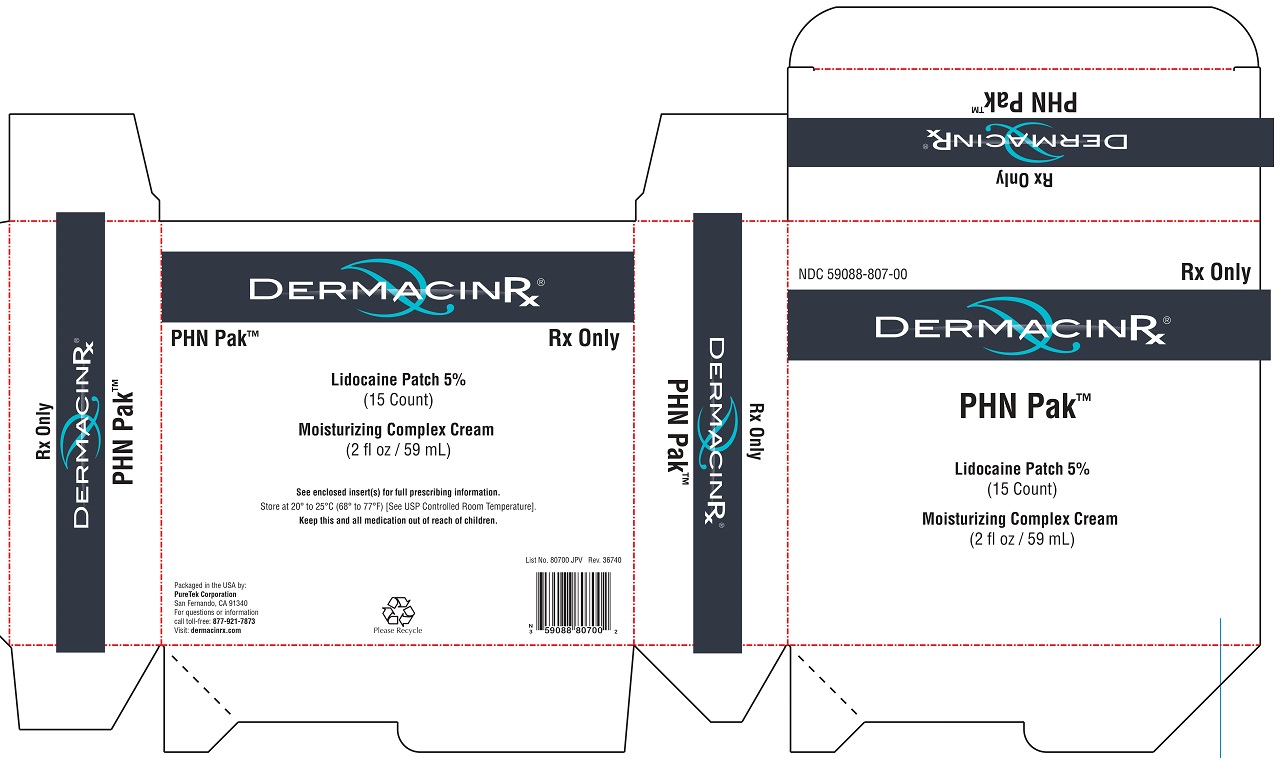
DermacinRx PHN Pak lidocaine Kit — NDC 59088-807-00 (Billing 59088-0807-00)
This is a package of DermacinRx PHN Pak lidocaine Kit from PureTek Corporation, marketed since May 2016 and currently FDA-listed. It is this product's only package size.
NDC database record
One package, one record: these facts belong to NDC 59088-807-00 alone.
- Record
- FDA NDC Directory package listing · Human prescription drug
- Code segments
- 59088 labeler · 807 product · 00 package
- Package marketed since
- May 17, 2016
- Sample package
- No — commercial package
- Listing certified through
- Dec 31, 2026
- Barcode (UPC-A, from the NDC)
- 3 5908880700 2
- FDA record last changed
- Jul 24, 2026
Other active recalls for Lidocaine (different manufacturers) — 2 · tap to view
Identity & classification
Regulatory identifiers FDA, NLM and CMS codes for this package
Drug-database identifiers Medi-Span GPI and First Databank GCN / HICL / AHFS classification
- GSN (GCN sequence number): 076406
- GCN: 41934
- GPI-14 (Medi-Span): 9085990206B120
- HICL (First Databank): 043648
- AHFS class code: 72:00.00.00
- RxCUI (RxNorm): 1745091
Where does this data come from?
- FDA openFDA NDC Directory · synced Oct 8, 2026
- FDA label on DailyMed · label index refreshed Oct 8, 2026
- RxNorm (NLM RxNav) · catalog refreshed Oct 1, 2026
- Medi-Span GPI (licensed)
- First Databank (licensed) · refreshed Oct 8, 2026
RxNorm drug class
This medicine belongs to the Antiarrhythmic class.
Where does this data come from?
- RxClass (NLM) · catalog refreshed Oct 1, 2026
Clinical
- Lidocaine numbs the area where it is used. Clinicians inject it for procedures. Skin products are used for pain, itching, minor burns, insect bites, hemorrhoid discomfort, and in s...
- Clean and dry the skin first, then apply as your product’s directions say. Wash your hands afterward. Don’t exceed the number of uses on the label. Ask a doctor before using a prod...
- No. Heat can increase how much lidocaine your body absorbs. Don’t bandage tightly either. Also avoid using other topical pain products at the same time.
- Can I use a heating pad with a lidocaine patch?
Patient education
Supplement & herbal interactions
Some supplements/herbs that may interact with Lidocaine — tap one for details:
Where does this data come from?
- MedlinePlus (NLM) · refreshed Oct 8, 2026
- FDA label on DailyMed · label index refreshed Oct 8, 2026
Ask a licensed pharmacist directly — free, answered by our team.
Pricing
A drug doesn't have one price. Each row is a different public payment system, and none is what you'd pay at the counter — that depends on your insurance. The ⓘ on each row explains what it measures.
| Price system | Per each | Per package |
|---|---|---|
| Retail pharmacies payNADAC · weekly | Not in the retail survey — common for institutional, discontinued, or low-volume packs. | |
| Medicaid paysCMS SDUD · 12 mo | No recent Medicaid claims on file for this NDC — rare and low-volume NDCs are suppressed in the public data. | |
| Medicare drug plans payPart D · quarterly | No Part D plan price is available for this NDC in our data. | |
Where does this data come from?
- CMS NADAC weekly file
- CMS ASP pricing files · refreshed Sep 20, 2026
- CMS Medicaid State Drug Utilization Data · refreshed Oct 8, 2026
- CMS Part D plan pricing files · refreshed Sep 24, 2026
- VA National Acquisition Center price file
Packaging — all sizes for this product
| Package NDC | Description | Marketing start | Marketing end | Status |
|---|---|---|---|---|
| 59088-0807-00 You're viewing this Main listing | 1 KIT in 1 KIT * 15 POUCH in 1 CARTON / .7 g in 1 POUCH | 2016-05-17 | — | Active |
Therapeutic equivalents
| Product | Labeler | Pack | NADAC/unit | TE | Status | Price vs. this |
|---|---|---|---|---|---|---|
| LidoPure Patch 59088-0712-00 | PureTek | 1 kit | — | — | FDA listed | — |
| Lidoxryl 59088-0722-00 | PureTek | 1 kit | — | — | FDA listed | — |
| Relivyx Plus 72835-0555-02 | V2 | 1 kit | — | — | FDA listed | — |
| Dr. Scholls Blister Pain Relief Complete 73469-0487-08 | Scholl's | 1 patch | — | — | FDA listed | — |
| Dr. Scholls Blister Pain Relief Complete 73469-0488-02 | Scholl's | 1 patch | — | — | FDA listed | — |
| DermacinRx PHN Pakthis 59088-0807-00 | PureTek | 1 kit | — | — | FDA listed | — |
| Elemar Patch 72835-0502-02 | V2 | 1 kit | — | — | FDA listed | — |
| CVS Hemorrhoidal Lidocaine 5 Rapid Pain Relief with 10 Finger Cots 51316-0204-01 | CVS | 1 kit | — | — | FDA listed | — |
Where does this data come from?
- FDA openFDA NDC Directory · synced Oct 8, 2026
- FDA Orange Book · refreshed Oct 3, 2026
- CMS NADAC weekly file
Availability & generic status
We did not find an FDA-approved generic match for this exact strength, form and route.
Where does this data come from?
- FDA Orange Book · refreshed Oct 3, 2026
Inactive Ingredients / Excipients
Inactive ingredients, also called excipients, are components of the drug product other than the active ingredient. They may include fillers, dyes, coatings, preservatives, flavors, or other formulation ingredients.
🧪 Avoiding an ingredient? See Lidocaine inactive ingredients by manufacturer: every current product's list side by side, so you can ask your pharmacy for the version that does not list it.
Where does this data come from?
IACT rows and label-wide narrative are kept separate; availability and product-level specificity depend on the submitted label.- FDA label on DailyMed · label index refreshed Oct 8, 2026
- FDA openFDA NDC Directory · synced Oct 8, 2026
Inactive ingredient FAQ
Are inactive ingredients the same for every manufacturer?
Why might an inactive ingredient be missing?
Can inactive ingredients matter?
Manufacturer & labeler
More NDCs from PureTek Corporation labeler code 59088
- Folcyteine Multivitamin 47 mg; 800 [iU]/1; 1000 ug; 200 mg; 16 mg Tablet NDC 59088-795-54
- Lextol Diclofenac Sodium, Capsaicin Kit NDC 59088-801-00
- Diclogen Diclofenac Sodium, Camphor and Menthol Kit NDC 59088-802-00
- Lixofen Diclofenac Sodium, kinesiology tape Kit NDC 59088-804-00
- DermacinRx ZRM Pak lidocaine, dimethicone Kit NDC 59088-805-00
- Diclolidol Kit Lidocaine HCl, Diclofenac Sodium Kit NDC 59088-806-00
- Lidocaine HCl - Hydrocortisone Acetate 20 mg/g; 20 mg/g Cream NDC 59088-816-01
- Lidocaine HCl - Hydrocortisone Acetate with Aloe 28 mg/g; 5.5 mg/g Gel NDC 59088-817-01
- Lidocaine HCl - Hydrocortisone Acetate 30 mg/g; 5 mg/g Cream NDC 59088-819-01
- Lidocaine HCl - Hydrocortisone Acetate 30 mg/g; 25 mg/g Gel NDC 59088-838-01
- DermacinRx Therazole Pak clotrimazole and betamethasone dipropionate, zinc oxide Kit NDC 59088-893-00
- Lidocan VII Lidocaine 5% 50 mg/g Patch NDC 59088-900-54
Where does this data come from?
- FDA openFDA NDC Directory · synced Oct 8, 2026
- Drugs@FDA
Full prescribing information FDA SPL
🎯 Indications and Usage ▾
INDICATION AND USAGE HIGHLIGHTS OF PRESCRIBING INFORMATION These highlights do not include all the information needed to use Lidocaine patch 5% safely and effectively. See full prescribing information for Lidocaine patch 5%. Lidocaine patch 5% is indicated for relief of pain associated with post-herpetic neuralgia.
It should be applied only to intact skin. Lidocaine patch 5% is indicated for relief of pain associated with post-herpetic neuralgia. It should be applied only to intact skin.
⏱️ Dosage and Administration ▾
DOSAGE AND ADMINISTRATION Apply lidocaine patch 5% to intact skin to cover the most painful area. Apply the prescribed number of patches (maximum of 3), only once for up to 12 hours within a 24-hour period. Patches may be cut into smaller sizes with scissors prior to removal of the release liner.
(See HANDLING AND DISPOSAL) Clothing may be worn over the area of application. Smaller areas of treatment are recommended in a debilitated patient, or a patient with impaired elimination. If irritation or a burning sensation occurs during application, remove the patch(es) and do not reapply until the irritation subsides.
When lidocaine patch 5% is used concomitantly with other products containing local anesthetic agents, the amount absorbed from all formulations must be considered. Lidocaine patch 5% may not stick if it gets wet. Avoid contact with water, such as bathing, swimming or showering.
⛔ Contraindications ▾
CONTRAINDICATIONS Lidocaine patch 5% is contraindicated in patients with a known history of sensitivity to local anesthetics of the amide type, or to any other component of the product.
⚠️ Warnings ▾
WARNINGS
🤒 Adverse Reactions ▾
ADVERSE REACTIONS
🔄 Drug Interactions ▾
Drug Interactions Antiarrhythmic Drugs: Lidocaine patch 5% should be used with caution in patients receiving Class I antiarrhythmic drugs (such as tocainide and mexiletine) since the toxic effects are additive and potentially synergistic. Local Anesthetics : When lidocaine patch 5% is used concomitantly with other products containing local anesthetic agents, the amount absorbed from all formulations must be considered.
🤰 Pregnancy ▾
Pregnancy Teratogenic Effects: Pregnancy Category B. Lidocaine patch 5% has not been studied in pregnancy. Reproduction studies with lidocaine have been performed in rats at doses up to 30 mg/kg subcutaneously and have revealed no evidence of harm to the fetus due to lidocaine.
There are, however, no adequate and well-controlled studies in pregnant women. Because animal reproduction studies are not always predictive of human response, lidocaine patch 5% should be used during pregnancy only if clearly needed.
🧒 Pediatric Use ▾
Pediatric Use Safety and effectiveness in pediatric patients have not been established.
🆘 Overdosage ▾
OVERDOSAGE Lidocaine overdose from cutaneous absorption is rare, but could occur. If there is any suspicion of lidocaine overdose (see ADVERSE REACTIONS, Systemic Reactions), drug blood concentration should be checked. The management of overdose includes close monitoring, supportive care, and symptomatic treatment.
Dialysis is of negligible value in the treatment of acute overdose with lidocaine. In the absence of massive topical overdose or oral ingestion, evaluation of symptoms of toxicity should include consideration of other etiologies for the clinical effects, or overdosage from other sources of lidocaine or other local anesthetics. The oral LD50 of lidocaine HCl is 459 (346 to 773) mg/kg (as the salt) in non-fasted female rats and 214 (159 to 324) mg/kg (as the salt) in fasted female rats, which are equivalent to roughly 4000 mg and 2000 mg, respectively, in a 60 to 70 kg man based on the equivalent surface area dosage conversion factors between species.
🧬 Clinical Pharmacology ▾
CLINICAL PHARMACOLOGY
📦 How Supplied / Storage and Handling ▾
HOW SUPPLIED Lidocaine patch 5% is available as the following: Carton of 15 patches, NDC 59088-396-82 Carton of 30 patches, NDC 59088-396-54 Each patch is packaged into an individual child-resistant envelope (NDC 59088-396-84). Store at 20o to 25oC (68o to 77oF) [See USP Controlled Room Temperature]. For more information, call Actavis at 1-800-272-5525.
Manufactured by: Actavis Laboratories UT, Inc. Salt Lake City, UT 84108 USA Distributed by: PureTek Corporation San Fernando, CA 91340 USA Rev. 37780 02/16
📋 Description ▾
DESCRIPTION Lidocaine patch 5% is comprised of an adhesive material containing 5% lidocaine, which is applied to a white non-woven polyethylene terephthalate (PET) material backing and covered with a transparent PET release liner. The release liner is removed prior to application to the skin. The size of the patch is 10 cm x 14 cm.
Lidocaine is chemically designated as acetamide, 2-(diethylamino)-N-(2,6-dimethylphenyl), has an octanol:water partition ratio of 43 at pH 7.4, and has the following structure: Each adhesive patch contains 700 mg of lidocaine (50 mg per gram adhesive) in an aqueous base. It also contains the following inactive ingredients: glycerin, D-sorbitol, propylene glycol, polyvinyl alcohol, urea, sodium polyacrylate, carboxymethylcellulose sodium, gelatin, polyacrylic acid, kaolin, tartaric acid, dihydroxyaluminum aminoacetate, methylparaben, propylparaben, and edetate disodium.
Lidocaine-Structure
⚠️ Precautions ▾
PRECAUTIONS
🍼 Nursing Mothers ▾
Lidocaine patch 5% has not been studied in nursing mothers. Lidocaine is excreted in human milk, and the milk:plasma ratio of lidocaine is 0.4. Caution should be exercised when lidocaine patch 5% is administered to a nursing woman.
🧬 Pharmacodynamics ▾
Pharmacodynamics Lidocaine is an amide-type local anesthetic agent and is suggested to stabilize neuronal membranes by inhibiting the ionic fluxes required for the initiation and conduction of impulses. The penetration of lidocaine into intact skin after application of lidocaine patch is sufficient to produce an analgesic effect, but less than the amount necessary to produce a complete sensory block.
Pharmacokinetics
🔬 Clinical Studies ▾
CLINICAL STUDIES Single-dose treatment with lidocaine patch was compared to treatment with vehicle patch (without lidocaine), and to no treatment (observation only) in a double-blind, crossover clinical trial with 35 post-herpetic neuralgia patients. Pain intensity and pain relief scores were evaluated periodically for 12 hours. Lidocaine patch performed statistically better than vehicle patch in terms of pain intensity from 4 to 12 hours.
Multiple-dose, two-week treatment with lidocaine patch was compared to vehicle patch (without lidocaine) in a double-blind, crossover clinical trial of withdrawal-type design conducted in 32 patients, who were considered as responders to the open-label use of lidocaine patch prior to the study. The constant type of pain was evaluated but not the pain induced by sensory stimuli (dysesthesia). Statistically significant differences favoring lidocaine patch were observed in terms of time to exit from the trial (14 versus 3.8 days at p-value <0.001), daily average pain relief, and patient’s preference of treatment.
About half of the patients also took oral medication commonly used in the treatment of post-herpetic neuralgia. The extent of use of concomitant medication was similar in the two treatment groups.
📄 Carcinogenesis, Mutagenesis, Impairment of Fertility ▾
Carcinogenesis, Mutagenesis, Impairment of Fertility Carcinogenesis: A minor metabolite, 2,6-xylidine, has been found to be carcinogenic in rats. The blood concentration of this metabolite is negligible following application of lidocaine patch 5%. Mutagenesis: Lidocaine HCl is not mutagenic in Salmonella/mammalian microsome test nor clastogenic in chromosome aberration assay with human lymphocytes and mouse micronucleus test.
Impairment of Fertility: The effect of lidocaine patch 5% on fertility has not been studied.
📄 Package Label / Principal Display Panel ▾
PRINCIPAL DISPLAY PANEL NDC 59088-807-00 DermacinRx® PHN Pak™ [Lidocaine Patch 5% and Moisturizing Complex Cream] Rx only Packaged in the USA by: PureTek Corporation, San Fernando, CA 91340 USA For question or information, call toll-free: 877-921-7873 Vist: dermacinrx.com DermacinRx PHN Pak
Medicare Part D spend CMS · PART D · 2026 (Q1)
Reported adverse events (FAERS)
Top reported reactions
Age at onset
Reporter sex
Serious outcomes
Where does this data come from?
About this NDC listing & data coverage
Listed without an FDA application
This product's marketing category indicates it is marketed without an approved FDA application (no NDA, ANDA, or BLA on file). Having an NDC does not by itself establish FDA approval — the NDC Directory is a listing system, not an approval decision. Approval-linked data such as Orange Book therapeutic-equivalence ratings therefore does not apply.
Kit / multi-component package
This NDC identifies a kit — a package containing more than one component. Structured data (pricing, ingredients, equivalents) is often reported per component rather than for the kit NDC itself, which can make this page look thinner than the components' own pages.
What data is (and isn’t) available for this NDC — tap to expand
| NDC identity (package / product / labeler codes) | ✓ Available |
| Labeler | ✓ Available |
| Product & package description | ✓ Available |
| Marketing category & status | ✓ Available |
| Active ingredient / dosage form / route | ✓ Available |
| FDA label (SPL via DailyMed) | ✓ Available |
| Package photos | ✓ Available |
| Inactive ingredients (structured) | — Not published for this NDC The labeler did not submit a structured excipient list, or no SPL is available. |
| NADAC pharmacy acquisition price (CMS) | — Not published for this NDC CMS publishes NADAC only for NDCs reported in its retail-pharmacy survey. |
| Orange Book / therapeutic-equivalence data | — Not published for this NDC Applies only to products approved under an NDA/ANDA; many listings are out of scope. |
| HCPCS J-code billing crosswalk | — Not published for this NDC Most self-administered / retail products have no J-code — that is normal. |
| Medicaid utilization (CMS SDUD) | — Not published for this NDC CMS reports utilization only for NDCs with Medicaid claims above its privacy threshold. |